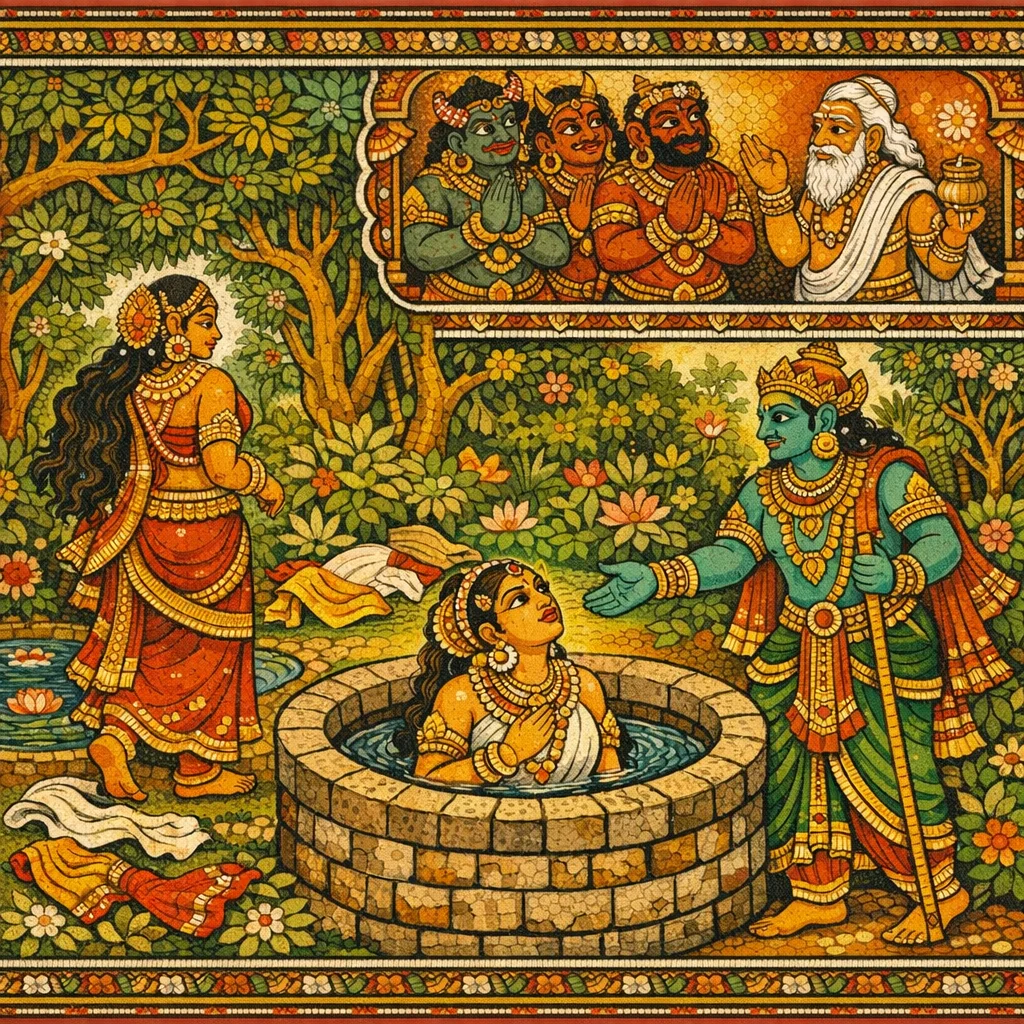
Adhyaya 27: Devayānī and Śarmiṣṭhā’s Quarrel, Devayānī Cast into a Well, and Yayāti’s Rescue
देवयानी-शर्मिष्ठा-विवादः कूपपतनो ययातिना उद्धारणं च
Speaker: Śaunaka, Devayānī, Śarmiṣṭhā, Śukrācārya (Kāvya), Indra (Maghavān/Śatakratu)
Śaunaka relates that after Kaca returns successfully bearing sacred knowledge, the devas rejoice and urge Indra to destroy their foes. As Indra sets forth, he sees maidens sporting in a forest and, becoming wind, confuses their garments. In the ensuing disorder Śarmiṣṭhā takes Devayānī’s clothing, and a quarrel erupts: Devayānī appeals to discipline and propriety, while Śarmiṣṭhā asserts royal superiority through the rhetoric of the “giver” over the “receiver.” Śarmiṣṭhā then, in anger, casts Devayānī into a well and departs. King Yayāti arrives in that region, finds Devayānī in the well, and, when she identifies herself as Śukra’s daughter, rescues her by taking her right hand and lifting her out. Devayānī sends Ghūrṇikā to inform Śukra; Śukra comes, consoles her in the light of karma, hears of the insult, and reaffirms Devayānī’s identity and the transcendent, sovereign force of Brahminic power.
Key Concepts
Shlokas in Adhyaya 27
Verse 1
*शौनक उवाच कृतविद्ये कचे प्राप्ते हृष्टरूपा दिवौकसः कचादवेत्य तां विद्यां कृतार्था भरतर्षभ //
Śaunaka said: O bull among the Bharatas, when Kaca returned having mastered the sacred vidyā, the dwellers of heaven became radiant with joy; having learned that very vidyā from Kaca, they deemed their purpose fulfilled.
Verse 2
सर्व एव समागम्य शतक्रतुमथाब्रुवन् कालस्त्वद्विक्रमस्याद्य जहि शत्रून्पुरंदर //
Then all assembled and said to Śatakratu (Indra): “Now is the time for your valor—slay the enemies, O Purandara!”
Verse 3
एवमुक्तस्तु सह तैस् त्रिदशैर् मघवांस्तदा तथेत्युक्त्वोपचक्राम सो ऽपश्यद्विपिने स्त्रियः //
Thus addressed, Maghavān (Indra), together with those thirty gods, replied, “So be it,” and set forth. As he proceeded, he saw women in the forest-grove.
Verse 4
क्रीडन्तीनां तु कन्यानां वने चैत्ररथोपमे वायुर्भूतः स वस्त्राणि सर्वाण्येव व्यमिश्रयत् //
But when the maidens were sporting in the forest, lovely like Caitraratha, he—having become the wind—thoroughly scattered and mixed up all of their garments.
Verse 5
ततो जलात् समुत्तीर्य ताः कन्याः सहितास्तदा वस्त्राणि जगृहुस्तानि यथासंस्थान्यनेकशः //
Then, climbing up out of the water, those maidens together at that time took up their garments—many of them—each arranged according to its proper placement and order.
Verse 6
तत्र वासो देवयान्याः शर्मिष्ठा जगृहे तदा व्यतिक्रममजानन्ती दुहिता वृषपर्वणः //
There, Śarmiṣṭhā—daughter of Vṛṣaparvan—took Devayānī’s garment at that time, not realizing that she was committing an offence (a transgression of propriety).
Verse 7
ततस्तयोर् मिथस्तत्र विरोधः समजायत देवयान्याश्च राजेन्द्र शर्मिष्ठायाश्च तत्कृते //
Then, O king, a mutual quarrel arose there between the two—between Devayānī and Śarmiṣṭhā—on account of that very matter.
Verse 8
*देवयान्युवाच कस्माद्गृह्णासि मे वस्त्रं शिष्या भूत्वा ममासुरि समुदाचारहीनाया न ते श्रेयो भविष्यति //
Devayānī said: “Why do you take my garment? Though you have become my pupil, O Asurī, you are devoid of proper conduct; this will not turn out to be for your good.”
Verse 9
*शर्मिष्ठोवाच आसीनं च शयानं च पिता ते पितरं मम स्तौति पृच्छति चाभीक्ष्णं नीचस्थः सुविनीतवत् //
Śarmiṣṭhā said: “Whether your father is seated or reclining, my father repeatedly praises him and inquires after him—standing in a lower place, as though he were thoroughly well-mannered and humble.”
Verse 10
याचतस्त्वं च दुहिता स्तुवतः प्रतिगृह्णतः सुताहं स्तूयमानस्य ददतो न तु गृह्णतः //
You are the daughter of one who begs; I am the son of one who accepts while being praised. Yet I belong to one who, though praised, gives—he does not take.
Verse 11
अनायुधा सायुधायाः किं त्वं कुप्यसि भिक्षुकि लप्स्यसे प्रतियोद्धारं न च त्वां गणयाम्यहम् //
Unarmed, why do you rage at one who is armed, O beggar-woman? You will find an opponent to fight—yet I do not count you as worthy of regard.
Verse 12
*शौनक उवाच सा विस्मयं देवयानीं गतां सक्तां च वाससि शर्मिष्ठा प्राक्षिपत्कूपे ततः स्वपुरमाविशत् //
Śaunaka said: Then Śarmiṣṭhā, seeing Devayānī stunned with bewilderment and her garment caught, threw her into a well; thereafter she entered her own city.
Verse 13
हतेयमिति विज्ञाय शर्मिष्ठा पापनिश्चया अनवेक्ष्य ययौ तस्मात् क्रोधवेगपरायणा //
Realizing, “She has been struck,” Śarmiṣṭhā—fixed in a sinful resolve—went away from that place without looking back, driven onward by the force of her anger.
Verse 14
अथ तं देशमभ्यागाद् ययातिर्नहुषात्मजः श्रान्तयुग्यः श्रान्तरूपो मृगलिप्सुः पिपासितः //
Then Yayāti, the son of Nahuṣa, came to that region—his draft animals exhausted, his own appearance worn with fatigue, eager for game, and tormented by thirst.
Verse 15
नाहुषिः प्रेक्षमाणो हि स निपाने गतोदके ददर्श कन्यां तां तत्र दीप्तामग्निशिखाम् इव //
As Nahusha (Yayāti) looked about, having gone down into the water at the watering-place, he saw that maiden there—radiant like a blazing tongue of fire.
Verse 16
तामपृच्छत्स दृष्ट्वैव कन्याममरवर्णिनीम् सान्त्वयित्वा नृपश्रेष्ठः साम्ना परमवल्गुना //
Seeing that maiden—radiant with a beauty like that of the immortals—the best of kings first soothed and reassured her, and then questioned her gently with exceedingly pleasing words.
Verse 17
का त्वं चारुमुखी श्यामा सुमृष्टमणिकुण्डला दीर्घं ध्यायसि चात्यर्थं कस्माच्छ्वसिषि चातुरा //
Who are you—dark-complexioned, lovely-faced, wearing well-polished jeweled earrings? Why do you brood so long and so intensely, and why do you sigh so restlessly?
Verse 18
कथं च पतिता ह्य् अस्मिन् कूपे वीरुत्तृणावृते दुहिता चैव कस्य त्वं वद सर्वं सुमध्यमे //
How have you fallen into this well, covered over with creepers and grass? And whose daughter are you? Tell me everything, O slender-waisted one.
Verse 19
*देवयान्युवाच यो ऽसौ देवैर्हतान् दैत्यान् उत्थापयति विद्यया तस्य शुक्रस्य कन्याहं त्वं मां नूनं न बुध्यसे //
Devayānī said: “He who, by his knowledge, revives the Daityas slain by the gods—of that Śukra I am the daughter. Surely you do not recognize me.”
Verse 20
एष मे दक्षिणो राजन् पाणिस् ताम्रनखाङ्गुलिः समुद्धर गृहीत्वा मां कुलीनस्त्वं हि मे मतः //
O King, here is my right hand, with fingers and copper-hued nails—take hold of me and lift me up; for in my judgment, you are truly noble.
Verse 21
जानामि त्वां च संशान्तं वीर्यवन्तं यशस्विनम् तस्मान्मां पतितां कूपाद् अस्माद् उद्धर्तुमर्हसि //
I know you to be serene, mighty in valor, and renowned; therefore, I—fallen into this well—ought to be lifted out by you.
Verse 22
*शौनक उवाच तामथ ब्राह्मणीं स्त्रीं च विज्ञाय नहुषात्मजः गृहीत्वा दक्षिणे पाणाव् उज्जहार ततो ऽवटात् //
Śaunaka said: Then, recognizing her to be a Brahmin woman, the son of Nahusha took her by the right hand and lifted her up from that pit.
Verse 23
उद्धृत्य चैनां तरसा तस्मात्कूपान्नराधिपः आमन्त्रयित्वा सुश्रोणीं ययातिः स्वपुरं ययौ //
Having swiftly lifted her up from that well, the king, Yayāti, after courteously addressing the fair-hipped lady, returned to his own city.
Verse 24
गते तु नाहुषे तस्मिन् देवयान्यपि निन्दिता उवाच शोकसंतप्ता घूर्णिकामागतां पुनः //
But when that Nahusha had departed, Devayānī too—having been reproached—spoke again, scorched by grief, to Ghūrṇikā who had come back once more.
Verse 25
*देवयान्युवाच त्वरितं घूर्णिके गच्छ सर्वमाचक्ष्व मे पितुः नेदानीं तु प्रवेक्ष्यामि नगरं वृषपर्वणः //
Devayānī said: “Quickly, Ghūrṇikā, go and report everything to my father. As for me, I shall now enter the city of Vṛṣaparvan.”
Verse 26
*शौनक उवाच सा तु वै त्वरितं गत्वा घूर्णिकासुरमन्दिरम् दृष्ट्वा काव्यमुवाचेदं कम्पमाना विचेतना //
Śaunaka said: She then hurriedly went to the dwelling of the asura Ghūrṇikā; on seeing Kāvya (Śukra), she spoke these words—trembling and beside herself.
Verse 27
आचख्यौ च महाभागा देवयानी वने हता शर्मिष्ठया महाप्राज्ञ दुहित्रा वृषपर्वणः //
The noble lady reported: “O greatly wise one, Devayānī has been attacked in the forest by Śarmiṣṭhā, the daughter of Vṛṣaparvan.”
Verse 28
श्रुत्वा दुहितरं काव्यस् तदा शर्मिष्ठया हताम् त्वरया निर्ययौ दुःखान् मार्गमाणः सुतां वने //
Hearing that his daughter had been harmed by Śarmiṣṭhā, Kāvya (Śukrācārya), stricken with grief, hurried out, searching for his daughter in the forest.
Verse 29
दृष्ट्वा दुहितरं काव्यो देवयानीं तपोवने बाहुभ्यां सम्परिष्वज्य दुःखितो वाक्यमब्रवीत् //
Seeing his daughter Devayānī in the forest of austerities, Kāvya (Śukrācārya) embraced her with both arms and, distressed, spoke these words.
Verse 30
आत्मदोषैर् नियच्छन्ति सर्वे दुःखसुखे जनाः मन्ये दुश्चरितं ते ऽस्ति तस्येयं निष्कृतिः कृता //
All people are bound—into both sorrow and happiness—by their own faults. I think you have some past misconduct; therefore this expiation has been undertaken for it.
Verse 31
*देवयान्युवाच निष्कृतिर् वास्तु वा मास्तु शृणुष्वावहितो मम शर्मिष्ठया यदुक्तास्मि दुहित्रा वृषपर्वणः //
Devayānī said: “Let there be atonement—or let there be none; but listen attentively to what I have been told by Śarmiṣṭhā, the daughter of Vṛṣaparvan.”
Verse 32
सत्यं किलैतत्सा प्राह दैत्यानामस्मि गायना एवं हि मे कथयति शर्मिष्ठा वार्षपर्वणी //
“Indeed, this is true,” she said. “Among the Daityas I am Gāyanā; for thus Śarmiṣṭhā, the daughter of Vṛṣaparvan, has told me.”
Verse 33
वचनं तीक्ष्णपरुषं क्रोधरक्तेक्षणा भृशम् स्तुवतो दुहितासि त्वं याचतः प्रतिगृह्णतः //
Your speech is sharp and harsh; your eyes are deeply reddened with anger. To one who praises you, you become as a daughter; but from one who begs, you accept all the more.
Verse 34
सुताहं स्तूयमानस्य ददतो ऽप्रतिगृह्णतः इति मामाह शर्मिष्ठा दुहिता वृषपर्वणः क्रोधसंरक्तनयना दर्पपूर्णानना ततः //
Then Śarmiṣṭhā, the daughter of Vṛṣaparvan—her eyes reddened with anger and her face swollen with pride—said to me: “I am the daughter of one who is praised, who gives, and who does not accept gifts in return.”
Verse 35
*शुक्र उवाच स्तुवतो दुहिता न त्वं भद्रे न प्रतिगृह्णतः अतस्त्वं स्तूयमानस्य दुहिता देवयान्यसि //
Śukra said: “O gentle one, you are not the daughter of one who offers praise yet does not accept what is due. Therefore you are indeed the daughter of the one who is praised; hence you are Devayānī.”
Verse 37
वृषपर्वैव तद्वेद शक्रो राजा च नाहुषः अचिन्त्यं ब्रह्म निर्द्वंद्वम् ऐश्वरं हि बलं मम //
Only Vṛṣaparvan truly knows it—so too Śakra (Indra) and King Nahūṣa: Brahman is inconceivable, beyond all dualities; indeed, my power is aiśvarya, sovereign divine lordship.
Frequently Asked Questions
The chapter uses the Devayānī–Śarmiṣṭhā conflict to teach that pride and anger distort dharma and social order, while true nobility is shown through righteous action (Yayāti’s rescue) and adherence to proper conduct (ācāra). Śukra’s response frames suffering through karmic causality and underscores the superior, subtle authority of spiritual power over mere political status.
This adhyāya is primarily Genealogy/Itihāsa narrative with strong Dharma themes: social propriety, insult, retaliation, and the ethics of giving/receiving. It does not teach Vastu Śāstra or architectural measurements in this section.