Adhyaya 58
अध्याय ५८ — वानरध्वजस्य महेन्द्रास्त्रप्रयोगः (Chapter 58: Arjuna’s Deployment of the Indra-Weapon)
Upa-parva: Gograhaṇa (Gograhana) Upa-Parva — Cattle-Recovery and Kuru–Virāṭa Engagement
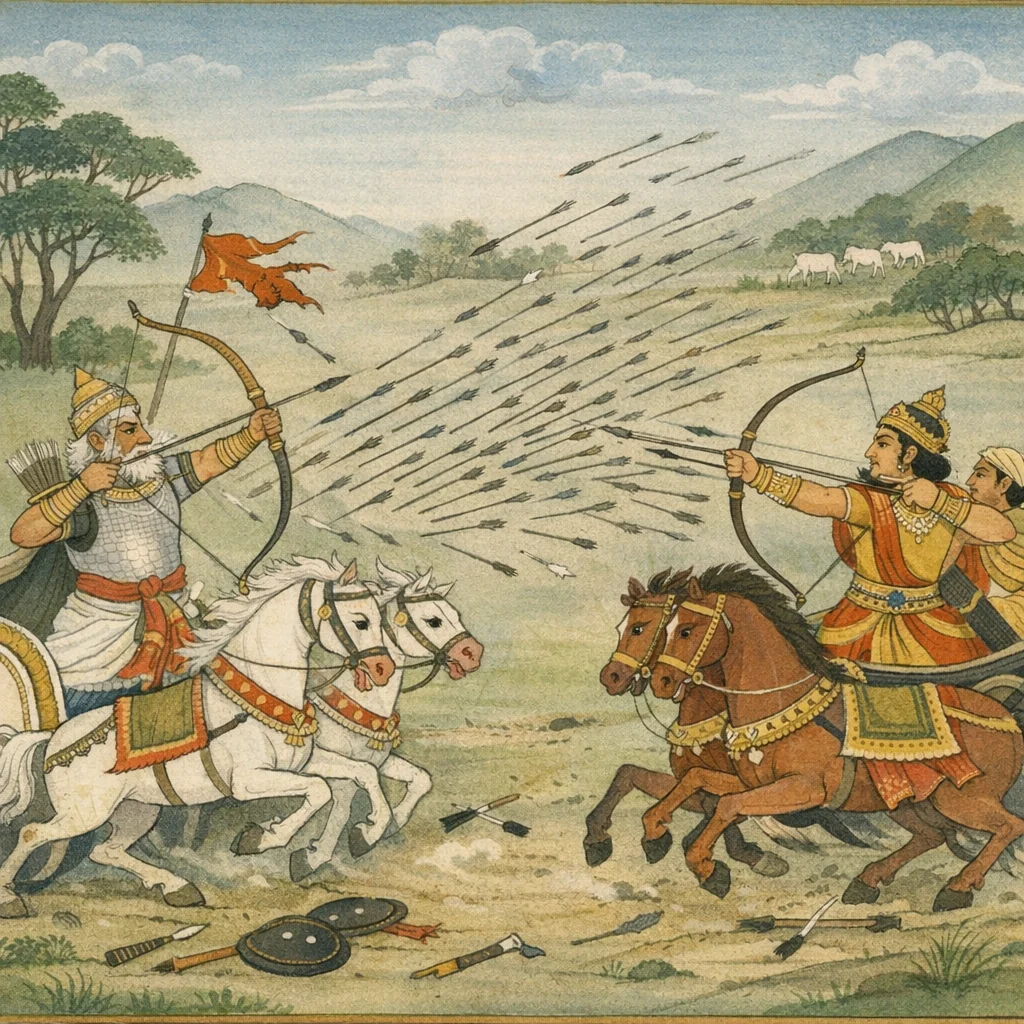
Vaiśaṃpāyana describes how Duryodhana, Karṇa, Duḥśāsana with his brothers, Droṇa with his son, and Kṛpa regroup and return with intensified intent to neutralize Dhanaṃjaya (Arjuna). They advance while drawing and flexing powerful bows, then surround Arjuna and release dense volleys likened to seasonal storm-clouds. The missile saturation becomes so complete that no small opening on Arjuna’s body is visible. Arjuna responds with controlled confidence, preparing a divine, Indra-associated weapon upon the Gāṇḍīva; its radiance and spread are compared to the sun’s rays and lightning in rainclouds, filling all directions like an extended rainbow. The Kuru charioteers become alarmed and psychologically destabilized, turning away from engagement; the wider forces break formation and flee in multiple directions, abandoning hope of safety. The chapter’s thematic lesson is tactical asymmetry: disciplined invocation of superior capability to terminate escalation and disperse hostile concentration without prolonged attrition.
Chapter Arc: उत्तरगोष्ठ की गौओं के अपहरण के प्रसंग में, रणभूमि पर सुवर्णमय रथ पर आरूढ़ गुरु द्रोण को निकट आते देख अर्जुन सारथि उत्तर को निर्देश देता है कि रथ को सीधे द्रोण-नीक की ओर ले चले। → अर्जुन, वनवास-अज्ञातवास की स्मृति और प्रतिकार की प्रतिज्ञा के साथ, आचार्य से संयमित वाणी में कहता है कि वे क्रोध न करें—पर युद्ध में उन्हें अजेय मानते हुए भी सामना स्वीकार करता है। दोनों ओर से दिव्यास्त्रों की तैयारी और शर-वर्षा से संघर्ष तीव्र होता जाता है। → द्रोण और किरीटधारी अर्जुन का घोर संग्राम वृत्र-वज्रधारी इन्द्र के तुल्य उपमा पाता है; दोनों क्रोधोन्मत्त होकर दिव्यास्त्रों का प्रयोग करते हैं। अंततः अर्जुन के परमेषुओं से द्रोण का कवच और ध्वज छिन्न-भिन्न हो जाता है और द्रोण को अवसर पाकर तीव्र गति से पीछे हटना पड़ता है। → अर्जुन रणकौशल से द्रोण को प्रत्यक्ष विनाश से नहीं, बल्कि रण-स्थितियों से हटने को विवश करता है; वह रथ-चालन को मोड़कर अश्वत्थामा की दिशा में अवसर बनाता है, जिससे द्रोण को पलायन का अंतर मिल जाता है। → क्रोध के वशीभूत द्रोणि (अश्वत्थामा) मेघवत् शर-वृष्टि करता हुआ आगे बढ़ता है—अब अर्जुन का सामना गुरु-पुत्र से निर्णायक रूप लेता है।
Shlokas
Verse 1
इस प्रकार श्रीमहाभारत विराटपर्वके अन्तर्गत गोहरणपर्वमें उत्तरगोष्ठकी गौओंके अपहरण के प्रसंगमें कृपाचार्यका पलायनसम्बन्धी सत्तावनवाँ अध्याय पूरा हुआ ॥/ ५७ ॥। हि न हुक है आम अष्टपजञज्चाशत्तमोड ध्याय: अर्जुनका द्रोणाचार्यके साथ युद्ध और आचार्यका पलायन वैशम्पायन उवाच कृपे5पनीते द्रोणस्तु प्रगृह् सशरं धनुः । अभ्यद्रवदनाधुष्य: शोणाश्व: श्वेतवाहनम्,वैशम्पायनजी कहते हैं--जनमेजय! जब कृपाचार्य रणभूमिसे बाहर हटा दिये गये, तब लाल घोड़ोंवाले दुर्धर्ष वीर आचार्य द्रोणने धनुष-बाण लेकर श्वेतवाहन अर्जुनपर धावा किया इस प्रकार श्रीमह्याभारत विराटपर्वके अन्तर्गत गोहरणपर्वमें द्रोणाचार्यके पलायनसे सम्बन्ध रखनेवाला अद्ठावनवाँ अध्याय पूरा हुआ ॥/ ५८ ॥ हि आन (0) है. 7 > “आर्यस्तु मारिष:' (अमरकोष)। एकोनषष्टितमो< ध्याय: अश्वत्थामाके साथ अर्जुनका युद्ध वैशम्पायन उवाच ततो द्रौणिमहाराज प्रययावर्जुनं रणे । त॑ं पार्थ: प्रतिजग्राह वायुवेगमिवोद्धतम् । शरजालेन महता वर्षमाणमिवाम्बुदम्
Vaiśampāyana said: O Janamejaya, when Kṛpācārya had been driven back from the battlefield, Droṇa—the formidable warrior with red horses—took up his bow together with arrows and charged straight at Arjuna of the white chariot. The scene shows how, as one commander withdraws, another steps forward to uphold the Kuru resistance, revealing the relentless momentum of war and the shifting burdens of duty between teacher and disciple.
Verse 2
स तु रुक्मरथं दृष्टवा गुरुमायान्तमन्तिकात् । अर्जुनो जयतां श्रेष्ठ उत्तरं वाक्यमब्रवीत्,सुवर्णमय रथपर आरूढ़ गुरुदेवको अपने निकट आते देख विजयी वीरोंमें श्रेष्ठ अर्जुन उत्तरसे इस प्रकार बोले
Vaiśampāyana said: Seeing the golden chariot approaching—bearing his revered teacher and coming close—Arjuna, foremost among victorious heroes, addressed Uttara with measured words, mindful of what duty required in the moment.
Verse 3
अजुन उवाच यत्रैषा काज्चनी वेदी ध्वजे यस्य प्रकाशते । उच्छिता प्रवरे दण्डे पताकाभिरलड्कृता । अत्र मां वह भद्ठ ते द्रोणानीकाय सारथे,अर्जुनने कहा--सारथे! तुम्हारा कल्याण हो। जिस रथकी ध्वजामें ऊँचे डंडेके ऊपर पताकाओंसे विभूषित यह ऊँची सुवर्णमयी वेदी प्रकाशित हो रही है, वहाँ आचार्य द्रोणकी सेना है। मुझे वहीं ले चलो
Arjuna said: “Charioteer, may you be well. There—where on a certain chariot’s banner a shining golden platform is seen, raised high upon an excellent staff and adorned with streamers—there stands the division led by Ācārya Droṇa. Take me there.”
Verse 4
अथवा: शोणा: प्रकाशन्ते बृहन्तश्नारुवाहिन: । स्निग्धविद्रुमसंकाशास्ताम्रास्या: प्रियदर्शना: । युक्ता रथवरे यस्य सर्वशिक्षाविशारदा:,जिनके श्रेष्ठ रथमें जुते हुए सब प्रकारकी शिक्षाओंमें निपुण, चिकने, मूँगेके समान लाल रंगके, ताँबे-से मुखवाले, सुन्दर तथा अच्छे ढंगसे रथका भार वहन करनेवाले बड़े-बड़े अश्व सुशोभित हो रहे हैं, वे महातेजस्वी दीर्घबाहु, बल एवं रूपसे सम्पन्न तथा समस्त संसारमें विख्यात पराक्रमी प्रतापी वीर भरद्वाजनन्दन द्रोण हैं
Arjuna said: “Or again, behold those chestnut-red horses—large, sinewy, and strong to bear the chariot’s weight—gleaming like polished coral, with coppery mouths and a pleasing appearance. Harnessed to the finest of chariots, they are perfectly trained in every discipline. Such a chariot and such steeds mark the renowned, mighty-armed, radiant hero Droṇa, son of Bharadvāja.”
Verse 5
दीर्घबाहुर्महातेजा बलरूपसमन्वित: । सर्वलोकेषु विक्रान्तो भारद्वाज: प्रतापवान्,जिनके श्रेष्ठ रथमें जुते हुए सब प्रकारकी शिक्षाओंमें निपुण, चिकने, मूँगेके समान लाल रंगके, ताँबे-से मुखवाले, सुन्दर तथा अच्छे ढंगसे रथका भार वहन करनेवाले बड़े-बड़े अश्व सुशोभित हो रहे हैं, वे महातेजस्वी दीर्घबाहु, बल एवं रूपसे सम्पन्न तथा समस्त संसारमें विख्यात पराक्रमी प्रतापी वीर भरद्वाजनन्दन द्रोण हैं
Arjuna said: “Long-armed, radiant with great splendor, endowed with strength and noble presence, renowned for his prowess throughout the worlds—this is the mighty Bhāradvāja (Droṇa), a hero of formidable valor.” In the epic’s ethical frame, Arjuna’s words acknowledge excellence and martial authority even in an adversary, reflecting the Kṣatriya ideal of honoring merit and power while preparing for the demands of conflict.
Verse 6
बुद्धया तुल्यो हुशनसा बृहस्पतिसमो नये । वेदास्तथैव चत्वारो ब्रह्मचर्य तथैव च,ये बुद्धिमें शुक्राचार्य और नीतिमें बृहस्पतिके समान हैं। >मारिष! इनमें चारों वेद, ब्रह्मचर्य, संहार-विधिसहित सम्पूर्ण दिव्यासत्र और समस्त थधरनुर्वेद सदा प्रतिष्ठित है
Arjuna said: “In intellect he is equal to Uśanas (Śukrācārya), and in statecraft he is like Bṛhaspati. In him are firmly established the four Vedas and the discipline of brahmacarya as well.”
Verse 7
ससंहाराणि सर्वाणि दिव्यान्यस्त्राणि मारिष | धरनुर्वेदश्न कार्त्स्न्येन यस्मिन् नित्यं प्रतिष्ठित:,ये बुद्धिमें शुक्राचार्य और नीतिमें बृहस्पतिके समान हैं। >मारिष! इनमें चारों वेद, ब्रह्मचर्य, संहार-विधिसहित सम्पूर्ण दिव्यासत्र और समस्त थधरनुर्वेद सदा प्रतिष्ठित है
O Maris! In him are ever established all the divine weapons, together with their rites of withdrawal and destruction, and the whole of Dhanurveda—the sacred science of archery and war.
Verse 8
क्षमा दमश्न सत्यं च आनृशंस्यमथार्जवम् । एते चान्ये च बहवो यस्मिन् नित्य॑ं द्विजे गुणा:,इन विप्रशिरोमणिमें क्षमा, इन्द्रियसंयम, सत्य, कोमलता, सरलता तथा अन्य बहुत-से सदगुण नित्य विद्यमान हैं
Arjuna said: “Forbearance, self-control, truthfulness, compassion, and straightforwardness—these and many other virtues are ever present in that foremost of Brahmins.”
Verse 9
तेनाहं योद्धुमिच्छामि महाभागेन संयुगे । तस्मात् त॑ प्रापयाचार्य क्षिप्रमुत्तर वाहय,अतः मैं इन्हीं महाभाग आचार्यके साथ इस समरभूमिमें युद्ध करना चाहता हूँ। अतः उत्तर! रथ बढ़ाओ और मुझे शीघ्र उन आचार्यके समीप पहुँचा दो
Arjuna said: “Therefore, I wish to fight in this battle with that illustrious master. So, O Uttara, drive the chariot swiftly and bring me quickly into the teacher’s presence.”
Verse 10
वैशम्पायन उवाच अर्जुनेनैवमुक्तस्तु वैराटिहेम भूषणान् | चोदयामास तानश्वचान् भारद्वाजरथं प्रति,वैशम्पायनजी कहते हैं--राजन्! अर्जुनके इस प्रकार आदेश देनेपर विराटनन्दन उत्तरने सोनेके आभूषणोंसे विभूषित उन अश्वोंको आचार्य द्रोणके रथकी ओर हाँक दिया
Vaiśampāyana said: When Arjuna had spoken thus, the son of Virāṭa urged on those horses, adorned with golden trappings, driving them toward the chariot of Bhāradvāja’s son (Droṇa).
Verse 11
तमापततन्तं वेगेन पाण्डवं रथिनां वरम् | द्रोण: प्रत्युद्ययौ पार्थ मत्तो मत्तमिव द्विपम्,महारथियोंमें श्रेष्ठ पाण्डुनन्दन अर्जुनको बड़े वेगसे अपनी ओर आते देख आचार्य द्रोण भी पार्थकी ओर आगे बढ़ आये, ठीक उसी तरह जैसे एक उन्मत्त गजराज दूसरे मतवाले गजराजसे भिड़नेके लिये जा रहा हो
Vaiśampāyana said: Seeing Arjuna, the Pāṇḍava—foremost among chariot-warriors—charging toward him with great speed, Droṇa advanced to meet Pārtha. It was like one intoxicated lord of elephants rushing to clash with another equally maddened elephant.
Verse 12
ततः प्राध्मापयच्छड्खं भेरीशतनिनादिनम् | प्रचुक्षुभे बल॑ सर्वमुद््भूत इव सागर:,तदनन्तर द्रोणने सौ नगाड़ोंके बराबर आवाज करनेवाले अपने शंखको बजाया। उसे सुनकर सारी सेनामें हलचल मच गयी, मानो समुद्रमें ज्वार आ गया हो
Then he blew his conch, whose roar was like the thunder of a hundred kettle-drums. Hearing it, the entire host was thrown into agitation, as if the ocean had suddenly surged in a great swell.
Verse 13
अथ शोणान् सदद्चांस्तान् हंसवर्णर्मनोजवै: । मिश्रितान् समरे दृष्टवा व्यस्मयन्त रणे नरा:,रणभूमिमें उन लाल रंगके सुन्दर घोड़ोंको हंसके समान वर्णवाले मनके सदृश वेगशाली श्वेत घोड़ोंसे मिला देख युद्ध करनेके विषयमें सब लोग आश्वर्यमें पड़ गये
Vaiśampāyana said: Then, seeing in the battle those fine red horses intermingled with white horses—swan-hued and swift as thought—the men on the battlefield were struck with astonishment.
Verse 14
तौ रथौ वीर्यसम्पन्नौ दृष्टवा संग्राममूर्थनि । आचार्यशिष्यावजितौ कृतविद्यो मनस्विनौ,महाबली द्रोण और दुन्तीपुत्र अर्जुन दोनों महारथी बल-वीर्य-सम्पन्न, अजेय, अस्त्रविद्याके विशेषज्ञ और मनस्वी थे। युद्धके सिरेपर वे दोनों आचार्य और शिष्य अपने- अपने रथपर बैठे हुए (ही एक-दूसरेकी ओर हाथ बढ़ाकर मानो) परस्पर आलिंगन करने लगे। उन्हें इस अवस्थामें देखकर भरतवंशियोंकी वह विशाल सेना बारंबार भयसे काँपने लगी
Vaiśampāyana said: Seeing those two chariots at the very forefront of battle, the teacher and the disciple—both unconquerable, fully trained in the sciences of weapons, resolute in mind, and endowed with great strength and valor—the vast army of the Bharatas began to tremble again and again in fear, as the two warriors, seated on their respective chariots, seemed to reach toward one another as if to embrace.
Verse 15
समश्लिष्टौ तदान्योन्यं द्रोणपार्थों महाबलौ । दृष्टवा प्राकम्पत मुहुर्भरतानां महद् बलम्,महाबली द्रोण और दुन्तीपुत्र अर्जुन दोनों महारथी बल-वीर्य-सम्पन्न, अजेय, अस्त्रविद्याके विशेषज्ञ और मनस्वी थे। युद्धके सिरेपर वे दोनों आचार्य और शिष्य अपने- अपने रथपर बैठे हुए (ही एक-दूसरेकी ओर हाथ बढ़ाकर मानो) परस्पर आलिंगन करने लगे। उन्हें इस अवस्थामें देखकर भरतवंशियोंकी वह विशाल सेना बारंबार भयसे काँपने लगी
Vaiśampāyana said: Then Droṇa and Pārtha (Arjuna), both of great might, appeared as though clasping one another in mutual embrace. Seeing them in that posture—teacher and disciple poised at the very edge of battle—the vast army of the Bharatas repeatedly trembled in fear.
Verse 16
हर्षयुक्तस्तत: पार्थ: प्रहसन्निव वीर्यवान् । रथं रथेन द्रोणस्य समासाद्य महारथ:,तदनन्तर शत्रुवीरोंका नाश करनेवाले महारथी और महापराक्रमी कुन्तीपुत्र महाबाहु अर्जुन हर्षोल्लासमें भर गये और आचार्य द्रोणके रथसे अपना रथ भिड़ाकर उन्हें प्रणाम करके हँसते हुए-से शान्तिपूर्वक मधुर वाणीमें यों बोले---
Then Pārtha (Arjuna), filled with exhilaration, the mighty hero seeming to smile, drove his chariot up to Droṇa’s chariot. That great chariot-warrior, poised and confident, closed in upon his revered teacher—signaling both martial resolve and the disciplined restraint expected in a dharmic encounter with one’s guru even amid battle.
Verse 17
तदनन्तर शत्रुवीरोंका नाश करनेवाले महारथी और महापराक्रमी कुन्तीपुत्र महाबाहु अर्जुन हर्षोल्लासमें भर गये और आचार्य द्रोणके रथसे अपना रथ भिड़ाकर उन्हें प्रणाम करके हँसते हुए-से शान्तिपूर्वक मधुर वाणीमें यों बोले---
Thereafter, Arjuna—the mighty-armed son of Kuntī, a great chariot-warrior of immense prowess and a destroyer of hostile champions—was filled with exhilaration. Drawing his own chariot close to the chariot of his teacher Droṇa, he bowed in reverence; then, as if smiling, he addressed him calmly and in a gentle, sweet voice. The scene underscores a warrior’s discipline: even amid impending conflict, Arjuna maintains respect for his preceptor and restraint in speech, holding to the ethical decorum of kṣatriya conduct.
Verse 18
उषिता: स्मो वने वासं प्रतिकर्म चिकीर्षव: । कोपं॑ नाहसि न: कर्तु सदा समरदुर्जय,“आचार्य! युद्धमें आपपर विजय पाना सर्वथा कठिन है। हमलोग बहुत वर्षोतक वनमें रहकर कष्ट उठाते रहे हैं। अब शत्रुओंसे बदला लेनेकी इच्छासे आये हैं; अतः आप हमलोगोंपर क्रोध न करें। अनघ! मैं तो आपपर तभी प्रहार करूँगा, जब पहले आप मुझपर प्रहार कर लेंगे। मेरा यही निश्चय है, अत: आप ही पहले मुझपर प्रहार करें”
Vaiśampāyana said: “We have lived in the forest for many years, enduring hardship, and now we have come resolved to repay our enemies. Therefore, O teacher—ever unconquerable in battle—do not be angry with us. O blameless one, I will strike you only after you have first struck me; this is my firm decision. So you yourself should attack me first.”
Verse 19
अहं तु प्रद्वते पूर्व प्रहरिष्पामि तेडनघ । इति मे वर्तते बुद्धिस्तद् भवान् कर्तुमहति,“आचार्य! युद्धमें आपपर विजय पाना सर्वथा कठिन है। हमलोग बहुत वर्षोतक वनमें रहकर कष्ट उठाते रहे हैं। अब शत्रुओंसे बदला लेनेकी इच्छासे आये हैं; अतः आप हमलोगोंपर क्रोध न करें। अनघ! मैं तो आपपर तभी प्रहार करूँगा, जब पहले आप मुझपर प्रहार कर लेंगे। मेरा यही निश्चय है, अत: आप ही पहले मुझपर प्रहार करें”
Vaiśampāyana said: “But I will strike you only after you have struck first, O sinless one. Such is the resolve that stands in my mind; therefore, let your honour do what is fitting—strike me first.” The statement frames combat not as blind aggression but as a self-imposed ethical restraint: the speaker refuses to initiate violence against a revered opponent, even in the midst of an unavoidable battle.
Verse 20
ततोअस्मै प्राहिणोद् द्रोण: शरानधिकविंशतिम् । अप्राप्तांश्वैव तान् पार्थश्रचिच्छेद कृतहस्तवत्,तब आचार्य द्रोणने अर्जुनपर इक्कीस बाण चलाये; किंतु पार्थने उन सबको पास आनेसे पहले ही काट गिराया, मानो उनके हाथ इस कलामें पूर्ण सुशिक्षित थे
Then Droṇa dispatched at him more than twenty arrows. But Pārtha (Arjuna), before those shafts could even reach their mark, cut them down in mid-course, as though his hands were perfectly trained and practiced in that very art—displaying disciplined mastery rather than mere fury in combat.
Verse 21
ततः शरसहस््रेण रथं पार्थस्य वीर्यवान् । अवाकिरत् ततो द्रोण: शीघ्रमस्त्रं विदर्शयन्,तदनन्तर पराक्रमी द्रोणने अपनी अस्त्र चलानेकी फुर्ती दिखाते हुए अर्जुनके रथपर सहस्रों बाणोंकी वृष्टि की
Vaiśampāyana said: Then the mighty Droṇa, displaying swift mastery of weapons, showered Arjuna’s chariot with a thousand arrows. The scene underscores how, in the press of battle, skill and speed become instruments of duty and contest, even as they intensify the peril faced by the righteous warrior.
Verse 22
हयांश्व॒ रजतप्रख्यान् कड्कपत्रै: शिलाशितै: । अवाकिरदमेयात्मा पार्थ संकोपयन्निव,उनका आत्मबल असीम था। उन्होंने चाँदीके समान अंगवाले अर्जुनके श्वेत घोड़ोंको भी शानपर चढ़ाकर तेज किये हुए सफेद चीलकी पाँखवाले बाणोंसे ढँक दिया। जान पड़ता था, आचार्य यह सब करके अर्जुनके क्रोधको उभाड़ना चाहते थे
Vaiśampāyana said: The warrior of immeasurable spirit showered Arjuna’s horses—shining like silver—with arrows whose feathers were like those of the white heron and whose points were whetted on stone. It seemed as though the teacher was doing this to provoke Arjuna’s wrath, intensifying the contest and testing his resolve amid the demands of righteous combat.
Verse 23
एवं प्रववृते युद्ध भारद्वाजकिरीटिनो: । सम॑ विमुञज्चतो संख्ये विशिखान् दीप्ततेजस:,इस प्रकार भरद्वाजनन्दन द्रोण और किरीटथारी अर्जुनमें युद्ध छिड़ गया। वे दोनों समरभूमिमें (एक दूसरेपर) समानरूपसे तेजस्वी बाणोंकी वर्षा करने लगे
Vaiśampāyana said: Thus the battle began between Bhāradvāja’s son Droṇa and the diadem-bearing Arjuna. On the field of combat, both of them, equal in resolve, began releasing blazing arrows upon one another—an encounter that displays the stern ethic of kṣatriya warfare, where mastery and duty are tested without retreat.
Verse 24
तावुभौ ख्यातकर्माणावुभौ वायुसमौ जवे । उभौ दिव्यास्त्रविदुषावुभावुत्तमतेजसौ । क्षिपन्ती शरजालानि मोहयामासतुर्न॒पान्,दोनों ही विख्यात पराक्रमी थे। वेगमें दोनों ही वायुके समान थे। वे दोनों गुरु-शिष्य दिव्यास्त्रोंके महापण्डित और उत्तम तेजसे सम्पन्न थे। परस्पर बाणोंकी झड़ी लगाते हुए दोनोंने सब राजाओंको मोहमें डाल दिया
Vaiśampāyana said: Both of them were renowned for their deeds, and in speed they were like the wind. Both were masters of celestial weapons, both blazing with excellent splendor. Showering one another with nets of arrows, the two so bewildered the kings that the onlookers could scarcely discern the course of the combat—an image of martial brilliance that also warns how spectacle and prowess can cloud clear judgment.
Verse 25
व्यस्मयन्त ततो योधा ये तत्रासन् समागता: । शरान् विसृजतोस्तूर्ण साधु साध्वित्यपूजयन्,तदनन्तर जो-जो सैनिक वहाँ आये थे, वे एक-दूसरेपर तीव्र गतिसे बाण-वर्षा करनेवाले दोनों वीरोंकी 'साधु-साधु" कहकर सराहना करने लगे---
Vaiśampāyana said: Then the warriors who had gathered there were struck with wonder. As they watched the two heroes swiftly showering arrows at one another, they praised them aloud, crying, “Well done! Well done!”—honouring martial excellence even amid the peril of combat.
Verse 26
द्रोणं हि समरे को5न्यो योद्धुमहति फाल्गुनात् । रौद्र: क्षत्रियधर्मोडयं गुरुणा यदयुध्यत । इत्यब्रुवञ्जनास्तत्र संग्रामशिरसि स्थिता:,“भला, युद्धमें अर्जुनके सिवा दूसरा कौन द्रोणाचार्यका सामना कर सकता है? यह क्षत्रियधर्म कितना भयंकर है कि शिष्यको गुरुसे युद्ध करना पड़ा है।” इस प्रकार वहाँ युद्धके मुहानेपर खड़े हुए योद्धा आपसमें बातें करते थे
“In battle, who else besides Phālguna (Arjuna) is fit to face Droṇa? How fierce indeed is this kṣatriya-duty, that a disciple has had to fight his own teacher!” Thus the warriors, standing at the very forefront of the clash, spoke among themselves—marvelling at both Droṇa’s unmatched might and the harsh ethical cost that war imposes even on sacred bonds like that of guru and student.
Verse 27
अभिवाद्य महाबाहु: सामपूर्वमिदं वच: । उवाच श्लक्ष्णया वाचा कौन्तेय: परवीरहा,वीरौ तावभिसंरब्धौ संनिकृष्टी महाभूजौ । छादयेतां शरव्रातैरन्योन्यमपराजितौ दोनों महाबाहु वीर क्रोधमें भरकर निकट आ गये और बाणसमूहोंसे एक-दूसरेको आच्छादित करने लगे। उनमेंसे कोई भी पराजित होनेवाला न था
Vaiśampāyana said: Having first offered respectful salutations, the mighty-armed son of Kuntī—slayer of enemy-heroes—spoke these words in a gentle, conciliatory tone. Then the two heroes, both great-armed and now inflamed with wrath, closed in upon one another and showered each other with volleys of arrows, each striving to cover the other; yet neither showed any sign of being overcome.
Verse 28
विस्फार्य सुमहच्चापं हेमपृष्ठं दुरासदम् । भारद्वाजो<थ संक्रुद्ध: फाल्गुनं प्रत्यविध्यत,भरद्वाजनन्दन द्रोण अत्यन्त कुपित हो, जिसके पृष्ठभागमें सुवर्ण जड़ा हुआ था और जिसे उठाना दूसरोंके लिये बहुत कठिन था, उस महान् धनुषको खींचकर अर्जुनको बाणोंसे बींधने लगे
Vaiśampāyana said: Drawing back his very great bow—gold-backed and difficult for others to even wield—Bhāradvāja’s son (Droṇa), inflamed with anger, shot at Phālguna (Arjuna), piercing him with arrows.
Verse 29
स सायकमयैजलिरर्जुनस्य रथं प्रति । भानुमद्धिः शिलाधौतैर्भानोराच्छादयत् प्रभाम्,उन्होंने अर्जुनके रथपर बाणोंका जाल-सा बिछा दिया। इतना ही नहीं, शानपर चढ़ाकर तेज किये हुए उन तेजस्वी बाणोंद्वारा उन्होंने सूर्यकी प्रभाकों भी आच्छादित कर दिया
Vaiśampāyana said: He cast a net-like shower of arrows toward Arjuna’s chariot. With those radiant shafts—sharpened on the whetstone and blazing with brilliance—he so thickly covered the sky that even the sun’s light seemed veiled.
Verse 30
पार्थ च सुमहाबाहुर्महावेगैर्महारथ: । विव्याध निशितैर्बाणैर्मेघो वृष्टयेव पर्वतम्,जैसे मेघ पर्वतपर जलकी वर्षा करता है, उसी प्रकार महाबाहु महारथी द्रोण पृथापुत्र अर्जुनको अत्यन्त वेगशाली तीखे बाणोंद्वारा बींध रहे थे
Vaiśampāyana said: The mighty-armed great warrior pierced Pārtha (Arjuna) with swift, razor-sharp arrows—just as a rain-cloud drenches a mountain with its downpour.
Verse 31
तथैव दिव्यं गाण्डीवं धनुरादाय पाण्डव: । शत्रुघ्नं वेगवान् हृष्टो भारसाधनमुत्तमम्,इसी प्रकार हर्षमें भरे हुए वेगशाली पाण्डुनन्दन अर्जुन भी भार सहन करनेमें समर्थ और शत्रुओंका नाश करनेवाला उत्तम एवं दिव्य गाण्डीव धनुष लेकर बहुतसे स्वर्णभूषित विचित्र बाणोंकी वर्षा कर रहे थे। पराक्रमी पार्थ अपने धनुषसे छूटे हुए बाणसमूहोंद्वारा तुरंत ही आचार्य द्रोणकी बाण-वर्षाको नष्ट करते जाते थे। यह एक अद्भुत-सी बात थी
Then, in the same manner, the Pāṇḍava (Arjuna), swift and exultant, took up the divine bow Gāṇḍīva—an excellent weapon able to bear great strain and a destroyer of foes. With it he poured forth showers of splendid, gold-adorned, variegated arrows, and by the volleys released from his bow he swiftly checked and broke the arrow-rain of Droṇa. The scene was wondrous to behold, displaying disciplined prowess directed toward the defeat of an adversary rather than mere rage.
Verse 32
विससर्ज शरांश्रित्रान् सुवर्णविकृतान् बहून् । नाशयन् शरवर्षाणि भारद्वाजस्य वीर्यवान् | तूर्ण चापविनिर्मुक्तैस्तदद्भुतमिवाभवत्,इसी प्रकार हर्षमें भरे हुए वेगशाली पाण्डुनन्दन अर्जुन भी भार सहन करनेमें समर्थ और शत्रुओंका नाश करनेवाला उत्तम एवं दिव्य गाण्डीव धनुष लेकर बहुतसे स्वर्णभूषित विचित्र बाणोंकी वर्षा कर रहे थे। पराक्रमी पार्थ अपने धनुषसे छूटे हुए बाणसमूहोंद्वारा तुरंत ही आचार्य द्रोणकी बाण-वर्षाको नष्ट करते जाते थे। यह एक अद्भुत-सी बात थी
Vaiśampāyana said: The mighty warrior loosed many sharp arrows, fashioned and adorned with gold. With the swift volleys released from his bow, he kept destroying the showers of arrows sent forth by Bhāradvāja’s son (Droṇa). It seemed almost wondrous—an image of disciplined prowess in battle, where skill and steadiness overcome even a teacher’s formidable assault.
Verse 33
स रथेन चरन् पार्थ: प्रेक्षणीयो धनंजय: । युगपद् दिक्षु सर्वासु सर्वतो<स्त्राण्यदर्शयत्,रथसे विचरनेवाले कुन्तीपुत्र धनंजय सबके लिये दर्शनीय हो रहे थे। उन्होंने सब दिशाओंमें एक ही साथ अस्त्रोंकी वर्षा दिखायी और आकाशको चारों ओरसे बाणोंद्वारा ढेककर एकमात्र अन्धकारमें निमग्न-सा कर दिया। उस समय आचार्य द्रोण कुहरेसे ढके हुएकी भाँति अदृश्य हो गये
Vaiśampāyana said: Riding in his chariot, Pārtha Dhanañjaya became a spectacle for all to behold. In a single moment he displayed his weapons in every direction at once, showering missiles on all sides and veiling the sky with arrows as though plunging it into darkness. In that tumult, even Droṇa—like something covered by mist—seemed to vanish from sight.
Verse 34
एकच्छायमिवाकाशं बाणैक्षक्रे समन््ततः । नादृश्यत तदा द्रोणो नीहारेणेव संवृत:,रथसे विचरनेवाले कुन्तीपुत्र धनंजय सबके लिये दर्शनीय हो रहे थे। उन्होंने सब दिशाओंमें एक ही साथ अस्त्रोंकी वर्षा दिखायी और आकाशको चारों ओरसे बाणोंद्वारा ढेककर एकमात्र अन्धकारमें निमग्न-सा कर दिया। उस समय आचार्य द्रोण कुहरेसे ढके हुएकी भाँति अदृश्य हो गये
Vaiśampāyana said: Arjuna so filled the sky on every side with a continuous shower of arrows that it seemed to become a single mass of shadow. In that blinding veil, Droṇa could no longer be seen, as though wrapped in mist—an image that underscores how mastery of arms can momentarily eclipse even a revered teacher, while still leaving the ethical tension between prowess and reverence unresolved.
Verse 35
तस्याभवत् तदा रूप॑ संवृतस्य शरोत्तमै: । जाज्वल्यमानस्य तदा पर्वतस्येव सर्वतः,उत्तम बाणोंसे ढके हुए द्रोणाचार्यका स्वरूप उस समय ऐसा जान पड़ता था, मानो सब ओरसे जलता हुआ कोई पर्वत हो
Vaiśampāyana said: At that time, when Droṇācārya was completely covered with excellent arrows, his appearance seemed like a mountain blazing on every side—an image that underscores how martial prowess, when driven to its peak, can make a single warrior appear awe-inspiring and fearsome, even as it signals the terrible intensity of battle.
Verse 36
दृष्टवा तु पार्थस्य रणे शरै: स्वरथमावृतम् । स विस्फार्य धनु: श्रेष्ठ मेघस्तनितनि:स्वनम्,आचार्य द्रोण संग्रामभूमिमें बड़ी शोभा पानेवाले थे। संग्राममें उन्होंने अपने रथको जब अर्जुनके बाणोंसे ढका हुआ देखा, तब मेघगर्जनाके समान गम्भीर नाद करनेवाले अग्निचक्रके सदृश भयंकर परम उत्तम आयुधश्रेष्ठ धनुषकी टंकार फैलाते हुए उसे (कानोंतक) खींचा और अपने शर-समूहोंसे अर्जुके उन सब बाणोंको काट डाला
Vaiśampāyana said: Seeing on the battlefield his own chariot covered by Pārtha’s arrows, Droṇa—splendid in the fight—twanged his excellent bow with a sound deep as thunderclouds. Drawing it back to the ear, he cut down Arjuna’s entire shower of arrows with his own volleys, revealing the disciplined mastery of a teacher-warrior amid the demands of war.
Verse 37
अग्निचक्रोपमं घोरं व्यकर्षत् परमायुधम् । व्यशातयच्छरांस्तांस्तु द्रोग: समितिशोभन:,आचार्य द्रोण संग्रामभूमिमें बड़ी शोभा पानेवाले थे। संग्राममें उन्होंने अपने रथको जब अर्जुनके बाणोंसे ढका हुआ देखा, तब मेघगर्जनाके समान गम्भीर नाद करनेवाले अग्निचक्रके सदृश भयंकर परम उत्तम आयुधश्रेष्ठ धनुषकी टंकार फैलाते हुए उसे (कानोंतक) खींचा और अपने शर-समूहोंसे अर्जुके उन सब बाणोंको काट डाला
Vaiśampāyana said: Droṇa, splendid in the press of battle, drew to the ear his supreme weapon—terrible like a blazing wheel of fire—and with his volleys he cut down all those arrows that had covered his chariot. The scene shows disciplined arms at work: even when hemmed in by an opponent’s shafts, the seasoned teacher-warrior answers with controlled force, turning skill into protection and renewed offense.
Verse 38
महानभूत् ततः शब्दो वंशानामिव दहाुताम्,उस समय जलते हुए बाँसोंके चटखनेका-सा बड़ा भयंकर शब्द हो रहा था
Vaiśampāyana said: Then there arose a great, dreadful sound—like the cracking of bamboo-stalks as they burn—signaling a sudden, violent turn in events and heightening the sense of imminent danger.
Verse 39
जाम्बूनदमयै: पुड्खैश्षित्रचापविनिर्गतै: । प्राच्छादयदमेयात्मा दिश: सूर्यस्य च प्रभाम्
Vaiśampāyana said: From his wondrous bow, arrows with golden shafts and variegated workmanship flew forth in such profusion that the mighty-souled warrior seemed to veil the very quarters of the sky and even the radiance of the sun.
Verse 40
जिनकी मन-बुद्धि अमेय है, उन द्रोणने अपने विचित्र धनुषसे छूटे हुए सुवर्णमय पंखोंवाले बाणोंद्वारा सम्पूर्ण दिशाओं तथा सूर्यके प्रकाशको भी ढक दिया ।। ततः कनकपुड्खानां शराणां नतपर्वणाम् | वियच्चराणां वियति दृश्यन्ते बहवो व्रजा:,उस समय सोनेकी पाँख और झुकी हुई गाँठवाले आकाशचारी बाणोंके बहुत-से समुदाय आकाशमें दृष्टिगोचर हो रहे थे
Vaiśaṃpāyana said: Droṇa, whose mind and judgment were beyond measure, loosed from his wondrous bow arrows with golden fletching, veiling all the directions and even the sun’s light. Then in the sky appeared many dense flights of air-borne arrows—gold-feathered, with bent joints—so numerous that they seemed to cover the open space itself.
Verse 41
द्रोणस्य पुडुखसक्ताश्न प्रभवन्त: शरासनात् | एको दीर्घ इवादृश्यदाकाशे संहत: शर:,वे सभी पक्षधारी बाण-समुदाय आचार्य द्रोणके धनुषसे प्रकट हुए थे। आकाशमें उन बाणोंका समूह परस्पर सटकर एक ही विशाल बाणके समान दिखायी देता था
Vaiśampāyana said: From Droṇa’s bow there issued a tightly packed mass of arrows. In the sky that cluster, pressed close together, appeared like a single long, gigantic arrow.
Verse 42
एवं तौ स्वर्णविकृतान् विमुञज्चन्ती महाशरान् । आकाशं संवृतं वीरावुल्काभिरिव चक्रतु:,इस प्रकार वे दोनों वीर सुवर्णविभूषित महाबाणोंकी वर्षा करते हुए आकाशको मानो उल्काओंसे आच्छादित करने लगे
Vaiśampāyana said: Thus those two heroes, releasing great arrows adorned with gold, made the sky seem covered over—as if filled with falling meteors.
Verse 43
शरास्तयोस्तु विबभु: कड्कबर्हिणवासस: । पड्कक््त्य: शरदि खस्थानां हंसानां चरतामिव,कंक और मोरकी पाँखवाले उन दोनोंके बाण शरदऋतुमें आकाशमें विचरनेवाले हंसोंकी पाँतके समान सुशोभित होते थे
Vaiśampāyana said: The arrows of those two, fletched with the feathers of herons and peacocks, shone brilliantly—like orderly rows of swans moving through the autumn sky.
Verse 44
युद्ध समभवत् तत्र सुसंरब्धं॑ महात्मनो: । द्रोणपाण्डवयोर्घोरें वृत्रवासवयोरिव
Vaiśampāyana said: There, a fiercely kindled battle broke out between the two great-souled warriors—Droṇa and the Pāṇḍava—terrible in its intensity, like the clash of Vṛtra and Vāsava (Indra).
Verse 45
महामना द्रोण और पाण्डुनन्दन अर्जुनका वह रोषपूर्ण युद्ध वृत्रासुर और इन्द्रके समान भयंकर प्रतीत होता था ।। तौ गजाविव चासाद्य विषाणाग्रै: परस्परम् । शरै: पूर्णायतोत्सूष्टैरन्योन्यमभिजषध्नतु:,जैसे दो हाथी एक-दूसरेसे भिड़कर दाँतोंके अग्रभागसे प्रहार करते हों, उसी प्रकार वे दोनों धनुषको अच्छी तरह खींचकर छोड़े हुए बाणोंद्वारा एक-दूसरेको घायल कर रहे थे
Vaiśampāyana said: The clash between the high-souled Droṇa and Pāṇḍu’s son Arjuna, charged with wrath, appeared as dreadful as the legendary combat of Vṛtrāsura and Indra. Like two elephants rushing together and striking with the tips of their tusks, the two warriors, drawing their bows to the full and releasing their arrows, wounded one another in fierce exchange.
Verse 46
तौ व्यवाहरतां युद्धे संरब्धी रणशोभिनौ । उदीरयन्तौ समरे दिव्यान्यस्त्राणि भागश:,क्रोधमें भरे हुए उन दोनों वीरोंकी रणभूमिमें बड़ी शोभा हो रही थी। वे उस संग्राममें पृथक्-पृथक् दिव्यास्त्र प्रकट करते हुए धर्मयुद्ध कर रहे थे
Vaiśampāyana said: Those two warriors, inflamed with wrath, fought on—both resplendent on the battlefield. In that encounter they kept unleashing, each in turn and in due measure, various divine missiles, maintaining the conduct of a righteous battle even amid their anger.
Verse 47
अथ वत्वाचार्यमुख्येन शरान् सृष्टाज्छिलाशितान् । न्यवारयच्छितैर्बाणैरर्जुनो जयतां वर:,तदनन्तर विजयी वीरोंमें श्रेष्ठ अर्जुनने आचार्यप्रवर द्रोणके द्वारा चलाये हुए शानपर तेज किये हुए बाणोंको अपने तीखे सायकोंसे नष्ट कर दिया
Vaiśampāyana said: Then Arjuna—foremost among victors—checked and destroyed with his own keen arrows the shafts released by the preeminent teacher (Droṇa), arrows honed upon stone.
Verse 48
दर्शयन् वीक्षमाणानामस्त्रमुग्रपराक्रम: । इषुभिस्तूर्णमाकाशं बहुभिश्व समावृणोत्,वे भयानक पराक्रमी थे, उन्होंने दर्शकोंको अपना अस्त्र-कौशल दिखाते हुए तुरंत बहुसंख्यक बाणोंद्वारा आकाशको ढँक दिया। यद्यपि प्रचण्ड तेजस्वी नरश्रेष्ठ अर्जुन विपक्षीको मार डालनेकी इच्छा रखते थे, तो भी शस्त्रधारियोंमें श्रेष्ठ आचार्यप्रवर द्रोण उस समरभूमिमें झुकी हुई गाँठवाले बाणोंद्वारा प्रहार करके अर्जुनके साथ मानो खेल कर रहे थे (उनमें अर्जुनके प्रति वात्सल्यका भाव उमड़ रहा था)
Vaiśampāyana said: Displaying his weapon-skill to the onlookers, the warrior of dreadful prowess swiftly covered the sky with a multitude of arrows.
Verse 49
जिधघांसन्तं नरव्याप्रमर्जुनं तिग्मतेजसम् | आचार्यमुख्य: समरे द्रोण: शस्त्रभूतां वर: । अर्जुनेन सहाक्रीडच्छरै: संनतपर्वभि:,वे भयानक पराक्रमी थे, उन्होंने दर्शकोंको अपना अस्त्र-कौशल दिखाते हुए तुरंत बहुसंख्यक बाणोंद्वारा आकाशको ढँक दिया। यद्यपि प्रचण्ड तेजस्वी नरश्रेष्ठ अर्जुन विपक्षीको मार डालनेकी इच्छा रखते थे, तो भी शस्त्रधारियोंमें श्रेष्ठ आचार्यप्रवर द्रोण उस समरभूमिमें झुकी हुई गाँठवाले बाणोंद्वारा प्रहार करके अर्जुनके साथ मानो खेल कर रहे थे (उनमें अर्जुनके प्रति वात्सल्यका भाव उमड़ रहा था)
Vaiśampāyana said: As Arjuna—the foremost of men, blazing with keen energy—burned with the intent to slay his opponent, Droṇa, the pre-eminent teacher and best among weapon-bearers, met him on the battlefield as though in sport. With arrows whose joints were bent (curved and deftly aimed), Droṇa struck and parried in a manner that displayed mastery without malice—suggesting a teacher’s restrained affection even amid the ethics and urgency of war.
Verse 50
दिव्यान्यस्त्राणि वर्षन्तं तस्मिन् वै तुमुले रणे । अस्त्रैरस्त्राणि संवार्य फाल्गुनं समयोधयत्,उस तुमुल युद्धमें अर्जुन दिव्यास्त्रोंकी वर्षा कर रहे थे, किंतु आचार्य अपने अस्त्रोंद्वारा उनके अस्त्रोंका निवारणमात्र करके उन्हें लड़ा रहे थे
Vaiśampāyana said: In that tumultuous battle, Arjuna (Phālguna) rained down divine weapons; yet the teacher, with his own weapons, merely countered those weapons and kept him engaged in combat.
Verse 51
तयोरासीत् सम्प्रहार: क्रुद्धयोर्नरसिंहयो: । अमर्षिणोस्तदान्योन्यं देवदानवयोरिव,वे दोनों नरश्रेष्ठ जब क्रोध और अमर्षमें भर गये, तब उनमें परस्पर देवताओं और दानवोंकी भाँति घमासान युद्ध छिड़ गया
Vaiśampāyana said: When those two lion-like heroes, inflamed with anger and stung in pride, closed upon each other, a fierce hand-to-hand clash erupted between them—like the tumultuous battles of the gods and the demons.
Verse 52
ऐन्द्रं वायव्यमाग्नेयमस्त्रमस्त्रेण पाण्डव: । द्रोणेन मुक्तमात्र तु ग्रसति सम पुनः पुनः:,पाण्डुनन्दन अर्जुन आचार्य द्रोणके छोड़े हुए ऐन्द्र, वायव्य और आग्नेय आदि अस्त्रोंको उसके विरोधी अस्त्रद्वारा बार-बार नष्ट कर देते थे
Vaiśampāyana said: Arjuna, the son of Pāṇḍu, repeatedly neutralized the Indra-, Wind-, and Fire-born missiles released by Droṇa, countering each weapon with its proper antidote.
Verse 53
एवं शूरौ महेष्वासौ विसृजन्ती शिताउछरान् | एकच्छायं चक्रतुस्तावाकाशं शरवृष्टिभि:,इस प्रकार वे दोनों महान् धनुर्धर शूरवीर तीखे बाण छोड़ते हुए अपनी बाणवर्षद्वारा आकाशको एकमात्र अन्धकारमें निमग्न करने लगे
Vaiśaṃpāyana said: Thus those two heroic, great bowmen, continually releasing razor-sharp arrows, made the sky seem as though covered by a single shadow, so dense was their rain of shafts.
Verse 54
तत्रार्जुनेन मुक्तानां पततां वै शरीरिषु । पर्वतेष्विव वज्भाणां शराणां श्रूयते स्वन:,अर्जुनके छोड़े हुए बाण जब देहधारियोंपर पड़ते थे, तब पर्वतोंपर गिरनेवाले वज्रके समान भयंकर शब्द सुनायी देता था
Vaiśampāyana said: There, as Arjuna’s arrows—once released—fell upon living warriors, a dreadful roar was heard, like thunderbolts crashing upon mountains.
Verse 55
ततो नागा रथाश्रैव वाजिनश्न विशाम्पते । शोणिताक्ता व्यदृश्यन्त पुष्पिता इव किंशुका:,जनमेजय! उस समय हाथीसवार, रथी और घुड़सवार लोहूलुहान होकर फूले हुए पलाश वृक्षके समान दिखायी देते थे
Vaiśampāyana said: Then, O lord of the people, the elephant-riders, charioteers, and horsemen—smeared with blood—appeared like kiṃśuka trees in full bloom, O Janamejaya.
Verse 56
बाहुभिश्न सकेयूरैविंचित्रैश्व महारथै: । सुवर्णचित्रै: कवचैर्ध्वजैश्न विनिपातितै:,द्रोणाचार्य और अर्जुनके उस युद्धमें पार्थके बाणोंसे पीड़ित हो कितने ही योद्धा मर गये थे। कितनोंकी केयूरभूषित भुजाएँ कटकर गिरी थीं। विचित्र वेष-भूषावाले महारथी धराशायी हो रहे थे। सुवर्णजटित विचित्र कवच और ध्वजाएँ वहाँ बिखरी पड़ी थीं। इन सब कारणोंसे वह सारी सेना उद्भ्रान्त (भयसे अचेत)-सी हो गयी थी
Vaiśampāyana said: In that battle, many warriors—struck and tormented by Pārtha’s arrows—fell dead. Arms adorned with keyūra armlets were severed and dropped to the ground. Great chariot-fighters in varied attire and ornamentation were being laid low. Gilded, intricately worked cuirasses and fallen banners lay scattered everywhere. Seeing these signs of ruin, the whole host became bewildered—almost senseless with fear.
Verse 57
योधैश्न निहतैस्तत्र पार्थबाणप्रपीडितै: । बलमासीत् समुदश्रान्तं द्रोणार्जुनसमागमे,द्रोणाचार्य और अर्जुनके उस युद्धमें पार्थके बाणोंसे पीड़ित हो कितने ही योद्धा मर गये थे। कितनोंकी केयूरभूषित भुजाएँ कटकर गिरी थीं। विचित्र वेष-भूषावाले महारथी धराशायी हो रहे थे। सुवर्णजटित विचित्र कवच और ध्वजाएँ वहाँ बिखरी पड़ी थीं। इन सब कारणोंसे वह सारी सेना उद्भ्रान्त (भयसे अचेत)-सी हो गयी थी
Vaiśampāyana said: In that encounter between Droṇa and Arjuna, many warriors there—crushed by Pārtha’s arrows—were slain. The army, seeing champions fall and the field strewn with shattered armor and standards, became bewildered and panic-stricken, as if robbed of clear sense by fear.
Verse 58
विधुन्वानौ तु तौ तत्र धनुषी भारसाधने । आच्छादयेतामन्योन्यं ततक्षतुरथेषुभि:,उन दोनोंके धनुष भार सहन करनेमें समर्थ थे। वे उन धनुषोंको कँपाते हुए (तीखे) बाणोंद्वारा एक-दूसरेको बींधते और आच्छादित कर देते थे इति श्रीमहाभारते विराटपर्वणि गोहरणपर्वणि द्रोणापयाने अष्टपञ्चाशत्तमो< ध्याय:
Vaiśampāyana said: There, the two warriors—each wielding a bow capable of bearing great strain—shook their bows and, with keen arrows, struck at one another, covering the other in a relentless shower.
Verse 59
तयो: समभवद् युद्ध तुमुलं भरतर्षभ । द्रोणकौन्तेययोस्तत्र बलिवासवयोरिव,भरतश्रेष्ठ जनमेजय! तदनन्तर द्रोण और कुन्तीपुत्रमें बलि और इन्द्रके संग्राम-सा तुमुल युद्ध होने लगा
Vaiśampāyana said: Between those two there arose a fierce and tumultuous battle, O bull among the Bharatas. There, between Droṇa and the son of Kuntī, the clash raged like the legendary combat of Bali and Vāsava (Indra). O best of the Bharatas, Janamejaya, thereafter Droṇa and the Kuntī-born hero engaged in a thunderous fight, comparable to that mythic struggle.
Verse 60
अथ पूर्णायतोत्सूष्टे: शरै: संनतपर्वभि: । व्यदारयेतामन्योन्यं प्राणद्यूते प्रवर्तिते,उस समय प्राणोंकी बाजी लगाकर (युद्धका जूआ खेला जा रहा था।) दोनों वीर धनुषको कानतक खींचकर छोड़े हुए झुकी गाँठवाले बाणोंसे एक-दूसरेको विदीर्ण कर रहे थे
Vaiśaṃpāyana said: Then, as the deadly game was underway with life itself staked, the two warriors tore into one another with arrows shot from fully drawn bows—shafts whose knotted joints were bent—each striving to break the other in that ruthless contest.
Verse 61
अथान्तरिक्षे नादो<भूद् द्रोणं तत्र प्रशंसताम् दुष्करं कृतवान् द्रोणो यदर्जुनमयोधयत्,इसी समय आचार्य द्रोणकी प्रशंसा करनेवाले देवताओंका यह शब्द आकाशमें गूँज उठा--'अहो! द्रोणाचार्यने बड़ा दुष्कर कार्य किया कि अबतक अर्जुनके साथ युद्धमें डटे रह गये। ये अर्जुन तो शत्रुओंको मथ डालनेवाले, महापराक्रमी, दृढ़ मुष्टिवाले, दुर्धर्ष तथा सम्पूर्ण देवताओं और दैत्योंको जीतनेवाले महारथी वीर हैं"
Vaiśampāyana said: Just then a voice resounded in the sky, spoken by those who were praising Droṇa: “Ah! Droṇa has accomplished a most difficult feat—that he has stood firm in battle and fought Arjuna.” The utterance highlights both Arjuna’s overwhelming prowess and the extraordinary steadiness required of a teacher-warrior like Droṇa to face such a foe without yielding.
Verse 62
प्रमाथिनं महावीर्य दृढमुष्टिं दुरासदम् । जेतारं देवदैत्यानां सर्वेषां च महारथम्,इसी समय आचार्य द्रोणकी प्रशंसा करनेवाले देवताओंका यह शब्द आकाशमें गूँज उठा--'अहो! द्रोणाचार्यने बड़ा दुष्कर कार्य किया कि अबतक अर्जुनके साथ युद्धमें डटे रह गये। ये अर्जुन तो शत्रुओंको मथ डालनेवाले, महापराक्रमी, दृढ़ मुष्टिवाले, दुर्धर्ष तथा सम्पूर्ण देवताओं और दैत्योंको जीतनेवाले महारथी वीर हैं"
Vaiśaṃpāyana said: “(Arjuna is) a crusher of foes, of great heroic power, firm-fisted and unassailable— a conqueror of all gods and Dānavas, and a great chariot-warrior. At that moment, words of the gods—praising Droṇa—resounded in the sky: ‘Ah! Droṇācārya has accomplished a most difficult feat, for he has stood firm in battle against Arjuna for so long. For this Arjuna is a hero who churns down enemies, supremely valorous, hard-fisted, irresistible, and a mahāratha who can overcome even gods and demons.’”
Verse 63
अविभ्रमं च शिक्षां च लाघवं दूरपातिताम् | पार्थस्य समरे दृष्टवा द्रोणस्याभूच्च विस्मय:,उस समरभूमिमें अर्जुनका कभी न चूकनेका स्वभाव, अस्त्र-शस्त्रोंकी अद्भुत शिक्षा, हाथोंकी फुर्ती और दूरतक बाण मारनेकी शक्ति देखकर आचार्य द्रोणको भी बड़ा विस्मय हुआ
Vaiśampāyana said: Seeing Pārtha (Arjuna) on the battlefield—his unerring aim, his extraordinary training in weapons, the swift agility of his hands, and his power to send arrows to far distances—even Droṇa, the great preceptor, was struck with amazement.
Verse 64
अथ गाण्डीवमुद्यम्य दिव्यं धनुरमर्षण: । विचकर्ष रणे पार्थो बाहुभ्यां भरतर्षभ,जनमेजय! तदनन्तर रणभूमिमें कुन्तीपुत्रने दिव्य गाण्डीव धनुषको ऊँचे उठाकर कुपित हो उसे दोनों हाथोंसे खींचना आरम्भ किया
Vaiśampāyana said: Then, in the midst of battle, Pārtha (Arjuna)—his patience exhausted—lifted up the divine bow Gāṇḍīva and began to draw it back with both arms, O bull among the Bharatas, Janamejaya.
Verse 65
तस्य बाणमयं वर्ष शलभानामिवायतिम् | दृष्टवा ते विस्मिता: सर्वे साधु साध्वित्य पूजयन्,फिर तो टिड्डियोंके झुंडके समान उनकी (अदभुत) बाणवर्षा देखकर वे सभी सैनिक आश्चर्यचकित हो 'साधु-साधु"” कहते हुए उनकी प्रशंसा करने लगे
Seeing his shower of arrows—dense and far-reaching like a swarm of locusts—all the warriors stood astonished and, crying “Well done! Well done!”, praised him in admiration.
Verse 66
न च बाणान्तरे वायुरस्य शक््नोति सर्पितुम् । अनिशं संदधानस्य शरानुत्सूजतस्तथा,उनके बाणोंके भीतर वायु भी प्रवेश नहीं कर पाती थी। कुन्तीनन्दन अर्जुन निरन्तर बाणोंको हाथमें लेते, धनुषपर रखते और छोड़ते थे। कोई भी उनकी इन क्रियाओंमें क्षणभरका भी अन्तर नहीं देख पाता था
Vaiśampāyana said: Such was his unbroken stream of arrows that even the wind could not slip through the gaps between them. The son of Kuntī, Arjuna, without pause kept taking up arrows, setting them to the bow, and releasing them—so seamless was his action that no one could perceive even a moment’s interval.
Verse 67
ददर्श नान्तरं कश्चित् पार्थस्याददतोडपि च,उनके बाणोंके भीतर वायु भी प्रवेश नहीं कर पाती थी। कुन्तीनन्दन अर्जुन निरन्तर बाणोंको हाथमें लेते, धनुषपर रखते और छोड़ते थे। कोई भी उनकी इन क्रियाओंमें क्षणभरका भी अन्तर नहीं देख पाता था
Vaiśampāyana said: No one could perceive even the slightest interval in Pārtha’s actions—even as he kept taking arrows. So unbroken was his rapid sequence of drawing, setting, and releasing shafts that not even the wind could find a gap between his arrows.
Verse 68
तथा शीतघ्रास्त्रयुद्धे तु वर्तमाने सुदारुणे । शीघ्र शीघ्रतरं पार्थ: शरानन्यानुदीरयत्,इस प्रकार शीघ्रतापूर्वक अस्त्रप्रहारके द्वारा चलनेवाले उस अत्यन्त भयंकर संग्राममें कुन्तीपुत्र अर्जुन शीघ्र एवं अत्यन्त शीघ्र दूसरे-दूसरे बाण प्रकट करने लगे
Vaiśampāyana said: As that exceedingly dreadful battle of swift, weapon-driven exchanges raged on, Pārtha (Arjuna), son of Kuntī, began to discharge other and other arrows—faster, and faster still.
Verse 69
ततः शतसहस््राणि शराणां नतपर्वणाम् | युगपत् प्रापतंस्तत्र द्रोणस्प रथमन्तिकात्,तत्पश्चात् एक ही साथ झुकी हुई गाँठवाले एक लाख बाण द्रोणाचार्यके रथके समीप आ गिरे। जनमेजय! गाण्डीवधन्वा अर्जुनके द्वारा जब द्रोणपर इस प्रकार बाणवर्षा होने लगी, तब कौरव-सैनिकोंमें भारी हाहाकार मच गया
Vaiśampāyana said: Then, all at once, a hundred thousand arrows—each with bent joints—fell there near Droṇa’s chariot. As Arjuna, wielder of the Gāṇḍīva, unleashed this relentless shower upon Droṇa, a great cry of alarm and confusion arose among the Kaurava soldiers.
Verse 70
कीर्यमाणे तदा द्रोणे शरैगाण्डीवधन्वना । हाहाकारो महानासीत् सैन्यानां भरतर्षभ,तत्पश्चात् एक ही साथ झुकी हुई गाँठवाले एक लाख बाण द्रोणाचार्यके रथके समीप आ गिरे। जनमेजय! गाण्डीवधन्वा अर्जुनके द्वारा जब द्रोणपर इस प्रकार बाणवर्षा होने लगी, तब कौरव-सैनिकोंमें भारी हाहाकार मच गया
Vaiśampāyana said: As Droṇa was being showered with arrows by the wielder of Gāṇḍīva, a great cry of alarm arose among the troops, O bull among the Bharatas.
Verse 71
पाण्डवस्य तु शीघ्रास्त्रं मघवा प्रत्यपूजयत् । गन्धर्वाप्सरसश्रैव ये च तत्र समागता:,पाण्डुनन्दनके शीघ्रतापूर्वक अस्त्र-संचालनके लिये इन्द्रने उनकी बड़ी प्रशंसा की। उनके सिवा वहाँ जो गन्धर्व और अप्सराएँ आयी थीं, उन्होंने भी उनकी बड़ी सराहना की
Then Maghavā—Indra—honored and praised the swift mastery of weapons shown by the son of Pāṇḍu; and the Gandharvas and Apsarases who had gathered there likewise extolled him greatly.
Verse 72
ततो वृन्देन महता रथानां रथयूथप: । आचार्यपुत्र: सहसा पाण्डवं पर्यवारयत्,तदनन्तर रथियोंके यूथपति आचार्यपुत्र अश्वत्थामाने रथारोहियोंके विशाल समूहके साथ सहसा वहाँ पहुँचकर पाण्डुनन्दनको चारों ओरसे घेर लिया
Then, with a great mass of chariots, the leader of the chariot-squadrons—Aśvatthāmā, the preceptor’s son—suddenly arrived and surrounded the Pāṇḍava on all sides.
Verse 73
अश्वत्थामा तु तत् कर्म हृदयेन महात्मन: । पूजयामास पार्थस्य कोप॑ं चास्याकरोद् भूशम्,अश्वत्थामाने महात्मा अर्जुनके उस पराक्रमकी मन-ही-मन भूरि-भूरि प्रशंसा की और उनपर अपना महान् क्रोध प्रकट किया
Aśvatthāmā, inwardly acknowledging the greatness of that deed, praised the mighty Pārtha (Arjuna) in his heart; yet at the same time he openly displayed intense anger toward him.
Verse 74
स मन्युवशमापतन्नः पार्थमभ्यद्रवद् रणे । किरज्छरसहस्राणि पर्जन्य इव वृष्टिमान्,आचार्यपुत्र क्रोधके वशीभूत हो गया था। वह रणभूमिमें जल बरसानेवाले मेघकी भाँति सहस्रों बाणोंकी बौछार करता हुआ पार्थपर टूट पड़ा
Overpowered by wrath, the son of the teacher rushed at Pārtha on the battlefield, showering thousands of arrows like a rain-laden cloud.
Verse 75
आवृत्य तु महाबाहुर्यतो द्रौणिस्ततो हयान् अन्तरं प्रददौ पार्थो द्रोणस्य व्यपसर्पितुम्,तब महाबाहु अर्जुनने जिधर अश्वत्थामा था, उसी ओर घोड़ोंको घुमाकर आचार्य द्रोणको भाग जानेका अवसर दे दिया
Then the mighty-armed Arjuna turned the horses toward the direction where Aśvatthāmā was; by doing so, Pārtha deliberately left an opening for Droṇa to withdraw and escape.
Verse 76
स तु लब्ध्वान्तरं तूर्णमपायाज्जवनैह्यै: । छिन्नवर्मध्वज: शूरो निकृत्त: परमेषुभि:,अर्जुनके उत्तम बाणोंसे द्रोणके कवच और ध्वज छिन्न-भिन्न हो चुके थे। वे स्वयं भी बहुत घायल हो गये थे, अतः मौका पाते ही वेगशाली घोड़ोंको बढ़ाकर तुरंत वहाँसे भाग निकले
Vaiśampāyana said: Having found an opening, he quickly withdrew, urging on his swift horses. The hero’s armour and banner had been cut to pieces by Arjuna’s finest arrows, and he himself was grievously wounded; therefore, seizing the moment, he fled from that place. The episode underscores a battlefield ethic: when one’s power to fight has been decisively impaired, a tactical retreat preserves life and strength for a later engagement more in keeping with dharma, rather than courting futile destruction.
Frequently Asked Questions
The dilemma is whether to sustain concealment at the cost of the host kingdom’s security, or to use decisive, potentially identity-revealing force to prevent further harm and terminate escalation.
Composure under pressure enables ethical clarity: when protective duty is unavoidable, disciplined and proportionate superiority can end conflict faster than reactive exchanges.
No explicit phalaśruti appears in this passage; its significance is contextual—demonstrating how restraint and decisive capability function together as dharmic instruments within the broader incognito framework.