Adhyaya 6
The Universal Form (Virāṭ-Puruṣa): The Lord’s Entry into the Elements, the Devas, and the Origin of Varṇāśrama
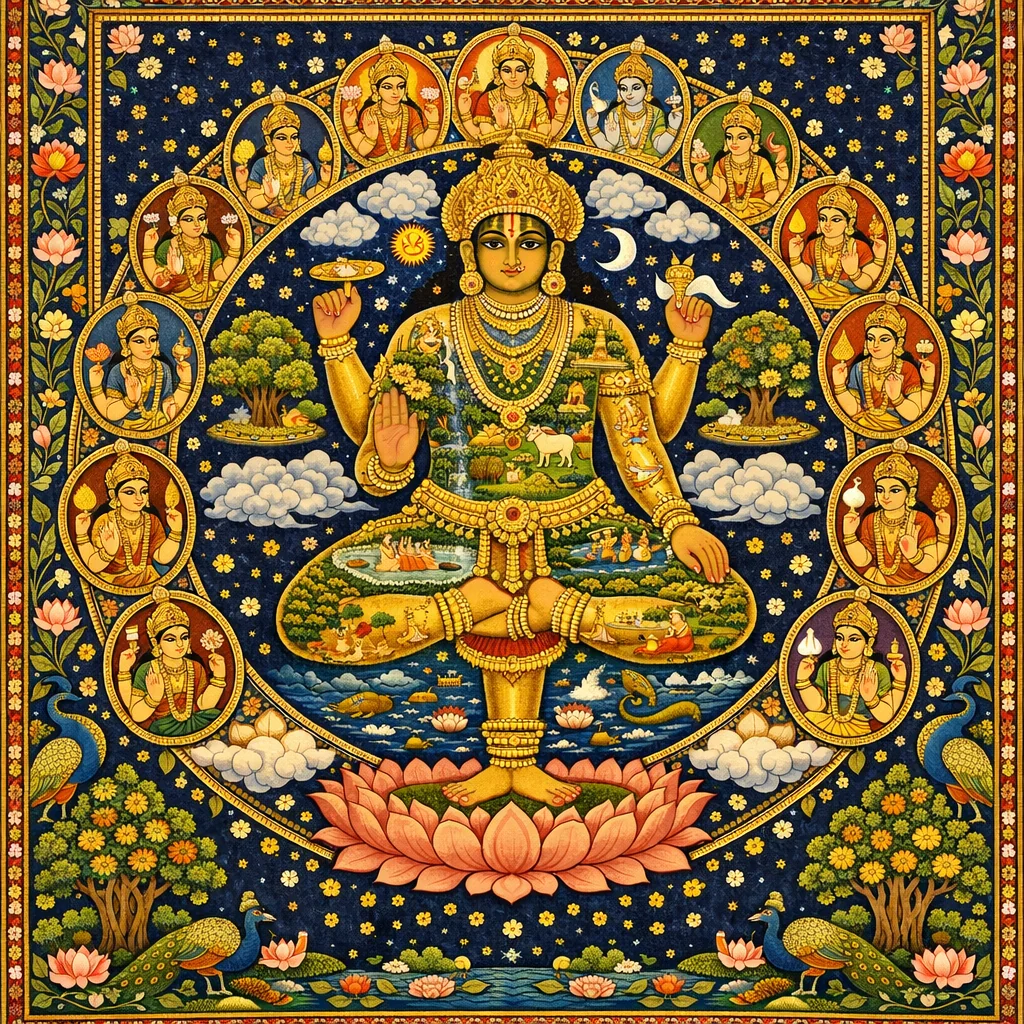
Continuing Maitreya’s cosmological teaching to Vidura, this chapter explains a pause in progressive creation because the Lord’s potencies do not combine. The Supreme Lord then enters the twenty-three elements with His external energy (here called Kālī), and the jīvas awaken to activity as if rising from sleep. From this activation appears the virāṭ-puruṣa (Hiraṇmaya), the first manifest universal form, within whom all planetary systems and beings rest. Maitreya identifies the devas who preside over the virāṭ’s organs and functions—speech, taste, smell, sight, touch, hearing, procreation, evacuation, grasping, locomotion, intelligence, mind, ego, and consciousness—presenting a coherent theology of embodiment and cosmic governance. He also places beings in loka-regions according to the guṇas and derives the four varṇas from the virāṭ’s limbs. The chapter concludes that self-realization requires worship of the Supreme under a guru’s guidance, and it stresses the Lord’s inconceivable potency beyond mind and speech, preparing for deeper inquiry into creation and the jīva’s deliverance in later chapters.
Shlokas
Verse 1
ऋषिरुवाच इति तासां स्वशक्तीनां सतीनामसमेत्य स: । प्रसुप्तलोकतन्त्राणां निशाम्य गतिमीश्वर: ॥ १ ॥
The sage Maitreya said: When the Lord’s own potencies did not unite, the progressive functions of creation were suspended, as though the order of the worlds lay asleep; seeing this, the Supreme Lord set matters in motion.
Verse 2
कालसंज्ञां तदा देवीं बिभ्रच्छक्तिमुरुक्रम: । त्रयोविंशतितत्त्वानां गणं युगपदाविशत् ॥ २ ॥
Then the all-powerful Lord, accompanied by the goddess known as Kāla—His external energy (māyā)—simultaneously entered the aggregate of the twenty-three elements.
Verse 3
सोऽनुप्रविष्टो भगवांश्चेष्टारूपेण तं गणम् । भिन्नं संयोजयमास सुप्तं कर्म प्रबोधयन् ॥ ३ ॥
Thus, when Bhagavān entered the elements as the very impulse of activity (ceṣṭā) through His energy, He joined what was separate and awakened the dormant karma into motion.
Verse 4
प्रबुद्धकर्मा दैवेन त्रयोविंशतिको गण: । प्रेरितोऽजनयत्स्वाभिर्मात्राभिरधिपूरुषम् ॥ ४ ॥
When the twenty-three principal elements were awakened into action by the will of the Supreme, they, through their respective measures, brought forth the Adhipuruṣa—the Lord’s cosmic form (virāṭ/viśvarūpa).
Verse 5
परेण विशता स्वस्मिन्मात्रया विश्वसृग्गण: । चुक्षोभान्योन्यमासाद्य यस्मिन्लोकाश्चराचरा: ॥ ५ ॥
As the Lord, in His plenary portion, entered the elements of universal creation, they stirred and transformed into the gigantic form in which all planetary systems, and all moving and unmoving beings, are situated.
Verse 6
हिरण्मय: स पुरुष: सहस्रपरिवत्सरान् । आण्डकोश उवासाप्सु सर्वसत्त्वोपबृंहित: ॥ ६ ॥
The immense virāṭ-puruṣa, known as Hiraṇmaya, dwelt for a thousand celestial years upon the waters of the universe within the cosmic egg, and all living beings lay there with Him.
Verse 7
स वै विश्वसृजां गर्भो देवकर्मात्मशक्तिमान् । विबभाजात्मनात्मानमेकधा दशधा त्रिधा ॥ ७ ॥
He, the womb of the universe’s creators, endowed with the potency for the gods’ cosmic work, divided Himself by Himself into one, into ten, and into three.
Verse 8
एष ह्यशेषसत्त्वानामात्मांश: परमात्मन: । आद्योऽवतारो यत्रासौ भूतग्रामो विभाव्यते ॥ ८ ॥
This gigantic universal form is the first incarnation and plenary portion of the Paramātmā. He is the Self of limitless living beings, and within Him the aggregate creation rests and thus flourishes.
Verse 9
साध्यात्म: साधिदैवश्च साधिभूत इति त्रिधा । विराट् प्राणो दशविध एकधा हृदयेन च ॥ ९ ॥
The universal form is understood in three ways—adhyātmika, adhidaivika, and adhibhautika. His prāṇa acts in ten kinds, and His heart is one, the source from which life-air arises.
Verse 10
स्मरन् विश्वसृजामीशो विज्ञापितमधोक्षज: । विराजमतपत्स्वेन तेजसैषां विवृत्तये ॥ १० ॥
The Supreme Lord Adhokṣaja, the Supersoul of the demigods entrusted with building the cosmos, remembered their appeal; reflecting within Himself, He revealed the virāṭ form by His own effulgence for their understanding.
Verse 11
अथ तस्याभितप्तस्य कतिधायतनानि ह । निरभिद्यन्त देवानां तानि मे गदत: शृणु ॥ ११ ॥
Maitreya said: Now hear from me how, after the vast universal form was manifested, the Supreme Lord differentiated Himself into the many forms and abodes of the presiding demigods.
Verse 12
तस्याग्निरास्यं निर्भिन्नं लोकपालोऽविशत्पदम् । वाचा स्वांशेन वक्तव्यं ययासौ प्रतिपद्यते ॥ १२ ॥
From His mouth Agni, the principle of heat, became manifest, and the governors of material affairs entered there in their respective posts. By that portion of energy the living being expresses himself in speech.
Verse 13
निर्भिन्नं तालु वरुणो लोकपालोऽविशद्धरे: । जिह्वयांशेन च रसं ययासौ प्रतिपद्यते ॥ १३ ॥
When the palate of the gigantic form manifested separately, Varuṇa, the presiding lord of the waters, entered there; and by the tongue’s portion of that potency the living being can taste all flavors.
Verse 14
निर्भिन्ने अश्विनौ नासे विष्णोराविशतां पदम् । घ्राणेनांशेन गन्धस्य प्रतिपत्तिर्यतो भवेत् ॥ १४ ॥
When the Lord’s two nostrils manifested separately, the twin Aśvinī-kumāras entered them in their proper places; and by that portion of the power of smell, living beings perceive the aromas of all things.
Verse 15
निर्भिन्ने अक्षिणी त्वष्टा लोकपालोऽविशद्विभो: । चक्षुषांशेन रूपाणां प्रतिपत्तिर्यतो भवेत् ॥ १५ ॥
Thereafter the two eyes of the Lord’s gigantic form manifested separately. The sun, the presiding lord of light (Tvasta), entered them; and by that portion of visual potency living beings behold forms.
Verse 16
निर्भिन्नान्यस्य चर्माणि लोकपालोऽनिलोऽविशत् । प्राणेनांशेन संस्पर्शं येनासौ प्रतिपद्यते ॥ १६ ॥
When the skin of the cosmic form manifested separately, Anila, the presiding deity of wind, entered it with a portion of the power of touch; by that prāṇa the living beings attain tactile knowledge.
Verse 17
कर्णावस्य विनिर्भिन्नौ धिष्ण्यं स्वं विविशुर्दिश: । श्रोत्रेणांशेन शब्दस्य सिद्धिं येन प्रपद्यते ॥ १७ ॥
When the ears of the cosmic form manifested, the presiding deities of the directions entered them in their own abodes. By a portion of the principle of hearing, sound was perfected, and thus living beings hear and benefit from it.
Verse 18
त्वचमस्य विनिर्भिन्नां विविशुर्धिष्ण्यमोषधी: । अंशेन रोमभि: कण्डूं यैरसौ प्रतिपद्यते ॥ १८ ॥
When the skin manifested separately, the presiding deities of the oṣadhis (plants and herbs) entered it in their own stations. By a portion of the bodily hairs, itching and the happiness of touch arise, which living beings experience.
Verse 19
मेढ्रं तस्य विनिर्भिन्नं स्वधिष्ण्यं क उपाविशत् । रेतसांशेन येनासावानन्दं प्रतिपद्यते ॥ १९ ॥
When the genitals of the cosmic form manifested separately, Prajāpati “Ka” (Kaśyapa) entered them in his own station. By a portion of the power of retas (semen), living beings experience the pleasure of union.
Verse 20
गुदं पुंसो विनिर्भिन्नं मित्रो लोकेश आविशत् । पायुनांशेन येनासौ विसर्गं प्रतिपद्यते ॥ २० ॥
When the evacuating channel manifested separately, Mitra, the lord who presides over the world, entered it in his own station. By a portion of the power of evacuation, living beings can pass stool and urine.
Verse 21
हस्तावस्य विनिर्भिन्नाविन्द्र: स्वर्पतिराविशत् । वार्तयांशेन पुरुषो यया वृत्तिं प्रपद्यते ॥ २१ ॥
Thereafter, when the hands of the universal gigantic form manifested separately, Indra, lord of the heavenly realms, entered them; thus the living being becomes able to act and conduct affairs for livelihood.
Verse 22
पादावस्य विनिर्भिन्नौ लोकेशो विष्णुराविशत् । गत्या स्वांशेन पुरुषो यया प्राप्यं प्रपद्यते ॥ २२ ॥
Thereafter, the legs of the universal gigantic form manifested separately, and the demigod named Viṣṇu (not the Supreme Lord) entered them with a portion of the power of movement; thus the living being can proceed to its destination.
Verse 23
बुद्धिं चास्य विनिर्भिन्नां वागीशो धिष्ण्यमाविशत् । बोधेनांशेन बोद्धव्यम् प्रतिपत्तिर्यतो भवेत् ॥ २३ ॥
When the intelligence of the universal gigantic form manifested separately, Brahmā, lord of the Vedas and master of speech, entered it with a portion of the power of understanding; thus living beings experience the object to be known.
Verse 24
हृदयं चास्य निर्भिन्नं चन्द्रमा धिष्ण्यमाविशत् । मनसांशेन येनासौ विक्रियां प्रतिपद्यते ॥ २४ ॥
After that, the heart of the universal gigantic form manifested separately, and the moon-god entered it with a portion of mental activity; thus the living being can engage in inner thought and mental speculation.
Verse 25
आत्मानं चास्य निर्भिन्नमभिमानोऽविशत्पदम् । कर्मणांशेन येनासौ कर्तव्यं प्रतिपद्यते ॥ २५ ॥
Thereafter, the material ego (abhimāna) of the universal gigantic form manifested separately, and Rudra, controller of false ego, entered it with a portion of his own activity; thus the living being undertakes its intended and obligatory actions.
Verse 26
सत्त्वं चास्य विनिर्भिन्नं महान्धिष्ण्यमुपाविशत् । चित्तेनांशेन येनासौ विज्ञानं प्रतिपद्यते ॥ २६ ॥
Thereafter, when His consciousness manifested separately, the mahat-tattva entered along with His conscious portion; thus the living being can apprehend specific knowledge.
Verse 27
शीर्ष्णोऽस्य द्यौर्धरा पद्भ्यां खं नाभेरुदपद्यत । गुणानां वृत्तयो येषु प्रतीयन्ते सुरादय: ॥ २७ ॥
Thereafter, from the head of the gigantic form the heavenly worlds manifested, from His legs the earthly worlds, and from His navel the sky separately appeared; within them the demigods and others arose according to the workings of the material modes.
Verse 28
आत्यन्तिकेन सत्त्वेन दिवं देवा: प्रपेदिरे । धरां रज:स्वभावेन पणयो ये च ताननु ॥ २८ ॥
The demigods, qualified by the supremely excellent mode of goodness, reside in the heavenly planets, whereas human beings, by their passionate nature, live on the earth along with their subordinates.
Verse 29
तार्तीयेन स्वभावेन भगवन्नाभिमाश्रिता: । उभयोरन्तरं व्योम ये रुद्रपार्षदां गणा: ॥ २९ ॥
Living beings who are associates of Rudra develop in the third mode, ignorance (tamas). Taking shelter of the Lord’s navel, they are situated in the sky between the earthly and heavenly planets.
Verse 30
मुखतोऽवर्तत ब्रह्म पुरुषस्य कुरूद्वह । यस्तून्मुखत्वाद्वर्णानां मुख्योऽभूद्ब्राह्मणो गुरु: ॥ ३० ॥
O chief of the Kuru dynasty, Vedic wisdom manifested from the mouth of the virāṭ, the gigantic form. Those inclined toward this Vedic knowledge are called brāhmaṇas, and they are the natural teachers and spiritual masters of all social orders.
Verse 31
बाहुभ्योऽवर्तत क्षत्रं क्षत्रियस्तदनुव्रत: । यो जातस्त्रायते वर्णान् पौरुष: कण्टकक्षतात् ॥ ३१ ॥
Thereafter, from the arms of the Lord’s virāṭ form arose the power of protection; following that principle, the kṣatriyas came forth to shield society from thieves and miscreants.
Verse 32
विशोऽवर्तन्त तस्योर्वोर्लोकवृत्तिकरीर्विभो: । वैश्यस्तदुद्भवो वार्तां नृणां य: समवर्तयत् ॥ ३२ ॥
From the thighs of the Lord’s virāṭ form arose the means of livelihood for all—grain production and its distribution; those who administer this work are known as vaiśyas.
Verse 33
पद्भ्यां भगवतो जज्ञे शुश्रूषा धर्मसिद्धये । तस्यां जात: पुरा शूद्रो यद्वृत्त्या तुष्यते हरि: ॥ ३३ ॥
Thereafter, for the perfection of dharma, service manifested from the feet of the Bhagavān; from this arose the śūdra, who satisfies Hari by a life of service.
Verse 34
एते वर्णा: स्वधर्मेण यजन्ति स्वगुरुं हरिम् । श्रद्धयात्मविशुद्ध्यर्थं यज्जाता: सह वृत्तिभि: ॥ ३४ ॥
All these social orders, with their duties and ways of life, are born from the Supreme Personality of Godhead; therefore, for purification and realization, one should worship Lord Hari with faith under the guidance of the spiritual master.
Verse 35
एतत्क्षत्तर्भगवतो दैवकर्मात्मरूपिण: । क: श्रद्दध्यादुपाकर्तुं योगमायाबलोदयम् ॥ ३५ ॥
O Vidura, who can estimate or measure the transcendental time, activity, and potency of the virāṭ form manifested by the Lord’s inner power, Yogamāyā?
Verse 36
तथापि कीर्तयाम्यङ्ग यथामति यथाश्रुतम् । कीर्तिं हरे: स्वां सत्कर्तुं गिरमन्याभिधासतीम् ॥ ३६ ॥
Even so, dear one, as far as I have heard and as far as my mind can grasp, I now speak with pure words to glorify Śrī Hari; otherwise my power of speech would remain unchaste.
Verse 37
एकान्तलाभं वचसो नु पुंसां सुश्लोकमौलेर्गुणवादमाहु: । श्रुतेश्च विद्वद्भिरुपाकृतायां कथासुधायामुपसम्प्रयोगम् ॥ ३७ ॥
The sole, highest gain of human speech is said to be discourse on the virtues and deeds of Śrī Hari, the crest of holy hymns. The nectar of such narrations, arranged from śruti by the learned sages, fulfills the very purpose of the ear simply by drawing near to it.
Verse 38
आत्मनोऽवसितो वत्स महिमा कविनादिना । संवत्सरसहस्रान्ते धिया योगविपक्कया ॥ ३८ ॥
O my son, Brahmā, the primal poet, after mature meditation for a thousand celestial years, could conclude only this: the glory of the Paramātmā is inconceivable (acintya).
Verse 39
अतो भगवतो माया मायिनामपि मोहिनी । यत्स्वयं चात्मवर्त्मात्मा न वेद किमुतापरे ॥ ३९ ॥
Therefore the māyā of Bhagavān bewilders even the masters of illusion. That potency is not known even to the self-sufficient Lord who abides on His own path—how, then, could it be known by others?
Verse 40
यतोऽप्राप्य न्यवर्तन्त वाचश्च मनसा सह । अहं चान्य इमे देवास्तस्मै भगवते नम: ॥ ४० ॥
Words, mind, and ego—along with their presiding devas—have failed to know Bhagavān. Therefore I, and these other gods as well, offer Him our reverent obeisances.
Frequently Asked Questions
Because prakṛti and its categories (including mahat-tattva) do not self-organize into progressive creation without the Supreme’s sanction and enlivening presence. The ‘suspension’ underscores that material causes are insufficient by themselves; the Lord’s entry as Paramātmā activates and harmonizes the elements so that living beings and cosmic functions can manifest coherently.
Kālī here denotes the Lord’s external energy (bahiraṅgā-śakti), the power that amalgamates and differentiates material elements for cosmic manifestation. She is not presented as an independent supreme principle; rather, she operates under the Supreme Lord’s will, enabling the combination of elements that supports embodied life and universal structure.
The chapter teaches an adhi-devatā framework: devas preside over specific sensory and functional capacities—Agni over speech, Varuṇa over taste, Aśvinī-kumāras over smell, Sūrya over sight, Anila over touch, Dik-pālas over hearing, Prajāpati over procreation, Mitra over evacuation, Indra over hands, and a deity named Viṣṇu over locomotion. This shows that embodied functions are coordinated through divine administration, not random material evolution.
The virāṭ-puruṣa is a pedagogical manifestation that helps conditioned beings understand the Lord’s immanence in the cosmos. It organizes the universe into a comprehensible sacred anatomy, leading the mind from gross cosmology toward the recognition of the Lord as the inner controller (Paramātmā) and ultimately toward bhakti, where one relates to Bhagavān beyond the material frame.
The description establishes that social orders and occupational duties are meant to be functional limbs of a God-centered civilization, not grounds for pride or oppression. Brāhmaṇas (from the mouth) represent teaching and Vedic wisdom; kṣatriyas (from the arms) protection; vaiśyas (from the thighs) production and distribution; śūdras (from the legs) service. The conclusion emphasizes worship of the Supreme under guru guidance as the goal of all varṇāśrama duties.