Adhyaya 89
Bhṛgu Tests the Trimūrti; Kṛṣṇa and Arjuna Visit Mahā-Viṣṇu and Recover the Brāhmaṇa’s Sons
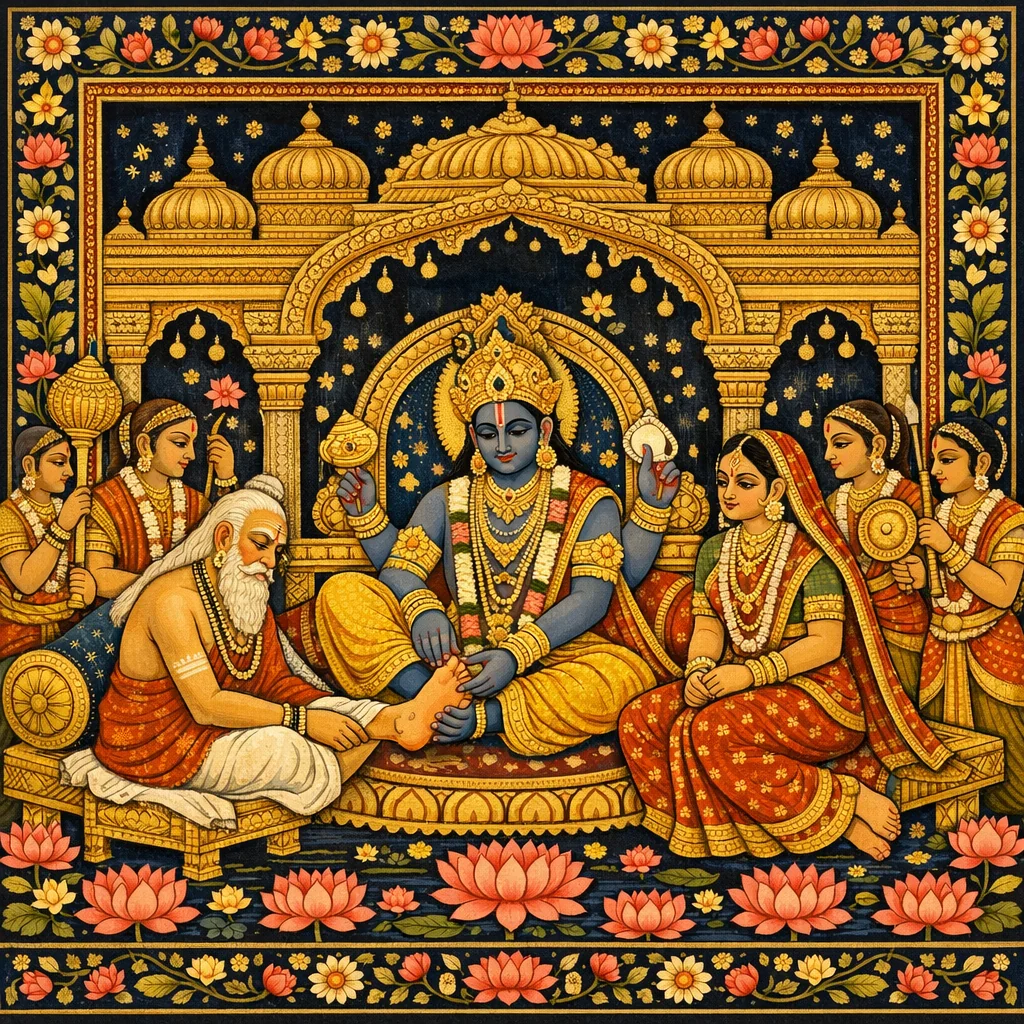
This chapter joins theological discernment with cosmic revelation. On the Sarasvatī, sages debating the supreme deity send Bhṛgu to test Brahmā, Śiva, and Viṣṇu. Bhṛgu withholds honor from Brahmā and sees his anger checked by intelligence; he then insults Śiva, who flares in wrath but is calmed by Devī. Finally Bhṛgu kicks Lord Viṣṇu on the chest, and Viṣṇu responds with humility, hospitality, and a request to wash the sage’s foot—revealing pure sattva and the Lord’s bhakta-vātsalya, His tender love for devotees. The sages affirm Viṣṇu’s supremacy and, through bhakti, attain His abode. The scene shifts to Dvārakā: a brāhmaṇa’s infants repeatedly die at birth, and he blames the king. Arjuna vows to protect the next child but fails when the newborn vanishes. To keep his promise, Arjuna searches the worlds; Kṛṣṇa intervenes and carries him beyond Lokāloka and the brahmajyoti to the realm where Mahā-Viṣṇu rests on Ananta Śeṣa. Mahā-Viṣṇu explains He took the children so they might behold Kṛṣṇa and Arjuna (as divine expansions) and instructs them to continue exemplifying dharma. They return the infants, confirming Kṛṣṇa’s supremacy and preparing for further displays of divine governance in Dvārakā.
Shlokas
Verse 1
श्रीशुक उवाच सरस्वत्यास्तटे राजन्नृषय: सत्रमासत । वितर्क: समभूत्तेषां त्रिष्वधीशेषु को महान् ॥ १ ॥
Śukadeva Gosvāmī said: O King, once on the bank of the Sarasvatī River the sages were performing a satra sacrifice, and a dispute arose among them as to which of the three chief deities is supreme.
Verse 2
तस्य जिज्ञासया ते वै भृगुं ब्रह्मसुतं नृप । तज्ज्ञप्त्यै प्रेषयामासु: सोऽभ्यगाद् ब्रह्मण: सभाम् ॥ २ ॥
Eager to settle that question, O King, the sages sent Bhṛgu, the son of Lord Brahmā, to ascertain the truth. He first went to his father Brahmā’s assembly.
Verse 3
न तस्मै प्रह्वणं स्तोत्रं चक्रे सत्त्वपरीक्षया । तस्मै चुक्रोध भगवान् प्रज्वलन् स्वेन तेजसा ॥ ३ ॥
To test how firmly Lord Brahmā was established in the mode of goodness, Bhṛgu neither bowed to him nor praised him with prayers. The lord grew angry, blazing with his own potency.
Verse 4
स आत्मन्युत्थितं मन्युमात्मजायात्मना प्रभु: । अशीशमद् यथा वह्निं स्वयोन्या वारिणात्मभू: ॥ ४ ॥
Though anger toward his son rose within his heart, Lord Brahmā subdued it by his intelligence, just as fire is quenched by its own product, water.
Verse 5
तत: कैलासमगमत् स तं देवो महेश्वर: । परिरब्धुं समारेभ उत्थाय भ्रातरं मुदा ॥ ५ ॥
Bhṛgu then went to Mount Kailāsa. There Lord Mahāśvara Śiva rose joyfully and came forward to embrace his brother.
Verse 6
नैच्छत्त्वमस्युत्पथग इति देवश्चुकोप ह । शूलमुद्यम्य तं हन्तुमारेभे तिग्मलोचन: ॥ ६ ॥ पतित्वा पादयोर्देवी सान्त्वयामास तं गिरा । अथो जगाम वैकुण्ठं यत्र देवो जनार्दन: ॥ ७ ॥
But Bhṛgu refused his embrace, saying, “You have strayed from the true path.” Lord Śiva, his eyes fierce, became enraged and raised his trident to kill Bhṛgu, but the Goddess Devī fell at his feet and pacified him with gentle words. Bhṛgu then departed for Vaikuṇṭha, where Lord Janārdana resides.
Verse 7
नैच्छत्त्वमस्युत्पथग इति देवश्चुकोप ह । शूलमुद्यम्य तं हन्तुमारेभे तिग्मलोचन: ॥ ६ ॥ पतित्वा पादयोर्देवी सान्त्वयामास तं गिरा । अथो जगाम वैकुण्ठं यत्र देवो जनार्दन: ॥ ७ ॥
Bhṛgu refused the embrace, saying, “You have strayed from the true path, a heretic.” Lord Śiva then flared with anger; his fierce eyes blazed as he raised his trident to slay Bhṛgu. But the Goddess Devī fell at his feet and soothed him with gentle words. Thereafter Bhṛgu departed for Vaikuṇṭha, the abode of Lord Janārdana.
Verse 8
शयानं श्रिय उत्सङ्गे पदा वक्षस्यताडयत् । तत उत्थाय भगवान् सह लक्ष्म्या सतां गति: ॥ ८ ॥ स्वतल्पादवरुह्याथ ननाम शिरसा मुनिम् । आह ते स्वागतं ब्रह्मन् निषीदात्रासने क्षणम् । अजानतामागतान् व: क्षन्तुमर्हथ न: प्रभो ॥ ९ ॥
In Vaikuṇṭha the Supreme Lord lay with His head upon Śrī’s lap, and Bhṛgu struck His chest with his foot. The Bhagavān—supreme refuge of the saintly—rose at once with Lakṣmī in reverence. Descending from His bed, He bowed low before the sage and said, “Welcome, O brāhmaṇa. Please sit upon this seat and rest a while. Forgive us, dear master, for we did not notice your arrival.”
Verse 9
शयानं श्रिय उत्सङ्गे पदा वक्षस्यताडयत् । तत उत्थाय भगवान् सह लक्ष्म्या सतां गति: ॥ ८ ॥ स्वतल्पादवरुह्याथ ननाम शिरसा मुनिम् । आह ते स्वागतं ब्रह्मन् निषीदात्रासने क्षणम् । अजानतामागतान् व: क्षन्तुमर्हथ न: प्रभो ॥ ९ ॥
In Vaikuṇṭha the Supreme Lord lay with His head upon Śrī’s lap, and Bhṛgu struck His chest with his foot. The Bhagavān—supreme refuge of the saintly—rose at once with Lakṣmī in reverence. Descending from His bed, He bowed low before the sage and said, “Welcome, O brāhmaṇa. Please sit upon this seat and rest a while. Forgive us, dear master, for we did not notice your arrival.”
Verse 10
पुनीहि सहलोकं मां लोकपालांश्च मद्गतान् । पादोदकेन भवतस्तीर्थानां तीर्थकारिणा ॥ १० ॥ अद्याहं भगवँल्लक्ष्म्या आसमेकान्तभाजनम् । वत्स्यत्युरसि मे भूतिर्भवत्पादहतांहस: ॥ ११ ॥
The Bhagavān said, “Please purify Me, My abode, and the realms of the world-rulers devoted to Me with the water that has washed your feet—holy water that sanctifies all places of pilgrimage. Today, my lord, since your foot has struck away all sin from Me, I have become the exclusive shelter of Lakṣmī; she will consent to dwell upon My chest.”
Verse 11
पुनीहि सहलोकं मां लोकपालांश्च मद्गतान् । पादोदकेन भवतस्तीर्थानां तीर्थकारिणा ॥ १० ॥ अद्याहं भगवँल्लक्ष्म्या आसमेकान्तभाजनम् । वत्स्यत्युरसि मे भूतिर्भवत्पादहतांहस: ॥ ११ ॥
The Bhagavān said, “Please purify Me, My abode, and the realms of the world-rulers devoted to Me with the water that has washed your feet—holy water that sanctifies all places of pilgrimage. Today, my lord, since your foot has struck away all sin from Me, I have become the exclusive shelter of Lakṣmī; she will consent to dwell upon My chest.”
Verse 12
श्रीशुक उवाच एवं ब्रुवाणे वैकुण्ठे भृगुस्तन्मन्द्रया गिरा । निर्वृतस्तर्पितस्तूष्णीं भक्त्युत्कण्ठोऽश्रुलोचन: ॥ १२ ॥
Śukadeva Gosvāmī said: Hearing the grave words spoken by Lord Vaikuṇṭha, Bhṛgu became satisfied and delighted. Overwhelmed by devotional ecstasy, he remained silent, his eyes brimming with tears.
Verse 13
पुनश्च सत्रमाव्रज्य मुनीनां ब्रह्मवादिनाम् । स्वानुभूतमशेषेण राजन् भृगुरवर्णयत् ॥ १३ ॥
O King, Bhṛgu then returned to the sacrificial arena of the sages learned in Vedic truth and described his entire experience in full.
Verse 14
तन्निशम्याथ मुनयो विस्मिता मुक्तसंशया: । भूयांसं श्रद्दधुर्विष्णुं यत: शान्तिर्यतोऽभयम् ॥ १४ ॥ धर्म: साक्षाद् यतो ज्ञानं वैराग्यं च तदन्वितम् । ऐश्वर्यं चाष्टधा यस्माद् यशश्चात्ममलापहम् ॥ १५ ॥ मुनीनां न्यस्तदण्डानां शान्तानां समचेतसाम् । अकिञ्चनानां साधूनां यमाहु: परमां गतिम् ॥ १६ ॥ सत्त्वं यस्य प्रिया मूर्तिर्ब्राह्मणास्त्विष्टदेवता: । भजन्त्यनाशिष: शान्ता यं वा निपुणबुद्धय: ॥ १७ ॥
Hearing Bhṛgu’s account, the sages were amazed; freed from all doubts, they became firmly convinced that Viṣṇu is the supreme Lord. From Him arise peace and fearlessness, the very essence of dharma, detachment joined with knowledge, the eight mystic perfections of yoga, and His glory, which cleanses the mind of all impurity. He is known as the highest destination of the peaceful and equipoised sādhus—selfless saints who have renounced all violence. His dearest form is pure goodness (sattva), and the brāhmaṇas are His worshipable deities; those of keen intellect, established in inner peace, worship Him without selfish desire.
Verse 15
तन्निशम्याथ मुनयो विस्मिता मुक्तसंशया: । भूयांसं श्रद्दधुर्विष्णुं यत: शान्तिर्यतोऽभयम् ॥ १४ ॥ धर्म: साक्षाद् यतो ज्ञानं वैराग्यं च तदन्वितम् । ऐश्वर्यं चाष्टधा यस्माद् यशश्चात्ममलापहम् ॥ १५ ॥ मुनीनां न्यस्तदण्डानां शान्तानां समचेतसाम् । अकिञ्चनानां साधूनां यमाहु: परमां गतिम् ॥ १६ ॥ सत्त्वं यस्य प्रिया मूर्तिर्ब्राह्मणास्त्विष्टदेवता: । भजन्त्यनाशिष: शान्ता यं वा निपुणबुद्धय: ॥ १७ ॥
Hearing Bhṛgu’s account, the sages were amazed; freed from all doubts, they became firmly convinced that Viṣṇu is the supreme Lord. From Him arise peace and fearlessness, the very essence of dharma, detachment joined with knowledge, the eight mystic perfections of yoga, and His glory, which cleanses the mind of all impurity. He is known as the highest destination of the peaceful and equipoised sādhus—selfless saints who have renounced all violence. His dearest form is pure goodness (sattva), and the brāhmaṇas are His worshipable deities; those of keen intellect, established in inner peace, worship Him without selfish desire.
Verse 16
तन्निशम्याथ मुनयो विस्मिता मुक्तसंशया: । भूयांसं श्रद्दधुर्विष्णुं यत: शान्तिर्यतोऽभयम् ॥ १४ ॥ धर्म: साक्षाद् यतो ज्ञानं वैराग्यं च तदन्वितम् । ऐश्वर्यं चाष्टधा यस्माद् यशश्चात्ममलापहम् ॥ १५ ॥ मुनीनां न्यस्तदण्डानां शान्तानां समचेतसाम् । अकिञ्चनानां साधूनां यमाहु: परमां गतिम् ॥ १६ ॥ सत्त्वं यस्य प्रिया मूर्तिर्ब्राह्मणास्त्विष्टदेवता: । भजन्त्यनाशिष: शान्ता यं वा निपुणबुद्धय: ॥ १७ ॥
Hearing Bhṛgu’s account, the sages were amazed; freed from all doubts, they became firmly convinced that Viṣṇu is the supreme Lord. From Him arise peace and fearlessness, the very essence of dharma, detachment joined with knowledge, the eight mystic perfections of yoga, and His glory, which cleanses the mind of all impurity. He is known as the highest destination of the peaceful and equipoised sādhus—selfless saints who have renounced all violence. His dearest form is pure goodness (sattva), and the brāhmaṇas are His worshipable deities; those of keen intellect, established in inner peace, worship Him without selfish desire.
Verse 17
तन्निशम्याथ मुनयो विस्मिता मुक्तसंशया: । भूयांसं श्रद्दधुर्विष्णुं यत: शान्तिर्यतोऽभयम् ॥ १४ ॥ धर्म: साक्षाद् यतो ज्ञानं वैराग्यं च तदन्वितम् । ऐश्वर्यं चाष्टधा यस्माद् यशश्चात्ममलापहम् ॥ १५ ॥ मुनीनां न्यस्तदण्डानां शान्तानां समचेतसाम् । अकिञ्चनानां साधूनां यमाहु: परमां गतिम् ॥ १६ ॥ सत्त्वं यस्य प्रिया मूर्तिर्ब्राह्मणास्त्विष्टदेवता: । भजन्त्यनाशिष: शान्ता यं वा निपुणबुद्धय: ॥ १७ ॥
Hearing Bhṛgu’s account, the sages were astonished; freed from doubt, they became firmly convinced that Viṣṇu is the Supreme Lord. From Him arise peace and fearlessness, the very essence of dharma, detachment joined with knowledge, the eight mystic perfections of yoga, and His fame, which washes away the mind’s impurities. He is proclaimed the highest destination of the nonviolent, tranquil, equipoised saints—selfless and wise. His dearest manifestation is pure sattva, and the brāhmaṇas are His worshipable deities. Those of keen intellect, established in inner peace, worship Him without selfish desire.
Verse 18
त्रिविधाकृतयस्तस्य राक्षसा असुरा: सुरा: । गुणिन्या मायया सृष्टा: सत्त्वं तत्तीर्थसाधनम् ॥ १८ ॥
The Lord manifests in three kinds of beings—Rākṣasas, Asuras, and Suras—created by His guṇa-filled māyā and bound by her modes. Yet among the three guṇas, sattva alone is the means to attain life’s highest perfection.
Verse 19
श्रीशुक उवाच इत्थं सारस्वता विप्रा नृणां संशयनुत्तये । पुरुषस्य पदाम्भोजसेवया तद्गतिं गता: ॥ १९ ॥
Śukadeva Gosvāmī said: Thus the learned brāhmaṇas on the banks of the Sarasvatī reached this conclusion to dispel the doubts of all people. Thereafter they rendered bhakti-service to the lotus feet of the Supreme Purusha and attained His abode.
Verse 20
श्रीसूत उवाच इत्येतन्मुनितनयास्यपद्मगन्ध- पीयूषं भवभयभित् परस्य पुंस: । सुश्लोकं श्रवणपुटै: पिबत्यभीक्ष्णं पान्थोऽध्वभ्रमणपरिश्रमं जहाति ॥ २० ॥
Sūta Gosvāmī said: Thus flowed the fragrant nectar from the lotus mouth of Śukadeva, son of the sage Vyāsa. This beautiful glorification of the Supreme Person destroys the fear of saṁsāra. A traveler who repeatedly drinks this nectar through the ears casts off the weariness of wandering the world’s roads.
Verse 21
श्रीशुक उवाच एकदा द्वारवत्यां तु विप्रपत्न्या: कुमारक: । जातमात्रो भुवं स्पृष्ट्वा ममार किल भारत ॥ २१ ॥
Śukadeva Gosvāmī said: O Bhārata, once in Dvārakā a brāhmaṇa’s wife gave birth to a son, but the newborn died the moment he touched the ground.
Verse 22
विप्रो गृहीत्वा मृतकं राजद्वार्युपधाय स: । इदं प्रोवाच विलपन्नातुरो दीनमानस: ॥ २२ ॥
The brāhmaṇa took the dead child’s body and laid it at the door of King Ugrasena’s court. Then, shaken with grief and wailing in misery, he spoke as follows.
Verse 23
ब्रह्मद्विष: शठधियो लुब्धस्य विषयात्मन: । क्षत्रबन्धो: कर्मदोषात् पञ्चत्वं मे गतोऽर्भक: ॥ २३ ॥
This unfit kṣatriya—an enemy of the brāhmaṇas, duplicitous in mind, greedy and addicted to sense pleasure—by faults in his duty has brought my child to death.
Verse 24
हिंसाविहारं नृपतिं दु:शीलमजितेन्द्रियम् । प्रजा भजन्त्य: सीदन्ति दरिद्रा नित्यदु:खिता: ॥ २४ ॥
Citizens who serve a wicked king—one who delights in violence and cannot master his senses—are doomed to poverty and unceasing misery.
Verse 25
एवं द्वितीयं विप्रर्षिस्तृतीयं त्वेवमेव च । विसृज्य स नृपद्वारि तां गाथां समगायत ॥ २५ ॥
In the same way, the brāhmaṇa sage met the same tragedy with his second and third child. Each time he left the dead boy’s body at the king’s door and sang the same lament.
Verse 26
तामर्जुन उपश्रुत्य कर्हिचित् केशवान्तिके । परेते नवमे बाले ब्राह्मणं समभाषत ॥ २६ ॥ किंस्विद् ब्रह्मंस्त्वन्निवासे इह नास्ति धनुर्धर: । राजन्यबन्धुरेते वै ब्राह्मणा: सत्रमासते ॥ २७ ॥
When the ninth child also died, Arjuna, who was near Lord Keśava, happened to overhear the brāhmaṇa’s lament. Arjuna then addressed him: “What is the matter, venerable brāhmaṇa? Is there not even a bowman here who can at least stand before your house with a bow in hand? These kṣatriyas act as though they were brāhmaṇas, idly seated at fire sacrifices.”
Verse 27
तामर्जुन उपश्रुत्य कर्हिचित् केशवान्तिके । परेते नवमे बाले ब्राह्मणं समभाषत ॥ २६ ॥ किंस्विद् ब्रह्मंस्त्वन्निवासे इह नास्ति धनुर्धर: । राजन्यबन्धुरेते वै ब्राह्मणा: सत्रमासते ॥ २७ ॥
When the ninth child died, Arjuna, who was near Lord Keśava, happened to overhear the brāhmaṇa lamenting. Thus Arjuna addressed the brāhmaṇa: “What is the matter, my dear brāhmaṇa? Isn’t there some lowly member of the royal order here who can at least stand before your house with a bow in his hand?
Verse 28
धनदारात्मजापृक्ता यत्र शोचन्ति ब्राह्मणा: । ते वै राजन्यवेषेण नटा जीवन्त्यसुम्भरा: ॥ २८ ॥
The rulers of a kingdom in which brāhmaṇas lament over lost wealth, wives and children are merely imposters playing the role of kings just to earn their livelihood.
Verse 29
अहं प्रजा: वां भगवन् रक्षिष्ये दीनयोरिह । अनिस्तीर्णप्रतिज्ञोऽग्निं प्रवेक्ष्ये हतकल्मष: ॥ २९ ॥
My lord, I will protect the progeny of you and your wife, who are in such distress. And if I fail to keep this promise, I will enter fire to atone for my sin.
Verse 30
श्रीब्राह्मण उवाच सङ्कर्षणो वासुदेव: प्रद्युम्नो धन्विनां वर: । अनिरुद्धोऽप्रतिरथो न त्रातुं शक्नुवन्ति यत् ॥ ३० ॥ तत् कथं नु भवान् कर्म दुष्करं जगदीश्वरै: । त्वं चिकीर्षसि बालिश्यात् तन्न श्रद्दध्महे वयम् ॥ ३१ ॥
The brāhmaṇa said: Neither Saṅkarṣaṇa; Vāsudeva; Pradyumna, the best of bowmen; nor the unequaled warrior Aniruddha could save my sons.
Verse 31
श्रीब्राह्मण उवाच सङ्कर्षणो वासुदेव: प्रद्युम्नो धन्विनां वर: । अनिरुद्धोऽप्रतिरथो न त्रातुं शक्नुवन्ति यत् ॥ ३० ॥ तत् कथं नु भवान् कर्म दुष्करं जगदीश्वरै: । त्वं चिकीर्षसि बालिश्यात् तन्न श्रद्दध्महे वयम् ॥ ३१ ॥
Then why do you naively attempt a feat that the almighty Lords of the universe could not perform? We cannot take you seriously.
Verse 32
श्रीअर्जुन उवाच नाहं सङ्कर्षणो ब्रह्मन् न कृष्ण: कार्ष्णिरेव च । अहं वा अर्जुनो नाम गाण्डीवं यस्य वै धनु: ॥ ३२ ॥
Śrī Arjuna said: O brāhmaṇa, I am neither Lord Saṅkarṣaṇa nor Lord Kṛṣṇa, nor even Kṛṣṇa’s son. I am Arjuna, the wielder of the Gāṇḍīva bow.
Verse 33
मावमंस्था मम ब्रह्मन् वीर्यं त्र्यम्बकतोषणम् । मृत्युं विजित्य प्रधने आनेष्ये ते प्रजा: प्रभो ॥ ३३ ॥
Do not belittle my prowess, O brāhmaṇa, which was enough to satisfy Tryambaka (Lord Śiva). My master, even if I must conquer Death in battle, I will bring back your sons.
Verse 34
एवं विश्रम्भितो विप्र: फाल्गुनेन परन्तप । जगाम स्वगृहं प्रीत: पार्थवीर्यं निशामयन् ॥ ३४ ॥
Thus reassured by Phālguna (Arjuna), O tormentor of enemies, the brāhmaṇa went home pleased, having heard Pārtha’s declaration of his prowess.
Verse 35
प्रसूतिकाल आसन्ने भार्याया द्विजसत्तम: । पाहि पाहि प्रजां मृत्योरित्याहार्जुनमातुर: ॥ ३५ ॥
When the wife of the exalted brāhmaṇa was again about to give birth, he went to Arjuna in great anxiety and begged, “Please, please protect my child from death!”
Verse 36
स उपस्पृश्य शुच्यम्भो नमस्कृत्य महेश्वरम् । दिव्यान्यस्त्राणि संस्मृत्य सज्यं गाण्डीवमाददे ॥ ३६ ॥
After touching pure water, offering obeisances to Maheśvara (Lord Śiva), and recalling the mantras of his celestial weapons, Arjuna strung his bow, Gāṇḍīva.
Verse 37
न्यरुणत् सूतिकागारं शरैर्नानास्त्रयोजितै: । तिर्यगूर्ध्वमध: पार्थश्चकार शरपञ्जरम् ॥ ३७ ॥
Arjuna fenced in the birthing house by shooting arrows empowered with various weapons. Thus the son of Pṛthā built a protective cage of arrows, covering it above, below, and on every side.
Verse 38
तत: कुमार: सञ्जातो विप्रपत्न्या रुदन्मुहु: । सद्योऽदर्शनमापेदे सशरीरो विहायसा ॥ ३८ ॥
Then the brāhmaṇa’s wife gave birth to a son; after crying for a brief moment, the newborn suddenly vanished into the sky, in that very body.
Verse 39
तदाह विप्रो विजयं विनिन्दन् कृष्णसन्निधौ । मौढ्यं पश्यत मे योऽहं श्रद्दधे क्लीबकत्थनम् ॥ ३९ ॥
The brāhmaṇa then mocked Arjuna in Lord Kṛṣṇa’s presence: “Behold my folly—I put my faith in the boasting of a eunuch!”
Verse 40
न प्रद्युम्नो नानिरुद्धो न रामो न च केशव: । यस्य शेकु: परित्रातुं कोऽन्यस्तदवितेश्वर: ॥ ४० ॥
“If neither Pradyumna nor Aniruddha, neither Rāma nor Keśava can save a person, who else could possibly protect him?”
Verse 41
धिगर्जुनं मृषावादं धिगात्मश्लाघिनो धनु: । दैवोपसृष्टं यो मौढ्यादानिनीषति दुर्मति: ॥ ४१ ॥
“To hell with Arjuna, that liar! To hell with the bow of that braggart! In foolish delusion, that ill-minded man thinks he can bring back one whom destiny has taken away.”
Verse 42
एवं शपति विप्रर्षौ विद्यामास्थाय फाल्गुन: । ययौ संयमनीमाशु यत्रास्ते भगवान् यम: ॥ ४२ ॥
As the wise brāhmaṇa sage continued to heap harsh words upon him, Arjuna, known as Phālguna, took shelter of a mystic incantation and swiftly went to Saṁyamanī, the city where Lord Yamarāja resides.
Verse 43
विप्रापत्यमचक्षाणस्तत ऐन्द्रीमगात् पुरीम् । आग्नेयीं नैऋर्तीं सौम्यां वायव्यां वारुणीमथ । रसातलं नाकपृष्ठं धिष्ण्यान्यन्यान्युदायुध: ॥ ४३ ॥ ततोऽलब्धद्विजसुतो ह्यनिस्तीर्णप्रतिश्रुत: । अग्निं विविक्षु: कृष्णेन प्रत्युक्त: प्रतिषेधता ॥ ४४ ॥
Not seeing the brāhmaṇa’s child there, Arjuna went to the cities of Indra, Agni, Nirṛti, Soma, Vāyu and Varuṇa. With weapons at the ready he searched all the realms of the universe, from Rasātala to the very roof of heaven. Yet finding nowhere the son of the dvija, and feeling his promise unfulfilled, he resolved to enter the sacred fire—when Lord Śrī Kṛṣṇa stopped him and spoke.
Verse 44
विप्रापत्यमचक्षाणस्तत ऐन्द्रीमगात् पुरीम् । आग्नेयीं नैऋर्तीं सौम्यां वायव्यां वारुणीमथ । रसातलं नाकपृष्ठं धिष्ण्यान्यन्यान्युदायुध: ॥ ४३ ॥ ततोऽलब्धद्विजसुतो ह्यनिस्तीर्णप्रतिश्रुत: । अग्निं विविक्षु: कृष्णेन प्रत्युक्त: प्रतिषेधता ॥ ४४ ॥
Not seeing the brāhmaṇa’s child there, Arjuna went to the cities of Indra, Agni, Nirṛti, Soma, Vāyu and Varuṇa. With weapons ready he searched from Rasātala up to the vault of heaven. Still unable to find the dvija’s son and thus failing his vow, he was about to enter the sacred fire—when Bhagavān Śrī Kṛṣṇa restrained him and spoke.
Verse 45
दर्शये द्विजसूनूंस्ते मावज्ञात्मानमात्मना । ये ते न: कीर्तिं विमलां मनुष्या: स्थापयिष्यन्ति ॥ ४५ ॥
I will show you the brāhmaṇa’s sons, so do not despise yourself in this way. These very men who now criticize us will soon establish our spotless fame.
Verse 46
इति सम्भाष्य भगवानर्जुनेन सहेश्वर: । दिव्यं स्वरथमास्थाय प्रतीचीं दिशमाविशत् ॥ ४६ ॥
Thus advising Arjuna, Bhagavān, the Supreme Lord, had him join Him upon His divine chariot, and together they set off toward the west.
Verse 47
सप्त द्वीपान् ससिन्धूंश्च सप्तसप्तगिरीनथ । लोकालोकं तथातीत्य विवेश सुमहत्तम: ॥ ४७ ॥
The Lord’s chariot passed over the seven dvīpas of the middle universe, with their oceans and seven chief mountains. Then it crossed the Lokāloka boundary and entered the vast realm of total darkness.
Verse 48
तत्राश्वा: शैब्यसुग्रीवमेघपुष्पबलाहका: । तमसि भ्रष्टगतयो बभूवुर्भरतर्षभ ॥ ४८ ॥ तान् दृष्ट्वा भगवान् कृष्णो महायोगेश्वरेश्वर: । सहस्रादित्यसङ्काशं स्वचक्रं प्राहिणोत् पुर: ॥ ४९ ॥
In that darkness the chariot’s horses—Śaibya, Sugrīva, Meghapuṣpa, and Balāhaka—lost their way, O best of the Bhāratas. Seeing this, Lord Śrī Kṛṣṇa, the supreme master of all great yogīs, sent His Sudarśana disc ahead of the chariot, blazing like a thousand suns.
Verse 49
तत्राश्वा: शैब्यसुग्रीवमेघपुष्पबलाहका: । तमसि भ्रष्टगतयो बभूवुर्भरतर्षभ ॥ ४८ ॥ तान् दृष्ट्वा भगवान् कृष्णो महायोगेश्वरेश्वर: । सहस्रादित्यसङ्काशं स्वचक्रं प्राहिणोत् पुर: ॥ ४९ ॥
In that darkness the chariot’s horses—Śaibya, Sugrīva, Meghapuṣpa, and Balāhaka—lost their way, O best of the Bhāratas. Seeing this, Lord Śrī Kṛṣṇa, the supreme master of all great yogīs, sent His Sudarśana disc ahead of the chariot, blazing like a thousand suns.
Verse 50
तम: सुघोरं गहनं कृतं महद् विदारयद् भूरितरेण रोचिषा । मनोजवं निर्विविशे सुदर्शनं गुणच्युतो रामशरो यथा चमू: ॥ ५० ॥
The Lord’s Sudarśana disc, racing with the speed of the mind, entered that darkness and tore apart the dreadful, dense gloom with its blazing radiance—just as an arrow shot from Śrī Rāma’s bow cleaves through an enemy army.
Verse 51
द्वारेण चक्रानुपथेन तत्तम: परं परं ज्योतिरनन्तपारम् । समश्नुवानं प्रसमीक्ष्य फाल्गुन: प्रताडिताक्षो पिदधेऽक्षिणी उभे ॥ ५१ ॥
Following the Sudarśana disc, the chariot passed through the gateway of darkness and reached the limitless supreme radiance—the all-pervading brahmajyoti. Beholding that blinding effulgence, Arjuna (Phālguna) felt pain in his eyes and closed them both.
Verse 52
तत: प्रविष्ट: सलिलं नभस्वता बलीयसैजद् बृहदूर्मिभूषणम् । तत्राद्भुतं वै भवनं द्युमत्तमं भ्राजन्मणिस्तम्भसहस्रशोभितम् ॥ ५२ ॥
Then they entered a shining expanse of water, adorned with immense waves churned by a mighty wind. Within that ocean Arjuna beheld an astonishing palace, more radiant than anything he had ever seen, its splendor enhanced by thousands of ornamental pillars set with brilliant gems.
Verse 53
तस्मिन् महाभोगमनन्तमद्भुतं सहस्रमूर्धन्यफणामणिद्युभि: । विभ्राजमानं द्विगुणेक्षणोल्बणं सिताचलाभं शितिकण्ठजिह्वम् ॥ ५३ ॥
Within that palace was the vast, awe-inspiring serpent Ananta Śeṣa. He blazed with the radiance of the gems upon His thousand hoods, reflected in twice as many fearsome eyes. He resembled the white Mount Kailāsa, while His necks and tongues were dark blue.
Verse 54
ददर्श तद्भोगसुखासनं विभुं महानुभावं पुरुषोत्तमोत्तमम् । सान्द्राम्बुदाभं सुपिशङ्गवाससं प्रसन्नवक्त्रं रुचिरायतेक्षणम् ॥ ५४ ॥ महामणिव्रातकिरीटकुण्डल- प्रभापरिक्षिप्तसहस्रकुन्तलम् । प्रलम्बचार्वष्टभुजं सकौस्तुभं श्रीवत्सलक्ष्मं वनमालया वृतम् ॥ ५५ ॥ सुनन्दनन्दप्रमुखै: स्वपार्षदै- श्चक्रादिभिर्मूर्तिधरैर्निजायुधै: । पुष्ट्या श्रिया कीर्त्यजयाखिलर्धिभि- र्निषेव्यमानं परमेष्ठिनां पतिम् ॥ ५६ ॥
Arjuna then beheld Mahā-Viṣṇu, the all-pervading, all-powerful Supreme Lord, seated at ease upon the serpent bed. His bluish hue was like a dense rain cloud; He wore a beautiful yellow garment; His face was serene, His broad eyes most enchanting, and He had eight long, handsome arms. The radiance of the precious gems on His crown and earrings bathed His abundant locks on every side. He bore the Kaustubha jewel, the mark of Śrīvatsa, and a garland of forest flowers. Serving Him—the Lord of the highest beings—were His attendants led by Sunanda and Nanda, His cakra and other weapons in personified forms, and His consort potencies Puṣṭi, Śrī, Kīrti and Ajā, along with all His mystic powers.
Verse 55
ददर्श तद्भोगसुखासनं विभुं महानुभावं पुरुषोत्तमोत्तमम् । सान्द्राम्बुदाभं सुपिशङ्गवाससं प्रसन्नवक्त्रं रुचिरायतेक्षणम् ॥ ५४ ॥ महामणिव्रातकिरीटकुण्डल- प्रभापरिक्षिप्तसहस्रकुन्तलम् । प्रलम्बचार्वष्टभुजं सकौस्तुभं श्रीवत्सलक्ष्मं वनमालया वृतम् ॥ ५५ ॥ सुनन्दनन्दप्रमुखै: स्वपार्षदै- श्चक्रादिभिर्मूर्तिधरैर्निजायुधै: । पुष्ट्या श्रिया कीर्त्यजयाखिलर्धिभि- र्निषेव्यमानं परमेष्ठिनां पतिम् ॥ ५६ ॥
Arjuna beheld Mahā-Viṣṇu, the all-pervading, all-powerful Supreme Lord, seated peacefully upon the serpent bed. His hue was like a dense rain cloud; He wore a splendid yellow garment; His face was serene, His broad eyes enchanting; and He had eight long, handsome arms. The brilliance of the gems on His crown and earrings illumined His abundant hair. He bore the Kaustubha jewel, the mark of Śrīvatsa, and a garland of forest flowers. Sunanda and Nanda and other attendants served Him, as did His cakra and other weapons in personified forms, and His potencies—Puṣṭi, Śrī, Kīrti, Ajā—together with all His mystic perfections, for He is the Lord of the highest beings.
Verse 56
ददर्श तद्भोगसुखासनं विभुं महानुभावं पुरुषोत्तमोत्तमम् । सान्द्राम्बुदाभं सुपिशङ्गवाससं प्रसन्नवक्त्रं रुचिरायतेक्षणम् ॥ ५४ ॥ महामणिव्रातकिरीटकुण्डल- प्रभापरिक्षिप्तसहस्रकुन्तलम् । प्रलम्बचार्वष्टभुजं सकौस्तुभं श्रीवत्सलक्ष्मं वनमालया वृतम् ॥ ५५ ॥ सुनन्दनन्दप्रमुखै: स्वपार्षदै- श्चक्रादिभिर्मूर्तिधरैर्निजायुधै: । पुष्ट्या श्रिया कीर्त्यजयाखिलर्धिभि- र्निषेव्यमानं परमेष्ठिनां पतिम् ॥ ५६ ॥
Arjuna saw Mahā-Viṣṇu, the all-pervading, all-powerful Supreme Lord, seated in peace upon the serpent bed. His hue was like a dense rain cloud; He wore a splendid yellow garment; His face was serene, His broad eyes enchanting; and He had eight long, handsome arms. The glow of the gems on His crown and earrings illumined His abundant hair. He bore the Kaustubha jewel, the mark of Śrīvatsa, and a garland of forest flowers. Sunanda and Nanda and other attendants served Him, as did His cakra and other weapons in personified forms, and His potencies—Puṣṭi, Śrī, Kīrti, Ajā—together with all His mystic perfections, for He is the Lord of the highest beings.
Verse 57
ववन्द आत्मानमनन्तमच्युतो जिष्णुश्च तद्दर्शनजातसाध्वस: । तावाह भूमा परमेष्ठिनां प्रभु- र्बद्धाञ्जली सस्मितमूर्जया गिरा ॥ ५७ ॥
In that boundless form, Lord Śrī Kṛṣṇa offered homage to His own Self, and Arjuna, awestruck by the darśana of Mahā-Viṣṇu, bowed down as well. Then, as they stood before Him with joined palms, the almighty Mahā-Viṣṇu—supreme Lord of all the rulers of the universe—smiled and spoke in a grave voice of sacred authority.
Verse 58
द्विजात्मजा मे युवयोर्दिदृक्षुणा मयोपनीता भुवि धर्मगुप्तये । कलावतीर्णाववनेर्भरासुरान् हत्वेह भूयस्त्वरयेतमन्ति मे ॥ ५८ ॥
Mahā-Viṣṇu said: I brought the brāhmaṇa’s sons here because I wished to see you two—My own expansions—who have descended to the earth to protect dharma. When you have slain the asuras who burden the world, return swiftly to Me.
Verse 59
पूर्णकामावपि युवां नरनारायणावृषी । धर्ममाचरतां स्थित्यै ऋषभौ लोकसङ्ग्रहम् ॥ ५९ ॥
Though all your desires are already fulfilled, O most exalted ones, for the welfare of the people you should continue to exemplify dharmic conduct, just as the sages Nara and Nārāyaṇa do.
Verse 60
इत्यादिष्टौ भगवता तौ कृष्णौ परमेष्ठिना । ॐ इत्यानम्य भूमानमादाय द्विजदारकान् ॥ ६० ॥ न्यवर्तेतां स्वकं धाम सम्प्रहृष्टौ यथागतम् । विप्राय ददतु: पुत्रान् यथारूपं यथावय: ॥ ६१ ॥
Thus instructed by the Supreme Lord, Kṛṣṇa and Arjuna assented with the utterance “Om,” bowed to the almighty Mahā-Viṣṇu, and took the brāhmaṇa’s sons with them. Rejoicing, they returned to their abode of Dvārakā by the very path they had come, and there restored the children to the brāhmaṇa in the same infant forms and ages as when they were lost.
Verse 61
इत्यादिष्टौ भगवता तौ कृष्णौ परमेष्ठिना । ॐ इत्यानम्य भूमानमादाय द्विजदारकान् ॥ ६० ॥ न्यवर्तेतां स्वकं धाम सम्प्रहृष्टौ यथागतम् । विप्राय ददतु: पुत्रान् यथारूपं यथावय: ॥ ६१ ॥
Thus instructed by the Supreme Lord, Kṛṣṇa and Arjuna assented with the utterance “Om,” bowed to the almighty Mahā-Viṣṇu, and took the brāhmaṇa’s sons with them. Rejoicing, they returned to their abode of Dvārakā by the very path they had come, and there restored the children to the brāhmaṇa in the same infant forms and ages as when they were lost.
Verse 62
निशाम्य वैष्णवं धाम पार्थ: परमविस्मित: । यत्किञ्चित् पौरुषं पुंसां मेने कृष्णानुकम्पितम् ॥ ६२ ॥
Seeing the Vaiṣṇava realm of Lord Viṣṇu, Arjuna was utterly astonished. He concluded that whatever extraordinary prowess appears in men is only a manifestation of Śrī Kṛṣṇa’s mercy.
Verse 63
इतीदृशान्यनेकानि वीर्याणीह प्रदर्शयन् । बुभुजे विषयान् ग्राम्यानीजे चात्युर्जितैर्मखै: ॥ ६३ ॥
Thus Lord Śrī Kṛṣṇa displayed many other similar heroic pastimes in this world. He appeared to enjoy the pleasures of ordinary human life, and He performed exceedingly potent fire sacrifices.
Verse 64
प्रववर्षाखिलान् कामान् प्रजासु ब्राह्मणादिषु । यथाकालं यथैवेन्द्रो भगवान् श्रैष्ठ्यमास्थित: ॥ ६४ ॥
Having demonstrated His supremacy, the Lord at suitable times showered all desirable things upon the brāhmaṇas and His other subjects, just as Indra pours down his rain.
Verse 65
हत्वा नृपानधर्मिष्ठान् घातयित्वार्जुनादिभि: । अञ्जसा वर्तयामास धर्मं धर्मसुतादिभि: ॥ ६५ ॥
Having killed many kings devoted to adharma and having devotees such as Arjuna slay others, the Lord could easily ensure the rule of dharma through pious rulers like Yudhiṣṭhira.
Frequently Asked Questions
Bhṛgu’s act is a deliberate test commissioned by sages to determine which deity embodies the highest sattva and is therefore fit to be recognized as supreme. Viṣṇu’s response—humility, hospitality, and concern for the sage’s comfort—reveals transcendence over ego and guṇic reactivity, establishing His bhakta-vātsalya and confirming Vaiṣṇava siddhānta that the Supreme is characterized by unalloyed goodness and compassion.
Brahmā becomes angry but restrains himself through intelligence, indicating goodness mixed with passion. Śiva erupts in destructive wrath, restrained only by Devī’s intervention, reflecting tamas-predominance in that moment. Viṣṇu remains entirely non-reactive and service-oriented, demonstrating pure sattva (viśuddha-sattva) and the hallmark of supremacy: effortless composure paired with protective affection for the devotee.
The text presents him as a brāhmaṇa householder whose repeated bereavement becomes the narrative catalyst to reveal Kṛṣṇa’s supreme position beyond ordinary cosmic administration. The lesson is twofold: worldly governance cannot overrule divine arrangement, and apparent reversals are used by the Lord to manifest deeper tattva—here, the personal source beyond the brahmajyoti and the dependence of all powers on Kṛṣṇa’s mercy.
Because the child was not within the jurisdiction of ordinary cosmic rulers. The episode teaches that even the greatest kṣatriya prowess and deva-administered realms have limits; ultimate causality rests with the Supreme Lord. Kṛṣṇa then reveals the higher ontological tier by taking Arjuna beyond Lokāloka, beyond darkness, and beyond the brahmajyoti to Mahā-Viṣṇu’s domain.
Lokāloka marks the boundary of the known, illuminated cosmos. Passing beyond it into darkness and then into the brahmajyoti dramatizes the movement from material cosmography to metaphysical ultimacy. The narrative then resolves potential impersonalism by showing that beyond the impersonal effulgence stands the personal Supreme (Mahā-Viṣṇu), who purposefully acts and speaks—thereby subordinating brahmajyoti to Bhagavān.
Mahā-Viṣṇu is portrayed as the awe-inspiring cosmic Lord resting on Ananta, attended by divine potencies and personified weapons—an aspect of the Supreme who presides over universal manifestation. He identifies Kṛṣṇa and Arjuna as His expansions descended to protect dharma, reinforcing the Bhāgavata’s theology that the personal Supreme coordinates multiple divine forms while remaining one nondual reality.