Adhyaya 52
Mucukunda’s Departure; Jarāsandha’s Pursuit; Prelude to Rukmiṇī’s Abduction (Rukmiṇī’s Message Begins)
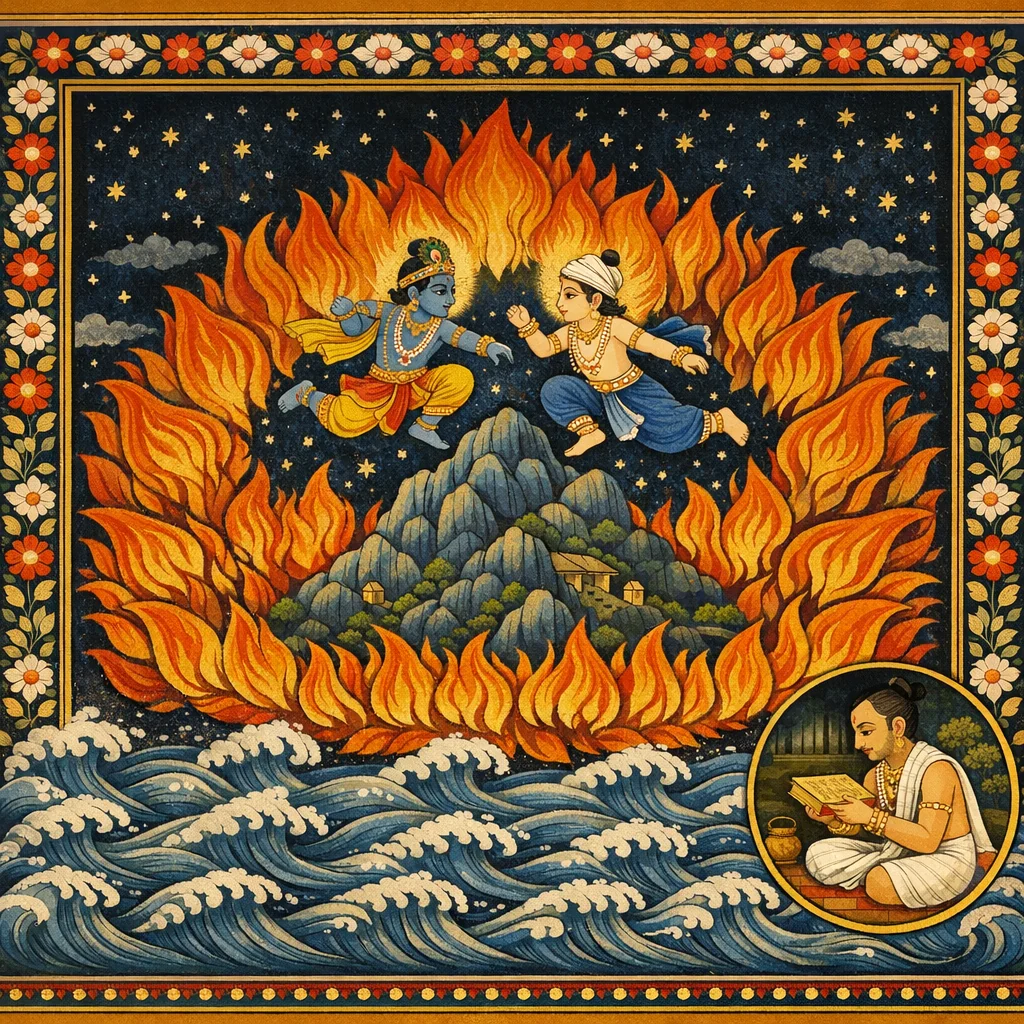
This chapter links two threads: the aftermath of Śrī Kṛṣṇa’s mercy to King Mucukunda and the political tension that prepares Kṛṣṇa’s marriage to Rukmiṇī. Blessed by the Lord, Mucukunda circumambulates Kṛṣṇa, leaves the cave, recognizes the reduced stature of beings as a sign of Kali-yuga’s onset, and goes north to Gandhamādana and Badarikāśrama to worship Nara-Nārāyaṇa through austerity—renunciation grounded in bhakti. Meanwhile Kṛṣṇa returns to Mathurā, defeats the surrounding Yavanas, and carries their wealth toward Dvārakā when Jarāsandha arrives with twenty-three armies. In nara-līlā, Kṛṣṇa and Balarāma retreat, abandon the riches, and climb Pravarṣaṇa Mountain; Jarāsandha burns it, yet the Lords leap away unseen and safely reach ocean-guarded Dvārakā, while Jarāsandha withdraws in error. The narrative then turns to dynastic marriages: Balarāma’s marriage to Raivatī is recalled, and Kṛṣṇa’s forthcoming union with Bhīṣmaka’s daughter Rukmiṇī is introduced. Prompted by Parīkṣit, Śukadeva begins the Vidarbha account—Bhīṣmaka’s family, Rukmiṇī’s choice of Kṛṣṇa, Rukmī’s opposition and plan to marry her to Śiśupāla, and Rukmiṇī’s secret letter sent through a brāhmaṇa messenger, urging Kṛṣṇa to act at once—leading directly into the next chapter.
Shlokas
Verse 1
श्रीशुक उवाच इत्थं सोऽनग्रहीतोऽङ्ग कृष्णेनेक्ष्वाकुनन्दन: । तं परिक्रम्य सन्नम्य निश्चक्राम गुहामुखात् ॥ १ ॥
Śukadeva Gosvāmī said: O King, thus graced by Lord Kṛṣṇa, Mucukunda, the beloved descendant of Ikṣvāku, circumambulated Him, bowed down, and then departed through the mouth of the cave.
Verse 2
संवीक्ष्य क्षुल्लकान् मर्त्यान् पशून्वीरुद्वनस्पतीन् । मत्वा कलियुगं प्राप्तं जगाम दिशमुत्तराम् ॥ २ ॥
Seeing that humans, animals, trees and plants had all become greatly diminished in size, and thus realizing that the Age of Kali had arrived, Mucukunda went toward the northern direction.
Verse 3
तप:श्रद्धायुतो धीरो नि:सङ्गो मुक्तसंशय: । समाधाय मन: कृष्णे प्राविशद् गन्धमादनम् ॥ ३ ॥
The sober king, endowed with austerity and faith, free from attachment and doubt, fixed his mind on Lord Kṛṣṇa and entered Gandhamādana Mountain.
Verse 4
बदर्याश्रममासाद्य नरनारायणालयम् । सर्वद्वन्द्वसह: शान्तस्तपसाराधयद्धरिम् ॥ ४ ॥
He reached Badarikāśrama, the abode of Lord Nara-Nārāyaṇa, and there, tolerating all dualities in peace, he worshiped Śrī Hari by severe austerities.
Verse 5
भगवान् पुनराव्रज्य पुरीं यवनवेष्टिताम् । हत्वा म्लेच्छबलं निन्ये तदीयं द्वारकां धनम् ॥ ५ ॥
The Lord returned to the city still surrounded by the Yavanas; after slaying the mleccha army, He began taking their wealth to Dvārakā.
Verse 6
नीयमाने धने गोभिर्नृभिश्चाच्युतचोदितै: । आजगाम जरासन्धस्त्रयोविंशत्यनीकप: ॥ ६ ॥
As the wealth was being carried by oxen and men under Acyuta’s command, Jarāsandha arrived, leading twenty-three akṣauhiṇī armies.
Verse 7
विलोक्य वेगरभसं रिपुसैन्यस्य माधवौ । मनुष्यचेष्टामापन्नौ राजन् दुद्रुवतुर्द्रुतम् ॥ ७ ॥
O King, seeing the fierce onrush of the enemy’s army, the two Mādhavas, as if imitating human ways, swiftly ran away.
Verse 8
विहाय वित्तं प्रचुरमभीतौ भीरुभीतवत् । पद्भ्यां पद्मपलाशाभ्यां चेलतुर्बहुयोजनम् ॥ ८ ॥
Leaving behind abundant riches, fearless yet feigning fear, They walked many yojanas on Their lotus-leaf-like feet.
Verse 9
पलायमानौ तौ दृष्ट्वा मागध: प्रहसन्बली । अन्वधावद् रथानीकैरीशयोरप्रमाणवित् ॥ ९ ॥
Seeing Them apparently flee, the powerful Jarāsandha of Magadha laughed loudly and pursued with charioteers and foot soldiers, not understanding the exalted position of the two Lords.
Verse 10
प्रद्रुत्य दूरं संश्रान्तौ तुङ्गमारुहतां गिरिम् । प्रवर्षणाख्यं भगवान् नित्यदा यत्र वर्षति ॥ १० ॥
After fleeing far and appearing exhausted, the two Lords climbed the lofty mountain called Pravarṣaṇa, upon which Indra pours incessant rain.
Verse 11
गिरौ निलीनावाज्ञाय नाधिगम्य पदं नृप । ददाह गिरिमेधोभि: समन्तादग्निमुत्सृजन् ॥ ११ ॥
O King, though he knew They were hiding on the mountain, Jarāsandha could find no trace of Them; so he piled firewood all around and set the mountain ablaze.
Verse 12
तत उत्पत्य तरसा दह्यमानतटादुभौ । दशैकयोजनात्तुङ्गान्निपेततुरधो भुवि ॥ १२ ॥
Then the two of Them suddenly leapt with great speed from the burning mountainside, from a height of eleven yojanas, and came down to the earth below.
Verse 13
अलक्ष्यमाणौ रिपुणा सानुगेन यदूत्तमौ । स्वपुरं पुनरायातौ समुद्रपरिखां नृप ॥ १३ ॥
O King, unseen by their foe and his followers, those two most exalted Yadus returned again to their own city of Dvārakā, guarded by the ocean like a protective moat.
Verse 14
सोऽपि दग्धाविति मृषा मन्वानो बलकेशवौ । बलमाकृष्य सुमहन्मगधान् मागधो ययौ ॥ १४ ॥
Jarāsandha of Magadha mistakenly thought that Balarāma and Keśava had been burned to death in the fire; thus he withdrew his vast army and returned to the kingdom of Magadha.
Verse 15
आनर्ताधिपति: श्रीमान् रैवतो रैवतीं सुताम् । ब्रह्मणा चोदित: प्रादाद् बलायेति पुरोदितम् ॥ १५ ॥
By the order of Lord Brahmā, Raivata, the opulent ruler of Ānarta, gave his daughter Raivatī in marriage to Lord Balarāma, as has already been described.
Verse 16
भगवानपि गोविन्द उपयेमे कुरूद्वह । वैदर्भीं भीष्मकसुतां श्रियो मात्रां स्वयंवरे ॥ १६ ॥ प्रमथ्य तरसा राज्ञ: शाल्वादींश्चैद्यपक्षगान् । पश्यतां सर्वलोकानां तार्क्ष्यपुत्र: सुधामिव ॥ १७ ॥
O hero among the Kurus, the Supreme Lord Govinda Himself married Vaidarbhī, Bhīṣmaka’s daughter, who is a direct expansion of Śrī, the goddess of fortune, in her svayaṃvara. By Rukmiṇī’s desire He swiftly crushed Śālva and the other kings allied with Śiśupāla, and before all eyes Śrī Kṛṣṇa carried Rukmiṇī away just as Garuḍa boldly seized nectar from the devas.
Verse 17
भगवानपि गोविन्द उपयेमे कुरूद्वह । वैदर्भीं भीष्मकसुतां श्रियो मात्रां स्वयंवरे ॥ १६ ॥ प्रमथ्य तरसा राज्ञ: शाल्वादींश्चैद्यपक्षगान् । पश्यतां सर्वलोकानां तार्क्ष्यपुत्र: सुधामिव ॥ १७ ॥
O hero among the Kurus, the Supreme Lord Govinda Himself married Vaidarbhī, Bhīṣmaka’s daughter, who is a direct expansion of Śrī, the goddess of fortune, in her svayaṃvara. By Rukmiṇī’s desire He swiftly crushed Śālva and the other kings allied with Śiśupāla, and before all eyes Śrī Kṛṣṇa carried Rukmiṇī away just as Garuḍa boldly seized nectar from the devas.
Verse 18
श्रीराजोवाच भगवान् भीष्मकसुतां रुक्मिणीं रुचिराननाम् । राक्षसेन विधानेन उपयेम इति श्रुतम् ॥ १८ ॥
King Parīkṣit said: I have heard that the Supreme Lord married Rukmiṇī, the beautiful-faced daughter of Bhīṣmaka, by the Rākṣasa rite.
Verse 19
भगवन् श्रोतुमिच्छामि कृष्णस्यामिततेजस: । यथा मागधशाल्वादीन् जित्वा कन्यामुपाहरत् ॥ १९ ॥
My lord, I wish to hear how the immeasurably powerful Lord Kṛṣṇa defeated kings like Māgadha and Sālva and carried away His bride.
Verse 20
ब्रह्मन् कृष्णकथा: पुण्या माध्वीर्लोकमलापहा: । को नु तृप्येत शृण्वान: श्रुतज्ञो नित्यनूतना: ॥ २० ॥
O brāhmaṇa, the narrations of Kṛṣṇa are holy, honey-sweet, and they cleanse away the world’s impurity; what discerning listener could ever be satiated, since they are eternally fresh?
Verse 21
श्रीबादरायणिरुवाच राजासीद् भीष्मको नाम विदर्भाधिपतिर्महान् । तस्य पञ्चाभवन् पुत्रा: कन्यैका च वरानना ॥ २१ ॥
Śrī Bādarāyaṇi said: There was a great king named Bhīṣmaka, the powerful ruler of Vidarbha. He had five sons and one lovely-faced daughter.
Verse 22
रुक्म्यग्रजो रुक्मरथो रुक्मबाहुरनन्तर: । रुक्मकेशो रुक्ममाली रुक्मिण्येषा स्वसा सती ॥ २२ ॥
Rukmī was the eldest son, followed by Rukmaratha, Rukmabāhu, Rukmakeśa, and Rukmamālī. Their sister was the exalted, virtuous Rukmiṇī.
Verse 23
सोपश्रुत्य मुकुन्दस्य रूपवीर्यगुणश्रिय: । गृहागतैर्गीयमानास्तं मेने सदृशं पतिम् ॥ २३ ॥
Hearing the palace visitors sing of Mukunda’s beauty, valor, virtues and opulence, Rukmiṇī deemed Him the husband perfectly suited for her.
Verse 24
तां बुद्धिलक्षणौदार्यरूपशीलगुणाश्रयाम् । कृष्णश्च सदृशीं भार्यां समुद्वोढुं मनो दधे ॥ २४ ॥
Lord Kṛṣṇa knew Rukmiṇī to be endowed with intelligence, auspicious marks, magnanimity, beauty, fine conduct and every virtue, and thus resolved to marry her as His ideal wife.
Verse 25
बन्धूनामिच्छतां दातुं कृष्णाय भगिनीं नृप । ततो निवार्य कृष्णद्विड् रुक्मी चैद्यममन्यत ॥ २५ ॥
O King, though the family wished to give their sister to Kṛṣṇa, Rukmī—hostile to the Lord—stopped them and resolved instead to give Rukmiṇī to Śiśupāla.
Verse 26
तदवेत्यासितापाङ्गी वैदर्भी दुर्मना भृशम् । विचिन्त्याप्तं द्विजं कञ्चित् कृष्णाय प्राहिणोद्द्रुतम् ॥ २६ ॥
Aware of this scheme, dark-eyed Vaidarbhī was deeply distressed. After weighing the situation, she quickly sent a trustworthy brāhmaṇa to Kṛṣṇa.
Verse 27
द्वारकां स समभ्येत्य प्रतीहारै: प्रवेशित: । अपश्यदाद्यं पुरुषमासीनं काञ्चनासने ॥ २७ ॥
Reaching Dvārakā, the brāhmaṇa was ushered in by the gatekeepers and beheld the primeval Personality of Godhead seated upon a golden throne.
Verse 28
दृष्ट्वा ब्रह्मण्यदेवस्तमवरुह्य निजासनात् । उपवेश्यार्हयां चक्रे यथात्मानं दिवौकस: ॥ २८ ॥
Seeing the brāhmaṇa, Śrī Kṛṣṇa—the Lord who cherishes the brāhmaṇas—descended from His throne, seated him, and honored him with worship, just as the demigods worship the Lord Himself.
Verse 29
तं भुक्तवन्तं विश्रान्तमुपगम्य सतां गति: । पाणिनाभिमृशन् पादावव्यग्रस्तमपृच्छत ॥ २९ ॥
After the brāhmaṇa had eaten and rested, Śrī Kṛṣṇa—the destination of the saintly—came near and, massaging the brāhmaṇa’s feet with His own hands, calmly questioned him.
Verse 30
कच्चिद् द्विजवरश्रेष्ठ धर्मस्ते वृद्धसम्मत: । वर्तते नातिकृच्छ्रेण सन्तुष्टमनस: सदा ॥ ३० ॥
[The Supreme Lord said:] O best of brāhmaṇas, are your religious duties, approved by the elders, proceeding without great hardship? Is your mind always fully content?
Verse 31
सन्तुष्टो यर्हि वर्तेत ब्राह्मणो येन केनचित् । अहीयमान: स्वद्धर्मात् स ह्यस्याखिलकामधुक् ॥ ३१ ॥
When a brāhmaṇa is content with whatever comes to him and does not deviate from his own dharma, that very dharma becomes his kāmadhenu, fulfilling all his desires.
Verse 32
असन्तुष्टोऽसकृल्लोकानाप्नोत्यपि सुरेश्वर: । अकिञ्चनोऽपि सन्तुष्ट: शेते सर्वाङ्गविज्वर: ॥ ३२ ॥
An unsatisfied brāhmaṇa roams restlessly from world to world, even if he becomes the king of heaven; but a satisfied brāhmaṇa, though possessing nothing, rests in peace, his whole body free from distress.
Verse 33
विप्रान् स्वलाभसन्तुष्टान् साधून् भूतसुहृत्तमान् । निरहङ्कारिण: शान्तान् नमस्ये शिरसासकृत् ॥ ३३ ॥
Again and again I bow my head to those brāhmaṇas who are content with what comes to them—saintly, free of pride and peaceful, the greatest well-wishers of all living beings.
Verse 34
कच्चिद् व: कुशलं ब्रह्मन् राजतो यस्य हि प्रजा: । सुखं वसन्ति विषये पाल्यमाना: स मे प्रिय: ॥ ३४ ॥
O brāhmaṇa, are you well? Is your king seeing to your welfare? Indeed, that king in whose realm the people live happily and are protected is very dear to Me.
Verse 35
यतस्त्वमागतो दुर्गं निस्तीर्येह यदिच्छया । सर्वं नो ब्रूह्यगुह्यं चेत् किं कार्यं करवाम ते ॥ ३५ ॥
From where have you come, crossing this difficult path—this impassable sea—and for what purpose? If it is not secret, tell Us everything, and say what We may do for you.
Verse 36
एवं सम्पृष्टसम्प्रश्नो ब्राह्मण: परमेष्ठिना । लीलागृहीतदेहेन तस्मै सर्वमवर्णयत् ॥ ३६ ॥
Thus questioned by the Supreme Personality of Godhead, who assumes a body to enact His divine pastimes, the brāhmaṇa told Him everything.
Verse 37
श्रीरुक्मिण्युवाच श्रुत्वा गुणान् भुवनसुन्दर शृण्वतां ते निर्विश्य कर्णविवरैर्हरतोऽङ्गतापम् । रूपं दृशां दृशिमतामखिलार्थलाभं त्वय्यच्युताविशति चित्तमपत्रपं मे ॥ ३७ ॥
Śrī Rukmiṇī said: O beauty of the worlds, having heard of Your virtues—entering through the ears of those who listen and stealing away the burning distress of the body—and having heard as well of Your beauty, which grants the eyes of the beholder the fulfillment of all they seek, O Acyuta Kṛṣṇa, my shameless heart has entered into You.
Verse 38
का त्वा मुकुन्द महती कुलशीलरूप- विद्यावयोद्रविणधामभिरात्मतुल्यम् । धीरा पतिं कुलवती न वृणीत कन्या काले नृसिंह नरलोकमनोऽभिरामम् ॥ ३८ ॥
O Mukunda, in lineage, virtue, beauty, learning, youth, wealth, and majesty You are equal only to Yourself. O lion among men, You delight the minds of all. When the proper time arrives, what noble, sober, marriageable maiden would not choose You as her husband?
Verse 39
तन्मे भवान् खलु वृत: पतिरङ्ग जाया- मात्मार्पितश्च भवतोऽत्र विभो विधेहि । मा वीरभागमभिमर्शतु चैद्य आराद् गोमायुवन्मृगपतेर्बलिमम्बुजाक्ष ॥ ३९ ॥
Therefore, my Lord, I have chosen You as my husband and I offer myself to You. O Almighty One, come swiftly and make me Your wife. O lotus-eyed Lord, let Śiśupāla never touch the hero’s rightful share, like a jackal stealing a lion’s property.
Verse 40
पूर्तेष्टदत्तनियमव्रतदेवविप्र- गुर्वर्चनादिभिरलं भगवान् परेश: । आराधितो यदि गदाग्रज एत्य पाणिं गृह्णातु मे न दमघोषसुतादयोऽन्ये ॥ ४० ॥
If by pious works, sacrifices, charity, rites and vows—and by honoring the devas, brāhmaṇas, and gurus—I have sufficiently worshiped the Supreme Lord, then may Gadāgraja come and take my hand, and not Damaghoṣa’s son or anyone else.
Verse 41
श्वोभाविनि त्वमजितोद्वहने विदर्भान् गुप्त: समेत्य पृतनापतिभि: परीत: । निर्मथ्य चैद्यमगधेन्द्रबलं प्रसह्य मां राक्षसेन विधिनोद्वह वीर्यशुल्काम् ॥ ४१ ॥
O unconquerable Lord, tomorrow as my wedding rite is about to begin, come unseen to Vidarbha, surrounded by the leaders of Your army. Then forcibly crush the forces of Caidya and the king of Magadha, and, O hero, marry me in the Rākṣasa manner, winning me by Your valor.
Verse 42
अन्त:पुरान्तरचरीमनिहत्य बन्धून्- त्वामुद्वहे कथमिति प्रवदाम्युपायम् । पूर्वेद्युरस्ति महती कुलदेवयात्रा यस्यां बहिर्नववधूर्गिरिजामुपेयात् ॥ ४२ ॥
Since I will be staying within the palace’s inner chambers, You may wonder, “How can I carry you away without killing some of your relatives?” But I will tell You a way: on the day before the wedding there is a grand procession to honor the family’s presiding goddess, and in that procession the new bride goes outside the city to worship Goddess Girijā.
Verse 43
यस्याङ्घ्रिपङ्कजरज:स्नपनं महान्तो वाञ्छन्त्युमापतिरिवात्मतमोऽपहत्यै । यर्ह्यम्बुजाक्ष न लभेय भवत्प्रसादं जह्यामसून्व्रतकृशान् शतजन्मभि: स्यात् ॥ ४३ ॥
O lotus-eyed Lord, great souls—even Śiva, the lord of Umā—yearn to bathe in the dust of Your lotus feet to destroy the darkness of ignorance. If I cannot obtain Your mercy, I will give up my life-breath, made feeble by severe vows and austerities; then, after striving through hundreds of births, I may perhaps attain Your grace.
Verse 44
ब्राह्मण उवाच इत्येते गुह्यसन्देशा यदुदेव मयाहृता: । विमृश्य कर्तुं यच्चात्र क्रियतां तदनन्तरम् ॥ ४४ ॥
The brāhmaṇa said: O Lord of the Yadus, these are the confidential words I have brought. Please consider what should be done in this situation, and do it at once.
Frequently Asked Questions
The phrase signals nara-līlā: the Lords are never overpowered, yet they enact humanlike strategies to accomplish broader purposes—relieving pressure on Mathurā, repositioning events toward Dvārakā, and drawing Jarāsandha into actions that reveal his ignorance (thinking the Lords burned). This preserves the līlā’s dramatic texture while affirming the Lord’s transcendence and sovereign control.
Traditional Purāṇic descriptions of Kali include diminishing longevity, strength, and bodily stature. Mucukunda’s observation functions as a narrative marker of yuga-transition awareness and as a moral-theological cue: recognizing decline, he turns from royal identity to bhakti-infused tapas at Badarikāśrama, illustrating the Bhāgavata’s preferred response to Kali—devotional orientation and inner renunciation.
Rukmiṇī (Vaidarbhī), daughter of King Bhīṣmaka of Vidarbha, is presented as the Lord’s eternal consort in the līlā context, hence described as a direct expansion of the goddess of fortune (Śrī/Lakṣmī). The text uses this to frame the marriage not as ordinary alliance-building but as divine union, with political conflict (Śiśupāla’s party) serving as the backdrop for revealing Bhagavān’s supremacy and the devotee’s surrender.
Kṛṣṇa’s praise establishes a bhakti-ethical standard: true spiritual authority is marked by santoṣa, humility, and welfare for all beings. It also elevates the messenger’s dignity and models proper dharma for rulers and householders—suggesting that ritual status without inner contentment yields restlessness, whereas contentment grounded in dharma supports clarity, peace, and devotion.
It introduces the Vidarbha royal family, Rukmiṇī’s deliberate choice of Kṛṣṇa, the obstacle (Rukmī arranging her marriage to Śiśupāla), and the tactical solution (the Girijā temple procession). The chapter ends with the brāhmaṇa delivering Rukmiṇī’s confidential appeal and urging immediate action—creating a direct narrative handoff to the next chapter’s execution of the plan and the ensuing confrontation with rival kings.