Adhyaya 6
The Lord Appears to the Devas and Instructs the Truce; Mandara Is Brought for Churning
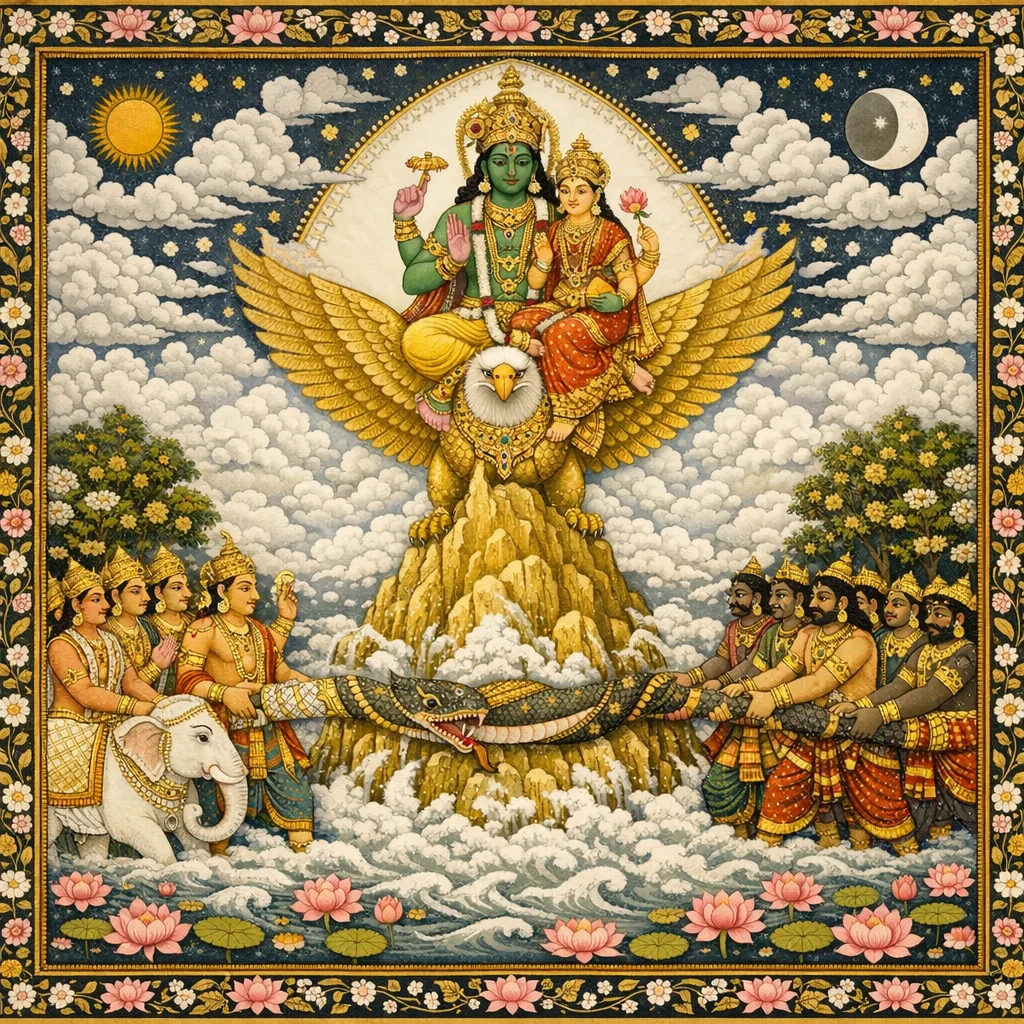
As the devas languish and seek divine shelter, Hari (Viṣṇu) appears before Brahmā, Śiva, and the assembled gods in a blinding effulgence. Brahmā and Śiva behold His emerald-hued form, adorned with the Kaustubha jewel, Lakṣmī, and divine weapons, and the devas bow in reverence. Brahmā offers philosophical prayers, affirming the Lord’s transcendence of the guṇas, His being the source, resting-place, and end of the cosmos, and bhakti-yoga as the way to approach Him. Asked for guidance, the Lord instructs them to make a strategic truce with the asuras (favored by time) and churn the Ocean of Milk with Mandara as the churning rod and Vāsuki as the rope—remaining patient, unafraid of the kālakūṭa poison, and unattached to interim gains. After He vanishes, the devas approach Bali, who accepts Indra’s Viṣṇu-inspired proposal; both sides uproot Mandara but, exhausted, drop it and crush many. Viṣṇu arrives on Garuḍa, revives the fallen, and effortlessly carries Mandara to the ocean, setting the stage for the next chapter’s churning and ensuing manifestations.
Shlokas
Verse 1
श्रीशुक उवाच एवं स्तुत: सुरगणैर्भगवान् हरिरीश्वर: । तेषामाविरभूद् राजन्सहस्रार्कोदयद्युति: ॥ १ ॥
Śrī Śukadeva Gosvāmī said: O King Parīkṣit, thus worshiped with prayers by the demigods and Lord Brahmā, the Supreme Lord Hari appeared before them, His bodily effulgence like the rising of thousands of suns at once.
Verse 2
श्रीएवं उक्त्वा हरिवंशेण शकुन्तला पुरो हृषीकेशम् । अभ्युपगम्य महाभागा हर्षेणाभिवाद्य भास्करम् ॥ २ ॥
Blinded by the Lord’s effulgence, the demigods could see neither sky nor directions nor earth, nor even themselves—what to speak of seeing Hṛṣīkeśa, who stood before them.
Verse 3
विरिञ्चो भगवान्दृष्ट्वा सह शर्वेण तां तनुम् । स्वच्छां मरकतश्यामां कञ्जगर्भारुणेक्षणाम् ॥ ३ ॥ तप्तहेमावदातेन लसत्कौशेयवाससा । प्रसन्नचारुसर्वाङ्गीं सुमुखीं सुन्दरभ्रुवम् ॥ ४ ॥ महामणिकिरीटेन केयूराभ्यां च भूषिताम् । कर्णाभरणनिर्भातकपोलश्रीमुखाम्बुजाम् ॥ ५ ॥ काञ्चीकलापवलयहारनूपुरशोभिताम् । कौस्तुभाभरणां लक्ष्मीं बिभ्रतीं वनमालिनीम् ॥ ६ ॥ सुदर्शनादिभि: स्वास्त्रैर्मूर्तिमद्भिरुपासिताम् । तुष्टाव देवप्रवर: सशर्व: पुरुषं परम् । सर्वामरगणै: साकं सर्वाङ्गैरवनिं गतै: ॥ ७ ॥
Brahmā, along with Śiva, beheld the Supreme Person’s form—crystal-clear, dark like a marakata gem, with lotus-deep reddish eyes; clad in yellow silk like molten gold; serene and exquisitely beautiful in every limb, with a smiling lotus face and graceful brows. He wore a crown set with great jewels, armlets upon His arms, and earrings that made His cheeks shine. His belt, bracelets, necklace, and ankle bells adorned Him; the Kaustubha gem and a forest garland graced His neck, with Goddess Lakṣmī at His side; and His weapons, such as Sudarśana, stood as if embodied, worshiping Him. Seeing this form, Brahmā, Śiva, and all the demigods at once fell to the earth and offered full prostrated obeisances.
Verse 4
विरिञ्चो भगवान्दृष्ट्वा सह शर्वेण तां तनुम् । स्वच्छां मरकतश्यामां कञ्जगर्भारुणेक्षणाम् ॥ ३ ॥ तप्तहेमावदातेन लसत्कौशेयवाससा । प्रसन्नचारुसर्वाङ्गीं सुमुखीं सुन्दरभ्रुवम् ॥ ४ ॥ महामणिकिरीटेन केयूराभ्यां च भूषिताम् । कर्णाभरणनिर्भातकपोलश्रीमुखाम्बुजाम् ॥ ५ ॥ काञ्चीकलापवलयहारनूपुरशोभिताम् । कौस्तुभाभरणां लक्ष्मीं बिभ्रतीं वनमालिनीम् ॥ ६ ॥ सुदर्शनादिभि: स्वास्त्रैर्मूर्तिमद्भिरुपासिताम् । तुष्टाव देवप्रवर: सशर्व: पुरुषं परम् । सर्वामरगणै: साकं सर्वाङ्गैरवनिं गतै: ॥ ७ ॥
Lord Brahmā, together with Lord Śiva, beheld the Supreme Lord’s personal form—clear as crystal, dark like a marakata gem, with lotus-deep, reddish eyes. Clad in yellow silks like molten gold, He shone with beauty in every limb, His face serene and His eyebrows exquisitely graceful.
Verse 5
विरिञ्चो भगवान्दृष्ट्वा सह शर्वेण तां तनुम् । स्वच्छां मरकतश्यामां कञ्जगर्भारुणेक्षणाम् ॥ ३ ॥ तप्तहेमावदातेन लसत्कौशेयवाससा । प्रसन्नचारुसर्वाङ्गीं सुमुखीं सुन्दरभ्रुवम् ॥ ४ ॥ महामणिकिरीटेन केयूराभ्यां च भूषिताम् । कर्णाभरणनिर्भातकपोलश्रीमुखाम्बुजाम् ॥ ५ ॥ काञ्चीकलापवलयहारनूपुरशोभिताम् । कौस्तुभाभरणां लक्ष्मीं बिभ्रतीं वनमालिनीम् ॥ ६ ॥ सुदर्शनादिभि: स्वास्त्रैर्मूर्तिमद्भिरुपासिताम् । तुष्टाव देवप्रवर: सशर्व: पुरुषं परम् । सर्वामरगणै: साकं सर्वाङ्गैरवनिं गतै: ॥ ७ ॥
They saw upon His head a crown set with great jewels and upon His arms splendid armlets. His cheeks shone with the radiance of His earrings, and His lotuslike face was lit by a gentle smile; thus Brahmā, with Śiva, beheld the form of Hari.
Verse 6
विरिञ्चो भगवान्दृष्ट्वा सह शर्वेण तां तनुम् । स्वच्छां मरकतश्यामां कञ्जगर्भारुणेक्षणाम् ॥ ३ ॥ तप्तहेमावदातेन लसत्कौशेयवाससा । प्रसन्नचारुसर्वाङ्गीं सुमुखीं सुन्दरभ्रुवम् ॥ ४ ॥ महामणिकिरीटेन केयूराभ्यां च भूषिताम् । कर्णाभरणनिर्भातकपोलश्रीमुखाम्बुजाम् ॥ ५ ॥ काञ्चीकलापवलयहारनूपुरशोभिताम् । कौस्तुभाभरणां लक्ष्मीं बिभ्रतीं वनमालिनीम् ॥ ६ ॥ सुदर्शनादिभि: स्वास्त्रैर्मूर्तिमद्भिरुपासिताम् । तुष्टाव देवप्रवर: सशर्व: पुरुषं परम् । सर्वामरगणै: साकं सर्वाङ्गैरवनिं गतै: ॥ ७ ॥
They saw the belt upon His waist, the bangles upon His arms, the necklace upon His chest, and the ankle bells upon His feet. His neck was adorned with the Kaustubha gem; He wore forest-flower garlands and bore Śrī Lakṣmī at His side.
Verse 7
विरिञ्चो भगवान्दृष्ट्वा सह शर्वेण तां तनुम् । स्वच्छां मरकतश्यामां कञ्जगर्भारुणेक्षणाम् ॥ ३ ॥ तप्तहेमावदातेन लसत्कौशेयवाससा । प्रसन्नचारुसर्वाङ्गीं सुमुखीं सुन्दरभ्रुवम् ॥ ४ ॥ महामणिकिरीटेन केयूराभ्यां च भूषिताम् । कर्णाभरणनिर्भातकपोलश्रीमुखाम्बुजाम् ॥ ५ ॥ काञ्चीकलापवलयहारनूपुरशोभिताम् । कौस्तुभाभरणां लक्ष्मीं बिभ्रतीं वनमालिनीम् ॥ ६ ॥ सुदर्शनादिभि: स्वास्त्रैर्मूर्तिमद्भिरुपासिताम् । तुष्टाव देवप्रवर: सशर्व: पुरुषं परम् । सर्वामरगणै: साकं सर्वाङ्गैरवनिं गतै: ॥ ७ ॥
Seeing the Supreme Person, worshiped by His own personified weapons such as Sudarśana, Brahmā—the foremost of the gods—together with Śiva and all the devas at once fell to the earth in full prostration, offered obeisance, and sang His praise.
Verse 8
श्रीब्रह्मोवाच अजातजन्मस्थितिसंयमाया- गुणाय निर्वाणसुखार्णवाय । अणोरणिम्नेऽपरिगण्यधाम्ने
Lord Brahmā said: Though You are never born, Your manifesting and withdrawing as an avatāra never cease. You are beyond the guṇas, the shelter of an ocean of nirvāṇic bliss; the subtlest of the subtle, eternally existent in Your transcendental being. Therefore we offer obeisance to You, the Supreme, whose existence is inconceivable.
Verse 9
रूपं तवैतत् पुरुषर्षभेज्यं श्रेयोऽर्थिभिर्वैदिकतान्त्रिकेण । योगेन धात: सह नस्त्रिलोकान् पश्याम्यमुष्मिन्नु ह विश्वमूर्तौ ॥ ९ ॥
O best of persons, O supreme director, those who seek the highest good worship this form of Yours according to the Vedic Tantras. My Lord, within this universal form (Viśvamūrti) we behold all the three worlds.
Verse 10
त्वय्यग्र आसीत् त्वयि मध्य आसीत् त्वय्यन्त आसीदिदमात्मतन्त्रे । त्वमादिरन्तो जगतोऽस्य मध्यं घटस्य मृत्स्नेव पर: परस्मात् ॥ १० ॥
My Lord, fully independent, this entire cosmic manifestation arises from You, rests upon You, and ends in You. You are the beginning, the sustenance, and the end of all—just as earth is the cause of a clay pot, supports it, and, when the pot breaks, receives it back.
Verse 11
त्वं माययात्माश्रयया स्वयेदं निर्माय विश्वं तदनुप्रविष्ट: । पश्यन्ति युक्ता मनसा मनीषिणो गुणव्यवायेऽप्यगुणं विपश्चित: ॥ ११ ॥
O Supreme, You are self-sufficient and need no other’s help. By Your own potency, You create this universe and then enter into it. The wise—purified by bhakti-yoga, grounded in śāstra, and clear in mind—see that though You are present amid the transformations of the guṇas, You remain nirguṇa, untouched by them.
Verse 12
यथाग्निमेधस्यमृतं च गोषु भुव्यन्नमम्बूद्यमने च वृत्तिम् । योगैर्मनुष्या अधियन्ति हि त्वां गुणेषु बुद्ध्या कवयो वदन्ति ॥ १२ ॥
Just as fire is drawn from wood, milk from the cow, grains and water from the earth, and prosperity from one’s endeavors, so by practicing bhakti-yoga—even within this material world—one can attain Your favor and approach You with awakened intelligence. The pious sages declare this.
Verse 13
तं त्वां वयं नाथ समुज्जिहानं सरोजनाभातिचिरेप्सितार्थम् । दृष्ट्वा गता निर्वृतमद्य सर्वे गजा दवार्ता इव गाङ्गमम्भ: ॥ १३ ॥
O Lord, O Sarojanābha, from whose navel the lotus springs—now that You have appeared before us, You whom we long desired to behold, we are all filled with transcendental joy, like elephants tormented by a forest fire who rejoice upon finding the waters of the Ganges.
Verse 14
स त्वं विधत्स्वाखिललोकपाला वयं यदर्थास्तव पादमूलम् । समागतास्ते बहिरन्तरात्मन् किं वान्यविज्ञाप्यमशेषसाक्षिण: ॥ १४ ॥
O Lord, protector of all worlds, we demigods have come to the root of Your lotus feet for a purpose; please fulfill it. You are the witness within and without; nothing is unknown to You, and thus there is no need to inform You again.
Verse 15
अहं गिरित्रश्च सुरादयो ये दक्षादयोऽग्नेरिव केतवस्ते । किं वा विदामेश पृथग्विभाता विधत्स्व शं नो द्विजदेवमन्त्रम् ॥ १५ ॥
I (Brahmā), Giritra (Śiva), and the other demigods, along with the prajāpatis such as Dakṣa, are merely sparks illumined by You, the original Fire. O Lord, being but Your parts, what can we know of our true welfare? O Supreme, grant us the means of deliverance befitting the brāhmaṇas and the devas.
Verse 16
श्रीशुक उवाच एवं विरिञ्चादिभिरीडितस्तद् विज्ञाय तेषां हृदयं यथैव । जगाद जीमूतगभीरया गिरा बद्धाञ्जलीन्संवृतसर्वकारकान् ॥ १६ ॥
Śukadeva Gosvāmī continued: Thus praised by the demigods headed by Brahmā, the Lord understood the intention within their hearts. Then, in a deep voice like the rumbling of clouds, He replied to the demigods who stood attentively with folded hands.
Verse 17
एक एवेश्वरस्तस्मिन्सुरकार्ये सुरेश्वर: । विहर्तुकामस्तानाह समुद्रोन्मथनादिभि: ॥ १७ ॥
Although the Supreme Personality of Godhead, the Lord of the demigods, could perform their work by Himself, He desired to relish the pastime of churning the ocean. Therefore He spoke to them as follows.
Verse 18
श्रीभगवानुवाच हन्त ब्रह्मन्नहो शम्भो हे देवा मम भाषितम् । शृणुतावहिता: सर्वे श्रेयो व: स्याद् यथा सुरा: ॥ १८ ॥
The Supreme Lord said: O Brahmā, O Śambhu (Śiva), and O gods, listen to My words with full attention, for what I speak will bring auspiciousness and welfare to you all.
Verse 19
यात दानवदैतेयैस्तावत् सन्धिर्विधीयताम् । कालेनानुगृहीतैस्तैर्यावद् वो भव आत्मन: ॥ १९ ॥
So long as you have not yet regained prosperity, make a truce with the Dānavas and Daityas, whom time now favors, until your own welfare is secured.
Verse 20
अरयोऽपि हि सन्धेया: सति कार्यार्थगौरवे । अहिमूषिकवद् देवा ह्यर्थस्य पदवीं गतै: ॥ २० ॥
When one’s purpose is weighty, even enemies should be met with a truce. O devas, for your own interest act by the reasoning of the snake and the mouse.
Verse 21
अमृतोत्पादने यत्न: क्रियतामविलम्बितम् । यस्य पीतस्य वै जन्तुर्मृत्युग्रस्तोऽमरो भवेत् ॥ २१ ॥
At once, without delay, strive to bring forth the nectar of immortality; by drinking it, even one seized by death becomes deathless.
Verse 22
क्षिप्त्वा क्षीरोदधौ सर्वा वीरुत्तृणलतौषधी: । मन्थानं मन्दरं कृत्वा नेत्रं कृत्वा तु वासुकिम् ॥ २२ ॥ सहायेन मया देवा निर्मन्थध्वमतन्द्रिता: । क्लेशभाजो भविष्यन्ति दैत्या यूयं फलग्रहा: ॥ २३ ॥
O devas, cast into the Ocean of Milk all kinds of vegetables, grasses, creepers, and medicinal herbs. Then make Mount Mandara the churning rod and Vāsuki the rope; with My help, churn the Ocean of Milk without negligence.
Verse 23
क्षिप्त्वा क्षीरोदधौ सर्वा वीरुत्तृणलतौषधी: । मन्थानं मन्दरं कृत्वा नेत्रं कृत्वा तु वासुकिम् ॥ २२ ॥ सहायेन मया देवा निर्मन्थध्वमतन्द्रिता: । क्लेशभाजो भविष्यन्ति दैत्या यूयं फलग्रहा: ॥ २३ ॥
Thus the Daityas will bear the toil of churning, but you, O devas, will receive the true fruit—the nectar that arises from the ocean will come to you.
Verse 24
यूयं तदनुमोदध्वं यदिच्छन्त्यसुरा: सुरा: । न संरम्भेण सिध्यन्ति सर्वार्था: सान्त्वया यथा ॥ २४ ॥
My dear demigods, by patience and peace all aims are fulfilled; by agitation and anger the goal is not attained. Therefore, agree to whatever the demons propose.
Verse 25
न भेतव्यं कालकूटाद् विषाज्जलधिसम्भवात् । लोभ: कार्यो न वो जातु रोष: कामस्तु वस्तुषु ॥ २५ ॥
From the Ocean of Milk a poison called kālakūṭa will arise; do not fear it. And as various treasures emerge, do not become greedy, anxious to possess them, or angry.
Verse 26
श्रीशुक उवाच इति देवान्समादिश्य भगवान् पुरुषोत्तम: । तेषामन्तर्दधे राजन्स्वच्छन्दगतिरीश्वर: ॥ २६ ॥
Śukadeva Gosvāmī continued: O King Parīkṣit, after instructing the demigods in this way, the independent Supreme Lord, Puruṣottama, disappeared from their sight.
Verse 27
अथ तस्मै भगवते नमस्कृत्य पितामह: । भवश्च जग्मतु: स्वं स्वं धामोपेयुर्बलिं सुरा: ॥ २७ ॥
Then Brahmā, the Pitāmaha, and Bhava (Śiva), after offering respectful obeisances to the Lord, returned to their own abodes. Thereafter all the demigods approached Mahārāja Bali.
Verse 28
दृष्ट्वारीनप्यसंयत्ताञ्जातक्षोभान्स्वनायकान् । न्यषेधद् दैत्यराट् श्लोक्य: सन्धिविग्रहकालवित् ॥ २८ ॥
Although his commanders, stirred by anger, were ready to slay the demigods, Mahārāja Bali—celebrated king of the asuras, expert in when to make peace and when to fight—seeing the demigods approach without hostility, forbade his men to attack them.
Verse 29
ते वैरोचनिमासीनं गुप्तं चासुरयूथपै: । श्रिया परमया जुष्टं जिताशेषमुपागमन् ॥ २९ ॥
The demigods approached Bali Mahārāja, the son of Virocana, and sat near him. Guarded by the asura commanders, Bali shone with supreme opulence, having conquered the entire universe.
Verse 30
महेन्द्र: श्लक्ष्णया वाचा सान्त्वयित्वा महामति: । अभ्यभाषत तत् सर्वं शिक्षितं पुरुषोत्तमात् ॥ ३० ॥
With gentle words Mahendra pleased the great-minded Bali, and then, most politely, presented all the proposals he had learned from Purusottama, Lord Viṣṇu.
Verse 31
तत्त्वरोचत दैत्यस्य तत्रान्ये येऽसुराधिपा: । शम्बरोऽरिष्टनेमिश्च ये च त्रिपुरवासिन: ॥ ३१ ॥
Indra’s proposals were at once accepted by Bali, king of the daityas. Led by Śambara and Ariṣṭanemi, the other asura chiefs and all the residents of Tripura also agreed immediately.
Verse 32
ततो देवासुरा: कृत्वा संविदं कृतसौहृदा: । उद्यमं परमं चक्रुरमृतार्थे परन्तप ॥ ३२ ॥
O Mahārāja Parīkṣit, subduer of enemies, the demigods and the asuras then made a friendly truce. Thereafter they undertook a great endeavor to obtain nectar.
Verse 33
ततस्ते मन्दरगिरिमोजसोत्पाट्य दुर्मदा: । नदन्त उदधिं निन्यु: शक्ता: परिघबाहव: ॥ ३३ ॥
Thereafter the demons and demigods, all immensely strong, with long, stout arms like clubs, uprooted Mandara Mountain by sheer might. Roaring loudly, they carried it toward the Ocean of Milk.
Verse 34
दूरभारोद्वहश्रान्ता: शक्रवैरोचनादय: । अपारयन्तस्तं वोढुं विवशा विजहु: पथि ॥ ३४ ॥
After carrying the great mountain over a long distance, Śakra (Indra), Vairochana (Bali), and the other devas and asuras grew weary. Unable to bear its weight, they abandoned it on the way.
Verse 35
निपतन्स गिरिस्तत्र बहूनमरदानवान् । चूर्णयामास महता भारेण कनकाचल: ॥ ३५ ॥
Then the Mandara mountain—immensely heavy, as if made of gold—fell and, by its tremendous weight, crushed many devas and asuras.
Verse 36
तांस्तथा भग्नमनसो भग्नबाहूरुकन्धरान् । विज्ञाय भगवांस्तत्र बभूव गरुडध्वज: ॥ ३६ ॥
Their hearts were broken, and their arms, thighs, and shoulders were shattered. Knowing all, the Supreme Bhagavān—He whose banner is Garuḍa—appeared there.
Verse 37
गिरिपातविनिष्पिष्टान्विलोक्यामरदानवान् । ईक्षया जीवयामास निर्जरान् निर्व्रणान् यथा ॥ ३७ ॥
Seeing the devas and asuras crushed by the mountain’s fall, the Lord cast His glance upon them and restored them to life. Their sorrow vanished, and their bodies bore not even a bruise.
Verse 38
गिरिं चारोप्य गरुडे हस्तेनैकेन लीलया । आरुह्य प्रययावब्धिं सुरासुरगणैर्वृत: ॥ ३८ ॥
With one hand, the Lord effortlessly lifted the mountain and set it upon Garuḍa’s back. Then He Himself mounted Garuḍa and went to the Ocean of Milk, surrounded by the hosts of devas and asuras.
Verse 39
अवरोप्य गिरिं स्कन्धात् सुपर्ण: पततां वर: । ययौ जलान्त उत्सृज्य हरिणा स विसर्जित: ॥ ३९ ॥
Thereafter Garuḍa, foremost among birds, set Mandara Mountain down from his shoulder and brought it near the waters. Then, by the command of Lord Hari, he left that place and departed.
Frequently Asked Questions
The chapter states that the asuras were ‘favored by time’ (kāla), so direct confrontation would not yield the devas’ welfare. Viṣṇu teaches upāya-kauśalya: for a higher objective (amṛta and restoration of cosmic balance), one may adopt a temporary truce—even with enemies—while remaining internally steady and dharmically guided.
He is described as radiantly effulgent (blinding like thousands of suns), yet personally beautiful: marakata-like dark complexion, lotus-reddish eyes, yellow garments, jeweled helmet, ornaments, garlands, Kaustubha, weapons, and Lakṣmī. The theological point is that Bhagavān is simultaneously transcendent (beyond guṇas and ordinary perception) and personal (sac-cid-ānanda vigraha), approachable through devotion rather than material vision.
Viṣṇu’s warning frames the churning as a process where dangerous and distracting byproducts appear before the final goal (amṛta). It teaches steadiness (kṣānti/śānti), freedom from fear and greed, and trust in divine oversight—an ethical and spiritual template for pursuing higher ends without being derailed by intermediate crises or temptations.
Bali Mahārāja, son of Virocana, is the asura king portrayed as politically discerning—knowing when to fight and when to make peace. He accepts because the devas approach without hostility and because the proposal promises a strategic advantage (participation in producing nectar), aligning with statecraft even within asuric power politics.