Adhyaya 23
The Song of the Avantī Brāhmaṇa (Avanti-brāhmaṇa-gītā): Mind as the Root of Suffering and Equanimity Amid Insult
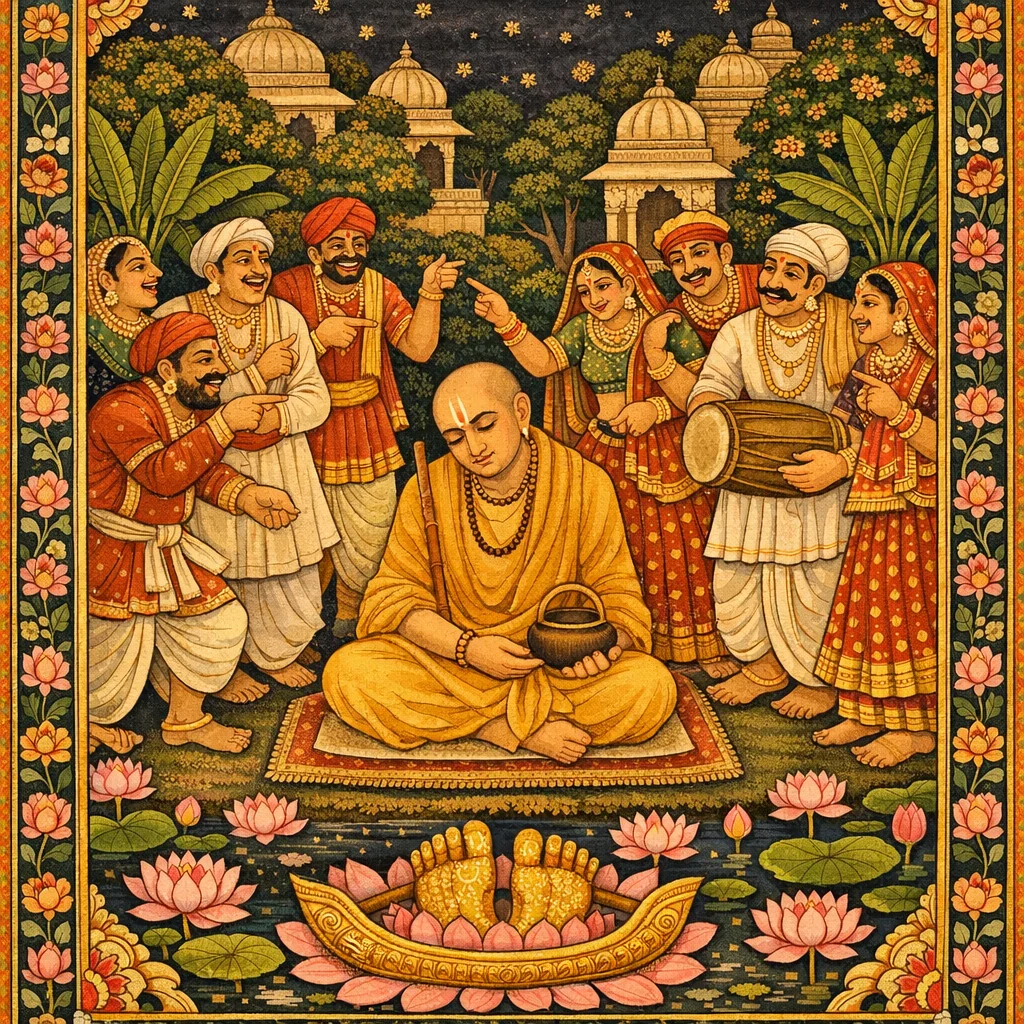
After Uddhava respectfully prompts Kṛṣṇa for higher instruction, the Lord introduces a practical problem: harsh words and public insult can destabilize even saintly persons. To illustrate the yogic solution, Kṛṣṇa narrates the history of a wealthy Avantī brāhmaṇa-merchant whose miserliness, anger, and neglect of dharma alienate family and deities, leading to the loss of all wealth and social support. Shocked into renunciation, he takes sannyāsa and wanders silently, only to face repeated humiliation—theft of his mendicant items, mockery, physical abuse, and false accusations. Rather than retaliate, he interprets his suffering as providential and begins his ‘song,’ a philosophical diagnosis: neither people, gods, body, planets, karma, nor time are the true cause of happiness and distress; the mind alone manufactures duality through guṇa-driven perception and false ego. He concludes that conquering the mind is the essence of yoga and that shelter at Kṛṣṇa’s lotus feet enables one to cross nescience. Kṛṣṇa then applies the lesson directly to Uddhava: fix intelligence on Him, control the mind, and transcend dualities—preparing the narrative momentum for subsequent, more systematic yogic instruction.
Shlokas
Verse 1
श्रीबादरायणिरुवाच स एवमाशंसित उद्धवेन भागवतमुख्येन दाशार्हमुख्य: । सभाजयन् भृत्यवचो मुकुन्द- स्तमाबभाषे श्रवणीयवीर्य: ॥ १ ॥
Śukadeva Gosvāmī said: Lord Mukunda, the chief of the Dāśārhas, having thus been respectfully requested by the best of His devotees, Śrī Uddhava, first acknowledged the fitness of his servant’s statements. Then the Lord, whose glorious exploits are most worthy of being heard, began to reply to him.
Verse 2
श्रीभगवानुवाच बार्हस्पत्य स नास्त्यत्र साधुर्वै दुर्जनेरितै: । दुरक्तैर्भिन्नमात्मानं य: समाधातुमीश्वर: ॥ २ ॥
Lord Śrī Kṛṣṇa said: O disciple of Bṛhaspati, there is virtually no saintly man in this world capable of resettling his own mind after it has been disturbed by the insulting words of uncivilized men.
Verse 3
न तथा तप्यते विद्ध: पुमान् बाणैस्तु मर्मगै: । यथा तुदन्ति मर्मस्था ह्यसतां परुषेषव: ॥ ३ ॥
Sharp arrows which pierce one’s chest and reach the heart do not cause as much suffering as the arrows of harsh, insulting words that become lodged within the heart when spoken by uncivilized men.
Verse 4
कथयन्ति महत्पुण्यमितिहासमिहोद्धव । तमहं वर्णयिष्यामि निबोध सुसमाहित: ॥ ४ ॥
My dear Uddhava, in this regard a most pious story is told, and I shall now describe it to you. Please listen with careful attention.
Verse 5
केनचिद् भिक्षुणा गीतं परिभूतेन दुर्जनै: । स्मरता धृतियुक्तेन विपाकं निजकर्मणाम् ॥ ५ ॥
Once a certain sannyāsī was insulted in many ways by impious men. However, with determination he remembered that he was suffering the fruit of his own previous karma. I will narrate to you his story and that which he spoke.
Verse 6
अवन्तिषु द्विज: कश्चिदासीदाढ्यतम: श्रिया । वार्तावृत्ति: कदर्यस्तु कामी लुब्धोऽतिकोपन: ॥ ६ ॥
In the country of Avantī there once lived a certain brāhmaṇa who was very rich and gifted with all opulences, and who was engaged in the occupation of commerce. But he was a miserly person — lusty, greedy and very prone to anger.
Verse 7
ज्ञातयोऽतिथयस्तस्य वाङ्मात्रेणापि नार्चिता: । शून्यावसथ आत्मापि काले कामैरनर्चित: ॥ ७ ॥
In his home, devoid of religiosity and lawful sense gratification, the family members and guests were never properly respected, even with words. He would not even allow sufficient gratification for his own body at the suitable times.
Verse 8
दु:शीलस्य कदर्यस्य द्रुह्यन्ते पुत्रबान्धवा: । दारा दुहितरो भृत्या विषण्णा नाचरन् प्रियम् ॥ ८ ॥
Since he was so hardhearted and miserly, his sons, in-laws, wife, daughters and servants began to feel inimical toward him. Becoming disgusted, they would never treat him with affection.
Verse 9
तस्यैवं यक्षवित्तस्य च्युतस्योभयलोकत: । धर्मकामविहीनस्य चुक्रुधु: पञ्चभागिन: ॥ ९ ॥
In this way the presiding deities of the five family sacrifices became angry at the brāhmaṇa, who, being niggardly, guarded his wealth like a Yakṣa, who had no good destination either in this world or the next, and who was totally deprived of religiosity and sense enjoyment.
Verse 10
तदवध्यानविस्रस्तपुण्यस्कन्धस्य भूरिद । अर्थोऽप्यगच्छन्निधनं बह्वायासपरिश्रम: ॥ १० ॥
O magnanimous Uddhava, by his neglect of these demigods he depleted his stock of piety and all his wealth. The accumulation of his repeated exhaustive endeavors was totally lost.
Verse 11
ज्ञातयो जगृहु: किञ्चित् किञ्चिद् दस्यव उद्धव । दैवत: कालत: किञ्चिद् ब्रह्मबन्धोर्नृपार्थिवात् ॥ ११ ॥
Some of the wealth of this so-called brāhmaṇa was taken away by his relatives, My dear Uddhava, some by thieves, some by the whims of providence, some by the effects of time, some by ordinary men and some by government authorities.
Verse 12
स एवं द्रविणे नष्टे धर्मकामविवर्जित: । उपेक्षितश्च स्वजनैश्चिन्तामाप दुरत्ययाम् ॥ १२ ॥
Finally, when his property was completely lost, he who never engaged in religiosity or sense enjoyment became ignored by his family members. Thus he began to feel unbearable anxiety.
Verse 13
तस्यैवं ध्यायतो दीर्घं नष्टरायस्तपस्विन: । खिद्यतो बाष्पकण्ठस्य निर्वेद: सुमहानभूत् ॥ १३ ॥
Having lost all his wealth, he felt great pain and lamentation. His throat choked up with tears, and he meditated for a long time on his fortune. Then a powerful feeling of renunciation came over him.
Verse 14
स चाहेदमहो कष्टं वृथात्मा मेऽनुतापित: । न धर्माय न कामाय यस्यार्थायास ईदृश: ॥ १४ ॥
The brāhmaṇa spoke as follows: O what great misfortune! I have simply tormented myself uselessly, struggling so hard for money that was not even intended for religiosity or material enjoyment.
Verse 15
प्रायेणार्था: कदर्याणां न सुखाय कदाचन । इह चात्मोपतापाय मृतस्य नरकाय च ॥ १५ ॥
Generally, the wealth of misers never allows them any happiness. In this life it causes their self-torment, and when they die it sends them to hell.
Verse 16
यशो यशस्विनां शुद्धं श्लाघ्या ये गुणिनां गुणा: । लोभ: स्वल्पोऽपि तान् हन्ति श्वित्रो रूपमिवेप्सितम् ॥ १६ ॥
Whatever pure fame is possessed by the famous and whatever praiseworthy qualities are found in the virtuous are destroyed by even a small amount of greed, just as one’s attractive physical beauty is ruined by a trace of white leprosy.
Verse 17
अर्थस्य साधने सिद्धे उत्कर्षे रक्षणे व्यये । नाशोपभोग आयासस्त्रासश्चिन्ता भ्रमो नृणाम् ॥ १७ ॥
In the earning, attainment, increase, protection, expense, loss and enjoyment of wealth, all men experience great labor, fear, anxiety and delusion.
Verse 18
स्तेयं हिंसानृतं दम्भ: काम: क्रोध: स्मयो मद: । भेदो वैरमविश्वास: संस्पर्धा व्यसनानि च ॥ १८ ॥ एते पञ्चदशानर्था ह्यर्थमूला मता नृणाम् । तस्मादनर्थमर्थाख्यं श्रेयोऽर्थी दूरतस्त्यजेत् ॥ १९ ॥
Theft, violence, speaking lies, duplicity, lust, anger, perplexity, pride, quarreling, enmity, faithlessness, envy and the dangers caused by women, gambling and intoxication are the fifteen undesirable qualities that contaminate men because of greed for wealth. Although these qualities are undesirable, men falsely ascribe value to them. One desiring to achieve the real benefit of life should therefore remain aloof from undesirable material wealth.
Verse 19
स्तेयं हिंसानृतं दम्भ: काम: क्रोध: स्मयो मद: । भेदो वैरमविश्वास: संस्पर्धा व्यसनानि च ॥ १८ ॥ एते पञ्चदशानर्था ह्यर्थमूला मता नृणाम् । तस्मादनर्थमर्थाख्यं श्रेयोऽर्थी दूरतस्त्यजेत् ॥ १९ ॥
Theft, violence, speaking lies, duplicity, lust, anger, perplexity, pride, quarreling, enmity, faithlessness, envy and the dangers caused by women, gambling and intoxication are the fifteen undesirable qualities that contaminate men because of greed for wealth. Although these qualities are undesirable, men falsely ascribe value to them. One desiring to achieve the real benefit of life should therefore remain aloof from undesirable material wealth.
Verse 20
भिद्यन्ते भ्रातरो दारा: पितर: सुहृदस्तथा । एकास्निग्धा: काकिणिना सद्य: सर्वेऽरय: कृता: ॥ २० ॥
Even a man’s brothers, wife, parents and friends united with him in love will immediately break off their affectionate relationships and become enemies over a single coin.
Verse 21
अर्थेनाल्पीयसा ह्येते संरब्धा दीप्तमन्यव: । त्यजन्त्याशु स्पृधो घ्नन्ति सहसोत्सृज्य सौहृदम् ॥ २१ ॥
For even a small amount of money these relatives and friends become very agitated and their anger is inflamed. Acting as rivals, they quickly give up all sentiments of goodwill and will reject one at a moment’s notice, even to the point of committing murder.
Verse 22
लब्ध्वा जन्मामरप्रार्थ्यं मानुष्यं तद्द्विजाग्र्यताम् । तदनादृत्य ये स्वार्थं घ्नन्ति यान्त्यशुभां गतिम् ॥ २२ ॥
Those who obtain human life, which is prayed for even by the demigods, and in that human birth become situated as first-class brāhmaṇas, are extremely fortunate. If they disregard this important opportunity, they are certainly killing their own self-interest and thus achieve a most unfortunate end.
Verse 23
स्वर्गापवर्गयोर्द्वारं प्राप्य लोकमिमं पुमान् । द्रविणे कोऽनुषज्जेत मर्त्योऽनर्थस्य धामनि ॥ २३ ॥
What mortal man, having achieved this human life, which is the very gateway to both heaven and liberation, would willingly become attached to that abode of worthlessness, material property?
Verse 24
देवर्षिपितृभूतानि ज्ञातीन् बन्धूंश्च भागिन: । असंविभज्य चात्मानं यक्षवित्त: पतत्यध: ॥ २४ ॥
One who fails to distribute his wealth to the proper shareholders — the demigods, sages, forefathers and ordinary living entities, as well as his immediate relatives, in-laws and own self — is maintaining his wealth simply like a Yakṣa and will fall down.
Verse 25
व्यर्थयार्थेहया वित्तं प्रमत्तस्य वयो बलम् । कुशला येन सिध्यन्ति जरठ: किं नु साधये ॥ २५ ॥
Discriminating persons are able to utilize their money, youth and strength to achieve perfection. But I have feverishly squandered these in the useless endeavor for further wealth. Now that I am an old man, what can I achieve?
Verse 26
कस्मात् सङ्क्लिश्यते विद्वान् व्यर्थयार्थेहयासकृत् । कस्यचिन्मायया नूनं लोकोऽयं सुविमोहित: ॥ २६ ॥
Why must an intelligent man suffer by his constant vain efforts to get wealth? Indeed, this whole world is most bewildered by someone’s illusory potency.
Verse 27
किं धनैर्धनदैर्वा किं कामैर्वा कामदैरुत । मृत्युना ग्रस्यमानस्य कर्मभिर्वोत जन्मदै: ॥ २७ ॥
For one who is in the grips of death, what is the use of wealth or those who offer it, sense gratification or those who offer it, or, for that matter, any type of fruitive activity, which simply causes one to again take birth in the material world?
Verse 28
नूनं मे भगवांस्तुष्ट: सर्वदेवमयो हरि: । येन नीतो दशामेतां निर्वेदश्चात्मन: प्लव: ॥ २८ ॥
The Supreme Personality of Godhead, Lord Hari, who contains within Himself all the demigods, must be satisfied with me. Indeed, He has brought me to this suffering condition and forced me to experience detachment, which is the boat to carry me over this ocean of material life.
Verse 29
सोऽहं कालावशेषेण शोषयिष्येऽङ्गमात्मन: । अप्रमत्तोऽखिलस्वार्थे यदि स्यात् सिद्ध आत्मनि ॥ २९ ॥
If there is any time remaining in my life, I will perform austerities and force my body to subsist on the bare necessities. Without further confusion I shall pursue that which constitutes my entire self-interest in life, and I shall remain satisfied within the self.
Verse 30
तत्र मामनुमोदेरन् देवात्रिभुवनेश्वरा: । मुहूर्तेन ब्रह्मलोकं खट्वाङ्ग: समसाधयत् ॥ ३० ॥
Thus may the presiding demigods of these three worlds kindly show their mercy upon me. Indeed, Mahārāja Khaṭvāṅga was able to achieve the spiritual world in a single moment.
Verse 31
श्रीभगवानुवाच इत्यभिप्रेत्य मनसा ह्यावन्त्यो द्विजसत्तम: । उन्मुच्य हृदयग्रन्थीन् शान्तो भिक्षुरभून्मुनि: ॥ ३१ ॥
Lord Śrī Kṛṣṇa continued: His mind thus determined, that most excellent Avantī brāhmaṇa was able to untie the knots of desire within his heart. He then assumed the role of a peaceful and silent sannyāsī mendicant.
Verse 32
स चचार महीमेतां संयतात्मेन्द्रियानिल: । भिक्षार्थं नगरग्रामानसङ्गोऽलक्षितोऽविशत् ॥ ३२ ॥
He wandered about the earth, keeping his intelligence, senses and life air under control. To beg charity he traveled alone to various cities and villages. He did not advertise his advanced spiritual position and thus was not recognized by others.
Verse 33
तं वै प्रवयसं भिक्षुमवधूतमसज्जना: । दृष्ट्वा पर्यभवन् भद्र बह्वीभि: परिभूतिभि: ॥ ३३ ॥
O kind Uddhava, seeing him as an old, dirty beggar, rowdy persons would dishonor him with many insults.
Verse 34
केचित्त्रिवेणुं जगृहुरेके पात्रं कमण्डलुम् । पीठं चैकेऽक्षसूत्रं च कन्थां चीराणि केचन । प्रदाय च पुनस्तानि दर्शितान्याददुर्मुने: ॥ ३४ ॥
Some of these persons would take away his sannyāsī rod, and some the waterpot which he was using as a begging bowl. Some took his deerskin seat, some his chanting beads, and some would steal his torn, ragged clothing. Displaying these things before him, they would pretend to offer them back but would then hide them again.
Verse 35
अन्नं च भैक्ष्यसम्पन्नं भुञ्जानस्य सरित्तटे । मूत्रयन्ति च पापिष्ठा: ष्ठीवन्त्यस्य च मूर्धनि ॥ ३५ ॥
When he was sitting on the bank of a river about to partake of the food that he had collected by his begging, such sinful rascals would come and pass urine on it, and they would dare to spit on his head.
Verse 36
यतवाचं वाचयन्ति ताडयन्ति न वक्ति चेत् । तर्जयन्त्यपरे वाग्भि: स्तेनोऽयमिति वादिन: । बध्नन्ति रज्ज्वा तं केचिद् बध्यतां बध्यतामिति ॥ ३६ ॥
Although he had taken a vow of silence, they would try to make him speak, and if he did not speak they would beat him with sticks. Others would chastise him, saying, “This man is just a thief.” And others would bind him up with rope, shouting, “Tie him up! Tie him up!”
Verse 37
क्षिपन्त्येकेऽवजानन्त एष धर्मध्वज: शठ: । क्षीणवित्त इमां वृत्तिमग्रहीत् स्वजनोज्झित: ॥ ३७ ॥
They would criticize and insult him, saying, “This man is just a hypocrite and a cheat. He makes a business of religion simply because he lost all his wealth and his family threw him out.”
Verse 38
अहो एष महासारो धृतिमान् गिरिराडिव । मौनेन साधयत्यर्थं बकवद् दृढनिश्चय: ॥ ३८ ॥ इत्येके विहसन्त्येनमेके दुर्वातयन्ति च । तं बबन्धुर्निरुरुधुर्यथा क्रीडनकं द्विजम् ॥ ३९ ॥
Some would ridicule him by saying, “Just see this greatly powerful sage! He is as steadfast as the Himālaya Mountains. By practice of silence he strives for his goal with great determination, just like a heron.” Other persons would pass foul air upon him, and sometimes others would bind this twice-born brāhmaṇa in chains and keep him captive like a pet animal.
Verse 39
अहो एष महासारो धृतिमान् गिरिराडिव । मौनेन साधयत्यर्थं बकवद् दृढनिश्चय: ॥ ३८ ॥ इत्येके विहसन्त्येनमेके दुर्वातयन्ति च । तं बबन्धुर्निरुरुधुर्यथा क्रीडनकं द्विजम् ॥ ३९ ॥
Some would ridicule him by saying, “Just see this greatly powerful sage! He is as steadfast as the Himālaya Mountains. By practice of silence he strives for his goal with great determination, just like a heron.” Other persons would pass foul air upon him, and sometimes others would bind this twice-born brāhmaṇa in chains and keep him captive like a pet animal.
Verse 40
एवं स भौतिकं दु:खं दैविकं दैहिकं च यत् । भोक्तव्यमात्मनो दिष्टं प्राप्तं प्राप्तमबुध्यत ॥ ४० ॥
The brāhmaṇa understood that all his suffering — from other living beings, from the higher forces of nature and from his own body — was unavoidable, being allotted to him by providence.
Verse 41
परिभूत इमां गाथामगायत नराधमै: । पातयद्भि: स्व धर्मस्थो धृतिमास्थाय सात्त्विकीम् ॥ ४१ ॥
Even while being insulted by these low-class men who were trying to effect his downfall, he remained steady in his spiritual duties. Fixing his resolution in the mode of goodness, he began to chant the following song.
Verse 42
द्विज उवाच नायं जनो मे सुखदु:खहेतु- र्न देवतात्मा ग्रहकर्मकाला: । मन: परं कारणमामनन्ति संसारचक्रं परिवर्तयेद् यत् ॥ ४२ ॥
The brāhmaṇa said: These people are not the cause of my happiness and distress. Neither are the demigods, my own body, the planets, my past work, or time. Rather, it is the mind alone that causes happiness and distress and perpetuates the rotation of material life.
Verse 43
मनो गुणान् वै सृजते बलीय- स्ततश्च कर्माणि विलक्षणानि । शुक्लानि कृष्णान्यथ लोहितानि तेभ्य: सवर्णा: सृतयो भवन्ति ॥ ४३ ॥
The powerful mind actuates the functions of the material modes, from which evolve the different kinds of material activities in the modes of goodness, ignorance and passion. From the activities in each of these modes develop the corresponding statuses of life.
Verse 44
अनीह आत्मा मनसा समीहता हिरण्मयो मत्सख उद्विचष्टे । मन: स्वलिङ्गं परिगृह्य कामान् जुषन् निबद्धो गुणसङ्गतोऽसौ ॥ ४४ ॥
Although present along with the struggling mind within the material body, the Supersoul is not endeavoring, because He is already endowed with transcendental enlightenment. Acting as my friend, He simply witnesses from His transcendental position. I, the infinitesimal spirit soul, on the other hand, have embraced this mind, which is the mirror reflecting the image of the material world. Thus I have become engaged in enjoying objects of desire and am entangled due to contact with the modes of nature.
Verse 45
दानं स्वधर्मो नियमो यमश्च श्रुतं च कर्माणि च सद्व्रतानि । सर्वे मनोनिग्रहलक्षणान्ता: परो हि योगो मनस: समाधि: ॥ ४५ ॥
Charity, prescribed duties, observance of major and minor regulative principles, hearing from scripture, pious works and purifying vows all have as their final aim the subduing of the mind. Indeed, concentration of the mind on the Supreme is the highest yoga.
Verse 46
समाहितं यस्य मन: प्रशान्तं दानादिभि: किं वद तस्य कृत्यम् । असंयतं यस्य मनो विनश्यद् दानादिभिश्चेदपरं किमेभि: ॥ ४६ ॥
If one’s mind is perfectly fixed and pacified, then tell me what need does one have to perform ritualistic charity and other pious rituals? And if one’s mind remains uncontrolled, lost in ignorance, then of what use are these engagements for him?
Verse 47
मनोवशेऽन्ये ह्यभवन् स्म देवा मनश्च नान्यस्य वशं समेति । भीष्मो हि देव: सहस: सहीयान् युञ्ज्याद वशे तं स हि देवदेव: ॥ ४७ ॥
All the senses have been under the control of the mind since time immemorial, and the mind himself never comes under the sway of any other. He is stronger than the strongest, and his godlike power is fearsome. Therefore, anyone who can bring the mind under control becomes the master of all the senses.
Verse 48
तं दुर्जयं शत्रुमसह्यवेग- मरुन्तुदं तन्न विजित्य केचित् । कुर्वन्त्यसद्विग्रहमत्र मर्त्यै- र्मित्राण्युदासीनरिपून् विमूढा: ॥ ४८ ॥
Failing to conquer this irrepressible enemy, the mind, whose urges are intolerable and who torments the heart, many people are completely bewildered and create useless quarrel with others. Thus they conclude that other people are either their friends, their enemies or parties indifferent to them.
Verse 49
देहं मनोमात्रमिमं गृहीत्वा ममाहमित्यन्धधियो मनुष्या: । एषोऽहमन्योऽयमिति भ्रमेण दुरन्तपारे तमसि भ्रमन्ति ॥ ४९ ॥
Persons who identify with this body, which is simply the product of the material mind, are blinded in their intelligence, thinking in terms of “I” and “mine.” Because of their illusion of “this is I, but that is someone else,” they wander in endless darkness.
Verse 50
जनस्तु हेतु: सुखदु:खयोश्चेत् किमात्मनश्चात्र हि भौमयोस्तत् । जिह्वां क्वचित् सन्दशति स्वदद्भि- स्तद्वेदनायां कतमाय कुप्येत् ॥ ५० ॥
If you say that these people are the cause of my happiness and distress, then where is the place of the soul in such a conception? This happiness and distress pertain not to the soul but to the interactions of material bodies. If someone bites his tongue with his own teeth, at whom can he become angry in his suffering?
Verse 51
दु:खस्य हेतुर्यदि देवतास्तु किमात्मनस्तत्र विकारयोस्तत् । यदङ्गमङ्गेन निहन्यते क्वचित् क्रुध्येत कस्मै पुरुष: स्वदेहे ॥ ५१ ॥
If you say that the demigods who rule the bodily senses cause suffering, still, how can such suffering apply to the spirit soul? This acting and being acted upon are merely interactions of the changeable senses and their presiding deities. When one limb of the body attacks another, with whom can the person in that body be angry?
Verse 52
आत्मा यदि स्यात् सुखदु:खहेतु: किमन्यतस्तत्र निजस्वभाव: । न ह्यात्मनोऽन्यद् यदि तन्मृषा स्यात् क्रुध्येत कस्मान्न सुखं न दु:खम् ॥ ५२ ॥
If the soul himself were the cause of happiness and distress, then we could not blame others, since happiness and distress would be simply the nature of the soul. According to this theory, nothing except the soul actually exists, and if we were to perceive something besides the soul, that would be illusion. Therefore, since happiness and distress do not actually exist in this concept, why become angry at oneself or others?
Verse 53
ग्रहानिमित्तं सुखदु:खयोश्चेत् किमात्मनोऽजस्य जनस्य ते वै । ग्रहैर्ग्रहस्यैववदन्तिपीडां क्रुध्येत कस्मैपुरुषस्ततोऽन्य: ॥ ५३ ॥
And if we examine the hypothesis that the planets are the immediate cause of suffering and happiness, then also where is the relationship with the soul, who is eternal? After all, the effect of the planets applies only to things that have taken birth. Expert astrologers have moreover explained how the planets are only causing pain to each other. Therefore, since the living entity is distinct from these planets and from the material body, against whom should he vent his anger?
Verse 54
कर्मास्तुहेतु: सुखदु:खयोश्चेत् किमात्मनस्तद्धिजडाजडत्वे । देहस्त्वचित् पुरुषोऽयं सुपर्ण: क्रुध्येत कस्मै न हि कर्ममूलम् ॥ ५४ ॥
If we assume that fruitive work is the cause of happiness and distress, we still are not dealing with the soul. The idea of material work arises when there is a spiritual actor who is conscious and a material body that undergoes the transformation of happiness and distress as a reaction to such work. Since the body has no life, it cannot be the actual recipient of happiness and distress, nor can the soul, who is ultimately completely spiritual and aloof from the material body. Since karma thus has no ultimate basis in either the body or the soul, at whom can one become angry?
Verse 55
कालस्तुहेतु: सुखदु:खयोश्चेत् किमात्मनस्तत्रतदात्मकोऽसौ । नाग्नेर्हि तापो न हिमस्य तत् स्यात् क्रुध्येत कस्मै न परस्य द्वन्द्वम् ॥ ५५ ॥
If we accept time as the cause of happiness and distress, that experience still cannot apply to the spirit soul, since time is a manifestation of the Lord’s spiritual potency and the living entities are also expansions of the Lord’s spiritual potency manifesting through time. Certainly a fire does not burn its own flames or sparks, nor does the cold harm its own snowflakes or hail. In fact, the spirit soul is transcendental and beyond the experience of material happiness and distress. At whom, therefore, should one become angry?
Verse 56
न केनचित् क्वापि कथञ्चनास्य द्वन्द्वोपराग: परत: परस्य । यथाहम: संसृतिरूपिण: स्या- देवं प्रबुद्धो न बिभेति भूतै: ॥ ५६ ॥
The false ego gives shape to illusory material existence and thus experiences material happiness and distress. The spirit soul, however, is transcendental to material nature; he can never actually be affected by material happiness and distress in any place, under any circumstance or by the agency of any person. A person who understands this has nothing whatsoever to fear from the material creation.
Verse 57
एतां स आस्थाय परात्मनिष्ठा- मध्यासितां पूर्वतमैर्महर्षिभि: । अहं तरिष्यामि दुरन्तपारं तमो मुकुन्दाङ्घ्रिनिषेवयैव ॥ ५७ ॥
I shall cross over the insurmountable ocean of nescience by being firmly fixed in the service of the lotus feet of Kṛṣṇa. This was approved by the previous ācāryas, who were fixed in firm devotion to the Lord, Paramātmā, the Supreme Personality of Godhead.
Verse 58
श्रीभगवानुवाच निर्विद्य नष्टद्रविणे गतक्लम: प्रव्रज्य गां पर्यटमान इत्थम् । निराकृतोऽसद्भिरपि स्वधर्मा- दकम्पितोऽमूं मुनिराह गाथाम् ॥ ५८ ॥
Lord Śrī Kṛṣṇa said: Thus becoming detached upon the loss of his property, this sage gave up his moroseness. He left home, taking sannyāsa, and began to travel about the earth. Even when insulted by foolish rascals he remained unswerved from his duty and chanted this song.
Verse 59
सुखदु:खप्रदो नान्य: पुरुषस्यात्मविभ्रम: । मित्रोदासीनरिपव: संसारस्तमस: कृत: ॥ ५९ ॥
No other force besides his own mental confusion makes the soul experience happiness and distress. His perception of friends, neutral parties and enemies and the whole material life he builds around this perception are simply created out of ignorance.
Verse 60
तस्मात् सर्वात्मना तात निगृहाण मनो धिया । मय्यावेशितया युक्त एतावान् योगसङ्ग्रह: ॥ ६० ॥
My dear Uddhava, fixing your intelligence on Me, you should thus completely control the mind. This is the essence of the science of yoga.
Verse 61
य एतां भिक्षुणा गीतां ब्रह्मनिष्ठां समाहित: । धारयञ्छ्रावयञ्छृण्वन्द्वन्द्वैर्नैवाभिभूयते ॥ ६१ ॥
Anyone who listens to or recites to others this song of the sannyāsī, which presents scientific knowledge of the Absolute, and who thus meditates upon it with full attention, will never again be overwhelmed by the dualities of material happiness and distress.
Frequently Asked Questions
Because the story converts abstract yoga into lived proof: when insult, poverty, and social rejection arrive, the practitioner must locate causality correctly. The Avantī brāhmaṇa demonstrates nirodha in practice—he withdraws from reactive blame and fixes responsibility on the mind’s misidentification, thereby remaining steady in dharma and devotion.
He systematically rejects external causes (other people, demigods, the body and senses, planets, karma, and time) as ultimate explanations and identifies the mind as the primary constructor of duality. The mind, empowered by the guṇas and shaped by false ego, projects ‘friend/enemy’ narratives and thus perpetuates saṁsāra; pacifying it through higher fixation ends the tyranny of dualities.
Rowdy, impious townspeople insult him—stealing his staff and bowl, contaminating his food, mocking his silence, and even chaining him. Their behavior serves as the text’s stress-test: genuine renunciation is not validated by social honor but by inner steadiness, forgiveness, and unwavering orientation to the Supreme.
They function as an ethical taxonomy of lobha’s downstream effects—showing how wealth-obsession breeds social violence (theft, lying, enmity), psychological agitation (pride, anger, envy), and addiction (intoxication, gambling, sexual danger). The list supports the chapter’s renunciation logic: greed corrodes both dharma and peace, making mind-control and detachment necessary for real benefit (paramārtha).
It follows the devotional intimacy of Uddhava’s inquiry by addressing a concrete obstacle to sādhana—insult and mental disturbance—through a narrative parable. It then transitions forward by distilling the takeaway as the ‘essence of yoga’: fix intelligence on Kṛṣṇa and control the mind, setting the stage for subsequent chapters to elaborate systematic practices of yoga, knowledge, and devotion.