Adhyaya 18
Vānaprastha-vidhi and Sannyāsa-dharma: Austerity, Detachment, and the Paramahaṁsa Ideal
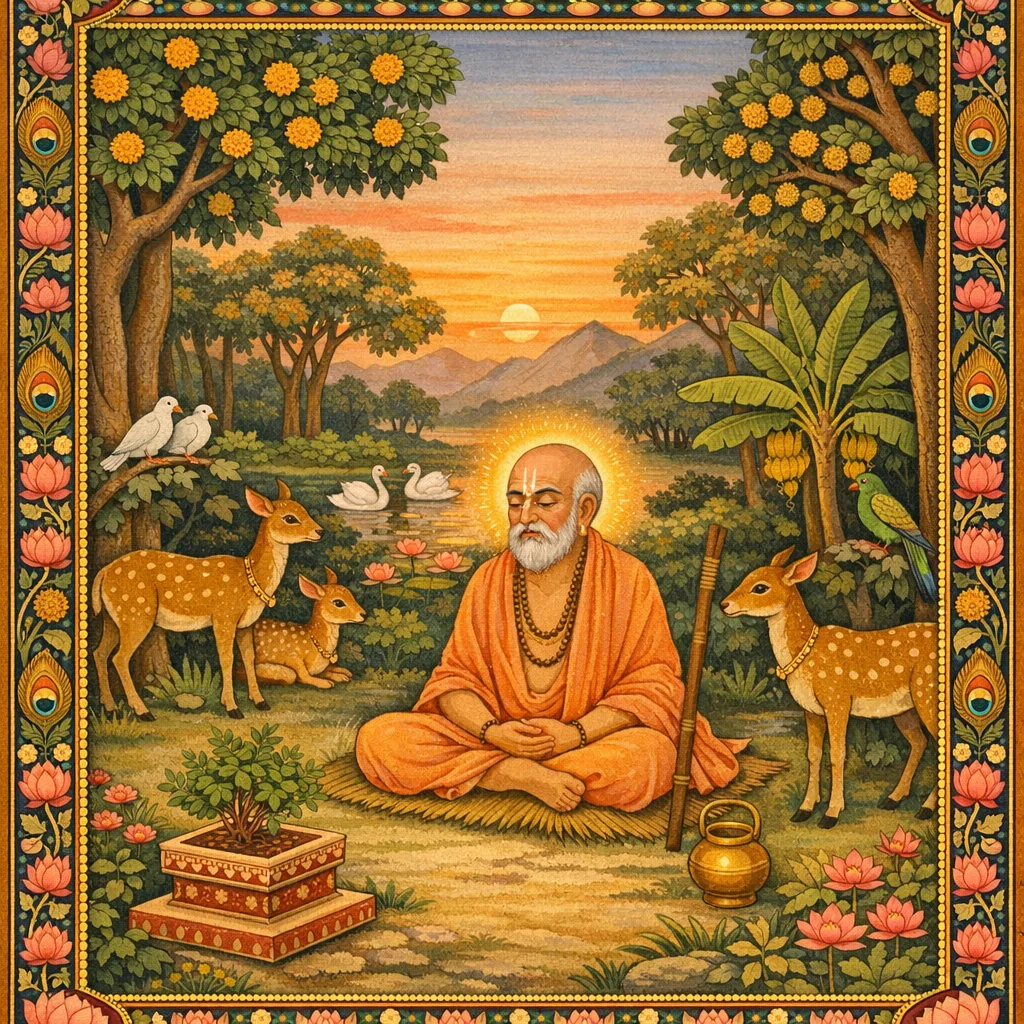
Continuing Kṛṣṇa’s systematic guidance to Uddhava on the architecture of spiritual life, this chapter moves from regulated renunciation (vānaprastha) to the mature renunciation of sannyāsa, and finally to the transcendent stance of the paramahaṁsa. Kṛṣṇa outlines how one enters the forest stage, lives on forest produce, accepts bodily austerities, performs limited Vedic rites without violence, and avoids hoarding. He then explains when vānaprastha should culminate either in meditative self-immolation (placing the fire within the heart) or in adopting sannyāsa through inner withdrawal of ritual fire. Kṛṣṇa warns that devas may test the renunciant with alluring forms, and He defines true sannyāsa through inner disciplines (speech, action, prāṇa-control) rather than external symbols. The chapter then broadens into the ethics of nonviolence, equanimity, humility, and equal vision, grounding them in the doctrine that the one Lord resides in all beings. It concludes by harmonizing varṇāśrama duties with bhakti: when prescribed duties are offered to Kṛṣṇa without ulterior worship, they purify existence and swiftly award devotion and attainment of the Supreme—setting up the next instructions on deeper realization and steadfast devotion.
Shlokas
Verse 1
श्रीभगवानुवाच वनं विविक्षु: पुत्रेषु भार्यां न्यस्य सहैव वा । वन एव वसेच्छान्तस्तृतीयं भागमायुष: ॥ १ ॥
The Supreme Personality of Godhead said: One who desires to adopt the third order of life, vānaprastha, should enter the forest with a peaceful mind, leaving his wife with his mature sons, or else taking her along with him.
Verse 2
कन्दमूलफलैर्वन्यैर्मेध्यैर्वृत्तिं प्रकल्पयेत् । वसीत वल्कलं वासस्तृणपर्णाजिनानि वा ॥ २ ॥
Having adopted the vānaprastha order of life, one should arrange one’s sustenance by eating uncontaminated bulbs, roots and fruits that grow in the forest. One may dress oneself with tree bark, grass, leaves or animal skins.
Verse 3
केशरोमनखश्मश्रुमलानि बिभृयाद् दत: । न धावेदप्सु मज्जेत त्रिकालं स्थण्डिलेशय: ॥ ३ ॥
The vānaprastha should not groom the hair on his head, body or face, should not manicure his nails, should not pass stool and urine at irregular times and should not make a special endeavor for dental hygiene. He should be content to take bath in water three times daily and should sleep on the ground.
Verse 4
ग्रीष्मे तप्येत पञ्चाग्नीन् वर्षास्वासारषाड्जले । आकण्ठमग्न: शिशिर एवंवृत्तस्तपश्चरेत् ॥ ४ ॥
Thus engaged as a vānaprastha, one should execute penance during the hottest summer days by subjecting oneself to burning fires on four sides and the blazing sun overhead; during the rainy season one should remain outside, subjecting oneself to torrents of rain; and in the freezing winter one should remain submerged in water up to one’s neck.
Verse 5
अग्निपक्वं समश्नीयात् कालपक्वमथापि वा । उलूखलाश्मकुट्टो वा दन्तोलूखल एव वा ॥ ५ ॥
One may eat foodstuffs prepared with fire, such as grains, or fruits ripened by time. One may grind one’s food with mortar and stone or with one’s own teeth.
Verse 6
स्वयं सञ्चिनुयात् सर्वमात्मनो वृत्तिकारणम् । देशकालबलाभिज्ञो नाददीतान्यदाहृतम् ॥ ६ ॥
The vānaprastha should personally collect whatever he requires for his bodily maintenance, carefully considering the time, place and his own capacity. He should never collect provisions for the future.
Verse 7
वन्यैश्चरुपुरोडाशैर्निर्वपेत् कालचोदितान् । न तु श्रौतेन पशुना मां यजेत वनाश्रमी ॥ ७ ॥
One who has accepted the vānaprastha order of life should perform seasonal sacrifices by offering oblations of caru and sacrificial cakes prepared from rice and other grains found in the forest. The vānaprastha, however, may never offer animal sacrifices to Me, even those sacrifices mentioned in the Vedas.
Verse 8
अग्निहोत्रं च दर्शश्च पौर्णमासश्च पूर्ववत् । चातुर्मास्यानि च मुनेराम्नातानि च नैगमै: ॥ ८ ॥
The vānaprastha should perform the agnihotra, darśa and paurṇamāsa sacrifices, as he did while in the gṛhastha-āśrama. He should also perform the vows and sacrifices of cāturmāsya, since all of these rituals are enjoined for the vānaprastha-āśrama by expert knowers of the Vedas.
Verse 9
एवं चीर्णेन तपसा मुनिर्धमनिसन्तत: । मां तपोमयमाराध्य ऋषिलोकादुपैति माम् ॥ ९ ॥
The saintly vānaprastha, practicing severe penances and accepting only the bare necessities of life, becomes so emaciated that he appears to be mere skin and bones. Thus worshiping Me through severe penances, he goes to the Maharloka planet and then directly achieves Me.
Verse 10
यस्त्वेतत् कृच्छ्रतश्चीर्णं तपो नि:श्रेयसं महत् । कामायाल्पीयसे युञ्ज्याद् बालिश: कोऽपरस्तत: ॥ १० ॥
One who with long endeavor executes this painful but exalted penance, which awards ultimate liberation, simply to achieve insignificant sense gratification must be considered the greatest fool.
Verse 11
यदासौ नियमेऽकल्पो जरया जातवेपथु: । आत्मन्यग्नीन् समारोप्य मच्चित्तोऽग्निं समाविशेत् ॥ ११ ॥
If the vānaprastha is overtaken by old age and because of his trembling body is no longer able to execute his prescribed duties, he should place the sacrificial fire within his heart by meditation. Then, fixing his mind on Me, he should enter into the fire and give up his body.
Verse 12
यदा कर्मविपाकेषु लोकेषु निरयात्मसु । विरागो जायते सम्यङ् न्यस्ताग्नि: प्रव्रजेत्तत: ॥ १२ ॥
If the vānaprastha, understanding that even promotion to Brahmaloka is a miserable situation, develops complete detachment from all possible results of fruitive activities, then he may take the sannyāsa order of life.
Verse 13
इष्ट्वा यथोपदेशं मां दत्त्वा सर्वस्वमृत्विजे । अग्नीन् स्वप्राण आवेश्य निरपेक्ष: परिव्रजेत् ॥ १३ ॥
Having worshiped Me according to scriptural injunctions and having given all one’s property to the sacrificial priest, one should place the fire sacrifice within oneself. Thus, with the mind completely detached, one should enter the sannyāsa order of life.
Verse 14
विप्रस्य वै सन्न्यसतो देवा दारादिरूपिण: । विघ्नान् कुर्वन्त्ययं ह्यस्मानाक्रम्य समियात् परम् ॥ १४ ॥
“This man taking sannyāsa is going to surpass us and go back home, back to Godhead.” Thus thinking, the demigods create stumbling blocks on the path of the sannyāsī by appearing before him in the shape of his former wife or other women and attractive objects. But the sannyāsī should pay the demigods and their manifestations no heed.
Verse 15
बिभृयाच्चेन्मुनिर्वास: कौपीनाच्छादनं परम् । त्यक्तं न दण्डपात्राभ्यामन्यत् किञ्चिदनापदि ॥ १५ ॥
If the sannyāsī desires to wear something besides a mere kaupīna, he may use another cloth around his waist and hips to cover the kaupīna. Otherwise, if there is no emergency, he should not accept anything besides his daṇḍa and waterpot.
Verse 16
दृष्टिपूतं न्यसेत् पादं वस्त्रपूतं पिबेज्जलम् । सत्यपूतां वदेद् वाचं मन:पूतं समाचरेत् ॥ १६ ॥
A saintly person should step or place his foot on the ground only after verifying with his eyes that there are no living creatures, such as insects, who might be injured by his foot. He should drink water only after filtering it through a portion of his cloth, and he should speak only words that possess the purity of truth. Similarly, he should perform only those activities his mind has carefully ascertained to be pure.
Verse 17
मौनानीहानिलायामा दण्डा वाग्देहचेतसाम् । न ह्येते यस्य सन्त्यङ्ग वेणुभिर्न भवेद् यति: ॥ १७ ॥
One who has not accepted the three internal disciplines of avoiding useless speech, avoiding useless activities and controlling the life air can never be considered a sannyāsī merely because of his carrying bamboo rods.
Verse 18
भिक्षां चतुर्षु वर्णेषु विगर्ह्यान् वर्जयंश्चरेत् । सप्तागारानसङ्क्लृप्तांस्तुष्येल्लब्धेन तावता ॥ १८ ॥
Rejecting those houses that are polluted and untouchable, one should approach without previous calculation seven houses and be satisfied with that which is obtained there by begging. According to necessity, one may approach each of the four occupational orders of society.
Verse 19
बहिर्जलाशयं गत्वा तत्रोपस्पृश्य वाग्यत: । विभज्य पावितं शेषं भुञ्जीताशेषमाहृतम् ॥ १९ ॥
Taking the food gathered through begging, one should leave the populated areas and go to a reservoir of water in a secluded place. There, having taken a bath and washed one’s hands thoroughly, one should distribute portions of the food to others who may request it. One should do this without speaking. Then, having thoroughly cleansed the remnants, one should eat everything on one’s plate, leaving nothing for future consumption.
Verse 20
एकश्चरेन्महीमेतां नि:सङ्ग: संयतेन्द्रिय: । आत्मक्रीड आत्मरत आत्मवान् समदर्शन: ॥ २० ॥
Without any material attachment, with senses fully controlled, remaining enthusiastic, and satisfied in realization of the Supreme Lord and his own self, the saintly person should travel about the earth alone. Having equal vision everywhere, he should be steady on the spiritual platform.
Verse 21
विविक्तक्षेमशरणो मद्भावविमलाशय: । आत्मानं चिन्तयेदेकमभेदेन मया मुनि: ॥ २१ ॥
Dwelling in a safe and solitary place, his mind purified by constant thought of Me, the sage should concentrate on the soul alone, realizing it to be nondifferent from Me.
Verse 22
अन्वीक्षेतात्मनो बन्धं मोक्षं च ज्ञाननिष्ठया । बन्ध इन्द्रियविक्षेपो मोक्ष एषां च संयम: ॥ २२ ॥
By steady knowledge a sage should clearly ascertain the nature of the soul’s bondage and liberation. Bondage occurs when the senses are deviated to sense gratification, and complete control of the senses constitutes liberation.
Verse 23
तस्मान्नियम्य षड्वर्गं मद्भावेन चरेन्मुनि: । विरक्त: क्षुद्रकामेभ्यो लब्ध्वात्मनि सुखं महत् ॥ २३ ॥
Therefore, completely controlling the five senses and the mind by Kṛṣṇa consciousness, a sage, having experienced spiritual bliss within the self, should live detached from insignificant material sense gratification.
Verse 24
पुरग्रामव्रजान्सार्थान् भिक्षार्थं प्रविशंश्चरेत् । पुण्यदेशसरिच्छैलवनाश्रमवतीं महीम् ॥ २४ ॥
The sage should travel in sanctified places, by flowing rivers and within the solitude of mountains and forests. He should enter the cities, towns and pasturing grounds and approach ordinary working men only to beg his bare sustenance.
Verse 25
वानप्रस्थाश्रमपदेष्वभीक्ष्णं भैक्ष्यमाचरेत् । संसिध्यत्याश्वसम्मोह: शुद्धसत्त्व: शिलान्धसा ॥ २५ ॥
One in the vānaprastha order of life should always practice taking charity from others, for one is thereby freed from illusion and quickly becomes perfect in spiritual life. Indeed, one who subsists on food grains obtained in such a humble manner purifies his existence.
Verse 26
नैतद् वस्तुतया पश्येद् दृश्यमानं विनश्यति । असक्तचित्तो विरमेदिहामुत्र चिकीर्षितात् ॥ २६ ॥
One should never see as ultimate reality those material things which obviously will perish. With consciousness free from material attachment, one should retire from all activities meant for material progress in this life and the next.
Verse 27
यदेतदात्मनि जगन्मनोवाक्प्राणसंहतम् । सर्वं मायेति तर्केण स्वस्थस्त्यक्त्वा न तत् स्मरेत् ॥ २७ ॥
One should logically consider the universe, which is situated within the Lord, and one’s own material body, which is composed of mind, speech and life air, to be ultimately products of the Lord’s illusory energy. Thus situated in the self, one should give up one’s faith in these things and should never again make them the object of one’s meditation.
Verse 28
ज्ञाननिष्ठो विरक्तो वा मद्भक्तो वानपेक्षक: । सलिङ्गानाश्रमांस्त्यक्त्वा चरेदविधिगोचर: ॥ २८ ॥
A learned transcendentalist dedicated to the cultivation of knowledge and thus detached from external objects, or My devotee who is detached even from desire for liberation — both neglect those duties based on external rituals or paraphernalia. Thus their conduct is beyond the range of rules and regulations.
Verse 29
बुधो बालकवत् क्रीडेत् कुशलो जडवच्चरेत् । वदेदुन्मत्तवद् विद्वान् गोचर्यां नैगमश्चरेत् ॥ २९ ॥
Although most wise, the paramahaṁsa should enjoy life like a child, oblivious to honor and dishonor; although most expert, he should behave like a stunted, incompetent person; although most learned, he should speak like an insane person; and although a scholar learned in Vedic regulations, he should behave in an unrestricted manner.
Verse 30
वेदवादरतो न स्यान्न पाषण्डी न हैतुक: । शुष्कवादविवादे न कञ्चित् पक्षं समाश्रयेत् ॥ ३० ॥
A devotee should never engage in the fruitive rituals mentioned in the karma-kāṇḍa section of the Vedas, nor should he become atheistic, acting or speaking in opposition to Vedic injunctions. Similarly, he should never speak like a mere logician or skeptic or take any side whatsoever in useless arguments.
Verse 31
नोद्विजेत जनाद् धीरो जनं चोद्वेजयेन्न तु । अतिवादांस्तितिक्षेत नावमन्येत कञ्चन । देहमुद्दिश्य पशुवद् वैरं कुर्यान्न केनचित् ॥ ३१ ॥
A saintly person should never let others frighten or disturb him and, similarly, should never frighten or disturb other people. He should tolerate the insults of others and should never himself belittle anyone. He should never create hostility with anyone for the sake of the material body, for he would thus be no better than an animal.
Verse 32
एक एव परो ह्यात्मा भूतेष्वात्मन्यवस्थित: । यथेन्दुरुदपात्रेषु भूतान्येकात्मकानि च ॥ ३२ ॥
The one Supreme Lord is situated within all material bodies and within everyone’s soul. Just as the moon is reflected in innumerable reservoirs of water, the Supreme Lord, although one, is present within everyone. Thus every material body is ultimately composed of the energy of the one Supreme Lord.
Verse 33
अलब्ध्वा न विषीदेत काले कालेऽशनं क्वचित् । लब्ध्वा न हृष्येद् धृतिमानुभयं दैवतन्त्रितम् ॥ ३३ ॥
If at times one does not obtain proper food one should not be depressed, and when one obtains sumptuous food one should not rejoice. Being fixed in determination, one should understand both situations to be under the control of God.
Verse 34
आहारार्थं समीहेत युक्तं तत् प्राणधारणम् । तत्त्वं विमृश्यते तेन तद् विज्ञाय विमुच्यते ॥ ३४ ॥
If required, one should endeavor to get sufficient foodstuffs, because it is always necessary and proper to maintain one’s health. When the senses, mind and life air are fit, one can contemplate spiritual truth, and by understanding the truth one is liberated.
Verse 35
यदृच्छयोपपन्नान्नमद्याच्छ्रेष्ठमुतापरम् । तथा वासस्तथा शय्यां प्राप्तं प्राप्तं भजेन्मुनि: ॥ ३५ ॥
A sage should accept the food, clothing and bedding — be they of excellent or inferior quality — that come of their own accord.
Verse 36
शौचमाचमनं स्नानं न तु चोदनया चरेत् । अन्यांश्च नियमाञ्ज्ञानी यथाहं लीलयेश्वर: ॥ ३६ ॥
Just as I, the Supreme Lord, execute regulative duties by My own free will, similarly, one who has realized knowledge of Me should maintain general cleanliness, purify his hands with water, take bath and execute other regulative duties not by force but by his own free will.
Verse 37
न हि तस्य विकल्पाख्या या च मद्वीक्षया हता । आदेहान्तात् क्वचित् ख्यातिस्तत: सम्पद्यते मया ॥ ३७ ॥
A realized soul no longer sees anything as separate from Me, for his realized knowledge of Me has destroyed such illusory perception. Since the material body and mind were previously accustomed to this kind of perception, it may sometimes appear to recur; but at the time of death the self-realized soul achieves opulences equal to Mine.
Verse 38
दु:खोदर्केषु कामेषु जातनिर्वेद आत्मवान् । अजिज्ञासितमद्धर्मो मुनिं गुरुमुपव्रजेत् ॥ ३८ ॥
One who is detached from sense gratification, knowing its result to be miserable, and who desires spiritual perfection, but who has not seriously analyzed the process for obtaining Me, should approach a bona fide and learned spiritual master.
Verse 39
तावत् परिचरेद् भक्त: श्रद्धावाननसूयक: । यावद् ब्रह्म विजानीयान्मामेव गुरुमादृत: ॥ ३९ ॥
Until a devotee has clearly realized spiritual knowledge, he should continue with great faith and respect and without envy to render personal service to the guru, who is nondifferent from Me.
Verse 40
यस्त्वसंयतषड्वर्ग: प्रचण्डेन्द्रियसारथि: । ज्ञानवैराग्यरहितस्त्रिदण्डमुपजीवति ॥ ४० ॥ सुरानात्मानमात्मस्थं निह्नुते मां च धर्महा । अविपक्वकषायोऽस्मादमुष्माच्च विहीयते ॥ ४१ ॥
One who has not controlled the six forms of illusion [lust, anger, greed, excitement, false pride and intoxication], whose intelligence, the leader of the senses, is extremely attached to material things, who is bereft of knowledge and detachment, who adopts the sannyāsa order of life to make a living, who denies the worshipable demigods, his own self and the Supreme Lord within himself, thus ruining all religious principles, and who is still infected by material contamination, is deviated and lost both in this life and the next.
Verse 41
यस्त्वसंयतषड्वर्ग: प्रचण्डेन्द्रियसारथि: । ज्ञानवैराग्यरहितस्त्रिदण्डमुपजीवति ॥ ४० ॥ सुरानात्मानमात्मस्थं निह्नुते मां च धर्महा । अविपक्वकषायोऽस्मादमुष्माच्च विहीयते ॥ ४१ ॥
One who has not controlled the six forms of illusion [lust, anger, greed, excitement, false pride and intoxication], whose intelligence, the leader of the senses, is extremely attached to material things, who is bereft of knowledge and detachment, who adopts the sannyāsa order of life to make a living, who denies the worshipable demigods, his own self and the Supreme Lord within himself, thus ruining all religious principles, and who is still infected by material contamination, is deviated and lost both in this life and the next.
Verse 42
भिक्षोर्धर्म: शमोऽहिंसा तप ईक्षा वनौकस: । गृहिणो भूतरक्षेज्या द्विजस्याचार्यसेवनम् ॥ ४२ ॥
The main religious duties of a sannyāsī are equanimity and nonviolence, whereas for the vānaprastha austerity and philosophical understanding of the difference between the body and soul are prominent. The main duties of a householder are to give shelter to all living entities and perform sacrifices, and the brahmacārī is mainly engaged in serving the spiritual master.
Verse 43
ब्रह्मचर्यं तप: शौचं सन्तोषो भूतसौहृदम् । गृहस्थस्याप्यृतौ गन्तु: सर्वेषां मदुपासनम् ॥ ४३ ॥
A householder may approach his wife for sex only at the time prescribed for begetting children. Otherwise, the householder should practice celibacy, austerity, cleanliness of mind and body, satisfaction in his natural position, and friendship toward all living entities. Worship of Me is to be practiced by all human beings, regardless of social or occupational divisions.
Verse 44
इति मां य: स्वधर्मेण भजेन् नित्यमनन्यभाक् । सर्वभूतेषु मद्भावो मद्भक्तिं विन्दते दृढाम् ॥ ४४ ॥
One who worships Me by his prescribed duty, having no other object of worship, and who remains conscious of Me as present in all living entities, achieves unflinching devotional service unto Me.
Verse 45
भक्त्योद्धवानपायिन्या सर्वलोकमहेश्वरम् । सर्वोत्पत्त्यप्ययं ब्रह्म कारणं मोपयाति स: ॥ ४५ ॥
My dear Uddhava, I am the Supreme Lord of all worlds, and I create and destroy this universe, being its ultimate cause. I am thus the Absolute Truth, and one who worships Me with unfailing devotional service comes to Me.
Verse 46
इति स्वधर्मनिर्णिक्तसत्त्वो निर्ज्ञातमद्गति: । ज्ञानविज्ञानसम्पन्नो नचिरात् समुपैति माम् ॥ ४६ ॥
Thus, one who has purified his existence by execution of his prescribed duties, who fully understands My supreme position and who is endowed with scriptural and realized knowledge, very soon achieves Me.
Verse 47
वर्णाश्रमवतां धर्म एष आचारलक्षण: । स एव मद्भक्तियुतो नि:श्रेयसकर: पर: ॥ ४७ ॥
Those who are followers of this varṇāśrama system accept religious principles according to authorized traditions of proper conduct. When such varṇāśrama duties are dedicated to Me in loving service, they award the supreme perfection of life.
Verse 48
एतत्तेऽभिहितं साधो भवान् पृच्छति यच्च माम् । यथा स्वधर्मसंयुक्तो भक्तो मां समियात् परम् ॥ ४८ ॥
My dear saintly Uddhava, I have now described to you, just as you inquired, the means by which My devotee, perfectly engaged in his prescribed duty, can come back to Me, the Supreme Personality of Godhead.
Frequently Asked Questions
Bondage is defined as the deviation of the senses toward sense gratification, which binds consciousness to impermanent objects and their reactions. Liberation is defined as complete control of the senses and mind, rooted in steady knowledge and remembrance of the Lord, whereby one experiences spiritual bliss within the self and no longer meditates upon perishable realities.
In this chapter Kṛṣṇa explicitly restricts the vānaprastha from animal sacrifice, emphasizing ahimsā and purity as prominent duties for that āśrama. The teaching aligns ritual with progressive internalization: as one advances toward renunciation, worship must become less dependent on external violence or paraphernalia and more aligned with compassion, philosophical discrimination, and devotion to the Supreme.
A true sannyāsī is identified by internal disciplines—avoiding useless speech, avoiding useless activity, and controlling the life air—along with truthfulness, purity, nonviolence, and detachment. External signs (such as carrying daṇḍa) are insufficient if one remains controlled by lust, anger, greed, pride, intoxication, or if one adopts renunciation as a livelihood.
Kṛṣṇa explains that devas may manifest alluring forms (including the appearance of one’s former wife or other attractive objects) to create stumbling blocks, fearing the sannyāsī will surpass them. The proper response is indifference: the renunciant should not give heed to such manifestations and should remain fixed in detachment and remembrance of the Lord.
The paramahaṁsa is described as behaving outwardly in unconventional ways—like a child (free from honor/dishonor), like an incompetent person (without display of expertise), like an insane person (without social posturing), while inwardly established in the highest realization. Such conduct is ‘beyond rules’ because realized knowledge and pure bhakti have dissolved the egoic motive that rules are meant to restrain; nevertheless, the paramahaṁsa never becomes atheistic or hostile to Vedic truth.
The chapter concludes that prescribed duties—whether of brahmacarya, gṛhastha, vānaprastha, or sannyāsa—become spiritually perfect when dedicated to Kṛṣṇa in loving service, without separate objects of worship. When one worships Kṛṣṇa while seeing Him present in all beings, varṇāśrama functions as a purification system that quickly matures into unflinching devotional service and attainment of the Lord.