Adhyaya 10
Karma-vāda Critiqued, Varṇāśrama Reframed, and the Soul’s Distinction from the Body
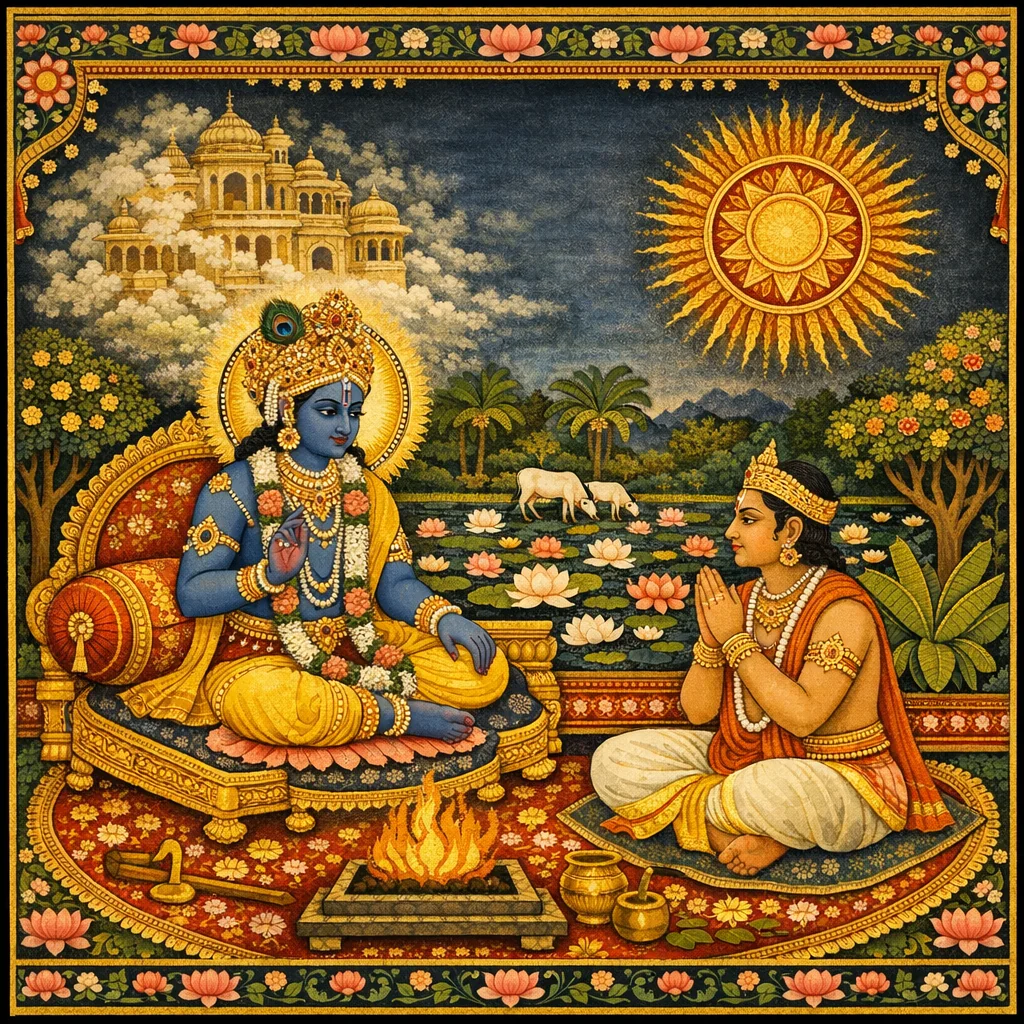
Continuing Kṛṣṇa’s instruction to Uddhava on the progressive path of spiritual life, this chapter begins by establishing the proper stance toward varṇāśrama: one should take full shelter of Bhagavān, fix the mind in devotional service, and live without personal desire while observing regulated duties. Kṛṣṇa then exposes the futility of endeavors rooted in sense gratification, comparing worldly enjoyment to dream-objects—mind-made and ultimately useless—generated by māyā. He outlines a progression: regulated action that purifies, followed by renunciation of fruitive injunctions when one is fully engaged in searching the soul’s ultimate truth, culminating in approaching a bona fide guru. The disciple’s ethos is detailed—humility, non-proprietorship, diligence, freedom from envy and idle talk. Philosophically, Kṛṣṇa distinguishes the self from the gross and subtle bodies using the fire-and-fuel analogy and explains bondage as false identification with guṇa-produced bodies, removable by knowledge. He then refutes karma-vāda and heavenly reward narratives by showing time destroys all results; sin leads to hellish degradation; and even Brahmā fears time. The chapter ends with Uddhava’s inquiry into how the soul can be said both bound and free, setting up the next chapter’s clarification of conditioned versus liberated symptoms.
Shlokas
Verse 1
श्रीभगवानुवाच मयोदितेष्ववहित: स्वधर्मेषु मदाश्रय: । वर्णाश्रमकुलाचारमकामात्मा समाचरेत् ॥ १ ॥
The Supreme Personality of Godhead said: Taking full shelter in Me, with the mind carefully fixed in the devotional service of the Lord as spoken by Me, one should live without personal desire and practice the social and occupational system called varṇāśrama.
Verse 2
अन्वीक्षेत विशुद्धात्मा देहिनां विषयात्मनाम् । गुणेषु तत्त्वध्यानेन सर्वारम्भविपर्ययम् ॥ २ ॥
A purified soul should see that because the conditioned souls who are dedicated to sense gratification have falsely accepted the objects of sense pleasure as truth, all of their endeavors are doomed to failure.
Verse 3
सुप्तस्य विषयालोको ध्यायतो वा मनोरथ: । नानात्मकत्वाद् विफलस्तथा भेदात्मधीर्गुणै: ॥ ३ ॥
One who is sleeping may see many objects of sense gratification in a dream, but such pleasurable things are merely creations of the mind and are thus ultimately useless. Similarly, the living entity who is asleep to his spiritual identity also sees many sense objects, but these innumerable objects of temporary gratification are creations of the Lord’s illusory potency and have no permanent existence. One who meditates upon them, impelled by the senses, uselessly engages his intelligence.
Verse 4
निवृत्तं कर्म सेवेत प्रवृत्तं मत्परस्त्यजेत् । जिज्ञासायां सम्प्रवृत्तो नाद्रियेत् कर्मचोदनाम् ॥ ४ ॥
One who has fixed Me within his mind as the goal of life should give up activities based on sense gratification and should instead execute work governed by the regulative principles for advancement. When, however, one is fully engaged in searching out the ultimate truth of the soul, one should not accept the scriptural injunctions governing fruitive activities.
Verse 5
यमानभीक्ष्णं सेवेत नियमान् मत्पर: क्वचित् । मदभिज्ञं गुरुं शान्तमुपासीत मदात्मकम् ॥ ५ ॥
One who has accepted Me as the supreme goal of life should strictly observe the scriptural injunctions forbidding sinful activities and, as far as possible, should execute the injunctions prescribing minor regulative duties such as cleanliness. Ultimately, however, one should approach a bona fide spiritual master who is full in knowledge of Me as I am, who is peaceful, and who by spiritual elevation is not different from Me.
Verse 6
अमान्यमत्सरो दक्षो निर्ममोदृढसौहृद: । असत्वरोऽर्थजिज्ञासुरनसूयुरमोघवाक् ॥ ६ ॥
The servant or disciple of the spiritual master should be free from false prestige, never considering himself to be the doer. He should be active and never lazy and should give up all sense of proprietorship over the objects of the senses, including his wife, children, home and society. He should be endowed with feelings of loving friendship toward the spiritual master and should never become deviated or bewildered. The servant or disciple should always desire advancement in spiritual understanding, should not envy anyone and should always avoid useless conversation.
Verse 7
जायापत्यगृहक्षेत्रस्वजनद्रविणादिषु । उदासीन: समं पश्यन् सर्वेष्वर्थमिवात्मन: ॥ ७ ॥
One should see one’s real self-interest in life in all circumstances and should therefore remain detached from wife, children, home, land, relatives, friends, wealth and so on.
Verse 8
विलक्षण: स्थूलसूक्ष्माद् देहादात्मेक्षिता स्वदृक् । यथाग्निर्दारुणो दाह्याद् दाहकोऽन्य: प्रकाशक: ॥ ८ ॥
Just as fire, which burns and illuminates, is different from firewood, which is to be burned to give illumination, similarly the seer within the body, the self-enlightened spirit soul, is different from the material body, which is to be illuminated by consciousness. Thus the spirit soul and the body possess different characteristics and are separate entities.
Verse 9
निरोधोत्पत्त्यणुबृहन्नानात्वं तत्कृतान् गुणान् । अन्त:प्रविष्ट आधत्त एवं देहगुणान् पर: ॥ ९ ॥
Just as fire may appear differently as dormant, manifest, weak, brilliant and so on, according to the condition of the fuel, similarly, the spirit soul enters a material body and accepts particular bodily characteristics.
Verse 10
योऽसौ गुणैर्विरचितो देहोऽयं पुरुषस्य हि । संसारस्तन्निबन्धोऽयं पुंसो विद्याच्छिदात्मन: ॥ १० ॥
The subtle and gross material bodies are created by the material modes of nature, which expand from the potency of the Supreme Personality of Godhead. Material existence occurs when the living entity falsely accepts the qualities of the gross and subtle bodies as being his own factual nature. This illusory state, however, can be destroyed by real knowledge.
Verse 11
तस्माज्जिज्ञासयात्मानमात्मस्थं केवलं परम् । सङ्गम्य निरसेदेतद्वस्तुबुद्धिं यथाक्रमम् ॥ ११ ॥
Therefore, by the cultivation of knowledge one should approach the Supreme Personality of Godhead situated within oneself. By understanding the Lord’s pure, transcendental existence, one should gradually give up the false vision of the material world as independent reality.
Verse 12
आचार्योऽरणिराद्य: स्यादन्तेवास्युत्तरारणि: । तत्सन्धानं प्रवचनं विद्यासन्धि: सुखावह: ॥ १२ ॥
The spiritual master can be compared to the lower kindling stick, the disciple to the upper kindling stick, and the instruction given by the guru to the third stick placed in between. The transcendental knowledge communicated from guru to disciple is compared to the fire arising from the contact of these, which burns the darkness of ignorance to ashes, bringing great happiness both to guru and disciple.
Verse 13
वैशारदी सातिविशुद्धबुद्धि- र्धुनोति मायां गुणसम्प्रसूताम् । गुणांश्च सन्दह्य यदात्ममेतत् स्वयं च शाम्यत्यसमिद् यथाग्नि: ॥ १३ ॥
By submissively hearing from an expert spiritual master, the expert disciple develops pure knowledge, which repels the onslaught of material illusion arising from the three modes of material nature. Finally this pure knowledge itself ceases, just as fire ceases when the stock of fuel has been consumed.
Verse 14
अथैषाम् कर्मकर्तृणां भोक्तृणां सुखदु:खयो: । नानात्वमथ नित्यत्वं लोककालागमात्मनाम् ॥ १४ ॥ मन्यसे सर्वभावानां संस्था ह्यौत्पत्तिकी यथा । तत्तदाकृतिभेदेन जायते भिद्यते च धी: ॥ १५ ॥ एवमप्यङ्ग सर्वेषां देहिनां देहयोगत: । कालावयवत: सन्ति भावा जन्मादयोऽसकृत् ॥ १६ ॥
My dear Uddhava, I have thus explained to you perfect knowledge. There are philosophers, however, who challenge My conclusion. They state that the natural position of the living entity is to engage in fruitive activities, and they see him as the enjoyer of the happiness and unhappiness that accrue from his own work. According to this materialistic philosophy, the world, time, the revealed scriptures and the self are all variegated and eternal, existing as a perpetual flow of transformations. Knowledge, moreover, cannot be one or eternal, because it arises from the different and changing forms of objects; thus knowledge itself is always subject to change. Even if you accept such a philosophy, My dear Uddhava, there will still be perpetual birth, death, old age and disease, since all living entities must accept a material body subject to the influence of time.
Verse 15
अथैषाम् कर्मकर्तृणां भोक्तृणां सुखदु:खयो: । नानात्वमथ नित्यत्वं लोककालागमात्मनाम् ॥ १४ ॥ मन्यसे सर्वभावानां संस्था ह्यौत्पत्तिकी यथा । तत्तदाकृतिभेदेन जायते भिद्यते च धी: ॥ १५ ॥ एवमप्यङ्ग सर्वेषां देहिनां देहयोगत: । कालावयवत: सन्ति भावा जन्मादयोऽसकृत् ॥ १६ ॥
My dear Uddhava, I have thus explained to you perfect knowledge. There are philosophers, however, who challenge My conclusion. They state that the natural position of the living entity is to engage in fruitive activities, and they see him as the enjoyer of the happiness and unhappiness that accrue from his own work. According to this materialistic philosophy, the world, time, the revealed scriptures and the self are all variegated and eternal, existing as a perpetual flow of transformations. Knowledge, moreover, cannot be one or eternal, because it arises from the different and changing forms of objects; thus knowledge itself is always subject to change. Even if you accept such a philosophy, My dear Uddhava, there will still be perpetual birth, death, old age and disease, since all living entities must accept a material body subject to the influence of time.
Verse 16
अथैषाम् कर्मकर्तृणां भोक्तृणां सुखदु:खयो: । नानात्वमथ नित्यत्वं लोककालागमात्मनाम् ॥ १४ ॥ मन्यसे सर्वभावानां संस्था ह्यौत्पत्तिकी यथा । तत्तदाकृतिभेदेन जायते भिद्यते च धी: ॥ १५ ॥ एवमप्यङ्ग सर्वेषां देहिनां देहयोगत: । कालावयवत: सन्ति भावा जन्मादयोऽसकृत् ॥ १६ ॥
My dear Uddhava, I have thus explained to you perfect knowledge. There are philosophers, however, who challenge My conclusion. They state that the natural position of the living entity is to engage in fruitive activities, and they see him as the enjoyer of the happiness and unhappiness that accrue from his own work. According to this materialistic philosophy, the world, time, the revealed scriptures and the self are all variegated and eternal, existing as a perpetual flow of transformations. Knowledge, moreover, cannot be one or eternal, because it arises from the different and changing forms of objects; thus knowledge itself is always subject to change. Even if you accept such a philosophy, My dear Uddhava, there will still be perpetual birth, death, old age and disease, since all living entities must accept a material body subject to the influence of time.
Verse 17
तत्रापि कर्मणां कर्तुरस्वातन्त्र्यं च लक्ष्यते । भोक्तुश्च दु:खसुखयो: को न्वर्थो विवशं भजेत् ॥ १७ ॥
Although the performer of fruitive activities desires perpetual happiness, it is clearly observed that materialistic workers are often unhappy and only occasionally satisfied, thus proving that they are not independent or in control of their destiny. When a person is always under the superior control of another, how can he expect any valuable results from his own fruitive actions?
Verse 18
न देहिनां सुखं किञ्चिद् विद्यते विदुषामपि । तथा च दु:खं मूढानां वृथाहङ्करणं परम् ॥ १८ ॥
It is observed within the material world that sometimes even an intelligent person is not happy. Similarly, sometimes even a great fool is happy. The concept of becoming happy through expertly performing material activities is simply a useless exhibition of false egotism.
Verse 19
यदि प्राप्तिं विघातं च जानन्ति सुखदु:खयो: । तेऽप्यद्धा न विदुर्योगं मृत्युर्न प्रभवेद् यथा ॥ १९ ॥
Even if people know how to achieve happiness and avoid unhappiness, they still do not know the process by which death will not be able to exert its power over them.
Verse 20
कोऽन्वर्थ: सुखयत्येनं कामो वा मृत्युरन्तिके । आघातं नीयमानस्य वध्यस्येव न तुष्टिद: ॥ २० ॥
Death is not at all pleasing, and since everyone is exactly like a condemned man being led to the place of execution, what possible happiness can people derive from material objects or the gratification they provide?
Verse 21
श्रुतं च दृष्टवद् दुष्टं स्पर्धासूयात्ययव्ययै: । बह्वन्तरायकामत्वात् कृषिवच्चापि निष्फलम् ॥ २१ ॥
That material happiness of which we hear, such as promotion to heavenly planets for celestial enjoyment, is just like that material happiness we have already experienced. Both are polluted by jealousy, envy, decay and death. Therefore, just as an attempt to raise crops becomes fruitless if there are many problems like crop disease, insect plague or drought, similarly, the attempt to attain material happiness, either on earth or on the heavenly planets, is always fruitless because of innumerable obstacles.
Verse 22
अन्तरायैरविहितो यदि धर्म: स्वनुष्ठित: । तेनापि निर्जितं स्थानं यथा गच्छति तच्छृणु ॥ २२ ॥
If one performs Vedic sacrifices and fruitive rituals without any mistake or contamination, one will achieve a heavenly situation in the next life. But even this result, which is only achieved by perfect performance of fruitive rituals, will be vanquished by time. Now hear of this.
Verse 23
इष्ट्वेह देवता यज्ञै: स्वर्लोकं याति याज्ञिक: । भुञ्जीत देववत्तत्र भोगान् दिव्यान् निजार्जितान् ॥ २३ ॥
If on earth one performs sacrifices for the satisfaction of the demigods, he goes to the heavenly planets, where, just like a demigod, he enjoys all of the heavenly pleasures he has earned by his performances.
Verse 24
स्वपुण्योपचिते शुभ्रे विमान उपगीयते । गन्धर्वैर्विहरन् मध्ये देवीनां हृद्यवेषधृक् ॥ २४ ॥
Having achieved the heavenly planets, the performer of ritualistic sacrifices travels in a glowing airplane, which he obtains as the result of his piety on earth. Being glorified by songs sung by the Gandharvas and dressed in wonderfully charming clothes, he enjoys life surrounded by heavenly goddesses.
Verse 25
स्त्रीभि: कामगयानेन किङ्किणीजालमालिना । क्रीडन् न वेदात्मपातं सुराक्रीडेषु निर्वृत: ॥ २५ ॥
Accompanied by heavenly women, the enjoyer of the fruits of sacrifice goes on pleasure rides in a wonderful airplane, which is decorated with circles of tinkling bells and which flies wherever he desires. Being relaxed, comfortable and happy in the heavenly pleasure gardens, he does not consider that he is exhausting the fruits of his piety and will soon fall down to the mortal world.
Verse 26
तावत् स मोदते स्वर्गे यावत् पुण्यं समाप्यते । क्षीणपुण्य: पतत्यर्वागनिच्छन् कालचालित: ॥ २६ ॥
Until his pious results are used up, the performer of sacrifice enjoys life in the heavenly planets. When the pious results are exhausted, however, he falls down from the pleasure gardens of heaven, being moved against his desire by the force of eternal time.
Verse 27
यद्यधर्मरत: सङ्गादसतां वाजितेन्द्रिय: । कामात्मा कृपणो लुब्ध: स्त्रैणो भूतविहिंसक: ॥ २७ ॥ पशूनविधिनालभ्य प्रेतभूतगणान् यजन् । नरकानवशो जन्तुर्गत्वा यात्युल्बणं तम: ॥ २८ ॥ कर्माणि दु:खोदर्काणि कुर्वन् देहेन तै: पुन: । देहमाभजते तत्र किं सुखं मर्त्यधर्मिण: ॥ २९ ॥
If a human being is engaged in sinful, irreligious activities, either because of bad association or because of his failure to control his senses, then such a person will certainly develop a personality full of material desires. He thus becomes miserly toward others, greedy and always anxious to exploit the bodies of women. When the mind is so polluted one becomes violent and aggressive and without the authority of Vedic injunctions slaughters innocent animals for sense gratification. Worshiping ghosts and spirits, the bewildered person falls fully into the grip of unauthorized activities and thus goes to hell, where he receives a material body infected by the darkest modes of nature. In such a degraded body, he unfortunately continues to perform inauspicious activities that greatly increase his future unhappiness, and therefore he again accepts a similar material body. What possible happiness can there be for one who engages in activities inevitably terminating in death?
Verse 28
यद्यधर्मरत: सङ्गादसतां वाजितेन्द्रिय: । कामात्मा कृपणो लुब्ध: स्त्रैणो भूतविहिंसक: ॥ २७ ॥ पशूनविधिनालभ्य प्रेतभूतगणान् यजन् । नरकानवशो जन्तुर्गत्वा यात्युल्बणं तम: ॥ २८ ॥ कर्माणि दु:खोदर्काणि कुर्वन् देहेन तै: पुन: । देहमाभजते तत्र किं सुखं मर्त्यधर्मिण: ॥ २९ ॥
If a human being is engaged in sinful, irreligious activities, either because of bad association or because of his failure to control his senses, then such a person will certainly develop a personality full of material desires. He thus becomes miserly toward others, greedy and always anxious to exploit the bodies of women. When the mind is so polluted one becomes violent and aggressive and without the authority of Vedic injunctions slaughters innocent animals for sense gratification. Worshiping ghosts and spirits, the bewildered person falls fully into the grip of unauthorized activities and thus goes to hell, where he receives a material body infected by the darkest modes of nature. In such a degraded body, he unfortunately continues to perform inauspicious activities that greatly increase his future unhappiness, and therefore he again accepts a similar material body. What possible happiness can there be for one who engages in activities inevitably terminating in death?
Verse 29
यद्यधर्मरत: सङ्गादसतां वाजितेन्द्रिय: । कामात्मा कृपणो लुब्ध: स्त्रैणो भूतविहिंसक: ॥ २७ ॥ पशूनविधिनालभ्य प्रेतभूतगणान् यजन् । नरकानवशो जन्तुर्गत्वा यात्युल्बणं तम: ॥ २८ ॥ कर्माणि दु:खोदर्काणि कुर्वन् देहेन तै: पुन: । देहमाभजते तत्र किं सुखं मर्त्यधर्मिण: ॥ २९ ॥
If a human being is engaged in sinful, irreligious activities, either because of bad association or because of his failure to control his senses, then such a person will certainly develop a personality full of material desires. He thus becomes miserly toward others, greedy and always anxious to exploit the bodies of women. When the mind is so polluted one becomes violent and aggressive and without the authority of Vedic injunctions slaughters innocent animals for sense gratification. Worshiping ghosts and spirits, the bewildered person falls fully into the grip of unauthorized activities and thus goes to hell, where he receives a material body infected by the darkest modes of nature. In such a degraded body, he unfortunately continues to perform inauspicious activities that greatly increase his future unhappiness, and therefore he again accepts a similar material body. What possible happiness can there be for one who engages in activities inevitably terminating in death?
Verse 30
लोकानां लोकपालानां मद्भयं कल्पजीविनाम् । ब्रह्मणोऽपि भयं मत्तो द्विपरार्धपरायुष: ॥ ३० ॥
In all the planetary systems, from the heavenly to the hellish, and for all of the great demigods who live for one thousand yuga cycles, there is fear of Me in My form of time. Even Brahmā, who possesses the supreme life span of 311,040,000,000,000 years, is also afraid of Me.
Verse 31
गुणा: सृजन्ति कर्माणि गुणोऽनुसृजते गुणान् । जीवस्तु गुणसंयुक्तो भुङ्क्ते कर्मफलान्यसौ ॥ ३१ ॥
The material senses create material activities, either pious or sinful, and the modes of nature set the material senses into motion. The living entity, being fully engaged by the material senses and modes of nature, experiences the various results of fruitive work.
Verse 32
यावत् स्याद् गुणवैषम्यं तावन्नानात्वमात्मन: । नानात्वमात्मनो यावत् पारतन्त्र्यं तदैव हि ॥ ३२ ॥
As long as the living entity thinks that the modes of material nature have separate existences, he will be obliged to take birth in many different forms and will experience varieties of material existence. Therefore, the living entity remains completely dependent on fruitive activities under the modes of nature.
Verse 33
यावदस्यास्वतन्त्रत्वं तावदीश्वरतो भयम् । य एतत् समुपासीरंस्ते मुह्यन्ति शुचार्पिता: ॥ ३३ ॥
The conditioned soul who remains dependent on fruitive activities under the material modes of nature will continue to fear Me, the Supreme Personality of Godhead, since I impose the results of one’s fruitive activities. Those who accept the material concept of life, taking the variegatedness of the modes of nature to be factual, devote themselves to material enjoyment and are therefore always absorbed in lamentation and grief.
Verse 34
काल आत्मागमो लोक: स्वभावो धर्म एव च । इति मां बहुधा प्राहुर्गुणव्यतिकरे सति ॥ ३४ ॥
When there is agitation and interaction of the material modes of nature, the living entities then describe Me in various ways such as all-powerful time, the Self, Vedic knowledge, the universe, one’s own nature, religious ceremonies and so on.
Verse 35
श्रीउद्धव उवाच गुणेषु वर्तमानोऽपि देहजेष्वनपावृत: । गुणैर्न बध्यते देही बध्यते वा कथं विभो ॥ ३५ ॥
Śrī Uddhava said: O my Lord, a living entity situated within the material body is surrounded by the modes of nature and the happiness and distress that are born of activities caused by these modes. How is it possible that he is not bound by this material encirclement? It may also be said that the living entity is ultimately transcendental and has nothing to do with the material world. Then how is he ever bound by material nature?
Verse 36
कथं वर्तेत विहरेत् कैर्वा ज्ञायेत लक्षणै: । किं भुञ्जीतोत विसृजेच्छयीतासीत याति वा ॥ ३६ ॥ एतदच्युत मे ब्रूहि प्रश्नं प्रश्नविदां वर । नित्यबद्धो नित्यमुक्त एक एवेति मे भ्रम: ॥ ३७ ॥
O my Lord, Acyuta, the same living entity is sometimes described as eternally conditioned and at other times as eternally liberated. I am not able to understand, therefore, the actual situation of the living entity. You, my Lord, are the best of those who are expert in answering philosophical questions. Please explain to me the symptoms by which one can tell the difference between a living entity who is eternally liberated and one who is eternally conditioned. In what various ways would they remain situated, enjoy life, eat, evacuate, lie down, sit or move about?
Verse 37
कथं वर्तेत विहरेत् कैर्वा ज्ञायेत लक्षणै: । किं भुञ्जीतोत विसृजेच्छयीतासीत याति वा ॥ ३६ ॥ एतदच्युत मे ब्रूहि प्रश्नं प्रश्नविदां वर । नित्यबद्धो नित्यमुक्त एक एवेति मे भ्रम: ॥ ३७ ॥
O my Lord, Acyuta, the same living entity is sometimes described as eternally conditioned and at other times as eternally liberated. I am not able to understand, therefore, the actual situation of the living entity. You, my Lord, are the best of those who are expert in answering philosophical questions. Please explain to me the symptoms by which one can tell the difference between a living entity who is eternally liberated and one who is eternally conditioned. In what various ways would they remain situated, enjoy life, eat, evacuate, lie down, sit or move about?
Frequently Asked Questions
It presents varṇāśrama as a regulated framework meant to support purification when performed without personal desire and with full shelter in Bhagavān. Duties are not the final goal; they are subordinated to fixing the mind in devotional service and advancing toward realized truth.
Because dream-objects appear real to a sleeping person but are mental constructions with no lasting substance. Similarly, sense objects pursued by one “asleep” to spiritual identity are māyā’s temporary manifestations; meditation on them, driven by the senses, misuses intelligence and yields no permanent gain.
Kṛṣṇa indicates that when one is fully engaged in searching out the ultimate truth of the soul (ātma-tattva-vicāra) and not motivated by sense gratification, one should not accept injunctions governing fruitive activities (karma-kāṇḍa), while still maintaining purity and approaching a realized guru.
The guru is described as fully knowledgeable of Kṛṣṇa as He is, peaceful, and spiritually elevated—so aligned with the Lord’s will that he is said to be ‘not different’ in the sense of representing the Lord’s instruction and presence without personal agenda.
Using the fire-and-fuel analogy: fire (the conscious seer) is distinct from firewood (the body to be illumined). The soul is self-luminous consciousness, while gross and subtle bodies are guṇa-made instruments mistakenly taken as the self.
They are karma-vādīs who claim the living entity’s natural position is fruitive action and that he is the independent enjoyer of results. The chapter argues this view cannot remove birth and death and is contradicted by observation: results are controlled, happiness is inconsistent, and time ultimately destroys all fruits.
Because svarga results depend on exhaustible piety and are vanquished by time. The chapter describes heavenly luxury to show its impermanence: when merit ends, the soul falls against his desire, proving that karma cannot grant lasting fearlessness or liberation.
Uddhava asks how the soul can be described as both eternally conditioned and eternally liberated, and how bondage occurs if the self is transcendental. This directly sets up the subsequent explanation of the symptoms and lived characteristics of conditioned versus liberated beings.