Adhyaya 2
Nārada’s Arrival, the Nine Yogendras, and the Foundations of Bhāgavata-dharma
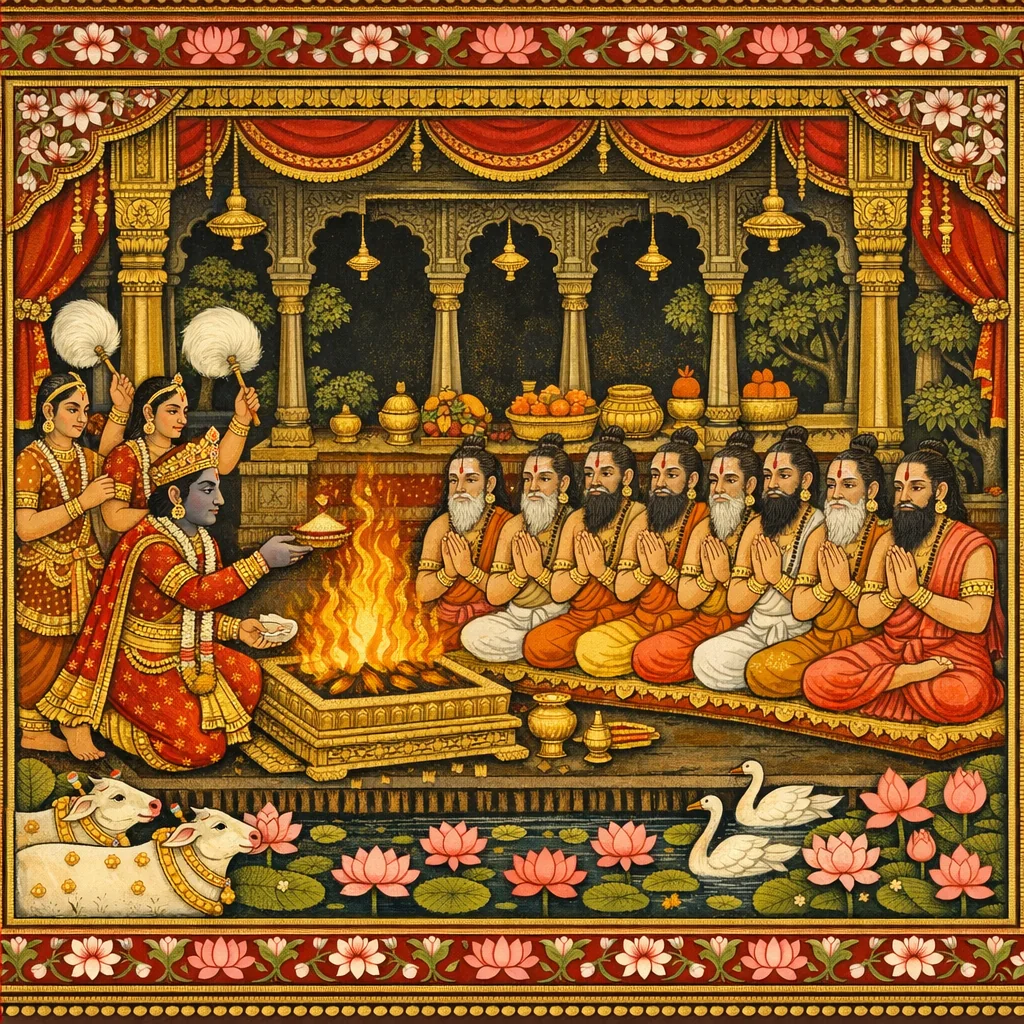
Continuing the Eleventh Canto’s emphasis on the urgent, practical science of devotion, Śukadeva describes Nārada’s stay in Dvārakā and his visit to Vasudeva, who seeks the duties that most please Mukunda and remove fear. Nārada affirms that devotion is the eternal dharma of the jīva and introduces an ancient instructional precedent: King Videha (Nimi) questioning the nine sons of Ṛṣabhadeva (the Yogendras). After outlining Ṛṣabhadeva’s lineage—Bharata’s renunciation, the division of sons into rulers, brāhmaṇas, and renounced sages—Nārada narrates how the Yogendras arrive at Nimi’s sacrifice and are honored like the Lord Himself. Nimi asks for the supreme good and the method of bhakti. Kavi teaches that fear arises from turning away from the Lord under māyā, and that fearlessness comes through unalloyed devotion under guru guidance, offering all acts to Nārāyaṇa, controlling the mind, and chanting the holy name until ecstatic love awakens. Havir then begins defining Vaiṣṇava gradations—uttama, madhyama, and prākṛta—setting up the next chapter’s deeper analysis of devotees’ symptoms and conduct.
Shlokas
Verse 1
श्रीशुक उवाच गोविन्दभुजगुप्तायां द्वारवत्यां कुरूद्वह । अवात्सीन्नारदोऽभीक्ष्णं कृष्णोपासनलालस: ॥ १ ॥
Śrī Śukadeva Gosvāmī said: Eager to engage in the worship of Lord Kṛṣṇa, O best of the Kurus, Nārada Muni stayed for some time in Dvārakā, which was always protected by the arms of Govinda.
Verse 2
को नु राजन्निन्द्रियवान् मुकुन्दचरणाम्बुजम् । न भजेत् सर्वतोमृत्युरुपास्यममरोत्तमै: ॥ २ ॥
My dear King, in the material world the conditioned souls are confronted by death at every step of life. Therefore, who among the conditioned souls would not render service to the lotus feet of Lord Mukunda, who is worshipable even for the greatest of liberated souls?
Verse 3
तमेकदा तु देवर्षिं वसुदेवो गृहागतम् । अर्चितं सुखमासीनमभिवाद्येदमब्रवीत् ॥ ३ ॥
One day the sage among the demigods, Nārada, came to the house of Vasudeva. After worshiping Nārada with suitable paraphernalia, seating him comfortably and respectfully bowing down to him, Vasudeva spoke as follows.
Verse 4
श्रीवसुदेव उवाच भगवन् भवतो यात्रा स्वस्तये सर्वदेहिनाम् । कृपणानां यथा पित्रोरुत्तमश्लोकवर्त्मनाम् ॥ ४ ॥
Śrī Vasudeva said: My lord, your visit, like that of a father to his children, is for the benefit of all living beings. You especially help the most wretched among them, as well as those who are advanced on the path toward the Supreme Lord, Uttamaśloka.
Verse 5
भूतानां देवचरितं दु:खाय च सुखाय च । सुखायैव हि साधूनां त्वादृशामच्युतात्मनाम् ॥ ५ ॥
The activities of demigods lead to both misery and happiness for living beings, but the activities of great saints like you, who have accepted the infallible Lord as their very soul, result only in the happiness of all beings.
Verse 6
भजन्ति ये यथा देवान् देवा अपि तथैव तान् । छायेव कर्मसचिवा: साधवो दीनवत्सला: ॥ ६ ॥
Those who worship the demigods receive reciprocation from the demigods in a way just corresponding to the offering. The demigods are attendants of karma, like a person’s shadow, but sādhus are actually merciful to the fallen.
Verse 7
ब्रह्मंस्तथापि पृच्छामो धर्मान् भागवतांस्तव । यान् श्रुत्वा श्रद्धया मर्त्यो मुच्यते सर्वतोभयात् ॥ ७ ॥
O brāhmaṇa, although I am satisfied simply by seeing you, I still wish to inquire about those duties which give pleasure to the Supreme Personality of Godhead. Any mortal who faithfully hears about them is freed from all kinds of fear.
Verse 8
अहं किल पुरानन्तं प्रजार्थो भुवि मुक्तिदम् । अपूजयं न मोक्षाय मोहितो देवमायया ॥ ८ ॥
In a previous birth on this earth, I worshiped the Supreme Lord, Ananta, who alone can award liberation, but because I desired to have a child, I did not worship Him for liberation. Thus I was bewildered by the Lord’s illusory energy.
Verse 9
यथा विचित्रव्यसनाद् भवद्भिर्विश्वतोभयात् । मुच्येम ह्यञ्जसैवाद्धा तथा न: शाधि सुव्रत ॥ ९ ॥
My dear lord, you are always true to your vow. Please instruct me clearly, so that by your mercy I may easily free myself from material existence, which is full of many dangers and keeps us constantly bound in fear.
Verse 10
श्रीशुक उवाच राजन्नेवं कृतप्रश्नो वसुदेवेन धीमता । प्रीतस्तमाह देवर्षिर्हरे: संस्मारितो गुणै: ॥ १० ॥
Śukadeva Gosvāmī said: O King, Devarṣi Nārada was pleased by the questions of the highly intelligent Vasudeva. Because they suggested the transcendental qualities of the Supreme Personality of Godhead, they reminded Nārada of Lord Kṛṣṇa. Thus Nārada replied to Vasudeva as follows.
Verse 11
श्रीनारद उवाच सम्यगेतद् व्यवसितं भवता सात्वतर्षभ । यत् पृच्छसे भागवतान् धर्मांस्त्वं विश्वभावनान् ॥ ११ ॥
Śrī Nārada said: O best of the Sātvatas, you have quite correctly asked about the eternal duty of the living entity toward the Supreme Lord. Such devotional service to the Lord is so potent that its performance can purify the entire universe.
Verse 12
श्रुतोऽनुपठितो ध्यात आदृतो वानुमोदित: । सद्य: पुनाति सद्धर्मो देव विश्वद्रुहोऽपि हि ॥ १२ ॥
Pure devotional service rendered to the Supreme Lord is spiritually so potent that simply by hearing about such transcendental service, by chanting its glories in response, by meditating on it, by respectfully and faithfully accepting it, or by praising the devotional service of others, even persons who hate the demigods and all other living beings can be immediately purified.
Verse 13
त्वया परमकल्याण: पुण्यश्रवणकीर्तन: । स्मारितो भगवानद्य देवो नारायणो मम ॥ १३ ॥
Today you have made me remember my Lord, the supremely blissful Personality of Godhead, Nārāyaṇa. The Supreme Lord is so auspicious that whoever hears and chants about Him becomes completely pious.
Verse 14
अत्राप्युदाहरन्तीममितिहासं पुरातनम् । आर्षभाणां च संवादं विदेहस्य महात्मन: ॥ १४ ॥
To explain the devotional service of the Lord, sages have related the ancient history of the conversation between the great soul King Videha and the sons of Ṛṣabha.
Verse 15
प्रियव्रतो नाम सुतो मनो: स्वायम्भुवस्य य: । तस्याग्नीध्रस्ततो नाभिऋर्षभस्तत्सुत: स्मृत: ॥ १५ ॥
Svāyambhuva Manu had a son named Mahārāja Priyavrata, and among Priyavrata’s sons was Āgnīdhra. From Āgnīdhra was born Nābhi, whose son was known as Ṛṣabhadeva.
Verse 16
तमाहुर्वासुदेवांशं मोक्षधर्मविवक्षया । अवतीर्णं सुतशतं तस्यासीद् ब्रह्मपारगम् ॥ १६ ॥
Śrī Ṛṣabhadeva is accepted as an expansion of the Supreme Lord, Vāsudeva. He incarnated in this world to propagate those religious principles that lead living entities to ultimate liberation. He had one hundred sons, all perfect in Vedic knowledge.
Verse 17
तेषां वै भरतो ज्येष्ठो नारायणपरायण: । विख्यातं वर्षमेतद् यन्नाम्ना भारतमद्भुतम् ॥ १७ ॥
Of the one hundred sons of Lord Ṛṣabhadeva, the eldest, Bharata, was completely devoted to Lord Nārāyaṇa. It is because of Bharata’s fame that this planet is now celebrated as the great Bhārata-varṣa.
Verse 18
स भुक्तभोगां त्यक्त्वेमां निर्गतस्तपसा हरिम् । उपासीनस्तत्पदवीं लेभे वै जन्मभिस्त्रिभि: ॥ १८ ॥
King Bharata rejected this material world, considering all types of material pleasure temporary and useless. Leaving his beautiful young wife and family, he worshiped Lord Hari by severe austerities and attained the abode of the Lord after three lifetimes.
Verse 19
तेषां नव नवद्वीपपतयोऽस्य समन्तत: । कर्मतन्त्रप्रणेतार एकाशीतिर्द्विजातय: ॥ १९ ॥
Nine of the remaining sons of Ṛṣabhadeva became the rulers of the nine islands of Bhārata-varṣa, and they exercised complete sovereignty over this planet. Eighty-one sons became twice-born brāhmaṇas and helped initiate the Vedic path of fruitive sacrifices [karma-kāṇḍa].
Verse 20
नवाभवन् महाभागा मुनयो ह्यर्थशंसिन: । श्रमणा वातरसना आत्मविद्याविशारदा: ॥ २० ॥ कविर्हविरन्तरीक्ष: प्रबुद्ध: पिप्पलायन: । आविर्होत्रोऽथ द्रुमिलश्चमस: करभाजन: ॥ २१ ॥
The nine remaining sons of Ṛṣabha were greatly fortunate sages who worked vigorously to spread knowledge of the Absolute Truth. They wandered about naked and were very well versed in spiritual science. Their names were Kavi, Havir, Antarīkṣa, Prabuddha, Pippalāyana, Āvirhotra, Drumila, Camasa and Karabhājana.
Verse 21
नवाभवन् महाभागा मुनयो ह्यर्थशंसिन: । श्रमणा वातरसना आत्मविद्याविशारदा: ॥ २० ॥ कविर्हविरन्तरीक्ष: प्रबुद्ध: पिप्पलायन: । आविर्होत्रोऽथ द्रुमिलश्चमस: करभाजन: ॥ २१ ॥
The nine remaining sons of Ṛṣabha were greatly fortunate sages who worked vigorously to spread knowledge of the Absolute Truth. They wandered about naked and were very well versed in spiritual science. Their names were Kavi, Havir, Antarīkṣa, Prabuddha, Pippalāyana, Āvirhotra, Drumila, Camasa and Karabhājana.
Verse 22
त एते भगवद्रूपं विश्वं सदसदात्मकम् । आत्मनोऽव्यतिरेकेण पश्यन्तो व्यचरन् महीम् ॥ २२ ॥
These sages wandered the earth seeing the entire universe, with all its gross and subtle objects, as a manifestation of the Supreme Lord and as nondifferent from the self.
Verse 23
अव्याहतेष्टगतय: सुरसिद्धसाध्य- गन्धर्वयक्षनरकिन्नरनागलोकान् । मुक्ताश्चरन्ति मुनिचारणभूतनाथ- विद्याधरद्विजगवां भुवनानि कामम् ॥ २३ ॥
The nine Yogendras are liberated souls who travel freely to the planets of the demigods, the perfected mystics, the Sādhyas, the heavenly musicians, the Yakṣas, the human beings, and the minor demigods such as the Kinnaras and the serpents. No mundane force can check their free movement, and exactly as they wish they can travel as well to the worlds of the sages, the angels, the ghostly followers of Lord Śiva, the Vidyādharas, the brāhmaṇas and the cows.
Verse 24
त एकदा निमे: सत्रमुपजग्मुर्यदृच्छया । वितायमानमृषिभिरजनाभे महात्मन: ॥ २४ ॥
Once in Ajanābha [the former name of the earth], they came upon the sacrificial performance of the great soul Mahārāja Nimi, which was being carried out under the direction of elevated sages.
Verse 25
तान् दृष्ट्वा सूर्यसङ्काशान् महाभागवतान् नृप । यजमानोऽग्नयो विप्रा: सर्व एवोपतस्थिरे ॥ २५ ॥
My dear King, seeing those pure devotees of the Lord, who rival the sun in brilliance, everyone present — the performer of the sacrifice, the brāhmaṇas and even the sacrificial fires — stood in respect.
Verse 26
विदेहस्तानभिप्रेत्य नारायणपरायणान् । प्रीत: सम्पूजयां चक्रे आसनस्थान् यथार्हत: ॥ २६ ॥
King Videha [Nimi] understood that the nine sages were exalted devotees of the Supreme Personality of Godhead. Therefore, overjoyed at their auspicious arrival, he offered them suitable sitting places and worshiped them in a proper way, just as one would worship the Supreme Personality of Godhead.
Verse 27
तान् रोचमानान् स्वरुचा ब्रह्मपुत्रोपमान् नव । पप्रच्छ परमप्रीत: प्रश्रयावनतो नृप: ॥ २७ ॥
Overwhelmed by transcendental joy, the King humbly bowed his head and then proceeded to question the nine sages. These nine great souls glowed with their own effulgence and thus appeared equal to the four Kumāras, the sons of Lord Brahmā.
Verse 28
श्रीविदेह उवाच मन्ये भगवत: साक्षात् पार्षदान् वो मधुद्विष: । विष्णोर्भूतानि लोकानां पावनाय चरन्ति हि ॥ २८ ॥
King Videha said: I think that you must be direct associates of the Supreme Personality of Godhead, who is famous as the enemy of the demon Madhu. Indeed, the pure devotees of Lord Viṣṇu wander throughout the universe not for their personal, selfish interest, but to purify all the conditioned souls.
Verse 29
दुर्लभो मानुषो देहो देहिनां क्षणभङ्गुर: । तत्रापि दुर्लभं मन्ये वैकुण्ठप्रियदर्शनम् ॥ २९ ॥
For the conditioned souls, the human body is most difficult to achieve, and it can be lost at any moment. But I think that even those who have achieved human life rarely gain the association of pure devotees, who are dear to the Lord of Vaikuṇṭha.
Verse 30
अत आत्यन्तिकं क्षेमं पृच्छामो भवतोऽनघा: । संसारेऽस्मिन् क्षणार्धोऽपि सत्सङ्ग: शेवधिर्नृणाम् ॥ ३० ॥
Therefore, O completely sinless ones, I ask you to kindly tell me what the supreme good is. After all, even half a moment’s association with pure devotees within this world of birth and death is a priceless treasure for any man.
Verse 31
धर्मान् भागवतान् ब्रूत यदि न: श्रुतये क्षमम् । यै: प्रसन्न: प्रपन्नाय दास्यत्यात्मानमप्यज: ॥ ३१ ॥
Please speak about how one engages in the devotional service of the Supreme Lord, if you consider me capable of properly hearing these topics. When a living entity offers loving service to the Supreme Lord, the Lord is immediately satisfied, and in return He will give even His own self to the surrendered soul.
Verse 32
श्रीनारद उवाच एवं ते निमिना पृष्टा वसुदेव महत्तमा: । प्रतिपूज्याब्रुवन् प्रीत्या ससदस्यर्त्विजं नृपम् ॥ ३२ ॥
Śrī Nārada said: O Vasudeva, when Mahārāja Nimi had thus inquired from the nine Yogendras about devotional service to the Lord, those best of saintly persons sincerely thanked the King for his questions and spoke to him with affection in the presence of the members of the sacrificial assembly and the brāhmaṇa priests.
Verse 33
श्रीकविरुवाच मन्येऽकुतश्चिद्भयमच्युतस्य पादाम्बुजोपासनमत्र नित्यम् । उद्विग्नबुद्धेरसदात्मभावाद् विश्वात्मना यत्र निवर्तते भी: ॥ ३३ ॥
Śrī Kavi said: I consider that one whose intelligence is constantly disturbed by his falsely identifying himself with the temporary material world can achieve real freedom from fear only by worshiping the lotus feet of the infallible Supreme Lord. In such devotional service, all fear ceases entirely.
Verse 34
ये वै भगवता प्रोक्ता उपाया ह्यात्मलब्धये । अञ्ज: पुंसामविदुषां विद्धि भागवतान् हि तान् ॥ ३४ ॥
Even ignorant living entities can very easily come to know the Supreme Lord if they adopt those means prescribed by the Supreme Lord Himself. The process recommended by the Lord is to be known as bhāgavata-dharma, or devotional service to the Supreme Personality of Godhead.
Verse 35
यानास्थाय नरो राजन् न प्रमाद्येत कर्हिचित् । धावन् निमील्य वा नेत्रे न स्खलेन्न पतेदिह ॥ ३५ ॥
O King, one who accepts this process of devotional service to the Supreme Personality of Godhead will never blunder on his path in this world. Even while running with eyes closed, he will never trip or fall.
Verse 36
कायेन वाचा मनसेन्द्रियैर्वा बुद्ध्यात्मना वानुसृतस्वभावात् । करोति यद् यत् सकलं परस्मै नारायणायेति समर्पयेत्तत् ॥ ३६ ॥
In accordance with the particular nature one has acquired in conditioned life, whatever one does with body, words, mind, senses, intelligence or purified consciousness one should offer to the Supreme, thinking, “This is for the pleasure of Lord Nārāyaṇa.”
Verse 37
भयं द्वितीयाभिनिवेशत: स्या- दीशादपेतस्य विपर्ययोऽस्मृति: । तन्माययातो बुध आभजेत्तं भक्त्यैकयेशं गुरुदेवतात्मा ॥ ३७ ॥
Fear arises when a living entity misidentifies himself as the material body because of absorption in the external, illusory energy of the Lord. When the living entity thus turns away from the Supreme Lord, he also forgets his own constitutional position as a servant of the Lord. This bewildering, fearful condition is effected by the potency for illusion, called māyā. Therefore, an intelligent person should engage unflinchingly in the unalloyed devotional service of the Lord, under the guidance of a bona fide spiritual master, whom he should accept as his worshipable deity and as his very life and soul.
Verse 38
अविद्यमानोऽप्यवभाति हि द्वयो ध्यातुर्धिया स्वप्नमनोरथौ यथा । तत् कर्मसङ्कल्पविकल्पकं मनो बुधो निरुन्ध्यादभयं तत: स्यात् ॥ ३८ ॥
Although the duality of the material world does not ultimately exist, the conditioned soul experiences it as real under the influence of his own conditioned intelligence. This imaginary experience of a world separate from Kṛṣṇa can be compared to the acts of dreaming and desiring. When the conditioned soul dreams at night of something desirable or horrible, or when he daydreams of what he would like to have or avoid, he creates a reality that has no existence beyond his own imagination. The tendency of the mind is to accept and reject various activities based on sense gratification. Therefore an intelligent person should control the mind, restricting it from the illusion of seeing things separate from Kṛṣṇa, and when the mind is thus controlled he will experience actual fearlessness.
Verse 39
शृण्वन् सुभद्राणि रथाङ्गपाणे- र्जन्मानि कर्माणि च यानि लोके । गीतानि नामानि तदर्थकानि गायन् विलज्जो विचरेदसङ्ग: ॥ ३९ ॥
An intelligent person who has controlled his mind and conquered fear should give up all attachment to material objects such as wife, family and nation and should wander freely without embarrassment, hearing and chanting the holy names of the Lord, the bearer of the chariot wheel. The holy names of Kṛṣṇa are all-auspicious because they describe His transcendental birth and activities, which He performs within this world for the salvation of the conditioned souls. Thus the holy names of the Lord are sung throughout the world.
Verse 40
एवंव्रत: स्वप्रियनामकीर्त्या जातानुरागो द्रुतचित्त उच्चै: । हसत्यथो रोदिति रौति गाय- त्युन्मादवन्नृत्यति लोकबाह्य: ॥ ४० ॥
By chanting the holy name of the Supreme Lord, one comes to the stage of love of Godhead. Then the devotee is fixed in his vow as an eternal servant of the Lord, and he gradually becomes very much attached to a particular name and form of the Supreme Personality of Godhead. As his heart melts with ecstatic love, he laughs very loudly or cries or shouts. Sometimes he sings and dances like a madman, for he is indifferent to public opinion.
Verse 41
खं वायुमग्निं सलिलं महीं च ज्योतींषि सत्त्वानि दिशो द्रुमादीन् । सरित्समुद्रांश्च हरे: शरीरं यत् किंच भूतं प्रणमेदनन्य: ॥ ४१ ॥
A devotee should not see anything as being separate from the Supreme Personality of Godhead, Kṛṣṇa. Ether, fire, air, water, earth, the sun and other luminaries, all living beings, the directions, trees and other plants, the rivers and oceans — whatever a devotee experiences he should consider to be an expansion of Kṛṣṇa. Thus seeing everything that exists within creation as the body of the Supreme Lord, Hari, the devotee should offer his sincere respects to the entire expansion of the Lord’s body.
Verse 42
भक्ति: परेशानुभवो विरक्ति- रन्यत्र चैष त्रिक एककाल: । प्रपद्यमानस्य यथाश्नत: स्यु- स्तुष्टि: पुष्टि: क्षुदपायोऽनुघासम् ॥ ४२ ॥
Devotion, direct experience of the Supreme Lord, and detachment from other things — these three occur simultaneously for one who has taken shelter of the Supreme Personality of Godhead, in the same way that pleasure, nourishment and relief from hunger come simultaneously and increasingly, with each bite, for a person engaged in eating.
Verse 43
इत्यच्युताङ्घ्रि भजतोऽनुवृत्त्या भक्तिर्विरक्तिर्भगवत्प्रबोध: । भवन्ति वै भागवतस्य राजं- स्तत: परां शान्तिमुपैति साक्षात् ॥ ४३ ॥
My dear King, the devotee who worships the lotus feet of the infallible Personality of Godhead with constant endeavor thus achieves unflinching devotion, detachment and experienced knowledge of the Personality of Godhead. In this way the successful devotee of the Lord achieves supreme spiritual peace.
Verse 44
श्रीराजोवाच अथ भागवतं ब्रूत यद्धर्मो यादृशो नृणाम् । यथा चरति यद् ब्रूते यैर्लिङ्गैर्भगवत्प्रिय: ॥ ४४ ॥
Mahārāja Nimi said: Now please tell me in greater detail about the devotees of the Supreme Lord. What are the natural symptoms by which I can distinguish between the most advanced devotees, those on the middle level and those who are neophytes? What are the typical religious activities of a Vaiṣṇava, and how does he speak? Specifically, please describe those symptoms and characteristics by which Vaiṣṇavas become dear to the Supreme Personality of Godhead.
Verse 45
श्रीहविरुवाच सर्वभूतेषु य: पश्येद् भगवद्भावमात्मन: । भूतानि भगवत्यात्मन्येष भागवतोत्तम: ॥ ४५ ॥
Śrī Havir said: The most advanced devotee sees within everything the soul of all souls, the Supreme Personality of Godhead, Śrī Kṛṣṇa. Consequently he sees everything in relation to the Supreme Lord and understands that everything that exists is eternally situated within the Lord.
Verse 46
ईश्वरे तदधीनेषु बालिशेषु द्विषत्सु च । प्रेममैत्रीकृपोपेक्षा य: करोति स मध्यम: ॥ ४६ ॥
An intermediate or second-class devotee, called madhyama-adhikārī, offers his love to the Supreme Personality of Godhead, is a sincere friend to all the devotees of the Lord, shows mercy to ignorant people who are innocent and disregards those who are envious of the Supreme Personality of Godhead.
Verse 47
अर्चायामेव हरये पूजां य: श्रद्धयेहते । न तद्भक्तेषु चान्येषु स भक्त: प्राकृत: स्मृत: ॥ ४७ ॥
A devotee who faithfully engages in the worship of the Deity in the temple but does not behave properly toward other devotees or people in general is called a prākṛta-bhakta, a materialistic devotee, and is considered to be in the lowest position.
Verse 48
गृहीत्वापीन्द्रियैरर्थान्यो न द्वेष्टि न हृष्यति । विष्णोर्मायामिदं पश्यन्स वै भागवतोत्तम: ॥ ४८ ॥
Even while engaging his senses in contact with their objects, one who sees this whole world as the energy of Lord Viṣṇu is neither repelled nor elated. He is indeed the greatest among devotees.
Verse 49
देहेन्द्रियप्राणमनोधियां यो जन्माप्ययक्षुद्भयतर्षकृच्छ्रै: । संसारधर्मैरविमुह्यमान: स्मृत्या हरेर्भागवतप्रधान: ॥ ४९ ॥
Within the material world, one’s material body is always subject to birth and decay. Similarly, the life air [prāṇa] is harassed by hunger and thirst, the mind is always anxious, the intelligence hankers for that which cannot be obtained, and all of the senses are ultimately exhausted by constant struggle in the material nature. A person who is not bewildered by the inevitable miseries of material existence, and who remains aloof from them simply by remembering the lotus feet of the Supreme Personality of Godhead, is to be considered bhāgavata-pradhāna, the foremost devotee of the Lord.
Verse 50
न कामकर्मबीजानां यस्य चेतसि सम्भव: । वासुदेवैकनिलय: स वै भागवतोत्तम: ॥ ५० ॥
One who has taken exclusive shelter of the Supreme Lord, Vāsudeva, becomes free from fruitive activities, which are based on material lust. In fact, one who has taken shelter of the lotus feet of the Lord is freed from even the desire to enjoy material sense gratification. Plans for enjoying sex life, social prestige and money cannot develop within his mind. Thus he is considered bhāgavatottama, a pure devotee of the Lord on the highest platform.
Verse 51
न यस्य जन्मकर्मभ्यां न वर्णाश्रमजातिभि: । सज्जतेऽस्मिन्नहंभावो देहे वै स हरे: प्रिय: ॥ ५१ ॥
Birth in an aristocratic family and the execution of austere and pious activities certainly cause one to take pride in himself. Similarly, if one enjoys a prestigious position within society because his parents are highly respected members of the varṇāśrama social system, one becomes even more infatuated with himself. But if despite these excellent material qualifications one does not feel even a tinge of pride within himself, he is to be considered the dearmost servitor of the Supreme Personality of Godhead.
Verse 52
न यस्य स्व: पर इति वित्तेष्वात्मनि वा भिदा । सर्वभूतसम: शान्त: स वै भागवतोत्तम: ॥ ५२ ॥
When a devotee gives up the selfish conception by which one thinks “This is my property, and that is his,” and when he is no longer concerned with the pleasures of his own material body or indifferent to the discomforts of others, he becomes fully peaceful and satisfied. He considers himself simply one among all the living beings who are equally part and parcel of the Supreme Personality of Godhead. Such a satisfied Vaiṣṇava is considered to be at the highest standard of devotional service.
Verse 53
त्रिभुवनविभवहेतवेऽप्यकुण्ठ- स्मृतिरजितात्मसुरादिभिर्विमृग्यात् । न चलति भगवत्पदारविन्दा- ल्लवनिमिषार्धमपि य: स वैष्णवाग्य्र: ॥ ५३ ॥
The lotus feet of the Supreme Personality of Godhead are sought even by the greatest of demigods, such as Brahmā and Śiva, who have all accepted the Supreme Personality of Godhead as their life and soul. A pure devotee of the Lord can never forget those lotus feet in any circumstance. He will not give up his shelter at the lotus feet of the Lord for a single moment — indeed, not for half a moment — even in exchange for the benediction of ruling and enjoying the opulence of the entire universe. Such a devotee of the Lord is to be considered the best of the Vaiṣṇavas.
Verse 54
भगवत उरुविक्रमाङ्घ्रिशाखा- नखमणिचन्द्रिकया निरस्ततापे । हृदि कथमुपसीदतां पुन: स प्रभवति चन्द्र इवोदितेऽर्कताप: ॥ ५४ ॥
How can the fire of material suffering continue to burn the hearts of those who worship the Supreme Lord? The Lord’s lotus feet have performed innumerable heroic deeds, and the beautiful nails on His toes resemble valuable jewels. The effulgence emanating from those nails resembles cooling moonshine, for it instantly relieves the suffering within the heart of the pure devotee, just as the appearance of the moon’s cooling light relieves the burning heat of the sun.
Verse 55
विसृजति हृदयं न यस्य साक्षा- द्धरिरवशाभिहितोऽप्यघौघनाश: । प्रणयरसनया धृताङ्घ्रिपद्म: स भवति भागवतप्रधान उक्त: ॥ ५५ ॥
The Supreme Personality of Godhead is so kind to the conditioned souls that if they call upon Him by speaking His holy name, even unintentionally or unwillingly, the Lord is inclined to destroy innumerable sinful reactions in their hearts. Therefore, when a devotee who has taken shelter of the Lord’s lotus feet chants the holy name of Kṛṣṇa with genuine love, the Supreme Personality of Godhead can never give up the heart of such a devotee. One who has thus captured the Supreme Lord within his heart is to be known as bhāgavata-pradhāna, the most exalted devotee of the Lord.
Frequently Asked Questions
Because conditioned life is threatened by death at every step, and only service to Mukunda—worshiped even by liberated souls—removes existential fear. Vasudeva’s question models bhakti as the highest prayojana: to learn the Lord-pleasing dharma that grants abhaya and release from saṁsāra.
They are Kavi, Havir, Antarīkṣa, Prabuddha, Pippalāyana, Āvirhotra, Drumila, Camasa, and Karabhājana—renounced sons of Ṛṣabhadeva. Their importance is that they function as authoritative transmitters of realized bhakti-jñāna, teaching Nimi the essence of bhāgavata-dharma and the marks of devotees.
Fear arises when the jīva misidentifies with the body and perceives a world separate from Kṛṣṇa due to absorption in the Lord’s external potency (māyā). Turning away from the Lord causes forgetfulness of one’s servant-identity; thus the remedy is unflinching devotion under guru guidance and disciplined mind-control that restores Kṛṣṇa-centered vision.
Bhāgavata-dharma is devotional service prescribed by the Supreme Lord Himself—accessible even to the ignorant—centered on offering all actions to Nārāyaṇa and practicing śravaṇa-kīrtana. It is called the Lord’s process because it is divinely authorized and unfailing: one who adopts it does not stumble spiritually, even amid worldly complexity.
Havir outlines: (1) uttama-bhakta, who sees Kṛṣṇa within everything and everything within Kṛṣṇa; (2) madhyama-adhikārī, who loves the Lord, befriends devotees, shows mercy to the innocent, and avoids the envious; and (3) prākṛta-bhakta, who worships the Deity but lacks proper behavior toward devotees and others.