Adhyaya 13
Guṇa-viveka, Haṁsa-gītā, and the Yoga that Cuts False Ego
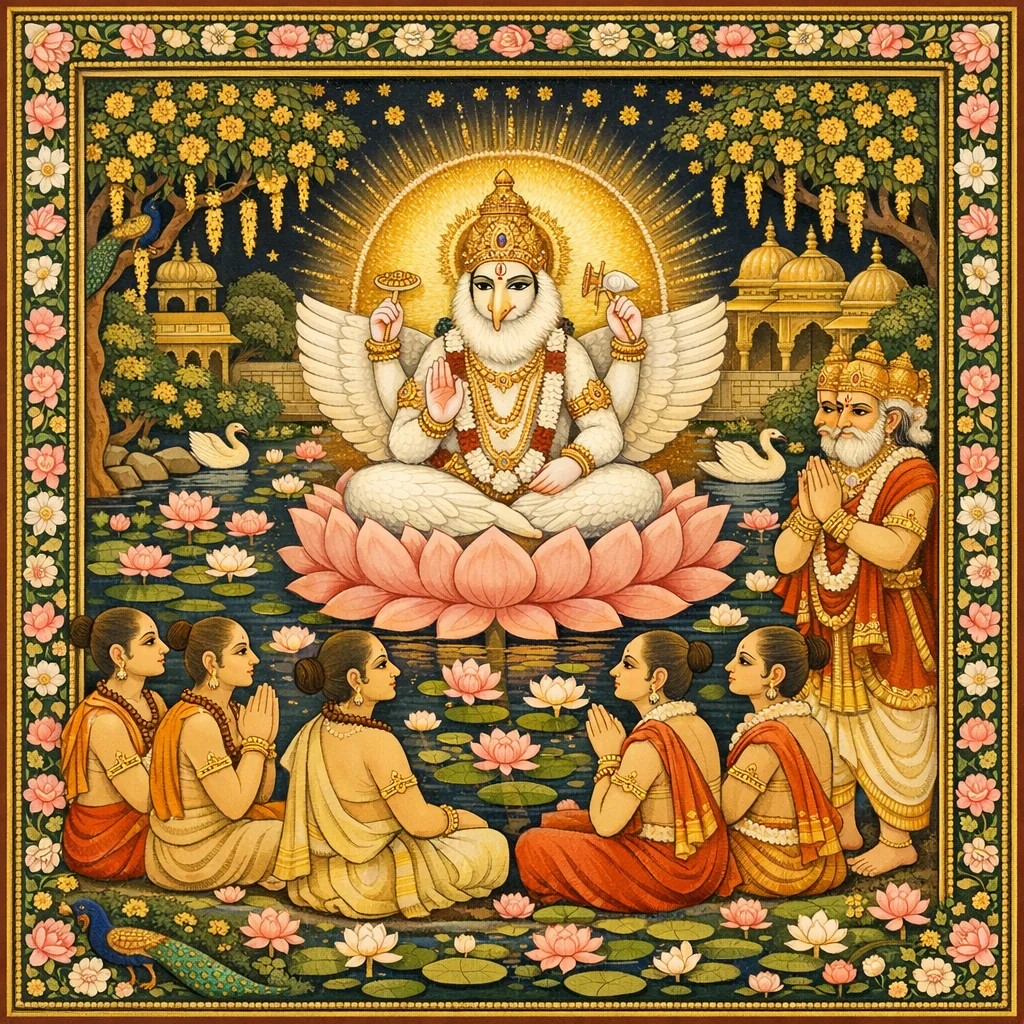
Continuing Kṛṣṇa’s progressive instruction to Uddhava on liberation, this chapter first distinguishes the guṇas as properties of material intelligence rather than the ātman, and teaches a practical ladder: cultivate sattva to subdue rajas and tamas, then transcend even sattva through transcendental goodness (bhakti/śuddha-sattva). Kṛṣṇa lists determinants that intensify guṇas—scripture, water, association, place, time, activities, birth, meditation, mantra-japa, and saṁskāras—urging the seeker to choose sattvic supports until direct self-knowledge awakens. Uddhava then asks why humans chase pleasure despite knowing future misery; Kṛṣṇa explains bondage through misidentification, passion-driven planning, and unrestrained senses, and prescribes renewed mind-control and tri-sandhyā absorption in Him. The narrative shifts to the origin of this yoga: the Sanaka sages question Brahmā, who cannot answer due to creative involvement; Kṛṣṇa appears as Haṁsa and delivers decisive nondual analysis—everything perceived is within Him—culminating in the teaching of the witness beyond waking/dream/sleep (turīya) and the sword of knowledge that severs ahaṅkāra. The sages’ doubts dissolve; they worship, and Haṁsa returns to His abode, setting up subsequent Uddhava-gītā emphases on unwavering remembrance and renunciation grounded in realization.
Shlokas
Verse 1
श्रीभगवानुवाच सत्त्वं रजस्तम इति गुणा बुद्धेर्न चात्मन: । सत्त्वेनान्यतमौ हन्यात् सत्त्वं सत्त्वेन चैव हि ॥ १ ॥
The Supreme Personality of Godhead said: The three modes of material nature, namely goodness, passion and ignorance, pertain to material intelligence and not to the spirit soul. By development of material goodness one can conquer the modes of passion and ignorance, and by cultivation of transcendental goodness one may free oneself even from material goodness.
Verse 2
सत्त्वाद् धर्मो भवेद् वृद्धात् पुंसो मद्भक्तिलक्षण: । सात्त्विकोपासया सत्त्वं ततो धर्म: प्रवर्तते ॥ २ ॥
When the living entity becomes strongly situated in the mode of goodness, then religious principles, characterized by devotional service to Me, become prominent. One can strengthen the mode of goodness by cultivation of those things that are already situated in goodness, and thus religious principles arise.
Verse 3
धर्मो रजस्तमो हन्यात् सत्त्ववृद्धिरनुत्तम: । आशु नश्यति तन्मूलो ह्यधर्म उभये हते ॥ ३ ॥
Religious principles, strengthened by the mode of goodness, destroy the influence of passion and ignorance. When passion and ignorance are overcome, their original cause, irreligion, is quickly vanquished.
Verse 4
आगमोऽप: प्रजा देश: काल: कर्म च जन्म च । ध्यानं मन्त्रोऽथ संस्कारो दशैते गुणहेतव: ॥ ४ ॥
According to the quality of religious scriptures, water, one’s association with one’s children or with people in general, the particular place, the time, activities, birth, meditation, chanting of mantras, and purificatory rituals, the modes of nature become differently prominent.
Verse 5
तत्तत् सात्त्विकमेवैषां यद् यद् वृद्धा: प्रचक्षते । निन्दन्ति तामसं तत्तद् राजसं तदुपेक्षितम् ॥ ५ ॥
Among the ten items I have just mentioned, the great sages who understand Vedic knowledge have praised and recommended those that are in the mode of goodness, criticized and rejected those in the mode of ignorance, and shown indifference to those in the mode of passion.
Verse 6
सात्त्विकान्येव सेवेत पुमान् सत्त्वविवृद्धये । ततो धर्मस्ततो ज्ञानं यावत् स्मृतिरपोहनम् ॥ ६ ॥
Until one revives one’s direct knowledge of the spirit soul and drives away the illusory identification with the material body and mind caused by the three modes of nature, one must cultivate those things in the mode of goodness. By increasing the mode of goodness, one automatically can understand and practice religious principles, and by such practice transcendental knowledge is awakened.
Verse 7
वेणुसङ्घर्षजो वह्निर्दग्ध्वा शाम्यति तद्वनम् । एवं गुणव्यत्ययजो देह: शाम्यति तत्क्रिय: ॥ ७ ॥
In a bamboo forest the wind sometimes rubs the bamboo stalks together, and such friction generates a blazing fire that consumes the very source of its birth, the bamboo forest. Thus, the fire is automatically calmed by its own action. Similarly, by the competition and interaction of the material modes of nature, the subtle and gross material bodies are generated. If one uses his mind and body to cultivate knowledge, then such enlightenment destroys the influence of the modes of nature that generated one’s body. Thus, like the fire, the body and mind are pacified by their own actions in destroying the source of their birth.
Verse 8
श्रीउद्धव उवाच विदन्ति मर्त्या: प्रायेण विषयान् पदमापदाम् । तथापि भुञ्जते कृष्ण तत्कथं श्वखराजवत् ॥ ८ ॥
Śrī Uddhava said: My dear Kṛṣṇa, generally human beings know that material life brings great future unhappiness, and still they try to enjoy material life. My dear Lord, how can one in knowledge act just like a dog, an ass or a goat?
Verse 9
श्रीभगवानुवाच अहमित्यन्यथाबुद्धि: प्रमत्तस्य यथा हृदि । उत्सर्पति रजो घोरं ततो वैकारिकं मन: ॥ ९ ॥ रजोयुक्तस्य मनस: सङ्कल्प: सविकल्पक: । तत: कामो गुणध्यानाद् दु:सह: स्याद्धि दुर्मते: ॥ १० ॥
The Supreme Personality of Godhead said: My dear Uddhava, a person bereft of intelligence first falsely identifies himself with the material body and mind, and when such false knowledge arises within one’s consciousness, material passion, the cause of great suffering, pervades the mind, which by nature is situated in goodness. Then the mind, contaminated by passion, becomes absorbed in making and changing many plans for material advancement. Thus, by constantly thinking of the modes of material nature, a foolish person is afflicted with unbearable material desires.
Verse 10
श्रीभगवानुवाच अहमित्यन्यथाबुद्धि: प्रमत्तस्य यथा हृदि । उत्सर्पति रजो घोरं ततो वैकारिकं मन: ॥ ९ ॥ रजोयुक्तस्य मनस: सङ्कल्प: सविकल्पक: । तत: कामो गुणध्यानाद् दु:सह: स्याद्धि दुर्मते: ॥ १० ॥
The Supreme Personality of Godhead said: My dear Uddhava, a person bereft of intelligence first falsely identifies himself with the material body and mind, and when such false knowledge arises within one’s consciousness, material passion, the cause of great suffering, pervades the mind, which by nature is situated in goodness. Then the mind, contaminated by passion, becomes absorbed in making and changing many plans for material advancement. Thus, by constantly thinking of the modes of material nature, a foolish person is afflicted with unbearable material desires.
Verse 11
करोति कामवशग: कर्माण्यविजितेन्द्रिय: । दु:खोदर्काणि सम्पश्यन् रजोवेगविमोहित: ॥ ११ ॥
One who does not control the material senses comes under the control of material desires and is thus bewildered by the strong waves of the mode of passion. Such a person executes material activities, although clearly seeing that the result will be future unhappiness.
Verse 12
रजस्तमोभ्यां यदपि विद्वान् विक्षिप्तधी: पुन: । अतन्द्रितो मनो युञ्जन् दोषदृष्टिर्न सज्जते ॥ १२ ॥
Although the intelligence of a learned person may be bewildered by the modes of passion and ignorance, he should again carefully bring the mind under control. By clearly seeing the contamination of the modes of nature, he does not become attached.
Verse 13
अप्रमत्तोऽनुयुञ्जीत मनो मय्यर्पयञ्छनै: । अनिर्विण्णो यथाकालं जितश्वासो जितासन: ॥ १३ ॥
A person should be attentive and grave and never lazy or morose. Mastering the yoga procedures of breathing and sitting properly, one should practice fixing the mind on Me at dawn, noon and sunset, and thus gradually the mind should be completely absorbed in Me.
Verse 14
एतावान् योग आदिष्टो मच्छिष्यै: सनकादिभि: । सर्वतो मन आकृष्य मय्यद्धावेश्यते यथा ॥ १४ ॥
The actual yoga system as taught by My devotees, headed by Sanaka-kumāra, is simply this: Having withdrawn the mind from all other objects, one should directly and appropriately absorb it in Me.
Verse 15
श्रीउद्धव उवाच यदा त्वं सनकादिभ्यो येन रूपेण केशव । योगमादिष्टवानेतद् रूपमिच्छामि वेदितुम् ॥ १५ ॥
Śrī Uddhava said: My dear Keśava, at what time and in what form did You instruct the science of yoga to Sanaka and his brothers? I now desire to know about these things.
Verse 16
श्रीभगवानुवाच पुत्रा हिरण्यगर्भस्य मानसा: सनकादय: । पप्रच्छु: पितरं सूक्ष्मां योगस्यैकान्तिकीं गतिम् ॥ १६ ॥
The Supreme Personality of Godhead said: Once, the mental sons of Lord Brahmā, namely, the sages headed by Sanaka, inquired from their father about the difficult subject matter of the supreme goal of yoga.
Verse 17
सनकादय ऊचु: गुणेष्वाविशते चेतो गुणाश्चेतसि च प्रभो । कथमन्योन्यसन्त्यागो मुमुक्षोरतितितीर्षो: ॥ १७ ॥
The sages headed by Sanaka said: O Lord, people’s minds are naturally attracted to material sense objects, and similarly the sense objects in the form of desire enter within the mind. Therefore, how can a person who desires liberation, who desires to cross over activities of sense gratification, destroy this mutual relationship between the sense objects and the mind? Please explain this to us.
Verse 18
श्रीभगवानुवाच एवं पृष्टो महादेव: स्वयम्भूर्भूतभावन: । ध्यायमान: प्रश्नबीजं नाभ्यपद्यत कर्मधी: ॥ १८ ॥
The Supreme Personality of Godhead said: My dear Uddhava, Brahmā himself, who is born directly from the body of the Lord and who is the creator of all living entities within the material world, being the best of the demigods, seriously contemplated the question of his sons headed by Sanaka. The intelligence of Brahmā, however, was affected by his own activities of creation, and thus he could not discover the essential answer to this question.
Verse 19
स मामचिन्तयद् देव: प्रश्नपारतितीर्षया । तस्याहं हंसरूपेण सकाशमगमं तदा ॥ १९ ॥
Lord Brahmā desired to attain the answer to the question that was puzzling him, and thus he fixed his mind on Me, the Supreme Lord. At that time, in My form of Haṁsa, I became visible to Lord Brahmā.
Verse 20
दृष्ट्वा मां त उपव्रज्य कृत्वा पादाभिवन्दनम् । ब्रह्माणमग्रत: कृत्वा पप्रच्छु: को भवानिति ॥ २० ॥
Thus seeing Me, the sages, placing Brahmā in the lead, came forward and worshiped My lotus feet. Then they frankly asked Me, “Who are You?”
Verse 21
इत्यहं मुनिभि: पृष्टस्तत्त्वजिज्ञासुभिस्तदा । यदवोचमहं तेभ्यस्तदुद्धव निबोध मे ॥ २१ ॥
My dear Uddhava, the sages, being eager to understand the ultimate truth of the yoga system, thus inquired from Me. Now please hear as I explain that which I spoke unto the sages.
Verse 22
वस्तुनो यद्यनानात्व आत्मन: प्रश्न ईदृश: । कथं घटेत वो विप्रा वक्तुर्वा मे क आश्रय: ॥ २२ ॥
My dear brāhmaṇas, if, when asking Me who I am, you believe that I am also a jīva soul and that there is no ultimate difference between us — since all souls are ultimately one without individuality — then how is your question possible or appropriate? Ultimately, what is the real situation or resting place both of yourselves and of Me?
Verse 23
पञ्चात्मकेषु भूतेषु समानेषु च वस्तुत: । को भवानिति व: प्रश्नो वाचारम्भो ह्यनर्थक: ॥ २३ ॥
If by asking Me “Who are You?” you were referring to the material body, then I must point out that all material bodies are constituted of five elements, namely earth, water, fire, air and ether. Thus, you should have asked, “Who are you five?” If you consider that all material bodies are ultimately one, being constituted essentially of the same elements, then your question is still meaningless, since there would be no deep purpose in distinguishing one body from another. Thus, it appears that in asking My identity, you are merely speaking words, without any real meaning or purpose.
Verse 24
मनसा वचसा दृष्ट्या गृह्यतेऽन्यैरपीन्द्रियै: । अहमेव न मत्तोऽन्यदिति बुध्यध्वमञ्जसा ॥ २४ ॥
Within this world, whatever is perceived by the mind, speech, eyes or other senses is Me alone and nothing besides Me. All of you please understand this by a straightforward analysis of the facts.
Verse 25
गुणेष्वाविशते चेतो गुणाश्चेतसि च प्रजा: । जीवस्य देह उभयं गुणाश्चेतो मदात्मन: ॥ २५ ॥
My dear sons, the mind has a natural proclivity to enter into the material sense objects, and similarly the sense objects enter into the mind; but both this material mind and the sense objects are merely designations that cover the spirit soul, who is part and parcel of Me.
Verse 26
गुणेषु चाविशच्चित्तमभीक्ष्णं गुणसेवया । गुणाश्च चित्तप्रभवा मद्रूप उभयं त्यजेत् ॥ २६ ॥
A person who has thus achieved Me by understanding that he is not different from Me realizes that the material mind is lodged within the sense objects because of constant sense gratification, and that the material objects are existing prominently within the material mind. Having understood My transcendental nature, he gives up both the material mind and its objects.
Verse 27
जाग्रत् स्वप्न: सुषुप्तं च गुणतो बुद्धिवृत्तय: । तासां विलक्षणो जीव: साक्षित्वेन विनिश्चित: ॥ २७ ॥
Waking, sleeping and deep sleep are the three functions of the intelligence and are caused by the modes of material nature. The living entity within the body is ascertained to possess characteristics different from these three states and thus remains as a witness to them.
Verse 28
यर्हि संसृतिबन्धोऽयमात्मनो गुणवृत्तिद: । मयि तुर्ये स्थितो जह्यात् त्यागस्तद् गुणचेतसाम् ॥ २८ ॥
The spirit soul is trapped in the bondage of material intelligence, which awards him constant engagement in the illusory modes of nature. But I am the fourth stage of consciousness, beyond wakefulness, dreaming and deep sleep. Becoming situated in Me, the soul should give up the bondage of material consciousness. At that time, the living entity will automatically renounce the material sense objects and the material mind.
Verse 29
अहङ्कारकृतं बन्धमात्मनोऽर्थविपर्ययम् । विद्वान् निर्विद्य संसारचिन्तां तुर्ये स्थितस्त्यजेत् ॥ २९ ॥
The false ego of the living entity places him in bondage and awards him exactly the opposite of what he really desires. Therefore, an intelligent person should give up his constant anxiety to enjoy material life and remain situated in the Lord, who is beyond the functions of material consciousness.
Verse 30
यावन्नानार्थधी: पुंसो न निवर्तेत युक्तिभि: । जागर्त्यपि स्वपन्नज्ञ: स्वप्ने जागरणं यथा ॥ ३० ॥
According to My instructions, one should fix the mind on Me alone. If, however, one continues to see many different values and goals in life rather than seeing everything within Me, then although apparently awake, one is actually dreaming due to incomplete knowledge, just as one may dream that one has wakened from a dream.
Verse 31
असत्त्वादात्मनोऽन्येषां भावानां तत्कृता भिदा । गतयो हेतवश्चास्य मृषा स्वप्नदृशो यथा ॥ ३१ ॥
Those states of existence that are conceived of as separate from the Supreme Personality of Godhead have no actual existence, although they create a sense of separation from the Absolute Truth. Just as the seer of a dream imagines many different activities and rewards, similarly, because of the sense of an existence separate from the Lord’s existence, the living entity falsely performs fruitive activities, thinking them to be the cause of future rewards and destinations.
Verse 32
यो जागरे बहिरनुक्षणधर्मिणोऽर्थान् भुङ्क्ते समस्तकरणैर्हृदि तत्सदृक्षान् । स्वप्ने सुषुप्त उपसंहरते स एक: स्मृत्यन्वयात्त्रिगुणवृत्तिदृगिन्द्रियेश: ॥ ३२ ॥
While awake the living entity enjoys with all of his senses the fleeting characteristics of the material body and mind; while dreaming he enjoys similar experiences within the mind; and in deep dreamless sleep all such experiences merge into ignorance. By remembering and contemplating the succession of wakefulness, dreaming and deep sleep, the living entity can understand that he is one throughout the three stages of consciousness and is transcendental. Thus, he becomes the lord of the senses.
Verse 33
एवं विमृश्य गुणतो मनसस्त्र्यवस्था मन्मायया मयि कृता इति निश्चितार्था: । सञ्छिद्य हार्दमनुमानसदुक्तितीक्ष्ण- ज्ञानासिना भजत माखिलसंशयाधिम् ॥ ३३ ॥
You should consider how, by the influence of My illusory energy, these three states of the mind, caused by the modes of nature, have been artificially imagined to exist in Me. Having definitely ascertained the truth of the soul, you should utilize the sharpened sword of knowledge, acquired by logical reflection and from the instructions of sages and Vedic literatures, to completely cut off the false ego, which is the breeding ground of all doubts. All of you should then worship Me, who am situated within the heart.
Verse 34
ईक्षेत विभ्रममिदं मनसो विलासं दृष्टं विनष्टमतिलोलमलातचक्रम् । विज्ञानमेकमुरुधेव विभाति माया स्वप्नस्त्रिधा गुणविसर्गकृतो विकल्प: ॥ ३४ ॥
One should see that the material world is a distinct illusion appearing in the mind, because material objects have an extremely flickering existence and are here today and gone tomorrow. They can be compared to the streaking red line created by whirling a fiery stick. The spirit soul by nature exists in the single state of pure consciousness. However, in this world he appears in many different forms and stages of existence. The modes of nature divide the soul’s consciousness into normal wakefulness, dreaming and dreamless sleep. All such varieties of perception, however, are actually māyā and exist only like a dream.
Verse 35
दृष्टिं तत: प्रतिनिवर्त्य निवृत्ततृष्ण- स्तूष्णीं भवेन्निजसुखानुभवो निरीह: सन्दृश्यते क्व च यदीदमवस्तुबुद्ध्या त्यक्तं भ्रमाय न भवेत् स्मृतिरानिपातात् ॥ ३५ ॥
Having understood the temporary illusory nature of material things, and thus having pulled one’s vision away from illusion, one should remain without material desires. By experiencing the happiness of the soul, one should give up material speaking and activities. If sometimes one must observe the material world, one should remember that it is not ultimate reality and therefore one has given it up. By such constant remembrance up till the time of death, one will not again fall into illusion.
Verse 36
देहं च नश्वरमवस्थितमुत्थितं वा सिद्धो न पश्यति यतोऽध्यगमत् स्वरूपम् । दैवादपेतमथ दैववशादुपेतं वासो यथा परिकृतं मदिरामदान्ध: ॥ ३६ ॥
Just as a drunken man does not notice if he is wearing his coat or shirt, similarly, one who is perfect in self-realization and who has thus achieved his eternal identity does not notice whether the temporary body is sitting or standing. Indeed, if by God’s will the body is finished or if by God’s will he obtains a new body, a self-realized soul does not notice, just as a drunken man does not notice the situation of his outward dress.
Verse 37
देहोऽपि दैववशग: खलु कर्म यावत् स्वारम्भकं प्रतिसमीक्षत एव सासु: । तं सप्रपञ्चमधिरूढसमाधियोग: स्वाप्नं पुनर्न भजते प्रतिबुद्धवस्तु: ॥ ३७ ॥
The material body certainly moves under the control of supreme destiny and therefore must continue to live along with the senses and vital air as long as one’s karma is in effect. A self-realized soul, however, who is awakened to the absolute reality and who is thus highly situated in the perfect stage of yoga, will never again surrender to the material body and its manifold manifestations, knowing it to be just like a body visualized in a dream.
Verse 38
मयैतदुक्तं वो विप्रा गुह्यं यत् साङ्ख्ययोगयो: । जानीत मागतं यज्ञं युष्मद्धर्मविवक्षया ॥ ३८ ॥
My dear brāhmaṇas, I have now explained to you the confidential knowledge of Sāṅkhya, by which one philosophically distinguishes matter from spirit, and of aṣṭāṅga-yoga, by which one links up with the Supreme. Please understand that I am the Supreme Personality of Godhead, Viṣṇu, and that I have appeared before you desiring to explain your actual religious duties.
Verse 39
अहं योगस्य सांख्यस्य सत्यस्यर्तस्य तेजस: । परायणं द्विजश्रेष्ठा: श्रिय: कीर्तेर्दमस्य च ॥ ३९ ॥
O best of the brāhmaṇas, please know that I am the supreme shelter of the yoga system, analytic philosophy, virtuous action, truthful religious principles, power, beauty, fame and self-control.
Verse 40
मां भजन्ति गुणा: सर्वे निर्गुणं निरपेक्षकम् । सुहृदं प्रियमात्मानं साम्यासङ्गादयोऽगुणा: ॥ ४० ॥
All superior transcendental qualities, such as being beyond the modes of nature, detached, the well-wisher, the most dear, the Supersoul, equally situated everywhere, and free from material entanglement — all such qualities, free from the transformations of material qualities, find their shelter and worshipable object in Me.
Verse 41
इति मे छिन्नसन्देहा मुनय: सनकादय: । सभाजयित्वा परया भक्त्यागृणत संस्तवै: ॥ ४१ ॥
[Lord Kṛṣṇa continued:] My dear Uddhava, thus all of the doubts of the sages headed by Sanaka were destroyed by My words. Fully worshiping Me with transcendental love and devotion, they chanted My glories with excellent hymns.
Verse 42
तैरहं पूजित: सम्यक् संस्तुत: परमर्षिभि: । प्रत्येयाय स्वकं धाम पश्यत: परमेष्ठिन: ॥ ४२ ॥
The greatest of sages, headed by Sanaka Ṛṣi, thus perfectly worshiped and glorified Me, and as Lord Brahmā looked on, I returned to My own abode.
Frequently Asked Questions
It teaches a staged method: since guṇas affect material intelligence (buddhi) rather than the ātman, one should first cultivate sattva through sattvic supports (śāstra, saṅga, mantra, saṁskāra, etc.) to overcome rajas and tamas. When sattva strengthens, dharma characterized by devotion becomes prominent; then, by absorption in the Lord (bhakti/śuddha-sattva), one transcends even material goodness and awakens direct self-knowledge.
Haṁsa is the Lord’s instructing manifestation who appears when Brahmā, unable to resolve the Kumāras’ question due to involvement in creation, turns his mind to the Supreme. Haṁsa teaches the essential yoga: withdraw the mind from objects and fix it directly in the Lord, cutting false ego and dissolving the imagined separation between seer, mind, and sense objects.
Kṛṣṇa explains that misidentification with body and mind generates false knowledge, after which rajas invades the mind and drives incessant planning for material advancement. Uncontrolled senses place one under the rule of desire, so one acts despite foreseeing future misery. The remedy is renewed vigilance, breath-and-posture discipline, and repeated absorption in the Lord, especially at the three sandhyās.
They are described as functions of intelligence shaped by guṇas. The ātman is the consistent witness across all three, and the Lord is presented as turīya—the fourth reality beyond them. By reflecting on the succession of states, one recognizes oneself as transcendental to them, gains mastery over the senses, and renounces the mind–object entanglement.