Adhyaya 30
The Disappearance of the Yadu Dynasty and Lord Kṛṣṇa’s Departure
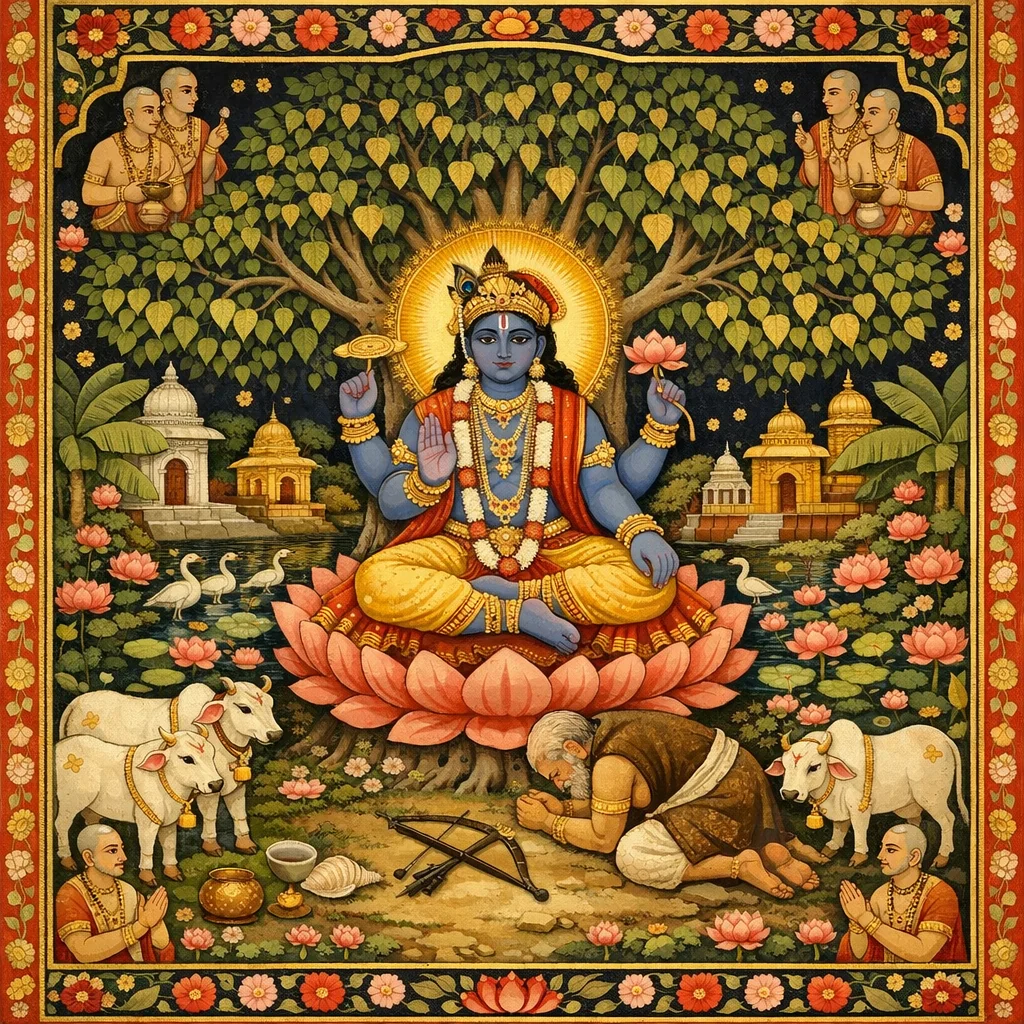
Continuing after Uddhava’s departure, Parīkṣit asks how Kṛṣṇa could conclude His manifest presence despite His incomparable beauty and liberating darśana. Śukadeva describes ominous portents over Dvārakā, prompting Kṛṣṇa to convene the Yadus in Sudharmā and order an immediate move to Prabhāsa for expiation, worship of devas, brāhmaṇas, and cows, and ritual purification. Yet, by providence (daiva) and yogamāyā, the Yādavas become intoxicated, quarrel, and slaughter one another—fulfilling the brāhmaṇas’ curse like a bamboo-forest fire consuming itself. Balarāma withdraws through meditation, and Kṛṣṇa sits beneath a pippala tree revealing His four-armed effulgent form. The hunter Jarā, mistaking the Lord’s foot for a deer, wounds Him with an arrow made from the remaining iron fragment of Sāmba’s club; Jarā repents, and Kṛṣṇa absolves and elevates him. Dāruka finds the Lord, witnesses the divine chariot and weapons ascend, and is instructed to inform the family, leave Dvārakā before the ocean inundation, and take all to Indraprastha under Arjuna—thus setting up the transition to the aftermath and the next narrative phase.
Shlokas
Verse 1
श्रीराजोवाच ततो महाभागवत उद्धवे निर्गते वनम् । द्वारवत्यां किमकरोद् भगवान् भूतभावन: ॥ १ ॥
King Parīkṣit said: After the great devotee Uddhava left for the forest, what did the Supreme Personality of Godhead, the protector of all living beings, do in the city of Dvārakā?
Verse 2
ब्रह्मशापोपसंसृष्टे स्वकुले यादवर्षभ: । प्रेयसीं सर्वनेत्राणां तनुं स कथमत्यजत् ॥ २ ॥
After His own dynasty met destruction from the curse of the brāhmaṇas, how could the best of the Yadus give up His body, the dearmost object of all eyes?
Verse 3
प्रत्याक्रष्टुं नयनमबला यत्र लग्नं न शेकु: कर्णाविष्टं न सरति ततो यत् सतामात्मलग्नम् । यच्छ्रीर्वाचां जनयति रतिं किं नु मानं कवीनां दृष्ट्वा जिष्णोर्युधि रथगतं यच्च तत्साम्यमीयु: ॥ ३ ॥
Once their eyes were fixed upon His transcendental form, women were unable to withdraw them, and once that form had entered the ears of the sages and become fixed in their hearts, it would never depart. What to speak of acquiring fame, the great poets who described the beauty of the Lord’s form would have their words invested with transcendentally pleasing attraction. And by seeing that form on Arjuna’s chariot, all the warriors on the battlefield of Kurukṣetra attained the liberation of gaining a spiritual body similar to the Lord’s.
Verse 4
श्री ऋषिरुवाच दिवि भुव्यन्तरिक्षे च महोत्पातान् समुत्थितान् । दृष्ट्वासीनान् सुधर्मायां कृष्ण: प्राह यदूनिदम् ॥ ४ ॥
Śukadeva Gosvāmī said: Having observed many disturbing signs in the sky, on the earth and in outer space, Lord Kṛṣṇa addressed the Yadus assembled in the Sudharmā council hall as follows.
Verse 5
श्रीभगवानुवाच एते घोरा महोत्पाता द्वार्वत्यां यमकेतव: । मुहूर्तमपि न स्थेयमत्र नो यदुपुङ्गवा: ॥ ५ ॥
The Supreme Personality of Godhead said: O leaders of the Yadu dynasty, please note all these terrible omens that have appeared in Dvārakā just like the flags of death. We should not remain here a moment longer.
Verse 6
स्त्रियो बालाश्च वृद्धाश्च शङ्खोद्धारं व्रजन्त्वित: । वयं प्रभासं यास्यामो यत्र प्रत्यक् सरस्वती ॥ ६ ॥
The women, children and old men should leave this city and go to Śaṅkhoddhāra. We shall go to Prabhāsa-kṣetra, where the river Sarasvatī flows toward the west.
Verse 7
तत्राभिषिच्य शुचय उपोष्य सुसमाहिता: । देवता: पूजयिष्याम: स्नपनालेपनार्हणै: ॥ ७ ॥
There we should bathe for purification, fast, and fix our minds in meditation. We should then worship the demigods by bathing their images, anointing them with sandalwood pulp, and presenting them various offerings.
Verse 8
ब्राह्मणांस्तु महाभागान् कृतस्वस्त्ययना वयम् । गोभूहिरण्यवासोभिर्गजाश्वरथवेश्मभि: ॥ ८ ॥
After performing the expiatory rituals with the help of greatly fortunate brāhmaṇas, we will worship those brāhmaṇas by offering them cows, land, gold, clothing, elephants, horses, chariots and dwelling places.
Verse 9
विधिरेष ह्यरिष्टघ्नो मङ्गलायनमुत्तमम् । देवद्विजगवां पूजा भूतेषु परमो भव: ॥ ९ ॥
This is indeed the appropriate process for counteracting our imminent adversity, and it is sure to bring about the highest good fortune. Such worship of the demigods, brāhmaṇas and cows can earn the highest birth for all living entities.
Verse 10
इति सर्वे समाकर्ण्य यदुवृद्धा मधुद्विष: । तथेति नौभिरुत्तीर्य प्रभासं प्रययू रथै: ॥ १० ॥
Having heard these words from Lord Kṛṣṇa, the enemy of Madhu, the elders of the Yadu dynasty gave their assent, saying, “So be it.” After crossing over the ocean in boats, they proceeded on chariots to Prabhāsa.
Verse 11
तस्मिन् भगवतादिष्टं यदुदेवेन यादवा: । चक्रु: परमया भक्त्या सर्वश्रेयोपबृंहितम् ॥ ११ ॥
There, with great devotion, the Yādavas performed the religious ceremonies according to the instructions of the Supreme Personality of Godhead, their personal Lord. They also performed various other auspicious rituals.
Verse 12
ततस्तस्मिन् महापानं पपुर्मैरेयकं मधु । दिष्टविभ्रंशितधियो यद्द्रवैर्भ्रश्यते मति: ॥ १२ ॥
Then, their intelligence covered by Providence, they liberally indulged in drinking the sweet maireya beverage, which can completely intoxicate the mind.
Verse 13
महापानाभिमत्तानां वीराणां दृप्तचेतसाम् । कृष्णमायाविमूढानां सङ्घर्ष: सुमहानभूत् ॥ १३ ॥
The heroes of the Yadu dynasty became intoxicated from their extravagant drinking and began to feel arrogant. When they were thus bewildered by the personal potency of Lord Kṛṣṇa, a terrible quarrel arose among them.
Verse 14
युयुधु: क्रोधसंरब्धा वेलायामाततायिन: । धनुर्भिरसिभिर्भल्लैर्गदाभिस्तोमरर्ष्टिभि: ॥ १४ ॥
Infuriated, they seized their bows and arrows, swords, bhallas, clubs, lances and spears and attacked one another on the shore of the ocean.
Verse 15
पतत्पताकै रथकुञ्जरादिभि: खरोष्ट्रगोभिर्महिषैर्नरैरपि । मिथ: समेत्याश्वतरै: सुदुर्मदा न्यहन्शरैर्दद्भिरिव द्विपा वने ॥ १५ ॥
Riding on elephants and chariots with flags flying, and also on donkeys, camels, bulls, buffalos, mules and even human beings, the extremely enraged warriors came together and violently attacked one another with arrows, just as elephants in the forest attack one another with their tusks.
Verse 16
प्रद्युम्नसाम्बौ युधि रूढमत्सराव्- अक्रूरभोजावनिरुद्धसात्यकी । सुभद्रसङ्ग्रामजितौ सुदारुणौ गदौ सुमित्रासुरथौ समीयतु: ॥ १६ ॥
Their mutual enmity aroused, Pradyumna fought fiercely against Sāmba, Akrūra against Kuntibhoja, Aniruddha against Sātyaki, Subhadra against Saṅgrāmajit, Sumitra against Suratha, and the two Gadas against each other.
Verse 17
अन्ये च ये वै निशठोल्मुकादय: सहस्रजिच्छतजिद्भानुमुख्या: । अन्योन्यमासाद्य मदान्धकारिता जघ्नुर्मुकुन्देन विमोहिता भृशम् ॥ १७ ॥
Others also, such as Niśaṭha, Ulmuka, Sahasrajit, Śatajit and Bhānu, confronted and killed one another, being blinded by intoxication and thus completely bewildered by Lord Mukunda Himself.
Verse 18
दाशार्हवृष्ण्यन्धकभोजसात्वता मध्वर्बुदा माथुरशूरसेना: । विसर्जना: कुकुरा: कुन्तयश्च मिथस्तु जघ्नु: सुविसृज्य सौहृदम् ॥ १८ ॥
Completely abandoning their natural friendship, the members of the various Yadu clans — the Dāśārhas, Vṛṣṇis and Andhakas, the Bhojas, Sātvatas, Madhus and Arbudas, the Māthuras, Śūrasenas, Visarjanas, Kukuras and Kuntis — all slaughtered one another.
Verse 19
पुत्रा अयुध्यन् पितृभिर्भ्रातृभिश्च स्वस्रीयदौहित्रपितृव्यमातुलै: । मित्राणि मित्रै: सुहृद: सुहृद्भि- र्ज्ञातींस्त्वहन् ज्ञातय एव मूढा: ॥ १९ ॥
Thus bewildered, sons fought with fathers, brothers with brothers, nephews with paternal and maternal uncles, and grandsons with grandfathers. Friends fought with friends, and well-wishers with well-wishers. In this way intimate friends and relatives all killed one another.
Verse 20
शरेषु हीयमानेषु भज्यमानेसु धन्वसु । शस्त्रेषु क्षीयमानेषु मुष्टिभिर्जह्रुरेरका: ॥ २० ॥
When all their bows had been broken and their arrows and other missiles spent, they seized the tall stalks of cane with their bare hands.
Verse 21
ता वज्रकल्पा ह्यभवन् परिघा मुष्टिना भृता: । जघ्नुर्द्विषस्तै: कृष्णेन वार्यमाणास्तु तं च ते ॥ २१ ॥
As soon as they took these cane stalks in their fists, the stalks changed into iron rods as hard as thunderbolts. With these weapons the warriors began attacking one another again and again, and when Lord Kṛṣṇa tried to stop them they attacked Him as well.
Verse 22
प्रत्यनीकं मन्यमाना बलभद्रं च मोहिता: । हन्तुं कृतधियो राजन्नापन्ना आततायिन: ॥ २२ ॥
In their confused state, O King, they also mistook Lord Balarāma for an enemy. Weapons in hand, they ran toward Him with the intention of killing Him.
Verse 23
अथ तावपि सङ्क्रुद्धावुद्यम्य कुरुनन्दन । एरकामुष्टिपरिघौ चरन्तौ जघ्नतुर्युधि ॥ २३ ॥
O son of the Kurus, Kṛṣṇa and Balarāma then became very angry. Picking up cane stalks, They moved about within the battle and began to kill with these clubs.
Verse 24
ब्रह्मशापोपसृष्टानां कृष्णमायावृतात्मनाम् । स्पर्धाक्रोध: क्षयं निन्ये वैणवोऽग्निर्यथा वनम् ॥ २४ ॥
The violent anger of these warriors, who were overcome by the brāhmaṇas’ curse and bewildered by Lord Kṛṣṇa’s illusory potency, now led them to their annihilation, just as a fire that starts in a bamboo grove destroys the entire forest.
Verse 25
एवं नष्टेषु सर्वेषु कुलेषु स्वेषु केशव: । अवतारितो भुवो भार इति मेनेऽवशेषित: ॥ २५ ॥
When all the members of His own dynasty were thus destroyed, Lord Kṛṣṇa thought to Himself that at last the burden of the earth had been removed.
Verse 26
राम: समुद्रवेलायां योगमास्थाय पौरुषम् । तत्याज लोकं मानुष्यं संयोज्यात्मानमात्मनि ॥ २६ ॥
Lord Balarāma then sat down on the shore of the ocean and fixed Himself in meditation upon the Supreme Personality of Godhead. Merging Himself within Himself, He gave up this mortal world.
Verse 27
रामनिर्याणमालोक्य भगवान् देवकीसुत: । निषसाद धरोपस्थे तुष्णीमासाद्य पिप्पलम् ॥ २७ ॥
Lord Kṛṣṇa, the son of Devakī, having seen the departure of Lord Rāma, sat down silently on the ground under a nearby pippala tree.
Verse 28
बिभ्रच्चतुर्भुजं रूपं भ्राजिष्णु प्रभया स्वया । दिशो वितिमिरा: कुर्वन् विधूम इव पावक: ॥ २८ ॥ श्रीवत्साङ्कं घनश्यामं तप्तहाटकवर्चसम् । कौशेयाम्बरयुग्मेन परिवीतं सुमङ्गलम् ॥ २९ ॥ सुन्दरस्मितवक्त्राब्जं नीलकुन्तलमण्डितम् । पुण्डरीकाभिरामाक्षं स्फुरन्मकरकुण्डलम् ॥ ३० ॥ कटिसूत्रब्रह्मसूत्रकिरीटकटकाङ्गदै: । हारनूपुरमुद्राभि: कौस्तुभेन विराजितम् ॥ ३१ ॥ वनमालापरीताङ्गं मूर्तिमद्भिर्निजायुधै: । कृत्वोरौ दक्षिणे पादमासीनं पङ्कजारुणम् ॥ ३२ ॥
The Lord was exhibiting His brilliantly effulgent four-armed form, the radiance of which, just like a smokeless fire, dissipated the darkness in all directions. His complexion was the color of a dark blue cloud and His effulgence the color of molten gold, and His all-auspicious form bore the mark of Śrīvatsa. A beautiful smile graced His lotus face, locks of dark blue hair adorned His head, His lotus eyes were very attractive, and His shark-shaped earrings glittered. He wore a pair of silken garments, an ornamental belt, the sacred thread, bracelets and arm ornaments, along with a helmet, the Kaustubha jewel, necklaces, anklets and other royal emblems. Encircling His body were flower garlands and His personal weapons in their embodied forms. As He sat He held His left foot, with its lotus-red sole, upon His right thigh.
Verse 29
बिभ्रच्चतुर्भुजं रूपं भ्राजिष्णु प्रभया स्वया । दिशो वितिमिरा: कुर्वन् विधूम इव पावक: ॥ २८ ॥ श्रीवत्साङ्कं घनश्यामं तप्तहाटकवर्चसम् । कौशेयाम्बरयुग्मेन परिवीतं सुमङ्गलम् ॥ २९ ॥ सुन्दरस्मितवक्त्राब्जं नीलकुन्तलमण्डितम् । पुण्डरीकाभिरामाक्षं स्फुरन्मकरकुण्डलम् ॥ ३० ॥ कटिसूत्रब्रह्मसूत्रकिरीटकटकाङ्गदै: । हारनूपुरमुद्राभि: कौस्तुभेन विराजितम् ॥ ३१ ॥ वनमालापरीताङ्गं मूर्तिमद्भिर्निजायुधै: । कृत्वोरौ दक्षिणे पादमासीनं पङ्कजारुणम् ॥ ३२ ॥
The Lord was exhibiting His brilliantly effulgent four-armed form, the radiance of which, just like a smokeless fire, dissipated the darkness in all directions. His complexion was the color of a dark blue cloud and His effulgence the color of molten gold, and His all-auspicious form bore the mark of Śrīvatsa. A beautiful smile graced His lotus face, locks of dark blue hair adorned His head, His lotus eyes were very attractive, and His shark-shaped earrings glittered. He wore a pair of silken garments, an ornamental belt, the sacred thread, bracelets and arm ornaments, along with a helmet, the Kaustubha jewel, necklaces, anklets and other royal emblems. Encircling His body were flower garlands and His personal weapons in their embodied forms. As He sat He held His left foot, with its lotus-red sole, upon His right thigh.
Verse 30
बिभ्रच्चतुर्भुजं रूपं भ्राजिष्णु प्रभया स्वया । दिशो वितिमिरा: कुर्वन् विधूम इव पावक: ॥ २८ ॥ श्रीवत्साङ्कं घनश्यामं तप्तहाटकवर्चसम् । कौशेयाम्बरयुग्मेन परिवीतं सुमङ्गलम् ॥ २९ ॥ सुन्दरस्मितवक्त्राब्जं नीलकुन्तलमण्डितम् । पुण्डरीकाभिरामाक्षं स्फुरन्मकरकुण्डलम् ॥ ३० ॥ कटिसूत्रब्रह्मसूत्रकिरीटकटकाङ्गदै: । हारनूपुरमुद्राभि: कौस्तुभेन विराजितम् ॥ ३१ ॥ वनमालापरीताङ्गं मूर्तिमद्भिर्निजायुधै: । कृत्वोरौ दक्षिणे पादमासीनं पङ्कजारुणम् ॥ ३२ ॥
The Lord was exhibiting His brilliantly effulgent four-armed form, the radiance of which, just like a smokeless fire, dissipated the darkness in all directions. His complexion was the color of a dark blue cloud and His effulgence the color of molten gold, and His all-auspicious form bore the mark of Śrīvatsa. A beautiful smile graced His lotus face, locks of dark blue hair adorned His head, His lotus eyes were very attractive, and His shark-shaped earrings glittered. He wore a pair of silken garments, an ornamental belt, the sacred thread, bracelets and arm ornaments, along with a helmet, the Kaustubha jewel, necklaces, anklets and other royal emblems. Encircling His body were flower garlands and His personal weapons in their embodied forms. As He sat He held His left foot, with its lotus-red sole, upon His right thigh.
Verse 31
बिभ्रच्चतुर्भुजं रूपं भ्राजिष्णु प्रभया स्वया । दिशो वितिमिरा: कुर्वन् विधूम इव पावक: ॥ २८ ॥ श्रीवत्साङ्कं घनश्यामं तप्तहाटकवर्चसम् । कौशेयाम्बरयुग्मेन परिवीतं सुमङ्गलम् ॥ २९ ॥ सुन्दरस्मितवक्त्राब्जं नीलकुन्तलमण्डितम् । पुण्डरीकाभिरामाक्षं स्फुरन्मकरकुण्डलम् ॥ ३० ॥ कटिसूत्रब्रह्मसूत्रकिरीटकटकाङ्गदै: । हारनूपुरमुद्राभि: कौस्तुभेन विराजितम् ॥ ३१ ॥ वनमालापरीताङ्गं मूर्तिमद्भिर्निजायुधै: । कृत्वोरौ दक्षिणे पादमासीनं पङ्कजारुणम् ॥ ३२ ॥
The Lord was exhibiting His brilliantly effulgent four-armed form, the radiance of which, just like a smokeless fire, dissipated the darkness in all directions. His complexion was the color of a dark blue cloud and His effulgence the color of molten gold, and His all-auspicious form bore the mark of Śrīvatsa. A beautiful smile graced His lotus face, locks of dark blue hair adorned His head, His lotus eyes were very attractive, and His shark-shaped earrings glittered. He wore a pair of silken garments, an ornamental belt, the sacred thread, bracelets and arm ornaments, along with a helmet, the Kaustubha jewel, necklaces, anklets and other royal emblems. Encircling His body were flower garlands and His personal weapons in their embodied forms. As He sat He held His left foot, with its lotus-red sole, upon His right thigh.
Verse 32
बिभ्रच्चतुर्भुजं रूपं भ्राजिष्णु प्रभया स्वया । दिशो वितिमिरा: कुर्वन् विधूम इव पावक: ॥ २८ ॥ श्रीवत्साङ्कं घनश्यामं तप्तहाटकवर्चसम् । कौशेयाम्बरयुग्मेन परिवीतं सुमङ्गलम् ॥ २९ ॥ सुन्दरस्मितवक्त्राब्जं नीलकुन्तलमण्डितम् । पुण्डरीकाभिरामाक्षं स्फुरन्मकरकुण्डलम् ॥ ३० ॥ कटिसूत्रब्रह्मसूत्रकिरीटकटकाङ्गदै: । हारनूपुरमुद्राभि: कौस्तुभेन विराजितम् ॥ ३१ ॥ वनमालापरीताङ्गं मूर्तिमद्भिर्निजायुधै: । कृत्वोरौ दक्षिणे पादमासीनं पङ्कजारुणम् ॥ ३२ ॥
The Lord was exhibiting His brilliantly effulgent four-armed form, the radiance of which, just like a smokeless fire, dissipated the darkness in all directions. His complexion was the color of a dark blue cloud and His effulgence the color of molten gold, and His all-auspicious form bore the mark of Śrīvatsa. A beautiful smile graced His lotus face, locks of dark blue hair adorned His head, His lotus eyes were very attractive, and His shark-shaped earrings glittered. He wore a pair of silken garments, an ornamental belt, the sacred thread, bracelets and arm ornaments, along with a helmet, the Kaustubha jewel, necklaces, anklets and other royal emblems. Encircling His body were flower garlands and His personal weapons in their embodied forms. As He sat He held His left foot, with its lotus-red sole, upon His right thigh.
Verse 33
मुषलावशेषाय:खण्डकृतेषुर्लुब्धको जरा । मृगास्याकारं तच्चरणं विव्याध मृगशङ्कया ॥ ३३ ॥
Just then a hunter named Jarā, who had approached the place, mistook the Lord’s foot for a deer’s face. Thinking he had found his prey, Jarā pierced the foot with his arrow, which he had fashioned from the remaining iron fragment of Sāmba’s club.
Verse 34
चतुर्भुजं तं पुरुषं दृष्ट्वा स कृतकिल्बिष: । भीत: पपात शिरसा पादयोरसुरद्विष: ॥ ३४ ॥
Then, seeing that four-armed personality, the hunter became terrified of the offense he had committed, and he fell down, placing his head upon the feet of the enemy of the demons.
Verse 35
अजानता कृतमिदं पापेन मधुसूदन । क्षन्तुमर्हसि पापस्य उत्तम:श्लोक मेऽनघ ॥ ३५ ॥
Jarā said: O Lord Madhusūdana, I am a most sinful person. I have committed this act out of ignorance. O purest Lord, O Uttamaḥśloka, please forgive this sinner.
Verse 36
यस्यानुस्मरणं नृणामज्ञानध्वान्तनाशनम् । वदन्ति तस्य ते विष्णो मयासाधु कृतं प्रभो ॥ ३६ ॥
O Lord Viṣṇu, the learned say that for any man, constant remembrance of You will destroy the darkness of ignorance. O master, I have wronged You!
Verse 37
तन्माशु जहि वैकुण्ठ पाप्मानं मृगलुब्धकम् । यथा पुनरहं त्वेवं न कुर्यां सदतिक्रमम् ॥ ३७ ॥
Therefore, O Lord of Vaikuṇṭha, please kill this sinful hunter of animals immediately so he may not again commit such offenses against saintly persons.
Verse 38
यस्यात्मयोगरचितं न विदुर्विरिञ्चो रुद्रादयोऽस्य तनया: पतयो गिरां ये । त्वन्मायया पिहितदृष्टय एतदञ्ज: किं तस्य ते वयमसद्गतयो गृणीम: ॥ ३८ ॥
Neither Brahmā nor his sons, headed by Rudra, nor any of the great sages who are masters of the Vedic mantras can understand the function of Your mystic power. Because Your illusory potency has covered their sight, they remain ignorant of how Your mystic power works. Therefore, what can I, such a low-born person, possibly say?
Verse 39
श्रीभगवानुवाच मा भैर्जरे त्वमुत्तिष्ठ काम एष कृतो हि मे । याहि त्वं मदनुज्ञात: स्वर्गं सुकृतिनां पदम् ॥ ३९ ॥
The Supreme Personality of Godhead said: My dear Jarā, do not fear. Please get up. What has been done is actually My own desire. With My permission, go now to the abode of the pious, the spiritual world.
Verse 40
इत्यादिष्टो भगवता कृष्णेनेच्छाशरीरिणा । त्रि: परिक्रम्य तं नत्वा विमानेन दिवं ययौ ॥ ४० ॥
So instructed by the Supreme Lord Kṛṣṇa, who assumes His transcendental body by His own will, the hunter circumambulated the Lord three times and bowed down to Him. Then the hunter departed in an airplane that had appeared just to carry him to the spiritual sky.
Verse 41
दारुक: कृष्णपदवीमन्विच्छन्नधिगम्य ताम् । वायुं तुलसिकामोदमाघ्रायाभिमुखं ययौ ॥ ४१ ॥
At that time Dāruka was searching for his master, Kṛṣṇa. As he neared the place where the Lord was sitting, he perceived the aroma of tulasī flowers in the breeze and went in its direction.
Verse 42
तं तत्र तिग्मद्युभिरायुधैर्वृतं ह्यश्वत्थमूले कृतकेतनं पतिम् । स्नेहप्लुतात्मा निपपात पादयो रथादवप्लुत्य सबाष्पलोचन: ॥ ४२ ॥
Upon seeing Lord Kṛṣṇa resting at the foot of a banyan tree, surrounded by His shining weapons, Dāruka could not control the affection he felt in his heart. His eyes filled with tears as he rushed down from the chariot and fell at the Lord’s feet.
Verse 43
अपश्यतस्त्वच्चरणाम्बुजं प्रभो दृष्टि: प्रणष्टा तमसि प्रविष्टा । दिशो न जाने न लभे च शान्तिं यथा निशायामुडुपे प्रणष्टे ॥ ४३ ॥
Dāruka said: Just as on a moonless night people are merged into darkness and cannot find their way, now that I have lost sight of Your lotus feet, my Lord, I have lost my vision and am wandering blindly in darkness. I cannot tell my direction, nor can I find any peace.
Verse 44
इति ब्रुवति सूते वै रथो गरुडलाञ्छन: । खमुत्पपात राजेन्द्र साश्वध्वज उदीक्षत: ॥ ४४ ॥
[Śukadeva Gosvāmī continued:] O foremost of kings, while the chariot driver was still speaking, before his very eyes the Lord’s chariot rose up into the sky along with its horses and its flag, which was marked with the emblem of Garuḍa.
Verse 45
तमन्वगच्छन् दिव्यानि विष्णुप्रहरणानि च । तेनातिविस्मितात्मानं सूतमाह जनार्दन: ॥ ४५ ॥
All the divine weapons of Viṣṇu rose up and followed the chariot. The Lord, Janārdana, then spoke to His chariot driver, who was most astonished to see all this.
Verse 46
गच्छ द्वारवतीं सूत ज्ञातीनां निधनं मिथ: । सङ्कर्षणस्य निर्याणं बन्धुभ्यो ब्रूहि मद्दशाम् ॥ ४६ ॥
O driver, go to Dvārakā and tell Our family members how their loved ones destroyed one another. Also tell them of the disappearance of Lord Saṅkarṣaṇa and of My present condition.
Verse 47
द्वारकायां च न स्थेयं भवद्भिश्च स्वबन्धुभि: । मया त्यक्तां यदुपुरीं समुद्र: प्लावयिष्यति ॥ ४७ ॥
You and your relatives should not remain in Dvārakā, the capital of the Yadus, because once I have abandoned that city it will be inundated by the ocean.
Verse 48
स्वं स्वं परिग्रहं सर्वे आदाय पितरौ च न: । अर्जुनेनाविता: सर्व इन्द्रप्रस्थं गमिष्यथ ॥ ४८ ॥
You should all take your own families, together with My parents, and under Arjuna’s protection go to Indraprastha.
Verse 49
त्वं तु मद्धर्ममास्थाय ज्ञाननिष्ठ उपेक्षक: । मन्मायारचितामेतां विज्ञायोपशमं व्रज ॥ ४९ ॥
You, Dāruka, should be firmly situated in devotion to Me, remaining fixed in spiritual knowledge and unattached to material considerations. Understanding these pastimes to be a display of My illusory potency, you should remain peaceful.
Verse 50
इत्युक्तस्तं परिक्रम्य नमस्कृत्य पुन: पुन: । तत्पादौ शीर्ष्ण्युपाधाय दुर्मना: प्रययौ पुरीम् ॥ ५० ॥
Thus ordered, Dāruka circumambulated the Lord and offered obeisances to Him again and again. He placed Lord Kṛṣṇa’s lotus feet upon his head and then with a sad heart went back to the city.
Frequently Asked Questions
Kṛṣṇa frames the move as a response to death-like omens over Dvārakā and prescribes tīrtha-bathing, fasting, meditation, and worship of devas and brāhmaṇas as prāyaścitta. On the theological level, Prabhāsa becomes the stage where the brāhmaṇa-śāpa and the Lord’s yogamāyā converge to conclude the Yadu line and remove the earth’s burden—an instance of nirodha operating within history.
The chapter portrays a providential transformation: when weapons were exhausted, the warriors grabbed cane stalks that became thunderbolt-hard iron rods. This links back to the curse narrative associated with Sāmba’s iron fragment, indicating that the dynasty’s end unfolds through a divinely sanctioned chain of causes—human intoxication and hostility serving as instruments of daiva and yogamāyā.
No in the Bhagavata’s theological framing. Jarā’s arrow strikes the Lord’s foot, but Kṛṣṇa is described as assuming and withdrawing His transcendental body by His own will. The incident functions as a līlā-device completing the curse’s residual iron-fragment thread, while the Lord’s absolution and Jarā’s ascent emphasize Kṛṣṇa’s sovereignty and compassion rather than mortality.
Kṛṣṇa states the act occurred by His own desire and removes Jarā’s fear. The episode teaches that the Lord’s līlā can transform even an apparent offense into purification when accompanied by repentance and surrender. It also safeguards the doctrine that Bhagavān is not subject to karma; instead, His will (icchā) governs the conclusion of His manifest pastimes.
Balarāma’s meditative withdrawal signals the deliberate, orderly closure of the divine mission. It underscores nirodha as conscious retraction rather than defeat and prepares the narrative for Kṛṣṇa’s solitary seated posture, His revealed four-armed form, and the final instructions to Dāruka—ensuring the transition of devotees and the relocation of the Lord’s family under Arjuna.
Kṛṣṇa predicts that once He abandons Dvārakā it will be inundated by the ocean, and He directs the survivors—along with His parents—to relocate under Arjuna’s protection. This instruction links the chapter to the broader Mahābhārata-era polity, ensures poṣaṇa (protection) for devotees, and sets the next narrative step: reporting the catastrophe and managing the aftermath of the Lord’s disappearance.