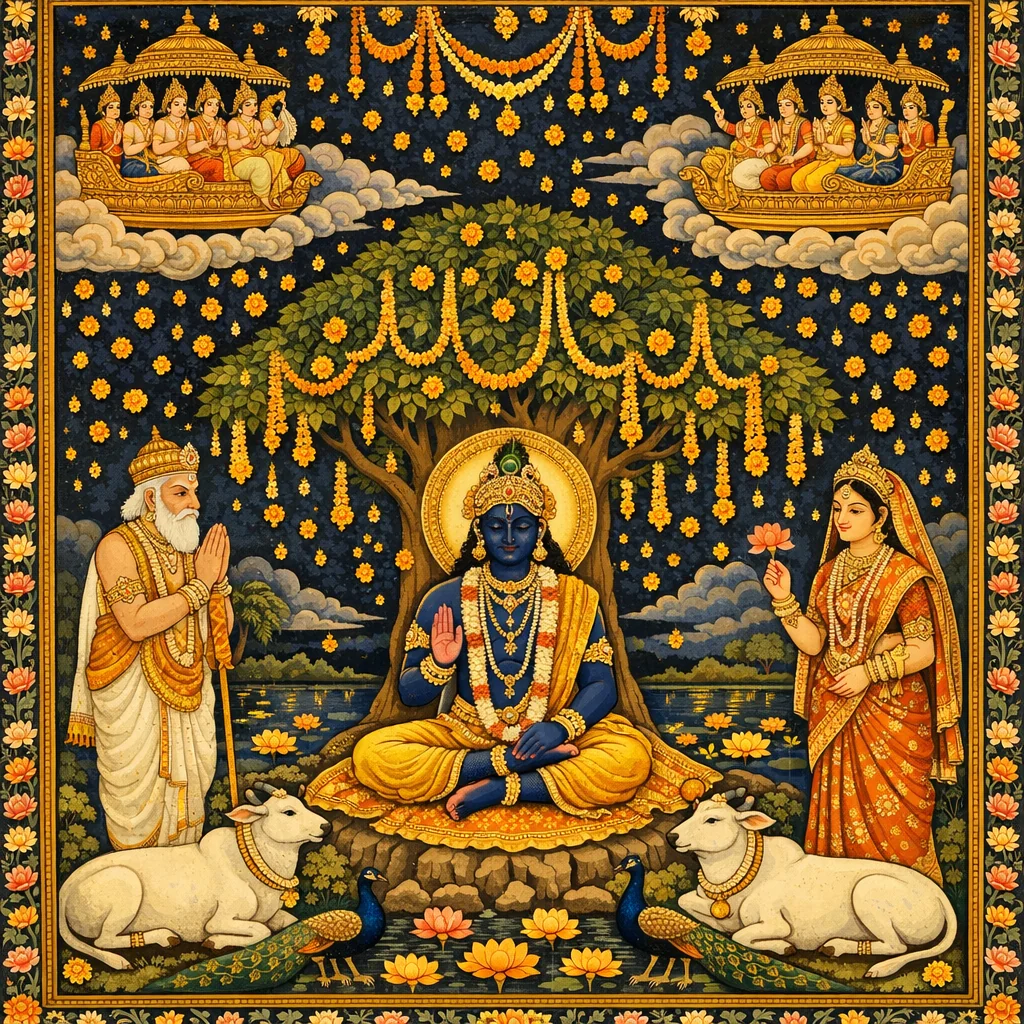
Adhyaya 31
The Disappearance of Lord Śrī Kṛṣṇa and the Aftermath in Dvārakā
Following the Prabhāsa events and the annihilation of the Vṛṣṇis, celestial beings—Brahmā, Śiva, Indra, sages, Pitṛs, Siddhas, Gandharvas and others—assemble to witness the Lord’s return to His own abode. They glorify Śauri’s birth and deeds and shower flowers from their vimānas. Kṛṣṇa, seeing the devas (His empowered expansions), closes His lotus eyes and, without employing the yogic ‘āgneyī’ burning of the body, withdraws His manifest form and enters His own dhāma. With His departure, personified Truth, Dharma, Faithfulness, Glory, and Beauty follow; drums resound and flowers fall. Most devas cannot track His movement, underscoring His acintya-śakti; Brahmā and Śiva partially discern it and praise His mystic potency. Śukadeva clarifies to Parīkṣit that the Lord’s appearance/disappearance is a māyā-like theatrical display, not conditioned mortality. Dāruka reaches Dvārakā and reports the Vṛṣṇi destruction, plunging the city into grief; Devakī, Rohiṇī, and Vasudeva collapse and then depart, while the Yadu wives enter funeral fires, including Kṛṣṇa’s queens. Arjuna performs rites, later escorts survivors to Indraprastha, installs Vajra, and the ocean submerges Dvārakā (saving the Lord’s palace). The chapter closes by prescribing morning remembrance and chanting of these līlās as a direct means to the supreme destination and prema-bhakti—transitioning the narrative toward dynastic succession and the world’s Kali-yuga trajectory.
Shlokas
Verse 1
श्रीशुक उवाच अथ तत्रागमद् ब्रह्मा भवान्या च समं भव: । महेन्द्रप्रमुखा देवा मुनय: सप्रजेश्वरा: ॥ १ ॥
Śukadeva Gosvāmī said: Then Lord Brahmā arrived at Prabhāsa along with Lord Śiva and his consort, the sages, the Prajāpatis and all the demigods, headed by Indra.
Verse 2
पितर: सिद्धगन्धर्वा विद्याधरमहोरगा: । चारणा यक्षरक्षांसि किन्नराप्सरसो द्विजा: ॥ २ ॥ द्रष्टुकामा भगवतो निर्याणं परमोत्सुका: । गायन्तश्च गृणन्तश्च शौरे: कर्माणि जन्म च ॥ ३ ॥
The forefathers, Siddhas, Gandharvas, Vidyādharas and great serpents also came, along with the Cāraṇas, Yakṣas, Rākṣasas, Kinnaras, Apsarās and relatives of Garuḍa, greatly eager to witness the departure of the Supreme Personality of Godhead. As they were coming, all these personalities variously chanted and glorified the birth and activities of Lord Śauri [Kṛṣṇa].
Verse 3
पितर: सिद्धगन्धर्वा विद्याधरमहोरगा: । चारणा यक्षरक्षांसि किन्नराप्सरसो द्विजा: ॥ २ ॥ द्रष्टुकामा भगवतो निर्याणं परमोत्सुका: । गायन्तश्च गृणन्तश्च शौरे: कर्माणि जन्म च ॥ ३ ॥
The forefathers, Siddhas, Gandharvas, Vidyādharas and great serpents also came, along with the Cāraṇas, Yakṣas, Rākṣasas, Kinnaras, Apsarās and relatives of Garuḍa, greatly eager to witness the departure of the Supreme Personality of Godhead. As they were coming, all these personalities variously chanted and glorified the birth and activities of Lord Śauri [Kṛṣṇa].
Verse 4
ववृषु: पुष्पवर्षाणि विमानावलिभिर्नभ: । कुर्वन्त: सङ्कुलं राजन् भक्त्या परमया युता: ॥ ४ ॥
O King, crowding the sky with their many airplanes, they showered down flowers with great devotion.
Verse 5
भगवान् पितामहं वीक्ष्य विभूतीरात्मनो विभु: । संयोज्यात्मनि चात्मानं पद्मनेत्रे न्यमीलयत् ॥ ५ ॥
Seeing before Him Brahmā, the grandfather of the universe, along with the other demigods, who are all His personal and powerful expansions, the Almighty Lord closed His lotus eyes, fixing His mind within Himself, the Supreme Personality of Godhead.
Verse 6
लोकाभिरामां स्वतनुं धारणाध्यानमङ्गलम् । योगधारणयाग्नेय्यादग्ध्वा धामाविशत् स्वकम् ॥ ६ ॥
Without employing the mystic āgneyī meditation to burn up His transcendental body, which is the all-attractive resting place of all the worlds and the object of all contemplation and meditation, Lord Kṛṣṇa entered into His own abode.
Verse 7
दिवि दुन्दुभयो नेदु: पेतु: सुमनसश्च खात् । सत्यं धर्मो धृतिर्भूमे: कीर्ति: श्रीश्चानु तं ययु: ॥ ७ ॥
As soon as Lord Śrī Kṛṣṇa left the earth, Truth, Religion, Faithfulness, Glory and Beauty immediately followed Him. Kettledrums resounded in the heavens and flowers showered from the sky.
Verse 8
देवादयो ब्रह्ममुख्या न विशन्तं स्वधामनि । अविज्ञातगतिं कृष्णं ददृशुश्चातिविस्मिता: ॥ ८ ॥
Most of the demigods and other higher beings led by Brahmā could not see Lord Kṛṣṇa as He was entering His own abode, since He did not reveal His movements. But some of them did catch sight of Him, and they were extremely amazed.
Verse 9
सौदामन्या यथाक्लाशे यान्त्या हित्वाभ्रमण्डलम् । गतिर्न लक्ष्यते मर्त्यैस्तथा कृष्णस्य दैवतै: ॥ ९ ॥
Just as ordinary men cannot ascertain the path of a lightning bolt as it leaves a cloud, the demigods could not trace out the movements of Lord Kṛṣṇa as He returned to His abode.
Verse 10
ब्रह्मरुद्रादयस्ते तु दृष्ट्वा योगगतिं हरे: । विस्मितास्तां प्रशंसन्त: स्वं स्वं लोकं ययुस्तदा ॥ १० ॥
A few of the demigods, however — notably Lord Brahmā and Lord Śiva — could ascertain how the Lord’s mystic power was working, and thus they became astonished. All the demigods praised the Lord’s mystic power and then returned to their own planets.
Verse 11
राजन् परस्य तनुभृज्जननाप्ययेहा मायाविडम्बनमवेहि यथा नटस्य । सृष्ट्वात्मनेदमनुविश्य विहृत्य चान्ते संहृत्य चात्ममहिनोपरत: स आस्ते ॥ ११ ॥
My dear King, you should understand that the Supreme Lord’s appearance and disappearance, which resemble those of embodied conditioned souls, are actually a show enacted by His illusory energy, just like the performance of an actor. After creating this universe He enters into it, plays within it for some time, and at last winds it up. Then the Lord remains situated in His own transcendental glory, having ceased from the functions of cosmic manifestation.
Verse 12
मर्त्येन यो गुरुसुतं यमलोकनीतं त्वां चानयच्छरणद: परमास्त्रदग्धम् । जिग्येऽन्तकान्तकमपीशमसावनीश: किं स्वावने स्वरनयन्मृगयुं सदेहम् ॥ १२ ॥
Lord Kṛṣṇa brought the son of His guru back from the planet of the lord of death in the boy’s selfsame body, and as the ultimate giver of protection He saved you also when you were burned by the brahmāstra of Aśvatthāmā. He conquered in battle even Lord Śiva, who deals death to the agents of death, and He sent the hunter Jarā directly to Vaikuṇṭha in his human body. How could such a personality be unable to protect His own Self?
Verse 13
तथाप्यशेषस्थितिसम्भवाप्यये- ष्वनन्यहेतुर्यदशेषशक्तिधृक् । नैच्छत् प्रणेतुं वपुरत्र शेषितं मर्त्येन किं स्वस्थगतिं प्रदर्शयन् ॥ १३ ॥
Although Lord Kṛṣṇa, being the possessor of infinite powers, is the only cause of the creation, maintenance and destruction of innumerable living beings, He simply did not desire to keep His body in this world any longer. Thus He revealed the destination of those fixed in the self and demonstrated that this mortal world is of no intrinsic value.
Verse 14
य एतां प्रातरुत्थाय कृष्णस्य पदवीं पराम् । प्रयत: कीर्तयेद् भक्त्या तामेवाप्नोत्यनुत्तमाम् ॥ १४ ॥
Anyone who regularly rises early in the morning and carefully chants with devotion the glories of Lord Śrī Kṛṣṇa’s transcendental disappearance and His return to His own abode will certainly achieve that same supreme destination.
Verse 15
दारुको द्वारकामेत्य वसुदेवोग्रसेनयो: । पतित्वा चरणावस्रैर्न्यषिञ्चत् कृष्णविच्युत: ॥ १५ ॥
As soon as Dāruka reached Dvārakā, he threw himself at the feet of Vasudeva and Ugrasena and drenched their feet with his tears, lamenting the loss of Lord Kṛṣṇa.
Verse 16
कथयामास निधनं वृष्णीनां कृत्स्नशो नृप । तच्छ्रुत्वोद्विग्नहृदया जना: शोकविर्मूर्च्छिता: ॥ १६ ॥ तत्र स्म त्वरिता जग्मु: कृष्णविश्लेषविह्वला: । व्यसव: शेरते यत्र ज्ञातयो घ्नन्त आननम् ॥ १७ ॥
Dāruka delivered the account of the total destruction of the Vṛṣṇis, and upon hearing this, O Parīkṣit, the people became deeply distraught in their hearts and stunned with sorrow. Feeling the overwhelming pain of separation from Kṛṣṇa, they struck their own faces while hurrying to the place where their relatives lay dead.
Verse 17
कथयामास निधनं वृष्णीनां कृत्स्नशो नृप । तच्छ्रुत्वोद्विग्नहृदया जना: शोकविर्मूर्च्छिता: ॥ १६ ॥ तत्र स्म त्वरिता जग्मु: कृष्णविश्लेषविह्वला: । व्यसव: शेरते यत्र ज्ञातयो घ्नन्त आननम् ॥ १७ ॥
Dāruka delivered the account of the total destruction of the Vṛṣṇis, and upon hearing this, O Parīkṣit, the people became deeply distraught in their hearts and stunned with sorrow. Feeling the overwhelming pain of separation from Kṛṣṇa, they struck their own faces while hurrying to the place where their relatives lay dead.
Verse 18
देवकी रोहिणी चैव वसुदेवस्तथा सुतौ । कृष्णरामावपश्यन्त: शोकार्ता विजहु: स्मृतिम् ॥ १८ ॥
When Devakī, Rohiṇī and Vasudeva could not find their sons, Kṛṣṇa and Rāma, they lost consciousness out of anguish.
Verse 19
प्राणांश्च विजहुस्तत्र भगवद्विरहातुरा: । उपगुह्य पतींस्तात चितामारुरुहु: स्त्रिय: ॥ १९ ॥
Tormented by separation from the Lord, His parents gave up their lives at that very spot. My dear Parīkṣit, the wives of the Yādavas then climbed onto the funeral pyres, embracing their dead husbands.
Verse 20
रामपत्न्यश्च तद्देहमुपगुह्याग्निमाविशन् । वसुदेवपत्न्यस्तद्गात्रं प्रद्युम्नादीन् हरे: स्नुषा: । कृष्णपत्न्योऽविशन्नग्निं रुक्मिण्याद्यास्तदात्मिका: ॥ २० ॥
The wives of Lord Balarāma also entered the fire and embraced His body, and Vasudeva’s wives entered his fire and embraced his body. The daughters-in-law of Lord Hari entered the funeral fires of their respective husbands, headed by Pradyumna. And Rukmiṇī and the other wives of Lord Kṛṣṇa — whose hearts were completely absorbed in Him — entered His fire.
Verse 21
अर्जुन: प्रेयस: सख्यु: कृष्णस्य विरहातुर: । आत्मानं सान्त्वयामास कृष्णगीतै: सदुक्तिभि: ॥ २१ ॥
Arjuna felt great distress over separation from Lord Kṛṣṇa, his dearmost friend. But he consoled himself by remembering the transcendental words the Lord had sung to him.
Verse 22
बन्धूनां नष्टगोत्राणामर्जुन: साम्परायिकम् । हतानां कारयामास यथावदनुपूर्वश: ॥ २२ ॥
Arjuna then saw to it that the funeral rites were properly carried out for the dead, who had no remaining male family members. He executed the required ceremonies for each of the Yadus, one after another.
Verse 23
द्वारकां हरिणा त्यक्तां समुद्रोऽप्लावयत् क्षणात् । वर्जयित्वा महाराज श्रीमद्भगवदालयम् ॥ २३ ॥
As soon as Dvārakā was abandoned by the Supreme Personality of Godhead, the ocean flooded it on all sides, O King, sparing only His palace.
Verse 24
नित्यं सन्निहितस्तत्र भगवान् मधुसूदन: । स्मृत्याशेषाशुभहरं सर्वमङ्गलमङ्गलम् ॥ २४ ॥
Lord Madhusūdana, the Supreme Personality of Godhead, is eternally present in Dvārakā. It is the most auspicious of all auspicious places, and merely remembering it destroys all contamination.
Verse 25
स्त्रीबालवृद्धानादाय हतशेषान् धनञ्जय: । इन्द्रप्रस्थं समावेश्य वज्रं तत्राभ्यषेचयत् ॥ २५ ॥
Arjuna took the survivors of the Yadu dynasty — the women, children and old men — to Indraprastha, where he installed Vajra as ruler of the Yadus.
Verse 26
श्रुत्वा सुहृद्वधं राजन्नर्जुनात्ते पितामहा: । त्वां तु वंशधरं कृत्वा जग्मु: सर्वे महापथम् ॥ २६ ॥
Hearing from Arjuna of the death of their friend, my dear King, your grandfathers established you as the maintainer of the dynasty and left to prepare for their departure from this world.
Verse 27
य एतद् देवदेवस्य विष्णो: कर्माणि जन्म च । कीर्तयेच्छ्रद्धया मर्त्य: सर्वपापै: प्रमुच्यते ॥ २७ ॥
A person who with faith engages in chanting the glories of these various pastimes and incarnations of Viṣṇu, the Lord of lords, will gain liberation from all sins.
Verse 28
इत्थं हरेर्भगवतो रुचिरावतार- वीर्याणि बालचरितानि च शन्तमानि । अन्यत्र चेह च श्रुतानि गृणन् मनुष्यो भक्तिं परां परमहंसगतौ लभेत ॥ २८ ॥ कलेर्दोषनिधे राजन्नस्ति ह्येको महान् गुण: । कीर्तनादेव कृष्णस्य मुक्तसङ्ग: परं व्रजेत् ॥ ५१ ॥
The all-auspicious exploits of the all-attractive incarnations of Lord Śrī Kṛṣṇa, the Supreme Personality of Godhead, and also the pastimes He performed as a child, are described in this Śrīmad-Bhāgavatam and in other scriptures. Anyone who clearly chants these descriptions of His pastimes will attain transcendental loving service unto Lord Kṛṣṇa, who is the goal of all perfect sages.
Frequently Asked Questions
The text emphasizes that Kṛṣṇa’s body is fully transcendental (sac-cid-ānanda) and the shelter of all worlds; therefore He does not require any yogic process to ‘dispose’ of a material body. His withdrawal is a līlā revealing His absolute independence (svātantrya) and the supremacy of His own abode.
Śukadeva explains that His appearance and disappearance resemble those of embodied beings only externally; they are a staged enactment by His yogamāyā, like an actor’s performance. The Lord remains situated in His own transcendental glory, unaffected by material time and decay.
Most devas, though exalted, could not perceive His precise movement because He did not reveal it; His passage is compared to a lightning bolt’s untraceable path. Brahmā and Śiva partially discerned the working of His mystic power, highlighting gradations of cosmic knowledge beneath the Supreme.
Dvārakā’s submergence signals nirodha at the level of the Lord’s manifest city—His visible līlā-space withdraws from mundane access once His purpose is complete. Yet the chapter also states the Lord is eternally present in Dvārakā, and remembrance of it destroys contamination, preserving its transcendental status.
Because śravaṇa and kīrtana of Bhagavān’s līlā invoke direct sambandha with Him; devotion (bhakti) is not limited by physical proximity. The chapter frames faithful, regular glorification—especially early-morning remembrance—as a sādhana that culminates in the supreme abode and loving service (prema-bhakti).