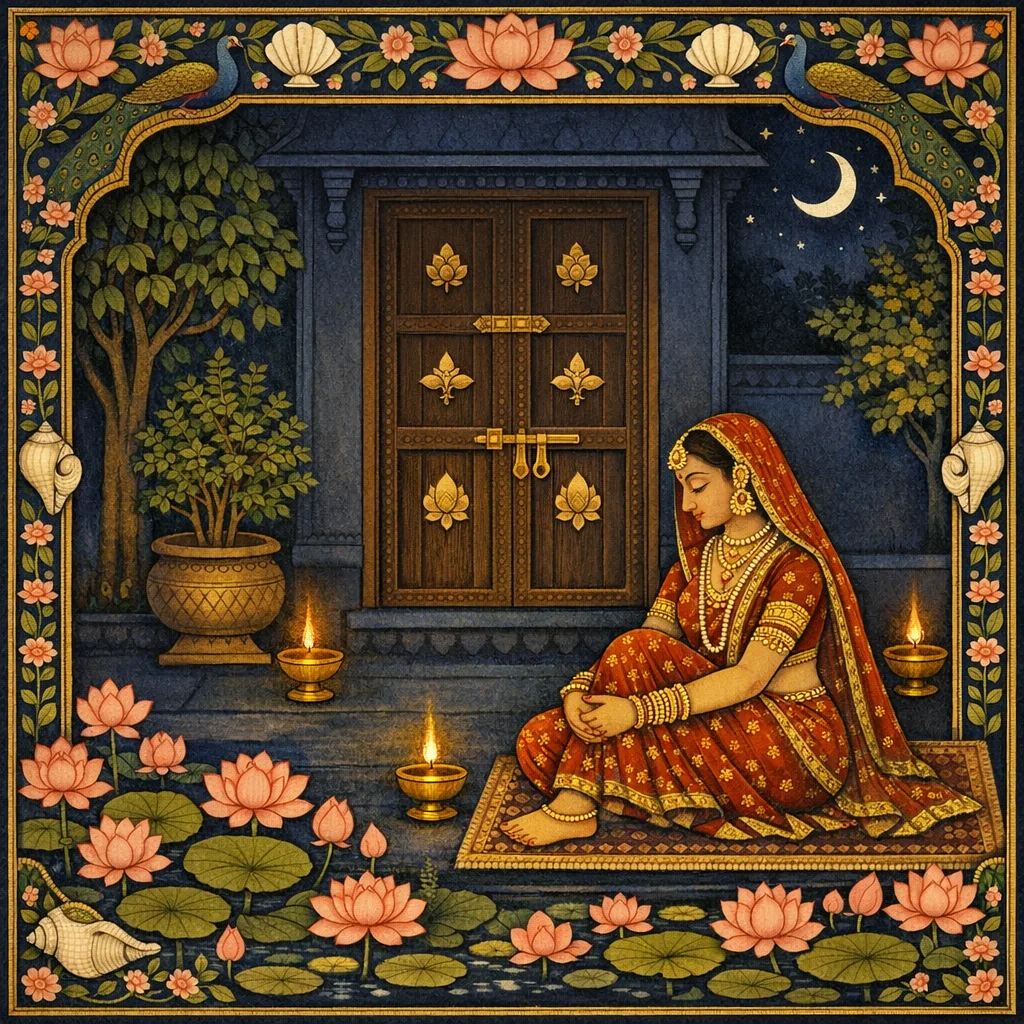
Adhyaya 8
Avadhūta’s Teachers: Python, Ocean, Moth, Bee, Elephant, Deer, Fish—and Piṅgalā’s Song of Detachment
Continuing the Avadhūta-brāhmaṇa’s instruction to King Yadu, this chapter deepens the method of learning vairāgya through “gurus” found in nature and human society. The Avadhūta first teaches radical non-endeavor for material happiness, since sukha and duḥkha arrive by providence; like a python, the wise accept maintenance without anxious striving and remain patient even when fasting is required. He then describes the ocean-like steadiness of a devotee who neither swells with opulence nor dries in poverty. Next, he warns of sensory downfall through vivid analogies: the moth ruined by attraction to fire (lust), the honeybee’s proper lesson (take essence, don’t hoard), the elephant trapped by touch (sexual entanglement), the deer killed by enchanting sound (entertainment), and the fish destroyed by taste (the tongue as hardest to conquer). The narrative then pivots to Piṅgalā the prostitute, whose midnight disappointment matures into decisive detachment; her inner “song” redirects hope from temporary lovers to the indwelling Lord. This prepares the next movement of the Avadhūta’s broader instruction: stable renunciation grounded in devotion and clear discrimination.
Shlokas
Verse 1
श्रीब्राह्मण उवाच सुखमैन्द्रियकं राजन् स्वर्गे नरक एव च । देहिनां यद् यथा दु:खं तस्मान्नेच्छेत तद् बुध: ॥ १ ॥
The saintly brāhmaṇa said: O King, the embodied living entity automatically experiences unhappiness in heaven or hell. Similarly, happiness will also be experienced, even without one’s seeking it. Therefore a person of intelligent discrimination does not make any endeavor to obtain such material happiness.
Verse 2
ग्रासं सुमृष्टं विरसं महान्तं स्तोकमेव वा । यदृच्छयैवापतितं ग्रसेदाजगरोऽक्रिय: ॥ २ ॥
Following the example of the python, one should give up material endeavors and accept for one’s maintenance food that comes of its own accord, whether such food be delicious or tasteless, ample or meager.
Verse 3
शयीताहानि भूरीणि निराहारोऽनुपक्रम: । यदि नोपनयेद् ग्रासो महाहिरिव दिष्टभुक् ॥ ३ ॥
If at any time food does not come, then a saintly person should fast for many days without making endeavor. He should understand that by God’s arrangement he must fast. Thus, following the example of the python, he should remain peaceful and patient.
Verse 4
ओज:सहोबलयुतं बिभ्रद् देहमकर्मकम् । शयानो वीतनिद्रश्च नेहेतेन्द्रियवानपि ॥ ४ ॥
A saintly person should remain peaceful and materially inactive, maintaining his body without much endeavor. Even though possessed of full sensual, mental and physical strength, a saintly person should not become active for material gain but rather should always remain alert to his actual self-interest.
Verse 5
मुनि: प्रसन्नगम्भीरो दुर्विगाह्यो दुरत्यय: । अनन्तपारो ह्यक्षोभ्य: स्तिमितोद इवार्णव: ॥ ५ ॥
A saintly sage is happy and pleasing in his external behavior, whereas internally he is most grave and thoughtful. Because his knowledge is immeasurable and unlimited he is never disturbed, and thus in all respects he is like the tranquil waters of the unfathomable and unsurpassable ocean.
Verse 6
समृद्धकामोहीनो वा नारायणपरो मुनि: । नोत्सर्पेत न शुष्येत सरिद्भिरिव सागर: ॥ ६ ॥
During the rainy season the swollen rivers rush into the ocean, and during the dry summer the rivers, now shallow, severely reduce their supply of water; yet the ocean does not swell up during the rainy season, nor does it dry up in the hot summer. In the same way, a saintly devotee who has accepted the Supreme Personality of Godhead as the goal of his life sometimes will receive by providence great material opulence, and sometimes he will find himself materially destitute. However, such a devotee of the Lord does not rejoice in a flourishing condition, nor is he morose when poverty-stricken.
Verse 7
दृष्ट्वा स्त्रियं देवमायां तद्भावैरजितेन्द्रिय: । प्रलोभित: पतत्यन्धे तमस्यग्नौ पतङ्गवत् ॥ ७ ॥
One who has failed to control his senses immediately feels attraction upon seeing a woman’s form, which is created by the illusory energy of the Supreme Lord. Indeed, when the woman speaks with enticing words, smiles coquettishly and moves her body sensuously, his mind is immediately captured, and thus he falls blindly into the darkness of material existence, just as the moth maddened by the fire rushes blindly into its flames.
Verse 8
योषिद्धिरण्याभरणाम्बरादि- द्रव्येषु मायारचितेषु मूढ: । प्रलोभितात्मा ह्युपभोगबुद्ध्या पतङ्गवन्नश्यति नष्टदृष्टि: ॥ ८ ॥
A foolish person with no intelligent discrimination is immediately aroused at the sight of a lusty woman beautifully decorated with golden ornaments, fine clothing and other cosmetic features. Being eager for sense gratification, such a fool loses all intelligence and is destroyed just like the moth who rushes into the blazing fire.
Verse 9
स्तोकं स्तोकं ग्रसेद् ग्रासं देहो वर्तेत यावता । गृहानहिंसन्नातिष्ठेद् वृत्तिं माधुकरीं मुनि: ॥ ९ ॥
A saintly person should accept only enough food to keep his body and soul together. He should go from door to door accepting just a little bit of food from each family. Thus he should practice the occupation of the honeybee.
Verse 10
अणुभ्यश्च महद्भ्यश्च शास्त्रेभ्य: कुशलो नर: । सर्वत: सारमादद्यात् पुष्पेभ्य इव षट्पद: ॥ १० ॥
Just as the honeybee takes nectar from all flowers, big and small, an intelligent human being should take the essence from all religious scriptures.
Verse 11
सायन्तनं श्वस्तनं वा न सङ्गृह्णीत भिक्षितम् । पाणिपात्रोदरामत्रो मक्षिकेव न सङ्ग्रही ॥ ११ ॥
A saintly person should not think, “This food I will keep to eat tonight and this other food I can save for tomorrow.” In other words, a saintly person should not store foodstuffs acquired by begging. Rather, he should use his own hands as his plate and eat whatever fits on them. His only storage container should be his belly, and whatever conveniently fits into his belly should be his stock of food. Thus one should not imitate the greedy honeybee who eagerly collects more and more honey.
Verse 12
सायन्तनं श्वस्तनं वा न सङ्गृह्णीत भिक्षुक: । मक्षिका इव सङ्गृह्णन् सह तेन विनश्यति ॥ १२ ॥
A saintly mendicant should not even collect foodstuffs to eat later in the same day or the next day. If he disregards this injunction and like the honeybee collects more and more delicious foodstuffs, that which he has collected will indeed ruin him.
Verse 13
पदापि युवतीं भिक्षुर्न स्पृशेद् दारवीमपि । स्पृशन् करीव बध्येत करिण्या अङ्गसङ्गत: ॥ १३ ॥
A saintly person should never touch a young girl. In fact, he should not even let his foot touch a wooden doll in the shape of a woman. By bodily contact with a woman he will surely be captured by illusion, just as the elephant is captured by the she-elephant due to his desire to touch her body.
Verse 14
नाधिगच्छेत् स्त्रियं प्राज्ञ: कर्हिचिन्मृत्युमात्मन: । बलाधिकै: स हन्येत गजैरन्यैर्गजो यथा ॥ १४ ॥
A man possessing intelligent discrimination should not under any circumstances try to exploit the beautiful form of a woman for his sense gratification. Just as an elephant trying to enjoy a she-elephant is killed by other bull elephants also enjoying her company, one trying to enjoy a lady’s company can at any moment be killed by her other lovers who are stronger than he.
Verse 15
न देयं नोपभोग्यं च लुब्धैर्यद् दु:खसञ्चितम् । भुङ्क्ते तदपि तच्चान्यो मधुहेवार्थविन्मधु ॥ १५ ॥
A greedy person accumulates a large quantity of money with great struggle and pain, but the person who has struggled so much to acquire this wealth is not always allowed to enjoy it himself or give it in charity to others. The greedy man is like the bee who struggles to produce a large quantity of honey, which is then stolen by a man who will enjoy it personally or sell it to others. No matter how carefully one hides his hard-earned wealth or tries to protect it, there are those who are expert in detecting the whereabouts of valuable things, and they will steal it.
Verse 16
सुदु:खोपार्जितैर्वित्तैराशासानां गृहाशिष: । मधुहेवाग्रतो भुङ्क्ते यतिर्वै गृहमेधिनाम् ॥ १६ ॥
Just as a hunter takes away the honey laboriously produced by the honeybees, similarly, saintly mendicants such as brahmacārīs and sannyāsīs are entitled to enjoy the property painstakingly accumulated by householders dedicated to family enjoyment.
Verse 17
ग्राम्यगीतं न शृणुयाद् यतिर्वनचर: क्वचित् । शिक्षेत हरिणाद् बद्धान्मृगयोर्गीतमोहितात् ॥ १७ ॥
A saintly person dwelling in the forest in the renounced order of life should never listen to songs or music promoting material enjoyment. Rather, a saintly person should carefully study the example of the deer, who is bewildered by the sweet music of the hunter’s horn and is thus captured and killed.
Verse 18
नृत्यवादित्रगीतानि जुषन् ग्राम्याणि योषिताम् । आसां क्रीडनको वश्य ऋष्यशृङ्गो मृगीसुत: ॥ १८ ॥
Becoming attracted to the worldly singing, dancing and musical entertainment of beautiful women, even the great sage Ṛṣyaśṛṅga, the son of a deer, fell totally under their control, just like a pet animal.
Verse 19
जिह्वयातिप्रमाथिन्या जनो रसविमोहित: । मृत्युमृच्छत्यसद्बुद्धिर्मीनस्तु बडिशैर्यथा ॥ १९ ॥
Just as a fish, incited by the desire to enjoy his tongue, is fatally trapped on the fisherman’s hook, similarly, a foolish person is bewildered by the extremely disturbing urges of the tongue and thus is ruined.
Verse 20
इन्द्रियाणि जयन्त्याशु निराहारा मनीषिण: । वर्जयित्वा तु रसनं तन्निरन्नस्य वर्धते ॥ २० ॥
By fasting, learned men quickly bring all of the senses except the tongue under control, because by abstaining from eating such men are afflicted with an increased desire to gratify the sense of taste.
Verse 21
तावज्जितेन्द्रियो न स्याद् विजितान्येन्द्रिय: पुमान् । न जयेद् रसनं यावज्जितं सर्वं जिते रसे ॥ २१ ॥
Although one may conquer all of the other senses, as long as the tongue is not conquered it cannot be said that one has controlled his senses. However, if one is able to control the tongue, then one is understood to be in full control of all the senses.
Verse 22
पिङ्गला नाम वेश्यासीद् विदेहनगरे पुरा । तस्या मे शिक्षितं किञ्चिन्निबोध नृपनन्दन ॥ २२ ॥
O son of kings, previously in the city of Videha there dwelled a prostitute named Piṅgalā. Now please hear what I have learned from that lady.
Verse 23
सा स्वैरिण्येकदा कान्तं सङ्केत उपनेष्यती । अभूत् काले बहिर्द्वारे बिभ्रती रूपमुत्तमम् ॥ २३ ॥
Once that prostitute, desiring to bring a lover into her house, stood outside in the doorway at night showing her beautiful form.
Verse 24
मार्ग आगच्छतो वीक्ष्य पुरुषान् पुरुषर्षभ । तान् शुल्कदान् वित्तवत: कान्तान् मेनेऽर्थकामुकी ॥ २४ ॥
O best among men, this prostitute was very anxious to get money, and as she stood on the street at night she studied all the men who were passing by, thinking, “Oh, this one surely has money. I know he can pay the price, and I am sure he would enjoy my company very much.” Thus she thought about all the men on the street.
Verse 25
आगतेष्वपयातेषु सा सङ्केतोपजीविनी । अप्यन्यो वित्तवान् कोऽपि मामुपैष्यति भूरिद: ॥ २५ ॥ एवं दुराशया ध्वस्तनिद्रा द्वार्यवलम्बती । निर्गच्छन्ती प्रविशती निशीथं समपद्यत ॥ २६ ॥
As the prostitute Piṅgalā stood in the doorway, many men came and went, walking by her house. Her only means of sustenance was prostitution, and therefore she anxiously thought, “Maybe this one who is coming now is very rich… Oh, he is not stopping, but I am sure someone else will come. Surely this man who is coming now will want to pay me for my love, and he will probably give lots of money.” Thus, with vain hope, she remained leaning against the doorway, unable to finish her business and go to sleep. Out of anxiety she would sometimes walk out toward the street, and sometimes she went back into her house. In this way, the midnight hour gradually arrived.
Verse 26
आगतेष्वपयातेषु सा सङ्केतोपजीविनी । अप्यन्यो वित्तवान् कोऽपि मामुपैष्यति भूरिद: ॥ २५ ॥ एवं दुराशया ध्वस्तनिद्रा द्वार्यवलम्बती । निर्गच्छन्ती प्रविशती निशीथं समपद्यत ॥ २६ ॥
As the prostitute Piṅgalā stood in the doorway, many men came and went, walking by her house. Her only means of sustenance was prostitution, and therefore she anxiously thought, “Maybe this one who is coming now is very rich… Oh, he is not stopping, but I am sure someone else will come. Surely this man who is coming now will want to pay me for my love, and he will probably give lots of money.” Thus, with vain hope, she remained leaning against the doorway, unable to finish her business and go to sleep. Out of anxiety she would sometimes walk out toward the street, and sometimes she went back into her house. In this way, the midnight hour gradually arrived.
Verse 27
तस्या वित्ताशया शुष्यद्वक्त्राया दीनचेतस: । निर्वेद: परमो जज्ञे चिन्ताहेतु: सुखावह: ॥ २७ ॥
As the night wore on, the prostitute, who intensely desired money, gradually became morose, and her face dried up. Thus being filled with anxiety for money and most disappointed, she began to feel a great detachment from her situation, and happiness arose in her mind.
Verse 28
तस्या निर्विण्णचित्ताया गीतं शृणु यथा मम । निर्वेद आशापाशानां पुरुषस्य यथा ह्यसि: ॥ २८ ॥
The prostitute felt disgusted with her material situation and thus became indifferent to it. Indeed, detachment acts like a sword, cutting to pieces the binding network of material hopes and desires. Now please hear from me the song sung by the prostitute in that situation.
Verse 29
न ह्यङ्गाजातनिर्वेदो देहबन्धं जिहासति । यथा विज्ञानरहितो मनुजो ममतां नृप ॥ २९ ॥
O King, just as a human being who is bereft of spiritual knowledge never desires to give up his false sense of proprietorship over many material things, similarly, a person who has not developed detachment never desires to give up the bondage of the material body.
Verse 30
पिङ्गलोवाच अहो मे मोहविततिं पश्यताविजितात्मन: । या कान्तादसत: कामं कामये येन बालिशा ॥ ३० ॥
The prostitute Piṅgalā said: Just see how greatly illusioned I am! Because I cannot control my mind, just like a fool I desire lusty pleasure from an insignificant man.
Verse 31
सन्तं समीपे रमणं रतिप्रदं वित्तप्रदं नित्यमिमं विहाय । अकामदं दु:खभयाधिशोक- मोहप्रदं तुच्छमहं भजेऽज्ञा ॥ ३१ ॥
I am such a fool that I have given up the service of that person who, being eternally situated within my heart, is actually most dear to me. That most dear one is the Lord of the universe, who is the bestower of real love and happiness and the source of all prosperity. Although He is in my own heart, I have completely neglected Him. Instead I have ignorantly served insignificant men who can never satisfy my real desires and who have simply brought me unhappiness, fear, anxiety, lamentation and illusion.
Verse 32
अहो मयात्मा परितापितो वृथा साङ्केत्यवृत्त्यातिविगर्ह्यवार्तया । स्त्रैणान्नराद् यार्थतृषोऽनुशोच्यात् क्रीतेन वित्तं रतिमात्मनेच्छती ॥ ३२ ॥
Oh, how I have uselessly tortured my own soul! I have sold my body to lusty, greedy men who are themselves objects of pity. Thus practicing the most abominable profession of a prostitute, I hoped to get money and sex pleasure.
Verse 33
यदस्थिभिर्निर्मितवंशवंश्य- स्थूणं त्वचा रोमनखै: पिनद्धम् । क्षरन्नवद्वारमगारमेतद् विण्मूत्रपूर्णं मदुपैति कान्या ॥ ३३ ॥
This material body is like a house in which I, the soul, am living. The bones forming my spine, ribs, arms and legs are like the beams, crossbeams and pillars of the house, and the whole structure, which is full of stool and urine, is covered by skin, hair and nails. The nine doors leading into this body are constantly excreting foul substances. Besides me, what woman could be so foolish as to devote herself to this material body, thinking that she might find pleasure and love in this contraption?
Verse 34
विदेहानां पुरे ह्यस्मिन्नहमेकैव मूढधी: । यान्यमिच्छन्त्यसत्यस्मादात्मदात् काममच्युतात् ॥ ३४ ॥
Certainly in this city of Videha I alone am completely foolish. I neglected the Supreme Personality of Godhead, who awards us everything, even our original spiritual form, and instead I desired to enjoy sense gratification with many men.
Verse 35
सुहृत् प्रेष्ठतमो नाथ आत्मा चायं शरीरिणाम् । तं विक्रीयात्मनैवाहं रमेऽनेन यथा रमा ॥ ३५ ॥
The Supreme Personality of Godhead is absolutely the most dear one for all living beings because He is everyone’s well-wisher and Lord. He is the Supreme Soul situated in everyone’s heart. Therefore I will now pay the price of complete surrender, and thus purchasing the Lord I will enjoy with Him just like Lakṣmīdevī.
Verse 36
कियत् प्रियं ते व्यभजन् कामा ये कामदा नरा: । आद्यन्तवन्तो भार्याया देवा वा कालविद्रुता: ॥ ३६ ॥
Men provide sense gratification for women, but all these men, and even the demigods in heaven, have a beginning and an end. They are all temporary creations who will be dragged away by time. Therefore how much actual pleasure or happiness could any of them ever give to their wives?
Verse 37
नूनं मे भगवान् प्रीतो विष्णु: केनापि कर्मणा । निर्वेदोऽयं दुराशाया यन्मे जात: सुखावह: ॥ ३७ ॥
Although I most stubbornly hoped to enjoy the material world, somehow or other detachment has arisen in my heart, and it is making me very happy. Therefore the Supreme Personality of Godhead, Viṣṇu, must be pleased with me. Without even knowing it, I must have performed some activity satisfying to Him.
Verse 38
मैवं स्युर्मन्दभाग्याया: क्लेशा निर्वेदहेतव: । येनानुबन्धं निर्हृत्य पुरुष: शममृच्छति ॥ ३८ ॥
A person who has developed detachment can give up the bondage of material society, friendship and love, and a person who undergoes great suffering gradually becomes, out of hopelessness, detached and indifferent to the material world. Thus, due to my great suffering, such detachment awoke in my heart; yet how could I have undergone such merciful suffering if I were actually unfortunate? Therefore, I am in fact fortunate and have received the mercy of the Lord. He must somehow or other be pleased with me.
Verse 39
तेनोपकृतमादाय शिरसा ग्राम्यसङ्गता: । त्यक्त्वा दुराशा: शरणं व्रजामि तमधीश्वरम् ॥ ३९ ॥
With devotion I accept the great benefit that the Lord has bestowed upon me. Having given up my sinful desires for ordinary sense gratification, I now take shelter of Him, the Supreme Personality of Godhead.
Verse 40
सन्तुष्टा श्रद्दधत्येतद्यथालाभेन जीवती । विहराम्यमुनैवाहमात्मना रमणेन वै ॥ ४० ॥
I am now completely satisfied, and I have full faith in the Lord’s mercy. Therefore I will maintain myself with whatever comes of its own accord. I shall enjoy life with only the Lord, because He is the real source of love and happiness.
Verse 41
संसारकूपे पतितं विषयैर्मुषितेक्षणम् । ग्रस्तं कालाहिनात्मानं कोऽन्यस्त्रातुमधीश्वर: ॥ ४१ ॥
The intelligence of the living entity is stolen away by activities of sense gratification, and thus he falls into the dark well of material existence. Within that well he is then seized by the deadly serpent of time. Who else but the Supreme Personality of Godhead could save the poor living entity from such a hopeless condition?
Verse 42
आत्मैव ह्यात्मनो गोप्ता निर्विद्येत यदाखिलात् । अप्रमत्त इदं पश्येद् ग्रस्तं कालाहिना जगत् ॥ ४२ ॥
When the living entity sees that the entire universe has been seized by the serpent of time, he becomes sober and sane and at that time detaches himself from all material sense gratification. In that condition the living entity is qualified to be his own protector.
Verse 43
श्रीब्राह्मण उवाच एवं व्यवसितमतिर्दुराशां कान्ततर्षजाम् । छित्त्वोपशममास्थाय शय्यामुपविवेश सा ॥ ४३ ॥
The avadhūta said: Thus, her mind completely made up, Piṅgalā cut off all her sinful desires to enjoy sex pleasure with lovers, and she became situated in perfect peace. Then she sat down on her bed.
Verse 44
आशा हि परमं दु:खं नैराश्यं परमं सुखम् । यथा सञ्छिद्य कान्ताशां सुखं सुष्वाप पिङ्गला ॥ ४४ ॥
Material desire is undoubtedly the cause of the greatest unhappiness, and freedom from such desire is the cause of the greatest happiness. Therefore, completely cutting off her desire to enjoy so-called lovers, Piṅgalā very happily went to sleep.
Frequently Asked Questions
The python symbolizes freedom from anxious material endeavor: since happiness and distress arise by providence, the wise do not exhaust themselves chasing sense-based outcomes. The saint maintains the body with what comes naturally, fasting without agitation when nothing comes, cultivating nirodha (withdrawal) and trust in the Lord’s arrangement.
Piṅgalā is a prostitute of Videha whose intense disappointment becomes the catalyst for genuine detachment. The Avadhūta cites her to show that vairāgya can arise from clear insight into the futility of material hopes; when desire collapses, the heart can turn to the Supreme Lord (āśraya), producing peace and real happiness.
It teaches that the tongue’s urge (taste and the habit of indulgence) is especially persistent: even when other senses are restrained, craving for taste can intensify. Conquering the tongue is presented as a practical keystone for indriya-nigraha, enabling broader mastery over the senses and steadiness in sādhana.
The honeybee lesson is twofold: (1) take small amounts from many places without burdening anyone, and (2) do not hoard, because accumulation breeds dependence, fear, and downfall. It supports a minimal-contact, non-possessive mendicant lifestyle rather than social exploitation or total avoidance without purpose.