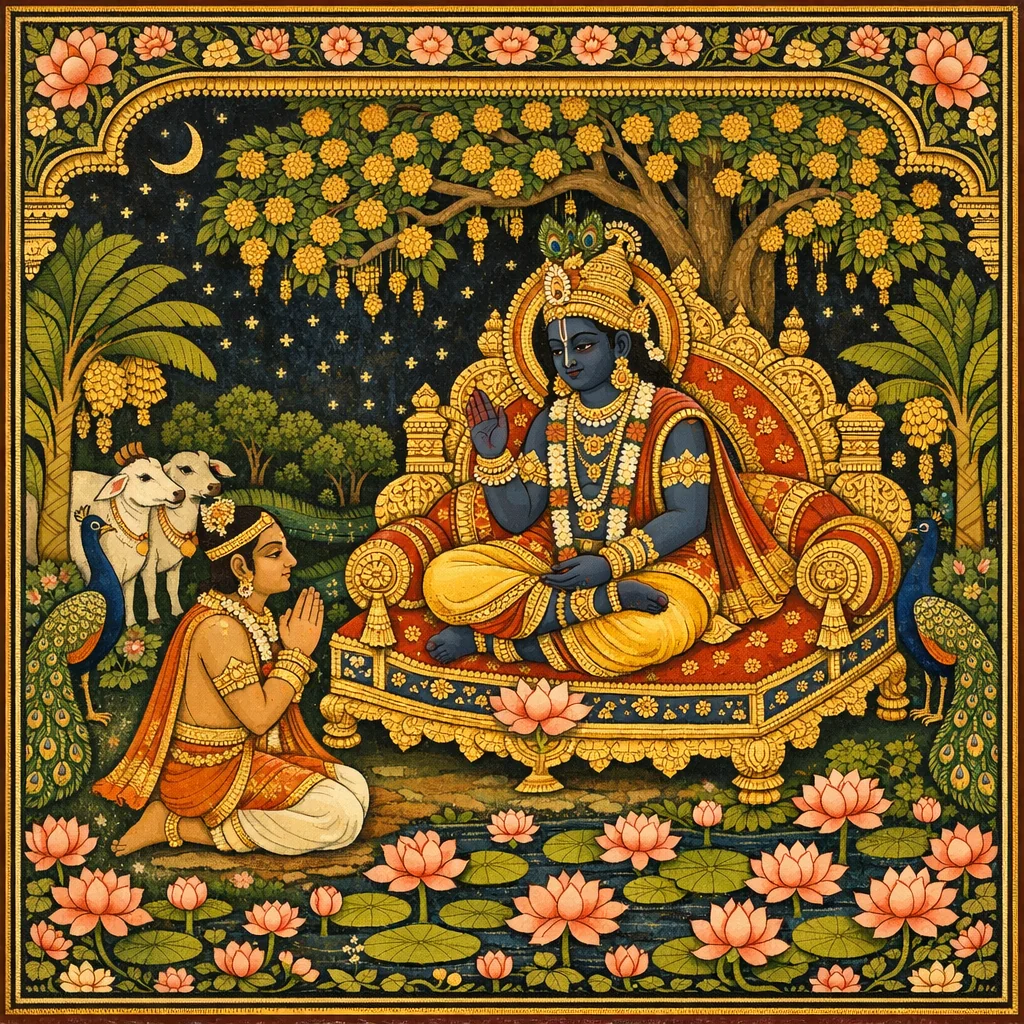
Adhyaya 19
Chapter 19
Perfection of Spiritual Knowledge
Shlokas
Verse 1
श्री-भगवान् उवाच यो विद्या-श्रुत-सम्पन्नः आत्मवान् नानुमानिकः । मया-मात्रम् इदं ज्ञात्वा ज्ञानं च मयि सन्न्यसेत् ॥
The Supreme Lord said: One who is endowed with true learning and scriptural hearing, who is self-controlled and not given to speculative inference, should understand this world to be sustained only by Me, and should then surrender even his knowledge unto Me.
Verse 2
ज्ञानिनस् त्व् अहम् एवेष्टः स्वार्थो हेतुश् च सम्मतः । स्वर्गश् चैवापवर्गश् च नान्यो 'र्थो मद्-ऋते प्रियः ॥
For the wise, I alone am the beloved—accepted as their true self-interest and the very purpose. Both heaven and liberation are found in Me; apart from Me, My dear one, there is no other real goal.
Verse 3
ज्ञान-विज्ञान-संसिद्धाः पदं श्रेष्ठं विदुर्मम । ज्ञानी प्रियतमो 'तो मे ज्ञानेनासौ बिभर्ति माम् ॥
Those who are perfected in knowledge and realized understanding know My supreme abode. Therefore the truly wise person is most dear to Me, for by knowledge he carries Me within himself.
Verse 4
तपस् तीर्थं जपो दानं पवित्राणीतराणि च । नालं कुर्वन्ति तां सिद्धिं या ज्ञान-कलया कृता ॥
Austerity, pilgrimage, chanting, charity, and other purifying practices cannot by themselves produce that perfection which is achieved even by a small portion of true spiritual knowledge.
Verse 5
तस्माज् ज्ञानेन सहितं ज्ञात्वा स्वात्मानम् उद्धव । ज्ञान-विज्ञान-सम्पन्नो भज मां भक्ति-भावतः ॥
Therefore, O Uddhava, having understood your own true Self along with spiritual knowledge, become endowed with realized wisdom and practical discernment, and worship Me with the inner mood of devotion.
Verse 6
ज्ञान-विज्ञान-यज्ञेन माम् इष्ट्वात्मानम् आत्मनि । सर्व-यज्ञ-पतिं मां वै संसिद्धिं मुनयो 'गमन् ॥
By the sacrifice of knowledge and realized wisdom—worshiping Me within the self, as the Supersoul—the sages attained perfection, for I am indeed the Lord and enjoyer of all sacrifices.
Verse 7
त्वय्युद्धवाश्रयति यस्त्रिविधो विकारो मायान्तरापतति नाद्यपवर्गयोर्वयत् । जन्मादयोऽस्य यदमी तव तस्य किं स्युर् आद्यन्तयोऱ्यदसतोऽस्ति तदेव मध्ये ॥
O Uddhava, the threefold transformation (of matter)—creation, maintenance and destruction—rests upon You. Māyā, standing between the beginning and the end, does not touch You, who are beyond both bondage and liberation. If birth and other changes are seen in this world, they belong to that māyā—what could they possibly mean for You? For that which is unreal has existence only in the interval between its beginning and its end.
Verse 8
श्री-उद्धव उवाच ज्ञानं विशुद्धं विपुलं यथैतद् वैराग्य-विज्ञान-युतं पुराणम् । आख्याहि विश्वेश्वर विश्व-मूर्ते त्वद्-भक्ति-योगं च महद्-विमृग्यम् ॥
Śrī Uddhava said: O Lord of the universe, O You whose form is the universe itself, please explain to me this Purāṇa’s vast and perfectly pure knowledge, endowed with realized understanding and renunciation—and also explain Your bhakti-yoga, which even the greatest souls seek to comprehend.
Verse 9
ताप-त्रयेणाभिहतस्य घोरे सन्तप्यमानस्य भवाध्वनीश । पश्यामि नान्यच् छरणं तवाङ्घ्रि- द्वन्द्वातपत्राद् अमृताभिवर्षात् ॥
O Lord, master of the journey of material existence, I am struck by the fierce threefold miseries and am burning within. I see no other shelter than the pair of Your lotus feet—an umbrella against the scorching heat, and a rain of nectar.
Verse 10
दष्टं जनं सम्पतितं बिले 'स्मिन् कालाहिना क्षुद्र-सुखोरु-तर्षम् । समुद्धरैनं कृपयापवर्ग्यैर् वचोभिर् आसीञ्च महाऽनुभाव ॥
O great soul, this person has been bitten by the serpent of time and has fallen into this pit, thirsting fiercely for petty pleasures. Out of compassion, please lift him up and sprinkle him with your liberating words.
Verse 11
श्री-भगवान् उवाच इत्थम् एतत् पुरा राजा भीष्मं धर्म-भृतां वरम् । अजात-शत्रुः पप्रच्छ सर्वेषां नो 'नुशृण्वताम् ॥
The Supreme Lord said: Thus, long ago, King Ajātaśatru (Yudhiṣṭhira) inquired from Bhīṣma, the foremost among upholders of dharma, while all of us listened attentively.
Verse 12
निवृत्ते भारते युद्धे सुहृन्-निधन-विह्वलः । श्रुत्वा धर्मान् बहून् पश्चान् मोक्ष-धर्मान् अपृच्छत ॥
After the Battle of Bhārata had ended, the king—overwhelmed by the death of his dear well-wishers—heard many teachings on dharma, and thereafter inquired specifically about the principles of liberation.
Verse 13
तान् अहं ते 'भिधास्यामि देव-व्रत-मखाच् छ्रुतान् । ज्ञान-वैराग्य-विज्ञान-श्रद्धा-भक्त्युपबृंहितान् ॥
I shall now explain to you those principles, heard from the sacrifice of Deva-vrata, which are enriched by knowledge, detachment, realized understanding, faith, and devotion.
Verse 14
नवैकादश पञ्च त्रीन् भावान् भूतेषु येन वै । ईक्षेताथैकम् अप्येषु तज् ज्ञानं मम निश्चितम् ॥
That is My definitive understanding: by which one perceives within all beings the nine, the eleven, the five, and the three principles—and also perceives the one (Supreme Reality) present among them.
Verse 15
एतद् एव हि विज्ञानं न तथैकॆन येन यत् । स्थित्युत्पत्त्यप्ययान् पश्येद् भावानां त्रिगुणात्मनाम् ॥
True realized knowledge is this alone: by it one clearly perceives the maintenance, creation, and dissolution of all states of existence, which are constituted of the three modes of material nature. Any other single, one-sided view is not the same as this genuine wisdom.
Verse 16
आदाव् अन्ते च मध्ये च सृज्यात् सृज्यं यद् अन्वियात् । पुनस् तत्प्रतिसङ्क्रमे यच् छिष्येत तदेव सत् ॥
That which is present in the beginning, in the end, and in the middle—pervading both the creator and the created—and which remains when the created returns back (at dissolution), that alone is real existence.
Verse 17
श्रुतिः प्रत्यक्षम् ऐतिह्यम् अनुमानं चतुष्टयम् । प्रमाणेष्व् अनवस्थानाद् विकल्पात् स विरज्यते ॥
Revealed scripture, direct perception, historical tradition, and inference—these four are considered sources of knowledge. Yet because these means of proof are not absolutely fixed and are subject to differing interpretations, a wise person becomes detached from mere argumentative speculation.
Verse 18
कर्मणां परिणामित्वाद् आ-विरिञ्च्याद् अमङ्गलम् । विपश्चिन् नश्वरं पश्येद् अदृष्टम् अपि दृष्ट-वत् ॥
Because the results of material actions inevitably transform, everything within this world—from the lowest condition up to Brahmā—ends in inauspiciousness. Therefore a truly discerning person sees even what is not yet visible as if it were already seen: all such attainments are perishable.
Verse 19
भक्ति-योगः पुरैवोक्तः प्रीयमाणाय तेऽनघ । पुनश्च कथयिष्यामि मद्-भक्तेः कारणं परम् ॥
O sinless one, I have previously described bhakti-yoga to you, who delight in hearing it. Now I shall again explain the supreme cause by which devotion unto Me arises.
Verse 20
श्रद्धामृत-कथायां मे शश्वन् मद्-अनुकीर्तनम् । परिनिष्ठा च पूजायां स्तुतिभिः स्तवनं मम ॥
Faith in My nectar-like narrations, constant chanting of My glories, steadfast dedication to My worship, and the offering of prayers that praise Me—these are (the principal ways by which) devotion to Me is nourished and established.
Verse 21
आदरः परिचर्यायां सर्वाङ्गैरभिवन्दनम् । मद्भक्तपूजाभ्यधिका सर्वभूतेषु मन्मतिः ॥
Reverent attentiveness in serving Me, offering obeisances with all one’s limbs, worship of My devotees as even greater (than worship of Me), and seeing all living beings with the understanding that they are related to Me—these are (features) of devotion.
Verse 22
मदर्थेष्वङ्गचेष्टा च वचसा मद्गुणेरणम् । मय्यर्पणं च मनसः सर्वकामविवर्जनम् ॥
Engaging one’s bodily activities for My sake, using one’s speech to describe My qualities, offering one’s mind to Me, and renouncing all selfish desires—these are (also) constituents of devotion.
Verse 23
मदर्थेऽर्थपरित्यागो भोगस्य च सुखस्य च । इष्टं दत्तं हुतं जप्तं मदर्थं यद् व्रतं तपः ॥
For My sake, one gives up material gain, and also renounces sense enjoyment and personal happiness. Whatever one performs—worship, charity, sacrifice, mantra-recitation, vows, or austerities—when done for My sake, that is (true) spiritual practice.
Verse 24
एवं धर्मैर्मनुष्याणामुद्धवात्मनिवेदिनाम् । मयि सञ्जायते भक्तिः कोऽन्योऽर्थोऽस्यावशिष्यते ॥
O Uddhava, by such religious practices, for those human beings who have offered their very self (to Me), devotion to Me arises. What other goal, then, remains to be achieved?
Verse 25
यदात्मन्यर्पितं चित्तं शान्तं सत्त्वोपबृंहितम् । धर्मं ज्ञानं स वैराग्यमैश्वर्यं चाभिपद्यते ॥
When one’s mind is offered and fixed within the Self, becoming peaceful and strengthened by goodness (sattva), one naturally attains true dharma, realized knowledge, detachment, and spiritual opulence.
Verse 26
यदर्पितं तद्विकल्पे इन्द्रियैः परिधावति । रजस्-वलं चासन्-निष्ठं चित्तं विद्धि विपर्ययम् ॥
But when the mind is not truly offered (to the Self/Lord), it runs after sense objects through the senses, becomes dominated by passion, rests on what is unreal, and should be understood as the reversed condition of consciousness.
Verse 27
धर्मो मद्-भक्ति-कृत् प्रोक्तो ज्ञानं चैकाात्म्य-दर्शनम् । गुणेष्व् असङ्गो वैराग्यम् ऐश्वर्यं चाणिमादयः ॥
I have declared that real dharma is that which awakens devotion to Me. True knowledge is the vision of oneness of the self (with spiritual reality). Detachment from the material modes is called renunciation, and My opulences are the mystic perfections beginning with aṇimā.
Verse 28
श्री-उद्धव उवाच यमः कति-विदः प्रोक्तो नियमो वारि-कर्षण । कः शमः को दमः कृष्ण ॥
Śrī Uddhava said: O Kṛṣṇa, O you who draw away all distress, how many kinds of yama have been described? And what is niyama? What is śama, and what is dama?
Verse 29
का तितिक्षा धृतिः प्रभो किं दानं किं तपः शौर्यं । किं सत्यं ऋतमुच्यते कस्त्यागः किं धनं चेष्टं ॥
O Lord, what is true tolerance, and what is steadfastness? What is charity, what is austerity, and what is real heroism? What is truth, what is called ṛta (truthfulness aligned with cosmic order)? Who is truly renounced, and what is real wealth and the most desirable endeavor?
Verse 30
को यज्ञः का च दक्षिणा पुंसः किं स्विद् बलं श्रीमन् । भगो लाभश्च केशव का विद्या ह्रीः परा का श्रीः ॥
O venerable Lord, what is sacrifice, and what is true dakṣiṇā (the proper offering)? What indeed is a person’s real strength? O Keśava, what are true opulence and true gain? What is real knowledge, what is higher modesty, and what is the supreme beauty and prosperity?
Verse 31
किं सुखं दुःखम् एव च कः पण्डितः कश् च मूर्खः । कः पन्था उत्पथश् च कः कः स्वर्गो नरकः कः स्वित् ॥
“What is happiness, and what indeed is suffering? Who is truly learned, and who is foolish? What is the true path, and what is a misleading byway? And what is heaven, and what is hell?”
Verse 32
को बन्धुर् उत किं गृहम् क आढ्यः को दरिद्रो वा । कृपणः कः क ईश्वरः एतान् प्रश्नान् मम ब्रूहि । विपरीतांश् च सत्-पते श्री-भगवान् उवाच ॥
“Who is one’s true friend, and what is truly one’s home? Who is genuinely wealthy, and who is poor? Who is miserly, and who is a real master? O saintly Lord, please explain these questions to me—and also their opposites.” Then the Supreme Lord spoke.
Verse 33
अहिंसा सत्यं अस्तेयम् असङ्गो ह्रीर् असञ्चयः । आस्तिक्यं ब्रह्मचर्यं च मौनं स्थैर्यं क्षमाभयम् ॥
Nonviolence, truthfulness, not stealing, detachment, modesty, and non-accumulation; faith in the Vedas, celibacy, disciplined silence, steadiness, forgiveness, and fearlessness—these are to be cultivated as ennobling virtues.
Verse 34
शौचं जपस् तपो होमः श्रद्धातिथ्यं मदर्चनम् । तीर्थाटनं परार्थेहा तुष्टिर् आचार्यसेवनम् ॥
Cleanliness, mantra-recitation, austerity, sacrificial offerings, faithful hospitality to guests, worship of Me; pilgrimage to holy places, effort for the welfare of others, contentment, and service to one’s spiritual teacher—these are also sacred practices.
Verse 35
एते यमाः स-नियमाः उभयोर् द्वादश स्मृताः । पुंसाम् उपासितास् तात यथा-कामं दुहन्ति हि ॥
These yamas, together with the niyamas—twelve in all—are remembered as the twin disciplines. When practiced and honored by human beings, dear Uddhava, they indeed yield the desired results according to one’s aim.
Verse 36
शमो मन्-निष्ठता बुद्धेर् दम इन्द्रिय-संयमः । तितिक्षा दुःख-सम्मर्षो जिह्वोपस्थ-जयो धृतिः ॥
Mental equilibrium is fixing the intelligence upon Me; self-control is the regulation of the senses. Tolerance is patiently enduring suffering; steadfastness is conquering the tongue and the genitals.
Verse 37
दण्ड-न्यासः परं दानं काम-त्यागस् तपः स्मृतम् । स्वभाव-विजयः शौर्यं सत्यं च सम-दर्शनम् ॥
Laying aside the impulse to punish is the highest charity. Renouncing lust is declared to be true austerity. Conquering one’s own conditioned nature is real heroism, and truthfulness is to see all beings with equal vision.
Verse 38
अन्यच् च सुनृता वाणी कविभिः परिकीर्तिता । कर्मस्व् असङ्गमः शौचं त्यागः सन्न्यास उच्यते ॥
And furthermore, pleasing and truthful speech is praised by the wise. Purity is detachment in one’s actions, and true renunciation is called the giving up of possessiveness and selfish claim.
Verse 39
धर्म इष्टं धनं नॄणां यज्ञो 'हं भगवत्तमः । दक्षिणा ज्ञान-सन्देशः प्राणायामः परं बलम् ॥
For human beings, dharma is the most cherished wealth. I, the Supreme Lord, am the very sacrifice (yajña). The true priestly gift (dakṣiṇā) is the imparting of spiritual knowledge, and the highest strength is prāṇāyāma—mastery of the life-air.
Verse 40
भगो म ऐश्वर्यो भावो लाभो मद्-भक्तिर उत्तमः । विद्यात्मनि भिदा-बाधो जुगुप्सा ह्रीर अकर्मसु ॥
My true opulence is divine lordship; real gain is the highest devotion to Me. True knowledge is the removal of the sense of difference within the self, and genuine modesty is to feel revulsion and shame toward actions that should not be done.
Verse 41
श्रीर्गुणा नैरपेक्ष्याद्याः सुखं दुःख-सुखात्ययः । दुःखं काम-सुखापेक्षा पण्डितो बन्ध-मोक्ष-वित् ॥
True prosperity is the cultivation of qualities such as self-reliance and freedom from dependence. Real happiness is to transcend both pleasure and pain. Real suffering is the craving for sense-enjoyment and the dependence on pleasure. A truly learned person is one who understands bondage and liberation.
Verse 42
मूर्खो देहाद्य-हं-बुद्धिः पन्था मन्-निगमः स्मृतः । उत्पथश् चित्त-विक्षेपः स्वर्गः सत्त्व-गुणोदयः ॥
A fool is one who identifies the self with the body and its extensions. The true path is understood to be My teaching as given in the Vedas. A wrong path is the distraction and scattering of the mind. Heaven is the rise and predominance of the mode of goodness.
Verse 43
नरकस् तम-उन्नाहो बन्धुर् गुरुर् अहं सखे । गृहं शरीरं मानुष्यं गुणाढ्यो ह्य् आढ्य उच्यते ॥
My friend, hell is the swelling of darkness (ignorance). I am your true well-wisher and your spiritual master. This human body is your real home, and one who is rich in good qualities is truly said to be wealthy.
Verse 44
दरिद्रो यस् त्व् असन्तुष्टः कृपणो यो 'जितेन्द्रियः । गुणेष्व् असक्त-धीर् ईशो गुण-सङ्गो विपर्ययः ॥
One is truly poor who is dissatisfied; one is truly miserly who has not conquered the senses. The real master is he whose intelligence is unattached to material qualities, whereas attachment to those qualities is the very opposite (of mastery).
Verse 45
एत उद्धव ते प्रश्नाः सर्वे साधु निरूपिताः । किं वर्णितेन बहुना लक्षणं गुण-दोषयोः ॥ गुण-दोष-दृशिर्दोषो गुणस्तूभय-वर्जितः ॥
O Uddhava, all your questions have been properly answered. But what is the use of elaborating further? The defining mark of virtue and fault is this: the very tendency to see things in terms of “good” and “bad” is itself a fault, whereas true goodness is to be free from both.