Adhyaya 17
Varṇāśrama-dharma as a Path to Bhakti (Yuga-dharma Origins, Universal Virtues, Brahmacarya and Gṛhastha Duties)
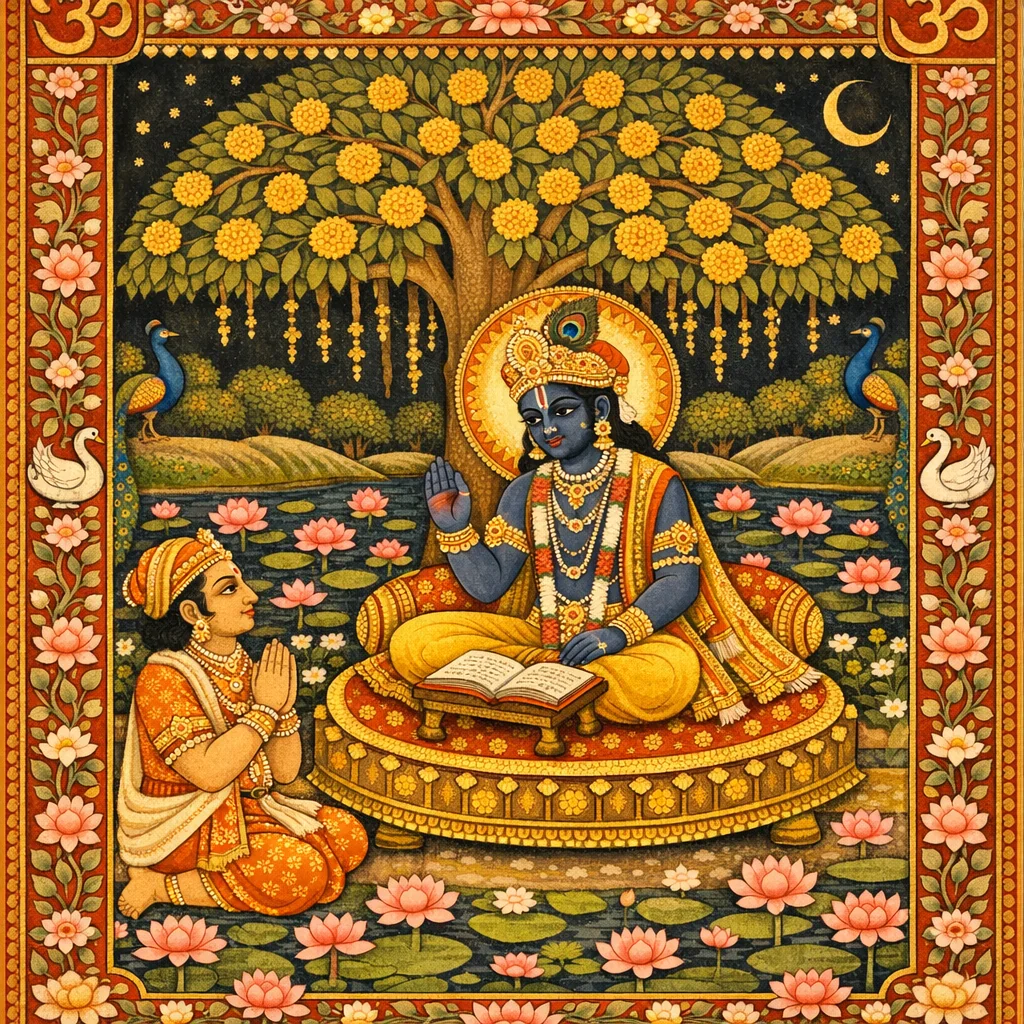
Uddhava asks Kṛṣṇa to explain how all people—both regulated followers of varṇāśrama and ordinary human beings—can attain loving service (bhakti) through prescribed duties, especially as ancient dharma is fading with time. He recalls the Lord’s prior instruction as Haṁsa to Brahmā and laments that when Kṛṣṇa departs, who will restore this lost spiritual knowledge. Śukadeva introduces Kṛṣṇa’s pleased response: the Lord will now speak eternal religious principles for the welfare of conditioned souls. Kṛṣṇa outlines the yuga-wise unfolding of dharma: in Satya-yuga a single ‘haṁsa’ order exists, the Veda is expressed as oṁ, and worship is directed to the Lord as Haṁsa; in Tretā the Veda expands into three divisions and sacrifice becomes prominent. He then explains the emergence of the four varṇas and four āśramas from the universal form, their natural qualities, and universal duties like ahiṁsā and satya. The chapter gives detailed brahmacārī discipline centered on guru-sevā and purity, warns renunciants and students against association with women, and prescribes general daily regulations for all. It then turns to gṛhastha dharma—pañca-mahā-yajñas, honest maintenance, non-attachment, and the peril of possessiveness—setting up the next movement toward deeper detachment and the progressive āśrama path as bhakti matures.
Shlokas
Verse 1
श्रीउद्धव उवाच यस्त्वयाभिहित: पूर्वं धर्मस्त्वद्भक्तिलक्षण: । वर्णाश्रमाचारवतां सर्वेषां द्विपदामपि ॥ १ ॥ यथानुष्ठीयमानेन त्वयि भक्तिर्नृणां भवेत् । स्वधर्मेणारविन्दाक्ष तन् ममाख्यातुमर्हसि ॥ २ ॥
Śrī Uddhava said: My dear Lord, previously You described the principles of devotional service that are to be practiced by followers of the varṇāśrama system and even ordinary, unregulated human beings. My dear lotus-eyed Lord, now please explain to me how all human beings can achieve loving service unto You by the execution of their prescribed duties.
Verse 2
श्रीउद्धव उवाच यस्त्वयाभिहित: पूर्वं धर्मस्त्वद्भक्तिलक्षण: । वर्णाश्रमाचारवतां सर्वेषां द्विपदामपि ॥ १ ॥ यथानुष्ठीयमानेन त्वयि भक्तिर्नृणां भवेत् । स्वधर्मेणारविन्दाक्ष तन् ममाख्यातुमर्हसि ॥ २ ॥
Śrī Uddhava said: My dear Lord, previously You described the principles of devotional service that are to be practiced by followers of the varṇāśrama system and even ordinary, unregulated human beings. My dear lotus-eyed Lord, now please explain to me how all human beings can achieve loving service unto You by the execution of their prescribed duties.
Verse 3
पुरा किल महाबाहो धर्मं परमकं प्रभो । यत्तेन हंसरूपेण ब्रह्मणेऽभ्यात्थ माधव ॥ ३ ॥ स इदानीं सुमहता कालेनामित्रकर्शन । न प्रायो भविता मर्त्यलोके प्रागनुशासित: ॥ ४ ॥
My dear Lord, O mighty-armed one, previously in Your form of Lord Haṁsa You spoke to Lord Brahmā those religious principles that bring supreme happiness to the practitioner. My dear Mādhava, now much time has passed, and that which You previously instructed will soon practically cease to exist, O subduer of the enemy.
Verse 4
पुरा किल महाबाहो धर्मं परमकं प्रभो । यत्तेन हंसरूपेण ब्रह्मणेऽभ्यात्थ माधव ॥ ३ ॥ स इदानीं सुमहता कालेनामित्रकर्शन । न प्रायो भविता मर्त्यलोके प्रागनुशासित: ॥ ४ ॥
My dear Lord, O mighty-armed one, previously in Your form of Lord Haṁsa You spoke to Lord Brahmā those religious principles that bring supreme happiness to the practitioner. My dear Mādhava, now much time has passed, and that which You previously instructed will soon practically cease to exist, O subduer of the enemy.
Verse 5
वक्ता कर्ताविता नान्यो धर्मस्याच्युत ते भुवि । सभायामपि वैरिञ्च्यां यत्र मूर्तिधरा: कला: ॥ ५ ॥ कर्त्रावित्रा प्रवक्त्रा च भवता मधुसूदन । त्यक्ते महीतले देव विनष्टं क: प्रवक्ष्यति ॥ ६ ॥
My dear Lord Acyuta, there is no speaker, creator and protector of supreme religious principles other than Your Lordship, either on the earth or even in the assembly of Lord Brahmā, where the personified Vedas reside. Thus, my dear Lord Madhusūdana, when You, who are the very creator, protector and speaker of spiritual knowledge, abandon the earth, who will again speak this lost knowledge?
Verse 6
वक्ता कर्ताविता नान्यो धर्मस्याच्युत ते भुवि । सभायामपि वैरिञ्च्यां यत्र मूर्तिधरा: कला: ॥ ५ ॥ कर्त्रावित्रा प्रवक्त्रा च भवता मधुसूदन । त्यक्ते महीतले देव विनष्टं क: प्रवक्ष्यति ॥ ६ ॥
My dear Lord Acyuta, there is no speaker, creator and protector of supreme religious principles other than Your Lordship, either on the earth or even in the assembly of Lord Brahmā, where the personified Vedas reside. Thus, my dear Lord Madhusūdana, when You, who are the very creator, protector and speaker of spiritual knowledge, abandon the earth, who will again speak this lost knowledge?
Verse 7
तत्त्वं न: सर्वधर्मज्ञ धर्मस्त्वद्भक्तिलक्षण: । यथा यस्य विधीयेत तथा वर्णय मे प्रभो ॥ ७ ॥
Therefore, my Lord, since You are the knower of all religious principles, please describe to me the human beings who may execute the path of loving service to You and how such service is to be rendered.
Verse 8
श्रीशुक उवाच इत्थं स्वभृत्यमुख्येन पृष्ट: स भगवान् हरि: । प्रीत: क्षेमाय मर्त्यानां धर्मानाह सनातनान् ॥ ८ ॥
Śrī Śukadeva Gosvāmī said: Śrī Uddhava, the best of devotees, thus inquired from the Lord. Hearing his question, the Personality of Godhead, Śrī Kṛṣṇa, was pleased and for the welfare of all conditioned souls spoke those religious principles that are eternal.
Verse 9
श्रीभगवानुवाच धर्म्य एष तव प्रश्नो नै:श्रेयसकरो नृणाम् । वर्णाश्रमाचारवतां तमुद्धव निबोध मे ॥ ९ ॥
The Supreme Personality of Godhead said: My dear Uddhava, your question is faithful to religious principles and thus gives rise to the highest perfection in life, pure devotional service, for both ordinary human beings and the followers of the varṇāśrama system. Now please learn from Me those supreme religious principles.
Verse 10
आदौ कृतयुगे वर्णो नृणां हंस इति स्मृत: । कृतकृत्या: प्रजा जात्या तस्मात् कृतयुगं विदु: ॥ १० ॥
In the beginning, in Satya-yuga, there is only one social class, called haṁsa, to which all human beings belong. In that age all people are unalloyed devotees of the Lord from birth, and thus learned scholars call this first age Kṛta-yuga, or the age in which all religious duties are perfectly fulfilled.
Verse 11
वेद: प्रणव एवाग्रे धर्मोऽहं वृषरूपधृक् । उपासते तपोनिष्ठा हंसं मां मुक्तकिल्बिषा: ॥ ११ ॥
In Satya-yuga the undivided Veda is expressed by the syllable om, and I am the only object of mental activities. I become manifest as the four-legged bull of religion, and thus the inhabitants of Satya-yuga, fixed in austerity and free from all sins, worship Me as Lord Haṁsa.
Verse 12
त्रेतामुखे महाभाग प्राणान्मे हृदयात्त्रयी । विद्या प्रादुरभूत्तस्या अहमासं त्रिवृन्मख: ॥ १२ ॥
O greatly fortunate one, at the beginning of Tretā-yuga Vedic knowledge appeared from My heart, which is the abode of the air of life, in three divisions — as Ṛg, Sāma and Yajur. Then from that knowledge I appeared as threefold sacrifice.
Verse 13
विप्रक्षत्रियविट्शूद्रा मुखबाहूरुपादजा: । वैराजात् पुरुषाज्जाता य आत्माचारलक्षणा: ॥ १३ ॥
In Tretā-yuga the four social orders were manifested from the universal form of the Personality of Godhead. The brāhmaṇas appeared from the Lord’s face, the kṣatriyas from the Lord’s arms, the vaiśyas from the Lord’s thighs and the śūdras from the legs of that mighty form. Each social division was recognized by its particular duties and behavior.
Verse 14
गृहाश्रमो जघनतो ब्रह्मचर्यं हृदो मम । वक्ष:स्थलाद्वनेवास: संन्यास: शिरसि स्थित: ॥ १४ ॥
The married order of life appeared from the loins of My universal form, and the celibate students came from My heart. The forest-dwelling retired order of life appeared from My chest, and the renounced order of life was situated within the head of My universal form.
Verse 15
वर्णानामाश्रमाणां च जन्मभूम्यनुसारिणी: । आसन् प्रकृतयो नृणां नीचैर्नीचोत्तमोत्तमा: ॥ १५ ॥
The various occupational and social divisions of human society appeared according to inferior and superior natures manifest in the situation of the individual’s birth.
Verse 16
शमो दमस्तप: शौचं सन्तोष: क्षान्तिरार्जवम् । मद्भक्तिश्च दया सत्यं ब्रह्मप्रकृतयस्त्विमा: ॥ १६ ॥
Peacefulness, self-control, austerity, cleanliness, satisfaction, tolerance, simple straightforwardness, devotion to Me, mercy and truthfulness are the natural qualities of the brāhmaṇas.
Verse 17
तेजो बलं धृति: शौर्यं तितिक्षौदार्यमुद्यम: । स्थैर्यं ब्रह्मण्यमैश्वर्यं क्षत्रप्रकृतयस्त्विमा: ॥ १७ ॥
Dynamic power, bodily strength, determination, heroism, tolerance, generosity, great endeavor, steadiness, devotion to the brāhmaṇas and leadership are the natural qualities of the kṣatriyas.
Verse 18
आस्तिक्यं दाननिष्ठा च अदम्भो ब्रह्मसेवनम् । अतुष्टिरर्थोपचयैर्वैश्यप्रकृतयस्त्विमा: ॥ १८ ॥
Faith in Vedic civilization, dedication to charity, freedom from hypocrisy, service to the brāhmaṇas and perpetually desiring to accumulate more money are the natural qualities of the vaiśyas.
Verse 19
शुश्रूषणं द्विजगवां देवानां चाप्यमायया । तत्र लब्धेन सन्तोष: शूद्रप्रकृतयस्त्विमा: ॥ १९ ॥
Service without duplicity to the brāhmaṇas, cows, demigods and other worshipable personalities, and complete satisfaction with whatever income is obtained in such service, are the natural qualities of śūdras.
Verse 20
अशौचमनृतं स्तेयं नास्तिक्यं शुष्कविग्रह: । काम: क्रोधश्च तर्षश्च स भावोऽन्त्यावसायिनाम् ॥ २० ॥
Dirtiness, dishonesty, thievery, faithlessness, useless quarrel, lust, anger and hankering constitute the nature of those in the lowest position outside the varṇāśrama system.
Verse 21
अहिंसा सत्यमस्तेयमकामक्रोधलोभता । भूतप्रियहितेहा च धर्मोऽयं सार्ववर्णिक: ॥ २१ ॥
Nonviolence, truthfulness, honesty, desire for the happiness and welfare of all others and freedom from lust, anger and greed constitute duties for all members of society.
Verse 22
द्वितीयं प्राप्यानुपूर्व्याज्जन्मोपनयनं द्विज: । वसन् गुरुकुले दान्तो ब्रह्माधीयीत चाहूत: ॥ २२ ॥
The twice-born member of society achieves second birth through the sequence of purificatory ceremonies culminating in Gāyatrī initiation. Being summoned by the spiritual master, he should reside within the guru’s āśrama and with a self-controlled mind carefully study the Vedic literature.
Verse 23
मेखलाजिनदण्डाक्षब्रह्मसूत्रकमण्डलून् । जटिलोऽधौतदद्वासोऽरक्तपीठ: कुशान् दधत् ॥ २३ ॥
The brahmacārī should regularly dress with a belt of straw and deerskin garments. He should wear matted hair, carry a rod and waterpot and be decorated with akṣa beads and a sacred thread. Carrying pure kuśa grass in his hand, he should never accept a luxurious or sensuous sitting place. He should not unnecessarily polish his teeth, nor should he bleach and iron his clothes.
Verse 24
स्नानभोजनहोमेषु जपोच्चारे च वाग्यत: । न च्छिन्द्यान्नखरोमाणि कक्षोपस्थगतान्यपि ॥ २४ ॥
A brahmacārī should always remain silent while bathing, eating, attending sacrificial performances, chanting japa or passing stool and urine. He should not cut his nails and hair, including the armpit and pubic hair.
Verse 25
रेतो नावकिरेज्जातु ब्रह्मव्रतधर: स्वयम् । अवकीर्णेऽवगाह्याप्सु यतासुस्त्रिपदां जपेत् ॥ २५ ॥
One observing the vow of celibate brahmacārī life should never pass semen. If the semen by chance spills out by itself, the brahmacārī should immediately take bath in water, control his breath by prāṇāyāma and chant the Gāyatrī mantra.
Verse 26
अग्न्यर्काचार्यगोविप्रगुरुवृद्धसुराञ्शुचि: । समाहित उपासीत सन्ध्ये द्वे यतवाग् जपन् ॥ २६ ॥
Purified and fixed in consciousness, the brahmacārī should worship the fire-god, sun, ācārya, cows, brāhmaṇas, guru, elderly respectable persons and demigods. He should perform such worship at sunrise and sunset, without speaking but by silently chanting or murmuring the appropriate mantras.
Verse 27
आचार्यं मां विजानीयान्नावमन्येत कर्हिचित् । न मर्त्यबुद्ध्यासूयेत सर्वदेवमयो गुरु: ॥ २७ ॥
One should know the ācārya as Myself and never disrespect him in any way. One should not envy him, thinking him an ordinary man, for he is the representative of all the demigods.
Verse 28
सायं प्रातरुपानीय भैक्ष्यं तस्मै निवेदयेत् । यच्चान्यदप्यनुज्ञातमुपयुञ्जीत संयत: ॥ २८ ॥
In the morning and evening one should collect foodstuffs and other articles and deliver them to the spiritual master. Then, being self-controlled, one should accept for oneself that which is allotted by the ācārya.
Verse 29
शुश्रूषमाण आचार्यं सदोपासीत नीचवत् । यानशय्यासनस्थानैर्नातिदूरे कृताञ्जलि: ॥ २९ ॥
While engaged in serving the spiritual master one should remain as a humble servant, and thus when the guru is walking the servant should humbly walk behind. When the guru lies down to sleep, the servant should also lie down nearby, and when the guru has awakened, the servant should sit near him, massaging his lotus feet and rendering other, similar services. When the guru is sitting down on his āsana, the servant should stand nearby with folded hands, awaiting the guru’s order. In this way one should always worship the spiritual master.
Verse 30
एवंवृत्तो गुरुकुले वसेद् भोगविवर्जित: । विद्या समाप्यते यावद् बिभ्रद् व्रतमखण्डितम् ॥ ३० ॥
Until the student has completed his Vedic education he should remain engaged in the āśrama of the spiritual master, should remain completely free of material sense gratification and should not break his vow of celibacy [brahmacarya].
Verse 31
यद्यसौ छन्दसां लोकमारोक्ष्यन् ब्रह्मविष्टपम् । गुरवे विन्यसेद् देहं स्वाध्यायार्थं बृहद्व्रत: ॥ ३१ ॥
If the brahmacārī student desires to ascend to the Maharloka or Brahmaloka planets, then he should completely surrender his activities to the spiritual master and, observing the powerful vow of perpetual celibacy, dedicate himself to superior Vedic studies.
Verse 32
अग्नौ गुरावात्मनि च सर्वभूतेषु मां परम् । अपृथग्धीरुपासीत ब्रह्मवर्चस्व्यकल्मष: ॥ ३२ ॥
Thus enlightened in Vedic knowledge by service to the spiritual master, freed from all sins and duality, one should worship Me as the Supersoul, as I appear within fire, the spiritual master, one’s own self and all living entities.
Verse 33
स्त्रीणां निरीक्षणस्पर्शसंलापक्ष्वेलनादिकम् । प्राणिनो मिथुनीभूतानगृहस्थोऽग्रतस्त्यजेत् ॥ ३३ ॥
Those who are not married — sannyāsīs, vānaprasthas and brahmacārīs — should never associate with women by glancing, touching, conversing, joking or sporting. Neither should they ever associate with any living entity engaged in sexual activities.
Verse 34
शौचमाचमनं स्नानं सन्ध्योपास्तिर्ममार्चनम् । तीर्थसेवा जपोऽस्पृश्याभक्ष्यासम्भाष्यवर्जनम् ॥ ३४ ॥ सर्वाश्रमप्रयुक्तोऽयं नियम: कुलनन्दन । मद्भाव: सर्वभूतेषु मनोवाक्कायसंयम: ॥ ३५ ॥
My dear Uddhava, general cleanliness, washing the hands, bathing, performing religious services at sunrise, noon and sunset, worshiping Me, visiting holy places, chanting japa, avoiding that which is untouchable, uneatable or not to be discussed, and remembering My existence within all living entities as the Supersoul — these principles should be followed by all members of society through regulation of the mind, words and body.
Verse 35
शौचमाचमनं स्नानं सन्ध्योपास्तिर्ममार्चनम् । तीर्थसेवा जपोऽस्पृश्याभक्ष्यासम्भाष्यवर्जनम् ॥ ३४ ॥ सर्वाश्रमप्रयुक्तोऽयं नियम: कुलनन्दन । मद्भाव: सर्वभूतेषु मनोवाक्कायसंयम: ॥ ३५ ॥
My dear Uddhava, general cleanliness, washing the hands, bathing, performing religious services at sunrise, noon and sunset, worshiping Me, visiting holy places, chanting japa, avoiding that which is untouchable, uneatable or not to be discussed, and remembering My existence within all living entities as the Supersoul — these principles should be followed by all members of society through regulation of the mind, words and body.
Verse 36
एवं बृहद्व्रतधरो ब्राह्मणोऽग्निरिव ज्वलन् । मद्भक्तस्तीव्रतपसा दग्धकर्माशयोऽमल: ॥ ३६ ॥
A brāhmaṇa observing the great vow of celibacy becomes brilliant like fire and by serious austerity burns to ashes the propensity to perform material activities. Free from the contamination of material desire, he becomes My devotee.
Verse 37
अथानन्तरमावेक्ष्यन् यथा जिज्ञासितागम: । गुरवे दक्षिणां दत्त्वा स्नायाद् गुर्वनुमोदित: ॥ ३७ ॥
A brahmacārī who has completed his Vedic education and desires to enter household life should offer proper remuneration to the spiritual master, bathe, cut his hair, put on proper clothes, and so on. Then, taking permission from the guru, he should go back to his home.
Verse 38
गृहं वनं वोपविशेत् प्रव्रजेद् वा द्विजोत्तम: । आश्रमादाश्रमं गच्छेन्नान्यथामत्परश्चरेत् ॥ ३८ ॥
A brahmacārī desiring to fulfill his material desires should live at home with his family, and a householder who is eager to purify his consciousness should enter the forest, whereas a purified brāhmaṇa should accept the renounced order of life. One who is not surrendered to Me should move progressively from one āśrama to another, never acting otherwise.
Verse 39
गृहार्थी सदृशीं भार्यामुद्वहेदजुगुप्सिताम् । यवीयसीं तु वयसा यां सवर्णामनुक्रमात् ॥ ३९ ॥
One who desires to establish family life should marry a wife of his own caste, who is beyond reproach and younger in age. If one desires to accept many wives he must marry them after the first marriage, and each wife should be of a successively lower caste.
Verse 40
इज्याध्ययनदानानि सर्वेषां च द्विजन्मनाम् । प्रतिग्रहोऽध्यापनं च ब्राह्मणस्यैव याजनम् ॥ ४० ॥
All twice-born men — brāhmaṇas, kṣatriyas and vaiśyas — must perform sacrifice, study the Vedic literature and give charity. Only the brāhmaṇas, however, accept charity, teach the Vedic knowledge and perform sacrifice on behalf of others.
Verse 41
प्रतिग्रहं मन्यमानस्तपस्तेजोयशोनुदम् । अन्याभ्यामेव जीवेत शिलैर्वा दोषदृक् तयो: ॥ ४१ ॥
A brāhmaṇa who considers that accepting charity from others will destroy his austerity, spiritual influence and fame should maintain himself by the other two brahminical occupations, namely teaching Vedic knowledge and performing sacrifice. If the brāhmaṇa considers that those two occupations also compromise his spiritual position, then he should collect rejected grains in agricultural fields and live without any dependence on others.
Verse 42
ब्राह्मणस्य हि देहोऽयं क्षुद्रकामाय नेष्यते । कृच्छ्राय तपसे चेह प्रेत्यानन्तसुखाय च ॥ ४२ ॥
The body of a brāhmaṇa is not intended to enjoy insignificant material sense gratification; rather, by accepting difficult austerities in his life, a brāhmaṇa will enjoy unlimited happiness after death.
Verse 43
शिलोञ्छवृत्त्या परितुष्टचित्तो धर्मं महान्तं विरजं जुषाण: । मय्यर्पितात्मा गृह एव तिष्ठ- न्नातिप्रसक्त: समुपैति शान्तिम् ॥ ४३ ॥
A brāhmaṇa householder should remain satisfied in mind by gleaning rejected grains from agricultural fields and marketplaces. Keeping himself free of personal desire, he should practice magnanimous religious principles, with consciousness absorbed in Me. In this way a brāhmaṇa may stay at home as a householder without very much attachment and thus achieve liberation.
Verse 44
समुद्धरन्ति ये विप्रं सीदन्तं मत्परायणम् । तानुद्धरिष्ये नचिरादापद्भ्यो नौरिवार्णवात् ॥ ४४ ॥
Just as a ship rescues those who have fallen into the ocean, similarly, I very quickly rescue from all calamities those persons who uplift brāhmaṇas and devotees suffering in a poverty-stricken condition.
Verse 45
सर्वा: समुद्धरेद् राजा पितेव व्यसनात् प्रजा: । आत्मानमात्मना धीरो यथा गजपतिर्गजान् ॥ ४५ ॥
Just as the chief bull elephant protects all other elephants in his herd and defends himself as well, similarly, a fearless king, just like a father, must save all of the citizens from difficulty and also protect himself.
Verse 46
एवंविधो नरपतिर्विमानेनार्कवर्चसा । विधूयेहाशुभं कृत्स्नमिन्द्रेण सह मोदते ॥ ४६ ॥
An earthly king who protects himself and all citizens by removing all sins from his kingdom will certainly enjoy with Lord Indra in airplanes as brilliant as the sun.
Verse 47
सीदन् विप्रो वणिग्वृत्त्या पण्यैरेवापदं तरेत् । खड्गेन वापदाक्रान्तो न श्ववृत्त्या कथञ्चन ॥ ४७ ॥
If a brāhmaṇa cannot support himself through his regular duties and is thus suffering, he may adopt the occupation of a merchant and overcome his destitute condition by buying and selling material things. If he continues to suffer extreme poverty even as a merchant, then he may adopt the occupation of a kṣatriya, taking sword in hand. But he cannot in any circumstances become like a dog, accepting an ordinary master.
Verse 48
वैश्यवृत्त्या तु राजन्यो जीवेन्मृगययापदि । चरेद् वा विप्ररूपेण न श्ववृत्त्या कथञ्चन ॥ ४८ ॥
A king or other member of the royal order who cannot maintain himself by his normal occupation may act as a vaiśya, may live by hunting or may act as a brāhmaṇa by teaching others Vedic knowledge. But he may not under any circumstances adopt the profession of a śūdra.
Verse 49
शूद्रवृत्तिं भजेद् वैश्य: शूद्र: कारुकटक्रियाम् । कृच्छ्रान्मुक्तो न गर्ह्येण वृत्तिं लिप्सेत कर्मणा ॥ ४९ ॥
A vaiśya, or mercantile man, who cannot maintain himself may adopt the occupation of a śūdra, and a śūdra who cannot find a master can engage in simple activities like making baskets and mats of straw. However, all members of society who have adopted inferior occupations in emergency situations must give up those substitute occupations when the difficulties have passed.
Verse 50
वेदाध्यायस्वधास्वाहाबल्यन्नाद्यैर्यथोदयम् । देवर्षिपितृभूतानि मद्रूपाण्यन्वहं यजेत् ॥ ५० ॥
One in the gṛhastha order of life should daily worship the sages by Vedic study, the forefathers by offering the mantra svadhā, the demigods by chanting svāhā, all living entities by offering shares of one’s meals, and human beings by offering grains and water. Thus considering the demigods, sages, forefathers, living entities and human beings to be manifestations of My potency, one should daily perform these five sacrifices.
Verse 51
यदृच्छयोपपन्नेन शुक्लेनोपार्जितेन वा । धनेनापीडयन् भृत्यान् न्यायेनैवाहरेत् क्रतून् ॥ ५१ ॥
A householder should comfortably maintain his dependents either with money that comes of its own accord or with that gathered by honest execution of one’s duties. According to one’s means, one should perform sacrifices and other religious ceremonies.
Verse 52
कुटुम्बेषु न सज्जेत न प्रमाद्येत् कुटुम्ब्यपि । विपश्चिन्नश्वरं पश्येददृष्टमपि दृष्टवत् ॥ ५२ ॥
A householder taking care of many dependent family members should not become materially attached to them, nor should he become mentally unbalanced, considering himself to be the lord. An intelligent householder should see that all possible future happiness, just like that which he has already experienced, is temporary.
Verse 53
पुत्रदाराप्तबन्धूनां सङ्गम: पान्थसङ्गम: । अनुदेहं वियन्त्येते स्वप्नो निद्रानुगो यथा ॥ ५३ ॥
The association of children, wife, relatives and friends is just like the brief meeting of travelers. With each change of body one is separated from all such associates, just as one loses the objects one possesses in a dream when the dream is over.
Verse 54
इत्थं परिमृशन्मुक्तो गृहेष्वतिथिवद् वसन् । न गृहैरनुबध्येत निर्ममो निरहङ्कृत: ॥ ५४ ॥
Deeply considering the actual situation, a liberated soul should live at home just like a guest, without any sense of proprietorship or false ego. In this way he will not be bound or entangled by domestic affairs.
Verse 55
कर्मभिगृहमेधीयैरिष्ट्वा मामेव भक्तिमान् । तिष्ठेद् वनं वोपविशेत् प्रजावान् वा परिव्रजेत् ॥ ५५ ॥
A householder devotee who worships Me by execution of his family duties may remain at home, go to a holy place or, if he has a responsible son, take sannyāsa.
Verse 56
यस्त्वासक्तमतिर्गेहे पुत्रवित्तैषणातुर: । स्त्रैण: कृपणधीर्मूढो ममाहमिति बध्यते ॥ ५६ ॥
But a householder whose mind is attached to his home and who is thus disturbed by ardent desires to enjoy his money and children, who is lusty after women, who is possessed of a miserly mentality and who unintelligently thinks, “Everything is mine and I am everything,” is certainly bound in illusion.
Verse 57
अहो मे पितरौ वृद्धौ भार्या बालात्मजात्मजा: । अनाथा मामृते दीना: कथं जीवन्ति दु:खिता: ॥ ५७ ॥
“O my poor elderly parents, and my wife with a mere infant in her arms, and my other young children! Without me they have absolutely no one to protect them and will suffer unbearably. How can my poor relatives possibly live without me?”
Verse 58
एवं गृहाशयाक्षिप्तहृदयो मूढधीरयम् । अतृप्तस्ताननुध्यायन् मृतोऽन्धं विशते तम: ॥ ५८ ॥
Thus, because of his foolish mentality, a householder whose heart is overwhelmed by family attachment is never satisfied. Constantly meditating on his relatives, he dies and enters into the darkness of ignorance.
Frequently Asked Questions
By presenting varṇāśrama as a discipline of purification: universal virtues, regulated conduct, and role-specific duties are to be performed with remembrance of the Lord as Supersoul and with offerings to Him. When work is done without possessiveness and with devotion—especially through guru-centered training and self-control—it ceases to bind (karma-bandha) and becomes bhakti in practice.
To show the historical unfolding and progressive fragmentation of dharma: from the unified ‘haṁsa’ order and oṁ-centered Veda in Satya-yuga to the threefold Veda and sacrifice-centered culture in Tretā. This yuga framework explains why dharma appears in organized social and āśrama forms and why it must be restated as time advances toward decline.
The ācārya is to be known as the Lord’s own representative and not treated as ordinary. The brahmacārī serves with humility—collecting alms/necessities, accepting only what is allotted, and attending the guru’s needs—because such service transmits Vedic knowledge, purifies sin, and anchors the student in devotion rather than pride.
Nonviolence, truthfulness, honesty, seeking the welfare of all beings, and freedom from lust, anger, and greed. These function as baseline dharma that supports any āśrama or varṇa and makes devotional practice stable.
It depicts possessiveness and identity based on ‘mine’ and ‘I am the lord’ as bondage-producing illusion. Excessive attachment to spouse, children, and wealth leads to anxiety, dissatisfaction, and a death absorbed in relatives—resulting in darkness of ignorance—whereas a liberated householder lives like a guest, without proprietorship, and keeps consciousness absorbed in the Lord.