Adhyaya 15
Yoga-siddhi — The Mystic Perfections and Their Origin in Meditation on the Lord
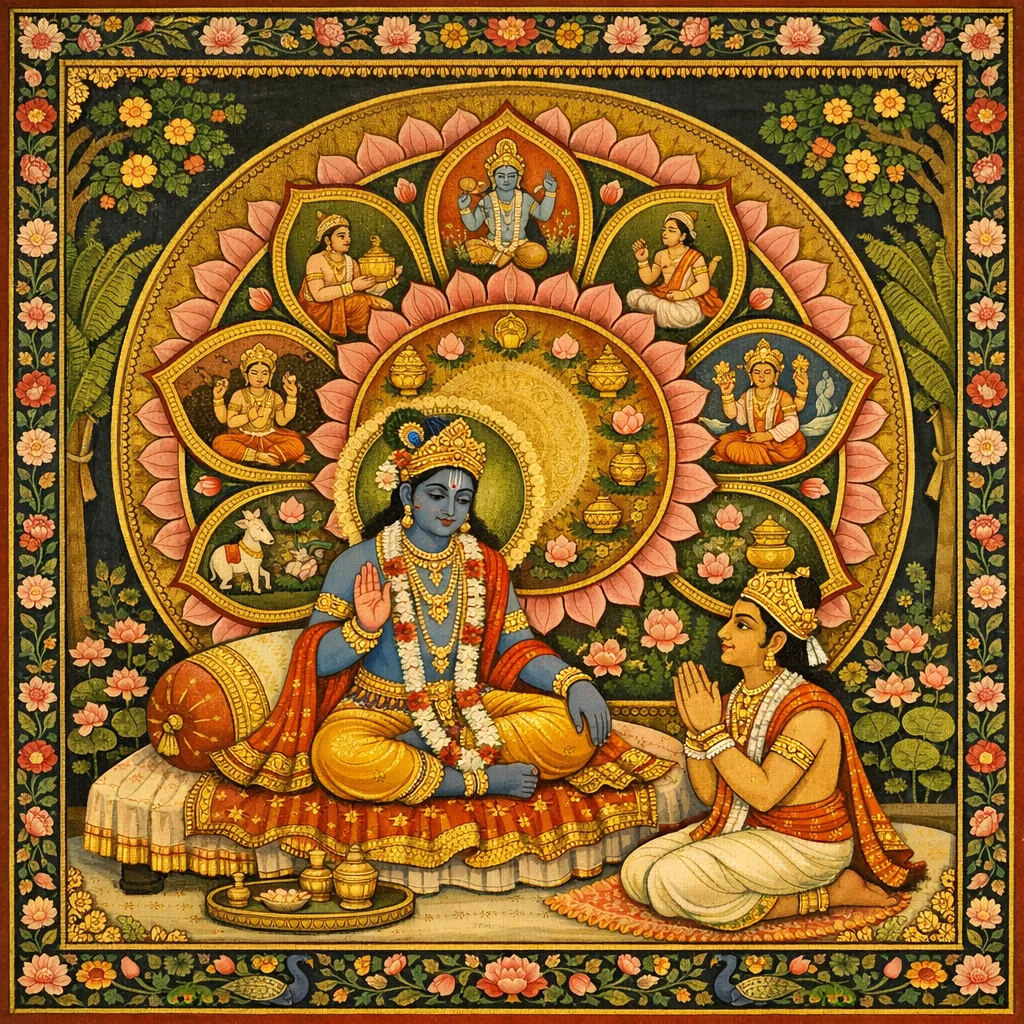
Continuing the Uddhava-gītā’s practical instruction on sādhana, this chapter addresses Uddhava’s inquiry into yoga-siddhi: what mystic perfections are, how many exist, and how they are attained. Kṛṣṇa outlines eighteen perfections—eight primary (aṣṭa-siddhi) rooted in Him and ten secondary arising through sattva-guṇa—then adds further yogic attainments connected with meditation and control. He maps specific siddhis to specific meditations on His presence within subtle elements, mahat-tattva, false ego, the sun and vision, prāṇa pathways, and His various forms (Viṣṇu/Nārāyaṇa and Brahman). The narrative arc then pivots: although Kṛṣṇa confirms that a disciplined yogī can attain these powers, He warns that devotees aiming for the supreme yoga (bhakti) regard siddhis as distractions. The chapter thus advances the canto’s progression from technique to telos—yoga’s powers are real, but devotion is the higher perfection—leading into subsequent teachings that further prioritize pure bhakti over subordinate attainments.
Shlokas
Verse 1
श्रीभगवानुवाच जितेन्द्रियस्य युक्तस्य जितश्वासस्य योगिन: । मयि धारयतश्चेत उपतिष्ठन्ति सिद्धय: ॥ १ ॥
The Supreme Personality of Godhead said: My dear Uddhava, the mystic perfections of yoga are acquired by a yogī who has conquered his senses, steadied his mind, conquered the breathing process and fixed his mind on Me.
Verse 2
श्रीउद्धव उवाच कया धारणया कास्वित् कथं वा सिद्धिरच्युत । कति वा सिद्धयो ब्रूहि योगिनां सिद्धिदो भवान् ॥ २ ॥
Śrī Uddhava said: My dear Lord Acyuta, by what process can mystic perfection be achieved, and what is the nature of such perfection? How many mystic perfections are there? Please explain these things to me. Indeed, You are the bestower of all mystic perfections.
Verse 3
श्रीभगवानुवाच सिद्धयोऽष्टादश प्रोक्ता धारणा योगपारगै: । तासामष्टौ मत्प्रधाना दशैव गुणहेतव: ॥ ३ ॥
The Supreme Personality of Godhead said: The masters of the yoga system have declared that there are eighteen types of mystic perfection and meditation, of which eight are primary, having their shelter in Me, and ten are secondary, appearing from the material mode of goodness.
Verse 4
अणिमा महिमा मूर्तेर्लघिमा प्राप्तिरिन्द्रियै: । प्राकाम्यं श्रुतदृष्टेषु शक्तिप्रेरणमीशिता ॥ ४ ॥ गुणेष्वसङ्गो वशिता यत्कामस्तदवस्यति । एता मे सिद्धय: सौम्य अष्टावौत्पत्तिका मता: ॥ ५ ॥
Among the eight primary mystic perfections, the three by which one transforms one’s own body are aṇimā, becoming smaller than the smallest; mahimā, becoming greater than the greatest; and laghimā, becoming lighter than the lightest. Through the perfection of prāpti one acquires whatever one desires, and through prākāmya-siddhi one experiences any enjoyable object, either in this world or the next. Through īśitā-siddhi one can manipulate the subpotencies of māyā, and through the controlling potency called vaśitā-siddhi one is unimpeded by the three modes of nature. One who has acquired kāmāvasāyitā-siddhi can obtain anything from anywhere, to the highest possible limit. My dear gentle Uddhava, these eight mystic perfections are considered to be naturally existing and unexcelled within this world.
Verse 5
अणिमा महिमा मूर्तेर्लघिमा प्राप्तिरिन्द्रियै: । प्राकाम्यं श्रुतदृष्टेषु शक्तिप्रेरणमीशिता ॥ ४ ॥ गुणेष्वसङ्गो वशिता यत्कामस्तदवस्यति । एता मे सिद्धय: सौम्य अष्टावौत्पत्तिका मता: ॥ ५ ॥
Among the eight primary mystic perfections, the three by which one transforms one’s own body are aṇimā, becoming smaller than the smallest; mahimā, becoming greater than the greatest; and laghimā, becoming lighter than the lightest. Through the perfection of prāpti one acquires whatever one desires, and through prākāmya-siddhi one experiences any enjoyable object, either in this world or the next. Through īśitā-siddhi one can manipulate the subpotencies of māyā, and through the controlling potency called vaśitā-siddhi one is unimpeded by the three modes of nature. One who has acquired kāmāvasāyitā-siddhi can obtain anything from anywhere, to the highest possible limit. My dear gentle Uddhava, these eight mystic perfections are considered to be naturally existing and unexcelled within this world.
Verse 6
अनूर्मिमत्त्वं देहेऽस्मिन् दूरश्रवणदर्शनम् । मनोजव: कामरूपं परकायप्रवेशनम् ॥ ६ ॥ स्वच्छन्दमृत्युर्देवानां सहक्रीडानुदर्शनम् । यथासङ्कल्पसंसिद्धिराज्ञाप्रतिहता गति: ॥ ७ ॥
The ten secondary mystic perfections arising from the modes of nature are the powers of freeing oneself from hunger and thirst and other bodily disturbances, hearing and seeing things far away, moving the body at the speed of the mind, assuming any form one desires, entering the bodies of others, dying when one desires, witnessing the pastimes between the demigods and the celestial girls called Apsarās, completely executing one’s determination and giving orders whose fulfillment is unimpeded.
Verse 7
अनूर्मिमत्त्वं देहेऽस्मिन् दूरश्रवणदर्शनम् । मनोजव: कामरूपं परकायप्रवेशनम् ॥ ६ ॥ स्वच्छन्दमृत्युर्देवानां सहक्रीडानुदर्शनम् । यथासङ्कल्पसंसिद्धिराज्ञाप्रतिहता गति: ॥ ७ ॥
The ten secondary mystic perfections arising from the modes of nature are the powers of freeing oneself from hunger and thirst and other bodily disturbances, hearing and seeing things far away, moving the body at the speed of the mind, assuming any form one desires, entering the bodies of others, dying when one desires, witnessing the pastimes between the demigods and the celestial girls called Apsarās, completely executing one’s determination and giving orders whose fulfillment is unimpeded.
Verse 8
त्रिकालज्ञत्वमद्वन्द्वं परचित्ताद्यभिज्ञता । अग्न्यर्काम्बुविषादीनां प्रतिष्टम्भोऽपराजय: ॥ ८ ॥ एताश्चोद्देशत: प्रोक्ता योगधारणसिद्धय: । यया धारणया या स्याद् यथा वा स्यान्निबोध मे ॥ ९ ॥
The power to know past, present and future; tolerance of heat, cold and other dualities; knowing the minds of others; checking the influence of fire, sun, water, poison, and so on; and remaining unconquered by others — these constitute five perfections of the mystic process of yoga and meditation. I am simply listing these here according to their names and characteristics. Now please learn from Me how specific mystic perfections arise from specific meditations and also of the particular processes involved.
Verse 9
त्रिकालज्ञत्वमद्वन्द्वं परचित्ताद्यभिज्ञता । अग्न्यर्काम्बुविषादीनां प्रतिष्टम्भोऽपराजय: ॥ ८ ॥ एताश्चोद्देशत: प्रोक्ता योगधारणसिद्धय: । यया धारणया या स्याद् यथा वा स्यान्निबोध मे ॥ ९ ॥
The power to know past, present and future; tolerance of heat, cold and other dualities; knowing the minds of others; checking the influence of fire, sun, water, poison, and so on; and remaining unconquered by others — these constitute five perfections of the mystic process of yoga and meditation. I am simply listing these here according to their names and characteristics. Now please learn from Me how specific mystic perfections arise from specific meditations and also of the particular processes involved.
Verse 10
भूतसूक्ष्मात्मनि मयि तन्मात्रं धारयेन्मन: । अणिमानमवाप्नोति तन्मात्रोपासको मम ॥ १० ॥
One who worships Me in My atomic form pervading all subtle elements, fixing his mind on that alone, obtains the mystic perfection called aṇimā.
Verse 11
महत्तत्त्वात्मनि मयि यथासंस्थं मनो दधत् । महिमानमवाप्नोति भूतानां च पृथक् पृथक् ॥ ११ ॥
One who absorbs his mind in the particular form of the mahat-tattva and thus meditates upon Me as the Supreme Soul of the total material existence achieves the mystic perfection called mahimā. By further absorbing the mind in the situation of each individual element such as the sky, air, fire, and so on, one progressively acquires the greatness of each material element.
Verse 12
परमाणुमये चित्तं भूतानां मयि रञ्जयन् । कालसूक्ष्मार्थतां योगी लघिमानमवाप्नुयात् ॥ १२ ॥
I exist within everything, and I am therefore the essence of the atomic constituents of material elements. By attaching his mind to Me in this form, the yogī may achieve the perfection called laghimā, by which he realizes the subtle atomic substance of time.
Verse 13
धारयन् मय्यहंतत्त्वे मनो वैकारिकेऽखिलम् । सर्वेन्द्रियाणामात्मत्वं प्राप्तिं प्राप्नोति मन्मना: ॥ १३ ॥
Fixing his mind completely in Me within the element of false ego generated from the mode of goodness, the yogī obtains the power of mystic acquisition, by which he becomes the proprietor of the senses of all living entities. He obtains such perfection because his mind is absorbed in Me.
Verse 14
महत्यात्मनि य: सूत्रे धारयेन्मयि मानसम् । प्राकाम्यं पारमेष्ठ्यं मे विन्दतेऽव्यक्तजन्मन: ॥ १४ ॥
One who concentrates all mental activities in Me as the Supersoul of that phase of the mahat-tattva which manifests the chain of fruitive activities obtains from Me, whose appearance is beyond material perception, the most excellent mystic perfection called prākāmya.
Verse 15
विष्णौ त्र्यधीश्वरे चित्तं धारयेत् कालविग्रहे । स ईशित्वमवाप्नोति क्षेत्रज्ञक्षेत्रचोदनाम् ॥ १५ ॥
One who places his consciousness on Viṣṇu, the Supersoul, the prime mover and Supreme Lord of the external energy consisting of three modes, obtains the mystic perfection of controlling other conditioned souls, their material bodies and their bodily designations.
Verse 16
नारायणे तुरीयाख्ये भगवच्छब्दशब्दिते । मनो मय्यादधद् योगी मद्धर्मा वशितामियात् ॥ १६ ॥
The yogī who places his mind in My form of Nārāyaṇa, known as the fourth factor, full of all opulences, becomes endowed with My nature and thus obtains the mystic perfection called vaśitā.
Verse 17
निर्गुणे ब्रह्मणि मयि धारयन् विशदं मन: । परमानन्दमाप्नोति यत्र कामोऽवसीयते ॥ १७ ॥
One who fixes his pure mind on Me in My manifestation as the impersonal Brahman obtains the greatest happiness, wherein all his desires are completely fulfilled.
Verse 18
श्वेतद्वीपपतौ चित्तं शुद्धे धर्ममये मयि । धारयञ्छ्वेततां याति षडूर्मिरहितो नर: ॥ १८ ॥
A human being who concentrates on Me as the upholder of religious principles, the personification of purity and the Lord of Śvetadvīpa obtains the pure existence in which he is freed from the six waves of material disturbance, namely hunger, thirst, decay, death, grief and illusion.
Verse 19
मय्याकाशात्मनि प्राणे मनसा घोषमुद्वहन् । तत्रोपलब्धा भूतानां हंसो वाच: शृणोत्यसौ ॥ १९ ॥
That purified living entity who fixes his mind on the extraordinary sound vibrations occurring within Me as the personified sky and total life air is then able to perceive within the sky the speaking of all living entities.
Verse 20
चक्षुस्त्वष्टरि संयोज्य त्वष्टारमपि चक्षुषि । मां तत्र मनसा ध्यायन् विश्वं पश्यति दूरत: ॥ २० ॥
Merging one’s sight into the sun planet and then the sun planet into one’s eyes, one should meditate on Me as existing within the combination of sun and vision; thus one acquires the power to see any distant thing.
Verse 21
मनो मयि सुसंयोज्य देहं तदनुवायुना । मद्धारणानुभावेन तत्रात्मा यत्र वै मन: ॥ २१ ॥
The yogī who completely absorbs his mind in Me, and who then makes use of the wind that follows the mind to absorb the material body in Me, obtains through the potency of meditation on Me the mystic perfection by which his body immediately follows his mind wherever it goes.
Verse 22
यदा मन उपादाय यद् यद् रूपं बुभूषति । तत्तद् भवेन्मनोरूपं मद्योगबलमाश्रय: ॥ २२ ॥
When the yogī, applying his mind in a certain way, desires to assume a particular form, that very form immediately appears. Such perfection is possible by absorbing the mind in the shelter of My inconceivable mystic potency, by which I assume innumerable forms.
Verse 23
परकायं विशन् सिद्ध आत्मानं तत्र भावयेत् । पिण्डं हित्वा विशेत् प्राणो वायुभूत: षडङ्घ्रिवत् ॥ २३ ॥
When a perfect yogī desires to enter another’s body, he should meditate upon himself within the other body, and then, giving up his own gross body, he should enter the other’s body through the pathways of air, as easily as a bee leaves one flower and flies into another.
Verse 24
पार्ष्ण्यापीड्य गुदं प्राणं हृदुर:कण्ठमूर्धसु । आरोप्य ब्रह्मरन्ध्रेण ब्रह्म नीत्वोत्सृजेत्तनुम् ॥ २४ ॥
The yogī who has achieved the mystic perfection called svacchanda-mṛtyu blocks the anus with the heel of the foot and then lifts the soul from the heart to the chest, to the neck and finally to the head. Situated within the brahma-randhra, the yogī then gives up his material body and guides the spirit soul to the selected destination.
Verse 25
विहरिष्यन् सुराक्रीडे मत्स्थं सत्त्वं विभावयेत् । विमानेनोपतिष्ठन्ति सत्त्ववृत्ती: सुरस्त्रिय: ॥ २५ ॥
The yogī who desires to enjoy in the pleasure gardens of the demigods should meditate on the purified mode of goodness, which is situated within Me, and then the heavenly women, generated from the mode of goodness, will approach him in airplanes.
Verse 26
यथा सङ्कल्पयेद् बुद्ध्या यदा वा मत्पर: पुमान् । मयि सत्ये मनो युञ्जंस्तथा तत् समुपाश्नुते ॥ २६ ॥
A yogī who has faith in Me, absorbing his mind in Me and knowing that My purpose is always fulfilled, will always achieve his purpose by the very means he has determined to follow.
Verse 27
यो वै मद्भावमापन्न ईशितुर्वशितु: पुमान् । कुतश्चिन्न विहन्येत तस्य चाज्ञा यथा मम ॥ २७ ॥
A person who perfectly meditates on Me acquires My nature of being the supreme ruler and controller. His order, like Mine, can never be frustrated by any means.
Verse 28
मद्भक्त्या शुद्धसत्त्वस्य योगिनो धारणाविद: । तस्य त्रैकालिकी बुद्धिर्जन्ममृत्यूपबृंहिता ॥ २८ ॥
A yogī who has purified his existence by devotion to Me and who thus expertly knows the process of meditation obtains knowledge of past, present and future. He can therefore see the birth and death of himself and others.
Verse 29
अग्न्यादिभिर्न हन्येत मुनेर्योगमयं वपु: । मद्योगशान्तचित्तस्य यादसामुदकं यथा ॥ २९ ॥
Just as the bodies of aquatics cannot be injured by water, similarly, the body of a yogī whose consciousness is pacified by devotion to Me and who is fully developed in yoga science cannot be injured by fire, sun, water, poison, and so forth.
Verse 30
मद्विभूतीरभिध्यायन् श्रीवत्सास्त्रविभूषिता: । ध्वजातपत्रव्यजनै: स भवेदपराजित: ॥ ३० ॥
My devotee becomes unconquerable by meditating on My opulent incarnations, which are decorated with Śrīvatsa and various weapons and are endowed with imperial paraphernalia such as flags, ornamental umbrellas and fans.
Verse 31
उपासकस्य मामेवं योगधारणया मुने: । सिद्धय: पूर्वकथिता उपतिष्ठन्त्यशेषत: ॥ ३१ ॥
A learned devotee who worships Me through yoga meditation certainly obtains in all respects the mystic perfections that I have described.
Verse 32
जितेन्द्रियस्य दान्तस्य जितश्वासात्मनो मुने: । मद्धारणां धारयत: का सा सिद्धि: सुदुर्लभा ॥ ३२ ॥
For a sage who has conquered his senses, breathing and mind, who is self-controlled and always absorbed in meditation on Me, what mystic perfection could possibly be difficult to achieve?
Verse 33
अन्तरायान् वदन्त्येता युञ्जतो योगमुत्तमम् । मया सम्पद्यमानस्य कालक्षपणहेतव: ॥ ३३ ॥
Learned experts in devotional service state that the mystic perfections of yoga that I have mentioned are actually impediments and are a waste of time for one who is practicing the supreme yoga, by which one achieves all perfection in life directly from Me.
Verse 34
जन्मौषधितपोमन्त्रैर्यावतीरिह सिद्धय: । योगेनाप्नोति ता: सर्वा नान्यैर्योगगतिं व्रजेत् ॥ ३४ ॥
Whatever mystic perfections can be achieved by good birth, herbs, austerities and mantras can all be achieved by devotional service to Me; indeed, one cannot achieve the actual perfection of yoga by any other means.
Verse 35
सर्वासामपि सिद्धीनां हेतु: पतिरहं प्रभु: । अहं योगस्य साङ्ख्यस्य धर्मस्य ब्रह्मवादिनाम् ॥ ३५ ॥
My dear Uddhava, I am the cause, the protector and the Lord of all mystic perfections, of the yoga system, of analytic knowledge, of pure activity and of the community of learned Vedic teachers.
Verse 36
अहमात्मान्तरो बाह्योऽनावृत: सर्वदेहिनाम् । यथा भूतानि भूतेषु बहिरन्त: स्वयं तथा ॥ ३६ ॥
Just as the same material elements exist within and outside of all material bodies, similarly, I cannot be covered by anything else. I exist within everything as the Supersoul and outside of everything in My all-pervading feature.
Frequently Asked Questions
Kṛṣṇa states that yoga masters describe eighteen types: eight primary perfections (aṣṭa-siddhi) that have their shelter in Him, and ten secondary perfections that arise from the material mode of goodness (sattva). He also mentions additional yogic attainments in the context of meditation, such as tri-kāla-jñāna (knowing past, present, future) and resistance to material dualities.
They are: aṇimā (becoming smaller than the smallest), mahimā (becoming greater than the greatest), laghimā (becoming lighter than the lightest), prāpti (obtaining desired objects), prākāmya (experiencing any enjoyable object), īśitā (manipulating subpotencies of māyā), vaśitā (unimpeded by the guṇas), and kāmāvasāyitā (obtaining anything from anywhere to the highest limit).
The chapter links each siddhi to a particular dhyāna: worshiping the Lord in His atomic presence yields aṇimā; meditating on Him as the Supersoul of mahat-tattva yields mahimā; absorption in His presence as the essence within elements yields laghimā; and other perfections arise by fixing consciousness on Him as Viṣṇu/Nārāyaṇa, within ahaṅkāra, within the sun and vision, and through prāṇa-pathways—showing that siddhis are derivative of focused meditation on the Lord’s omnipresence.
Kṛṣṇa states that learned bhakti authorities consider siddhis impediments because they can redirect attention from the supreme goal—exclusive devotion and direct attainment of the Lord. Since bhakti grants the highest perfection (the Lord Himself), fascination with powers can become a waste of time for one practicing para-yoga.
Kṛṣṇa declares Himself to be the cause, protector, and Lord of all mystic perfections, of the yoga system, of analytic knowledge, and of pure activity—establishing that siddhis are not independent achievements but depend on His sanction and presence as Paramātmā within and beyond everything.