Adhyaya 16
Vibhūti-yoga in the Bhāgavata: The Lord’s Manifest Opulences and the Discipline of Control
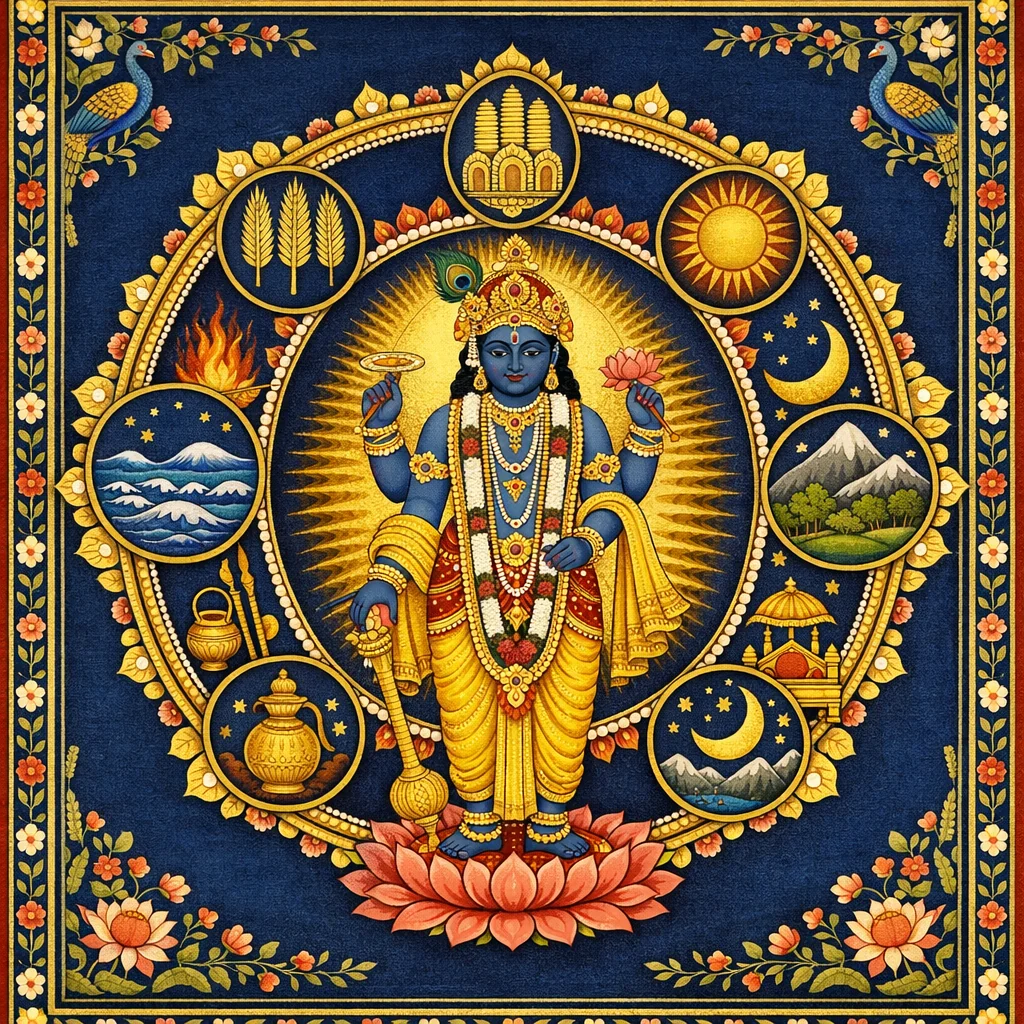
Continuing Uddhava’s earnest inquiry into the Lord’s hidden presence as Paramātmā, this chapter opens with Uddhava praising Kṛṣṇa as beginningless, endless, and the life of all beings, then requesting knowledge of the siddhis attained by devotion and the various divine forms worshiped by sages. The Lord responds by linking Uddhava’s question to Arjuna’s earlier inquiry at Kurukṣetra, establishing continuity with the Gītā tradition of vibhūti (divine excellences). Kṛṣṇa then enumerates representative manifestations—among Vedas, meters, deities, sages, kings, celestial beings, natural forces, time divisions, virtues, and cosmic principles—showing that whatever is supreme, beautiful, powerful, or purifying is an expansion of His opulence. The discourse culminates in a practical injunction: mastery of speech, mind, prāṇa, and senses through purified intelligence, for without such control one’s vows and austerities leak away like water from an unbaked pot. This chapter thus transitions from metaphysical recognition (“everything is His vibhūti”) to the next-step sādhana imperative (“therefore, control and surrender”).
Shlokas
Verse 1
श्रीउद्धव उवाच त्वं ब्रह्म परमं साक्षादनाद्यन्तमपावृतम् । सर्वेषामपि भावानां त्राणस्थित्यप्ययोद्भव: ॥ १ ॥
Śrī Uddhava said: My dear Lord, You are beginningless and endless, the Absolute Truth Himself, unlimited by anything else. You are the protector and life-giver, the destruction and creation of all things that exist.
Verse 2
उच्चावचेषु भूतेषु दुर्ज्ञेयमकृतात्मभि: । उपासते त्वां भगवन् याथातथ्येन ब्राह्मणा: ॥ २ ॥
My dear Lord, although it is difficult for the impious to understand that You are situated in all superior and inferior creations, those brāhmaṇas who are actual knowers of the Vedic conclusion worship You in truth.
Verse 3
येषु येषु च भूतेषु भक्त्या त्वां परमर्षय: । उपासीना: प्रपद्यन्ते संसिद्धिं तद् वदस्व मे ॥ ३ ॥
Please tell me of the perfections that great sages achieve by worshiping You with devotion. Also, kindly explain which of Your different forms they worship.
Verse 4
गूढश्चरसि भूतात्मा भूतानां भूतभावन । न त्वां पश्यन्ति भूतानि पश्यन्तं मोहितानि ते ॥ ४ ॥
O my Lord, maintainer of all, although You are the Supersoul of the living entities, You remain hidden. Thus being bewildered by You, the living entities cannot see You, although You are seeing them.
Verse 5
या: काश्च भूमौ दिवि वै रसायां विभूतयो दिक्षु महाविभूते । ता मह्यमाख्याह्यनुभावितास्ते नमामि ते तीर्थपदाङ्घ्रिपद्मम् ॥ ५ ॥
O supremely potent Lord, please explain to me Your innumerable potencies, which You manifest on the earth, in heaven, in hell and indeed in all directions. I offer my humble obeisances at Your lotus feet, which are the shelter of all holy places.
Verse 6
श्रीभगवानुवाच एवमेतदहं पृष्ट: प्रश्नं प्रश्नविदां वर । युयुत्सुना विनशने सपत्नैरर्जुनेन वै ॥ ६ ॥
The Supreme Personality of Godhead said: O best of those who know how to inquire, on the Battlefield of Kurukṣetra, Arjuna, desiring to fight with his rivals, asked Me the same question that you are now posing.
Verse 7
ज्ञात्वा ज्ञातिवधं गर्ह्यमधर्मं राज्यहेतुकम् । ततो निवृत्तो हन्ताहं हतोऽयमिति लौकिक: ॥ ७ ॥
On the Battlefield of Kurukṣetra Arjuna thought that killing his relatives would be an abominable, irreligious activity, motivated only by his desire to acquire a kingdom. He therefore desisted from the battle, thinking, “I would be the killer of my relatives. They would be destroyed.” Thus Arjuna was afflicted with mundane consciousness.
Verse 8
स तदा पुरुषव्याघ्रो युक्त्या मे प्रतिबोधित: । अभ्यभाषत मामेवं यथा त्वं रणमूर्धनि ॥ ८ ॥
At that time I enlightened Arjuna, the tiger among men, with logical arguments, and thus in the front of the battle Arjuna addressed Me with questions in the same way that you are now inquiring.
Verse 9
अहमात्मोद्धवामीषां भूतानां सुहृदीश्वर: । अहं सर्वाणि भूतानि तेषां स्थित्युद्भवाप्यय: ॥ ९ ॥
My dear Uddhava, I am the Supersoul of all living entities, and therefore I am naturally their well-wisher and supreme controller. Being the creator, maintainer and annihilator of all entities, I am not different from them.
Verse 10
अहं गतिर्गतिमतां काल: कलयतामहम् । गुणानां चाप्यहं साम्यं गुणिन्यौत्पत्तिको गुण: ॥ १० ॥
I am the ultimate goal of all those seeking progress, and I am time among those who exert control. I am the equilibrium of the modes of material nature, and I am natural virtue among the pious.
Verse 11
गुणिनामप्यहं सूत्रं महतां च महानहम् । सूक्ष्माणामप्यहं जीवो दुर्जयानामहं मन: ॥ ११ ॥
Among things possessing qualities I am the primary manifestation of nature, and among great things I am the total material creation. Among subtle things I am the spirit soul, and of things that are difficult to conquer I am the mind.
Verse 12
हिरण्यगर्भो वेदानां मन्त्राणां प्रणवस्त्रिवृत् । अक्षराणामकारोऽस्मि पदानिच्छन्दसामहम् ॥ १२ ॥
Among the Vedas I am their original teacher, Lord Brahmā, and of all mantras I am the three-lettered oṁkāra. Among letters I am the first letter, “a,” and among sacred meters I am the Gāyatrī mantra.
Verse 13
इन्द्रोऽहं सर्वदेवानां वसूनामस्मि हव्यवाट् । आदित्यानामहं विष्णू रुद्राणां नीललोहित: ॥ १३ ॥
Among the demigods I am Indra, and among the Vasus I am Agni, the god of fire. I am Viṣṇu among the sons of Aditi, and among the Rudras I am Lord Śiva.
Verse 14
ब्रह्मर्षीणां भृगुरहं राजर्षीणामहं मनु: । देवर्षीणां नारदोऽहं हविर्धान्यस्मि धेनुषु ॥ १४ ॥
Among saintly brāhmaṇas I am Bhṛgu Muni, and I am Manu among saintly kings. I am Nārada Muni among saintly demigods, and I am Kāmadhenu among cows.
Verse 15
सिद्धेश्वराणां कपिल: सुपर्णोऽहं पतत्रिणाम् । प्रजापतीनां दक्षोऽहं पितृणामहमर्यमा ॥ १५ ॥
I am Lord Kapila among perfected beings and Garuḍa among birds. I am Dakṣa among the progenitors of mankind, and I am Aryamā among the forefathers.
Verse 16
मां विद्ध्युद्धव दैत्यानां प्रह्लादमसुरेश्वरम् । सोमं नक्षत्रौषधीनां धनेशं यक्षरक्षसाम् ॥ १६ ॥
My dear Uddhava, among the demoniac sons of Diti know Me to be Prahlāda Mahārāja, the saintly lord of the asuras. Among the stars and herbs I am their lord, Candra (the moon), and among Yakṣas and Rākṣasas I am the lord of wealth, Kuvera.
Verse 17
ऐरावतं गजेन्द्राणां यादसां वरुणं प्रभुम् । तपतां द्युमतां सूर्यं मनुष्याणां च भूपतिम् ॥ १७ ॥
I am Airāvata among lordly elephants, and among aquatics I am Varuṇa, the lord of the seas. Among all things that heat and illuminate I am the sun, and among human beings I am the king.
Verse 18
उच्चै:श्रवास्तुरङ्गाणां धातूनामस्मि काञ्चनम् । यम: संयमतां चाहम् सर्पाणामस्मि वासुकि: ॥ १८ ॥
Among horses I am Uccaiḥśravā, and I am gold among metals. I am Yamarāja among those who suppress and punish, and among serpents I am Vāsuki.
Verse 19
नागेन्द्राणामनन्तोऽहं मृगेन्द्र: शृङ्गिदंष्ट्रिणाम् । आश्रमाणामहं तुर्यो वर्णानां प्रथमोऽनघ ॥ १९ ॥
O sinless Uddhava, among the best of snakes I am Anantadeva, and among those animals with sharp horns or teeth I am the lion. Among the social orders I am the fourth, or the renounced order of life, and among the occupational divisions I am the first, the brāhmaṇas.
Verse 20
तीर्थानां स्रोतसां गङ्गा समुद्र: सरसामहम् । आयुधानां धनुरहं त्रिपुरघ्नो धनुष्मताम् ॥ २० ॥
Among sacred and flowing things I am the holy Ganges, and among steady bodies of water I am the ocean. Among weapons I am the bow, and of the wielders of weapons I am Lord Śiva.
Verse 21
धिष्ण्यानामस्म्यहं मेरुर्गहनानां हिमालय: । वनस्पतीनामश्वत्थ ओषधीनामहं यव: ॥ २१ ॥
Among residences I am Mount Sumeru, and of impervious places I am the Himālayas. Among trees I am the holy fig tree, and among plants I am those that bear grains.
Verse 22
पुरोधसां वसिष्ठोऽहं ब्रह्मिष्ठानां बृहस्पति: । स्कन्दोऽहं सर्वसेनान्यामग्रण्यां भगवानज: ॥ २२ ॥
Among priests I am Vasiṣṭha Muni, and among those highly situated in Vedic culture I am Bṛhaspati. I am Kārtikeya among great military leaders, and among those advancing in superior ways of life I am the great personality Lord Brahmā.
Verse 23
यज्ञानां ब्रह्मयज्ञोऽहं व्रतानामविहिंसनम् । वाय्वग्न्यर्काम्बुवागात्मा शुचीनामप्यहं शुचि: ॥ २३ ॥
Among sacrifices I am study of the Veda, and I am nonviolence among vows. Among all things that purify I am the wind, fire, the sun, water and speech.
Verse 24
योगानामात्मसंरोधो मन्त्रोऽस्मि विजिगीषताम् । आन्वीक्षिकी कौशलानां विकल्प: ख्यातिवादिनाम् ॥ २४ ॥
Among the eight progressive states of yoga I am the final stage, samādhi, in which the soul is completely separated from illusion. Among those desiring victory I am prudent political counsel, and among processes of expert discrimination I am the science of the soul, by which one distinguishes spirit from matter. Among all speculative philosophers I am diversity of perception.
Verse 25
स्त्रीणां तु शतरूपाहं पुंसां स्वायम्भुवो मनु: । नारायणो मुनीनां च कुमारो ब्रह्मचारिणाम् ॥ २५ ॥
Among ladies I am Śatarūpā, and among male personalities I am her husband, Svāyambhuva Manu. I am Nārāyaṇa among the sages and Sanat-kumāra among brahmacārīs.
Verse 26
धर्माणामस्मि संन्यास: क्षेमाणामबहिर्मति: । गुह्यानां सुनृतं मौनं मिथुनानामजस्त्वहम् ॥ २६ ॥
Among religious principles I am renunciation, and of all types of security I am consciousness of the eternal soul within. Of secrets I am pleasant speech and silence, and among sexual pairs I am Brahmā.
Verse 27
संवत्सरोऽस्म्यनिमिषामृतूनां मधुमाधवौ । मासानां मार्गशीर्षोऽहं नक्षत्राणां तथाभिजित् ॥ २७ ॥
Among the vigilant cycles of time I am the year, and among seasons I am spring. Among months I am Mārgaśīrṣa, and among lunar houses I am the auspicious Abhijit.
Verse 28
अहं युगानां च कृतं धीराणां देवलोऽसित: । द्वैपायनोऽस्मि व्यासानां कवीनां काव्य आत्मवान् ॥ २८ ॥
Among ages I am the Satya-yuga, the age of truth, and among steady sages I am Devala and Asita. Among those who have divided the Vedas I am Kṛṣṇa Dvaipāyana Vedavyāsa, and among learned scholars I am Śukrācārya, the knower of spiritual science.
Verse 29
वासुदेवो भगवतां त्वं तु भागवतेष्वहम् । किम्पुरुषाणां हनुमान् विद्याध्राणां सुदर्शन: ॥ २९ ॥
Among those entitled to the name Bhagavān I am Vāsudeva, and indeed, you, Uddhava, represent Me among the devotees. I am Hanumān among the Kimpuruṣas, and among the Vidyādharas I am Sudarśana.
Verse 30
रत्नानां पद्मरागोऽस्मि पद्मकोश: सुपेशसाम् । कुशोऽस्मि दर्भजातीनां गव्यमाज्यं हवि:ष्वहम् ॥ ३० ॥
Among jewels I am the ruby, and among beautiful things I am the lotus cup. Among all types of grass I am the sacred kuśa, and of oblations I am ghee and other ingredients obtained from the cow.
Verse 31
व्यवसायिनामहं लक्ष्मी: कितवानां छलग्रह: । तितिक्षास्मि तितिक्षूणां सत्त्वं सत्त्ववतामहम् ॥ ३१ ॥
Among the enterprising I am fortune, and among the cheaters I am gambling. I am the forgiveness of the tolerant and the good qualities of those in the mode of goodness.
Verse 32
ओज: सहो बलवतां कर्माहं विद्धि सात्वताम् । सात्वतां नवमूर्तीनामादिमूर्तिरहं परा ॥ ३२ ॥
Of the powerful I am bodily and mental strength, and I am the devotional activities of My devotees. My devotees worship Me in nine different forms, among which I am the original and primary Vāsudeva.
Verse 33
विश्वावसु: पूर्वचित्तिर्गन्धर्वाप्सरसामहम् । भूधराणामहं स्थैर्यं गन्धमात्रमहं भुव: ॥ ३३ ॥
Among the Gandharvas I am Viśvāvasu, and I am Pūrvacitti among the heavenly Apsaras. I am the steadiness of mountains and the fragrant aroma of the earth.
Verse 34
अपां रसश्च परमस्तेजिष्ठानां विभावसु: । प्रभा सूर्येन्दुताराणां शब्दोऽहं नभस: पर: ॥ ३४ ॥
I am the sweet taste of water, and among brilliant things I am the sun. I am the effulgence of the sun, moon and stars, and I am the transcendental sound that vibrates in the sky.
Verse 35
ब्रह्मण्यानां बलिरहं वीराणामहमर्जुन: । भूतानां स्थितिरुत्पत्तिरहं वै प्रतिसङ्क्रम: ॥ ३५ ॥
Among those dedicated to brahminical culture I am Bali Mahārāja, the son of Virocana, and I am Arjuna among heroes. Indeed, I am the creation, maintenance and annihilation of all living entities.
Verse 36
गत्युक्त्युत्सर्गोपादानमानन्दस्पर्शलक्षणम् । आस्वादश्रुत्यवघ्राणमहं सर्वेन्द्रियेन्द्रियम् ॥ ३६ ॥
I am the functions of the five working senses — the legs, speech, anus, hands and sex organs — as well as those of the five knowledge-acquiring senses — touch, sight, taste, hearing and smell. I am also the potency by which each of the senses experiences its particular sense object.
Verse 37
पृथिवी वायुराकाश आपो ज्योतिरहं महान् । विकार: पुरुषोऽव्यक्तं रज: सत्त्वं तम: परम् । अहमेतत्प्रसङ्ख्यानं ज्ञानं तत्त्वविनिश्चय: ॥ ३७ ॥
I am form, taste, aroma, touch and sound; false ego; the mahat-tattva; earth, water, fire, air and sky; the living entity; material nature; the modes of goodness, passion and ignorance; and the transcendental Lord. All these items, along with knowledge of their individual symptoms and the steady conviction that results from this knowledge, represent Me.
Verse 38
मयेश्वरेण जीवेन गुणेन गुणिना विना । सर्वात्मनापि सर्वेण न भावो विद्यते क्वचित् ॥ ३८ ॥
As the Supreme Lord I am the basis of the living entity, of the modes of nature and of the mahat-tattva. Thus I am everything, and nothing whatsoever can exist without Me.
Verse 39
सङ्ख्यानं परमाणूनां कालेन क्रियते मया । न तथा मे विभूतीनां सृजतोऽण्डानि कोटिश: ॥ ३९ ॥
Even though over a period of time I might count all the atoms of the universe, I could not count all of My opulences which I manifest within innumerable universes.
Verse 40
तेज: श्री: कीर्तिरैश्वर्यं ह्रीस्त्याग: सौभगं भग: । वीर्यं तितिक्षा विज्ञानं यत्र यत्र स मेंऽशक: ॥ ४० ॥
Whatever power, beauty, fame, opulence, humility, renunciation, mental pleasure, fortune, strength, tolerance or spiritual knowledge there may be is simply an expansion of My opulence.
Verse 41
एतास्ते कीर्तिता: सर्वा: सङ्क्षेपेण विभूतय: । मनोविकारा एवैते यथा वाचाभिधीयते ॥ ४१ ॥
I have briefly described to you all My spiritual opulences and also the extraordinary material features of My creation, which are perceived by the mind and defined in different ways according to circumstances.
Verse 42
वाचं यच्छ मनो यच्छ प्राणान् यच्छेन्द्रियाणि च । आत्मानमात्मना यच्छ न भूय: कल्पसेऽध्वने ॥ ४२ ॥
Therefore, control your speaking, subdue the mind, conquer the life air, regulate the senses and through purified intelligence bring your rational faculties under control. In this way you will never again fall onto the path of material existence.
Verse 43
यो वै वाङ्मनसी सम्यगसंयच्छन् धिया यति: । तस्य व्रतं तपो दानं स्रवत्यामघटाम्बुवत् ॥ ४३ ॥
A transcendentalist who does not completely control his words and mind by superior intelligence will find that his spiritual vows, austerities and charity flow away just as water flows out of an unbaked clay pot.
Verse 44
तस्माद्वचोमन:प्राणान् नियच्छेन्मत्परायण: । मद्भक्तियुक्तया बुद्ध्या तत: परिसमाप्यते ॥ ४४ ॥
Being surrendered to Me, one should control the speech, mind and life air, and then through loving devotional intelligence one will completely fulfill the mission of life.
Frequently Asked Questions
By invoking Kurukṣetra, Kṛṣṇa frames Uddhava’s inquiry within a recognized śāstric template: the vibhūti teaching that converts abstract theism into perceivable recognition of the Lord’s presence everywhere. The reference also signals that the same Absolute Truth who guided Arjuna through dharma-conflict now guides Uddhava through the subtler task of nirodha—withdrawal from material identification—by learning to see all excellences as rooted in Bhagavān.
The list is not mere poetry or mythology; it is a theological method (upāsanā-sāhitya) teaching that the supreme exemplar within any category points to the category’s source. By recognizing the ‘best’ (śreṣṭha) or governing principle in each domain—Veda, mantra, deity, time, element, virtue, ruler—one learns to trace perception back to āśraya (Kṛṣṇa). This transforms ordinary cognition into devotional discrimination: the world becomes a map of vibhūtis rather than a field of separate enjoyables.
The chapter’s conclusion shows the practical consequence of vibhūti-knowledge: if everything is Kṛṣṇa’s expansion, then the sādhaka must stop dissipating consciousness through uncontrolled talk, restless mind, and unregulated senses. Kṛṣṇa states that without such mastery, vows, austerities, and charity ‘leak away’ like water from an unbaked pot—indicating lack of inner consolidation (saṁskāra). Control is not repression but disciplined offering (yukta-vairāgya) performed in surrender, culminating in bhakti guided by ‘loving devotional intelligence.’