Adhyaya 9
Avadhūta’s Further Teachers: Detachment, Solitude, One-Pointed Meditation, and the Lord as Āśraya
Continuing the avadhūta brāhmaṇa’s instruction to King Yadu, this chapter deepens the theme that attachment (āsakti) to “dear” material objects inevitably yields misery, whereas relinquishment produces fearlessness and happiness. The avadhūta illustrates renunciation through nature-based teachers: the hawk that drops meat and becomes relieved; the young girl whose clinking bracelets teach the advantage of solitude and minimal association; the arrow-maker whose absorption models ekāgratā (one-pointed focus) in yoga; and the snake that lives in houses built by others, teaching non-possessiveness. The discourse then shifts from ethics to metaphysics: Nārāyaṇa as the sole shelter at dissolution, time as His potency, pradhāna/mahat-tattva as the basis of manifestation, and the spider analogy for creation and withdrawal (sarga/nirodha). The wasp-and-insect principle explains how constant meditation shapes one’s next state. The avadhūta finally names the body as a teacher of detachment and warns of sense-harassment, urging quick use of rare human life for perfection. The chapter concludes as Yadu is transformed by the teaching and the avadhūta departs, leading into Kṛṣṇa’s continued instruction to Uddhava.
Shlokas
Verse 1
श्रीब्राह्मण उवाच परिग्रहो हि दु:खाय यद् यत्प्रियतमं नृणाम् । अनन्तं सुखमाप्नोति तद् विद्वान् यस्त्वकिञ्चन: ॥ १ ॥
The saintly brāhmaṇa said: Everyone considers certain things within the material world to be most dear to him, and because of attachment to such things one eventually becomes miserable. One who understands this gives up material possessiveness and attachment and thus achieves unlimited happiness.
Verse 2
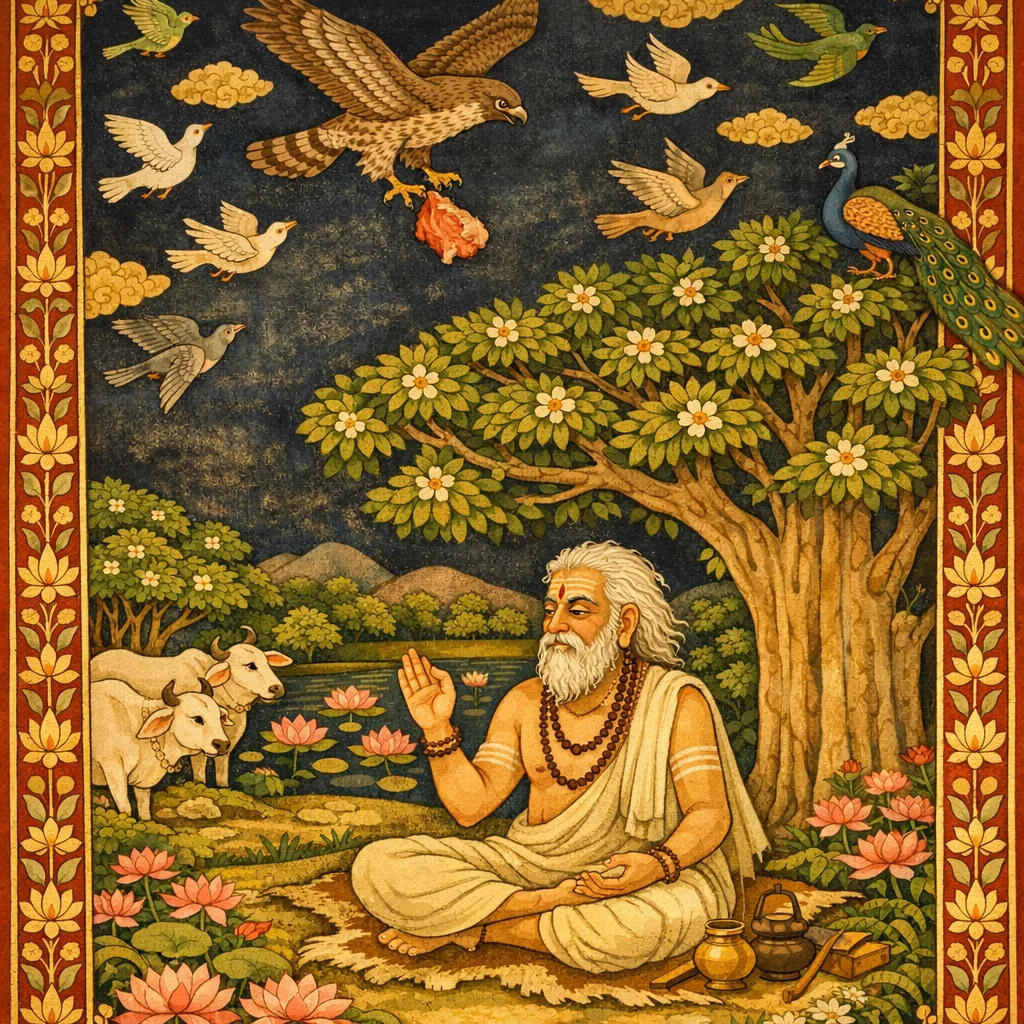
सामिषं कुररं जघ्नुर्बलिनोऽन्ये निरामिषा: । तदामिषं परित्यज्य स सुखं समविन्दत ॥ २ ॥
Once a group of large hawks who were unable to find any prey attacked another, weaker hawk who was holding some meat. At that time, being in danger of his life, the hawk gave up his meat and experienced actual happiness.
Verse 3
न मे मानापमानौ स्तो न चिन्ता गेहपुत्रिणाम् । आत्मक्रीड आत्मरतिर्विचरामीह बालवत् ॥ ३ ॥
In family life, the parents are always in anxiety about their home, children and reputation. But I have nothing to do with these things. I do not worry at all about any family, and I do not care about honor and dishonor. I enjoy only the life of the soul, and I find love on the spiritual platform. Thus I wander the earth like a child.
Verse 4
द्वावेव चिन्तया मुक्तौ परमानन्द आप्लुतौ । यो विमुग्धो जडो बालो यो गुणेभ्य: परं गत: ॥ ४ ॥
In this world two types of people are free from all anxiety and merged in great happiness: one who is a retarded and childish fool and one who has approached the Supreme Lord, who is beyond the three modes of material nature.
Verse 5
क्वचित् कुमारी त्वात्मानं वृणानान् गृहमागतान् । स्वयं तानर्हयामास क्वापि यातेषु बन्धुषु ॥ ५ ॥
Once a marriageable young girl was alone in her house because her parents and relatives had gone that day to another place. At that time a few men arrived at the house, specifically desiring to marry her. She received them with all hospitality.
Verse 6
तेषामभ्यवहारार्थं शालीन् रहसि पार्थिव । अवघ्नन्त्या: प्रकोष्ठस्थाश्चक्रु: शङ्खा: स्वनं महत् ॥ ६ ॥
The girl went to a private place and began to make preparations so that the unexpected male guests could eat. As she was beating the rice, the conchshell bracelets on her arms were colliding and making a loud noise.
Verse 7
सा तज्जुगुप्सितं मत्वा महती व्रीडिता तत: । बभञ्जैकैकश: शङ्खान् द्वौ द्वौ पाण्योरशेषयत् ॥ ७ ॥
The young girl feared that the men would consider her family to be poor because their daughter was busily engaged in the menial task of husking rice. Being very intelligent, the shy girl broke the shell bracelets from her arms, leaving just two on each wrist.
Verse 8
उभयोरप्यभूद् घोषो ह्यवघ्नन्त्या: स्वशङ्खयो: । तत्राप्येकं निरभिददेकस्मान्नाभवद् ध्वनि: ॥ ८ ॥
Thereafter, as the young girl continued to husk the rice, the two bracelets on each wrist continued to collide and make noise. Therefore she took one bracelet off each arm, and with only one left on each wrist there was no more noise.
Verse 9
अन्वशिक्षमिमं तस्या उपदेशमरिन्दम । लोकाननुचरन्नेतान् लोकतत्त्वविवित्सया ॥ ९ ॥
O subduer of the enemy, I travel throughout the surface of the earth learning constantly about the nature of this world, and thus I personally witnessed the lesson of the young girl.
Verse 10
वासे बहूनां कलहो भवेद् वार्ता द्वयोरपि । एक एव वसेत्तस्मात् कुमार्या इव कङ्कण: ॥ १० ॥
When many people live together in one place there will undoubtedly be quarreling. And even if only two people live together there will be frivolous conversation and disagreement. Therefore, to avoid conflict, one should live alone, as we learn from the example of the bracelet of the young girl.
Verse 11
मन एकत्र संयुञ्ज्याज्जितश्वासो जितासन: । वैराग्याभ्यासयोगेन ध्रियमाणमतन्द्रित: ॥ ११ ॥
Having perfected the yoga sitting postures and conquered the breathing process, one should make the mind steady by detachment and the regulated practice of yoga. Thus one should carefully fix the mind on the single goal of yoga practice.
Verse 12
यस्मिन् मनो लब्धपदं यदेत- च्छनै: शनैर्मुञ्चति कर्मरेणून् । सत्त्वेन वृद्धेन रजस्तमश्च विधूय निर्वाणमुपैत्यनिन्धनम् ॥ १२ ॥
The mind can be controlled when it is fixed on the Supreme Personality of Godhead. Having achieved a stable situation, the mind becomes free from polluted desires to execute material activities; thus as the mode of goodness increases in strength, one can completely give up the modes of passion and ignorance, and gradually one transcends even the material mode of goodness. When the mind is freed from the fuel of the modes of nature, the fire of material existence is extinguished. Then one achieves the transcendental platform of direct relationship with the object of his meditation, the Supreme Lord.
Verse 13
तदैवमात्मन्यवरुद्धचित्तो न वेद किञ्चिद् बहिरन्तरं वा । यथेषुकारो नृपतिं व्रजन्त- मिषौ गतात्मा न ददर्श पार्श्वे ॥ १३ ॥
Thus, when one’s consciousness is completely fixed on the Absolute Truth, the Supreme Personality of Godhead, one no longer sees duality, or internal and external reality. The example is given of the arrow maker who was so absorbed in making a straight arrow that he did not even see or notice the king himself, who was passing right next to him.
Verse 14
एकचार्यनिकेत: स्यादप्रमत्तो गुहाशय: । अलक्ष्यमाण आचारैर्मुनिरेकोऽल्पभाषण: ॥ १४ ॥
A saintly person should remain alone and constantly travel without any fixed residence. Being alert, he should remain secluded and should act in such a way that he is not recognized or noticed by others. Moving without companions, he should not speak more than required.
Verse 15
गृहारम्भो हि दु:खाय विफलश्चाध्रुवात्मन: । सर्प: परकृतं वेश्म प्रविश्य सुखमेधते ॥ १५ ॥
When a person living in a temporary material body tries to construct a happy home, the result is fruitless and miserable. The snake, however, enters a home that has been built by others and prospers happily.
Verse 16
एको नारायणो देव: पूर्वसृष्टं स्वमायया । संहृत्य कालकलया कल्पान्त इदमीश्वर: । एक एवाद्वितीयोऽभूदात्माधारोऽखिलाश्रय: ॥ १६ ॥
The Lord of the universe, Nārāyaṇa, is the worshipable God of all living entities. Without extraneous assistance, the Lord creates this universe by His own potency, and at the time of annihilation the Lord destroys the universe through His personal expansion of time and withdraws all of the cosmos, including all the conditioned living entities, within Himself. Thus, His unlimited Self is the shelter and reservoir of all potencies. The subtle pradhāna, the basis of all cosmic manifestation, is conserved within the Lord and is in this way not different from Him. In the aftermath of annihilation the Lord stands alone.
Verse 17
कालेनात्मानुभावेन साम्यं नीतासु शक्तिषु । सत्त्वादिष्वादिपुरुष: प्रधानपुरुषेश्वर: ॥ १७ ॥ परावराणां परम आस्ते कैवल्यसंज्ञित: । केवलानुभवानन्दसन्दोहो निरुपाधिक: ॥ १८ ॥
When the Supreme Personality of Godhead displays His own potency in the form of time and guides His material potencies, such as the mode of goodness, into a neutral condition of equilibrium, He remains as the supreme controller of that neutral state, called pradhāna, as well as of the living entities. He is also the supreme worshipable object for all beings, including liberated souls, demigods and ordinary conditioned souls. The Lord is eternally free from any material designation, and He constitutes the totality of spiritual bliss, which one experiences by seeing the Lord’s spiritual form. The Lord thus exhibits the fullest meaning of the word “liberation.”
Verse 18
कालेनात्मानुभावेन साम्यं नीतासु शक्तिषु । सत्त्वादिष्वादिपुरुष: प्रधानपुरुषेश्वर: ॥ १७ ॥ परावराणां परम आस्ते कैवल्यसंज्ञित: । केवलानुभवानन्दसन्दोहो निरुपाधिक: ॥ १८ ॥
When the Supreme Personality of Godhead displays His own potency in the form of time and guides His material potencies, such as the mode of goodness, into a neutral condition of equilibrium, He remains as the supreme controller of that neutral state, called pradhāna, as well as of the living entities. He is also the supreme worshipable object for all beings, including liberated souls, demigods and ordinary conditioned souls. The Lord is eternally free from any material designation, and He constitutes the totality of spiritual bliss, which one experiences by seeing the Lord’s spiritual form. The Lord thus exhibits the fullest meaning of the word “liberation.”
Verse 19
केवलात्मानुभावेन स्वमायां त्रिगुणात्मिकाम् । सङ्क्षोभयन् सृजत्यादौ तया सूत्रमरिन्दम ॥ १९ ॥
O subduer of the enemies, at the time of creation the Personality of Godhead expands His own transcendental potency in the form of time, and agitating His material energy, māyā, composed of the three modes of material nature, He creates the mahat-tattva.
Verse 20
तामाहुस्त्रिगुणव्यक्तिं सृजन्तीं विश्वतोमुखम् । यस्मिन् प्रोतमिदं विश्वं येन संसरते पुमान् ॥ २० ॥
According to great sages, that which is the basis of the three modes of material nature and which manifests the variegated universe is called the sūtra or mahat-tattva. Indeed, this universe is resting within that mahat-tattva, and due to its potency the living entity undergoes material existence.
Verse 21
यथोर्णनाभिर्हृदयादूर्णां सन्तत्य वक्त्रत: । तया विहृत्य भूयस्तां ग्रसत्येवं महेश्वर: ॥ २१ ॥
Just as from within himself the spider expands thread through his mouth, plays with it for some time and eventually swallows it, similarly, the Supreme Personality of Godhead expands His personal potency from within Himself. Thus, the Lord displays the network of cosmic manifestation, utilizes it according to His purpose and eventually withdraws it completely within Himself.
Verse 22
यत्र यत्र मनो देही धारयेत् सकलं धिया । स्नेहाद् द्वेषाद् भयाद् वापि याति तत्तत्स्वरूपताम् ॥ २२ ॥
If out of love, hate or fear an embodied soul fixes his mind with intelligence and complete concentration upon a particular bodily form, he will certainly attain the form that he is meditating upon.
Verse 23
कीट: पेशस्कृतं ध्यायन् कुड्यां तेन प्रवेशित: । याति तत्सात्मतां राजन् पूर्वरूपमसन्त्यजन् ॥ २३ ॥
O King, once a wasp forced a weaker insect to enter his hive and kept him trapped there. In great fear the weak insect constantly meditated upon his captor, and without giving up his body, he gradually achieved the same state of existence as the wasp. Thus one achieves a state of existence according to one’s constant concentration.
Verse 24
एवं गुरुभ्य एतेभ्य एषा मे शिक्षिता मति: । स्वात्मोपशिक्षितां बुद्धिं शृणु मे वदत: प्रभो ॥ २४ ॥
O King, from all these spiritual masters I have acquired great wisdom. Now please listen as I explain what I learned from my own body.
Verse 25
देहो गुरुर्मम विरक्तिविवेकहेतु- र्बिभ्रत् स्म सत्त्वनिधनं सततार्त्युदर्कम् । तत्त्वान्यनेन विमृशामि यथा तथापि पारक्यमित्यवसितो विचराम्यसङ्ग: ॥ २५ ॥
The material body is also my spiritual master because it teaches me detachment. Being subject to creation and destruction, it always comes to a painful end. Thus, although using my body to acquire knowledge, I always remember that it will ultimately be consumed by others, and remaining detached, I move about this world.
Verse 26
जायात्मजार्थपशुभृत्यगृहाप्तवर्गान् पुष्णाति यत्प्रियचिकीर्षया वितन्वन् । स्वान्ते सकृच्छ्रमवरुद्धधन: स देह: सृष्ट्वास्य बीजमवसीदति वृक्षधर्म: ॥ २६ ॥
A man attached to the body accumulates money with great struggle to expand and protect the position of his wife, children, property, domestic animals, servants, homes, relatives, friends, and so on. He does all this for the gratification of his own body. As a tree before dying produces the seed of a future tree, the dying body manifests the seed of one’s next material body in the form of one’s accumulated karma. Thus assuring the continuation of material existence, the material body sinks down and dies.
Verse 27
जिह्वैकतोऽमुमपकर्षति कर्हि तर्षा शिश्नोऽन्यतस्त्वगुदरं श्रवणं कुतश्चित् । घ्राणोऽन्यतश्चपलदृक् क्व च कर्मशक्ति- र्बह्व्य: सपत्न्य इव गेहपतिं लुनन्ति ॥ २७ ॥
A man who has many wives is constantly harassed by them. He is responsible for their maintenance, and thus all the ladies constantly pull him in different directions, each struggling for her self-interest. Similarly, the material senses harass the conditioned soul, pulling him in many different directions at once. On one side the tongue is pulling him to arrange tasty food; then thirst drags him to get a suitable drink. Simultaneously the sex organs clamor for satisfaction, and the sense of touch demands soft, sensuous objects. The belly harasses him until it is filled, the ears demand to hear pleasing sounds, the sense of smell hankers for pleasant aromas, and the fickle eyes clamor for pleasing sights. Thus the senses, organs and limbs, all desiring satisfaction, pull the living entity in many directions.
Verse 28
सृष्ट्वा पुराणि विविधान्यजयात्मशक्त्या वृक्षान् सरीसृपपशून् खगदन्दशूकान् । तैस्तैरतुष्टहृदय: पुरुषं विधाय ब्रह्मावलोकधिषणं मुदमाप देव: ॥ २८ ॥
The Supreme Personality of Godhead, expanding His own potency, māyā-śakti, created innumerable species of life to house the conditioned souls. Yet by creating the forms of trees, reptiles, animals, birds, snakes and so on, the Lord was not satisfied within His heart. Then He created human life, which offers the conditioned soul sufficient intelligence to perceive the Absolute Truth, and became pleased.
Verse 29
लब्ध्वा सुदुर्लभमिदं बहुसम्भवान्ते मानुष्यमर्थदमनित्यमपीह धीर: । तूर्णं यतेत न पतेदनुमृत्यु याव- न्नि:श्रेयसाय विषय: खलु सर्वत: स्यात् ॥ २९ ॥
After many, many births and deaths one achieves the rare human form of life, which, although temporary, affords one the opportunity to attain the highest perfection. Thus a sober human being should quickly endeavor for the ultimate perfection of life as long as his body, which is always subject to death, has not fallen down and died. After all, sense gratification is available even in the most abominable species of life, whereas Kṛṣṇa consciousness is possible only for a human being.
Verse 30
एवं सञ्जातवैराग्यो विज्ञानालोक आत्मनि । विचरामि महीमेतां मुक्तसङ्गोऽनहङ्कृत: ॥ ३० ॥
Having learned from my spiritual masters, I remain situated in realization of the Supreme Personality of Godhead and, fully renounced and enlightened by realized spiritual knowledge, wander the earth without attachment or false ego.
Verse 31
न ह्येकस्माद् गुरोर्ज्ञानं सुस्थिरं स्यात् सुपुष्कलम् । ब्रह्मैतदद्वितीयं वै गीयते बहुधर्षिभि: ॥ ३१ ॥
Although the Absolute Truth is one without a second, the sages have described Him in many different ways. Therefore one may not be able to acquire very firm or complete knowledge from one spiritual master.
Verse 32
श्रीभगवानुवाच इत्युक्त्वा स यदुं विप्रस्तमामन्त्र्य गभीरधी: । वन्दित: स्वर्चितो राज्ञा ययौ प्रीतो यथागतम् ॥ ३२ ॥
The Supreme Personality of Godhead said: Having thus spoken to King Yadu, the wise brāhmaṇa accepted obeisances and worship from the King and felt pleased within himself. Then bidding farewell, he left exactly as he had come.
Verse 33
अवधूतवच: श्रुत्वा पूर्वेषां न: स पूर्वज: । सर्वसङ्गविनिर्मुक्त: समचित्तो बभूव ह ॥ ३३ ॥
O Uddhava, hearing the words of the avadhūta, the saintly King Yadu, who is the forefather of our own ancestors, became free from all material attachment, and thus his mind was evenly fixed on the spiritual platform.
Frequently Asked Questions
The hawk represents the conditioned soul burdened by possessiveness. The “meat” is the object of attachment that attracts hostility, fear, and struggle. When the hawk abandons the object, immediate relief arises—teaching that happiness is not produced by acquisition but by freedom from clinging (tyāga/virakti). In bhakti terms, relinquishing possessive claims makes the heart fit for dependence on Bhagavān rather than on temporary supports.
The girl reduces noisy bracelets until only one remains, symbolizing that social clustering multiplies friction: many people bring quarrel; even two bring distraction and argument. The teaching is not misanthropy but sādhana-priority—minimizing unnecessary association (asaṅga) to protect inner silence, reduce prajalpa (idle talk), and support steady remembrance of the Lord.
The arrow-maker is an illustration of total absorption: he is so focused on straightening an arrow that he does not notice the king passing nearby. The avadhūta uses this to teach ekāgratā—yoga succeeds when the mind is fixed on a single goal, and its highest form is concentration on the Supreme Personality of Godhead, which burns up material desires as guṇas are transcended.
It presents Nārāyaṇa as the independent creator and withdrawer: by His time potency He agitates māyā and produces mahat-tattva; by the same potency He brings guṇas to equilibrium (pradhāna) and withdraws the cosmos into Himself. The spider analogy conveys that the universe expands from the Lord’s own potency, is utilized according to His purpose, and is finally reabsorbed—affirming āśraya as the final ground of reality.
A trapped insect, fearing the wasp, constantly contemplates the wasp and gradually attains a similar state. The principle is that sustained mental fixation shapes one’s destination; therefore, the text urges fixing the mind on Bhagavān. Even negative fixation (fear/hate) has transformative power, but devotional absorption is presented as the purifying and liberating form leading to direct relationship with the Lord.
The chapter states that after many births one attains human life, which uniquely provides intelligence to inquire into the Absolute Truth. Sense enjoyment exists in all species, but Kṛṣṇa consciousness (God-realization) is uniquely accessible in human life. Therefore urgency is stressed: before death arrives, one should strive for the highest perfection—bhakti culminating in mukti as realized shelter in the Lord.