Adhyaya 7
यमस्य अधिकारभङ्गः — वैष्णवस्य लक्षणम् (Freedom from Yama through Hari-śaraṇāgati)
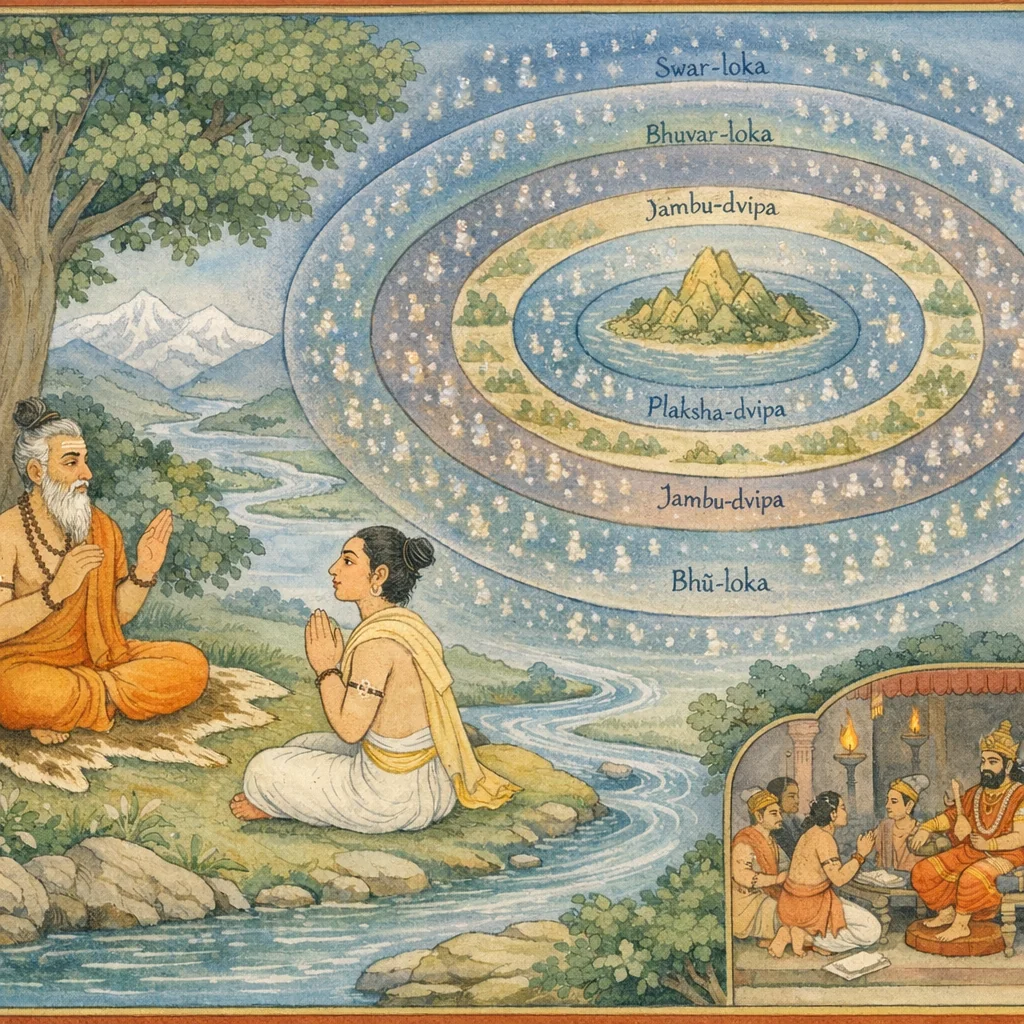
Maitreya, after hearing the ordering of the cosmos, asks Parāśara what practice keeps humans from falling under Yama’s dominion after death. Parāśara replies through a chain of testimonies—Nakula and Bhīṣma, a Kāliṅga brāhmaṇa who remembers past births, and a dialogue among Yama’s attendants. Yama orders his noose-bearing servant to avoid those surrendered to Madhusūdana, declaring his lordship only over non-Vaiṣṇavas. Parāśara then describes the marks of a Viṣṇu-bhakta: steadfastness in svadharma, equal regard for friend and foe, non-violence, truthfulness, freedom from envy, detachment from wealth and from others’ property, and constant remembrance of Janārdana, especially remaining unstained by Kali’s impurity. Metaphors—gold within ornaments and darkness absent in sunlight—teach that Hari’s presence in the heart destroys sin. The chapter concludes that neither Yama, his servants, nor torments can touch one who rests solely in Keśava.
Shlokas
Verse 1
यथावत् कथितं सर्वं यत् पृष्टो ऽसि मया गुरो श्रोतुम् इच्छाम्य् अहं त्व् एकं तद् भवान् प्रब्रवीतु मे
O Guru, you have duly explained everything that I asked. Yet I long to hear one more point—pray, tell that to me as well.
Verse 2
सप्तद्वीपानि पातालवीथ्यश् च सुमहामुने सप्त लोकाश् च ये ऽन्तःस्था ब्रह्माण्डस्यास्य सर्वतः
O great sage, within this cosmic egg (the brahmāṇḍa) on every side abide the seven continents, the pathways of the nether realms (Pātāla), and the seven worlds (lokas) within, arrayed as the ordered domains of the universe.
Verse 3
स्थूलैः सूक्ष्मैस् तथासूक्ष्मैः सूक्ष्मात् सूक्ष्मतरैस् तथा स्थूलैः स्थूलतरैश् चैतत् सर्वं प्राणिभिर् आवृतम्
This whole expanse is enveloped by living beings—by the gross, the subtle, and the yet more subtle; by what is subtler than the subtle, and likewise by the gross and what is even more gross.
Verse 4
अङ्गुलस्याष्टभागो ऽपि न सो ऽस्ति मुनिसत्तम न सन्ति प्राणिनो यत्र कर्मबन्धनिबन्धनाः
O best of sages, there is not even an eighth part of a finger’s breadth of any place where living beings are absent—beings whose very condition is fastened to the bondage of karma.
Verse 5
सर्वे चैते वशं यान्ति यमस्य भगवन् किल आयुषो ऽन्ते ततो यान्ति यातनास् तत्प्रचोदिताः
O revered one, it is indeed said that when their allotted lifespan comes to its end, all beings fall under the authority of Yama; and then, driven onward by his command, they proceed to the appointed ordeals.
Verse 6
यातनाभ्यः परिभ्रष्टा देवाद्यास्व् अथ योनिषु जन्तवः परिवर्तन्ते शास्त्राणाम् एष निर्णयः
Released from those torments, living beings turn again through births—beginning even with divine states and onward through other wombs; such is the settled conclusion of the sacred teachings.
Verse 7
सो ऽहम् इच्छामि तच् छ्रोतुं यमस्य वशवर्तिनः न भवन्ति नरा येन तत् कर्म कथयामलम्
Therefore I wish to hear it—tell me clearly and without confusion—what is that sacred course of action by which human beings do not fall under the dominion of Yama?
Verse 8
अयम् एव मुने प्रश्नो नकुलेन महात्मना पृष्टः पितामहः प्राह भीष्मो यत् तच् छृणुष्व मे
O sage, this very question was once asked by the great-souled Nakula; and what the grandsire Bhīṣma replied—hear that from me.
Verse 9
पुरा ममागतो वत्स सखा कालिङ्गको द्विजः माम् उवाच स पृष्टो वै मया जातिस्मरो मुनिः
Formerly, dear child, a Brahmin friend of mine from Kaliṅga came to me. When I questioned him, that sage—endowed with remembrance of previous births—spoke to me.
Verse 10
तेनाख्यातम् इदं चेदम् इत्थं चैतद् भविष्यति तथा च तद् अभूद् वत्स यथोक्तं तेन धीमता
That wise one declared, “Thus indeed shall it be.” And so, dear child, it came to pass exactly as that discerning sage had spoken.
Verse 11
स पृष्टश् च मया भूयः श्रद्दधानेन वै द्विजः यद् यद् आह न तद् दृष्टम् अन्यथा हि मया क्वचित्
And questioned again and again by me with trusting faith, that twice-born sage spoke as he willed; for never did I find any of his words to be otherwise, at any time.
Verse 12
एकदा तु मया पृष्टम् यद् एतद् भवतोदितम् प्राह कालिङ्गको विप्रः स्मृत्वा तस्य मुनेर् वचः
Once, when I asked about precisely what you have just stated, the brāhmaṇa Kāliṅgaka replied—after calling to mind the words of that sage.
Verse 13
जातिस्मरेण कथितं रहस्यं परमं मम यमकिंकरयोर् यो ऽभूत् संवादस् तं ब्रवीमि ते
Now I shall tell you the supremely secret teaching spoken by one who remembered former births—namely, the dialogue that occurred between Yama’s attendants; that very account I relate to you.
Verse 14
स्वपुरुषम् अभिवीक्ष्य पाशहस्तं वदति यमः किल तस्य कर्णमूले परिहर मधुसूदनप्रपन्नान् प्रभुर् अहम् अन्यनृणां न वैष्णवानाम्
Seeing his own servant standing with the noose in hand, Yama is said to whisper in his ear: “Avoid those who have taken refuge in Madhusūdana. I am lord over other men—never over the Vaiṣṇavas.”
Verse 16
कटकमुकुटकर्णिकादिभेदैः कनकम् अभेदम् अपीष्यते यथैकम् सुरपशुमनुजादिकल्पनाभिर् हरिर् अखिलाभिर् उदीर्यते तथैकः
Just as gold, though fashioned into differing forms—bracelet, crown, ear-ornament and the like—is still acknowledged to be one and undivided, so too Hari is proclaimed through all conceptions—god, animal, human, and other forms—yet He remains the One alone.
Verse 17
क्षितिजलपरमाणवो ऽनिलान्ते पुनर् अपि यान्ति यथैकतां धरित्र्याः सुरपशुमनुजादयस् तथान्ते गुणकलुषेण सनातनेन तेन
Just as the minute particles of earth and water, at the end of the wind’s course, again merge into a single unity with the mass of the earth, so too—at the final end—gods, beasts, humans, and the rest are gathered back into oneness by that eternal principle, made manifest through the obscuring impurity of the guṇas.
Verse 18
हरिम् अमरगणार्चिताङ्घ्रिपद्मं प्रणमति यः परमार्थतो हि मर्त्यः तम् अपगतसमस्तपापबन्धं व्रज परिहृत्य यथाग्निम् आज्यसिक्तम्
That mortal who, in the highest truth, bows to Hari—whose lotus-feet are worshipped by the hosts of immortals—go to Him alone. Abandon all else: for on approaching Him, every bond of sin falls away, just as fire blazes forth when fed with clarified butter.
Verse 19
इति यमवचनं निशम्य पाशी यमपुरुषस् तम् उवाच धर्मराजम् कथय मम विभो समस्तधातुर् भवति हरेः खलु यादृशो ऽस्य भक्तः
Hearing Yama’s words, the noose-bearing servant of Yama addressed Dharmarāja: “Tell me, O Lord—how does one become wholly steadfast in every way? And what, indeed, is a devotee of Hari like; what is his true nature?”
Verse 20
न चलति निजवर्णधर्मतो यः सममतिर् आत्मसुहृद्विपक्षपक्षे न हरति न च हन्ति किंचिद् उच्चैः सितमनसं तम् अवैहि विष्णुभक्तम्
Know as a devotee of Viṣṇu the one who does not swerve from the dharma proper to their station, whose mind is even toward friend and foe alike, who neither steals nor harms, and who—pure of heart—does not erupt into loud, injurious passion.
Verse 21
कलिकलुषमलेन यस्य नात्मा विमलमतेर् मलिनीकृतो ऽस्तमोहे मनसि कृतजनार्दनं मनुष्यं सततम् अवैहि हरेर् अतीव भक्तम्
Know, without doubt and at all times, as exceedingly devoted to Hari that person whose inner self, though living in the age of Kali, is not stained by its foulness; whose lucid understanding is not clouded by delusion; and in whose mind Janārdana has been firmly established as a constant refuge.
Verse 22
कनकम् अपि रहस्य् अवेक्ष्य बुद्ध्या तृणम् इव यः समवैति वै परस्वम् भवति च भगवत्य् अनन्यचेताः पुरुषवरं तम् अवैहि विष्णुभक्तम्
Know as the best among men—a devotee of Viṣṇu—the one who, discerning with understanding the hidden snare even in gold, regards it like a blade of grass; who is not swayed by another’s wealth; and whose mind rests in the Blessed Lord alone, without any second object.
Verse 23
स्फटिकगिरिशिलामलः क्व विष्णुर् मनसि नृणां क्व च मत्सरादिदोषः न हि तुहिनमयूखरश्मिपुञ्जे भवति हुताशनदीप्तिजः प्रतापः
Where is Viṣṇu—spotless as a crystal mountain—abiding in the human mind, and where, in that same mind, can jealousy and the rest of the faults endure? For in a heap of moonbeams, born of coolness, the scorching blaze that arises from fire can never be found.
Verse 24
विमलमतिर् अमत्सरः प्रशान्तः शुचिचरितो ऽखिलसत्त्वमित्रभूतः प्रियहितवचनो ऽस्तमानमायो वसति सदा हृदि तस्य वासुदेवः
In the heart of one whose understanding is stainless—free from envy, inwardly serene, pure in conduct, a friend to all beings, speaking words both dear and beneficial, and in whom pride and deceit have come to rest—Vāsudeva ever abides.
Verse 25
वसति हृदि सनातने च तस्मिन् भवति पुमाञ् जगतो ऽस्य सौम्यरूपः क्षितिरसम् अतिरम्यम् आत्मनो ऽन्तः कथयति चारुतयैव शालपोतः
When that Eternal One abides within the heart, the person becomes, as it were, the gentle-formed presence of this whole world. Like a śālapota-bird singing from within, he speaks—by sheer loveliness of utterance—of the earth’s essence, supremely delightful, as an inward realization of the Self.
Verse 26
यमनियमविधूतकल्मषाणाम् अनुदिनम् अच्युतसक्तमानसानाम् अपगतमदमानमत्सराणां व्रज भट दूरतरेण मानवानाम्
“O guard, keep far away from those human beings whose sins have been washed away by the disciplines of yama and niyama—who, day after day, keep their minds fastened to Acyuta—and in whom pride, self-importance, and envy have fallen away.”
Verse 27
हृदि यदि भगवान् अनादिर् आस्ते हरिर् असिशङ्खगदाधरो ऽव्ययात्मा तदघम् अघविघातकर्तृभिन्नं भवति कथं सति चान्धकारम् अर्के
If the Blessed Lord—Hari, beginningless, imperishable in essence, bearing the sword, conch, and mace—abides within the heart, then how could sin remain there, distinct from the One who destroys all sin? How can darkness exist when the sun is present?
Verse 28
हरति परधनं निहन्ति जन्तून् वदति तथानृतनिष्ठुराणि यश् च अशुभजनितदुर्मदस्य पुंसः कलुषमतेर् हृदि तस्य नास्त्य् अनन्तः
He who steals another’s wealth, who strikes down living beings, and who speaks harsh falsehoods—such a man, intoxicated by the arrogance born of evil, is of tainted understanding. In the heart of that corrupted-minded person, Ananta, the Infinite Lord, is not present.
Verse 29
न सहति परसंपदं विनिन्दां कलुषमतिः कुरुते सताम् असाधुः न यजति न ददाति यश् च सन्तं मनसि न तस्य जनार्दनो ऽधमस्य
He cannot endure another’s prosperity; with a tainted mind he slanders the virtuous. Such a man—base and unrighteous—neither worships nor gives in charity; in that lowest of men Janardana does not abide.
Verse 30
परमसुहृदि बान्धवे कलत्रे सुततनयापितृमातृभृत्यवर्गे शठमतिर् उपयाति यो ऽर्थतृष्णां तम् अधमचेष्टम् अवैहि नास्य भक्तम्
Know as base in conduct—and not a true devotee—that deceitful-minded man who, even toward his dearest friend, family, spouse, children, parents, and servants, approaches with a thirst for wealth.
Verse 31
अशुभमतिर् असत्प्रवृत्तिसक्तः सततम् अनार्यविशालसङ्गमत्तः अनुदिनकृतपापबन्धयत्नः पुरुषपशुर् न हि वासुदेवभक्तः
One whose mind is bent toward the inauspicious, clinging to unrighteous conduct, ever intoxicated by base association, striving daily to tighten the bonds of sin—such a person is a beast in human form, not a devotee of Vasudeva.
Verse 32
सकलम् इदम् अहं च वासुदेवः परमपुमान् परमेश्वरः स एकः इति मतिर् अमला भवत्य् अनन्ते हृदयगते व्रज तान् विहाय दूरात्
When the Infinite Lord is established in the heart, a stainless conviction arises: 'All this universe—and I too—are Vasudeva; He alone is the Supreme Person.' Go, leave them and stay far away.
Verse 33
कमलनयन वासुदेव विष्णो धरणिधराच्युत शङ्खचक्रपाणे भव शरणम् इतीरयन्ति ये वै त्यज भट दूरतरेण तान् अपापान्
“O lotus-eyed Vasudeva—O Vishnu, bearer of the earth; O Acyuta, wielder of conch and discus—be my refuge!” Abandon those who utter this surrender, O warrior, and keep far away from those sinless ones.
Verse 34
वसति मनसि यस्य सो ऽव्ययात्मा पुरुषवरस्य न तस्य दृष्टिपाते तव गतिर् अथवा ममास्ति चक्र प्रतिहतवीर्यबलस्य सो ऽन्यलोक्यः
He whose imperishable Self abides in the mind of that Supreme Person—beneath that Lord’s gaze, neither you nor I have any refuge or way of escape. My valor and strength have already been checked by the discus; He is not one to be conquered or grasped in this world, but is beyond it.
Verse 35
इति निजभटशासनाय देवो रवितनयः स किलाह धर्मराजः मम कथितम् इदं च तेन तुभ्यं कुरुवर सम्यग् इदं मयापि चोक्तम्
“Thus,” said the divine son of the Sun, famed as Dharmarāja, as he commanded his own attendants: “This has been declared by me, and by him it has also been conveyed to you. O best of the Kurus, hold it rightly and without confusion—for this, too, has been spoken by me.”
Verse 36
नकुलैतन् ममाख्यातं पूर्वं तेन द्विजन्मना कलिङ्गदेशाद् अभ्येत्य प्रीयता सुमहात्मना
O Nakula, this was formerly narrated to me by that twice-born sage, who, having come here from the land of Kaliṅga, was graciously received and honored by that great-souled one.
Verse 37
मयाप्य् एतद् यथान्यायं सम्यग् वत्स तवोदितम् यथा विष्णुम् ऋते नान्यत् त्राणं संसारसागरे
Indeed, my child, you have spoken rightly and in accord with reason: in this ocean of worldly becoming, apart from Viṣṇu there is no other saving refuge.
Verse 38
किंकरा दण्डपाशौ वा न यमो न च यातना समर्थास् तस्य यस्यात्मा केशवालम्बनः सदा
Neither Yama, nor his servants, nor the rod and noose, nor any torment has power over one whose very self forever rests, unwaveringly, upon Keśava as its sole support.
Verse 39
एतन् मुने तवाख्यातं गीतं वैवस्वतेन यत् त्वत्प्रश्नानुगतं सम्यक् किम् अन्यच् छ्रोतुम् इच्छसि
O sage, I have faithfully told you what Vaivasvata once sang, fully in accord with your questions. What else do you wish to hear?
Frequently Asked Questions
Yama instructs his servant with the noose to avoid those who have taken refuge in Madhusūdana, stating he is the lord over other men, not over Vaiṣṇavas.
Steadiness in one’s svadharma, equanimity, non-stealing, non-violence, truthfulness, freedom from envy and pride, detachment from gold/others’ wealth, and constant mental establishment of Janārdana.
Through analogies: gold remains one despite ornaments; beings merge back into unity; likewise Hari is one though spoken of through many forms, and His presence eliminates sin like the sun eliminates darkness.