Brahmā–Viṣṇu-Pūjā: Upacāra-Vistāra and Īśvara’s Prasāda (Offerings in Shiva Worship and the Lord’s Grace)
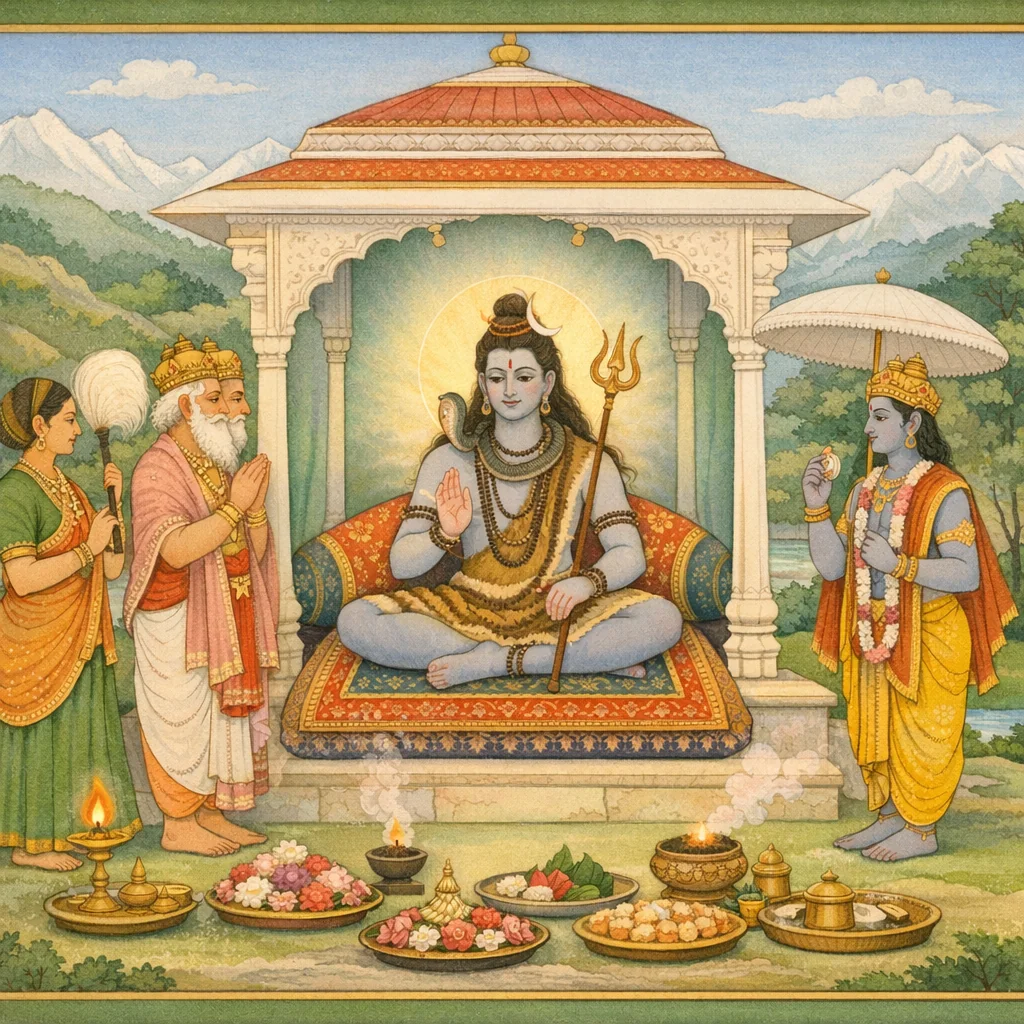
Narrated by Nandikeśvara, this chapter portrays Brahmā and Viṣṇu approaching the Lord in reverent discipline—praṇāma, folded hands, and composed silence—standing to His right and left in proper worship etiquette. Together they establish (saṃsthāpya) Śiva with His divine household (sakuṭumba) upon an excellent seat (varāsana) and perform pūjā with ‘puruṣa/prākṛta’ offerings: materially available items ritually ennobled. A detailed list of upacāras follows—ornaments (hāra, nūpura, keyūra, kirīṭa, maṇi, kuṇḍala), sacred thread and garments, garlands and rings, flowers, tāmbūla, camphor, sandal and agaru unguents, incense, lamps, white parasol, fans, banners, and cāmara—culminating in offerings whose splendor is beyond speech and mind (vāṇmanotīta-vaibhava). The doctrinal pivot states the criterion: whatever is pati-yogya (worthy of the Lord) and best among what is accessible should be offered. Śiva then redistributes those offerings as prasāda to the assembled devotees, stirring joyful commotion and teaching that worship culminates in grace and communal sanctification. The chapter ends with Śiva’s pleased words to the two deities, affirming His satisfaction on that auspicious day.
Shlokas
Verse 1
नंदिकेश्वर उवाच । तत्रांतरे तौ च नाथं प्रणम्य विधिमाधवौ । बद्धांजलिपुटौ तूष्णीं तस्थतुर्दक्षवामगौ
Nandikeśvara said: Meanwhile, Brahmā the Ordainer and Mādhava (Viṣṇu) bowed to the Lord. With palms joined in añjali, they stood in silent reverence—one at His right and the other at His left.
Verse 2
तत्र संस्थाप्य तौ देवं सकुटुंबं वरासने । पूजयामासतुः पूज्यं पुण्यैः पुरुषवस्तुभिः
There, the two of them installed the Lord—together with His divine household—upon an excellent seat, and then worshipped that Worship-worthy Deity with auspicious, sanctifying offerings fit for a noble person.
Verse 3
पौरुषं प्राकृतं वस्तुज्ञेयं दीर्घाल्पकालिकम् । हारनूपुरकेयूरकिरीटमणिकुंडलैः
Whatever is man-made and material in nature is to be understood as perishable—lasting for a long time or a short time only—such as necklaces, anklets, armlets, crowns, gems, and earrings.
Verse 4
यज्ञसूत्रोत्तरीयस्रक्क्षौममाल्यांगुलीयकैः । पुष्पतांबूलकर्पूरचंदनागुरुलेपनैः
One should worship Lord Śiva with the sacred thread, an upper cloth, garlands, linen garments, floral wreaths and rings; and also with flowers, betel, camphor, and with unguents of sandalwood and fragrant agaru—thus offering auspicious substances in devoted service.
Verse 5
धूपदीपसितच्छत्रव्यजनध्वजचामरैः । अन्यैर्दिव्योपहारैश्च वाण्मनोतीतवैभवैः
With incense and lamps, white parasols, fans, banners and yak-tail whisks, and with other divine offerings whose splendor surpasses both speech and mind—thus they worshipped the Lord.
Verse 6
पतियोग्यैः पश्वलभ्यैस्तौ समर्चयतां पतिम् । यद्यच्छ्रेष्ठतमं वस्तु पतियोग्यं हितद्ध्वजे
With offerings that are fit for the Lord (Pati) and obtainable to embodied beings, let them worship Pati (Śiva). Whatever is the very best among things—so long as it is suitable for Pati—should be offered, O one whose banner is for the welfare (of all).
Verse 7
तद्वस्त्वखिलमीशोपि पारं पर्यचिकीर्षया । सभ्यानां प्रददौ हृष्टः पृथक्तत्र यथाक्रमम्
Desiring to lead them across (the ocean of worldly existence), the Lord too—delighted—distributed all those things among the assembled people, separately and in due order.
Verse 8
कोलाहलो महानासीत्तत्र तद्वस्तु गृह्णताम् । तत्रैव ब्रह्मविष्णुभ्यां चार्चितः शंकरः पुरा
As they tried to seize that wondrous Reality, a great tumult arose there; and right there, in ancient times, Śaṅkara was worshipped by Brahmā and Viṣṇu.
Verse 9
इति श्रीशिवमहापुराणे विद्येश्वरसंहितायां नवमोऽध्यायः
Thus, in the Śrī Śiva Mahāpurāṇa, within the Vidyeśvara-saṃhitā, the ninth chapter concludes.
Verse 10
दिनमेतत्ततः पुण्यं भविष्यति महत्तरम् । शिवरात्रिरिति ख्याता तिथिरेषा मम प्रिया
“Therefore, this day shall become exceedingly sacred. This lunar date is renowned as ‘Śivarātri’; it is especially dear to Me.”
Verse 11
एतत्काले तु यः कुर्यात्पूजां मल्लिंगबेरयोः । कुर्यात्तु जगतः कृत्यं स्थितिसर्गादिकं पुमान्
But whoever, at this prescribed time, performs worship of My Liṅga and the consecrated icon, that person truly accomplishes the cosmic work of the universe—such as creation and sustenance—and becomes a fit instrument of the Lord’s ordered power.
Verse 12
शिवरात्रावहोरात्रं निराहारो जितेंद्रि यः । अर्चयेद्वा यथान्यायं यथाबलमवंचकः
On the night and day of Śivarātri, one who fasts and has mastered the senses should worship Śiva according to the prescribed rite, to the best of one’s ability, without deceit; such straightforward devotion is the discipline that pleases the Lord.
Verse 13
यत्फलं मम पूजायां वर्षमेकं निरंतरम् । तत्फलं लभते सद्यः शिवरात्रौ मदर्चनात्
Whatever fruit is gained by worshipping Me continuously for a full year, that very same fruit is obtained immediately by worshipping Me on the night of Śivarātri.
Verse 14
मद्धर्मवृद्धिकालोऽयं चंद्र काल इवांबुधेः । प्रतिष्ठाद्युत्सवो यत्र मामको मंगलायनः
“This is the season for the increase of My dharma—like the moon’s time that makes the ocean swell. In that place, the festivals beginning with the consecration of My Liṅga are truly Mine and become a pathway of auspiciousness.”
Verse 15
यत्पुनः स्तंभरूपेण स्वाविरासमहं पुरा । स कालो मार्गशीर्षे तु स्यादाद्रा र् ऋक्षमर्भकौ
Moreover, the time when I formerly manifested by Myself in the form of the (endless) pillar—know that sacred occasion to be in the month of Mārgaśīrṣa, under the Ārdrā nakṣatra, in the tender early portion of the time.
Verse 16
आद्रा र्यां मार्गशीर्षे तु यः पश्येन्मामुमासखम् । मद्बेरमपि वा लिंगं स गुहादपि मे प्रियः
In the month of Mārgaśīrṣa, on the sacred occasion of Ārdrā, whoever beholds Me—Śiva, the companion of Umā—or beholds My consecrated image, or even the Liṅga, becomes dear to Me—dearer even than Guha (Kārttikeya) himself.
Verse 17
अलं दर्शनमात्रेण फलं तस्मिन्दिने शुभे । अभ्यर्चनं चेदधिकं फलं वाचामगोचरम्
On that auspicious day, mere darśana—the sacred sight—is enough to bear fruit; but if one also performs abhyarcana, devout worship, the merit is greater still, beyond the reach of words.
Verse 18
रणरंगतलेऽमुष्मिन्यदहं लिंगवर्ष्मणा । जृंभितो लिंगवत्तस्माल्लिंगस्थानमिदं भवेत्
“On this very battlefield-ground, I expanded into a Liṅga-like form through a body of the nature of the Liṅga; therefore this place shall become a sacred ‘Liṅga-sthāna’—a seat where the Liṅga is to be worshipped.”
Verse 19
अनाद्यंतमिदं स्तंभमणुमात्रं भविष्यति । दर्शनार्थं हि जगतां पूजनार्थं हि पुत्रको
This pillar (the Liṅga), beginningless and endless, will become as minute as an atom, so that the worlds may behold it; and, O son, so that it may be worshipped.
Verse 20
भोगावहमिदं लिंगं भुक्तिं मुक्त्येकसाधनम् । दर्शनस्पर्शनध्यानाज्जंतूनां जन्ममोचनम्
This Liṅga bestows worldly enjoyments and is the single means to both bhukti (prosperity) and mukti (liberation). By beholding it, touching it, and meditating upon it, embodied beings are freed from repeated birth.
Verse 21
अनलाचलसंकाशं यदिदं लिंगमुत्थितम् । अरुणाचलमित्येव तदिदं ख्यातिमेष्यति
This Liṅga that has arisen here, resembling a mountain of blazing fire, shall indeed become renowned by the name “Aruṇācala.”
Verse 22
अत्र तीर्थं च बहुधा भविष्यति महत्तरम् । मुक्तिरप्यत्र जंतूनां वासेन मरणेन च
Here, this sacred ford (tīrtha) will become exceedingly great in many ways; and here too, embodied beings attain liberation—either by dwelling in this place or even by dying here.
Verse 23
रथोत्सवादिकल्याणं जनावासं तु सर्वतः । अत्र दत्तं हुतं जप्तं सर्वं कोटिगुणं भवेत्
This sacred region is auspicious with chariot-festivals and other holy celebrations, and it is thronged with people on all sides. Whatever is given in charity here, whatever is offered into the sacred fire, and whatever is repeated as japa—every such act becomes a millionfold in merit.
Verse 24
मत्क्षेत्रादपि सर्वस्मात्क्षेत्रमेतन्महत्तरम् । अत्र संस्मृतिमात्रेण मुक्तिर्भवति देहिनाम्
Even compared to all sacred fields—and even to My own holy domain—this sacred place is greater. Here, for embodied beings, liberation arises by mere remembrance (of it).
Verse 25
तस्मान्महत्तरमिदं क्षेत्रमत्यंतशोभनम् । सर्वकल्याणसंपूर्णं सर्वमुक्तिकरं शुभम्
Therefore, this sacred field (kṣetra) is supremely great and exceedingly beautiful—complete with every auspicious blessing, holy in itself, and a bestower of liberation for all.
Verse 26
अर्चयित्वाऽत्र मामेव लिंगे लिंगिनमीश्वरम् । सालोक्यं चैव सामीप्यं सारूप्यं सार्ष्टिरेव च
Having worshipped Me here—Me alone, the Supreme Lord, the Īśvara who dwells within the Liṅga—one attains sālokya (My realm), sāmīpya (nearness to Me), sārūpya (likeness to My form), and sārṣṭi (participation in My lordly powers and prosperity).
Verse 27
सायुज्यमिति पंचैते क्रियादीनां फलं मतम् । सर्वेपि यूयं सकलं प्राप्स्यथाशु मनोरथम्
“Sāyujya (union with Śiva) is regarded as the fifth and highest fruit of these disciplines beginning with ritual action. Indeed, all of you will swiftly obtain the complete fulfillment of your cherished spiritual aims.”
Verse 28
नंदिकेश्वर उवाच । इत्यनुगृह्य भगवान्विनीतौ विधिमाधवौ । यत्पूर्वं प्रहतं युद्धे तयोः सैन्यं परस्परम्
Nandikeśvara said: “Thus did the Blessed Lord show grace to the humble Vidhi (Brahmā) and Mādhava (Viṣṇu). And the armies of those two—formerly struck down in their battle against each other—were restored and set at peace by His compassion.”
Verse 29
तदुत्थापयदत्यर्थं स्वशक्त्याऽमृतधारया । तयोर्मौढ्यं च वैरं च व्यपनेतुमुवाच तौ
Then, by His own divine power, He raised them up completely by pouring forth a stream of amṛta, the nectar of immortality; and He spoke to the two of them to remove their delusion and their enmity.
Verse 30
सकलं निष्कलं चेति स्वरूपद्वयमस्ति मे । नान्यस्य कस्यचित्तस्मादन्यः सर्वोप्यनीश्वरः
“I possess a twofold nature: sakala, the manifest with attributes, and niṣkala, the unmanifest without parts. Therefore, apart from Me there is no other Lord whatsoever; all others are without independent sovereignty.”
Verse 31
पुरस्तात्स्तंभरूपेण पश्चाद्रू पेण चार्भकौ । ब्रह्मत्वं निष्कलं प्रोक्तमीशत्वं सकलं तथा
In front, as the form of a pillar, and behind, as a manifested form—thus the two (Brahmā and Viṣṇu) perceived Him. Brahman-hood is declared to be partless (niṣkala), and Lordship (Īśatva) is likewise taught as possessed of parts and manifestation (sakala).
Verse 32
द्वयं ममैव संसिद्धं न मदन्यस्य कस्यचित् । तस्मादीशत्वमन्येषां युवयोरपि न क्वचित्
This twofold reality is perfected in Me alone, and in none other besides Me. Therefore, sovereignty (īśatva) does not truly belong to anyone else—nor does it ever belong, even to you two.
Verse 33
तदज्ञानेन वां वृत्तमीशमानं महाद्भुतम् । तन्निराकर्तुमत्रैवमुत्थितोऽहं रणक्षितौ
Because of your ignorance, a most astonishing situation has arisen here, seeming to overrule proper order. Therefore, to dispel that very confusion, I have risen right here on this battlefield.
Verse 34
त्यजतं मानमात्मीयं मयीशे कुरुतं मतिम् । मत्प्रसादेन लोकेषु सर्वोप्यर्थः प्रकाशते
Abandon your self-centered pride, and fix your understanding upon Me, the Lord. By My grace, in the worlds, every aim and true meaning becomes clearly revealed.
Verse 35
गुरूक्तिर्व्यंजकं तत्र प्रमाणं वा पुनः पुनः । ब्रह्मतत्त्वमिदं गूढं भवत्प्रीत्या भणाम्यहम्
Here, the Guru’s instruction is the true revealer—and again and again it serves as the valid means of knowing. This profound and hidden truth of Brahman (the Supreme Reality, Śiva) I speak out of affection for you.
Verse 36
अहमेव परं ब्रह्म मत्स्वरूपं कलाकलम् । ब्रह्मत्वादीश्वरश्चाहं कृत्यं मेनुग्रहादिकम्
I alone am the Supreme Brahman—my own essential nature, beyond all parts and divisions. I am also the Lord who manifests as Brahmā and the rest; my work is the bestowal of grace and all such divine acts.
Verse 37
बृहत्त्वाद्बृंहणत्वाच्च ब्रह्माहं ब्रह्मकेशवौ । समत्वाद्व्यापकत्वाच्च तथैवात्माहमर्भकौ
Because I am the Vast, and because I am the One who makes all things expand and grow, I am called Brahmā; and thus, within My own power, I am also Brahmā and Keśava (Viṣṇu). Because I am equal to all and all-pervading, I am likewise called the Ātman—O child.
Verse 38
अनात्मानः परे सर्वे जीवा एव न संशयः । अनुग्रहाद्यं सर्गांतं जगत्कृत्यं च पंकजम्
All those who are ‘other than the Self’ are indeed individual souls (jīvas)—of this there is no doubt. From divine grace as the beginning up to the end of creation, the lotus-like cosmos and its functions proceed accordingly.
Verse 39
ईशत्वादेव मे नित्यं न मदन्यस्य कस्यचित् । आदौ ब्रह्मत्त्वबुद्ध्यर्थं निष्कलं लिंगमुत्थितम्
Because sovereign lordship belongs eternally to Me alone, and to none other, in the beginning the partless (niṣkala) Liṅga manifested so that the knowledge of My Brahman-nature might arise.
Verse 40
तस्मादज्ञातमीशत्वं व्यक्तं द्योतयितुं हि वाम् । सकलोहमतो जातः साक्षादीशस्तु तत्क्षणात्
Therefore, in order to clearly reveal to you both My lordship that was not yet understood, I have assumed this manifest, complete form; and in that very instant I am indeed the Lord Himself, directly present.
Verse 41
सकलत्वमतो ज्ञेयमीशत्वं मयि सत्वरम् । यदिदं निष्कलं स्तंभं मम ब्रह्मत्वबोधकम्
Therefore, know without delay My lordly sovereignty as the manifest (sakala) Lord. This partless (niṣkala) pillar reveals My Brahman‑nature—My absolute reality beyond all limitation.
Verse 42
लिंगलक्षणयुक्तत्वान्मम लिंगं भवेदिदम् । तदिदं नित्यमभ्यर्च्यं युवाभ्यामत्र पुत्रकौ
Because it is endowed with the marks of the Liṅga, this indeed becomes My Liṅga. Therefore, O beloved sons, you two should worship this very Liṅga here continually.
Verse 43
मदात्मकमिदं नित्यं मम सान्निध्यकारणम् । महत्पूज्यमिदं नित्यमभेदाल्लिंगसिंगिनोः
This (Liṅga) is eternally of My very nature and is the cause of My immediate presence. It is ever worthy of great worship, because the Liṅga and the Liṅgin (Śiva, the Bearer of the Liṅga) are non-different.
Verse 44
यत्रप्रतिष्ठितं येन मदीयं लिंगमीदृशम् । तत्र प्रतिष्ठितः सोहमप्रतिष्ठोपि वत्सकौ
Wherever this My Liṅga—of this very form—has been installed by anyone, there indeed I am established. Even though, in truth, I am beyond all installation, O dear children.
Verse 45
मत्साम्यमेकलिंगस्य स्थापने फलमीरितम् । द्वितीये स्थापिते लिंगे मदैक्यं फलमेव हि
It has been declared that installing a single Śiva-Liṅga grants the fruit of a state equal to Mine. But when a second Liṅga is installed, the fruit indeed is oneness with Me.
Verse 46
लिंगं प्राधान्यतः स्थाप्यं तथाबेरं तु गौणकम् । लिंगाभावेन तत्क्षेत्रं सबेरमपि सर्वतः
The Liṅga should be installed as the primary object of worship, while the anthropomorphic image (bera) is secondary. If the Liṅga is absent, that sacred place—though it may have an image—becomes, in every respect, deficient in its full sanctity.
Frequently Asked Questions
The chapter stages Brahmā and Viṣṇu performing a complete pūjā to Śiva (with His household) and culminates in Śiva’s pleased response and redistribution of the offered items as prasāda—arguing that even the highest cosmic deities model devotion and that worship is validated by divine grace.
The enumerated upacāras function as a semiotics of sovereignty: ornaments and textiles signify majesty, fragrance and light signify purity and illumination, and ‘vāṇmanotīta’ gifts indicate that true offering transcends mere materiality by carrying intention beyond speech and mind. The prasāda distribution encodes the teaching that offerings return transformed—sanctifying the community and converting private devotion into shared liberation-oriented merit.
Śiva is highlighted primarily as Īśvara/Śaṅkara—the Lord who receives worship and grants prasāda—together with His ‘sakuṭumba’ presence (divine household), signaling a householded, relational divinity rather than an abstract absolute, even while His grandeur is described as beyond speech and mind.