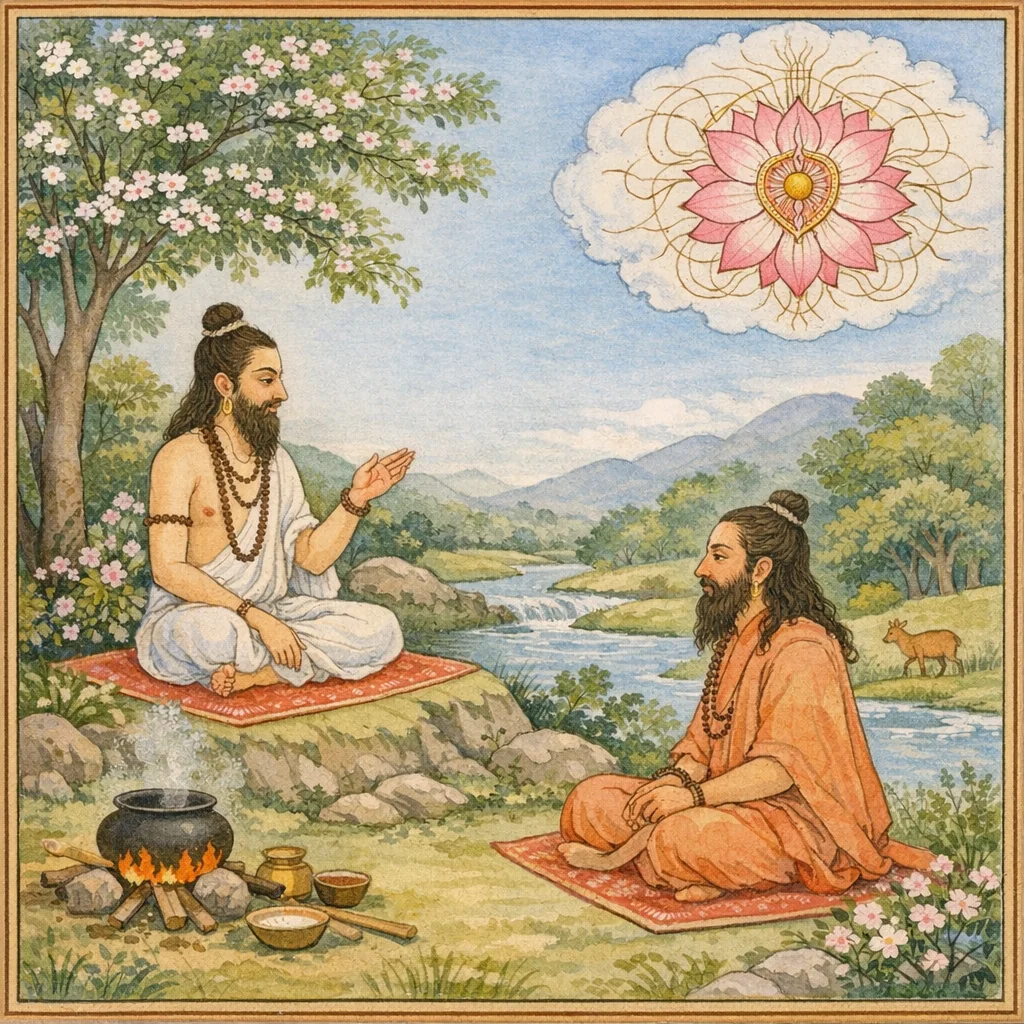
Garbha-sthiti, Deha-pariṇāma, and Vairāgya-upadeśa (Embryonic Condition, Bodily Transformation, and Instruction in Detachment)
Adhyāya 22 unfolds as a didactic dialogue: Vyāsa asks Sanatkumāra for a concise account of the jīva’s embodied birth (jīva-janma-vidhi) and its condition in the womb (garbhe-sthiti), expressly as a means to cultivate vairāgya (detachment). Sanatkumāra replies with a compressed śāstra-essence, describing digestion and bodily formation in a technical, quasi-physiological way. Using a culinary metaphor—food and water heated by fire—he explains their transformation into rasa (nutritive essence) and kiṭṭa (waste), lists bodily impurities and their outlets, and outlines inner circulation through nāḍīs rooted in the heart-lotus (hṛt-padma). The chapter’s esoteric purpose is not medical instruction but demystification of embodiment, weakening fascination with the body and turning the seeker toward liberating discernment and Śaiva spiritual priorities.
Shlokas
Verse 1
व्यास उवाच । विधिं तात वदेदानीं जीव जन्मविधानतः । गर्भे स्थितिं च तस्यापि वैराग्यार्थं मुनीश्वर
Vyāsa said: “O dear one, O lord among sages, now please explain the rule and process by which the jīva, the individual soul, takes birth, and also describe its condition while dwelling in the womb—so that vairāgya, dispassion, may arise.”
Verse 2
सनत्कुमार उवाच । शृणु व्यास समासेन शास्त्रसारमशेषतः । वदिष्यामि सुवैराग्यं मुमुक्षोर्भवबंधकृत्
Sanatkumāra said: “Listen, O Vyāsa—briefly, yet completely, to the essential purport of all the śāstras. I shall declare true dispassion, suvairāgya, which for the seeker of liberation cuts the bondage of saṃsāra.”
Verse 3
पाकपात्रस्य मध्ये तु पृथगन्नं पृथग्जलम् । अग्नेरूर्ध्वं जलं स्थाप्यं तदन्नं च जलोपरि
In the middle of the cooking vessel, one should keep the food and the water separate. The water is to be placed above the fire, and the cooked offering of food is to be set above the water.
Verse 4
जलस्याधस्स चाग्निर्हि स्थितोऽग्निं धमते शनैः । वायुनाधम्यमानोऽग्निरत्युष्णं कुरुते जलम्
Indeed, beneath the waters abides fire, which slowly kindles and fans the flame. When that fire is further fanned by the wind, it makes the water exceedingly hot.
Verse 5
तदन्नमुष्णतोयेन समन्तात्पच्यते पुनः । द्विधा भवति तत्पक्वं पृथक्किट्टं पृथग्रसः
That food, again, is cooked on all sides by the warm fluids within. When it is thus digested, it becomes twofold—separating into waste (impurity) and into nutritive essence (rasa).
Verse 6
मलैर्द्वादशभिः किट्टं भिन्नं देहाद्बहिर्भवेत् । रसस्तु देहे सरति स पुष्टस्तेन जायते
By the twelve bodily impurities, the waste-matter is separated and expelled outside the body. But the nutritive essence (rasa) circulates within the body; nourished by it, the body’s strength and growth arise.
Verse 7
कर्णाक्षिनासिका जिह्वा दन्ताः शिश्नो गुदं नखाः । मलाश्रयः कफः स्वेदो विण्मूत्रं द्वादश स्मृताः
The ears, eyes, nose, tongue, teeth, the generative organ, the anus, and the nails—together with the seat of impurities, phlegm (kapha), sweat, feces, and urine—these are remembered as the twelve impure constituents.
Verse 8
हृत्पद्मे प्रतिबद्धाश्च सर्वनाड्यस्समंततः । ज्ञेया रसप्रवाहिन्यस्तत्प्रकारं ब्रुवे मुने
All the nāḍīs are bound on every side to the lotus of the heart; know them as the channels through which the body’s vital essences flow. O sage, I shall describe their arrangement and nature.
Verse 9
तासां मुखेषु तं सूक्ष्मं प्राणस्स्थापयेत् रसम् । रसेन तेन नाडीस्ताः प्राणं पूरयते पुनः
In the mouths (openings) of those subtle channels, one should establish that refined vital essence, prāṇa. By that very essence, those nāḍīs are again filled and pervaded with the life-breath.
Verse 10
पुनः प्रयांति संपूर्णास्ताश्च देहं समंततः । ततस्स नाडीमध्यस्थश्शरीरेणात्मना रसः
Again, when they become fully complete, they spread throughout the body on every side. Thereupon, the vital essence—abiding in the middle of the subtle channels (nāḍīs)—pervades the body as the Self (Ātman), becoming the inner sap of embodied life.
Verse 11
पच्यते पच्यमानाच्च भवेत्पाकद्वयं पुनः । त्वक् तया वेष्ट्यते पूर्वं रुधिरं च प्रजायते
As it undergoes ‘cooking’ (maturation), and from that very process of being matured, a further twofold transformation again arises. First, a skin is formed and it envelops it; and then blood comes into being.
Verse 12
रक्ताल्लोमानि मांसं च केशाः स्नायुश्च मांसतः । स्नायुतश्च तथास्थीनि नखा मज्जास्थिसंभवाः
From blood arise the body-hairs and the flesh; from the flesh come the head-hairs and the sinews (snāyu). From the sinews arise the bones, and the nails are produced from marrow (majjā) and bone. (Knowing thus the body’s compounded nature, the seeker turns the mind toward Śiva, the Lord beyond bondage.)
Verse 13
मज्जाकारणवैकल्यं शुक्रं हि प्रसवात्मकम् । इति द्वादशधान्नस्य परिणामः प्रकीर्तिताः
Semen (śukra) is indeed reproductive in nature, and it arises as the transformation connected with marrow (majjā); thus the twelvefold transformation of food has been described.
Verse 14
शुक्रोऽन्नाज्जायते शुक्राद्दिव्यदेहस्य संभवः । ऋतुकाले यदा शुक्रं निर्दोषं योनिसंस्थितम्
Semen (śukra) arises from food; and from semen arises the possibility of a refined, divine-bodied form (divya-deha). When, in the proper season, the semen—free from defect—becomes established within the womb (yoni), the basis for conception is formed.
Verse 15
तद्वा तद्वायुसंस्पृष्टं स्त्रीरक्तेनैकतां व्रजेत् । विसर्गकाले शुक्रस्य जीवः कारणसंयुतः
Or else, when that semen is touched by the vital wind (vāyu), it attains unity with the woman’s blood. At the time of emission, the jīva—the individual soul—joined with its causal determinants, enters and becomes connected with the semen.
Verse 17
पंचरात्रेण कलिलं बुद्बुदाकारतां व्रजेत् । बुद्बुदस्सप्तरात्रेण मांसपेशी भवेत्पुनः
Within five nights, the kalila—the embryo-like mass—takes on the form of a bubble. Then, within seven nights, that bubble again becomes a lump of flesh, a muscular mass.
Verse 18
ग्रीवा शिरश्च स्कंधौ च पृष्ठवंशस्तथोदरम् । पाणिपादन्तथा पार्श्वे कटिर्गात्रं तथैव च
The neck, the head, and the shoulders; the spinal column and the abdomen; the hands and feet; the sides, the waist, and likewise the limbs of the body—these are to be understood in this manner.
Verse 19
द्विमासाभ्यन्तरेणैव क्रमशस्संभवेदिह । त्रिभिर्मासैः प्रजायंते सर्वे ह्यंकुरसंधयः
Here, within just two months, the process begins to manifest step by step; and within three months, all the embryo’s joints and the sprouting limbs are generated.
Verse 20
मासैश्चतुर्भिरंगुल्यः प्रजायंते यथाक्रमम् । मुखं नासा च कर्णौ मासैः पंचभिरेव च
In the fourth month, the fingers are formed in due order. In the fifth month, the face, the nose, and the ears are formed as well.
Verse 21
दन्तपंक्तिस्तथा गुह्यं जायंते च नखाः पुनः । कर्णयोस्तु भवेच्छिद्रं षण्मासाभ्यंतरेण तु
Then the rows of teeth, the secret organ (genitals), and again the nails come into manifestation; and within six months, openings are formed in the two ears.
Verse 22
पायुर्मेहमुपस्थं च नाभिश्चाभ्युपजायते । संधयो ये च गात्रेषु मासैर्जायंति सप्तभिः
The anus, the urinary organ, the generative organ, and the navel become manifest; and the joints that are in the limbs are formed within seven months.
Verse 23
अंगप्रत्यंगसंपूर्णः परिपक्वस्स तिष्ठति । उदरे मातुराच्छन्नो जरायौ मुनि सत्तम
O best of sages, the child—complete in all limbs and sub-limbs and fully matured—abides there, concealed within the mother’s womb, wrapped in the embryonic membrane.
Verse 24
मातुराहारचौर्य्येण षड्विधेन रसेन तु । नाभिनालनिबद्धेन वर्द्धते स दिनेदिने
As though “stealing” the mother’s nourishment—made of the sixfold tastes—and being bound by the umbilical cord, the foetus grows day by day.
Verse 25
ततस्मृतिं लभेज्जीवस्संपूर्णेऽस्मिञ्शरीरके । सुखं दुःखं विजानाति निद्रास्वप्नं पुराकृतम्
Then the jīva, fully established in this body, regains memory; and it comes to know pleasure and pain, as well as sleep and dream—experiences fashioned by its former deeds (karma).
Verse 26
मृतश्चाहं पुनर्जातो जातश्चाहं पुनर्मृतः । नानायोनिसहस्राणि मया दृष्टानि जायता
I have died and been born again; and having been born, I have died again. Passing through birth after birth, I have beheld thousands of different wombs and forms of existence.
Verse 27
अधुना जातमात्रोऽहं प्राप्तसंस्कार एव च । श्रेयोऽमुना करिष्यामि येन गर्भे न संभवः
Now I have only just been born, and I have already received the purifying rites. By this means I shall accomplish what is truly beneficial—so that there will be no further entering into the womb (no rebirth).
Verse 28
गर्भस्थश्चिंतयत्येवमहं गर्भाद्विनिस्सृतः । अन्वेष्यामि शिवज्ञानं संसारविनिवर्तकम्
Even while in the womb, the seeker reflects thus: “When I am released from the womb, I shall seek the knowledge of Śiva—that liberating wisdom which turns one back from saṃsāra.”
Verse 29
एवं स गर्भदुःखेन महता परिपीडितः । जीवः कर्मवशादास्ते मोक्षोपायं विचिंतयन्
Thus, grievously oppressed by the great suffering of life in the womb, the bound soul—driven by the force of its own karma—remains there, reflecting upon the means to liberation.
Verse 30
यथा गिरिवराक्रांतः कश्चिद्दुःखेन तिष्ठति । तथा जरायुणा देही दुःखं तिष्ठति वेष्टितः
Just as someone crushed beneath a mighty mountain stands only in misery, so too the embodied soul, wrapped in the fetal membrane (jarāyu), remains in suffering.
Verse 31
संवृतः प्रविशेद्योनिं कर्मभिस्स्वैर्नियोजितः । तच्छुक्ररक्तमेकस्थमेकाहात्कलिलं भवेत्
Driven by its own karmic impetus, the embodied being—enclosed in subtle coverings—enters the womb. There, the semen and blood, having come together in one place, become a gelatinous embryonic mass (kalila) within a single day.
Verse 32
लोहकुंभे यथा न्यस्तः पच्यते कश्चिदग्निना । गर्भकुंभे तथा क्षिप्तः पच्यते जठराग्निना
Just as something placed in an iron pot is cooked by an outer fire, so too, when cast into the pot of the womb, a being is “cooked”—matured and shaped—by the inner fire of the belly.
Verse 33
सूचीभिरग्निवर्णाभिनिर्भिन्नस्य निरंतरम् । यद्दुःखं जायते तस्य तत्र संस्थस्य चाधिकम्
For one who is ceaselessly pierced by needles as if of fiery hue, whatever pain arises—greater still is the suffering of the one who must remain fixed in that very condition.
Verse 34
गर्भावासात्परं दुःखं कष्टं नैवास्ति कुत्रचित् । देहिनां दुःखबहुलं सुघोरमतिसंकटम्
There is no suffering anywhere that surpasses the misery of dwelling in the womb. For embodied beings, it is a condition filled with pain—most dreadful and exceedingly constricted.
Verse 35
इत्येतत्सुमहद्दुःखं पापिनां परिकीर्तितम् । केवलं धर्मबुदीनां सप्तमासैर्भवस्सदा
Thus has this exceedingly great suffering of sinners been described. But for those whose understanding is grounded only in dharma, worldly becoming—the bondage of saṁsāra—endures merely for seven months, and no more.
Verse 36
गर्भात्सुदुर्लभं दुःखं योनियंत्रनिपीडनात् । भवेत्पापात्मनां व्यास न हि धर्मयुतात्मनाम्
O Vyāsa, the exceedingly hard-to-bear suffering that arises in the womb—through the crushing pressure of the womb’s constriction—befalls those of sinful disposition, not those whose inner being is joined to dharma.
Verse 37
इक्षुवत्पीड्यमानस्य यंत्रेणैव समंततः । शिरसा ताड्यमानस्य पाप मुद्गरकेण च
He is crushed on every side by a machine, like sugarcane in a press; and his head is struck—alas—again and again with a hammer.
Verse 38
यंत्रेण पीडिता यद्वन्निस्सारा स्स्युस्तिलाः क्षणात् । तथा शरीरं निस्सारं योनियंत्रनिपीडनात्
Just as sesame seeds, when pressed in a machine, are stripped of their essence in a moment, so too the body is drained of vitality when crushed by the mechanism of the womb. Therefore the wise should not cling to the body as the Self, but seek refuge in Śiva, the Lord beyond birth.
Verse 39
अस्थिपादतुलास्तंभं स्नायुबन्धेन यंत्रितम् । रक्तमांसमृदालिप्तं विण्मूत्रद्रव्यभाजनम्
This body is a framework of bones—feet, beams, and pillars—held together by the binding cords of sinews; plastered over with the clay of flesh and blood, it is but a vessel that contains filth and urine. From the Śaiva view, such a perishable sheath should not be mistaken for the Self; one should seek refuge in Pati (Lord Śiva), the liberator from bondage.
Verse 40
केशरोमनखच्छन्नं रोगायतनमातुरम् । वदनैकमहाद्वारं गवाक्षाष्टकभूषितम्
Covered with hair, body-hair, and nails, this ailing body is itself a dwelling of disease. It has a single great doorway—the mouth—and is adorned with eight “windows,” the openings of perception.
Verse 41
ओष्ठद्वयकपाटं च तथा जिह्वार्गलान्वितम् । भोगतृष्णातुरं मूढं रागद्वेषवशानुगम्
With the two lips as its door-panels and the tongue as its bolt, the deluded embodied being is tormented by craving for enjoyments and is driven onward under the sway of attachment and aversion.
Verse 42
संवर्तितांगप्रत्यंगं जरायुपरिवेष्टितम् । संकटेनाविविक्तेन योनिमार्गेण निर्गतम्
With all its limbs and sub-limbs contracted, wrapped in the fetal membrane, it emerges through the narrow, impure passage of the womb.
Verse 43
विण्मूत्ररक्तसिक्तांगं विकोशिकसमुद्भवम् । अस्थिपञ्जरविख्यातमस्मिञ्ज्ञेयं कलेवरम्
This body should be understood as a frame drenched with feces, urine, and blood—arisen from impure fluids—and known as a mere cage of bones.
Verse 44
शतत्रयं षष्ट्यधिकं पंचपेशीशतानि च । सार्द्धाभिस्तिसृभिश्छन्नं समंताद्रोमकोटिभिः
It has three hundred and sixty bones, and five hundred muscles; and it is covered on all sides with three and a half crores of hairs.
Verse 45
शरीरं स्थूलसूक्ष्माभिर्दृश्याऽदृश्या हि तास्स्मृताः । एतावतीभिर्नाडीभिः कोटिभिस्तत्समंततः
The body is pervaded by nāḍīs of both the gross and the subtle kinds; some are visible and some are invisible—so they are remembered. By so many nāḍīs, numbering in crores, it is encompassed on every side.
Verse 46
अस्वेदमधुभिर्याभिरंतस्थः स्रवते बहिः । द्वात्रिंशद्दशनाः प्रोक्ता विंशतिश्च नखाः स्मृताः
Those (organs or channels) by which the inner essence flows outward—together with sweat and honey-like secretions—have been described. It is taught that there are thirty-two teeth, and it is remembered that there are twenty nails.
Verse 47
पित्तस्य कुडवं ज्ञेयं कफस्याथाढकं स्मृतम् । वसायाश्च पलं विंशत्तदर्धं कपिलस्य च
One should know the measure of bile (pitta) to be a kuḍava; and the measure of phlegm (kapha) is remembered as an āḍhaka. The fat (vasā) is twenty palas; and half of that is (the measure) for the tawny one (kapila).
Verse 48
पंचार्द्धं तु तुला ज्ञेया पलानि दश मेदसः । पलत्रयं महारक्तं मज्जायाश्च चतुर्गुणम्
Know that the measure called tulā is five arddhas; fat is ten palas; the great blood is three palas; and marrow is four times that.
Verse 49
शुक्रोर्द्धं कुडवं ज्ञेयं तद्बीजं देहिनां बलम् । मांसस्य चैकपिंडेन पलसाहस्रमुच्यते
Know that half a kuḍava is the measure of semen; it is the seed and strength of embodied beings. And it is said that from a single lump of flesh there arises a thousand palas in weight.
Verse 50
रक्तं पलशतं ज्ञेयं विण्मूत्रं यत्प्रमाणत । अंजलयश्च चत्वारश्चत्वारो मुनिसत्तम
O best of sages, know that the measure of blood is said to be one hundred palas; and the quantity of feces and urine, by standard measure, is four añjalis (handfuls).
Verse 51
इति देहगृहं ह्येतन्नित्यस्यानित्यमात्मनः । अविशुद्धं विशुद्धस्य कर्मबंधाद्विनिर्मितम्
Thus, this “house called the body” belongs to the eternal Self, yet it is itself impermanent. Though the Self is intrinsically pure, this body is impure, fashioned as a product of bondage to karma.
Frequently Asked Questions
The chapter argues for detachment by demonstrating the constructed nature of embodiment: birth and bodily continuity are explained as processes of transformation (food/water → rasa and kiṭṭa) governed by heat and circulation, thereby weakening identification with the body and strengthening mumukṣutva.
Rasa/kiṭṭa functions as a symbolic and analytic device to show that the body is sustained by impermanent transformations and impurities, while the nāḍī/prāṇa schema maps the subtle infrastructure that animates the body—together serving as a contemplative framework for dispassion and self-inquiry rather than sensual self-investment.
No distinct iconographic manifestation is foregrounded in the sampled material; the chapter is primarily instructional and anthropological, using embodied analysis to support Śaiva soteriology (movement toward liberation) rather than narrating a particular Śiva/Umā līlā or form.