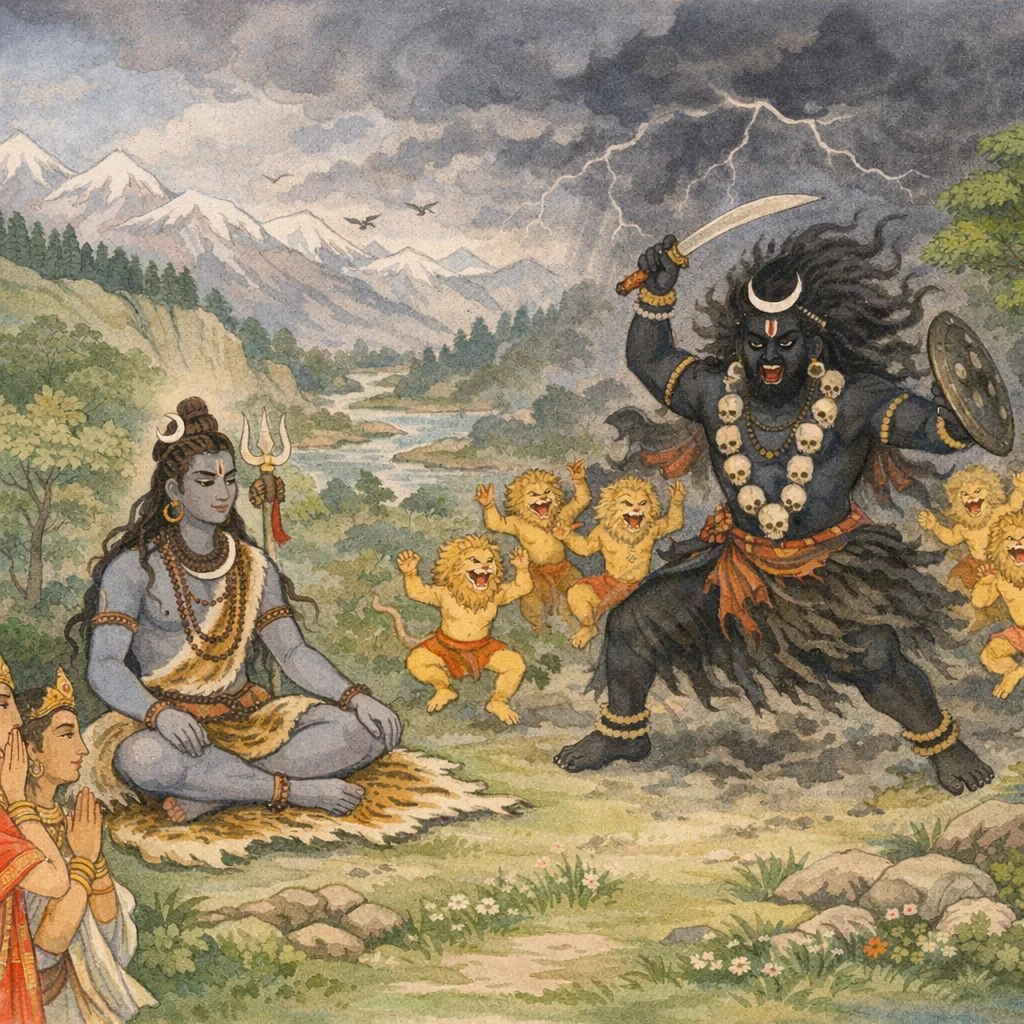
वीरभद्र-भैरव-आह्वानम् — Invocation of Vīrabhadra/Bhairava for Cosmic Reabsorption
Framed as Nandīśvara’s report, this chapter tells how Parameśvara, petitioned by the devas, resolves upon a decisive act of pralaya (dissolution and reabsorption) against an overwhelming nṛsiṃha-like power (nṛsiṃhākhya mahātejas). Rudra then “remembers” and summons Vīrabhadra, explicitly identified as Rudra’s own Bhairava-form and praised as pralayakāraka, the agent of cosmic reabsorption. Vīrabhadra manifests swiftly amid tumultuous laughter, leading an innumerable gaṇa-host of ultra-fierce nṛsiṃha-forms who dance and exult, creating a controlled terror that signals the awakening of corrective cosmic power. Iconographic features become theology: three blazing eyes, jaṭā, the crescent moon, sharp fangs, thunderous huṅkāra, and a dark cloud-like complexion signify time, dissolution, and unbounded agency. Endowed with varā-śakti (boon-granting potency), Vīrabhadra addresses the Lord and asks for the specific command that defines his mission. Esoterically, the chapter teaches that fearsome divine forms are not other than Śiva, but Śiva’s self-extension to restore equilibrium; the gaṇas symbolize disciplined energies marshaled under divine intelligence, not chaotic violence.
Shlokas
Verse 1
नंदीश्वर उवाच । एवमभ्यर्थितो देवैर्मतिं चक्रे कृपा लयः । महातेजो नृसिंहाख्यं संहर्त्तुं परमेश्वरः
Nandīśvara said: Thus entreated by the gods, the Supreme Lord—an abode of compassion—resolved to quell that exceedingly radiant one known as Narasiṁha.
Verse 2
तदूर्द्ध्वं स्मृतवान्रुद्रो वीरभद्रम्महाबलम् । आत्मनो भैरवं रूपं प्राह प्रलयकारकम्
Thereafter, Rudra remembered the mighty and immensely powerful Vīrabhadra, and He proclaimed His own Bhairava-form—the form that brings about dissolution (pralaya).
Verse 3
आजगाम ततस्सद्यो गणानामग्रणीर्हसन् । साट्टहासैर्गणवरैरुत्पतद्भिरितस्ततः
Then, at once, the leader of Śiva’s gaṇas arrived, smiling; and with him came excellent gaṇas, bursting forth on every side with loud, boisterous laughter.
Verse 4
नृसिंहरूपैरत्युग्रैः कोटिभिः परिवारितः । माद्यद्भिरभितो वीरैर्नृत्यद्भिश्च मुदान्वितैः
He was surrounded by crores of exceedingly fierce lion‑formed beings; all around were intoxicated heroes, dancing in every direction, filled with exultant joy.
Verse 5
क्रीडद्भिश्च महावीरैर्ब्रह्माद्यैः कन्दुकैरिव । अदृष्टपूर्वैरन्यैश्च वेष्टितो वीरवन्दितः
He was surrounded by mighty heroes—Brahmā and the other exalted ones—who sported around him as if he were a ball; and he was also encircled by other, never-before-seen beings, while the valorous praised and saluted him.
Verse 6
कल्पान्तज्वलनज्वालो विलसल्लोचनत्रयः । अशस्त्रो हि जटाजूटी ज्वलद्बालेन्दुमण्डितः
He blazed like the fire at the end of an aeon; His three eyes shone brilliantly. Though without weapons, He was the matted-haired Lord, adorned with the glowing crescent moon upon His locks.
Verse 7
बालेन्दुवलया कारतीक्ष्णदंष्ट्रांकुरद्वयः । आखण्डलधनुःखण्डसंनिभभ्रूलतान्वितः
He bears ornaments shaped like the crescent moon; from His mouth rise two sprouting fangs, sharp as a saw. His arched eyebrows resemble the broken fragment of Indra’s bow—marking the Lord’s formidable, saguna manifestation that subdues impurity and protects devotees.
Verse 8
महाप्रचण्डहुङ्कारबधिरीकृतदिङ्मुखः । नीलमेघाञ्जन श्यामो भीषणः श्मश्रुलोद्भुतः
With a tremendously fierce roar that deafened the faces of all the directions, He appeared dark—like a blue rain-cloud and collyrium—terrifying in aspect, with a wondrous, prominent beard and moustache.
Verse 9
वाद्यखण्डमखण्डाभ्यां भ्रामयंस्त्रिशिखं मुहुः । वीरभद्रोऽपि भगवान्वरशक्तिविजृम्भितः
Driven by the resounding instruments’ fractured and unfractured forces, he whirled the tri-pointed weapon again and again; and even the Lord Vīrabhadra surged forth, his might expanding through the boons of divine Śakti.
Verse 10
स्वयं विज्ञापयामास किमत्र स्मृतिकारणम् । आज्ञापय जगत्स्वामिन् प्रसादः क्रियताम्मयि
Then he personally submitted his plea: “What here is the cause of my being remembered? Command me, O Lord of the worlds—be gracious to me.”
Verse 11
इति श्रीशिवमहापुराणे तृतीयायां शतरुद्रसंहितायां शरभावतारवर्णनं नामैकादशोऽध्यायः
Thus, in the revered Śiva Mahāpurāṇa, in the Third Book—the Śatarudra Saṃhitā—ends the Eleventh Chapter entitled “Description of the Incarnation of Śarabha.”
Verse 12
शंकर उवाच । अकाले भयमुत्पन्नं देवानामपि भैरवम् । ज्वलितस्य नृसिंहाग्निश्शमयैनं दुरासदम्
Śaṅkara said: “At an untimely moment a dreadful fear has arisen—even for the gods. The blazing fire of Narasiṃha is hard to approach; pacify and quell this terrible force.”
Verse 13
सान्त्वयन्बोधयादौ तं तेन किन्नोपशाम्यति । ततो मत्परमं भावं भैरवं सम्प्रदर्शय
First, console him and instruct him—why does he not become calm by that? Then reveal to him My supreme state: the awe-inspiring Bhairava nature.
Verse 14
सूक्ष्मं संहृत्य सूक्ष्मेण स्थूलं स्थूलेन तेजसा । वक्त्रमानाय कृत्तिं च वीरभद्र ममाज्ञया
“Absorb the subtle into the subtle, and the gross into the gross by your fiery power. And, O Vīrabhadra, by My command, bring here the face and the hide as well.”
Verse 15
नन्दीश्वर उवाच । इत्यादिष्टो गणाध्यक्षो प्रशान्तं वपुरास्थितः । जगाम रंहसा तत्र यत्रास्ते नरकेसरी
Nandīśvara said: Thus instructed, the leader of Śiva’s gaṇas, established in a tranquil and composed form, swiftly went to that place where Narakeśarī was staying.
Verse 16
ततस्तम्बोधयामास वीरभद्रो हरो हरिम् । उवाच वाक्यमीशानः पितापुत्रमिवौरसम्
Then Vīrabhadra—Hara himself—roused Hari (Viṣṇu) from his stunned state. Thereupon the Lord Īśāna spoke to him, as a father speaks to his own true-born son.
Verse 17
वीरभद्र उवाच । जगत्सुखाय भगवन्नवतीर्णोसि माधव । स्थित्यर्थं त्वं प्रयुक्तोऽसि परेशः परमेष्ठिना
Vīrabhadra said: “O Blessed Lord Mādhava, you have descended for the welfare and happiness of the world. For the purpose of sustaining creation, you have been appointed by the Supreme Lord, the Creator (Parameṣṭhin).”
Verse 18
जन्तुचक्रं भगवता प्रच्छिन्नं मत्स्यरूपिणा । पुच्छेनैव समाबध्य भ्रमन्नेकार्णवे पुरा
In ancient times, when only the One Ocean remained, the Blessed Lord—assuming the form of a Fish—cut through the revolving wheel of creatures; and binding it fast with His very tail, He moved about within that primal flood.
Verse 19
बिभर्षि कर्मरूपेण वाराहेणोद्धृता मही । अनेन हरिरूपेण हिरण्यकशिपुर्हतः
You uphold the worlds by the power of Your action; as Varāha, the Boar, You lifted up the Earth. And in that very form as Hari, Hiraṇyakaśipu was slain—thus Your divine manifestations protect the cosmos.
Verse 20
वामनेन बलिर्बद्धस्त्वया विक्रमता पुनः । त्वमेव सर्व्वभूतानां प्रभवः प्रभुरव्ययः
As Vāmana You bound Bali, and again as the mighty Strider You measured the worlds. Yet in truth, You alone are the origin of all beings—the Lord, the sovereign, the imperishable.
Verse 21
यदायदा हि लोकस्य दुःखं किञ्चित्प्रजायते । तदातदावतीर्णस्त्वं करिष्यसि निरामयम्
Whenever any suffering arises in the world, at that very time You descend (manifest) and make it free from affliction—restoring well-being through Your gracious presence.
Verse 22
नाधिकस्त्वत्समोऽप्यस्ति हरे शिवपरायणः । त्वया वेदाश्च धर्माश्च शुभमार्गे प्रतिष्ठिताः
O Hari, wholly devoted to Śiva—none is superior to you, nor even your equal. Through you, the Vedas and the ordinances of dharma have been firmly established upon the auspicious path.
Verse 23
यदर्थमवतारोऽयं निहतस्स हि दानवः । हिरण्यकशिपुश्चैव प्रह्लादोऽपि सुरक्षितः
For the very purpose for which this divine descent occurred, that demon has indeed been slain; and Hiranyakashipu as well—while Prahlada too has been protected.
Verse 24
अतीव घोरं भगवन्नरसिंहवपुस्तव । उपसंहर विश्वात्मंस्त्वमेव मम सन्निधौ
O Blessed Lord, this Narasiṃha-form of Yours is exceedingly fierce. O Soul of the universe, withdraw it—You alone are present before me here.
Verse 25
नन्दीश्वर उवाच । इत्युक्तो वीरभद्रेण नृसिंहः शान्तया गिरा । ततोऽधिकं महाघोरं कोपञ्चक्रे महामदः
Nandīśvara said: Thus addressed by Vīrabhadra with calm words, Narasiṃha—overcome by great pride—became even more dreadfully fierce and stirred up his anger all the more.
Verse 26
उवाच च महाघोरं कठिनं वचनन्तदा । वीरभद्रम्महावीरं दंष्ट्राभिर्भीषयन्मुने
Then, O sage, baring his fangs to strike fear, he spoke exceedingly terrible and harsh words to Vīrabhadra, the great hero.
Verse 27
नृसिंह उवाच । आगतोसि यतस्तत्र गच्छ त्वम्मा हितं वद । इदानीं संहरिष्यामि जगदेतच्चराचरम्
Nṛsiṃha said: “Since you have come here from that place, return there and tell me what is beneficial. Now I shall withdraw this entire universe—both the moving and the unmoving—into dissolution.”
Verse 28
संहर्तुर्न हि संहारः स्वतो वा परतोऽपि वा । शासितम्मम सर्व्वत्र शास्ता कोऽपि न विद्यते
For Me, the Dissolver, there is no dissolution—neither from Myself nor from any other. Everywhere I alone am the One who governs; there exists no other ruler over Me.
Verse 29
मत्प्रसादेन सकलमभयं हि प्रवर्त्तते । अहं हि सर्वशक्तीनां प्रवर्तकनिवर्तकः
By My grace alone, all things proceed in fearlessness. For I indeed am the One who sets every power in motion—and I am also the One who withdraws and restrains them.
Verse 30
यद्यद्विभूतिमत्सत्त्वं श्रीमदूर्जितमेव वा । तत्तद्विद्धि गणाध्यक्ष मम तेजोविजृम्भितम्
Whatever being is endowed with extraordinary splendor, prosperity, or mighty power—know, O Lord of the Gaṇas, that to be a manifestation of the expansion of My divine radiance.
Verse 31
देवतापरमार्थज्ञं मामेव परमम्विदुः । मदंशाश्शक्तिसम्पन्ना ब्रह्मशक्रादयस्सुराः
Those who know the supreme truth and the highest purport of the gods know Me alone; thus they recognize Me as the Supreme. Endowed with power, deities such as Brahmā and Śakra (Indra) are but portions of My own being.
Verse 32
मन्नाभिकमलाज्जातः पुरा ब्रह्मा जगत्करः । सर्वाधिकस्स्वतन्त्रश्च कर्ता हर्ताखिलेश्वरः
Formerly, Brahmā—born from the lotus of my navel—became the maker of the world; (he was regarded as) supreme and independent, the doer and the withdrawer, the lord of all.
Verse 33
इदन्तु मत्परं तेजः किं पुनः श्रोतुमिच्छसि । अतो मां शरणम्प्राप्य गच्छ त्वं विगतज्वरः
This indeed is the supreme radiance established in Me. What more do you still wish to hear? Therefore, having taken refuge in Me, go forth—free from fever, free from affliction.
Verse 34
अवेहि परमं भावमिदम्भूतं गणेश्वर । मामकं सकलं विश्वं सदेवासुरमानुषम्
Know, O Gaṇeśvara, this highest truth as it truly is: the entire universe is Mine—together with the gods, the asuras, and humankind.
Verse 35
कालोऽस्म्यहं लोकविनाशहेतुर्लोकान्समाहर्तुमहम्प्रवृत्तः । मृत्योर्मृत्युं विद्धि मां वीरभद्र जीवन्त्येते मत्प्रसादेन देवाः
I am Time itself, the cause of the world’s dissolution; I have set forth to withdraw the worlds back into Myself. Know Me, O Vīrabhadra, as the Death of death; and it is by My grace alone that these gods continue to live.
Verse 36
नन्दीश्वर उवाच । साहङ्कारं वचः श्रुत्वा हरेरमितविक्रमः । विहस्योवाच सावज्ञन्ततो विस्फुरिताधरः
Nandīśvara said: Hearing Hari’s words, spoken with ego, the One of immeasurable prowess (Śiva) laughed and then replied with a tone of dismissal, his lips quivering in indignation.
Verse 37
वीरभद्र उवाच । किन्न जानासि विश्वेशं संहर्तारम्पिनाकिनम् । असद्वादो विवादश्च विनाशस्त्वयि केवलः
Vīrabhadra said: “Do you not know the Lord of the universe—Śiva, wielder of the Pināka bow, the cosmic dissolver? In you alone are found false speech, quarrel, and ruin.”
Verse 38
तवान्योन्यावताराणि कानि शेषाणि साम्प्रतम् । कृतानि येन केनैव कथाशेषो भविष्यति
Which of Your further incarnations still remain to be described at present? And by whom were the ones already accomplished performed—so that the remaining portion of this sacred narrative may proceed?
Verse 39
दोषं तं वद येन त्वमवस्थामीदृशी गतः । तेन संहारदक्षेण दक्षिणाशेषमेष्यसि
Tell me the fault by which you have fallen into such a condition. Through Dakṣa—skilled in saṃhāra, the bringing of all to its end—you shall proceed southward to the complete remainder, the final outcome.
Verse 40
प्रकृतिस्त्वं पुमान्रुद्रस्त्वयि वीर्य्यं समाहितम् । त्वन्नाभिपङ्कजाज्जातः पञ्च वक्त्रः पितामहः
O Rudra, You are Prakṛti, and You are also the Puruṣa. Within You the creative potency is perfectly gathered. From the lotus of Your navel was born the Grandsire—Brahmā, the five-faced one.
Verse 41
जगत्त्रयीसर्जनार्थं शंकरं नीललोहितम् । ललाटेऽचिन्तयत्सोयन्तपस्युग्रे च संस्थितः
To bring forth the three worlds, he contemplated Śaṅkara—Nīlalohita—within his forehead, and remained established in fierce austerity.
Verse 42
तल्ललाटादभूच्छम्भुः सृष्ट्यर्थे तेन भूषणम् । अतोऽहं देवदेवस्य तस्य भैरवरूपिणः
From His forehead, Śambhu manifested for the sake of creation; therefore that manifestation became His adornment. Hence I am connected with that Deva of devas—He who assumes the form of Bhairava.
Verse 43
त्वत्संहारे नियुक्तोऽस्मि विनयेन बलेन च । देवदेवेन रुद्रेण सकलप्रभुणा हरे
O Hari, I have been appointed for your work of dissolution—both through humility and through strength—by Rudra, the God of gods, the universal Lord who governs all.
Verse 44
एकं रक्षो विदार्यैव तच्छक्तिकलया युतः । अहंकारावलेपेन गर्जसि त्वमतन्द्रितः
Having torn apart just one demon—empowered only by a mere fraction of that divine Power—you now roar ceaselessly, intoxicated with the arrogance of ego.
Verse 45
उपकारो हि साधूनां सुखाय किल संमतः । उपकारो ह्यसाधूनामपकाराय केवलम्
Indeed, kindness shown to the virtuous is accepted as a cause of happiness; but kindness shown to the unvirtuous becomes only a cause of harm.
Verse 46
यन्नृसिंह महेशानं पुनर्भूतं तु मन्यसे । तर्ह्यज्ञानी महागर्वी विकारी सर्वथा भवान्
O Narasiṃha, if you think that Maheśāna (Lord Śiva) has ‘become again’—as though He were subject to rebirth—then you are, in every way, ignorant, greatly arrogant, and deluded by change.
Verse 47
न त्वं स्रष्टा न संहर्ता भर्तापि न नृसिंहक । परतन्त्रो विमूढात्मा न स्वतन्त्रो हि कुत्रचित्
O Nṛsiṃha, you are neither creator nor destroyer, nor even the true sustainer. Deluded in understanding and dependent on another, you are independent nowhere at all.
Verse 48
कुलालचक्रवच्छक्त्या प्रेरितोसि पिनाकिना । नानावतारकर्ता त्वं तदधीनस्सदा हरे
O Hari (Viṣṇu), you are set in motion by the power of Pinākin (Lord Śiva), just as a potter’s wheel is driven by force. Though you bring forth many avatāras, you remain ever dependent upon Him.
Verse 49
अद्यापि तव निक्षिप्तं कपालं कूर्मरूपिणः । हर हारलतामध्ये दग्धः कश्चिन्न बध्यते
Even now, the skull you cast down—belonging to the one who assumed the form of Kūrma (the tortoise)—remains amid Hara’s garland-creeper. Burned by Śiva’s power, it binds no one, and no one is bound by it.
Verse 50
विस्मृतिः किं तदंशेन दंष्ट्रोत्पातनपीडितम् । वाराहविघ्नहस्तेऽद्य याक्रोशन्तारकारिणा
How could there be any forgetfulness or negligence on His part? Even by a mere fraction of His power, He can crush the torment born of the uprooting of the tusks. Today, by that very hand which removes the obstacle of Varāha (the Boar), He becomes the Savior who ferries across those who cry out in distress.
Verse 51
दग्धोसि पश्य शूलाग्रे विष्वक्सेनच्छलाद्भवान् । दक्षयज्ञे शिरश्छिन्नं मया तेजःस्वरूपिणा
“You have been burnt—look!—and now you are fixed upon the tip of my trident, because of your deceit involving Viṣvaksena. In Dakṣa’s sacrifice too, I—whose very nature is blazing divine radiance—severed the head.”
Verse 52
अद्यापि तव पुत्रस्य ब्रह्मणः पञ्चमं शिरः । छिन्नं न सज्जितं भूयो हरे तद्विस्मृतन्त्वया
Even now, O Hari, the fifth head of your son Brahmā has been cut off, and it has not been restored again—this truth has been forgotten by you.
Verse 53
निर्जितस्त्वं दधीचेन संग्रामे समरुद्गणः । कण्डूयमाने शिरसि कथं तद्विस्मृतन्त्वया
O host of the Maruts, you were once defeated by Dadhīci in battle. When your head is itching (even now), how have you forgotten that incident?
Verse 54
चक्रं विक्रमतो यस्य चक्रपाणे तव प्रियम् । कुतः प्राप्तं कृतं केन त्वया तदपि विस्मृतम्
O Cakrapāṇi (Vishnu), the discus that is dear to you—whose power makes you stride forth in valor—where did you obtain it from, and who fashioned it? Have you even forgotten that as well?
Verse 55
ये मया सकला लोका गृहीतास्त्वं पयोनिधौ । निद्रापरवशश्शेषे स कथं सात्त्विको भवान्
“All the worlds have been seized by me, while you lie in the Ocean of Milk, overcome by sleep upon Śeṣa. How, then, can you be called ‘sāttvika’ (pure, established in sattva)?”
Verse 56
त्वदादिस्तम्बपर्यन्तं रुद्रशक्तिविजृम्भितम् । शक्तिमानभितस्त्वं च ह्यनलात्त्वं विमोहितः
From you up to the very end of the cosmic pillar, all this is the vast unfolding of Rudra’s Śakti. Though you are mighty and surrounded by your own energies, you have been deluded by the fire and do not recognize the Lord who transcends it and yet pervades it.
Verse 57
तत्तेजसो हि माहात्म्यं पुमान्द्र ष्टुन्न हि क्षमः । अस्थूला ये प्रपश्यन्ति तद्विष्णोः परमम्पदम्
Indeed, no embodied being can fully behold the greatness of that divine radiance. Only subtle seers—free from gross perception—perceive it; that is called the supreme state of Viṣṇu, the all-pervading Lord.
Verse 58
द्यावापृथिव्या इन्द्राग्नेर्यमस्य वरुणस्य च । ध्वान्तोदरे शशांके च जनित्वा परमेश्वरः
The Supreme Lord (Parameśvara) manifested Himself as Dyāvā and Pṛthivī (heaven and earth), as Indra and Agni, as Yama and Varuṇa; and He was also born within the womb of darkness and in the moon—thus revealing His all-pervading forms.
Verse 59
कालोसि त्वं महाकालः कालकालो महेश्वर । अतस्त्वमुग्रकलया मृत्योर्मृत्युर्भविष्यसि
You are Time itself—Mahākāla, the Lord over Time, O Maheśvara. Therefore, by Your fierce divine power, You shall become the Death of death itself, transcending and conquering mortality.
Verse 60
स्थिरोद्य त्वक्षरो वीरो वीरो विश्वावकः प्रभुः । उपहन्ता ज्वरं भीमो मृगः पक्षी हिरण्मयः
He is the steadfast and ever-uplifted One; the imperishable Reality; the heroic Lord—indeed Heroism itself—who pervades and sustains the whole universe as its Master. He is the remover of fever and affliction, the awe-inspiring Protector; He appears as the beast and as the bird, and He shines as the golden Splendour.
Verse 61
शास्ता शेषस्य जगतस्तत्त्वं नैव चतुर्मुखः । नान्ये च केवलं शम्भुस्सर्वशास्ता न संशयः
The true Lord and Governor of all that remains as the universe is not even the four-faced Brahmā, nor any other deity. Only Śambhu alone is the supreme Ruler of all—of this there is no doubt.
Verse 62
इत्थं सर्वं समालोक्य संहारात्मानमात्मना । न विनष्टन्त्वमात्मानं कुरु हे नृहरेऽबुध
Thus, having beheld all this with your own inner awareness—as the very Self whose nature is dissolution—O Nṛhari, do not regard yourself as perished. O unknowing one, do not make the Self into ‘one that is destroyed’.
Verse 63
नो चेदिदानीं क्रोधस्य महाभैरवरूपिणः । वज्राशनिरिव स्थाणौ त्वयि मृत्युः पतिष्यति
If even now you do not withdraw, then Death will fall upon you—like a thunderbolt striking a pillar—through the great, terrifying form of wrath.
Verse 64
नन्दीश्वर उवाच । इत्युक्त्वा वीरभद्रोपि विररामाकुतोभयः । दृष्ट्वा नृसिंहाभिप्रायं क्रोधमूर्त्तिश्शिवस्य सः
Nandīśvara said: Having spoken thus, even Vīrabhadra—fearless on all sides—fell silent, for he perceived in Śiva, the very embodiment of wrath, the intent to manifest as Narasiṃha.
Frequently Asked Questions
The devas petition Parameśvara, who resolves to neutralize an immense nṛsiṃha-like force; Rudra summons Vīrabhadra—identified with his Bhairava aspect—as the pralayakāraka, establishing that Shiva’s fierce agencies operate by divine commission to restore cosmic balance.
The tri-netra, blazing fire-at-epoch’s-end imagery, crescent moon, huṅkāra, and terrifying features encode time-power and transformative dissolution: they signify not nihilism but the yogic principle that the Lord’s ‘fierce’ form burns ignorance and reabsorbs disorder into higher coherence.
Vīrabhadra is foregrounded as Rudra’s own Bhairava-rūpa (a self-manifested extension), accompanied by gaṇas appearing in ultra-fierce nṛsiṃha-like forms—together presenting the theology of Shiva’s delegated yet non-separate powers.