बाणस्य शोकः शिवस्मरणं च — Bāṇa’s Grief and the Turn to Śiva-Remembrance
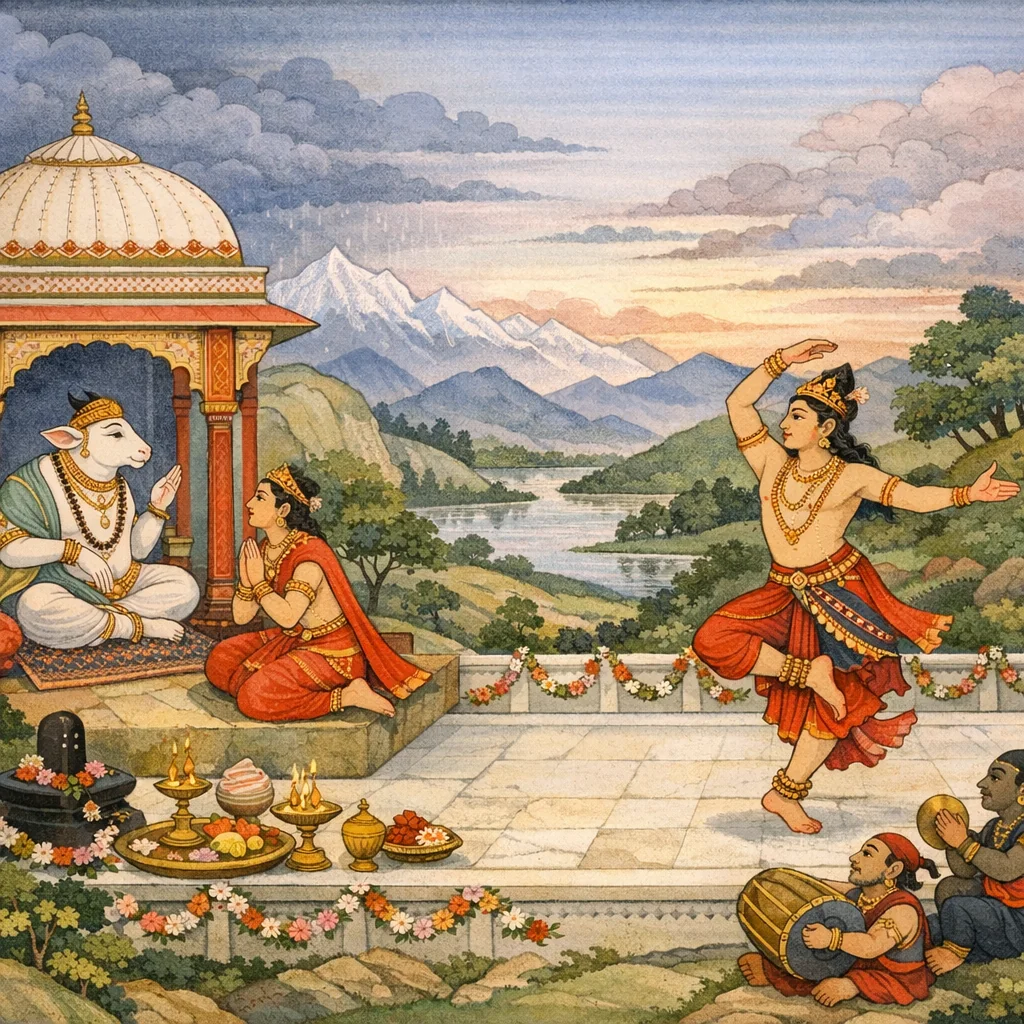
Adhyāya 56 begins with Nārada asking Sanatkumāra what Bāṇa did after Kṛṣṇa departed for Dvārakā with Aniruddha and his wife. Sanatkumāra describes Bāṇa’s anguish and self-reflection as he recalls his own mistaken judgment. At that moment Nandī (as Nandīśvara), leader of Śiva’s gaṇas, counsels the grieving asura-devotee to abandon excessive remorse, accept the events as Śiva’s will, and intensify Śiva-smaraṇa (remembrance of Śiva) along with regular mahotsava (devotional festival and ritual observance). Heeding this, Bāṇa regains composure, hastens to Śiva’s abode, bows, weeps in humility, and performs acts of bhakti—stotra praise, prostrations, and ritualized bodily gestures. The cited verses culminate in Bāṇa performing a prominent tāṇḍava dance in formal postures, showing devotion expressed through embodied liturgy. Overall, the chapter shifts from reactive sorrow to devotional praxis, highlighting Śiva’s compassion and the transforming power of remembrance, worship, and surrender.
Shlokas
Verse 1
नारद उवाच । कृष्णे गते द्वारकायाम निरुद्धेन भार्यया । अकार्षीत्किं ततो बाणस्तत्त्वं वद महामुने
Narada said: “When Krishna had departed for Dvaraka, what did Bāṇa do thereafter regarding Aniruddha and his wife? O great sage, tell me the true account.”
Verse 2
सनत्कुमार उवाच । कृष्णे गते द्वारकायामनिरुद्धेन भार्यया । दुःखितोऽभूत्ततो बाणस्स्वाज्ञानं संस्मरन्हृदा
Sanatkumāra said: When Kṛṣṇa had departed for Dvārakā, along with Aniruddha and his wife, Bāṇa became grief-stricken, remembering in his heart his own folly born of ignorance.
Verse 3
ततो नन्दीशिवगणो बाणं प्रोवाच दुःखितम् । दैत्यं शोणितदिग्धांगमनुता पसमन्वितम्
Then Nandī—foremost among Śiva’s gaṇas—spoke to Bāṇa, who was distressed: that asura, his body smeared with blood, was seized by burning anguish.
Verse 4
नन्दीश्वर उवाच । बाण शंकरसद्भक्त मानुतापं कुरुष्व भोः । भक्तानुकंपी शंभुर्वै भक्तवत्सलनामधृक्
Nandīśvara said: “O Bāṇa, true devotee of Śaṅkara—do not grieve as a mere man. Śambhu is compassionate to His devotees, and He bears the name ‘Bhaktavatsala’, the tender guardian of those who worship Him.”
Verse 5
तदिच्छया च यज्जातं तज्जातमिति चेतसा । मन्यस्व भक्तशार्दूल शिवं स्मर पुनःपुनः
Whatever has occurred has occurred by His will—hold this conviction firmly in your mind. O tiger among devotees, accept it thus, and remember Lord Śiva again and again.
Verse 6
मन आद्ये समाधाय कुरु नित्यं महो त्सवम् । भक्तानुकंपनश्चाऽस्य शंकरस्य पुनःपुनः
First, steady your mind in inner absorption; then perform the great sacred celebration every day. For Śaṅkara—ever compassionate to His devotees—again and again bestows grace.
Verse 7
नन्दिवाक्यात्ततो बाणो द्विषा शीर्षकमात्रकः । शिवस्थानं जगामाशु धृत्वा धैर्यं महामनाः
Then, taking Nandin’s words to heart, Bāṇa—though reduced by his foe to only a head—steadfastly gathered his courage and, great-souled, quickly went to the abode of Lord Śiva.
Verse 8
गत्वा तत्र प्रभुं नत्वा रुरोदातीव विह्वलः । गतगर्वव्रजो बाणः प्रेमाकुलितमानसः
Going there, Bāṇa bowed to the Lord (Śiva). Overwhelmed, he wept as though helpless—his pride wholly cast aside, his mind stirred and softened by love and devotion.
Verse 9
संस्तुवन्विविधैः स्तोत्रै स्संनमन्नुतितस्तथा । यथोचितं पादघातं कुर्वन्विक्षेपयन्करान्
Praising the Lord with many kinds of hymns, and likewise bowing down and offering reverent salutations, he performed fitting rhythmic steps, striking the ground with his feet as appropriate, while gesturing and moving his hands.
Verse 10
ननर्त तांडवं मुख्यं प्रत्यालीढादिशोभितम् । स्थानकैर्विविधाकारैरालीढप्रमुखैरपि
He danced the supreme Tāṇḍava, made resplendent by the pratyālīḍha and other heroic postures, and by many kinds of stances—ālīḍha and the rest—manifest in diverse forms.
Verse 11
सुखवादसहस्राणि भ्रूक्षेपसहितान्यपि । शिरःकम्पसहस्राणि प्राप्तानीकः सहस्रशः
Arriving in countless waves, there arose thousands upon thousands of pleasing acclamations, with gestures of raised eyebrows; and likewise thousands of tremblings of the head, coming in great multitudes.
Verse 12
वारीश्च विविधाकारा दर्शयित्वा शनैश्शनः । तथा शोणितधाराभिस्सिञ्चयित्वा महीतलम्
Gradually, he displayed the waters assuming many forms; then, with streams of blood, he drenched the surface of the earth.
Verse 13
रुद्रं प्रसादयामास शूलिनं चन्द्र शेखरम् । बाणासुरो महाभक्तो विस्मृतात्मगतिर्नतः
Bāṇāsura—though a great devotee—bowed down, forgetting all concern for his own fate, and sought to win the grace of Rudra, the Trident-bearer, the Lord crowned with the moon.
Verse 14
ततो नृत्यं महत्कृत्वा भगवान्भक्तवत्सलः । उवाच बाणं संहृष्टो नृत्य गीतप्रियो हरः
Then the Blessed Lord—ever tender to His devotees—performed a magnificent dance. Delighted, Hara, who loves dance and sacred song, spoke to Bāṇa.
Verse 15
रुद्र उवाच । बाण तात बलेः पुत्र संतुष्टो नर्तनेन ते । वरं गृहाण दैत्येन्द्र यत्ते मनसि वर्तते
Rudra said: “O dear Bāṇa, son of Bali! I am pleased with your dancing. O lord of the Daityas, accept a boon—whatever abides in your mind, whatever you desire.”
Verse 16
सनत्कुमार उवाच । इत्याकर्ण्य वचश्शंम्भोर्दैत्येन्द्रेण तदा मुने । बाणेन संवृणीतोऽभूद्वरस्तु व्रणरोपणे
Sanatkumāra said: “O sage, having thus heard the words of Śambhu, the lord of the Daityas at that time was overcome by Bāṇa; yet the boon remained effective in the healing of his wounds.”
Verse 17
बाहुयुद्धस्य चोद्ध त्तिर्गाणपत्यमथाक्षयम् । उषापुत्रस्य राज्यं तु तस्मिञ्शोणितकाह्वये
From that arm-to-arm combat arose the unfailing sovereignty of Gaṇapati; and the kingdom of Uṣā’s son was established there, in the city renowned as Śoṇitaka.
Verse 18
निर्वैरता च विबुधैर्विष्णुना च विशेषतः । न पुनर्दैत्यता दुष्टा रजसा तमसा युता
Even the gods—Vishnu in particular—abide in a state free from enmity; but the wicked demon-nature does not, for it is bound to rajas and tamas.
Verse 19
शंभुभक्तिर्विशेषेण निर्विकारा सदा मुने । शिवभक्तेषु च स्नेहो दया सर्वेषु जंतुषु
O sage, devotion to Śambhu is, above all, ever unchanging and free from distortion. It expresses itself as affectionate regard toward the devotees of Śiva, and as compassion toward all living beings.
Verse 20
कृत्वा वराञ्शंभोर्बलिपुत्रो महाऽसुरः । प्रेम्णाऽश्रुनयनो रुद्रं तुष्टाव सुकृतांजलिः
Having obtained boons from Śambhu, the great Asura—Bali’s son—his eyes filled with tears of love, praised Rudra with hands reverently joined in a well-formed añjali.
Verse 21
बाण उवाच । देवदेव महादेव शरणा गतवत्सल । त्वां नमामि महेशान दीनबन्धो दयानिधे
Bāṇa said: “O God of gods, O Mahādeva—O compassionate One who is tender to those who take refuge in You—O Maheśāna, I bow to You, the friend of the helpless, the very ocean of mercy.”
Verse 22
कृता मयि कृपातीव कृपासागर शंकर । गर्वोपहारितस्सर्वः प्रसन्नेन मम प्रभो
O Śaṅkara, ocean of compassion! You have shown abundant grace toward me. By Your gracious favor, O my Lord, all my pride has been taken away.
Verse 23
त्वं ब्रह्म परमात्मा हि सर्वव्याप्यखिलेश्वरः । ब्रह्मांडतनुरुग्रेशो विराट् सर्वान्वितः परः
You indeed are Brahman—the Supreme Self—all-pervading and the Lord of all. O fierce Sovereign, whose body is the very cosmos, You are the Virāṭ (cosmic form), the One who contains all, and the Supreme beyond all.
Verse 24
नाभिर्नभोऽग्निर्वदनमंबु रेतो दिशः श्रुतिः । द्यौश्शीर्षमंघ्रिरुर्वी ते मनश्चन्द्रस्तव प्रभो
O Lord, Your navel is the ether; Your mouth is fire; water is Your seed. The directions are Your ears. Heaven is Your head; the earth is Your feet; and the moon is Your mind.
Verse 25
दृगर्को जठरं वार्द्धिर्भुजेंद्रो धिषणा विधिः । प्रजापतिर्विसर्गश्च धर्मो हि हृदयं तव
Your eye is the Sun; Your belly is the ocean; Your arm is the lord of serpents; Your intellect is the cosmic ordinance. You are Brahmā, the Lord of progeny and creation itself—and truly, Dharma is Your very heart.
Verse 26
रोमाण्यौषधयो नाथ केशा जलमुचस्तव । गुणास्त्रयस्त्रिनेत्राणि सर्वात्मा पुरुषो भवान्
O Lord, the hairs upon your body are healing herbs; your matted locks are rain-bearing clouds. The three guṇas are your three eyes. You are the indwelling Self of all, the supreme Person.
Verse 27
ब्राह्मणं ते मुखं प्राहुर्बाहुं क्षत्रियमेव च । ऊरुजं वैश्यमाहुस्ते पादजं शूद्रमेव च
They declare your mouth to be the Brāhmaṇa; your arms, indeed, the Kṣatriya. They say your thighs are the Vaiśya, and your feet, indeed, the Śūdra—thus portraying the four social orders as arising from your cosmic person, as differentiated functions within a single sacred whole.
Verse 28
त्वमेव सर्वदोपास्यस्सर्वैर्जीवैर्महेश्वर । त्वां भजन्परमां मुक्तिं लभते पुरुषो ध्रुवम्
O Maheśvara, You alone are ever worthy of worship by all embodied souls. Whoever adores You surely attains the supreme liberation.
Verse 29
यस्त्वां विसृजते मर्त्य आत्मानं प्रियमीश्वरम् । विपर्ययेन्द्रियार्थार्थं विषमत्त्यमृतं त्यजन्
That mortal who abandons You—his own dearest Lord and inner Self—and, through perverted understanding, runs after the objects of the senses, forsakes the nectar of immortality and instead chooses the bitter poison of bondage.
Verse 30
विष्णुर्ब्रह्माऽथ विबुधा मुनयश्चामलाशयाः । सर्वात्मना प्रपन्नास्त्वां शंकरं प्रियमीश्वरम्
Viṣṇu, Brahmā, the gods, and the sages of stainless intention have, with their whole being, taken refuge in You—Śaṅkara, the beloved Lord and Supreme Ruler.
Verse 31
सनत्कुमार उवाच । इत्युक्त्वा बलिपुत्रस्तु विरराम शरासुरः । प्रेमप्रफुल्लितांगश्च प्रणम्य स महेश्वरम्
Sanatkumāra said: Having spoken thus, Śarāsura—the son of Bali—desisted; and with his body blossoming with love, he bowed down in reverence to Maheśvara (Lord Śiva).
Verse 32
इति श्रुत्वा स्वभक्तस्य बाणस्य भगवान्भवः । सर्वं लभिष्यसीत्युक्त्वा तत्रैवांतरधीयत
Hearing thus the words of his own devotee Bāṇa, the Blessed Lord Bhava (Śiva) said, “You shall attain everything,” and at that very place he vanished from sight.
Verse 33
ततश्शंभोः प्रसादेन महाकालत्वमागतः । रुद्रस्यानुचरो बाणो महाप्रमुदितोऽभवत्
Thereafter, by Śambhu’s gracious favor, Bāṇa attained the state of Mahākāla. That attendant of Rudra became exceedingly delighted.
Verse 34
इति किल शरनाम्नः शंकरस्यापि वृत्तं सकलगुरु जनानां सद्गुरोश्शूलपाणेः । कथितमिह वरिष्ठं श्रोत्ररम्यैर्वचोभिस्सकलभुवनमध्ये क्रीडमानस्य नित्यम्
Thus indeed, in this place, the sacred account of Śaṅkara—known here as Śara—of the Trident-bearing Lord, the true Guru of all gurus, has been told in excellent, ear-delighting words: of Him who ever plays His divine līlā in the midst of all the worlds.
Verse 56
इति श्रीशिवमहापुराणे द्विती यायां रुद्रसंहितायां पं० युद्धखंडे बाणासुरगणपत्वप्राप्तिवर्णनं नाम षट्पंचाशत्तमोऽध्यायः
Thus, in the Śrī Śiva Mahāpurāṇa, in the second part—within the Rudra Saṃhitā, in the Yuddha Khaṇḍa—ends the fifty-sixth chapter entitled “The Account of Bāṇāsura’s Attainment of the Status of Śiva’s Gaṇas.”
Frequently Asked Questions
After Kṛṣṇa returns to Dvārakā with Aniruddha and his wife, Bāṇa becomes distressed; Nandīśvara counsels him to accept Śiva’s will and renew worship, after which Bāṇa approaches Śiva and performs praise and tāṇḍava.
The chapter models a Shaiva psychology of crisis: sorrow is redirected into smaraṇa and ritual discipline, presenting devotion as the method by which inner disorder is stabilized and grace is accessed.
Śiva is highlighted as Śambhu/Śaṅkara the bhaktavatsala (compassionate to devotees), while devotion manifests through stotra, prostration, and tāṇḍava—ritualized speech and body as vehicles of bhakti.