कामप्रादुर्भावः — The Manifestation/Arising of Kāma
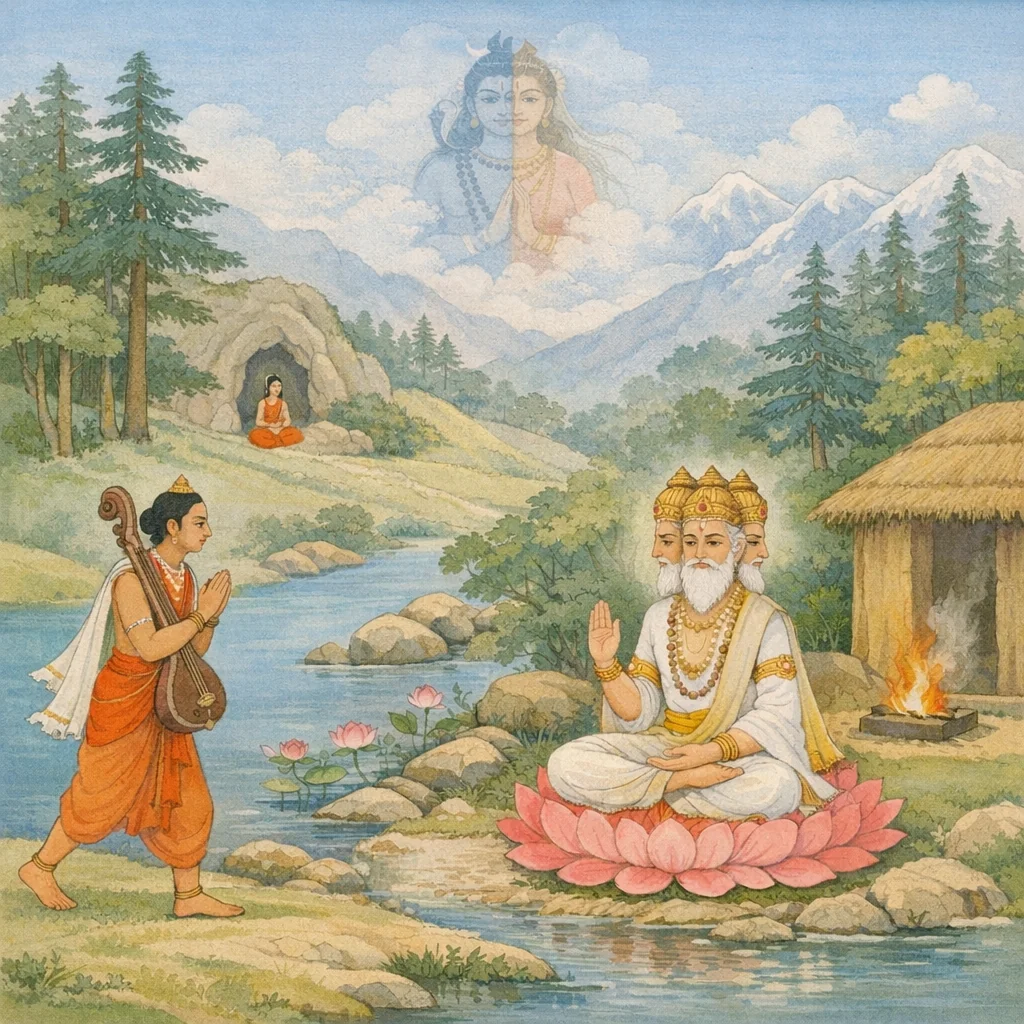
Adhyāya 2 continues the established frame as Sūta speaks to the sages of Naimiṣāraṇya; having heard the earlier discourse, a foremost sage asks for a sin-destroying (pāpa-praṇāśinī) account. The scene then shifts to Nārada reverently questioning Brahmā, declaring an unquenchable longing to hear the auspicious narrative of Śambhu (Śiva) and requesting a full explanation of Śiva’s sacred deeds connected with Satī. Nārada’s inquiry unfolds as focused questions: Satī’s birth in Dakṣa’s household; how Śiva’s mind turned toward taking a bride; how Satī, due to Dakṣa’s anger, abandoned her body and was reborn as Himavat’s daughter; how she returned as Pārvatī and what led to her severe tapas; how the marriage took place; and how she came to share the “half-body” state with the destroyer of Smara (Kāma). Brahmā begins his reply, praising the narrative as supremely purifying, divine, and esoteric—“most secret among secrets”—marking it as both sacred history and initiatory theology. The colophon names the chapter “Kāmaprādurbhāva,” indicating that what follows will connect these questions to Kāma’s role and Śiva’s response within the wider Satī–Pārvatī cycle.
Shlokas
Verse 1
सूत उवाच । इत्याकर्ण्य वचस्तस्य नेमिषारण्यवासिनः । पप्रच्छ च मुनिश्रेष्ठः कथां पापप्रणाशिनीम्
Sūta said: Having heard his words, the sages dwelling in Naimiṣāraṇya—then the foremost of sages asked again for that sacred narrative which destroys sin.
Verse 2
इति श्रीशिवमहापुराणे द्वितीयायां रुद्रसंहितायां द्वितीये सतीखंडे कामप्रादुर्भावो नाम द्वितीयोऽध्यायः
Thus, in the Śrī Śiva Mahāpurāṇa—within the Second Book, the Rudra Saṃhitā, in the second division called the Satī Khaṇḍa—ends the Second Chapter titled “The Manifestation of Kāma.”
Verse 3
अतः कथय तत्सर्वं शिवस्य चरितं शुभम् । सतीकीर्त्यन्वितं दिव्यं श्रोतुमिच्छामि विश्वकृत्
Therefore, recount all of that auspicious sacred history of Lord Śiva—divine, and adorned with the glory of Satī. I, the Maker of the universe, desire to hear it.
Verse 4
सती हि कथमुत्पन्ना दक्षदारेषु शोभना । कथं हरो मनश्चक्रे दाराहरणकर्मणि
“How, indeed, was the radiant Satī born in the household of Dakṣa’s wife? And how did Hara (Śiva) set His mind upon the act of taking her as His bride?”
Verse 5
कथं वा दक्षकोपेन त्यक्तदेहा सती पुरा । हिमवत्तनया जाता भूयो वाकाशमागता
How indeed did Satī, who formerly cast off her body because of Dakṣa’s wrath, become born again as the daughter of Himavat, and then once more attain the divine state—union with Śiva?
Verse 6
पार्वत्याश्च तपोऽत्युग्रं विवाहश्च कथं त्वभूत् । कथमर्द्धशरीरस्था बभूव स्मरनाशिनः
How did Pārvatī undertake such exceedingly austere tapas, and how did her marriage come to pass? And how did she become established as the very half of the body of the Destroyer of Smara (Kāma)—Lord Śiva?
Verse 7
एतत्सर्वं समाचक्ष्व विस्तरेण महामते । नान्योस्ति संशयच्छेत्ता त्वत्समो न भविष्यति
O great and wise one, recount all of this to us in full detail. There is none other who can dispel our doubts; none will ever be your equal in this.
Verse 8
ब्रह्मोवाच । शृणु त्वं च मुने सर्वं सतीशिवयशश्शुभम् । पावनं परमं दिव्यं गुह्याद्गुह्यतमं परम्
Brahmā said: O sage, listen to everything—the auspicious glory of Satī and Śiva. It is supremely purifying, most excellent and divine, and the highest secret, more hidden than all that is hidden.
Verse 9
एतच्छंभुः पुरोवाच भक्तवर्याय विष्णवे । पृष्टस्तेन महाभक्त्या परोपकृतये मुने
Thus Śambhu (Lord Śiva) spoke this beforehand to Viṣṇu, the foremost among devotees, having been asked by him with great devotion, O sage, for the welfare of others.
Verse 10
ततस्सोपि मया पृष्टो विष्णुश्शैववरस्सुधीः । प्रीत्या मह्यं समाचख्यौ विस्तरान्मुनिसत्तम
Then I questioned him as well—Viṣṇu, the wise one and foremost among the Śaivas. Out of affection, O best of sages, he explained everything to me in full detail.
Verse 11
अहं तत्कथयिष्यामि कथामेतां पुरातनीम् । शिवाशिवयशोयुक्तां सर्वकामफलप्रदाम्
I shall now recount that ancient sacred narrative—filled with the glory of Śiva and Śivā (Satī)—a tale that bestows the fruits of all rightful aspirations.
Verse 12
पुरा यदा शिवो देवो निर्गुणो निर्विकल्पकः । अरूपश्शक्तिरहितश्चिन्मात्रस्सदसत्परः
In the beginning, when Lord Śiva was without attributes and free from all differentiation—formless, without manifest power, pure consciousness alone—He transcended both being and non-being.
Verse 13
अभवत्सगुणस्सोपि द्विरूपश्शक्तिमान्प्रभुः । सोमो दिव्याकृतिर्विप्र निर्वि कारी परात्परः
That Lord Soma too became manifest as saguṇa, endowed with attributes. O brāhmaṇa, the powerful Sovereign assumed a twofold form of divine splendor, yet remained nirvikāra—unchanging—the Supreme beyond the supreme.
Verse 14
तस्य वामांगजो विष्णुर्ब्रह्माहं दक्षिणांगजः । रुद्रो हृदयतो जातोऽभवच्च मुनिसत्तम
From His left side was born Viṣṇu; from His right side I, Brahmā, was born. And Rudra arose from His heart—O best of sages.
Verse 15
सृष्टिकर्ताभवं ब्रह्मा विष्णुः पालनकारकः । लयकर्ता स्वयं रुद्रस्त्रिधाभूतस्सदाशिवः
Brahmā became the agent of creation; Viṣṇu is the one who carries out preservation; Rudra himself is the agent of dissolution. Thus Sadāśiva—one Supreme Lord—manifests in three ways to govern the cosmos.
Verse 16
मरीचिमत्रिं पुलहं पुलस्त्यांगिरसौ क्रतुम् । वसिष्ठं नारदं दक्षं भृगुं चेति महाप्रभून्
He mentioned those mighty and illustrious ones—Marīci, Atri, Pulaha, Pulastya, Aṅgiras, Kratu, Vasiṣṭha, Nārada, Dakṣa, and Bhṛgu—great luminaries among the sages.
Verse 17
सृष्ट्वा प्रजापतीन् दक्षप्रमुखान्सुरसत्तमान् । अमन्यं सुप्रसन्नोहं निजं सर्वमहोन्नतम्
Having created the Prajāpatis—foremost among them Dakṣa—the best among the gods, I, wholly delighted, regarded my own state as entirely exalted and supremely fulfilled.
Verse 19
ब्रह्माहं मानसान्पुत्रानसर्जं च यदा मुने । तदा मन्मनसो जाता चारुरूपा वरांगना
Brahmā said: “O sage, when I created the mind-born sons, at that very time there arose from my own mind a noble lady of exquisite beauty.”
Verse 20
नाम्ना संध्या दिवक्षांता सायं संध्या जपंतिका । अतीव सुन्दरी सुभ्रूर्मुनिचेतोविमोहिनी
She was known as Sandhyā, also called Divakṣāntā; and in the evening she would perform Sandhyā-japa. Exceedingly beautiful, with graceful brows, she could enchant even the minds of sages.
Verse 22
दृष्ट्वाहं तां समुत्थाय चिन्तयन्हृदि हृद्गतम् । दक्षादयश्च स्रष्टारो मरीच्याद्याश्च मत्सुताः
Seeing her, I rose and pondered within my heart what lay hidden in my inmost mind: “Dakṣa and the other Prajāpatis, the creators, and Marīci and the rest—my mind-born sons—(are all involved in this matter).”
Verse 23
एवं चिंतयतो मे हि ब्रह्मणो मुनिसत्तम । मानसः पुरुषो मंजुराविर्भूतो महाद्भुतः
O best of sages, as I—Brahmā—was thus reflecting, a wondrous and most astonishing Person, born of the mind, appeared before me with a radiant and pleasing form.
Verse 24
कांचनीकृतजाताभः पीनोरस्कस्सुनासिकः । सुवृत्तोरुकटीजंघो नीलवेलितकेसरः
His complexion shone like refined gold; his chest was broad and full, and his nose was well-formed. His thighs, hips, and shanks were beautifully proportioned, and his hair was dark, curling in bluish waves.
Verse 25
लग्नभ्रूयुगलो लोलः पूर्णचन्द्रनिभाननः । कपाटायतसद्वक्षो रोमराजीवराजितः
His two eyebrows met in a single graceful arch, and His gaze was gently playful and ever-moving. His face shone like the full moon. His noble chest was broad like a great door-panel, beautified by a splendid line of hair—thus was revealed the auspicious saguna form of Śiva, bestower of devotion and liberation.
Verse 26
अभ्रमातंगकाकारः पीनो नीलसुवासकः । आरक्तपाणिनयनमुखपादकरोद्भवः
He appeared in hue and majesty like a rain-cloud and an elephant—broad and powerful—clad in blue garments; and from Him shone a reddish radiance in His hands, eyes, face, feet, and in the palms extended for blessing and protection.
Verse 27
क्षीणमध्यश्चारुदन्तः प्रमत्तगजगंधनः । प्रफुल्लपद्मपत्राक्षः केसरघ्राणतर्पणः
He is slender-waisted and bears beautiful tusks; He is like the fragrance of an intoxicated elephant. His eyes are like the petals of a fully blossomed lotus, and He delights in the scent of kesar (saffron).
Verse 28
कंबुग्रीवो मीनकेतुः प्रांशुर्मकरवाहनः । पंचपुष्पायुधो वेगी पुष्पकोदंडमंडितः
He had a conch-like neck; his banner bore the fish-emblem; he was tall, and his vehicle was the makara. Armed with five flower-arrows, swift in movement, he was adorned with a floral bow—thus was Kāma, the god of desire, described.
Verse 29
कांतः कटाक्षपातेन भ्रामयन्नयनद्वयम् । सुगंधिमारुतो तात शृंगाररससेवितः
O dear one, the beloved spring makes the pair of eyes reel with its sidelong glances; and the fragrant breeze, steeped in śṛṅgāra-rasa, the savor of love, stirs the heart toward worldly delight—thus binding the embodied soul through attraction.
Verse 30
तं वीक्ष्य पुरुषं सर्वे दक्षाद्या मत्सुताश्च ते । औत्सुक्यं परमं जग्मुर्विस्मयाविष्टमानसाः
Seeing that exalted Puruṣa, all of them—Dakṣa and the others, along with my daughters—were seized by wonder; their minds, absorbed in amazement, were filled with the highest eagerness.
Verse 31
अभवद्विकृतं तेषां मत्सुतानां मनो द्रुतम् । धैर्यं नैवालभत्तात कामाकुलितचेतसाम्
Then the minds of those sons of mine quickly became disturbed and perverted; for their hearts, agitated by desire, could not attain steadiness, dear one.
Verse 32
मां सोपि वेधसं वीक्ष्य स्रष्टारं जगतां पतिम् । प्रणम्य पुरुषः प्राह विनयानतकंधरः
Then that person, seeing Brahmā (Vedhas)—the creator and lord of the worlds—bowed down and, with his neck bent in humility, spoke.
Verse 33
पुरुष उवाच । किं करिष्याम्यहं कर्म ब्रह्मंस्तत्र नियोजय । मान्योद्य पुरुषो यस्मादुचितः शोभितो विधे
The Puruṣa said: “O Brahmā, what task shall I perform? Appoint me to it. For today I am to be honored as one worthy—befitting and beautifully adorned—O Ordainer.”
Verse 34
अभिमानं च योग्यं च स्थानं पत्नी च या मम । तन्मे वद त्रिलोकेश त्वं स्रष्टा जगतां पतिः
“Tell me of the fitting honor due to me, the proper station to be granted, and the wife who shall be mine. O Lord of the three worlds—since you are the Creator and the sovereign of the universe—declare this to me.”
Verse 35
ब्रह्मोवाच । एवं तस्य वचः श्रुत्वा पुरुषस्य महात्मनः । क्षणं न किंचित्प्रावोचत्स स्रष्टा चातिविस्मितः
Brahmā said: Having thus heard the words of that great-souled Supreme Person, the Creator (Brahmā) remained silent for a moment, saying nothing—utterly astonished.
Verse 36
अतो मनस्सुसंयम्य सम्यगुत्सृज्य विस्मयम् । अवोचत्पुरुषं ब्रह्मा तत्कामं च समावहन्
Then Brahmā, steadying his mind and fully casting off astonishment, addressed that Supreme Person—while inwardly gathering and fixing his resolve for the desired purpose.
Verse 37
ब्रह्मोवाच । अनेन त्वं स्वरूपेण पुष्पबाणैश्च पंचभिः । मोहयन् पुरुषान् स्त्रीश्च कुरु सृष्टिं सनातनीम्
Brahmā said: “With this very form of yours, and with your five flower-arrows, bewilder men and women, and thereby bring about the eternal process of creation.”
Verse 38
अस्मिञ्जीवाश्च देवाद्यास्त्रैलोक्ये सचराचरे । एते सर्वे भविष्यन्ति न क्षमास्त्यवलंबने
In this threefold world—moving and unmoving—there exist beings beginning with the gods and all embodied souls. All of them arise and pass away; none has the power to remain here by relying on any support.
Verse 39
अहं वा वासुदेवो वा स्थाणुर्वा पुरुषोत्तमः । भविष्यामस्तव वशे किमन्ये प्राणधारकाः
“Whether it be I, or Vāsudeva (Viṣṇu), or Sthāṇu (Śiva), or even the Supreme Person—each of us will remain under your dominion; what then can be said of other embodied beings who merely sustain life-breath?”
Verse 40
प्रच्छन्नरूपो जंतूनां प्रविशन्हृदयं सदा । सुखहेतुः स्वयं भूत्वा सृष्टिं कुरु सनातनीम्
“Assuming a concealed form, ever enter the hearts of living beings; becoming Yourself the very cause of their well-being, bring forth the eternal creation.”
Verse 41
त्वत्पुष्पबाणस्य सदा सुखलक्ष्यं मनोद्भुतम् । सर्वेषां प्राणिनां नित्यं सदा मदकरो भवान्
“Your flower-arrows ever find a pleasant target, born of the mind. For all living beings, you are always—unceasingly—the maker of intoxication, the bewildering passion.”
Verse 42
इति ते कर्म कथितं सृष्टिप्रावर्तकं पुनः । नामान्येते वदिष्यंति सुता मे तव तत्त्वतः
Thus I have again explained to you that act which sets creation in motion. Now my daughters will declare these names to you, in accordance with the true principle (tattva).
Verse 43
ब्रह्मोवाच । इत्युक्त्वाहं सुरश्रेष्ठ स्वसुतानां मुखानि च । आलोक्य स्वासने पाद्मे प्रोपविष्टोऽभवं क्षणम्
Brahmā said: Having spoken thus, O best among the gods, I looked upon the faces of my own sons; then, upon my lotus-seat, I sat down for a moment.
Frequently Asked Questions
The chapter formally introduces the inquiry that links Satī’s life-cycle (birth in Dakṣa’s house, body-abandonment, rebirth as Pārvatī) to the Kāma/Smara complex—i.e., the narrative conditions leading to Śiva as ‘Smaranāśin’ and to Pārvatī’s tapas and marriage.
By labeling the teaching “guhyād guhyatamam,” the text frames Satī–Śiva history as more than myth: it is a doctrinal disclosure about purification through hearing, the inner meaning of tapas, and the metaphysical continuity of Śakti across embodiments.
Satī’s manifestation in Dakṣa’s lineage and her re-manifestation as Himavat’s daughter (Pārvatī) are foregrounded, with Kāma/Smara invoked as the catalytic figure whose encounter with Śiva becomes integral to the later narrative arc.