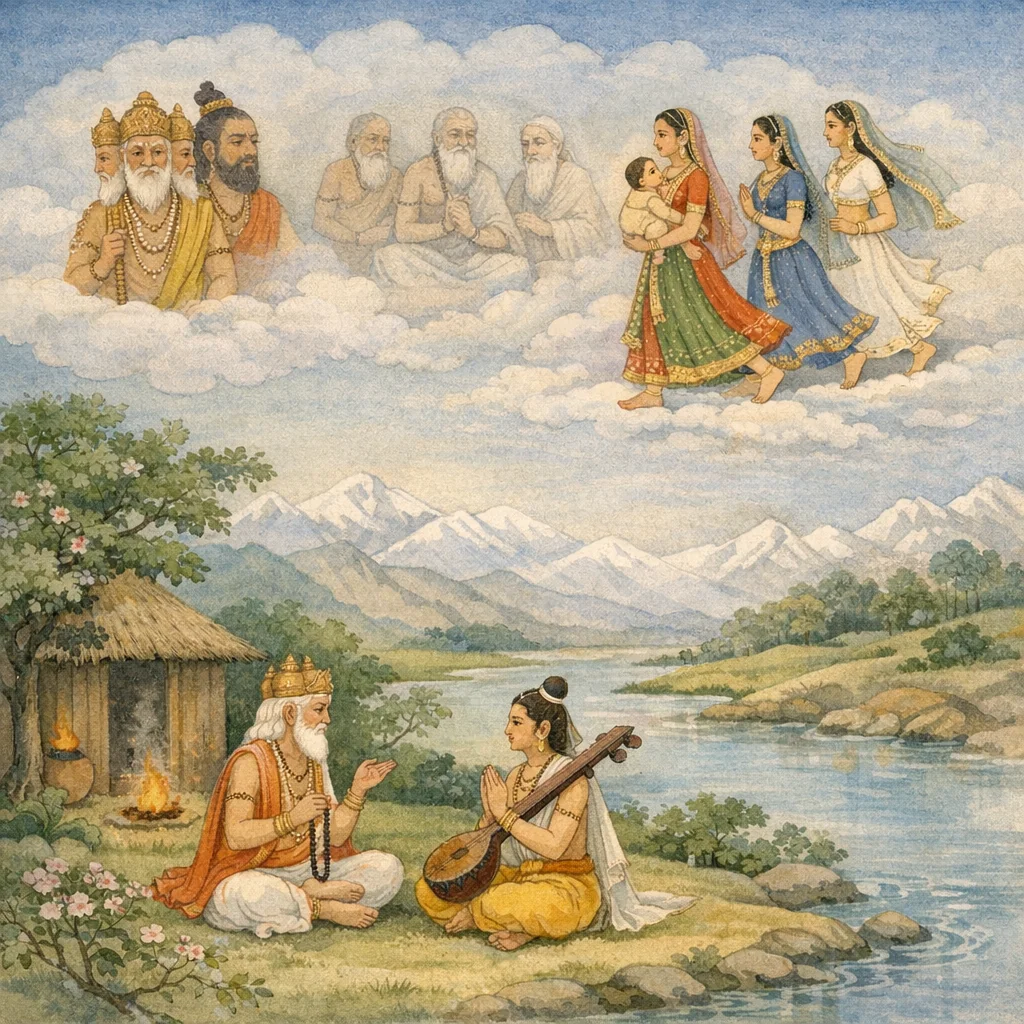
पूर्वगतिवर्णनम् (Pūrvagati-varṇana) — “Description of the Prior Course / Earlier Lineage Account”
Adhyāya 2 unfolds as a doubt-clearing dialogue: Nārada asks Brahmā to explain Menā’s origin (menotpatti) and to disclose any relevant curse (śāpa), so that uncertainty may be removed. Brahmā answers by placing the account within earlier creation lineages, beginning with Dakṣa, his descendants, and marital alliances with sages such as Kaśyapa. In this genealogical setting, Svadhā is given to the Pitṛs, and from Svadhā arise three daughters—Menā (eldest), Dhanyā (middle), and Kalāvatī (youngest)—said to be mind-born (mānasa-udbhava) and commonly regarded as ayonijāḥ (not womb-born). The chapter stresses the spiritual merit of hearing and reciting these auspicious names, praising them as vighna-hara (obstacle-removing) and mahā-maṅgala-dā (bestowing great auspiciousness). It further portrays the daughters as world-venerated, mothers of the worlds, yoginīs, and vessels of supreme knowledge moving through the three worlds, thus elevating genealogy into a devotional and metaphysical teaching.
Shlokas
Verse 1
नारद उवाच । विधे प्राज्ञ वदेदानीं मेनोत्पत्तिं समादरात् । अपि शापं समाचक्ष्व कुरु संदेहभंजनम्
Nārada said: “O wise Vidhātr̥ (Brahmā), now tell me with reverent care the account of Menā’s origin. Also explain the matter of the curse, and thus shatter my doubt.”
Verse 2
ब्रह्मोवाच । शृणु नारद सुप्रीत्या मेनोत्पत्तिं विवेकतः । मुनिभिः सह वक्ष्येहं सुतवर्य्य महाबुध
Brahmā said: O Nārada, listen with glad attention as I explain, with clear discernment, the account of Menā’s origin. Together with the sages, I shall tell you here, O best of sons, O greatly wise one.
Verse 3
दक्षनामा मम सुतो यः पुरा कथितो मुने । तस्य जाताः सुताः षष्टिप्रमितास्सृष्टिकारणाः
O sage, Dakṣa—who was earlier spoken of as my son—had sixty sons; they became instrumental causes in the work of creation.
Verse 4
तासां विवाहमकरोत्स वरैः कश्यपादिभिः । विदितं ते समस्तं तत्प्रस्तुतं शृणु नारद
He arranged their marriages with the excellent sages—Kaśyapa and others. All of that is already known to you; now, O Nārada, listen to what is presently being narrated.
Verse 5
तासां मध्ये स्वधानाम्नीं पितृभ्यो दत्तवान्सुताम् । तिस्रोभवन्सुतास्तस्यास्सुभगा धर्ममूर्तयः
Among those daughters, he gave the maiden named Svadhā to the Pitṛs. From her were born three daughters—auspicious in nature and embodiments of Dharma.
Verse 6
तासां नामानि शृणु मे पावनानि मुनीश्वर । सदा विघ्नहराण्येव महामंगलदानि च
O lord among sages, listen to me as I recount their names—names that are purifying, ever-destroyers of obstacles, and bestowers of great auspiciousness.
Verse 7
मेनानाम्नी सुता ज्येष्ठा मध्या धन्या कलावती । अन्त्या एतास्सुतास्सर्वाः पितॄणाम्मानसोद्भवाः
Among them, the eldest daughter was named Menā; the middle one was Dhanyā; and the youngest was Kalāvatī. All these daughters were mind-born progeny of the Pitṛs, the ancestral Fathers.
Verse 8
अयोनिजाः स्वधायाश्च लोकतस्तत्सुता मताः । आसाम्प्रोच्य सुनामानि सर्वान्कामाञ्जनो लभेत्
These maidens are said to be ayoni-jā, not born from a womb, and in the worlds they are regarded as the daughters of Svadhā. Whoever reverently utters their auspicious names attains all desired aims.
Verse 9
जगद्वंद्याः सदा लोकमातरः परमोददाः । योगिन्यः परमा ज्ञाननिधानास्तास्त्रिलोकगाः
Ever revered by the whole world, they are the Mothers of the worlds, supremely generous. Those Yoginīs are the highest, treasuries of spiritual knowledge, and they move throughout the three worlds.
Verse 10
एकस्मिन्समये तिस्रो भगिन्यस्ता मुनीश्वर । श्वेतद्वीपं विष्णुलोकं जग्मुर्दर्शनहेतवे
O lord among sages, at one time those three sisters went to Śvetadvīpa, the realm of Viṣṇu, for the purpose of obtaining darśana, the divine audience.
Verse 11
कृत्वा प्रणामं विष्णोश्च संस्तुतिं भक्तिसंयुताः । तस्थुस्तदाज्ञया तत्र सुसमाजो महानभूत्
Having offered salutations (pranāma) to Lord Viṣṇu and praised him with devotion, they remained there in accordance with his command; and in that place a great and harmonious assembly came into being.
Verse 12
तदैव सनकाद्यास्तु सिद्धा ब्रह्मसुता मुने । गतास्तत्र हरिं नत्वा स्तुत्वा तस्थुस्तदाज्ञया
Then, O sage, the perfected Brahmā-born ones—Sanaka and the rest—went there at once. Bowing to Hari and praising him, they remained standing, abiding by his command.
Verse 13
सनकाद्यान्मुनीन्दृष्ट्वोत्तस्थुस्ते सकला द्रुतम् । तत्रस्थान्संस्थितान्नत्वा देवाद्यांल्लोकवन्दितान्
Seeing the sages beginning with Sanaka, they all rose up at once. Bowing to those deities and venerable ones who were present there—revered by the worlds—they stood with due humility.
Verse 14
तिस्रो भगिन्यस्तांस्तत्र नोत्तस्थुर्मोहिता मुने । मायया दैवविवशाश्शङ्करस्य परात्मनः
O sage, those three sisters, deluded there, did not rise. Overpowered by destiny through the māyā of Śaṅkara—the Supreme Self—they were rendered helpless.
Verse 15
मोहिनी सर्व लोकानां शिवमाया गरीयसी । तदधीनं जगत्सर्वं शिवेच्छा सा प्रकीर्त्यते
Shiva’s Māyā is supremely powerful and bewitches all the worlds. The entire universe depends upon it; therefore it is proclaimed to be the very Will of Shiva (Śivecchā).
Verse 16
प्रारब्धं प्रोच्यते सैव तन्नामानि ह्यनेकशः । शिवेच्छया भवत्येव नात्र कार्या विचारणा
This alone is called prārabdha (destiny already set in motion), and it is spoken of by many names. It comes to be solely by Śiva’s will—there is no need for further disputation about it.
Verse 17
भूत्वा तद्वशगास्ता वै न चक्रुरपि तन्नतिम् । विस्मितास्सम्प्रदृश्यैव संस्थितास्तत्र केवलम्
Coming under Her irresistible sway, they could not even bow to Him in reverence. Astonished by what they beheld, they merely stood there, motionless.
Verse 18
तादृशीं तद्गतिं दृष्ट्वा सनकाद्या मुनीश्वराः । ज्ञानिनोऽपि परं चक्रुः क्रोधं दुर्विषहं च ते
Seeing that extraordinary course and outcome, the venerable sages beginning with Sanaka—even though they knew the highest truth—became fiercely enraged; and their anger was unbearable.
Verse 19
शिवेच्छामोहितस्तत्र सक्रोधस्ता उवाच ह । सनत्कुमारो योगीशश्शापन्दण्डकरं ददन्
There, deluded by Śiva’s own will and stirred by anger, he spoke. Sanatkumāra—the lord of yogins—then raised the rod of a curse and proceeded to pronounce it.
Verse 20
सनत्कुमार उवाच । यूयं तिस्रो भगिन्यश्च मूढाः सद्वयुनोज्झिताः । अज्ञातश्रुतितत्त्वा हि पितृकन्या अपि ध्रुवम्
Sanatkumāra said: “You three sisters are deluded, cast away from right discernment. Truly you have not understood the real purport of the Vedas; though you are daughters of your father, it is certainly so.”
Verse 21
अभ्युत्थानं कृतं नो यन्नमस्कारोपि गर्वतः । मोहिता नरभावत्वात्स्वर्गाद्दूरा भवन्तु हि
“Since you did not rise in respect for us, nor even offer obeisance—puffed up with pride—may you, deluded by the limitations of human nature, indeed remain far from heaven.”
Verse 22
नरस्त्रियः सम्भवन्तु तिस्रोऽपि ज्ञानमोहिताः । स्वकर्मणः प्रभणावे लभध्वं फलमीदृशम्
“Let men and women—indeed all the three conditions of embodied life—be deluded by knowledge. Yet, in the very unfolding and consequence of one’s own actions, may you obtain a fruit such as this.”
Verse 23
ब्रह्मोवाच । इत्याकर्ण्य च साध्वस्तास्तिस्रोऽपि चकिता भृशम् । पतित्वा पादयोस्तस्य समूचूर्नतमस्तकाः
Brahmā said: Hearing those words, the three virtuous ones were greatly alarmed. Falling at his feet with heads bowed in reverence, they spoke together.
Verse 24
पितृतनया ऊचुः । मुनिवर्य्य दयासिन्धो प्रसन्नो भव चाधुना । त्वत्प्रणामं वयं मूढाः कुर्महे स्म न भावतः
The daughters of the Pitṛs said: “O best of sages, ocean of compassion, be gracious to us now. Deluded as we were, we offered you salutations, yet not with true inner feeling and understanding.”
Verse 25
प्राप्तं च तत्फलं विप्र न ते दोषो महामुने । अनुग्रहं कुरुष्वात्र लभेम स्वर्गतिम्पुनः
“O brāhmaṇa, that fruit has indeed been obtained; O great sage, there is no fault in you. Bestow your grace upon us here, so that we may again attain the heavenly path.”
Verse 26
ब्रह्मोवाच । श्रुत्वा तद्वचनं तात प्रोवाच स मुनिस्तदा । शापोद्धारं प्रसन्नात्मा प्रेरितः शिवमायया
Brahmā said: O dear one, having heard those words, the sage then spoke—his heart serene—explaining the means for the removal of the curse, impelled by Śiva’s divine Māyā.
Verse 27
सनत्कुमार उवाच । पितॄणां तनयास्तिस्रः शृणुत प्रीतमानसाः । वचनं मम शोकघ्नं सुखदं सर्वदैव वः
Sanatkumāra said: “O beloved ones, listen with gladdened hearts to my words. The Pitṛs have three daughters; my speech will destroy sorrow and will ever bestow happiness upon you.”
Verse 28
विष्णोरंशस्य शैलस्य हिमाधारस्य कामिनी । ज्येष्ठा भवतु तत्कन्या भविष्यत्येव पार्वती
The beloved consort of Himādhāra (Himālaya)—that mountain who is a portion of Viṣṇu—shall bear an elder daughter; indeed, that very girl will be born as Pārvatī.
Verse 29
धन्या प्रिया द्वितीया तु योगिनी जनकस्य च । तस्याः कन्या महालक्ष्मीर्नाम्ना सीता भविष्यति
Janaka’s second beloved queen was Dhanyā, a yoginī. From her a daughter will be born—Mahālakṣmī herself—who will be known by the name Sītā.
Verse 30
वृषभानस्य वैश्यस्य कनिष्ठा च कलावती । भविष्यति प्रिया राधा तत्सुता द्वापरान्ततः
Kalāvatī, the younger daughter of Vṛṣabhānu the vaiśya, will—at the close of the Dvāpara age—become the beloved Rādhā, his daughter.
Verse 31
मेनका योगिनी पत्या पार्वत्याश्च वरेण च । तेन देहेन कैलासं गमिष्यति परम्पदम्
By her husband’s yogic merit, and by the boon granted through Pārvatī, Menakā—becoming a perfected yoginī—shall depart in that very body to Kailāsa, the supreme abode.
Verse 32
धन्या च सीतया सीरध्वजो जनकवंशजः । जीवन्मुक्तो महायोगी वैकुण्ठं च गमिष्यति
Blessed indeed is Sītā, and blessed too is Sīradhvaja Janaka, born in Janaka’s lineage. A great yogin, liberated while still embodied (jīvanmukta), he shall also attain Vaikuṇṭha.
Verse 33
कलावती वृषभानस्य कौतुकात्कन्यया सह । जीवन्मुक्ता च गोलोकं गमिष्यति न संशयः
Out of affectionate curiosity, Kalāvatī of Vṛṣabhānu will go together with the maiden. She will become liberated while still living (jīvanmuktā) and will certainly attain Goloka; of this there is no doubt.
Verse 34
विना विपत्तिं महिमा केषां कुत्र भविष्यति । सुकर्मिणां गते दुःखे प्रभवेद्दुर्लभं सुखम्
Without adversity, where—and for whom—can greatness truly arise? When the sorrow of the virtuous, those established in right action, has passed, a rare and hard-won happiness comes forth.
Verse 35
यूयं पितॄणां तनयास्सर्वास्स्वर्गविलासिकाः । कर्मक्षयश्च युष्माकमभवद्विष्णुदर्शनात्
You are all daughters of the Pitṛs, heavenly maidens who delight in Svarga. By the very vision of Viṣṇu, the accumulated karma within you has been exhausted and dissolved.
Verse 36
इत्युक्त्वा पुनरप्याह गतक्रोधो मुनीश्वरः । शिवं संस्मृत्य मनसा ज्ञानदं भुक्तिमुक्तिदम्
Having spoken thus, the lord among sages—his anger now gone—spoke again, mentally remembering Śiva, the giver of true knowledge, who bestows both worldly enjoyment (bhukti) and final liberation (mukti).
Verse 37
अपरं शृणुत प्रीत्या मद्वचस्सुखदं सदा । धन्या यूयं शिवप्रीता मान्याः पूज्या ह्यभीक्ष्णशः
Hear further, with affection, my words that ever bestow well-being. Blessed are you—dear to Lord Śiva—worthy of honor and truly fit to be revered again and again.
Verse 38
मेनायास्तनया देवी पार्वती जगदम्बिका । भविष्यति प्रिया शम्भोस्तपः कृत्वा सुदुस्सहम्
Menā’s daughter—the Goddess Pārvatī, Mother of the universe—will become beloved of Śambhu after performing exceedingly arduous austerities.
Verse 39
धन्या सुता स्मृता सीता रामपत्नी भविष्यति । लौकिकाचारमाश्रित्य रामेण विहरिष्यति
That blessed daughter will be known as Sītā and will become the wife of Rāma. Upholding the accepted conduct of the world (dharma in worldly life), she will dwell and delight in companionship with Rāma.
Verse 40
कलावतीसुता राधा साक्षाद्गोलोकवासिनी । गुप्तस्नेहनिबद्धा सा कृष्णपत्नी भविष्यति
Rādhā, the daughter of Kalāvatī, is truly a dweller of Goloka. Bound by a hidden bond of love, she shall become the wife of Kṛṣṇa.
Verse 41
ब्रह्मोवाच इत्थमाभाष्य स मुनिर्भ्रातृभिस्सह संस्तुतः । सनत्कुमारो भगवांस्तत्रैवान्तर्हितोऽभवत्
Brahmā said: Having spoken thus, that sage—Sanatkumāra—was praised along with his brothers; and then the revered Sanatkumāra vanished from that very place.
Verse 42
तिस्रो भगिन्यस्तास्तात पितॄणां मानसीः सुताः । गतपापास्सुखं प्राप्य स्वधाम प्रययुर्द्रुतम्
O dear one, those three sisters—mind-born daughters of the Pitṛs—having been freed from sin and having attained happiness, swiftly departed to their own divine abode.
Frequently Asked Questions
The chapter centers on the account of Menā’s origin within the Dakṣa–Svadhā–Pitṛ lineage, naming Menā, Dhanyā, and Kalāvatī as Svadhā’s daughters and describing their extraordinary (mānasa/ayonija) birth-status.
The text explicitly claims that stating and hearing these names is vighna-hara (removes obstacles) and mahā-maṅgala-dā (bestows great auspiciousness), presenting genealogy as a devotional practice with tangible spiritual efficacy.
They are portrayed as jagad-vandyā (world-venerated), lokamātaraḥ (mothers of the worlds), yoginyaḥ, and jñāna-nidhānāḥ (treasuries of knowledge), moving through the three worlds—linking lineage to cosmic function and spiritual authority.