तारकवाक्य-शक्रविष्णुवीरभद्रयुद्धवर्णनम् — Account of Tāraka’s declarations and the battle involving Śakra (Indra), Viṣṇu, and Vīrabhadra
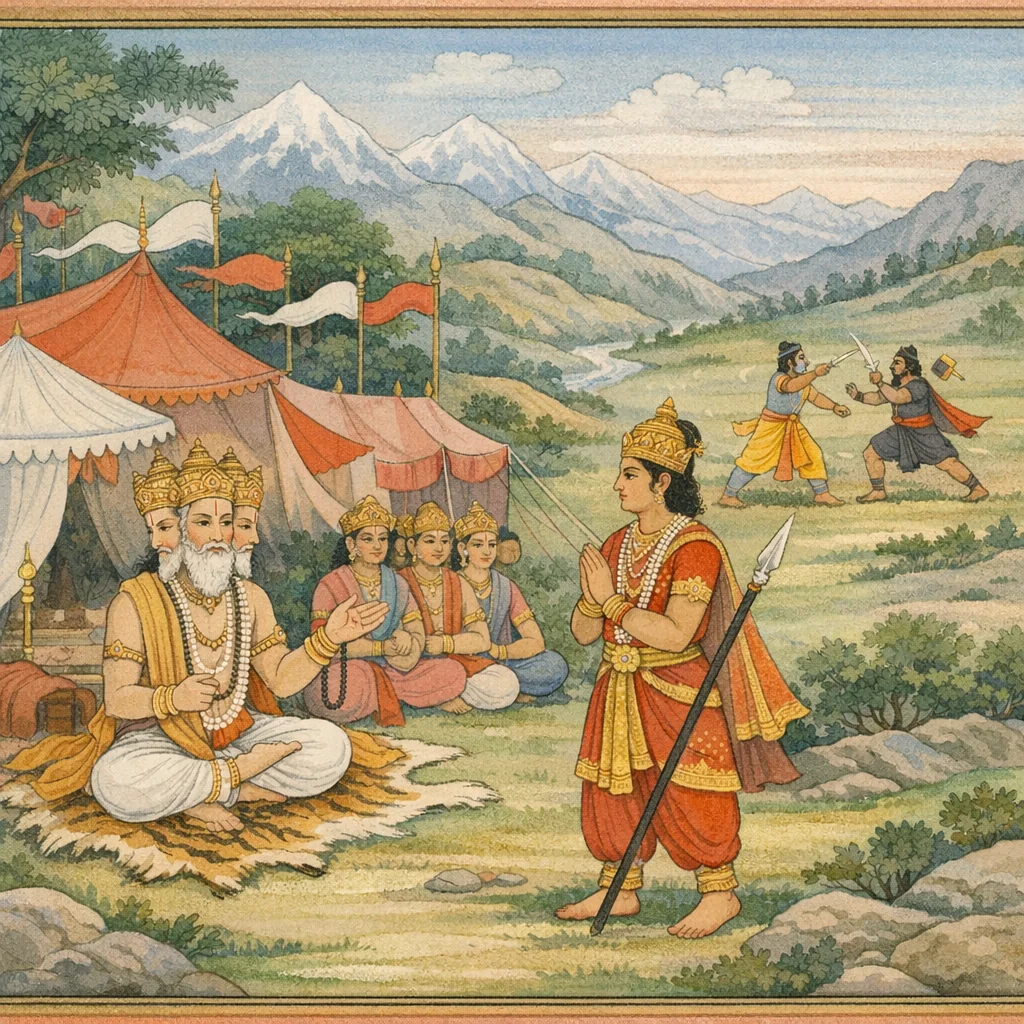
Adhyāya 9 portrays the Devas’ crisis under the asura Tāraka within the strict limits of a boon. Brahmā tells Guha (Pārvatīsuta, Śivāsuta) that Viṣṇu’s struggle with Tāraka is futile, for by Brahmā’s own boon Tāraka cannot be slain by Viṣṇu. Brahmā therefore declares Guha the sole competent slayer, urges immediate preparation, and explains that Guha’s very manifestation has arisen from Śaṅkara for Tāraka’s destruction. He also elevates Guha’s standing: not a mere child or youth, but a lord in function, appointed to protect the afflicted Devas. The chapter stresses the humiliation and defeat of Śakra (Indra) and the lokapālas, and even Viṣṇu’s discomfiture, all due to Tāraka’s tapas-born power. With Guha present, the Devas renew the battle, and Brahmā’s command clarifies the ethical-political aim: slay the “pāpa-puruṣa” Tāraka and restore happiness to the three worlds (trailokya). The colophon names the chapter and places it in the Kumārakhaṇḍa of the Rudrasaṃhitā.
Shlokas
Verse 1
ब्रह्मोवाच । देवदेव गुह स्वामिञ्शांकरे पार्वतीसुत । न शोभते रणो विष्णु तारकासुरयोर्वृथा
Brahmā said: “O Guha, Lord among gods—O master, born of Śaṅkara and son of Pārvatī—this battle between Viṣṇu and Tārakāsura is not becoming; it is futile.”
Verse 2
विष्णुना न हि वध्योऽसौ तारको बलवानति । मया दत्तवरस्तस्मात्सत्यं सत्यं वदाम्यहम्
That mighty Tāraka cannot be slain by Viṣṇu, for he is exceedingly powerful. Since a boon has been granted to him by me, I declare—truly, truly—this is so.
Verse 3
नान्यो हंतास्य पापस्य त्वां विना पार्वतीसुत । तस्मात्त्वया हि कर्तव्यं वचनं मे महाप्रभो
O son of Pārvatī, apart from you there is no other who can destroy this sin. Therefore, O great lord, you must indeed carry out my command.
Verse 4
सन्नद्धो भव दैत्यस्य वधायाशु परंतप । तद्वधार्थं समुत्पन्नः शंकरात्त्वं शिवासुत
O scorcher of foes, arm yourself at once for the slaying of that demon. For the very purpose of destroying him you have manifested—born from Śaṅkara, O son of Śiva.
Verse 5
रक्ष रक्ष महावीर त्रिदशान्व्यथितान्रणे । न बालस्त्वं युवा नैव किं तु सर्वेश्वरः प्रभुः
“Protect, protect (us), O great hero—protect the gods who are afflicted in battle. You are neither a mere child nor only a youth; rather, you are the Lord, the supreme Ruler of all.”
Verse 6
शक्रं पश्य तथा विष्णुं व्याकुलं च सुरान् गणान् । एवं जहि महादैत्यं त्रैलोक्यं सुखिनं कुरु
“Look at Śakra (Indra), and also at Viṣṇu, and at the hosts of devas who have become distressed. Therefore, slay this great demon in this manner and make the three worlds happy.”
Verse 7
अनेन विजितश्चेन्द्रो लोकपालैः पुरा सह । विष्णुश्चापि महावीरो तर्जितस्तपसो बलात्
By the power of this very tapas, Indra was once subdued together with the guardians of the worlds; and even the great hero Viṣṇu was overawed and held in check by the force of that austerity.
Verse 8
त्रैलोक्यं निर्जितं सर्वमसुरेण दुरात्मना । इदानीं तव सान्निध्यात्पुनर्युद्धं कृतं च तैः
“The entire three worlds have been conquered by that wicked-souled asura. But now, by the power of your very presence, they have once again taken up the battle.”
Verse 9
इति श्रीशिवमहापुराणे द्वितीयायां रुद्रसंहितायां चतुर्थे कुमारखंडे तारकवाक्यशक्रविष्णुवी रभद्रयुद्धवर्णनं नाम नवमोऽध्यायः
Thus ends the ninth chapter, entitled “The account of Tāraka’s words, (the roles of) Śakra (Indra) and Viṣṇu, and the description of the battle with Vīrabhadra,” in the fourth section, the Kumāra-khaṇḍa, of the second division (Rudra-saṃhitā) of the Śrī Śiva Mahāpurāṇa.
Verse 10
ब्रह्मोवाच । इति श्रुत्वा मम वचः कुमारः शंकरात्मजः । विजहास प्रसन्नात्मा तथास्त्विति वचोऽब्रवीत्
Brahmā said: Having thus heard my words, Kumāra—the son of Śaṅkara—laughed gently, his heart serene, and replied, “So be it.”
Verse 11
विनिश्चित्यासुरवधं शांकरिस्स महा प्रभुः । विमानादवतीर्याथ पदातिरभवत्तदा
Having firmly resolved upon the destruction of the demon, that great lord—Śaṅkara’s commander—descended from the aerial car; and at that moment he proceeded on foot.
Verse 12
पद्भ्यां तदासौ परिधावमानो रेजेऽतिवीरः शिवजः कुमारः । करे समादाय महाप्रभां तां शक्तिं महोल्कामिव दीप्तिदीप्ताम्
Then that exceedingly valiant Kumāra, the son of Śiva, ran swiftly on foot and shone with splendor, holding in his hand that mighty, radiant spear—blazing like a great meteor, brilliant with brilliance.
Verse 13
दृष्ट्वा तमायातमतिप्रचंडमव्याकुलं षण्मुखमप्रमेयम् । दैत्यो बभाषे सुरसत्तमान्स कुमार एष द्विषतां प्रहंता
Seeing that immeasurable, six-faced Kumāra advancing—most fierce, yet unagitated—the Daitya spoke to the foremost of the gods: “This Kumāra is the destroyer of enemies.”
Verse 14
अनेन साकं ह्यहमेकवीरो योत्स्ये च सर्वानहमेव वीरान् । गणांश्च सर्वानपि घातयामि सलोकपालान्हरिनायकांश्च
Along with him, I—alone as a single champion—will fight all those heroes. I shall also strike down all the gaṇas, and even the guardians of the worlds together with the leaders of Hari’s hosts.
Verse 15
इत्येवमुक्त्वा स तदा महाबलः कुमारमुद्दिश्य ययौ च योद्धुम् । जग्राह शक्तिं परमाद्भुतां च स तारको देववरान्बभाषे
Having spoken thus, the mighty Tāraka, fixing his aim upon Kumāra (Skanda), advanced to fight. He seized a supremely wondrous spear (śakti), and then addressed the foremost of the gods.
Verse 16
तत्र विष्णुश्छली दोषी ह्यविवेकी विशे षतः । बलिर्येन पुरा बद्धश्छलमाश्रित्य पापतः
In that matter, Viṣṇu is indeed the deceitful one—blameworthy and especially lacking discernment—for it was by resorting to a trick, and thus sinfully, that he formerly bound King Bali.
Verse 17
पुरैताभ्यां कृतं कर्म विरुद्धं वेदमार्गतः । तच्छृणुध्वं मया प्रोक्तं वर्णयामि विशेषतः
Formerly, the deed performed by those two was contrary to the path of the Vedas. Listen as I speak—now I shall describe it to you in particular detail.
Verse 19
तेनैव यत्नतः पूर्वमसुरौ मधुकैटभौ । शिरौहीनौ कृतौ धौर्त्याद्वेदमार्गो विवर्जितः
By that very one, earlier—through careful effort—the two asuras Madhu and Kaiṭabha were made headless. Yet, due to deceitful wrongdoing, the Vedic path was cast aside and violated.
Verse 20
मोहिनीरूपतोऽनेन पंक्तिभेदः कृतो हि वै । देवासुरसुधापाने वेदमार्गो विगर्हितः
Assuming the form of Mohinī, he indeed created a division of rows, separating the parties; and in the drinking of the nectar by the gods and the asuras, the Vedic path of propriety was censured and set aside.
Verse 21
रामो भूत्वा हता नारी वाली विध्वंसितो हि सः । पुनर्वैश्रवणो विप्रौ हतो नीतिर्हता श्रुतेः
Assuming the role of Rāma, a woman was slain, and Vālī indeed was brought to ruin. Again, as Vaiśravaṇa (Kubera), O brāhmaṇas, the very order of righteous conduct was struck down, and the authority of the sacred revelation (śruti) was, as it were, wounded.
Verse 22
पापं विना स्वकीया स्त्री त्यक्ता पापरतेन यत् । तत्रापि श्रुतिमार्गश्च ध्वंसितस्स्वार्थहेतवे
When a man devoted to sin abandons his own wife though she is without fault, then—driven by selfish motives—he also destroys the very Vedic path of righteous conduct.
Verse 23
स्वजनन्याश्शिरश्छिन्नमवतारे रसाख्यके । गुरुपुत्रापमानश्च कृतोऽनेन दुरात्मना
In the incarnation known as Rasa, this wicked-souled one severed the head of his own mother; and he also committed the disgrace of the Guru’s son.
Verse 24
कृष्णो भूत्वान्यनार्यश्च दूषिताः कुलधर्मतः । श्रुतिमार्गं परित्यज्य स्वविवाहाः कृतास्तथा
Having become ‘Kṛṣṇa’ and acting in ways unbecoming of the noble, they became tainted with respect to the duties of their lineage. Abandoning the Vedic path of śruti, they likewise contracted marriages by their own choice.
Verse 25
पुनश्च वेदमार्गो हि निंदितो नवमे भवे । स्थापितं नास्तिकमतं वेदमार्गविरोधकृत्
Again, in the ninth incarnation, the Vedic path was indeed censured, and a non‑theistic doctrine was established—one that acted in opposition to the way of the Vedas.
Verse 26
एवं येन कृतं पापं वेदमार्गं विसृज्य वै । स कथं विजयेद्युद्धे भवेद्धर्मवतांवरः
Thus, one who has committed sin by abandoning the Vedic path—how could he ever be victorious in battle, or become the foremost among the righteous?
Verse 27
भ्राता ज्येष्ठश्च यस्तस्य शक्रः पापी महान्मतः । तेन पापान्यनेकानि कृतानि निजहेतुतः
His elder brother—Śakra (Indra)—is regarded as greatly sinful; for, driven by his own self-interest, he committed many misdeeds.
Verse 28
निकृत्तो हि दितेर्गर्भस्स्वार्थ हेतोर्विशेषतः । धर्षिता गौतमस्त्री वै हतो वृत्रश्च विप्रजः
Indeed, Diti’s embryo was cut down—done especially for one’s own advantage. Gautama’s wife was violated, and Vṛtra too, born of a brāhmaṇa, was slain.
Verse 29
विश्वरूपद्विजातेर्वै भागिनेयस्य यद्गुरोः । निकृत्तानि च शीर्षाणि तदध्वाध्वंसितश्श्रुतेः
Indeed, the heads that were cut off belonged to the preceptor of Viśvarūpa, the twice-born—who was also the maternal uncle’s son (bhāgineya). Thus is heard the account, preserved in the sacred tradition, of how his course was brought to ruin.
Verse 30
कृत्वा बहूनि पापानि हरिश्शक्रः पुनःपुनः । तेजोभिर्विहतावेव नष्टवीर्यौ विशेषतः
Having repeatedly committed many sinful acts, Hari and Śakra were struck down, as it were, by the overpowering divine radiance; in particular, they were left bereft of their strength and prowess.
Verse 31
तयोर्बलेन नो यूयं संग्रामे जयमाप्स्यथ । किमर्थं मूढतां प्राप्य प्राणांस्त्यक्तुमिहागताः
By the strength of those two, you will not attain victory in battle. Why, having fallen into delusion, have you come here intending to throw away your lives?
Verse 32
जानन्तौ धर्ममेतौ न स्वार्थलंपटमानसौ । धर्मं विनाऽमराः कृत्यं निष्फलं सकलं भवेत्
Knowing dharma well, these two were not driven by minds greedy for selfish gain. For, O immortals, without dharma every undertaking—whatever it may be—becomes wholly fruitless.
Verse 33
महाधृष्टाविमौ मेद्य कृतवंतौ पुरश्शिशुम् । अहं बालं वधिष्यामि तयोस्सोऽपि भविष्यति
“These two are exceedingly insolent; they have defiled the child here in front. I shall kill the boy, and for those two, the same fate will also come to pass.”
Verse 34
किं बाल इतो यायाद्दूरं प्राणपरीप्सया । इत्युक्तोद्दिश्य च हरी वीरभद्रमुवाच सः
“Why, child, would you go far away from here, seeking to preserve your life?” Having spoken thus, Hari then addressed Vīrabhadra.
Verse 36
ब्रह्मोवाच । इत्येवमुक्त्वा तु विधूय पुण्यं निजं स तन्निंदनकर्मणा वै । जग्राह शक्तिं परमाद्भुतां च स तारको युद्धवतां वरिष्ठः
Brahmā said: Having spoken thus, Tāraka—foremost among warriors—through that act of blasphemy shook off his own accumulated merit; and then he seized a supremely wondrous spear-weapon (śakti) for battle.
Verse 37
तं बालान्तिकमायातं तारकासुरमोजसा । आजघान च वज्रेण शक्रो गुहपुरस्सरः
Then Śakra (Indra), advancing in front of Guha (Kumāra), struck with his thunderbolt that Tārakāsura who—swollen with might—had come close to the boy.
Verse 38
तेन वज्रप्रहारेण तारको जर्जरीकृतः । भूमौ पपात सहसा निंदाहतबलः क्षणम्
Struck by that vajra-like blow, Tāraka was shattered and broken. In an instant, his strength ruined by the weight of blame and disgrace, he suddenly fell to the ground.
Verse 39
पतितोऽपि समुत्थाय शक्त्या तं प्राहरद्रुषा । पुरंदरं गजस्थं हि पातयामास भूतले
Though he had fallen, he rose up again with strength and, in wrath, struck him with a spear; indeed, he caused Purandara (Indra), seated upon his elephant, to fall down upon the earth.
Verse 40
हाहाकारो महानासीत्पतिते च पुरंदरे । सेनायां निर्जराणां हि तद्दृष्ट्वा क्लेश आविशत्
When Purandara (Indra) fell, a great cry of lamentation arose. Seeing that, anguish and distress entered the army of the deathless gods.
Verse 41
तारकेणाऽपि तत्रैव यत्कृतं कर्म दुःखदम् । स्वनाशकारणं धर्मविरुदं तन्निबोध मे
Understand from me that the deed which Tāraka performed there itself—pain-giving, opposed to dharma, and becoming the very cause of his own ruin—was indeed so.
Verse 42
पतितं च पदाक्रम्य हस्ताद्वज्रं प्रगृह्य वै । पुनरुद्वज्रघातेन शक्रमाताडयद्भृशम्
Trampling upon the fallen one, he seized the thunderbolt (vajra) from (Indra’s) hand; then, striking again with that very thunderbolt, he violently battered Śakra (Indra).
Verse 43
एवं तिरस्कृतं दृष्ट्वा शक्रविष्णुप्रतापवान् । चक्रमुद्यस्य भगवांस्तारकं स जघान ह
Seeing him thus insulted, the Blessed Lord—mighty with the splendor of Indra and Viṣṇu—raised his discus and struck down Tāraka.
Verse 44
चक्रप्रहाराभितो निपपात क्षितौ हि सः । पुनरुत्थाय दैत्येन्द्रशक्त्या विष्णुं जघान तम्
Struck all around by the blows of the discus, he indeed fell upon the earth. Rising again, he then struck that Viṣṇu with the spear-weapon of the lord of the Daityas.
Verse 45
तेन शक्तिप्रहारेण पतितो भुवि चाच्युतः । करो महानासीच्चुक्रुशुश्चाऽतिनिर्जराः
Struck by that spear-blow, Acyuta fell upon the earth. A great uproar arose, and the exalted immortals cried out in distress.
Verse 46
निमेषेण पुनर्विष्णुर्यावदुत्तिष्ठते स्वयम् । तावत्स वीरभद्रो हि तत्क्षणादागतोऽसुरम्
Before even the blink of an eye had passed and Viṣṇu could rise up of his own accord, Vīrabhadra arrived at that very instant and closed upon the asura.
Verse 47
त्रिशूलं च समुद्यम्य वीरभद्रः प्रतापवान् । तारकं दितिजाधीशं जघान प्रसभं बली
Then the mighty and radiant Vīrabhadra, raising the trident, struck down Tāraka—the overlord of the Dānavas—forcefully, with irresistible strength.
Verse 48
तत्त्रिशूलप्रहारेण स पपात क्षितौ तदा । पतितोऽपि महातेजास्तारकः पुनरुत्थितः
Struck by that thrust of the trident, he fell upon the earth. Yet, though fallen, Tāraka—of great fiery prowess—rose up again.
Verse 49
कृत्वा क्रोधं महावीरस्सकलासुरनायकः । जघान परया शक्त्या वीरभद्रं तदोरसि
Then, inflamed with wrath, that mighty hero—the commander of all the Asuras—struck Vīrabhadra upon the chest with his supreme power.
Verse 50
वीरभद्रोऽपि पतितो भूतले मूर्छितः क्षणम् । तच्छक्त्या परया क्रोधान्निहतो वक्षसि धुवम्
Vīrabhadra too fell upon the ground and for a moment lay unconscious. Struck on the chest by that supreme power in wrath, he was surely felled.
Verse 51
सगणश्चैव देवास्ते गंधर्वोरगराक्षसाः । हाहाकारेण महता चुक्रुशुश्च मुहुर्मुहुः
Then those devas, with their attendant hosts—together with the gandharvas, nāgas, and rākṣasas—again and again cried out loudly in a great wail of “hā hā,” overwhelmed by the intensity of what was unfolding.
Verse 52
निमेषमात्रात्सहसा महौजास्स वीरभद्रो द्विषतां निहंता । त्रिशूलमुद्यम्य तडित्प्रकाशं जाज्वल्यमानं प्रभया विरेजे
In but a single blink, the mighty and radiant Vīrabhadra—slayer of the hostile—suddenly rose; and, lifting his trident blazing with lightning-like brilliance, he shone forth, aflame with overpowering splendor.
Verse 53
स्वरोचिषा भासितदिग्वितानं सूर्येन्दुबिम्बाग्निसमानमंडलम् । महाप्रभं वीरभयावहं परं कालाख्यमत्यंतकरं महोज्ज्वलम्
By its own radiance it illumined the whole expanse of the directions; its orb was like the sun, the moon, and fire. Supremely resplendent and transcendent, it inspired dread even in the mighty; it was called Kāla (Time/Death), utterly destructive and intensely brilliant.
Verse 54
यावत्त्रिशूलेन तदा हंतुकामो महाबलः । वीरभद्रोऽसुरं यावत्कुमारेण निवारितः
Just as the mighty Vīrabhadra, desiring to slay the asura with his trident, was about to strike, Kumāra intervened and restrained him.
Frequently Asked Questions
Brahmā’s formal commissioning of Guha/Skanda to slay Tārakāsura, explaining that Viṣṇu cannot kill him because Tāraka is protected by Brahmā’s boon.
It models Purāṇic causality where tapas-generated boons create binding constraints; cosmic resolution must occur through the precise agent permitted by the boon, highlighting ṛta/dharma over brute force.
Guha is presented as Śiva’s purpose-born agent for Tāraka’s destruction, simultaneously a protector of the Devas and a functional sovereign (sarveśvara-prabhu) rather than merely a youthful deity.