रामेश्वरलिङ्गप्रादुर्भावः (The Manifestation/Origin of the Rāmeśvara Liṅga)
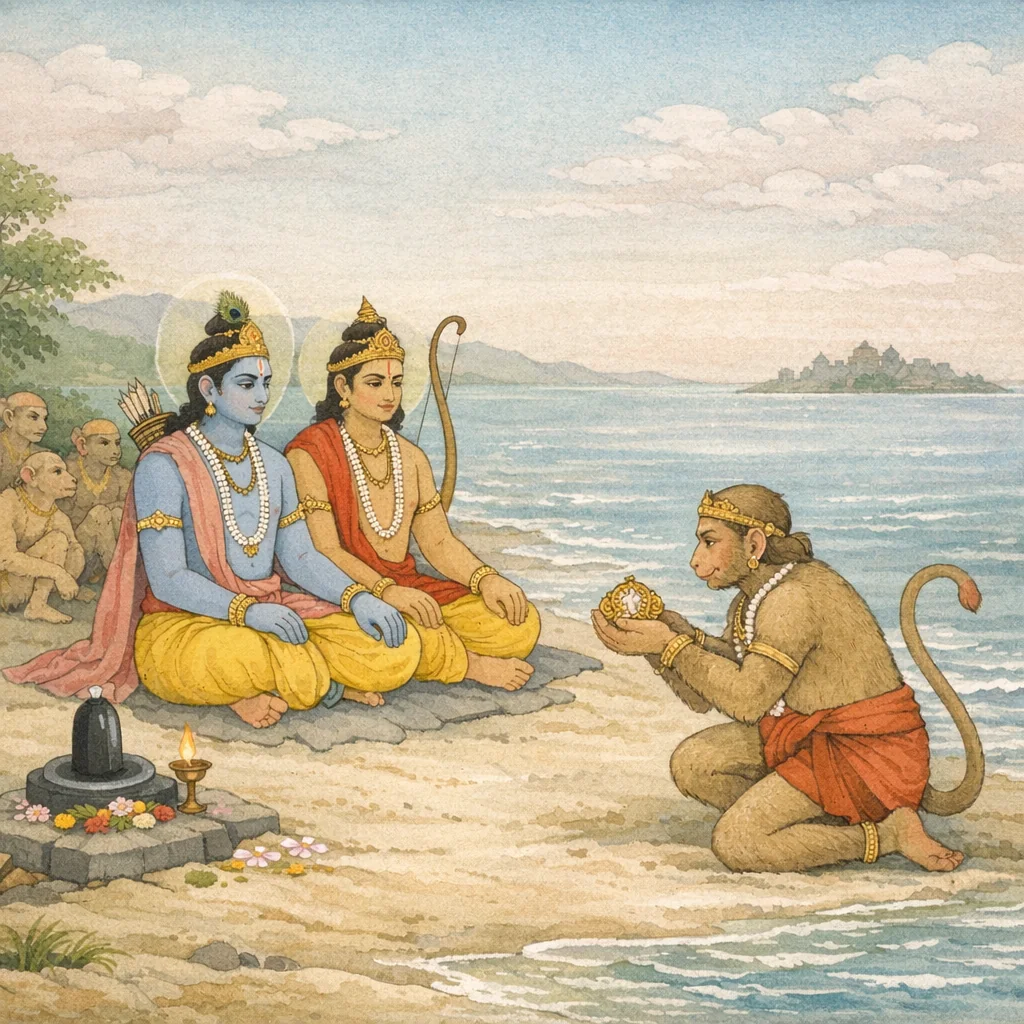
This adhyāya, spoken by Sūta to the assembled ṛṣis, introduces the liṅga called Rāmeśvara and promises to narrate its manifestation and origin (prādurbhāva). It frames the topic within the Rāmāyaṇa: Viṣṇu’s descent as Rāma, Sītā’s abduction by Rāvaṇa, the Kiṣkindhā episode (alliance with Sugrīva and the slaying of Vālin), the dispatch of the vānaras to scout, Hanumān’s success and the return of Sītā’s cūḍāmaṇi, and Rāma’s arrival at the southern seashore. The chapter functions as a sacred-site etiology, turning the epic sequence into a Śaiva tīrtha charter and preparing the claim that Rāma—though an avatāra of Viṣṇu—honors Śiva by establishing a liṅga, exemplifying proper ritual conduct. Esoterically, the liminal shore before Laṅkā becomes a place of consecration: before decisive action, the devotee-king grounds his agency in Śiva’s grace, making the liṅga both ritual center and metaphysical axis for victory and the restoration of dharma.
Shlokas
Verse 1
सूत उवाच । अतः परं प्रवक्ष्यामि लिंगं रामेश्वराभिधम् । उत्पन्नं च यथा पूर्वमृषयश्शृणुतादरात्
Sūta said: “Next, I shall expound the Liṅga known as Rāmeśvara, and how it first manifested in ancient times. O sages, listen to it with reverent attention.”
Verse 2
पुरा विष्णुः पृथिव्यां चावततार सतां प्रियः
In ancient times, Viṣṇu—beloved of the virtuous—descended upon the earth.
Verse 3
तत्र सीता हृता विप्रा रावणेनोरुमायिना । प्रापिता स्वगृहं सा हि लंकायां जनकात्मजा
There, O brahmins, Sītā—the daughter of Janaka—was abducted by Rāvaṇa, the wielder of vast illusion, and she was indeed taken to his own residence in Laṅkā.
Verse 4
अन्वेषणपरस्तस्याः किष्किन्धाख्यां पुरीमगात् । सुग्रीवहितकृद्भूत्वा वालिनं संजघान ह
Intent on searching for her, he went to the city called Kiṣkindhā; and, becoming the benefactor of Sugrīva, he indeed struck down Vālin. In Shaiva understanding, this reflects how Dharma—upheld through the Lord Śiva’s will—removes obstructive power so the seeker’s righteous aim may proceed.
Verse 5
तत्र स्थित्वा कियत्कालं तदन्वेषणतत्परः । सुग्रीवाद्यैर्लक्ष्मणेन विचारं कृतवान्स वै
Staying there for some time, fully intent on that search, he indeed held counsel and deliberated together with Lakṣmaṇa and with Sugrīva and the others.
Verse 6
कपीन्संप्रेषयामास चतुर्दिक्षु नृपात्मजः । हनुमत्प्रमुखान्रामस्तदन्वेषणहेतवे
Rāma, the prince (son of the king), dispatched the monkeys in the four directions—sending forth Hanumān and the others as leaders—for the purpose of searching for her.
Verse 7
अथ ज्ञात्वा गतां लंकां सीतां कपिवराननात् । सीताचूडामणिं प्राप्य मुमुदे सोऽति राघवः
Then, learning from the foremost of monkeys that Sītā had gone to Laṅkā, and receiving Sītā’s crest-jewel (cūḍāmaṇi), Rāghava (Rāma) rejoiced exceedingly.
Verse 8
सकपीशस्तदा रामो लक्ष्मणेन युतो द्विजाः । सुग्रीवप्रमुखैः पुण्यैर्वानरैर्बलवत्तरैः
O twice-born sages, at that time Rāma—accompanied by Lakṣmaṇa and allied with the lord of monkeys—was surrounded by the most powerful and virtuous vānaras, led chiefly by Sugrīva.
Verse 9
पद्मैरष्टादशाख्यैश्च ययौ तीरं पयोनिधेः । दक्षिणे सागरे यो वै दृश्यते लवणाकरः
With the aerial lotus-seats known as the eighteen, he went to the shore of the Ocean—the salt-bearing sea that is indeed seen in the southern direction.
Verse 10
तत्रागत्य स्वयं रामो वेलायां संस्थितो हि सः । वानरैस्सेव्यमानस्तु लक्ष्मणेन शिवप्रियः
Having arrived there, Rama himself stood upon the seashore. Attended by the monkeys and accompanied by Lakshmana, that beloved devotee of Shiva, he remained there.
Verse 11
हा जानकि कुतो याता कदा चेयं मिलिष्यति । अगाधस्सागरश्चैवातार्या सेना च वानरी
“Alas, O Jānakī—where have you gone? When shall I meet her again? The ocean is unfathomable, and this army of vānaras cannot cross.”
Verse 12
राक्षसो गिरिधर्त्ता च महाबलपराक्रमः । लंकाख्यो दुर्गमो दुर्ग इंद्रजित्तनयोस्य वै
He was a Rākṣasa, famed as ‘Giridhartā’ (the mountain-bearer), possessed of immense strength and valor. He was known as Laṅkā—hard to approach, a formidable fortress—and indeed he was the son of Indrajit.
Verse 13
इत्येवं स विचार्यैव तटे स्थित्वा सलक्ष्मणः । आश्वासितो वनौकोभिरंगदादिपुरस्सरैः
Thus, having reflected, he stood upon the riverbank together with Lakṣmaṇa; and the forest-dwellers, led by Aṅgada and the others, consoled him.
Verse 14
एतस्मिन्नंतरे तत्र राघवश्शैवसत्तमः । उवाच भ्रातरं प्रीत्या जलार्थी लक्ष्मणाभिधम्
Just then, there, Rāghava—foremost among the devotees of Śiva—affectionately spoke to his brother Lakṣmaṇa, who had gone in search of water.
Verse 15
राम उवाच । भ्रातर्लक्ष्मण वीरेशाहं जलार्थी पिपासितः । तदानय द्रुतं पाथो वानरैः कैश्चिदेव हि
Rāma said: “Brother Lakṣmaṇa, O lord among heroes, I need water and am parched with thirst. Therefore bring water quickly—indeed, have some of the vānaras fetch it.”
Verse 16
सूत उवाच । तच्छ्रुत्वा वानरास्तत्र ह्यधावंत दिशो दश । नीत्वा जलं च ते प्रोचुः प्रणिपत्य पुरः स्थिताः
Sūta said: Hearing that, the monkeys there immediately ran in the ten directions. Bringing water, they reported it, bowing down and standing before him.
Verse 17
वानरा ऊचुः । जलं च गृह्यतां स्वामिन्नानीतं तत्त्वदाज्ञया । महोत्तमं च सुस्वादु शीतलं प्राणतर्पणम्
The monkeys said: “O master, please accept this water, brought according to the true command. It is of the finest quality—pleasant in taste, cool, and refreshing to one’s very life-breath.”
Verse 18
सूत उवाच । सुप्रसन्नतरो भूत्वा कृपादृष्ट्या विलोक्य तान् । तच्छ्रुत्वा रामचन्द्रोऽसौ स्वयं जग्राह तज्जलम्
Sūta said: Greatly pleased, and gazing upon them with compassionate eyes, Rāmacandra—having heard those words—personally accepted that water.
Verse 19
स शैवस्तज्जलं नीत्वा पातुमारब्धवान्यदा । तदा च स्मरणं जातमित्थमस्य शिवेच्छया
When that devotee of Śiva took the water and began to drink it, at that very moment remembrance awakened within him—thus it happened by Śiva’s own will.
Verse 20
न कृतं दर्शनं शंभोर्गृह्यते च जलं कथम् । स्वस्वामिनः परेशस्य सर्वानंदप्रदस्य वै
If Śambhu’s darśana has not been obtained, how can the water of worship be accepted? For He is one’s own true Lord—Parameśvara, the Supreme Master—who indeed bestows all bliss.
Verse 21
इत्युक्त्वा च जलं पीतं तदा रघुवरेण च । पश्चाच्च पार्थिवीं पूजां चकार रघुनंदनः
Having spoken thus, the best of the Raghu line then drank the water; thereafter, Raghu’s delight performed the earthen (pārthiva) worship—fashioning and honoring the Śiva-liṅga—thereby expressing devoted service to Lord Śiva in a tangible, saguṇa form.
Verse 22
आवाहनादिकांश्चैव ह्युपचारान्प्रकल्प्य वै । विधिवत्षोडश प्रीत्या देवमानर्च शङ्करम्
Having duly arranged the ritual services beginning with invocation (āvāhana) and the other offerings, he worshipped Lord Śaṅkara with devotion, according to rule, by performing the sixteenfold upacāras.
Verse 23
प्रणिपातैस्स्तवैर्दिव्यैश्शिवं संतोष्य यत्नतः । प्रार्थयामास सद्भक्त्या स रामश्शंकरं मुदा
Having earnestly pleased Lord Śiva through prostrations and divine hymns, Rāma—filled with pure devotion—joyfully prayed to Śaṅkara.
Verse 24
राम उवाच । स्वामिञ्छंभो महादेव सर्वदा भक्तवत्सल । पाहि मां शरणापन्नं त्वद्भक्तं दीनमानसम्
Rāma said: “O Lord Śambhu, O Mahādeva, ever affectionate to Your devotees, protect me. I have taken refuge in You; I am Your devotee, with a humble and distressed heart.”
Verse 25
एतज्जलमगाधं च वारिधेर्भवतारण । रावणाख्यो महावीरो राक्षसो बलवत्तरः
“This expanse of water is unfathomably deep; how will you cross this ocean? There is a mighty and heroic Rākṣasa named Rāvaṇa, exceedingly powerful.”
Verse 26
वानराणां बलं ह्येतच्चंचलं युद्धसाधनम् । ममकार्यं कथं सिद्धं भविष्यति प्रियाप्तये
“This strength of the monkeys is indeed fickle—an unstable means for war. How, then, will my undertaking be accomplished, so that I may attain my beloved?”
Verse 27
तस्मिन्देव त्वया कार्यं साहाय्यं मम सुव्रत । साहाय्यं ते विना नाथ मम कार्य्यं हि दुर्लभम्
“Therefore, O God—O noble and steadfast one—please render me your assistance. Without your help, O Lord, my task is indeed difficult to accomplish.”
Verse 28
त्वदीयो रावणोऽपीह दुर्ज्जयस्सर्वथाखिलैः । त्वद्दत्तवरदृप्तश्च महावीरस्त्रिलोकजित्
“Even your own Rāvaṇa here is utterly unconquerable by anyone in every way. Proud of the boon granted by you, he is a mighty hero, a conqueror of the three worlds.”
Verse 29
अप्यहं तव दासोऽस्मि त्वदधीनश्च सर्वथा । विचार्येति त्वया कार्यः पक्षपातस्सदाशिव
Indeed, I am Your servant and in every way dependent upon You. Therefore, O Sadāśiva, after due reflection, You alone should extend Your gracious favor.
Verse 30
सूत उवाच । इत्येवं स च संप्रार्थ्य नमस्कृत्य पुनःपुनः । तदा जयजयेत्युच्चैरुद्धोषैश्शंकरेति च
Sūta said: Thus, having offered his earnest supplication and bowing again and again, he then raised loud acclamations, crying, “Victory! Victory!” and also calling out, “O Śaṅkara!”
Verse 31
इति स्तुत्वा शिवं तत्र मंत्रध्यानपरायणः । पुनः पूजां ततः कृत्वा स्वाम्यग्रे स ननर्त ह
Thus, having praised Śiva there, wholly devoted to mantra and meditation, he again performed worship; and then, before his Lord, he danced.
Verse 32
प्रेमी विक्लिन्नहृदयो गल्लनादं यदाकरोत् । तदा च शंकरो देवस्सुप्रसन्नो बभूव ह
When the devotee—his heart melted in love—uttered a choked, trembling cry, then Lord Śaṅkara, the Deva, became exceedingly pleased.
Verse 33
सांगस्सपरिवारश्च ज्योतीरूपो महेश्वरः । यथोक्तरूपममलं कृत्वाविरभवद्द्रुतम्
Then Mahādeva, the Great Lord—manifest as pure Light and accompanied by His own limbs (powers) and retinue—assumed the spotless form just as described, and swiftly revealed Himself.
Verse 34
ततस्संतुष्टहृदयो रामभक्त्या महेश्वरः । शिवमस्तु वरं ब्रूहि रामेति स तदाब्रवीत्
Then Mahādeva, his heart fully pleased by Rāma’s devotion, spoke at that moment: “Let there be auspiciousness. Ask for a boon—and remain devoted to ‘Rāma’.”
Verse 35
तद्रूपं च तदा दृष्ट्वा सर्वे पूतास्ततस्स्वयम् । कृतवान्राघवः पूजां शिवधर्मपरायणः
Seeing that divine form at that very moment, all of them became purified of themselves. Then Rāghava—devoted to the dharma of Śiva—performed worship (pūjā) to Lord Śiva.
Verse 36
स्तुतिं च विविधां कृत्वा प्रणिपत्य शिवं मुदा । जयं च प्रार्थयामास रावणाजौ तदात्मनः
Having offered many kinds of hymns, and bowing down to Lord Śiva with joy, he then prayed for victory for his own self in the battle with Rāvaṇa.
Verse 37
ततः प्रसन्नहृदयो रामभक्त्या महेश्वरः । जयोस्तु ते महाराज प्रीत्या स पुनरब्रवीत्
Then Maheśvara, his heart gladdened by Rāma’s devotion, was filled with tender affection. Rejoicing, he spoke again: “Victory be to you, O great king!”
Verse 38
शिवदत्तं जयं प्राप्य ह्यनुज्ञां समवाप्य च । पुनश्च प्रार्थयामास सांजलिर्नतमस्तकः
Having obtained the victory bestowed by Śiva, and also receiving His gracious permission, he once again made a supplication—standing with folded hands and head bowed in reverence.
Verse 39
राम उवाच । त्वया स्थेयमिह स्वामिंल्लोकानां पावनाय च । परेषामुपकारार्थं यदि तुष्टोऽसि शंकर
Rama said: O Lord, if you are pleased, then remain here—for the purification of the worlds and for the welfare of others, O Śaṅkara.
Verse 40
सूत उवाच । इत्युक्तस्तु शिवस्तत्र लिंगरूपोऽभवत्तदा । रामेश्वरश्च नाम्ना वै प्रसिद्धो जगतीतले
Sūta said: Thus addressed, Śiva thereupon manifested in the form of the Liṅga at that very place. And by the name “Rāmeśvara” he indeed became renowned upon the surface of the world.
Verse 41
रामस्तु तत्प्रभावाद्वै सिन्धुमुत्तीर्य चांजसा । रावणादीन्निहत्याशु राक्षसान्प्राप तां प्रियाम्
By the power of that holy Śaiva influence, Rāma swiftly crossed the ocean with ease; then, after quickly slaying Rāvaṇa and the other rākṣasas, he regained his beloved (Sītā).
Verse 42
रामेश्वरस्य महिमाद्भुतोऽभूद्भुवि चातुलः । भुक्तिमुक्तिप्रदश्चैव सर्वदा भक्तकामदः
On earth, the wondrous and incomparable greatness of Rāmeśvara became manifest. It bestows both worldly enjoyment and liberation, and it ever fulfills the cherished desires of devotees.
Verse 43
दिव्यगंगाजलेनैव स्नापयिष्यति यश्शिवम् । रामेश्वरं च सद्भक्त्या स जीवन्मुक्त एव हि
Whoever, with true devotion, bathes Śiva—Rāmeśvara—with the divine waters of the Gaṅgā, that person is indeed liberated while still living (jīvanmukta).
Verse 44
इह भुक्त्वाखिलान्भोगान्देवानां दुर्लभानपि । अंते प्राप्य परं ज्ञानं कैवल्यं प्राप्नुयाद्ध्रुवम्
Having enjoyed here all pleasures—even those rare to attain even among the gods—one ultimately gains the supreme knowledge, and then surely attains kaivalya (liberating aloneness), the final moksha, through realizing Śiva as the Supreme Lord (Pati).
Verse 45
इति वश्च समाख्यातं ज्योतिर्लिगं शिवस्य तु । रामेश्वराभिधं दिव्यं शृण्वतां पापहारकम्
Thus has this Jyotirliṅga of Śiva been declared to you—the divine one known as Rāmeśvara; merely hearing of it removes the sins of the listener.
Frequently Asked Questions
It stages an etiological prelude to the Rāmeśvara Liṅga: Rāma’s Rāmāyaṇa journey is retold up to the southern seashore, positioning the forthcoming liṅga-establishment as the theological claim that righteous action culminates in Śiva-worship and depends upon Śiva’s sanction.
The liṅga functions as an axis of stabilization at a liminal threshold (the oceanic boundary before Laṅkā): it encodes the doctrine that agency (karma) is purified and empowered when anchored in Śiva-tattva, transforming a geographic edge into a metaphysical center through consecration.
Śiva is highlighted primarily through the toponymic/iconic manifestation ‘Rāmeśvara’—Śiva as present in the liṅga associated with Rāma’s worship—rather than through an anthropomorphic form; Gaurī is not foregrounded in the sampled passage.