Sarga 39
अभिज्ञानमणि-प्रदानम् — The Signet Jewel as Proof and the Consolation of Sita
सुन्दरकाण्ड
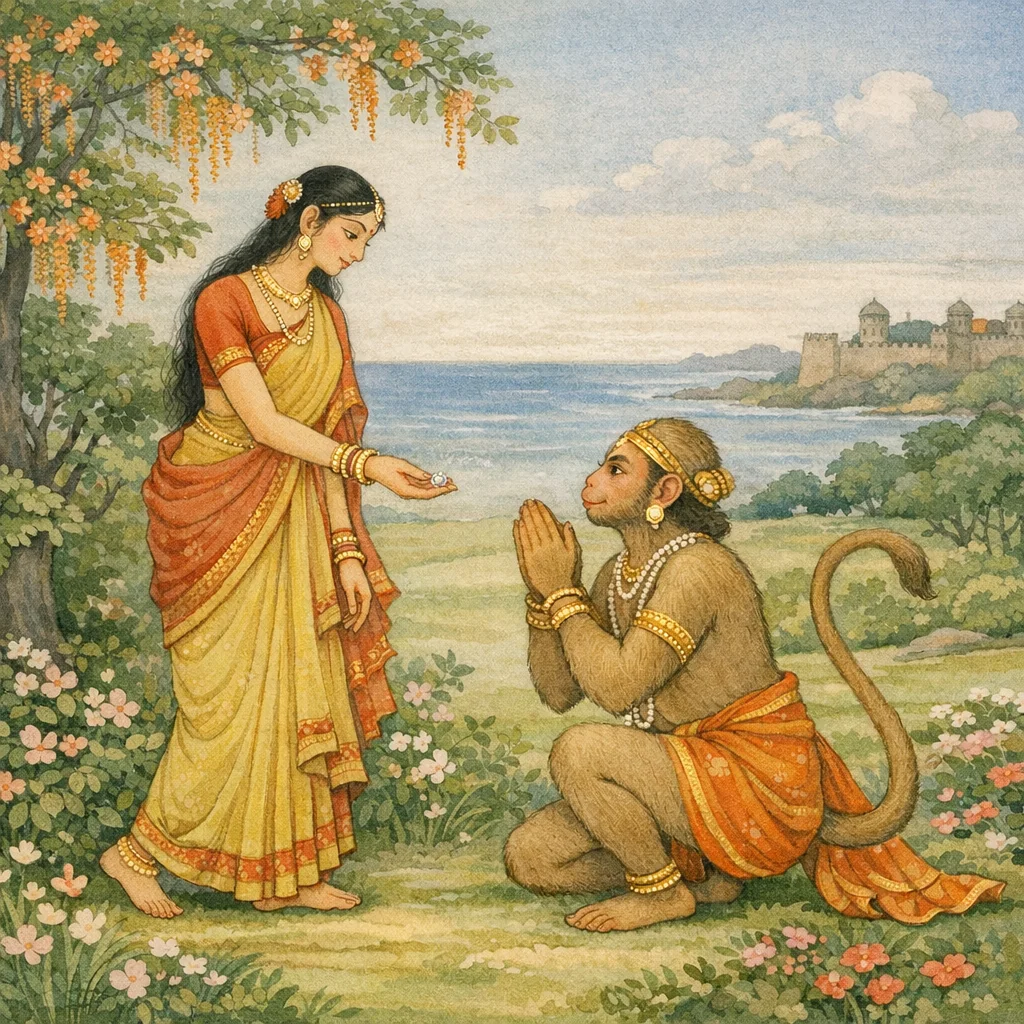
Sarga 39 solemnly completes the diplomatic exchange between Sita and Hanuman through an abhijñāna (recognition-token): Sita entrusts Hanuman with a jewel/signet ornament known intimately to Rama, so that the message will reach him with unquestionable certainty. She instructs Hanuman to report her welfare and to urge Rama to rescue her alive, affirming that speech (vācaḥ), when directed to righteous ends, becomes dharma-producing. Hanuman replies in deep reverence (añjali raised to the head) and offers firm assurances: Rama’s martial power is without equal; Sugriva’s vast host of vānaras and bears will soon arrive; and the ocean-crossing is achievable through extraordinary allies. Though consoled, Sita voices practical doubts—especially the sea’s difficulty—and asks Hanuman to remain a little longer, for his departure sharpens her sorrow. Hanuman answers with strategic reassurance about the army’s prowess and exhorts Sita to abandon despair, foretelling Rama and Lakshmana’s near approach, Lanka’s destruction, Ravana’s defeat, and their reunion. Thus the chapter weaves together proof (pramāṇa), instruction (upadeśa), and the strengthening of morale as essential to righteous rescue and dharmic war.
Shlokas
Verse 1
मणिं दत्त्वा ततः सीता हनूमन्तमथाब्रवीत्।अभिज्ञानमभिज्ञातमेतद्रामस्य तत्त्वतः।।।।
Having given the jewel, Sītā said to Hanumān: “This is the true token of recognition, known in truth to Rāma.”
Verse 2
मणिं तु दृष्ट्वा रामो वै त्रयाणां संस्मरिष्यति।वीरो जनन्या मम च राज्ञो दशरथस्य च।।।।
But when the hero Rāma sees this jewel, he will surely remember the three of us—my mother, me, and King Daśaratha.
Verse 3
स भूयस्त्वं समुत्साहे चोदितो हरिसत्तम।अस्मिन्कार्यसमारम्भे प्रचिन्तय यदुत्तरम्।।।।
O best of the monkeys, once again stirred by zeal, at the very outset of this undertaking reflect carefully on what should be done next.
Verse 4
त्वमस्मिन्कार्यनिर्योगे प्रमाणं हरिसत्तम।हनुमन्यत्नमास्थाय दुःखक्षयकरो भव।।।।तस्य चिन्तयतो यत्नो दुःखक्षयकरो भवेत्।
O best among monkeys, in the execution of this mission you are the decisive authority. O Hanumān, take up the effort with resolve and become the remover of my sorrow; for the one who reflects and strives, that very effort becomes the means of ending grief.
Verse 5
स तथेति प्रतिज्ञाय मारुतिर्भीमविक्रमः।।।।शिरसा वन्ध्य वैदेहीं गमनायोपचक्रमे।
Maruti, fierce in valor, pledged, “So be it.” Bowing his head in reverence to Vaidehī, he then set about preparing to depart.
Verse 6
ज्ञात्वा सम्प्रस्थितं देवी वानरं मारुतात्मजम्।।।।बाष्पगद्गदया वाचा मैथिली वाक्यमब्रवीत्।
Realizing that the vānara, the son of the Wind, was setting out, the noble Maithilī spoke, her voice choked with tears.
Verse 7
कुशलं हनुमन्ब्रूयाः सहितौ रामलक्ष्मणौ।।।।सुग्रीवं च सहामात्यं वृद्धान् सर्वांश्च वानरान्।ब्रूयास्त्वं वानरश्रेष्ठ कुशलं धर्मसंहितम्।।।।
O Hanumān, convey my welfare to Rāma and Lakṣmaṇa together; and to Sugrīva with his ministers, and to all the elder vānara leaders. O best of vānara-s, convey it in a manner consistent with dharma.
Verse 8
कुशलं हनुमन्ब्रूयाः सहितौ रामलक्ष्मणौ।।5.39.7।।सुग्रीवं च सहामात्यं वृद्धान् सर्वांश्च वानरान्।ब्रूयास्त्वं वानरश्रेष्ठ कुशलं धर्मसंहितम्।।5.39.8।।
And convey well-being also to Sugrīva together with his ministers, and to all the elder Vānaras. O best of Vānaras, you should deliver these greetings in a manner consistent with dharma.
Verse 9
यथा स च महाबाहुर्मां तारयति राघवः।अस्माद्धुःखाम्बुसंरोधात्त्वं समाधातुमर्हसि।।।।
You should reassure and steady the strong-armed Rāghava, so that he may rescue me and help me cross beyond this barrier—this flood-bank—of the ocean of sorrow.
Verse 10
जीवन्तीं मां यथा रामः सम्भावयति कीर्तिमान्।तत्तथा हनुमन्वाच्यं वाचा धर्ममवाप्नुहि।।।।
Therefore speak, O Hanumān, so that the illustrious Rāma may restore and receive me while I yet live; by such truthful, dharmic speech you will gain merit.
Verse 11
नित्यमुत्साहयुक्ताश्च वाचश्रुत्वा त्वयेरिताः।वर्धिष्यते दाशरथेः पौरुषं मदवाप्तये।।।।
Hearing your words—ever filled with resolve—Daśaratha’s son will have his manly valor increase, intent on winning me back.
Verse 12
मत्सन्देशयुता वाचस्त्वत्तश्श्रुत्वा च राघवः।पराक्रमविधिं वीरो विधिवत्संविधास्यति।।5.39.12।।
After hearing from you words that carry my message, the heroic Rāghava will duly set in motion the course of valorous action.
Verse 13
सीताया वचनं श्रुत्वा हनुमान्मारुतात्मजः।शिरस्यञ्जलिमाधाय वाक्यमुत्तरमब्रवीत्।।।।
Having heard Sītā’s words, Hanumān—the son of the Wind—placed his joined palms upon his head in reverence and then replied.
Verse 14
क्षिप्रमेष्यति काकुत्स्थो हार्यृक्षप्रवरैर्वृतः।यस्ते युधि विजित्यारीन्शोकं व्यपनयिष्यति।।।।
Swiftly will Kākutstha come, surrounded by the foremost among the Vānaras and the bears; conquering your foes in battle, he will drive away your grief.
Verse 15
न हि पश्यामि मर्त्येषु नासुरेषु सुरेषु वा।यस्तस्य क्षिपतो बाणान्स्थातुमुत्सहतेऽग्रतः।।।।
I see no one—among mortals, among the Asuras, or even among the Devas—who would dare to stand before him as he lets fly his arrows.
Verse 16
अप्यर्कमपि पर्जन्यमपि वैवस्वतं यमम्।स हि सोढुं रणे शक्तस्तव हेतोर्विशेषतः।।।।
Even the Sun, even Parjanya, even Yama the son of Vivasvat—he is able to withstand them in battle, especially for your sake.
Verse 17
स हि सागरपर्यन्तां महीं शासितुमीहति।त्वन्निमित्तो हि रामस्य जयो जनकनन्दिनि।।।।
He is fit to rule this earth bounded by the ocean; and for your sake, O joy of Janaka, victory truly belongs to Rāma.
Verse 18
तस्य तद्वचनं श्रुत्वा सम्यक्सत्यं सुभाषितम्।जानकी बहुमेनेऽथ वचनं चेदमब्रवीत्।।।।
Hearing his words—well-spoken, truthful, and fitting—Jānakī esteemed them greatly, and then spoke these words.
Verse 19
ततस्तं प्रस्थितं सीता वीक्षमाणा पुनः पुनः।भर्तृस्नेहान्वितं वाक्यं सौहार्दादनुमानयत्।।।।
Then Sītā, gazing at him again and again as he set out, gently conveyed—out of affection—words filled with her love for her husband.
Verse 20
यदि वा मन्यसे वीर वसैकाहमरिन्दम।कस्मिंश्चित्संवृते देशे विश्रान्तःश्वो गमिष्यसि।।।।
O hero, destroyer of enemies—if you think it best, stay here for a single day in some enclosed, hidden place; once rested, you may depart tomorrow.
Verse 21
मम चेदल्पभाग्याया सान्निध्यात्तव वानर।अस्य शोकस्य महतो मुहूर्तं मोक्षणं भवेत्।।।।
O Vānara, if by your presence this unfortunate woman—me—could gain even a moment’s release from this immense sorrow, it would be a grace.
Verse 22
गते हि हरिशार्दूल पुनरागमनाय तु।प्राणानामपि सन्देहो मम स्यान्नात्र संशयः।।।।
For, O tiger among Vānaras, if you depart intending to return again, my very life would become uncertain—of this there is no doubt.
Verse 23
तवादर्शनजः शोको भूयो मां परितापयेत्।दुःखाद्धुःखपरामृष्टां दीपयन्निव वानर।।।।
The grief born of not seeing you again would torment me all the more, O Vānara—like a fire rekindling one already scorched by sorrow.
Verse 24
अयं च वीर सन्देहस्तिष्ठतीव ममाग्रतः।सुमहांस्त्वत्सहायेषु हर्यृक्षेषु हरीश्वरः।।।।
And, O hero, a great doubt stands before me: can the lord of the Vānaras truly receive effective help from those Vānaras and bears who are with you?
Verse 25
कथं नु खलु दुष्पारं तरिष्यन्ति महोदधिम्।तानि हर्यृक्षसैन्यानि तौ वा नरवरात्मजौ।।।।
How indeed will those armies of Vānaras and bears cross the vast ocean so hard to ford—and how will those two princes, the sons of the best of men, do so?
Verse 26
त्रयाणामेव भूतानां सागरस्यास्य लङ्घने।शक्तिस्स्याद्वैनतेयस्य तव वा मारुतस्य वा।।।।
Only three beings, it seems, have the power to leap across this ocean: Vainateya (Garuḍa), or you, or Māruta (the Wind-god).
Verse 27
तदस्मिन्कार्यनिर्योगे वीरैवं दुरतिक्रमे।किं पश्यसि समाधानं त्वं हि कार्यविदां वरः।।।।
So, in this undertaking—so difficult to carry through—what solution do you foresee, O hero? For you are foremost among those who understand how to get things done.
Verse 28
काममस्य त्वमेवैकः कार्यस्य परिसाधने।पर्याप्तः परवीरघ्न यशस्यस्ते फलोदयः।।।।
Truly, O slayer of enemy heroes, you alone are sufficient to bring this task to completion; the fruit of success and renown rightly belongs to you.
Verse 29
बलैस्समग्रैर्यदि मां रावणं जित्य संयुगे।विजयी स्वपुरं यायात्तत्तस्य सदृशं भवेत्।।।।
If, with all his forces assembled, he were to conquer Rāvaṇa in battle and—victorious—return with me to his own city, that would indeed be worthy of him.
Verse 30
शरैस्तु सङ्कुलां कृत्वा लङ्कां परबलार्दनः।मां नयेद्यदि काकुत्स्थः तत्तस्य सदृशं भवेत्।।।।
If Kakutstha—slayer of hostile armies—were to flood Laṅkā with his arrows and then lead me away, such a deed would be wholly worthy of him.
Verse 31
तद्यथा तस्य विक्रान्तमनुरूपं महात्मनः।भवेदाहवशूरस्य तथा त्वमुपपादय।।।।
Therefore, arrange matters so that the great-souled hero—brave in battle—may advance toward victory in a manner truly fitting to him.
Verse 32
तदर्थोपहितं वाक्यं प्रश्रितं हेतुसंहितम्।निशम्य हनुमान्शेषं वाक्यमुत्तरमब्रवीत्।।।।
Having heard Sītā’s words—rich in meaning, courteous in tone, and grounded in reason—Hanumān then spoke his further reply.
Verse 33
देवि हर्यृक्षसैन्यानामीश्वरः प्लवतां वरः।सुग्रीवस्सत्त्वसम्पन्नस्तवार्थे कृतनिश्चयः।।।।
O Lady, Sugrīva—the lord of the monkey and bear hosts, foremost among those who leap—rich in courage and virtue, stands firmly resolved for your sake.
Verse 34
स वानरसहस्राणां कोटीभिरभिसंवृतः।क्षिप्रमेष्यति वैदेहि राक्षसानां निबर्हणः।।।।
O Vaidehī, he will come swiftly, surrounded by crores upon crores of monkeys; the destroyer of the rākṣasas will arrive here soon.
Verse 35
तस्य विक्रमसम्पन्नास्सत्त्ववन्तो महाबलाः।मनस्सङ्कल्पसम्पाता निदेशे हरयः स्थिताः।।।।
At his command stand the monkeys—mighty and valiant, steadfast in spirit—able to leap with the speed of thought and resolve.
Verse 36
येषां नोपरि नाधस्तान्न तिर्यक्सज्जते गतिः।न च कर्मसु सीदन्ति महत्स्वमिततेजसः।।।।
Their movement meets no obstruction—neither upward nor downward nor sideways; and those of immeasurable brilliance never falter in great undertakings.
Verse 37
असकृत्तैर्महोत्साहैस्ससागरधराधरा।प्रदक्षिणीकृता भूमिर्वायुमार्गानुसारिभिः।।।।
Again and again, with mighty ardor—moving along the pathways of the wind—they have circled the earth, with its oceans and mountains.
Verse 38
मद्विशिष्टाश्च तुल्याश्च सन्ति तत्र वनौकसः।मत्तः प्रत्यवरः कश्चिन्नास्ति सुग्रीवसन्निधौ।।।।
Among Sugrīva’s forest-dwellers there are some superior to me and some equal to me; and none there is inferior to me.
Verse 39
अहं तावदिह प्राप्तः किं पुनस्ते महाबलाः।न हि प्रकृष्टाः प्रेष्यन्ते प्रेष्यन्ते हीतरे जनाः।।।।
If I have managed to reach here, then how much more surely will those mighty ones of yours! For the foremost are not usually sent as mere envoys; it is the ordinary who are dispatched.
Verse 40
तदलं परितापेन देवि शोको व्यपैतु ते।एकोत्पातेन ते लङ्कामेष्यन्ति हरियूथपाः।।।।
Therefore, O noble lady, enough of lamentation—let your grief fall away. The leaders of the monkey hosts will reach Laṅkā in a single bound.
Verse 41
मम पृष्ठगतौ तौ च चन्द्रसूर्याविवोदितौ।त्वत्सकाशं महासत्त्वौ नृसिंहावागमिष्यतः।।।।
Those two great-souled lions among men—Rāma and Lakṣmaṇa—radiant like the risen moon and sun, will come into your presence riding upon my back.
Verse 42
ततो वीरौ नरवरौ सहितौ रामलक्ष्मणौ।आगम्य नगरीं लङ्कां सायकैर्विधमिष्यतः।।।।
Then the two heroic princes, Rāma and Lakṣmaṇa, arriving together at the city of Laṅkā, will shatter it with their arrows.
Verse 43
सगणं रावणं हत्त्वा राघवो रघुनन्दनः।त्वामादाय वरारोहे स्वपुरीं प्रतियास्यति।।।।
Rāghava—delight of the Raghu line—having slain Rāvaṇa together with his forces, will take you, O fair-hipped lady, and return to his own city.
Verse 44
तदाश्वसिहि भद्रं ते भव त्वं कालकाङ्क्षिणी।नचिराद्द्रक्ष्यसे रामं प्रज्वलन्तमिवानलम्।।।।
Therefore be comforted—may auspiciousness be yours; wait only for the time. Before long you will see Rāma, blazing like fire.
Verse 45
निहते राक्षसेन्द्रेऽस्मिन्सपुत्रामात्यबान्धवे।त्वं समेष्वसि रामेण शशाङ्केनेव रोहिणी।।।।
When this lord of rākṣasas is slain—along with his sons, ministers, and kinsmen—you will be reunited with Rāma, as Rohiṇī is reunited with the Moon.
Verse 46
क्षिप्रं त्वं देवि शोकस्य पारं यास्यसि मैथिलि।रावणं चैव रामेण निहतं द्रक्ष्यसेऽचिरात्।।।।
Soon, O queen—O Maithilī—you shall cross to the far shore of sorrow; and before long you will behold Rāvaṇa slain by Rāma.
Verse 47
एवमाश्वास्य वैदेहीं हनुमान्मारुतात्मजः।गमनाय मतिं कृत्वा वैदेहीं पुनरब्रवीत्।।।।
Having thus consoled Vaidehī, Hanumān—the son of the Wind-god—resolved to depart, and he spoke once again to Vaidehī.
Verse 48
तमरिघ्नं कृतात्मानं क्षिप्रं द्रक्ष्यसि राघवम्।लक्ष्मणं च धनुष्पाणिं लङ्काद्वारमुपागतम्।।।।
Very soon you will see Rāghava (Rāma), the slayer of enemies and steadfast in self-mastery—together with Lakṣmaṇa, bow in hand—arrived at the very gates of Laṅkā.
Verse 49
नखदंष्ट्रायुधान्वीरान्सिम्हशार्दूलविक्रमान्।वानरान्वारणेन्द्राभान्क्षिप्रं द्रक्ष्यसि सङ्गतान्।।।।
Soon you will see the assembled vānara heroes—armed with nails and teeth—whose prowess is like lions and tigers, and whose might resembles lordly elephants.
Verse 50
शैलाम्बुदनिकाशानां लङ्कामलयसानुषु।नर्दतां कपिमुख्यानामार्ये यूधान्यनेकशः।।।।
O noble lady, you will behold many companies of roaring vānara chiefs—like cloud-masses upon mountains—ranging over the slopes and peaks of Laṅkā’s Malaya heights.
Verse 51
स तु मर्मणि घोरेण ताडितो मन्मथेषुणा।न शर्म लभते रामस्सिंहार्धित इव द्विपः।।।।
But Rāma—struck in his very vitals by the dreadful arrows of Love—finds no peace, like an elephant mauled by a lion.
Verse 52
मा रुदो देवि शोकेन माभूत्ते मनसोऽप्रियम्।शचीव पत्या शक्रेण भर्त्रा नाथवती ह्यसि।।।।
Do not weep, O lady, out of sorrow; let no bitter thought take hold in your heart. You are protected by your husband—just as Śacī is guarded by her lord Śakra (Indra).
Verse 53
रामाद्विशिष्टः कोऽन्योऽस्ति कश्चित्सौमित्रिणा समः।अग्निमारुतकल्पौ तौ भ्रातरौ तव संश्रयौ।।।।
Who is more distinguished than Rāma? And who can equal Saumitri (Lakṣmaṇa)? Those two brothers—like Fire and Wind—are your refuge.
Verse 54
नास्मिंश्चिरं वत्स्यसि देवि देशे रक्षोगणैरध्युषितेऽतिरौद्रे।न ते चिरादामगमनं प्रियस्य क्षमस्व मत्सङ्गमकालमात्रम्।।।।
O lady, you will not remain long in this land—so dreadfully occupied by hosts of rākṣasas. Before long your beloved will come; forgive me for the brief time of our meeting.
Frequently Asked Questions
The pivotal action is Sita’s transfer of an abhijñāna (recognition-token) to ensure truthful verification for Rama, coupled with her instruction that Hanuman use persuasive, dharma-aligned speech to secure her rescue alive—balancing urgency with moral restraint.
The chapter teaches that righteous outcomes depend on pramāṇa (reliable proof), satya and hita-vākya (truthful, beneficial speech), and steadfast hope: moral persuasion and disciplined courage are portrayed as instruments of dharma equal to physical force.
Lanka and the Mahodadhi (ocean) frame the logistical problem of crossing; the abhijñāna jewel functions as a cultural-ritual object of recognition tied to marital memory and legitimacy, anchoring the message in verifiable personal history.
Read Valmiki Ramayana in the Vedapath app
Scan the QR code to open this directly in the app, with audio, word-by-word meanings, and more.