Kanda 568 Sargas2808 Verses

Sundara Kanda — Book of Beauty/Excellence (the ‘beautiful’ book, celebrated for its literary and spiritual brilliance)

सुन्दरकाण्ड

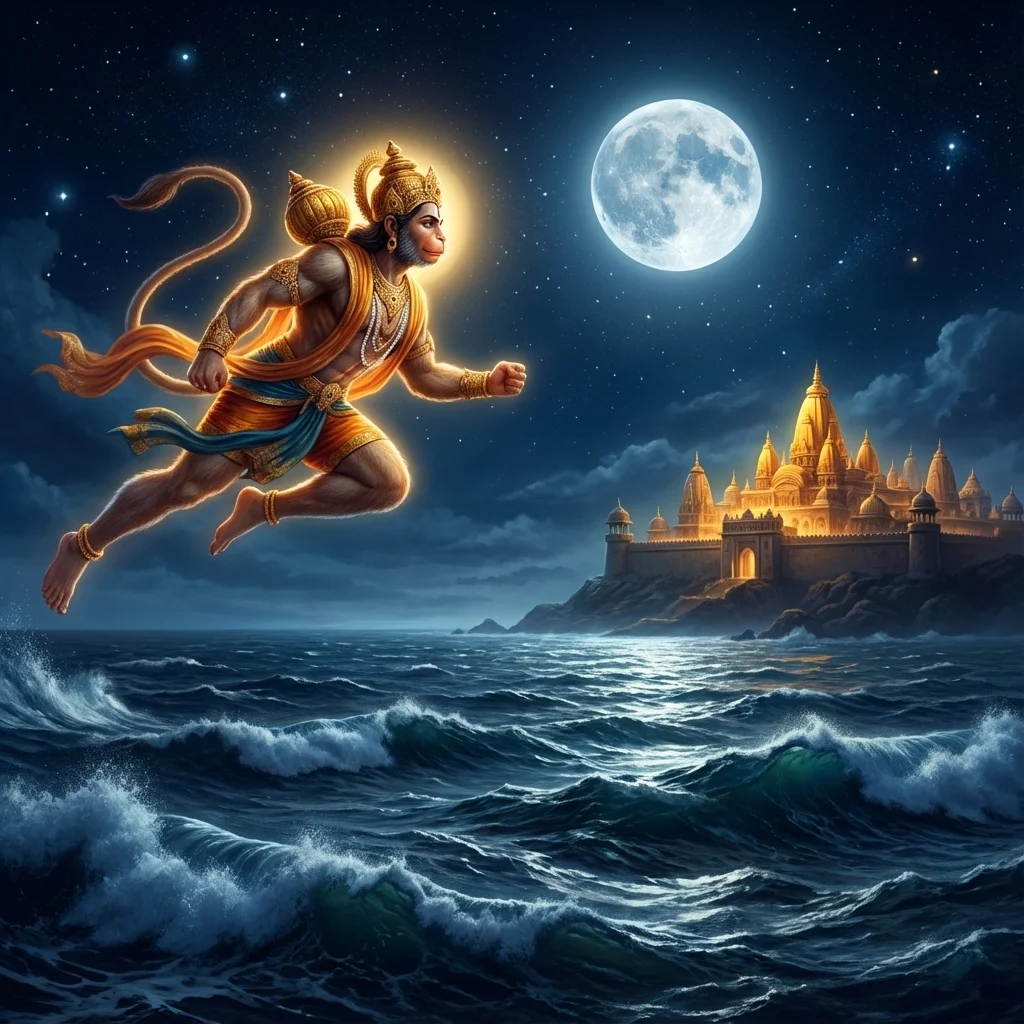
Sundarakāṇḍa forms the narrative and emotional hinge of the Vālmīki Rāmāyaṇa, concentrating the epic’s outward quest into a single agent—Hanumān—whose intelligence (buddhi), devotion (bhakti), and heroic energy (vīrya) become the means by which Rāma’s cause penetrates Laṅkā. The book opens with Hanumān’s resolve to locate Sītā and his ocean-leap, a classic epic set-piece that dramatizes the conversion of inner determination into cosmic-scale action. Entering Laṅkā by night, he surveys the city’s opulence—gardens, mansions, and the Pushpaka-vimāna—contrasting rākṣasa luxury with the dhārmic austerity and suffering of Sītā in the Aśoka grove. The central movement is the discovery of Sītā, her steadfast refusal of Rāvaṇa’s inducements and threats, and the delicate diplomacy by which Hanumān gains her trust, narrates Rāma’s alliance with Sugrīva, and receives the cūḍāmaṇi as a token (abhijñāna). The text then pivots to controlled violence: Hanumān’s deliberate devastation of the grove, his battles with Laṅkā’s champions, his capture and audience with Rāvaṇa, and the climactic burning of Laṅkā—an act that is simultaneously strategic intimidation and symbolic purification. Within the 24,000-verse Ādikāvya, Sundarakāṇḍa is prized for its integration of rasa (heroism, pathos, wonder), its urban and natural descriptions, and its sustained ethical discourse on chastity, kingship, perseverance, and messenger-dharma. In the IIT Kanpur Southern Recension, the book also preserves additional traditional readings and expansions that accentuate descriptive richness and devotional reception-history.

Hanumān, sent by Sugrīva and Rāma, resolves to find Sītā and leaps across the ocean to Laṅkā. He enters the city at night, surveys its splendor, and searches the palaces before locating Sītā guarded in the Aśoka grove. Hearing Rāvaṇa’s proposals and Sītā’s unwavering refusal, Hanumān reveals himself cautiously, recounts Rāma’s story, and gains her confidence. She gives him the cūḍāmaṇi as proof for Rāma and entrusts a message of urgency. To signal Rāma’s power and unsettle Laṅkā, Hanumān destroys the grove, defeats multiple rākṣasa forces, is captured, addresses Rāvaṇa in court, and finally burns Laṅkā before returning to report to Rāma, who is moved to decisive action.

Sargas in Sundara Kanda

Sarga 1

समुद्रलङ्घनारम्भः — Commencement of the Ocean-Crossing

Sarga 1 inaugurates Hanumān’s transoceanic passage as a carefully staged test of resolve, scale, and discernment. Having resolved to seek Sītā’s whereabouts (5.1.1), Hanumān expands his form for Rāma’s welfare, observed by the vānaras (5.1.10–11), and launches into the aerial route associated with celestial movement. The ocean (personified through its presiding order) prompts Mount Maināka to rise as an offered resting-place; Maināka explains the ancient account of winged mountains and Indra’s severing of their wings, emphasizing reciprocal dharma and hospitality (atithi-dharma). Hanumān refuses delay due to time-bound duty and vow, yet honors the offer through courteous contact and departure. The gods then commission Surasā, mother of nāgas, to test Hanumān’s strength and ingenuity; he satisfies her boon by entering and exiting her mouth through strategic resizing, receiving her blessing to proceed. Next, Simhikā, the shadow-clutcher, attempts to seize him; Hanumān identifies the threat, enters her mouth, destroys her vital parts, and resumes flight. The sarga concludes with Hanumān reaching the far shore, reducing to a suitable form for stealth, and deliberating on the next operational steps toward Laṅkā—thus linking physical prowess to ethical restraint and mission-oriented intelligence.

210 verses | हनुमान् (Hanuman), मैनाकः (Mainaka), सुरसा (Surasa), देवाः/सिद्धाः/चारणाः (gods, siddhas, charanas)

Sarga 2

लङ्कादर्शनं तथा रात्रौ सूक्ष्मरूपेण प्रवेशोपायचिन्तनम् (Vision of Lanka and Strategy for Nocturnal Entry)

This sarga narrates Hanuman’s arrival at Trikūṭa, his first sustained visual survey of Laṅkā, and his internal strategic reasoning. He observes luxuriant groves, ponds, and pleasure-gardens surrounding the city, then shifts to a fortified-city assessment: moats with lotuses, golden ramparts, towering mansions, banners, archways, and the sense of a ‘deva-purī’ likeness. The text intensifies security imagery—rākṣasas with fierce weapons, the city compared to Bhogavatī and a serpent-guarded cavern—prompting Hanuman’s dharma-centered deliberation as a messenger. He evaluates feasibility: open war is untenable; even the wind cannot pass undetected; only a few vanaras could reach this place. He concludes that success depends on deśa-kāla alignment: shrinking to an inconspicuous form, entering at dusk/night, and searching systematically for Vaidehī without alerting Ravana. The chapter ends with the moonrise imagery, reinforcing nocturnal timing and the poised transition from observation to covert action.

58 verses | Hanuman (internal deliberation / self-addressed reasoning)

Sarga 3

लङ्काप्रवेशः — Hanuman Enters Lanka and Encounters Laṅkā-devatā

This sarga narrates Hanumān’s nocturnal entry into Laṅkā from the Lamba peak, emphasizing stealth, resolve, and situational awareness. He surveys the city’s extraordinary architecture—golden doors, gem-inlaid floors, vaidūrya platforms and stairways, resonant music, and bird-filled courtyards—framed through elevated similes that liken Laṅkā to celestial cities (Amarāvatī; Vasvaukasārā). After reflecting on the city’s near-impregnability and the caliber of forces required to reach it, Hanumān’s confidence is reinforced by remembrance of Rāma and Lakṣmaṇa’s valor. The presiding deity/ogress of Laṅkā manifests, challenges his identity and intent, and attempts to bar entry. A brief combat ensues: she strikes first; Hanumān responds with measured force, consciously restraining excessive anger because she is a woman. Defeated, Laṅkā-devatā reveals a boon of Brahmā: when a vānara subdues her, it signals impending ruin for Rāvaṇa’s rākṣasas due to Sītā’s abduction. She then permits Hanumān to enter freely and continue his search for Janaka’s daughter.

51 verses | Hanumān, Laṅkā-devatā (Laṅkā, the presiding guardian/ogress)

Sarga 4

लङ्काप्रवेशः — Hanuman’s Stealth Entry and Survey of Lanka

After subduing Laṅkā’s presiding guardian deity (kāmarūpiṇī), Hanumān crosses the city’s boundary wall via a rear approach, signaling a tactical, non-ceremonial entry into hostile space (5.4.1). Entering at night, he deliberately places the left foot first—an adversarial omen and a conventional marker of intent to overcome the enemy’s domain (5.4.2–5.4.4). The chapter then shifts into an acoustic and architectural mapping of Laṅkā: pearl-like floral adornments along the highway, diamond-latticed mansions, painted façades with lotus and svastika motifs, and the city’s luminous skyline (5.4.3–5.4.7). Hanumān’s reconnaissance is multi-sensory: he hears melodious songs in tri-sthāna and tri-svara registers, jewelry and anklet sounds, footsteps on stairways, clapping, and joking across elite residences (5.4.10–5.4.11). He also detects ritual life inside rākṣasa houses—mantra recitation, svādhyāya, and loud praise of Rāvaṇa—indicating a complex cultural ecosystem rather than mere militarism (5.4.12–5.4.13). The survey escalates to security intelligence: demon troops line the main road, spies are stationed mid-city, and diverse armed contingents appear with distinctive physiognomies, banners, and weapons (5.4.14–5.4.22). Finally, Hanumān reaches the fortified royal sector: a hundred-thousand-strong guard before the harem, a golden archway, lotus-filled moats, enclosing walls, and a heaven-like interior filled with vehicles, horses, elephants, ornaments, and guarded entrances—culminating in his entry into Rāvaṇa’s antaḥpura for the next phase of the mission (5.4.23–5.4.29).

29 verses | Narrator (Valmiki), Hanuman (as focal agent; primarily observational)

Sarga 5

चन्द्रप्रकाशे लङ्कानिरीक्षणम् — Moonlit Survey of Lanka and the Unfound Sita

Sarga 5 frames Hanuman’s reconnaissance through a sustained moonlit tableau. The Moon is described at mid-sky as a canopy of light that calms beings, swells the ocean, and transforms night into a legible field for observation. Against this luminous backdrop, Hanuman inspects Lanka’s mansions and social interiors: intoxicated rakṣasas quarrel, boast, and display physical vigor; households are rich with chariots, horses, weapons, and ornamentation; women appear in varied states—sleeping with husbands, laughing, sighing, or embracing lovers—rendered with kāvya similes (stars, birds among flowers, lightning-like ornaments). The city is also shown as militarily alive: bows are drawn, warriors breathe heavily, elephants trumpet. Yet the reconnaissance culminates in a negative finding: despite searching through these spaces, Hanuman does not see Sita. The chapter closes with his inward projection of Sita’s qualities—noble birth, steadfast dharma, devotion to Rama—followed by a brief collapse into grief and dejection when she remains undiscovered.

27 verses | Hanuman (narrative focalizer / observer)

Sarga 6

राक्षसेन्द्रनिवेशनविचारः (Survey of Ravana’s Residence and Lanka’s Inner Quarters)

Sarga 6 narrates Hanumān’s methodical yet rapid movement through Lanka after failing to find Sītā in earlier mansions. Assuming forms at will (kāmarūpa) and relying on lāghava (agility/quickness), he reaches the rākṣasa-king’s residence, described through layered architectural and sensory detail: blazing red ramparts, silver-and-gold toraṇas, inner apartments, and a constant clangor resembling the sea from ornaments, drums, conches, and ritual activity. The text maps the social and military ecology of the capital by listing prominent rākṣasa households (Prahasta, Mahāpārśva, Kumbhakarṇa, Vibhīṣaṇa, Indrajit, and many others), then returns to the palace core where Hanumān observes armed guards, troops, elite horses and war-elephants likened to clouds and mountains, and vast stores of gold, gems, vessels, palanquins, pleasure pavilions, and crafted landscapes. The chapter’s lesson emphasizes reconnaissance with restraint: accurate assessment of enemy wealth, ritual routine, and defenses, while maintaining the mission’s ethical focus—finding Sītā without reckless exposure.

42 verses | Narrator (Valmiki), Hanuman (as focal observer)

Sarga 7

पुष्पकविमानदर्शनम् — The Vision of the Pushpaka and Lanka’s Jewel-like Mansions

This sarga presents Hanumān’s close reconnaissance of Laṅkā’s elite architecture and the Pushpaka vimāna through a sequence of visual catalogues and extended similes. He observes a dense ‘network’ of mansions fitted with golden lattices and vaidūrya (cat’s-eye gem), likened to monsoon cloud-masses threaded with lightning and alive with birds (5.7.1). He notes specialized halls and armories for conches, weapons, bows, and arrows, and moonlit terraces crowning the attics (5.7.2). The houses appear treasure-laden, defect-free, and as if built by Māyā, the divine architect—an aesthetic of engineered wonder that signals Ravana’s amassed power (5.7.3–4). Hanumān then beholds a matchless golden palace and an aerial chariot described as heaven-like on earth, gem-studded, and cloud-and-sky-like in coloration (5.7.5–8). Interior ornamentation is rendered as pictorial cosmography: mountains, trees, flowers, ponds, lotuses, and gardens, along with gem-crafted birds, serpents, horses, elephants, and a Lakṣmī motif (5.7.9–14). Having reached this mountain-like, fragrant palace, Hanumān resumes searching the city for Sītā; failing to find her, his mind becomes deeply distressed, revealing the ethical tension between sensory splendor and the mission’s sorrowful urgency (5.7.15–17).

17 verses | Valmiki (narrator), Hanuman (focal observer)

Sarga 8

पुष्पकविमानदर्शनम् (Vision of the Pushpaka Aerial Chariot)

In this sarga, Hanumān—moving through the inner spaces of Laṅkā’s palatial architecture—observes the Pushpaka vimāna positioned within the mansion’s center. The chapter is primarily descriptive (vastu-varṇana): the aerial chariot is portrayed as gem-inlaid, diamond-adorned, and fitted with latticed windows of burnished gold. Its craftsmanship is attributed to Viśvakarman and framed as beyond ordinary measure, shining like a beacon in the solar path. The narration emphasizes that nothing in it is uncrafted or non-precious; its uniqueness surpasses even divine standards, suggesting royal sovereignty and superhuman resources. The vimāna is further characterized as responsive to the master’s intention—able to reach desired places by thought—furnished with multiple special resting areas, and shaped like a mountain peak with many wondrous towers. Finally, its conveyance by thousands of swift, fearsome bhūta-groups (night-ranging beings) is noted, culminating in Hanumān’s appraisal of its beauty as exceeding even springtime’s charm. Thematically, the sarga juxtaposes Laṅkā’s opulence with the ethical mission of restraint and observation.

7 verses | Narrator (Valmiki’s epic voice), Hanuman (as focal observer)

Sarga 9

पुष्पकविमानवर्णनम् — Description of the Pushpaka Vimana and Ravana’s Inner Palace

In this sarga, Hanumān continues his methodical search for Vaidehī by surveying the demon-king’s principal residence. The narration shifts into technical architectural and aesthetic description: a vast central mansion complex, then the gem-embellished Puṣpaka-vimāna—crafted by Viśvakarmā for Brahmā, later obtained by Kubera through tapas, and seized by Rāvaṇa by force—serving as a moral genealogy of objects (legitimate acquisition versus violent appropriation). The text catalogs materials (multiple gold types, crystal, sapphire, coral, pearls), structural elements (pillars, latticed windows, stairways, platforms), and sensory atmosphere (incense, flowers, food-and-wine fragrance), using kāvya imagery to render Laṅkā’s opulence as both alluring and ethically dissonant. Hanumān is guided by fragrance toward Rāvaṇa’s favored hall, where innumerable women sleep after revelry; their ornamentation and postures are compared to lotuses, stars, rivers, and creepers. Hanumān’s internal reasoning culminates in a dharmic inference: among these women, only Sītā is described as not willingly associated with Rāvaṇa, sharpening the condemnation of the abduction as an anārya act.

73 verses | Narrator (Valmiki), Hanuman (internal reflections)

Sarga 10

रावणान्तःपुरे शयनदर्शनम् (Hanumān Observes Rāvaṇa’s Inner Apartments and Sleeping Court)

In this sarga, Hanumān—moving as a covert observer—encounters the opulent sleeping chamber within Rāvaṇa’s inner palace. The narration foregrounds material splendor: crystal and gem-encrusted couches, golden furnishings, garlands, lamps, perfumes, and ritual-like luxury. Hanumān then sees the rākṣasa-king asleep, described through layered similes (cloud, twilight-red sky with lightning, Mandara mountain, elephant by the Gaṅgā), emphasizing power, sensuality, and martial history marked upon his body. The chapter also records Hanumān’s momentary fear at Rāvaṇa’s serpent-like breathing and his subsequent recovery of composure, illustrating vigilance under pressure. The gaze widens to the sleeping women of the harem—artists and attendants—portrayed with instruments and ornaments, forming a tableau of exhausted revelry. Hanumān notices Mandodarī, mistakes her for Sītā due to her beauty and adornment, and briefly rejoices; the episode functions as an interpretive test, showing how visual evidence must be checked against dharmic criteria. The sarga thus juxtaposes royal excess with the seeker’s ethical discernment and advances the reconnaissance motif central to Sundarakāṇḍa.

54 verses | Narrator (Valmiki), Hanuman (as focal perceiver)

Sarga 11

रावणान्तःपुर-पानभूमि-विचयः (Hanumān’s Survey of Rāvaṇa’s Inner Palace and Banquet Hall)

This sarga presents a reconnaissance sequence framed by ethical reflection. Hanumān rejects an earlier inference and renews his reasoning about Sītā, concluding that a woman separated from Rāma would not indulge in sleep, adornment, feasting, or drink, nor seek any other man—even a divine ruler—since none equals Rāma. Proceeding through Rāvaṇa’s palace, he observes the pānabhūmi (banquet/drinking hall): abundant meats prepared in varied ways, lēhya–pēya–bhōjya categories, syrups (rāgaṣāḍava), vessels of gold, silver, and crystal, scattered garlands, fruits, spilt drinks, couches and seats arranged so the hall seems to glow without fire. He also sees women asleep after revelry and dalliance, with Rāvaṇa shining among them. After thoroughly searching the inner apartments, he does not find Jānakī. A dharma-scruple arises: whether observing sleeping women in others’ inner chambers constitutes moral lapse. Hanumān resolves it through intent-based ethics—his mind remained non-sensual and firmly established in righteousness—and argues that searching for a woman necessarily involves looking among women. Recommitting to the mission, he leaves the banquet hall to continue the search elsewhere.

47 verses | Hanumān (internal deliberation)

Sarga 12

द्वादशः सर्गः — हनूमतः अन्तःपुरविचयः (Hanuman’s Search Through Ravana’s Inner Apartments)

This sarga records a renewed, systematic search within the central mansion complex of Laṅkā. Hanumān, eager for Sītā’s sight, revisits internal spaces—creeper-bowers, picture halls, night-rest chambers, banquet halls, sports rooms, garden lanes, subterranean cells, shrines/temples, and nested residences—leaving virtually no searchable gap within Rāvaṇa’s antaḥpura. The discourse is largely Hanumān’s interior reasoning: he fears mission failure, imagines Sītā’s possible death from terror or violence, and anticipates the moral and operational consequences for the vānaras waiting across the sea (including the expectations of Jāmbavān and Aṅgada). At the chapter’s ethical pivot, he rejects despair through the maxim “anirveda” (freedom from despondency) as the root of prosperity and success, and recommits to optimal effort. The sarga ends with exhaustive reconnaissance findings: many extraordinary women (including vidyādhara and nāga maidens) are seen, as well as rākṣasī attendants of varied and fearsome forms, yet Sītā—Janaka’s daughter and Rāghava’s beloved—is not found, intensifying grief while reinforcing perseverance as method.

25 verses | Hanuman (internal monologue)

Sarga 13

रावणभवनपरिक्रमणं हनूमतः शोकविचारश्च (Hanuman’s Circuit of Ravana’s Palace and the Crisis of Deliberation)

Sarga 13 records a methodological search turning into a structured ethical crisis. After leaping from the aerial chariot to Laṅkā’s boundary wall “like lightning in clouds” (5.13.1), Hanumān circles Rāvaṇa’s residence yet fails to locate Sītā (5.13.2–5). He enumerates plausible scenarios for her absence—falling into the sea during abduction, being killed or consumed, dying of grief while meditating on Rāma, or being imprisoned like a caged bird (5.13.7–16). The discourse then shifts from conjecture to consequence-analysis: he foresees cascading deaths if he returns without news—Rāma, Lakṣmaṇa, Bharata, Śatrughna, the queens, Sugrīva, Rumā, Tārā, Aṅgada, and the wider vānaras (5.13.20–37). Hanumān considers self-erasure (fire, drowning, fasting) but rejects suicide as adharma producing “many faults,” affirming that auspicious outcomes belong to the living (5.13.40–47). He resolves to continue the search, identifies the Aśokavanikā as an unsearched locus, offers salutations to deities and allies, and proceeds toward the grove with renewed operational clarity (5.13.52–60). The sarga closes with anticipatory reflection on the grove’s guarded sanctity and a prayer for success (5.13.61–69).

69 verses | हनुमान् (Hanuman) — internal monologue / self-address

Sarga 14

अशोकवनिकाविचारः (Survey of the Aśoka Grove and its Enchanted Landscape)

Sarga 14 narrates Hanumān’s controlled descent to the palace boundary and his entry into the Aśokavanikā as part of a covert search for Vaidehī. The chapter foregrounds sensory mapping: flowering trees shaken by his swift movement release multicolored showers; birds scatter; the grove appears like spring personified. The text employs elaborate similes—trees likened to defeated gamblers, and the grove likened to a disheveled young woman—converting physical disturbance into poetic signification. Hanumān observes engineered opulence: gem-, gold-, and silver-paved floors; ponds with jeweled steps, crystal pavements, lotus beds, and waterfowl; artificial lakes and mansions attributed to Viśvakarmā. He identifies a prominent golden śiṃśupā tree encircled by golden platforms and resounding like anklets in the wind, climbs it, and reasons that Sītā—accustomed to forest life and twilight rites—may come to the auspicious waters nearby. He then conceals himself amid dense leaves and blossoms, maintaining vigilance while awaiting the queen’s appearance.

52 verses | Hanuman

Sarga 15

अशोकवनिकायां सीतादर्शनम् (Sita Seen in the Ashoka Grove)

अस्मिन् पञ्चदश-सर्गे हनूमन् सिम्शुपा-वृक्षात् अशोकवनिकां सर्वतः निरीक्षते (5.15.1), उद्यानस्य अलङ्कार-समृद्धिं, पुष्प-प्रभा-वैचित्र्यं, नन्दन-चैत्ररथ-उपमानं, तथा सहस्रशः अशोक-वृक्षान् वर्णयति (5.15.10–14)। मध्ये चैत्यप्रासाद-सदृशं उच्छ्रितं, सहस्र-स्तम्भ-समाश्रितं, कैलास-पाण्डुर-प्रभं, प्रवाल-सोपान-तप्तकाञ्चन-वेदिकायुक्तं भवनं पश्यति (5.15.15–17)। ततः राक्षसी-परिवृतां, मलिन-वसनां, उपवास-कृशां, पुनः पुनः निःश्वसन्तीं स्त्रीं ददर्श (5.15.18–23) तथा उपमा-श्रृङ्खलाभिः तस्याः शोक-स्थितिं निरूपयति—धूमावृत-शिखा, मेघावृत-चन्द्र-प्रभा, रोहिणी-पीडन-उपमा इत्यादि। हनूमतः ‘सीतेति’ निश्चयः क्रमशः कारण-लक्षणैः दृढीभवति (5.15.26, 5.15.40), रामेण पूर्वं वर्णित-आभरण-चिह्नानां निरीक्षणेन प्रमाणं लभते (5.15.41–44) तथा अपविद्ध-वस्त्र-भूषण-स्मरणं कथानक-प्रमाण-शृङ्खलां पूरयति (5.15.45–47)। अन्ते स सीतादर्शनात् हृष्टः, मनसा रामं गत्वा तं प्रभुं प्रशंसति (5.15.55)—अत्र दूतस्य ‘प्रमाण-सङ्ग्रहः’ (verification) तथा करुणा-विवेकयोः सहवासः सर्गस्य मुख्य-शिक्षा।

55 verses | हनूमन् (मारुतिः) — अन्तर्मनसि तर्क/निश्चय-प्रवाहः, वर्णकः (वाल्मीकि-नार्रेटर)

Sarga 16

षोडशः सर्गः (Sarga 16): Hanumān’s Recognition of Sītā and Renewed Lament

This sarga presents Hanumān’s internal verification that the woman he observes in the Aśoka-grove is indeed Sītā, followed by a structured lament that doubles as an ethical inventory of her worth and Rāma’s dharmic capacity. After admiring Sītā and recalling Rāma’s virtues, Hanumān’s grief resurfaces (5.16.1–2), yet it is tempered by a strategic consciousness: Sītā’s steadiness is linked to her knowledge of Rāma-Lakṣmaṇa’s prowess (5.16.4–5). Hanumān then rehearses the causal chain of major combats undertaken ‘for her sake’—Vālī, Kabandha, Virādha, and the Janasthāna battles including Khara, Triśiras, Dūṣaṇa, and the fourteen thousand rākṣasas (5.16.7–10)—and notes political consequences such as Sugrīva’s regained kingship (5.16.11). He frames his own ocean-crossing and Laṅkā survey as service to Sītā’s recovery (5.16.12) and affirms that even world-upturning war would be justified for her (5.16.13–14). The chapter intensifies Sītā’s identity markers—Janaka’s daughter, born from the furrow, devoted wife, and Daśaratha’s eldest daughter-in-law (5.16.15–17)—and contrasts her former protection by Rāma-Lakṣmaṇa with her present guarding by rākṣasīs (5.16.18–29). Through layered similes (lotus frost-blasted; cakravākī separated; Aśoka blossoms and moonlight increasing sorrow), the sarga depicts captivity as both psychological and aesthetic inversion, culminating in Hanumān’s settled conclusion and watchful concealment on the Śiṃśupā tree (5.16.32).

32 verses | Hanumān (internal monologue / lament)

Sarga 17

सप्तदशः सर्गः — Hanuman Beholds Sita in the Ashoka Grove

Sarga 17 stages a deliberate shift from cosmic calm to moral horror and finally to recognition. The moon rises in a stainless, cooling radiance, described through layered similes (moon as a swan in blue water), and its light appears to “minister” to Hanumān, underscoring the epic’s alignment of nature with righteous purpose. Hanumān, seeking Vaidehī, first observes the immediate security environment: a dense catalogue of rākṣasīs marked by grotesque physiognomy, animal-faced hybridity, and iron weaponry (śūla, mudgara), seated around a massive tree trunk—an archival inventory that conveys intimidation as a system, not a single antagonist. Beneath that tree, he finally identifies Sītā: lustreless, dust-stained, and grief-stricken, yet ethically radiant through chastity and steadfast love for her husband. Multiple similes articulate her condition—meteor fallen to earth, crescent moon veiled by autumn clouds, an unused lute—while affirming that her inner dharma remains intact despite external deprivation. Hanumān’s response is controlled joy: tears of relief, inward salutations to Rāma and Lakṣmaṇa, and concealment in the foliage to continue the mission without compromising Sītā’s safety.

32 verses | Narrator (Vālmīki), Hanumān (internal response implied)

Sarga 18

अष्टादशः सर्गः (Sarga 18): रावणस्य प्रमदावनप्रवेशः — Ravana’s entry into the women’s grove

As Hanumān continues searching the flowering Aśoka grove for Vaidehī, the night wanes and dawn approaches (5.18.1–2). Auspicious instruments awaken the powerful Daśagrīva, who rises with disordered garland and clothing, his mind fixed on Sītā and passion unhidden (5.18.3–5). Adorned in ornaments, he proceeds through a garden rich with trees, ponds, birds, animals, and gem-and-gold gateways, entering the Aśokavanikā (5.18.6–9). Ravana is followed by women bearing lamps, fans, water-pitchers, seats, wine, and a moon-bright umbrella; his chief wives—dizzy with sleep and intoxication—trail him like lightning around a cloud, their ornaments and cosmetics disarrayed (5.18.10–19). Hanumān hears their anklets and girdles, sees Ravana at the entrance illuminated by many oil-wet lamps, and studies his appearance—lustful, proud, intoxicated, Cupid-like—while remaining concealed in foliage (5.18.20–31). Ravana, desiring to see Sītā, turns back into the grove, closing the sarga with the imminent confrontation between predatory power and steadfast virtue (5.18.32).

32 verses | Narrator (Valmiki’s narrative voice), Hanuman (internal recognition/assessment), Ravana (implied intent; no extended dialogue in the given verses)

Sarga 19

सीताव्यथा-वर्णनम् / Sītā’s Distress and Rāvaṇa’s Attempt at Coercive Allurement

Sarga 19 presents a concentrated psychological tableau: Rāvaṇa approaches Sītā in captivity, and the text renders her immediate bodily and emotional recoil—she trembles upon seeing the rākṣasa-lord, a reaction framed through a striking simile (banana plant shaken by wind). The chapter then develops an extended chain of analogical comparisons to depict the erosion of auspiciousness and stability: Sītā is likened to dimmed fame, slighted faith, disrupted worship, frustrated hope, a blighted lotus-creeper, an army bereft of heroes, radiance smothered by darkness, a dried river, and a full moon eclipsed by Rāhu. These images serve a technical purpose: they map the moral disorder produced by abduction onto cosmic, ritual, and social symbols, while preserving Sītā’s inner dharma as intact. The description also notes her austerities—fasting, grief, brooding, fear—yet portrays her as spiritually “wealthy” through tapas. The sarga culminates with Rāvaṇa attempting to allure and threatening lethal force when she remains devoted to Rāma, reinforcing the ethical polarity between coercion and steadfast fidelity.

23 verses | Narrator (Vālmīki), Rāvaṇa

Sarga 20

रावणस्य सीताप्रलोभनम् (Ravana’s Persuasion and Coercive Courtship of Sita)

Sarga 20 presents a sustained rhetorical sequence in which Rāvaṇa addresses Sītā—described as grief-stricken, ascetic, and surrounded by rākṣasī guards—with “sweet, animated words” that alternate between inducement and intimidation. He offers material luxuries (garlands, sandal, incense, garments, ornaments), sensory entertainments (song, dance, instruments), and political power (authority over his harem; wealth and lands; even the promise of conquest and gifts to Janaka). He intensifies flattery by asserting her unmatched beauty, urging adornment, and using the trope of fleeting youth. Parallel to seduction, he asserts unrivalled martial power and minimizes Rāma’s capacity, portraying him as impoverished, forest-bound, and possibly dead, and claims Rāma cannot retrieve her from Laṅkā. The chapter thus functions as a literary anatomy of coercive persuasion: lavish promises, aesthetic praise, and strategic disparagement of the rightful spouse, set against Sītā’s visible austerity and refusal context.

36 verses | Ravana

Sarga 21

सीताया रावणं प्रति धर्मोपदेशः (Sita’s Dharmic Admonition to Ravana)

Sarga 21 presents Sītā’s measured yet uncompromising reply after hearing Rāvaṇa’s aggressive proposal. She establishes a protective boundary (placing a blade of grass between them) and articulates a layered dharma-critique: a king must restrain desire, protect others’ wives as his own, and heed wise counsel. She predicts political ruin for realms led by unjust rulers, frames Rāvaṇa as the agent of his clan’s destruction, and asserts her inseparability from Rāghava through tightly drawn similes (light and sun; knowledge and the realized brāhmaṇa). The discourse turns from moral instruction to strategic counsel—urging friendship with Rāma and the return of Sītā as the only path to welfare—then escalates into a forewarning of Rāma’s martial arrival: the bow’s thunder-like twang, arrow-rain over Laṅkā, and the inevitable extraction of Sītā as Viṣṇu-Vāmana reclaimed prosperity from the asuras. The chapter closes by condemning the cowardly circumstance of her abduction and asserting that no refuge can avert Rāma’s retribution.

34 verses | Sita, Ravana

Sarga 22

रावणस्य तर्जनं सीताया धर्मोक्तिः (Ravana’s Threats and Sita’s Dharma-Centered Reply)

Sarga 22 stages a high-intensity verbal confrontation in Aśoka-vana: Rāvaṇa, provoked by Sītā’s sharp rebuke, replies with coercive threats, sets a two-month ultimatum, and orders the rākṣasīs to employ alternating tactics—conciliation, inducement, deception, and punishment—to bend her will. Observing Sītā’s peril, divine and gandharva maidens display grief and attempt to console her through silent gestures, underscoring the moral isolation of the captive. Reassured, Sītā answers in self-defence with uncompromising dharma-argumentation: she condemns Rāvaṇa’s counsellors for failing to restrain him, asserts her exclusive marital bond to Rāma, and predicts inevitable retribution for the adharma of abduction. The chapter then pivots to a monumental physical description of Rāvaṇa’s terrifying splendour—cloud-dark, lion-gaited, jewel-adorned—highlighting the epic’s technique of juxtaposing external majesty with internal moral corruption. After renewed intimidation, Rāvaṇa delegates enforcement to grotesquely described demonesses; Dhānyamālinī attempts to redirect him toward pleasure and away from Sītā. Rāvaṇa withdraws to his palace, leaving Sītā trembling yet steadfast, thereby intensifying the ethical stakes and foreshadowing the collapse of coercive power before principled resolve.

46 verses | रावण (Ravana), सीता / जानकी / वैदेही / मैथिली (Sita), धान्यमालिनी (Dhanyamalini)

Sarga 23

राक्षसी-भर्त्सना (The Demonesses’ Coercive Counsel to Sītā)

After Rāvaṇa concludes his direct pressure on Sītā and departs, he commands the rākṣasīs, who immediately crowd around her in Aśoka-grove confinement. The chapter is structured as a chorus of escalating speech-acts: harsh rebukes, genealogical legitimation of Rāvaṇa (Pulastya → Viśravas → Rāvaṇa), and repeated inducements that frame coerced marriage as “privilege.” Individual rākṣasīs—Ekajaṭā, Harijaṭā, Praghasā, Vikaṭā, and Durmukhī—advance complementary rhetorical strategies: lineage prestige, claims of military supremacy (victories over gods, Indra, nāgas, gandharvas, dānavas), wealth and harem imagery, and cosmic intimidation (sun and wind restrained by fear; nature yielding flowers and water). The sarga culminates in a pseudo-benevolent ultimatum: accept the advice or face death, highlighting the ethical contrast between consent-based dharma and fear-based domination, while foregrounding Sītā’s isolation as the moral crucible of Laṅkā’s captivity narrative.

21 verses | Rāvaṇa, Rākṣasīs (Ekajaṭā, Harijaṭā, Praghasā, Vikaṭā, Durmukhī), Sītā (addressed; largely silent in the cited verses)

Sarga 24

सीताभर्त्सना — The Ogresses’ Threats to Sita and Her Vow of Fidelity

Sarga 24 stages a coercive dialogue in Aśoka-vana where multiple rākṣasīs, acting under Rāvaṇa’s command, attempt to break Sītā’s resolve through alternating persuasion and terror. The chapter opens with a collective approach and harsh speech, urging Sītā to accept residence in the inner apartments and to choose Rāvaṇa as husband, amplifying claims of wealth, pleasure, and political inevitability. Sītā replies with moral refusal: a human woman should not become wife to a rākṣasa; even if threatened with death, she will not abandon Rāma. She articulates a dharma-based definition of marriage—Rāma remains her guru and lawful spouse whether impoverished or dethroned—and reinforces this with exempla of ideal marital devotion (Śacī–Indra, Arundhatī–Vasiṣṭha, Rohiṇī–Candra, Lopāmudrā–Agastya, Sukanyā–Cyavana, Sāvitrī–Satyavān, Damayantī–Nala, and others). Enraged, the rākṣasīs escalate to explicit violence (axes, trident), fantasies of dismemberment and cannibalism, and threats of immediate execution, while Sītā retreats weeping toward the śiṃśupā tree. Hanumān, concealed and speechless, listens—positioning the scene as both ethical testimony and tactical intelligence for the rescue mission.

48 verses | Sita, Vinatā (rākṣasī), Vikaṭā (rākṣasī), Caṇḍodarī (rākṣasī), Praghasā (rākṣasī), Ajāmukhī (rākṣasī), Śūrpaṇakhā (rākṣasī)

Sarga 25

सीताविलापः (Sita’s Lament amid Rākṣasī Threats)

Sarga 25 presents a concentrated psychological portrait of Sītā in Aśokavatikā after hearing repeated harsh threats from the rākṣasī guards. She weeps, trembles, and physically withdraws into herself; the narration intensifies through a sequence of similes (doe beset by wolves, banana plant felled by wind, braid like a serpent) to map fear onto bodily signs. Clinging to a blossoming Aśoka branch, she broods on Rāma and breaks into lament, calling out to Rāma, Lakṣmaṇa, and her mothers-in-law (Kauśalyā, Sumitrā). She articulates a reflective proverb-like observation: untimely death is said to be rare or impossible, even when life feels unendurable—thereby framing captivity as a prolonged ethical trial rather than a momentary crisis. The chapter underscores her refusal to accept a rākṣasa marriage, her isolation under surveillance, and the moral steadfastness that persists despite despair and the wish to relinquish life.

20 verses | Sita (Vaidehi/Maithili/Janakatmaja), Raksasis (ogress guards)

Sarga 26

सीताविलापः — Sita’s Lament and Prophecy of Lanka’s Ruin

Sarga 26 presents a sustained psychological and ethical monologue of Sītā (Janakātmajā) in captivity. She begins with visible grief—tears, lowered face, and disoriented movement—signaling trauma under rākṣasī intimidation. She then articulates an uncompromising rejection of Rāvaṇa: she will not touch him even with her left foot, and she prefers death (cut, broken, or burnt) to acceptance. The discourse shifts to interpretive reasoning about Rāma’s delay: she considers possibilities ranging from ignorance of her location to a feared (but contested) indifference, and she recalls Rāma’s prior feats (Janasthāna’s rākṣasas, Virādha’s slaying) to argue that Laṅkā’s oceanic position cannot obstruct Rāma’s arrows. Sītā forecasts Laṅkā’s imminent desolation—funeral smoke, vultures, widowed rākṣasī households—linking adharma to inevitable calamity. The chapter culminates in existential despair and suicidal ideation (seeking poison), while still affirming Rāma’s character and the moral law that condemns rākṣasa wrongdoing.

51 verses | Sita (Janakatmaja)

Sarga 27

त्रिजटास्वप्नवर्णनम् (Trijata’s Dream-Omens and the Rakshasis’ Reversal)

After Sītā’s firm rebuke, some enraged rākṣasīs report to Rāvaṇa while others return to threaten her with immediate violence. The elderly rākṣasī Trijaṭā intervenes, halting escalation by narrating a terrifying yet auspicious dream: Rāma and Lakṣmaṇa appear in radiant white, arriving in celestial conveyances (ivory palanquin drawn by swans; later the Puṣpaka vimāna), and Sītā is seen reunited with Rāma, elevated upon a great elephant, with cosmic playfulness (touching Moon and Sun) symbolizing restored order. The dream then pivots to ominous images of Rāvaṇa—smeared with oil, intoxicated, fallen from Puṣpaka, dragged southward (Yama-direction), riding ignoble mounts (boar/donkey), plunging into filth and darkness—extending the omen-field to Kumbhakarṇa and Ravana’s sons, while Vibhīṣaṇa alone is marked by white auspicious regalia and elevation on a four-tusked elephant amid celebratory sounds. Trijaṭā interprets these nimittas as imminent fulfilment for Vaidehī, the demon-king’s destruction, and Rāma’s victory; she urges the rākṣasīs to abandon cruelty, seek pardon, and adopt conciliatory speech. The chapter closes with embodied auspicious signs (Sītā’s throbbing eye/limb, trembling thigh) and a bird repeating sweet notes as if prompting rejoicing—an ethical turn from coercion to accountability under the pressure of dharma’s approaching consequence.

50 verses | Sita, Trijata, Rakshasis (collectively)

Sarga 28

सीताविलापः (Sita’s Lament and Resolve under Threat)

Sarga 28 intensifies the Aśoka-vāṭikā crisis through Sītā’s immediate psychological response to Rāvaṇa’s harsh ultimatum. Hearing the ‘unpleasant words’ of the rākṣasa king, she is compared to a young elephant-calf seized by a lion—an upamā that frames vulnerability amid predation (5.28.1). Encircled by rākṣasīs and verbally threatened, Sītā articulates the paradox of delayed death: elders say untimely death does not occur, yet she remains alive in pitiable fear (5.28.3), and wonders why her heart does not shatter like a thunderstruck mountain-peak (5.28.4). She rejects any notion of yielding affection to Rāvaṇa, likening it to a brāhmaṇa refusing to impart mantra to the unqualified (5.28.5), and fears dismemberment if Rāma does not arrive in time (5.28.6–7). Her lament calls out to Rāma, Lakṣmaṇa, and the mothers (5.28.8, 5.28.11), and she interprets the deer-episode as ‘kāla’ (time/fate) that tempted her into sending the brothers away (5.28.10). In despair she considers suicide by poison or weapon (5.28.16), then moves toward the flowering śiṃśupā tree, grasping her braid as a means to reach Yama’s realm (5.28.17–18). As she stands holding a branch and remembers Rāma, Lakṣmaṇa, and their lineage, auspicious bodily omens manifest—traditional signs that dispel grief and restore courage (5.28.19–20), closing the chapter with a subtle narrative counterweight to suicidal intent.

19 verses | Sita

Sarga 29

निमित्तप्रादुर्भावः — Auspicious Omens Arise for Sita

Sarga 29 depicts a decisive emotional turn in Ashoka Vatika: while Sita stands under the śiṃśupā tree in agony and joyless distress, a sequence of śubha-nimitta (auspicious omens) manifests as bodily signs. Her left eye throbs auspiciously; her left arm—once a pillow for her beloved—quivers; her left thigh throbs, explicitly presaging reunion with Rama. Even her dust-dulled, gold-hued garment slips slightly, read as a favorable sign. These omens, described as time-tested and affirmed by siddhas (seer-figures), restore her inner vitality: the text likens her renewed joy to a heat-and-wind-blighted seed revived by rain. The chapter closes with heightened radiance imagery—Sita’s face shining like the moon released from Rahu—and a calm, joy-illumined composure that replaces exhaustion and fear, signaling narrative readiness for hope and forthcoming action.

8 verses | Valmiki (narrator)

Sarga 30

हनुमता सीतासंवादोपायचिन्ता — Hanuman’s Deliberation on How to Address Sita

This sarga is a technical portrait of messenger-dharma (dūta-nīti) under surveillance. Hanumān, concealed in Aśoka-vana, hears the exchange involving Sītā, Trijaṭā’s dream, and the rākṣasīs’ threats (5.30.1), and then undertakes a layered risk analysis. He recognizes that returning without Sītā’s message would jeopardize accountability before Rāma and render the vānaras’ mobilization futile (5.30.13–15). Yet speaking openly risks triggering Sītā’s fear—she may suspect a disguised Rāvaṇa—leading to alarm, armed response, capture, and exhaustion that would prevent the ocean-crossing return (5.30.18–29, 34). The chapter’s central dilemma is thus dual: silence may cause Vaidehī’s despair unto death, while ill-timed speech may collapse the mission (5.30.12, 36). Hanumān resolves to approach through gentle, dharma-aligned praise of Rāma, selecting humanly intelligible, sweet, confidence-building language so Sītā can listen without agitation (5.30.40–44).

44 verses | Hanuman

Sarga 31

सुन्‍दरकाण्डे एकत्रिंशः सर्गः — Hanuman’s Sweet Address to Sita and Sita’s Recognition

This sarga stages the controlled disclosure of identity: after internal deliberation (bahuvidhā cintā), Hanumān begins speaking in a sweet, confidence-building register to Vaidehī. He summarizes the Ikṣvāku lineage and Daśaratha’s royal virtues, then characterizes Rāma as the foremost archer and protector of dharma, establishing credibility through accurate royal genealogy and ethical profile. He recounts the forest exile, the Janasthāna conflict and the deaths of Khara and Dūṣaṇa, and frames Sītā’s abduction as Rāvaṇa’s retaliatory act executed through māyā (the deer-form deception). He narrates Rāma’s alliance with Sugrīva, Vālin’s death, and the mobilization of thousands of kāmarūpin vānaras to search all directions. Hanumān then situates his own ocean-leap as mission evidence, claims he has found the very Sītā described by Rāma, and pauses. Sītā, astonished, cautiously surveys the surroundings, looks toward the śiṃśupā tree, and finally beholds Vāyu’s son—Sugrīva’s minister—radiant like the rising sun, experiencing renewed joy while remembering Rāma.

19 verses | Hanuman, Sita (responsive perception rather than extended speech)

Sarga 32

Sundarakāṇḍa Sarga 32 — Sītā’s Perplexity and Recognition of Hanumān

This sarga stages the first psychologically complex moments of Sītā’s encounter with Hanumān in the Aśoka grove. She sees a tawny vanara figure, lightning-like in brilliance and clad in pale/white coverings, concealed among branches; the sight destabilizes her already grief-stricken mind. Alternating between fear, fainting, and reflective analysis, Sītā tests whether the experience is dream, omen, or hallucination, citing her sleeplessness under sorrow and separation from the “full-moon-faced” Rāma. She repeatedly verbalizes Rāma’s name and Lakṣmaṇa’s, then reasons: desire (manoratha) is formless, yet the speaker before her has a manifest form—therefore the experience demands a different explanation than mere mental projection. The chapter closes with her reverential invocation to deities associated with speech, sovereignty, creation, and fire (Indra, Bṛhaspati/Vācaspati, Brahmā/Svayambhū, and Agni), wishing that the vanara’s words prove true. The sarga thus combines close interior monologue with ethical-epistemic scrutiny: how a traumatized witness verifies truth when perception is impaired by grief.

14 verses | Sita

Sarga 33

हनूमत्सीतासंवादः (Hanumān–Sītā Dialogue and Identity Verification)

Sarga 33 stages a careful approach-and-verification sequence in Aśoka-vāṭikā. Hanumān descends from the tree in a विनीत (sober, non-threatening) guise, offers प्रणिपात with folded palms placed upon his head, and addresses Sītā with मधुर वाणी, signaling respectful intent. He first probes her identity through observational reasoning: her tears, heavy sighs, and touching the earth indicate human embodiment rather than divinity; her signs and qualities suggest royal lineage. He then frames a direct test: if she is Sītā abducted by Rāvaṇa from Janasthāna, she should state it plainly. Sītā, heartened by Rāma’s praise, replies with genealogical and biographical identifiers—her relation to Daśaratha, her birth as Janaka’s daughter, her marriage to Rāma, the years of shared prosperity, and the coronation preparations disrupted by Kaikeyī’s demand. She recounts Rāma’s truth-centered conduct, the renunciation of royal garments, her own choice to follow him, Lakṣmaṇa’s readiness, their entry into the forest, and finally her abduction by Rāvaṇa with a two-month deadline. The chapter thus converts suspicion into authenticated recognition through narrative detail and dharmic self-presentation.

31 verses | हनूमान् (Hanuman), वैदेही/सीता (Vaidehi/Sita)

Sarga 34

सीताहनूमद्भाषणम् — Sita Tests the Messenger; Hanuman Offers Reassurance

Sarga 34 stages a high-stakes verification dialogue in Aśoka-vāṭikā. After Hanumān approaches and prostrates, Sītā—overwhelmed by grief and fear—suspects he may be Rāvaṇa in disguise, recalling the earlier deception at Jana-sthāna. Her speech oscillates between dread (the rākṣasas’ kāma-rūpatva, ‘shape-shifting’) and an emergent intuitive trust, articulated as a subtle psychological criterion: her mind experiences prīti (calm pleasure) in his presence, which argues against a hostile illusion. Hanumān responds as an ideal envoy: he identifies himself as Rāma’s dūta, conveys welfare inquiries from Rāma, Lakṣmaṇa, and Sugrīva, and praises Rāma’s qualities through cosmological similes (Sun/Moon/Viṣṇu/Vaiśravaṇa), thereby grounding credibility in recognizable dharmic rhetoric. Sītā’s internal debate continues—dream vs. reality, delusion vs. sanity—until Hanumān explicitly requests that suspicion be set aside and trust granted. The chapter’s lesson is epistemic as well as ethical: in crisis, verification must be rigorous, yet compassion and truthful speech can rebuild confidence without coercion.

41 verses | सीता (Sita), हनुमान् (Hanuman)

Sarga 35

रामलक्षणवर्णनम् (Description of Rama and Lakshmana; Alliance Narrative to Sita)

This sarga begins with Vaidehī (Sītā) responding to Hanumān’s Rāma-kathā in a sweet, consoling tone, then interrogating him for verifiable details: where he met Rāma, how he recognized Lakṣmaṇa, and how the vanara–human alliance arose. Hanumān answers by (1) providing a detailed, traditional physiognomic and ethical portrait of Rāma—protector of the living world, guardian of cāturvarṇya and maryādā, disciplined in brahmacarya, trained in statecraft and Vedic learning, and described through auspicious bodily marks—thereby functioning as “evidence through description.” (2) He narrates the coalition’s origin: Rāma and Lakṣmaṇa, searching for Sītā, meet the exiled Sugrīva on Ṛśyamūka; Hanumān mediates introductions; friendship forms; a pact is made to kill Vāli and search for Sītā; Sugrīva regains Kiṣkindhā and dispatches search parties in ten directions. (3) He recounts the southern search under Aṅgada, their despair and contemplated prāyopaveśa, Sampāti’s disclosure that Sītā resides in Rāvaṇa’s abode, and Hanumān’s leap across the ocean to Laṅkā. The chapter closes with Hanumān’s self-identification as Rāma’s messenger and Vāyu’s son, reaffirming Rāma’s well-being and promising imminent rescue—leading Sītā to trust him through reasons and recognitions and to experience renewed joy.

89 verses | Sita (Vaidehi/Janaki/Maithili), Hanuman (Pavanatmaja; Sugriva-sachiva)

Sarga 36

सीताप्रत्यय-प्रदानम् (Sita’s Recognition and Reassurance by the Envoy)

This sarga formalizes recognition (pratyaya) between envoy and captive queen through a carefully staged diplomatic exchange. Hanumān, to inspire trust, identifies himself as Rāma’s messenger and presents the signet-ring inscribed with Rāma’s name, a material token that functions as evidentiary proof. Sītā’s affect shifts from guarded doubt to relief and reverent praise: she acknowledges Hanumān’s extraordinary crossing of the hundred-yojana ocean and his fearlessness in the rākṣasa stronghold. The discourse then pivots to Sītā’s interrogatives (kaccit…): a structured sequence of welfare-questions regarding Rāma’s composure, strategic policy (twofold/threefold upāya), alliances, divine favor, and the readiness of Bharata, Sugrīva, and Lakṣmaṇa. Hanumān replies with assurances of Rāma’s imminent advance with a vast vānarā-bear host, his capacity to still even the ocean, and his unstoppable resolve against any obstruction. He also reports Rāma’s ascetic restraint and intense viraha—wakefulness, repeated utterance of Sītā’s name, and single-minded effort to recover her. The chapter closes with Sītā’s sorrow mitigated yet deepened by empathy for Rāma’s suffering, rendered through seasonal moon-and-cloud imagery; the Southern Recension preserves an oath-and-promise passage with repeated verse-numbering that reinforces the vow of reunion.

47 verses | हनुमान् (Hanuman/Maruti), सीता (Sita/Janaki/Vaidehi)

Sarga 37

हनूमत्सीतासंवादः — Hanuman’s Offer of Rescue and Sita’s Dharmic Refusal

Sītā responds to Hanumān’s report of Rāma’s grief with a dharma-grounded reply: she affirms Rāma’s virtues and inevitable victory, notes the time-limit imposed by Rāvaṇa, and references counsel within Laṅkā (including news conveyed by Nālā, Vibhīṣaṇa’s daughter). Hanumān proposes immediate extraction—inviting Sītā to ride on his back across the ocean—asserting his capacity to bear even Laṅkā. Sītā, initially astonished, questions the feasibility given his apparent small form; Hanumān then reveals an immense, mountain-like body to establish credibility. Sītā acknowledges his power and speed yet refuses the plan on ethical and strategic grounds: risk of falling, interception by armed rākṣasas, uncertainty of aerial battle, and the possibility that Hanumān’s solo victory would diminish Rāma’s rightful fame. She insists propriety requires Rāma himself to defeat Rāvaṇa and retrieve her, preserving royal maryādā and the moral narrative of justice. The sarga concludes with Sītā’s request that Hanumān quickly bring Rāma (with Lakṣmaṇa and the vānaras) to Laṅkā, transforming private despair into coordinated action.

66 verses | Sita (Vaidehi, Maithili), Hanuman (Marutatmaja)

Sarga 38

अभिज्ञानप्रदानम् — The Token of Recognition (Chūḍāmaṇi) and the Crow Episode Recalled

Sarga 38 advances the verification protocol of the rescue mission. Hanuman, satisfied with Sita’s words and propriety, reiterates practical constraints and requests an abhijñāna (token) so Rama can be certain of Hanuman’s successful audience. Sita responds through a memory-based authentication: she recounts an intimate, situationally specific episode at Siddhāśrama near Citrakūṭa and the Mandākinī—where a crow (later identified as Indra’s son) repeatedly wounded her. The narrative details Rama’s awakening, his invocation of the Brahmāstra via a darbha blade, the crow’s flight across the three worlds, and its eventual śaraṇāgati to Rama, who spares it through compassionate adjudication—blinding the right eye as expiation. Sita then turns the episode into moral pressure and grief: if Rama could deploy Brahmāstra for a mere crow, why is her abductor still unpunished? Hanuman consoles her, affirms Rama and Lakshmana’s sorrow, forecasts Lanka’s destruction, solicits messages, and receives the auspicious chūḍāmaṇi as the definitive token. The sarga closes with Hanuman’s reverent circumambulation, acceptance of the jewel, and readiness to return—physically present, mentally aligned with Rama’s cause.

73 verses | Hanuman, Sita

Sarga 39

अभिज्ञानमणि-प्रदानम् — The Signet Jewel as Proof and the Consolation of Sita

Sarga 39 formalizes the diplomatic handoff between Sita and Hanuman through an abhijñāna (recognition-token): Sita gives Hanuman a jewel/signet ornament known intimately to Rama, ensuring epistemic certainty when the message reaches him. Sita instructs Hanuman to communicate her welfare and to persuade Rama to rescue her alive, framing speech (vācaḥ) as dharma-producing when used for righteous ends. Hanuman responds with reverent posture (añjali on the head) and a series of assurances: Rama’s unmatched martial capacity, the imminent arrival of Sugriva’s vast vānaras and bears, and the feasibility of the ocean-crossing through extraordinary allies. Sita, though consoled, voices logistical doubts—especially the ocean’s difficulty—then requests that Hanuman remain briefly, noting that his absence intensifies her grief. Hanuman answers with strategic reassurance about the army’s prowess and concludes by urging Sita to abandon despair, forecasting Rama-Lakshmana’s approach, Lanka’s destruction, Ravana’s defeat, and reunion. The chapter thus interweaves pramāṇa (proof), upadeśa (instruction), and morale-building as essential components of righteous warfare and rescue.

54 verses | Sita (Janaki, Vaidehi, Maithili), Hanuman (Marutatmaja, Maruti)

Sarga 40

अभिज्ञानदानम् / The Gift of Recognition (Sita’s Token and Resolve)

Sarga 40 is structured as a tightly linked exchange between Sītā and Hanumān that converts emotion into verifiable mission data. After hearing Hanumān’s assurances, Sītā replies in a tone of karuṇā: she states a strict temporal limit on endurance—she will sustain life for only one month without Rāma—and describes Rāvaṇa’s predatory gaze and the unbearable psychological pressure. Hanumān responds with stabilizing counsel: he swears that Rāma and Lakṣmaṇa are consumed by separation, urges Sītā not to grieve now that contact is established, and forecasts the military reversal—Laṅkā will be reduced to ashes and Sītā restored after Rāvaṇa’s defeat. He then requests an additional abhijñāna (proof-token) that will generate confidence and joy for Rāma. Sītā indicates she has already provided the best identification and gives her cūḍāmaṇi (hair-jewel), emphasizing its evidentiary value. Hanumān receives it with reverence, prostrates, and prepares to depart. As he enlarges his body to leap away, Sītā—tearful and choked with emotion—sends benedictions to Rāma, Lakṣmaṇa, Sugrīva and the ministers, and asks Hanumān to report her suffering and the demons’ threats, framing the rescue as a crossing from an ‘ocean of sorrow’ into restored order.

25 verses | Sita (Vaidehi/Janakatmaja), Hanuman (Marutatmaja/Vayusuno)

Sarga 41

प्रमदावनविध्वंसः | The Devastation of the Pleasure-Garden (Ashoka Vatika)

After being honored by Sītā’s words, Hanumān withdraws and reflects on the remaining objectives of the mission. He evaluates the classical upāyas—sāma (conciliation), dāna (gifts), and bheda (division)—and concludes that against force-proud rākṣasas only daṇḍa/parākrama (coercive power) will disclose their true strength and induce strategic softening. He frames a multi-goal action: without compromising the primary success (finding Sītā), he will generate a controlled disturbance to compel Rāvaṇa to mobilize. Hanumān then praises the Ashoka grove as Nandana-like in beauty, yet resolves to destroy it “like fire in a dry forest,” anticipating that the outrage will trigger deployment of troops with horses, chariots, and elephants, armed with tridents and iron spears. Acting on this intent, he uproots and fells trees, breaks ponds and structures, scatters animals and serpents, and turns the garden into a scene likened to a forest consumed by wildfire—creepers trembling like disarrayed women. Having caused grave displeasure to the lord of Laṅkā, he stations himself at the gateway, blazing in resolve, ready to fight many warriors single-handedly.

21 verses | Hanuman

Sarga 42

द्विचत्वारिंशः सर्गः (Sarga 42): Omens in Laṅkā, Report to Rāvaṇa, and the Kinkara Assault

The sarga opens with Laṅkā’s sensory upheaval—bird-cries, splintering trees, and the flight of beasts—read as hostile portents for the rākṣasas. Awakened rākṣasīs witness Aśokavanikā devastated and interrogate Sītā about the intruder; Sītā replies with guarded epistemic restraint, implying that only those of the same kind truly know another’s intent. Some rākṣasīs rush to Rāvaṇa, describing a fearsome, powerful vāṇara who conversed with Sītā and spared only the area of her rest, including the śiṃśupā tree. Their report frames the incident as both breach of royal possession and strategic threat, urging severe punishment. Rāvaṇa’s rage is depicted through fire imagery and tears like oil-drops from lamps; he orders the “Kiṅkaras” to seize Hanumān. Eighty thousand armed kiṅkaras surge toward Hanumān near the toraṇa. Hanumān enlarges his form, roars proclamations of allegiance and victory for Rāma, and demonstrates martial superiority by wielding an iron beam (parigha), annihilating the force and returning to the archway seeking further combat. Survivors report the slaughter, prompting Rāvaṇa to dispatch Prahasta’s son—escalating the confrontation in a structured military sequence.

43 verses | Sita (Vaidehi/Janaki), Rakshasis (ogresses of Ashoka Vatika), Hanuman (Marutatmaja), Ravana (Raksasesvara)

Sarga 43

चैत्यप्रासाद-विध्वंसः (Destruction of the Chaitya Palace and Hanuman’s Proclamation)

किङ्कर-वधोत्तरं हनुमान् आत्मनि विचारयति—उद्यान-विध्वंसः कृतः, किन्तु ‘चैत्यप्रासाद’ (देवायतन-तुल्यः प्रासादः) अद्यापि न नष्टः; अतः स्वबल-प्रदर्शनार्थं स प्रासाद-शिखरं मेरुशृङ्गमिवोन्नतं आरुह्य, बाहु-ताडन-घोषेण लङ्कां पूरयति। ततः जय-प्रशस्ति-रूपेण राम-लक्ष्मण-सुग्रीव-विजयाशंसां करोति तथा स्व-परिचयं (रामस्य दासः, शत्रुसैन्य-निहन्ता) घोषितवान्। स्वपराक्रमं अतिशयेन निर्दिशति—‘रावणसहस्रमपि’ न प्रतिबलं; शिलाभिः पादपैश्च सहस्रशः प्रहरण-समर्थता। घोष-श्रवणात् चैत्यपालाः शतं विविधास्त्र-प्रास-खड्ग-परश्वथैः सह आगत्य तं परिवेष्टयन्ति; हनुमान् क्रुद्धः भीमरूपं धृत्वा हेमपरिष्कृतं स्तम्भं उत्पाट्य शतधारं भ्रामयन् संघर्षेण अग्निं जनयति, प्रासादं दहति, राक्षसशतं च निहत्य अन्तरिक्षे स्थितः पुनरपि घोषयति—सुग्रीवस्य अनेके सहस्र-कोटि-वानराः पृथिव्यां विचरन्ति, विविध-बल-प्रमाणैः (दशनागबलादि) युक्ताः; इक्ष्वाकुनाथेन सह वैरबन्धात् लङ्का-रावणादीनां अनाश्रयत्वं सूचयति।

25 verses | हनुमान्

Sarga 44

जम्बुमालिवधः (The Slaying of Jambumali)

Sarga 44 intensifies the Laṅkā confrontation by introducing Jambumālī—Prahasta’s son—dispatched under Rāvaṇa’s command as a formidable archer. The chapter foregrounds martial aesthetics and sonic power: Jambumālī’s red garlands and attire, striking ornaments, and the thunder-like twang of his bow establish him as a ritualized emblem of Rakshasa force. He attacks Hanumān stationed at the city gate-arch (toraṇa), striking face, head, arms, chest, and the hollow of the chest with multiple arrow types. Hanumān’s response illustrates adaptive strategy under injury: after being enraged, he attempts to hurl a massive rock, which is shattered by Jambumālī’s arrows; he then uproots and whirls a sāla tree, only to have it cut down. Finally, Hanumān seizes an iron club/spear-like parigha and, with high-speed rotation, hurls it into Jambumālī’s broad chest, annihilating him so completely that limbs, weapons, chariot, and mounts are no longer discernible. The report of Jambumālī’s death (and earlier losses among the kiṅkaras) drives Rāvaṇa into visible rage, prompting him to order further elite forces—sons of ministers—thereby narratively escalating the conflict’s next phase.

20 verses | Narrator (Valmiki’s epic voice)

Sarga 45

मन्त्रिणां सुतयुद्धम् — Battle with the Sons of the Ministers

In this chapter Ravana escalates the defense of Lanka by dispatching seven ministerial sons—portrayed as fire-bright, heavily armed, and competitively valorous—who sortie from the palace in horse-yoked chariots adorned with golden mesh, flags, and identifying staffs. Their approach is rendered through storm imagery: chariot-roar like thunderclouds and bows glittering like lightning. They attack Hanuman at the city’s main archway (toraṇa), releasing torrents of arrows that momentarily shroud him. Hanuman counters through aerial mobility, nullifying both missile volleys and chariot momentum, and appears in the sky like the Wind-god amid clouds. He then shifts to close-quarters combat, striking with palm, feet, fist, nails, chest, and thighs; the ministerial sons fall, and their army breaks and flees in all directions. The aftermath is marked by panic among mounts and war-gear—elephants trumpet discordantly, horses collapse, and broken chariots litter the ground—while Lanka resounds with horrific cries and blood-streams. Having slain these strong adversaries, Hanuman advances again toward the toraṇa, seeking further engagement, underscoring the sarga’s lesson on morale-collapse and the tactical superiority of controlled speed over ornamented might.

17 verses | Narrator (Vālmīki’s epic voice)

Sarga 46

षट्चत्वारिंशः सर्गः — Ravana Deploys Five Generals; Hanuman Destroys the Commanders and the Remaining Host

This chapter pivots from earlier setbacks to a tactical escalation. Ravana, concealing grief after learning that the ministers’ sons have been slain, formulates a measured plan: capture rather than dishonor or recklessly kill the intruding vanara, whom he suspects may be divinely engineered and therefore dangerous. He orders five senior field-commanders—Vīrūpākṣa, Yūpākṣa, Durdhara, Praghasa, and Bhāskarna—to march with a combined-arms force (chariots, elephants, horses, and infantry) and to act with strategy appropriate to time and place. Ravana’s speech explicitly compares Hanuman’s capabilities against earlier-seen vanara leaders (Vālī, Sugrīva, Jāmbavān, Nīla, Dvivida), concluding that this opponent exhibits unprecedented speed, radiance, intellect, strength, and transformative capacity, and that victory in war is uncertain unless one protects oneself through intelligent policy. The battle sequence then unfolds as a field report: the generals surround Hanuman at the city archway (toraṇa). Durdhara’s arrow-volley is neutralized; Hanuman enlarges his form, crashes onto the chariot like lightning, and kills Durdhara. Vīrūpākṣa and Yūpākṣa strike with iron hammers in midair; Hanuman counters and slays both using an uprooted śāla tree. Praghasa attacks with a sharp paṭṭisa weapon while Bhāskarna advances with a śūla (trident/spear); Hanuman, blood-smeared and blazing like the rising sun, uproots a mountain peak with its flora and fauna and kills both. With all five commanders fallen, he proceeds to annihilate the remaining army and returns to the archway, standing like Time (kāla) intent on destruction—an image that frames power as apocalyptic when opposed to dharma.

39 verses | Ravana (Daśagrīva)

Sarga 47

अक्षवधः (The Slaying of Prince Aksha) — Sundarakāṇḍa Sarga 47

This sarga depicts a decisive escalation in Laṅkā’s response to Hanumān. After the report that five senāpatis (with followers and vehicles) have been destroyed, Rāvaṇa silently signals his son Akṣa to engage. Akṣa rises from the royal assembly, armed with a gold-inlaid bow, and advances on a radiant, weapon-filled chariot yoked to eight swift horses; the text lingers on the chariot’s aerial mobility, armaments, and splendor as a marker of royal power. In combat, Akṣa initiates with three sharp, poison-smeared arrows that strike Hanumān’s head; cosmic portents amplify the duel’s magnitude (earth’s cry, dimmed sun, still wind, shaking mountains, agitated ocean). Hanumān—admiring Akṣa’s youth, focus, and martial skill—briefly reflects on the ethics of killing a worthy, youthful opponent, then concludes that unchecked valor grows like neglected fire. He strikes down the eight horses, crashes the chariot, seizes Akṣa midair by the legs, whirls and smashes him to the ground, producing terror in Rāvaṇa and astonishment among sages and celestial beings. The chapter closes with Hanumān returning to the gateway (toraṇa) like a death-deity poised for further destruction, signaling the breakdown of conventional defense.

38 verses | Hanuman (internal deliberation), Narrator (Valmiki)

Sarga 48

इन्द्रजित्प्रेषणम्—ब्रह्मास्त्रबन्धः, हनूमद्ग्रहणं, रावणसभाप्रवेशः (Indrajit’s Deployment—Brahmāstra Binding, Hanuman’s Capture, Entry into Ravana’s Court)

अक्षवधात् अनन्तरं रक्षोधिपतिः रावणः क्रोधं निगृह्य इन्द्रजितं समादिशति—सेनानाशं विना शत्रुनिग्रहः, आत्मबल-परबल-पर्यालोचनं, तथा अस्त्रविद्यायाः युक्तप्रयोगः। इन्द्रजित् (पैतामहास्त्र-सम्पन्नः) दिव्यरथेन, चतुर्व्याळयुत-रथेन, हनूमन्तं प्रति प्रस्थितः। उभयोः वेगसम्पन्नयोः युद्धं सर्वभूतमनोग्राहि भवति; इन्द्रजितस्य ‘अमोघ’ शराः अपि लक्ष्यं विहन्यन्ते, ततोऽसौ निग्रहार्थं ‘अवध्यत्व’बुद्ध्या ब्रह्मास्त्रं योजयति। हनूमान् ब्रह्मास्त्रबन्धं ज्ञात्वा, स्वविमोक्षशक्तिं स्मृत्वापि पितामहाज्ञामनुवर्तते—रणनीतिक-लाभाय राक्षसेन्द्र-दर्शनं साधयितुम्। राक्षसैः शणवल्क-द्रुमचीरैः बन्धने कृते ब्रह्मास्त्रबन्धः निवर्तते (अस्त्रबन्धस्य अन्यबन्ध-असहिष्णुता)। इन्द्रजित् हनूमन्तं सभायां नयति; राक्षसाः विविधदण्डविचारान् कुर्वन्ति; रावणः मन्त्रिवृद्धान् हनूमद्विषये पृच्छति; हनूमान् स्वपरिचयं दत्त्वा ‘हरीश्वरस्य दूतः’ इति निवेदयति।

61 verses | रावणः, इन्द्रजित् (मेघनादः), हनूमान्, राक्षसमन्त्रिणः / सभ्याः

Sarga 49

रावणदर्शनम् — Hanuman Beholds Ravana in Court

Sarga 49 stages Hanumān’s forced presentation before Rāvaṇa after the humiliating act of binding and dragging him, to which Hanumān responds with astonishment and controlled anger (eyes reddened). The narration shifts into a courtly spectacle: Rāvaṇa is described through dense visual catalogues—golden crown netted with pearls, diamond-studded ornaments, silk garments, red sandal paste, and elaborate bodily designs—establishing royal authority through material culture. His ten heads and terrifying physiognomy are compared to the peaks of Mount Mandara, while further similes liken him to a rain-laden cloud on Mount Meru and to the world encircled by four oceans, emphasizing sovereignty and scale. The court is populated by decorated attendants bearing yak-tail whisks, and by four prominent ministers—Durdhara, Prahasta, Mahāpārśva, and Nikumbha—portrayed as proud and counsel-skilled. Hanumān’s inner discourse then reframes the scene ethically: he acknowledges Rāvaṇa’s exceptional qualities (form, courage, strength, splendor) and concludes that only adharma prevents him from being a protector even of the gods; fear of Rāvaṇa arises from cruel, socially condemned deeds and his capacity for catastrophic wrath. The chapter thus juxtaposes political magnificence with moral failure, using descriptive poetics to support a dharma-centered evaluation of power.

20 verses | Narrator (Valmiki), Hanuman (internal reflection)

Sarga 50

रावण-प्रहस्त-हनूमद्वार्ता (Ravana and Prahasta Question Hanuman)

Sarga 50 stages a court interrogation in Laṅkā. Rāvaṇa, angered yet inwardly uncertain, scrutinizes the radiant ‘tawny-eyed’ Vānara standing before him and privately considers whether this figure could be a cursed-returned Nandī or another formidable being. He orders his minister Prahasta to question the captive about origin, motive, the destruction of the royal garden, and the intimidation of rākṣasī guards. Prahasta adopts a calibrated diplomatic tone, offering reassurance and conditional release if the truth is spoken, while raising possibilities of foreign intelligence work (Indra, Yama, Varuṇa, Kubera/Vaiśravaṇa, or even Viṣṇu’s prompting). Hanumān replies with deliberate clarity: he is not sent by those deities, claims no alliance with Kubera, and asserts his Vānara birth. He frames the garden’s destruction and combat as instrumental to gaining audience and as self-defense against attacking rākṣasas. He explains his binding as voluntary compliance with Brahmā’s boon and states his mission: he is the dūta (messenger) of the powerful Rāghava, delivering welfare-oriented counsel to the king.

19 verses | रावण (Ravana), प्रहस्त (Prahasta), हनुमान् / हरिश्रेष्ठ (Hanuman)

Sarga 51

हनूमदुपदेशः रावणस्य च कोपः (Hanuman’s Counsel to Ravana and Ravana’s Wrath)

This sarga is structured as a formal dūta-vākya in which Hanumān, after observing Rāvaṇa’s power, speaks deliberately and with measured meaning. He identifies himself as Sugrīva’s emissary and Rāma’s servant, then narrates the alliance-chain: Rāma’s exile with Sītā and Lakṣmaṇa, Sītā’s loss, the meeting with Sugrīva at Ṛṣyamūka, Vāli’s death by Rāma’s single arrow, and Sugrīva’s mobilization of vast search-parties across directions and realms. Hanumān asserts his own ocean-leap (a hundred yojanas) and confirms he has seen Sītā in Rāvaṇa’s house, pivoting to a dharma-argument: abducting another’s wife is root-destructive adharma, unfit for a ruler reputed for tapas and discernment. He warns of Rāma–Lakṣmaṇa’s irresistible martial force, frames Sītā as a perilous “kālarātri” for Laṅkā, and urges restitution of Jānakī as a tri-kāla-hita (beneficial across past, present, future) course. The sarga culminates in Rāvaṇa’s rage: hearing the unpleasant yet dignified counsel, the ten-headed king orders Hanumān’s execution, marking the collapse of diplomatic resolution.

46 verses | Hanuman, Ravana

Sarga 52

दूतधर्म-परामर्शः (Envoy-Immunity and Royal Counsel in Ravana’s Court)

Sarga 52 stages a courtroom dharma-debate triggered by Rāvaṇa’s anger after hearing Hanumān’s speech. Rāvaṇa orders Hanumān’s execution (5.52.1), asserting that killing a “sinner” is not sinful (5.52.11). Vibhīṣaṇa, positioned as a policy-minded guardian of rājadharma, refuses to endorse the order (5.52.2–4) and argues that slaying an envoy violates royal ethics and accepted diplomatic custom (5.52.5–6, 5.52.13–15). He proposes alternative punishments historically prescribed for envoys—mutilation, flogging, shaving, disfigurement—while maintaining that execution is forbidden (5.52.15). He further reframes strategy: killing Hanumān yields no advantage, risks eliminating the only messenger capable of returning across the ocean, and may even squander the opportunity for a decisive war on favorable terms (5.52.19–24). Vibhīṣaṇa culminates with a counsel to redirect force toward Rāma and Lakṣmaṇa rather than the emissary (5.52.22–26). The sarga closes with Rāvaṇa accepting Vibhīṣaṇa’s advice (5.52.27), highlighting the epic’s recurring lesson that statecraft must discipline wrath through deliberation on the proper and improper (युक्तायुक्त).

27 verses | Ravana, Vibhishana

Sarga 53

लाङ्गूलदाह-पर्यटनम् (The Burning Tail and the Parade through Laṅkā)

Sarga 53 stages a juridical-ethical and tactical sequence. Rāvaṇa, after hearing Vibhīṣaṇa’s counsel that killing an envoy is censured, orders a punishment short of execution: Hanumān’s tail—dear as an ornament to monkeys—is to be ignited and he is to be paraded across Laṅkā’s junctions and royal roads. Rakṣasas wrap the tail in cotton rags, soak it in oil, and set it aflame; crowds gather, and the city’s public space becomes a theater of state intimidation. Hanumān, bound again, performs situational reasoning: he can destroy the rakṣasas, yet endures humiliation to please Rāma and to re-observe Laṅkā’s fortifications by daylight. When Sītā hears the cruel report, she invokes the Fire-god with vows of fidelity and austerity, praying that the flames be cool to Hanumān; the fire indeed does not harm him, which Hanumān interprets as protection arising from Sītā’s virtue, Rāma’s tejas, and the Wind-god’s alliance. Reaching the city gate, Hanumān sheds bonds, enlarges his form, seizes an iron club near the archway, kills guards, and shines over Laṅkā like the sun garlanded with rays—poetically foreshadowing the coming conflagration and siege.

44 verses | Ravana, Hanuman, Sita

Sarga 54

लङ्कादाहः — The Burning of Lanka (Catuḥpañcāśaḥ Sargaḥ)

Sarga 54 presents the culminating phase of Hanumān’s punitive demonstration in Laṅkā after the successful completion of his primary reconnaissance and contact objectives. He assesses the remaining task—citadel-level destabilization—and converts the fire on his tail into an instrument of strategic deterrence. Moving rooftop-to-rooftop, he ignites key residences associated with prominent rākṣasas (including Prahasta, Mahāpārśva, Vajradaṃṣṭra, Śuka, Sāraṇa, Indrajit, Jambumālī, Sumālī, and a long catalogue of elite householders), while explicitly sparing Vibhīṣaṇa’s dwelling as a marker of dharmic discrimination and alliance-recognition. The narrative then escalates to the symbolic center: Hanumān reaches Rāvaṇa’s chief palace—described with gem-inlaid splendor like Meru and Mandara—and sets it ablaze, roaring like a dissolution-era cloud. Wind intensifies the conflagration; golden latticework, pearl-and-gem structures, and molten metals collapse, producing tumult among fleeing rākṣasas and terrified families. The chapter closes with cosmic-scale similes (kālāgni, yugānta imagery), theological speculation among rākṣasas about Hanumān’s identity (as Indra, Yama, Rudra, Viṣṇu, or Time), and divine acclaim for Hanumān’s disciplined ferocity—establishing Laṅkā’s psychological and infrastructural weakening before the main invasion.

50 verses | Hanuman, Rakshasas of Lanka (collective)

Sarga 55

लङ्कादाहानन्तरचिन्ता — Hanuman’s Post-Conflagration Self-Examination and Assurance of Sita’s Safety

After igniting Laṅkā with the tail-fire and extinguishing it in the ocean, Hanumān surveys the burning city and is seized by fear and self-reproach. He articulates an ethical diagnosis of anger (krodha): it collapses discernment, permits harsh speech and even violence against elders, and makes any act seem permissible. He worries that in burning the city he may have destroyed the mission’s root—Sītā’s safety—leading to thoughts of self-termination and cascading political catastrophe for the Ikṣvāku line (Rāma, Lakṣmaṇa, Bharata, Śatrughna) and even Sugrīva’s coalition. The chapter then pivots through nimitta (auspicious omens) and doctrinal reasoning: Sītā’s chastity, tapas, truthfulness, and Rāma’s protective influence render her inviolable to fire—‘fire cannot burn fire.’ Hanumān hears celestial Cāraṇas confirm the marvel: Laṅkā is burned, yet Jānakī is not. Reassured by proofs, omens, and praise, he resolves to see Sītā again directly and then depart to report successfully.

34 verses | Hanuman, Charanas (celestial witnesses/praisers)

Sarga 56

षट्पञ्चाशः सर्गः — वैदेही-आश्वासनम् तथा अरिष्टारोहणम् (Consoling Sita and Ascending Mount Arishta)

This sarga closes Hanumān’s audience with Sītā and transitions to his return-leap. Hanumān offers reverent salutation at the śiṃśupā tree, explicitly noting Sītā’s uninjured state, establishing the envoy’s first duty: truthful witnessing and respectful address (5.56.1). Sītā then speaks with bhartṛ-sneha (spousal fidelity), affirming Hanumān’s competence while prescribing a strategic ethic: Rāma’s rescue should manifest his battle-worthy valor—Laṅkā to be overwhelmed by arrows and Sītā restored in a manner consonant with his stature (5.56.2–5). Hanumān answers with reasoned reassurance that Rāma will soon arrive with elite vānaras and bears to remove her sorrow (5.56.6–7), then formally takes leave (5.56.8). The scene shifts to Mount Ariṣṭa: an extended kāvya description personifies the mountain—cloud-wrapped, mineral-eyed, Veda-reciting waters, and reverberant falls—before the action intensifies as Hanumān ascends, enlarges his body, and prepares to cross the lavaṇārṇava. His pressure crushes rocks, shakes trees, terrifies lions, dislodges vidyādharīs, and drives supernatural beings skyward; the mountain is depicted as sinking and leveling under the force (5.56.9–33). The sarga culminates with Hanumān’s effortless leap into the sky to traverse the wave-lashed ocean toward the northern shore and reunion with Rāma (5.56.34).

34 verses | Hanuman, Sita (Vaidehi/Janaki)

Sarga 57

सप्तपञ्चाशः सर्गः — Hanumān’s Return, Roar of Success, and the Announcement “Sītā Seen”

Sarga 57 narrates Hanumān’s return flight from Laṅkā toward the northern shore, rendered through a sustained astronomical-oceanic simile: the sky becomes an ‘ocean’ with Moon and Sun as lotuses and waterfowl, constellations as aquatic life, clouds as shoreline vegetation, and wind-made billows as waves. Hanumān repeatedly appears and disappears within cloud-masses, likened to the Moon veiled and revealed. His roar—compared to thunder—signals success even before visual contact, prompting the waiting vānaras to shift from dejection to eager anticipation. Jāmbavān infers accomplishment from the quality of the sound, articulating an evidentiary logic: such a triumphant nāda would not arise from failure. Hanumān lands on Mahendra mountain, is received with offerings and salutations, and then delivers the decisive, compressed report: “dṛṣṭā sītā”—Sītā has been seen—followed by brief descriptive markers of her condition in Aśokavanikā under rākṣasī guard. The sarga closes with communal rejoicing and readiness to hear the full operational account of Laṅkā, Sītā, and Rāvaṇa.

51 verses | Narrator (Vālmīki), Jāmbavān, Hanumān, Aṅgada

Sarga 58

सुन्दरकाण्डे अष्टपञ्चाशः सर्गः — हनुमद्वृत्तान्तकथनम्, सीताभिज्ञान-प्रदानम्, लङ्कादाह-वर्णनम्

This sarga is structured as a mission debrief on Mahendra’s summit: the vānaras rejoice and Jāmbavān formally elicits Hanumān’s full report, including what should be disclosed or tactfully withheld. Hanumān recounts the oceanic trials (Surasā’s test and Siṃhikā’s ambush), clandestine entry into Laṅkā, and the discovery of Sītā in Aśokavanikā under rākṣasī surveillance. He narrates Rāvaṇa’s coercion and Sītā’s steadfast refusal, the prognostic counsel of Trijaṭā, and his own method of initiating dialogue by invoking the Ikṣvāku lineage. The account culminates in mutual recognition: Hanumān bows to Sītā and offers Rāma’s signet ring as abhijñāna; Sītā reciprocates by giving a precious jewel as a token for Rāma and instructs Hanumān to narrate in a manner that brings Rāma swiftly, warning of her two-month limit. The sarga then shifts to calibrated escalation: Hanumān destroys the pleasure-garden, defeats successive rākṣasa contingents (including Akṣa), is captured by Indrajit’s Brahmāstra, debates envoy-immunity through Vibhīṣaṇa’s intervention, and is punished via the burning of his tail—an act that becomes the instrument for the burning of Laṅkā. Finally, Hanumān’s anxiety over Sītā’s safety is resolved by auspicious signs and heavenly proclamation that she is unharmed, after which he returns toward the vānaras to complete the report and prompt the next strategic phase.

166 verses | हनुमान् (Hanuman), जाम्बवान् (Jambavan), सीता (Sita), रावणः (Ravana), विभीषणः (Vibhishana), सुरसा (Surasa), त्रिजटा (Trijata)

Sarga 59

हनूमद्वृत्तान्तः—वानरबलप्रशंसा च (Hanuman’s Report and Praise of the Vanara Host)

After completing his prior narration, Hanumān resumes with an expanded operational report to the senior vanaras led by Jāmbavān. He asserts capability to destroy Laṅkā and Rāvaṇa’s forces, even if Indrajit deploys formidable divine missiles (brahmāstra, aindrāstra, raudrāstra, vāyavyāstra, vāruṇāstra), and requests permission to counter them with overwhelming force, including a “ceaseless shower of rocks.” The discourse then widens into a calibrated catalogue of vanara martial assets: Jāmbavān’s immovability, Vāli’s son as sufficient for annihilating demon hosts, the thigh-speed of Panasa and Nīla, and the near-invulnerability of Mainda and Dvivida (Aśvinī-kumāra lineage, boons of Brahmā, nectar-drinking). Hanumān also records his public proclamation in Laṅkā—Rāma’s victory and his own identity as the Kosala king’s servant—thereby framing the mission as dharma-driven psychological warfare. He concludes with a precise description of Sītā in Aśokavanikā beneath the Śiṃśupā tree: surrounded by rākṣasīs, emaciated, steadfastly devoted to Rāma, rejecting Rāvaṇa, and at times resolved upon death; yet she is pacified into trust when informed of the Rāma–Sugrīva alliance. A theological-ethical rationale is added: Sītā’s chastity-power could destroy Rāvaṇa, but she refrains, leaving his death to Rāma, and the assembly is urged to proceed with the necessary next steps.

36 verses | Hanuman

Sarga 60

अङ्गदवाक्यम्—सीताहरण-प्रतिवेदन-धर्मविचारः (Angada’s Counsel on Reporting Without Sita)

Sarga 60 records a critical post-discovery deliberation among the vānaras after Hanuman’s report of seeing Sītā. Aṅgada (Vāli’s son) argues that returning to Rāma without physically bringing Sītā is procedurally and ethically “ayukta” (improper): merely reporting “seen but not brought” would be unworthy of warriors famed for valor. He asserts the vānaras’ unmatched capacity in leaping and prowess—even among gods and demons—thereby framing retrieval as feasible, not aspirational. He then proposes immediate action: since Hanuman has already neutralized key rākṣasa fighters, the remaining task is to seize Jānakī and depart. Jāmbavān responds with strategic restraint: while Aṅgada’s intent is acceptable in spirit, the team must align execution with Rāma’s established intent and command, because success (kāryasiddhi) in dharma depends not only on capability but on authorized method. The chapter thus contrasts impulse-driven rescue with command-aligned mission ethics, defining a governance model for collective action.

6 verses | अङ्गद (Angada), जाम्बवान् (Jambavan)

Sarga 61

मधुवनप्रवेशः — The Vanaras Enter Madhuvana (Honey-Grove Episode)

After accepting Jāmbavān’s counsel, Aṅgada and the returning vanara leaders accompany Hanumān from Mahendra mountain, praising his success and preparing mentally to serve Rama’s cause. The troop reaches Sugrīva’s famed Madhuvana—an Indra-like grove protected by Dadhimukha, Sugrīva’s maternal uncle. Overjoyed, the vanaras request permission from Aṅgada to drink the grove’s honey; Aṅgada seeks and receives Jāmbavān’s assent, after which the troop celebrates with singing, dancing, and uninhibited revelry. The scene escalates into disorder: the garden is damaged, trees and blossoms are ruined, and intoxication becomes a collective loss of restraint. Dadhimukha attempts multiple modes of governance—reprimand, physical restraint, quarrel, and conciliation—but is overwhelmed; the drunken vanaras abuse and assault him and continue looting the grove. The sarga functions as a transitional social tableau: mission-success converts into communal exuberance, testing norms of stewardship, authority, and proportional response immediately before the narrative turns toward reporting Hanumān’s achievement to the royal leadership.

23 verses | Jāmbavān, Aṅgada, Dadhimukha

Sarga 62

मधुवनभङ्गः — The Disruption of Madhuvana and Dadhimukha’s Complaint

Sarga 62 records a morale-release episode immediately after the vānaras receive the successful intelligence regarding Maithilī. Hanumān authorizes the troop to drink the royal honey of Madhuvana without fear, and Aṅgada—invoking Hanumān’s accomplished status—publicly affirms the permission, which the vānaras celebrate and rush to the grove. The chapter then depicts escalating intoxication and disorder: drinking from large vessels, throwing honeycomb, unsteady revelry, shouting and singing, sleeping on the ground, and even indecent conduct. The garden guards (madhupālas) are beaten and scattered. Dadhimukha, the appointed guardian and a senior kinsman within the royal network, attempts to stop the revelers with force; a clash ensues in which Aṅgada, blinded by intoxicated arrogance, violently subdues Dadhimukha, who is injured and briefly unconscious. Regaining composure, Dadhimukha withdraws, resolves to report the violation to King Sugrīva, and frames Madhuvana as a cherished, ancestral, restricted royal preserve. He then flies swiftly to Sugrīva’s presence—where Rāma and Lakṣmaṇa are also present—offers formal obeisance, and prepares to lodge the complaint. The sarga thus balances celebration of mission-success with a cautionary ethics of power, property, and discipline within allied ranks.

39 verses | हनुमान् (Hanuman), अङ्गदः (Angada), दधिमुखः (Dadhimukha)

Sarga 63

दधिमुख-विज्ञापनम् / Dadhimukha Reports the Madhuvana Incident

This sarga stages a courtly-legal inquiry within the vanara polity. Dadhimukha, the appointed guardian of Madhuvana, prostrates before Sugriva and reports that Angada and the returning search-party have entered the protected grove, consumed honey and fruit, and forcibly repelled the guards. Lakshmana questions the cause of Dadhimukha’s distress, prompting Sugriva’s interpretive judgment: such celebratory transgression would not occur without success in the mission. Sugriva infers that Sita has been seen—most likely by Hanuman—because the capacity (sādhana), resolve (vyavasāya), intellect (mati), and proven prowess required for the task are established in him. The chapter thus converts an apparent breach of discipline into evidence of accomplished duty, reframing disorder as a sign of fulfilled purpose. Rama and Lakshmana rejoice upon hearing this reasoning, and Sugriva orders that the leaders, headed by Hanuman, be brought quickly so that the details of Sita’s discovery can be heard directly.

29 verses | Sugriva, Dadhimukha, Lakshmana

Sarga 64

अङ्गद-प्रत्यागमनम् — Angada’s Return and the Confirmation of Sītā’s Discovery

Sarga 64 stages the transition from mission-completion to formal reporting and political reintegration. Dadhimukha, pleased by Sugrīva’s directive, offers salutations and moves between the Madhuvana episode and the courtly sphere, urging restraint and requesting pardon for earlier obstruction. Aṅgada, exercising leadership without arrogance, argues it is improper to linger after success and invites the troops’ consensus, explicitly refusing to command them despite his status as yuvarāja. The vanaras respond by praising his humility and insisting that movement is impossible without his order, after which the host rises into the sky with thunderous cries. Before their arrival, Sugrīva consoles the grief-stricken Rāma by inferential reasoning: the destruction of ancestral Madhuvana and Aṅgada’s confident demeanor indicate success; he further attributes the accomplishment uniquely to Hanumān. The sarga culminates in the direct report: Hanumān bows and states that Sītā has been seen and is physically well and steadfast in devotion to Rāma, bringing immediate joy to Rāma and Lakṣmaṇa and public recognition of Hanumān’s decisive competence.

40 verses | Dadhimukha, Angada, Vanara troops (hariyūthapāḥ), Sugriva, Hanuman

Sarga 65

सीतावृत्तान्तनिवेदनम् / Report of Sītā’s Condition and Tokens of Recognition

At Prasravaṇa mountain, the returning vānaras bow to Rāma, Lakṣmaṇa, and Sugrīva, placing the heir-apparent (yuvarāja, i.e., Aṅgada) respectfully in front as they begin the formal report on Sītā. Rāma, hearing that Vaidehī is alive and unharmed, requests precise details: where she is, and her disposition toward him. The group prompts Hanumān—expert in Sītā’s circumstances—to speak. Hanumān salutes Sītā directionally and narrates his ocean-crossing, Laṅkā’s location on the southern shore, and his sighting of Sītā in confinement: guarded by hideous rākṣasīs, repeatedly threatened, living in grief, with a single braid as a sign of desolation, lying on bare ground, pallid like a lotus in winter, rejecting Rāvaṇa and resolved to die. He explains how he established trust by praising the Ikṣvāku lineage and by communicating the Rāma–Sugrīva alliance. Sītā provides abhijñāna (recognition proofs): an anecdote from Citrakūṭa (the crow episode), and tangible tokens—especially the cūḍāmaṇi jewel—asking Hanumān to report everything to Rāma (with Sugrīva hearing) and warning she will endure only one more month. Hanumān then delivers the identification token to Rāma, completing the message in ordered sequence, and the princes’ relief is noted.

27 verses | Rama, Hanuman, Sita

Sarga 66

चूडामणि-दर्शनम् — Rama Receives Sita’s Token and Questions Hanuman

Sarga 66 records the immediate affective and strategic impact of Hanumān’s successful return. On receiving Sītā’s token (the cūḍāmaṇi), Rāma presses it to his heart and weeps together with Lakṣmaṇa, marking the transition from anxious uncertainty to verified knowledge. Addressing Sugrīva and those present, Rāma identifies the jewel’s provenance—given by Janaka (Vaideha) at marriage and associated with familial sanctity—thereby establishing authenticity and intensifying remembrance. A sequence of similes articulates grief and recognition: the heart ‘melts’ like a cow’s milk flowing at the sight of its calf, and Sītā’s concealed radiance is compared to the autumn moon veiled by clouds. Rāma repeatedly urges Hanumān to recount Sītā’s words as life-sustaining ‘water’ for a thirsty person, underscoring the epistemic value of truthful testimony and the therapeutic function of message-bearing speech. The chapter culminates in urgency—Rāma’s inability to remain even a moment after learning her whereabouts—and in compassion-laden concern for Sītā’s fragility amid fearsome rākṣasas, framing the ethical imperative for swift, dharma-aligned action.

15 verses | Rama, Hanuman

Sarga 67

अभिज्ञानवृत्तान्त-प्रत्यायनम् (Token of Recognition and the Crow–Brahmāstra Episode)

Sarga 67 is structured as Hanumān’s formal debriefing to Rāma: he transmits Sītā’s words in full, including an ‘abhijñāna’ (recognition-token narrative) meant to authenticate the messenger and stabilize trust across separation. Sītā recounts the Citrakūṭa incident where an Indra-born crow wounds her; Rāma, angered yet principled, invokes Brahmāstra using a blade of darbha-grass. The weapon pursues the crow across the three worlds; abandoned by gods and sages, it returns for refuge, and Rāma—unable to render a divine missile futile—mitigates harm by striking only the crow’s right eye, sparing its life. The episode functions as ethical proof-text: Rāma’s power is real, his restraint is deliberate, and his compassion extends even to offenders who seek śaraṇāgati (refuge). Sītā then questions why such power is not deployed immediately against rākṣasas, voicing anguish and perceived neglect; Hanumān responds with oath-bound reassurance that Rāma and Lakṣmaṇa are overwhelmed by grief yet preparing decisive action. The chapter culminates in the transfer of a divine jewel (maṇi) preserved in Sītā’s garment/hair arrangement as a tangible token for Rāma, and in Sītā’s final instructions to convey her welfare, her suffering under rākṣasī threats, and her steadfast fidelity.

37 verses | Hanumān, Sītā (quoted testimony), Rāma (as addressee; recalled speech)

Sarga 68

सीताया यशोधर्मविचारः — Sita’s Counsel on Honor, Rescue-Strategy, and Hanuman’s Reassurance

This sarga is a concentrated dialogue in which Sītā, moved by affection for Hanumān and love for Rāma, speaks with urgency about how the rescue should occur. She asks Hanumān to advise an expedient for a difficult undertaking, acknowledging his unique capacity to accomplish tasks single-handed, yet reframing the goal toward Rāma’s rightful glory. Sītā argues that her retrieval must not resemble Rāvaṇa’s fearful abduction by deceit; rather, Rāma should display fitting valor—subduing Laṅkā’s defenses and enemy forces in open contest—so that the restoration aligns with royal honor (yaśas) and maryādā. After hearing her courteous and reasoned words, Hanumān replies with operational assurance: Sugrīva, lord of the Vānara and Ṛkṣa hosts, is resolved; under his command are swift, powerful troops capable of unobstructed movement, even circumnavigating the earth. Hanumān counters Sītā’s anxiety about the ocean-crossing by emphasizing the army’s capability and promising that Rāma and Lakṣmaṇa will soon stand at Laṅkā’s gate. The chapter closes with Sītā gaining composure through Hanumān’s auspicious, calming speech, linking strategic confidence with emotional stabilization.

29 verses | Sita, Hanuman