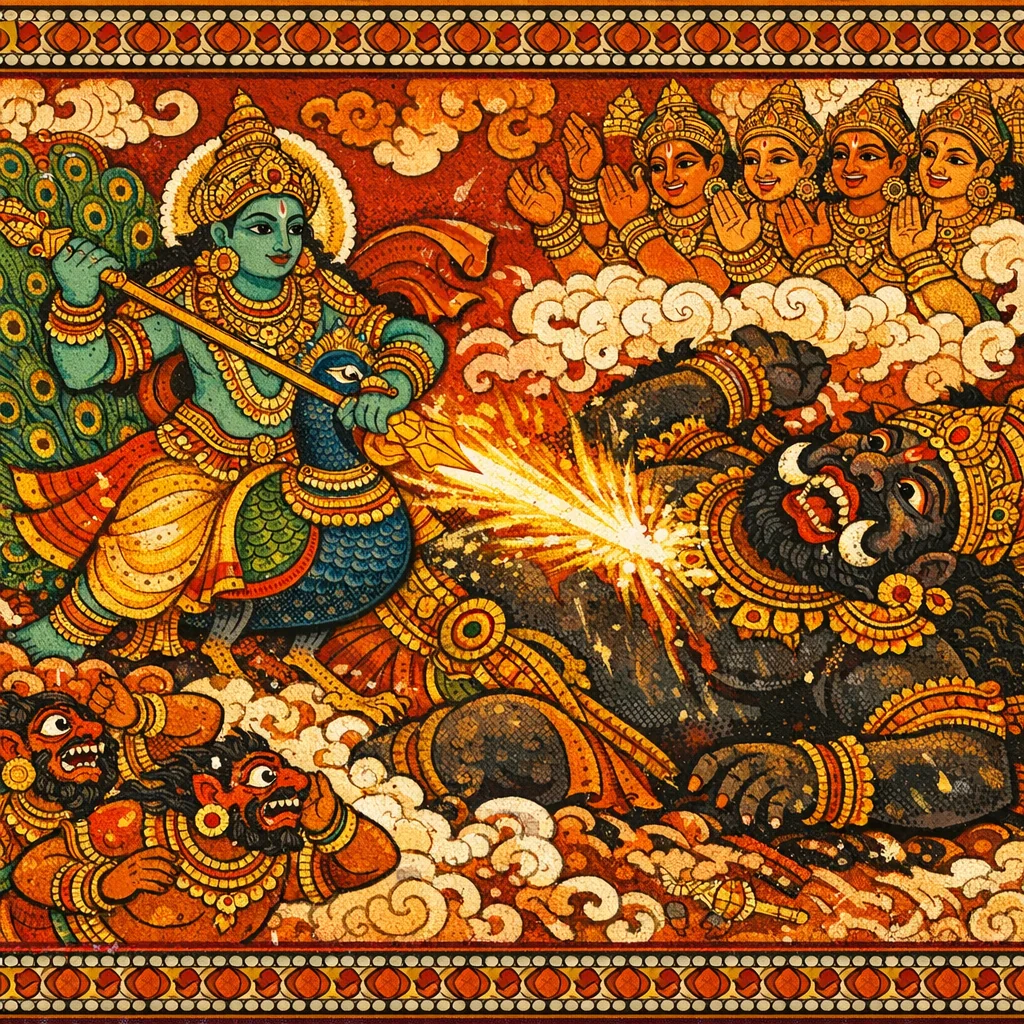
Adhyaya 160: The Slaying of Tāraka: Skanda’s Śakti and the Victory of the Devas
तारकवधः (स्कन्दशक्तिप्रहारः)
Speaker: Sūta, Tāraka, Kumāra/Skanda (Ṣaṇmukha), Devas (collective)
Adhyāya 160 continues Sūta’s narration of the Deva–Asura conflict culminating in Tāraka’s destined death at the hands of a “mere boy,” Kumāra/Skanda. Hearing the divine bards, Tāraka recalls Brahmā’s boon-condition and is shaken, while the Daityas rally under Kālanemi. A sharp philosophical subtext appears in Kumāra’s rebuttal: śāstra is not mere book-learning but is verified in the crucible of action; youth is not a measure of spiritual power, as with the “young” sun that is still unbearable to gaze upon. The battle escalates through successive weapons—mace, bhindipāla, arrows—until Skanda’s spotless śakti pierces Tāraka’s thunderbolt-hard heart, fulfilling fate (kāla) and restoring cosmic order. The chapter closes with a phalaśruti: reciting or hearing Skanda’s narrative grants fame, longevity, prosperity, fearlessness, freedom from sorrow, release from sins (after Sandhyā), and finally sāyujya with Ṣaṇmukha. This frames heroic myth as a devotional, merit-producing practice.
Key Concepts
Shlokas in Adhyaya 160
Verse 1
*सूत उवाच श्रुत्वैतत्तारकः सर्वम् उद्घुष्टं देवबन्दिभिः सस्मार ब्रह्मणो वाक्यं वधं बालादुपस्थितम् //
Sūta said: Having heard all that was loudly proclaimed by the gods’ bards, Tāraka remembered Brahmā’s pronouncement—that his death was imminent and would come at the hands of a mere boy.
Verse 2
स्मृत्वा घर्मार्द्रसर्वाङ्गः पदातिरपदानुगः मन्दिरान्निर्जगामाशु शोकग्रस्तेन चेतसा //
Remembering (what had occurred), his whole body drenched with sweat, he went out swiftly from the palace on foot, his mind overwhelmed by grief.
Verse 3
कालनेमिमुखा दैत्याः संरम्भाद्भ्रान्तचेतसः स्वे स्वे स्वनीकेषु तदा त्वराविस्मितचेतसः योधा धावत गृहीत योजयध्वं वरूथिनीम् //
Then the Daityas led by Kālanemi—minds thrown into confusion by wrath and agitation—rushed back to their own divisions. In hurried astonishment they cried, “Warriors, run! Seize your arms and harness the battle-array (the marching host)!”
Verse 4
कुमारं तारको दृष्ट्वा बभाषे भीषणाकृतिः किं बाल योद्धुकामो ऽसि क्रीड कन्दुकलीलया //
Seeing Kumāra, Tāraka—of terrifying form—spoke: “What is this, child? Do you wish to fight? Go on, play instead with ball-games and childish sport.”
Verse 5
त्वया न दानवा दृष्टा यत्सङ्गरविभीषकाः बालत्वादथ ते बुद्धिर् एवं स्वल्पार्थदर्शिनी //
You have not yet seen the Dānavas—those who are terrifying in the clash of battle. Because of your youth, your understanding is thus narrow, seeing only a small part of the matter.
Verse 6
कुमारो ऽपि तमग्रस्थं बभाषे हर्षयन्सुरान् शृणु तारक शास्त्रार्थस् तव चैव निरूप्यते //
Even the youthful Kumāra addressed him as he stood at the fore, delighting the gods: “Listen, Tāraka—now the true purport of the sacred teaching will be set forth for you as well.”
Verse 7
शास्त्रैरर्था न दृश्यन्ते समरे निर्भयैर्भटैः शिशुत्वं मावमंस्था मे शिशुः कालभुजंगमः //
In the clash of battle, the true import of the treatises is not ‘seen’ (i.e., cannot be applied as mere book-knowledge) by soldiers who stand fearless. Do not despise my ‘childhood’—this child of mine is a serpent with the jaws of Time (Death) itself.
Verse 8
दुष्प्रेक्ष्यो भास्करो बालस् तथाहं दुर्जयः शिशुः अल्पाक्षरो न मन्त्रः किं सुस्फुरो दैत्य दृश्यते //
Even the Sun, though (as it were) young, is hard to gaze upon; in the same way I too—though appearing as a mere child—am unconquerable. A mantra is not to be dismissed for having few syllables; then why should a radiant Daitya be regarded as insignificant (or easily faced)?
Verse 9
कुमारे प्रोक्तवत्येवं दैत्यश्चिक्षेप मुद्गरम् कुमारस्तं निरस्याथ वज्रेणामोघवर्चसा //
When Kumāra had spoken thus, the Daitya hurled a mace. Kumāra, of unfailing splendor, struck it aside and then (answered) with his thunderbolt-like weapon.
Verse 10
ततश्चिक्षेप दैत्येन्द्रो भिन्दिपालमयोमयम् करेण तच्च जग्राह कार्तिकेयो ऽमरारिहा //
Then the lord of the Daityas hurled an iron bhindipāla (a javelin-like spear). But Kārtikeya—the slayer of the enemies of the gods—seized it with his hand.
Verse 11
गदां मुमोच दैत्याय षण्मुखः परमस्वनाम् तया हतस्ततो दैत्यश् चकम्पे ऽचलराडिव //
Ṣaṇmukha (Skanda) hurled at the Daitya a mace that roared with an overwhelming sound; struck by it, the demon reeled and trembled like the king of mountains.
Verse 12
मेने च दुर्जयं दैत्यस् तदा षड्वदनं रणे चिन्तयामास बुद्ध्या वै प्राप्तः कालो न संशयः //
And then the Daitya judged the six-faced one to be unconquerable in battle; reflecting with his mind, he concluded: “The destined hour has arrived—there is no doubt.”
Verse 13
कुपितं तु तमालोक्य कालनेमिपुरोगमाः सर्वे दैत्येश्वरा जघ्नुः कुमारं रणदारुणम् //
But seeing him enraged, all the lords of the Dānavas—led by Kālanemi—struck down the youthful warrior (Kumāra), fierce in the terrors of battle.
Verse 14
स तैः प्रहारैरस्पृष्टो वृथाक्लेशैर्महाद्युतिः रणशौण्डास्तु दैत्येन्द्राः पुनः प्रासैः शिलीमुखैः //
Untouched by those blows—making the attackers’ exertions futile—the greatly radiant one remained unshaken. But the battle-hardened lords of the Daityas once again assailed him with spears and sharp arrows.
Verse 15
कुमारं सामरं जघ्नुर् बलिनो देवकण्टकाः कुमारस्य व्यथा नाभूद् दैत्यास्त्रनिहतस्य तु //
The mighty Daityas—thorn-like enemies of the gods—struck Kumāra (Skanda) in the midst of battle. Yet Kumāra felt no pain at all, though he had been hit by the Daityas’ weapons.
Verse 16
प्राणान्तकरणो जातो देवानां दानवाहवः देवान्निपीडितान्दृष्ट्वा कुमारः कोपमाविशत् //
A Dānava champion arose—one who brought death to the gods. Seeing the devas oppressed and tormented, Kumāra was seized by wrath.
Verse 17
ततो ऽस्त्रैर्वारयामास दानवानामनीकिनीम् ततस्तैर् निष्प्रतीकरैस् ताडिताः सुरकण्टकाः //
Then he checked the army of the Dānavas with missiles; and thereafter those thorn-like foes of the gods were struck down, left without any effective countermeasure.
Verse 18
कालनेमिमुखाः सर्वे रणादासन्पराङ्मुखाः विद्रुतेष्वथ दैत्येषु हतेषु च समन्ततः //
Led by Kālanemi, all of them turned their backs and fled from the battlefield; and as the Daityas were routed—many being slain on every side—the field was strewn with their fallen.
Verse 19
ततः क्रुद्धो महादैत्यस् तारको ऽसुरनायकः जग्राह च गदां दिव्यां हेमजालपरिष्कृताम् //
Then, enraged, the mighty Daitya Tāraka—the leader of the Asuras—seized a celestial mace, adorned with an intricate net-work of gold.
Verse 20
जघ्ने कुमारं गदया निष्टप्तकनकाङ्गदः शरैर्मयूरपत्रैश्च चकार विमुखान्सुरान् //
Wearing armlets of heated gold, he struck down Kumāra with a mace; and with arrows—feathered like peacock plumes—he made the gods turn back in retreat.
Verse 21
तथा परैर्महाभल्लैर् मयूरं गुहवाहनम् बिभेद तारकः क्रुद्धः स सैन्ये ऽसुरनायकः //
Likewise, the enraged Tāraka—leader of the asuras amid his army—pierced with other great barbed darts the peacock that served as Guha’s mount.
Verse 22
दृष्ट्वा पराङ्मुखान्देवान् मुक्तरक्तं स्ववाहनम् जग्राह शक्तिं विमलां रणे कनकभूषणाम् //
Seeing the gods turned away (in retreat), and his own mount freed from its bloodied state, he seized in battle a spotless śakti (spear)—adorned with gold ornaments.
Verse 23
बाहुना हेमकेयूररुचिरेण षडाननः ततो जवान्महासेनस् तारकं दानवाधिपम् //
Then Ṣaḍānana (Skanda), whose arm shone with a golden armlet, swift and as the great commander of hosts, charged at Tāraka, the lord of the Dānavas.
Verse 24
तिष्ठ तिष्ठ सुदुर्बुद्धे जीवलोकं विलोकय हतो ऽस्यद्य मया शक्त्या स्मर शस्त्रं सुशिक्षितम् //
“Stand—stand, you foolish-minded one! Look upon the world of the living. Today he is slain by me with my spear-power. Remember the weapon you were well-trained in!”
Verse 25
इत्युक्त्वा च ततः शक्तिं मुमोच दितिजं प्रति सा कुमारभुजोत्सृष्टा तत्केयूररवानुगा बिभेद दैत्यहृदयं वज्रशैलेन्द्रकर्कशम् //
Having spoken thus, he then hurled the śakti (spear) toward the son of Diti. Released from Kumāra’s arm, accompanied by the clang of his armlet, it pierced the demon’s heart—hard as a thunderbolt and as rugged as a mountain peak.
Verse 26
गतासुः स पपातोर्व्यां प्रलये भूधरो यथा विकीर्णमुकुटोष्णीषो विस्रस्ताखिलभूषणः //
Bereft of life, he fell upon the earth—like a mountain collapsing at the time of cosmic dissolution (pralaya)—his crown and diadem scattered, and all his ornaments loosened and cast down.
Verse 27
तस्मिन्विनिहते दैत्ये त्रिदशानां महोत्सवे नाभूत् कश्चित् तदा दुःखी नरकेष्वपि पापकृत् //
When that demon had been slain and the gods were holding a great festival, at that time no one was unhappy— not even a sinner in the hells.
Verse 28
स्तुवन्तः षण्मुखं देवाः क्रीडन्तश्चाङ्गनायुताः जग्मुः स्वानेव भवनान् भूरिधामान उत्सुकाः //
Praising Ṣaṇmukha, the gods—sporting together with their celestial maidens—eagerly went back to their own splendid, radiant dwellings.
Verse 29
ददुश्चापि वरं सर्वे देवाः स्कन्दमुखं प्रति तुष्टाः सम्प्राप्तसर्वेच्छाः सह सिद्धैस्तपोधनैः //
Then all the gods, pleased, granted a boon in Skanda’s presence; and together with the perfected sages—those rich in austerity—they had attained the fulfillment of all their desires.
Verse 30
*देवा ऊचुः यः पठेत्स्कन्दसम्बद्धां कथां मर्त्यो महामतिः शृणुयाच्छ्रावयेद्वापि स भवेत्कीर्तिमान्नरः //
The gods said: Any mortal of great understanding who recites this narrative connected with Skanda—or who listens to it, or causes it to be recited—becomes a person of lasting fame.
Verse 31
बह्वायुः सुभगः श्रीमान् कान्तिमाञ्छुभदर्शनः भूतेभ्यो निर्भयश्चापि सर्वदुःखविवर्जितः //
He becomes long-lived, fortunate, and prosperous—radiant and pleasing to behold; fearless among all beings as well, and completely free from every sorrow.
Verse 32
संध्यामुपास्य यः पूर्वां स्कन्दस्य चरितं पठेत् स मुक्तः किल्बिषैः सर्वैर् महाधनपतिर्भवेत् //
Whoever, having first performed Sandhyā worship, recites the account of Skanda’s deeds becomes freed from all sins and attains the status of a great lord of wealth.
Verse 33
बालानां व्याधिजुष्टानां राजद्वारं च सेवताम् इदं तत्परमं दिव्यं सर्वदा सर्वकामदम् तनुक्षये च सायुज्यं षण्मुखस्य व्रजेन्नरः //
For children, for those afflicted by disease, and for those who serve at the king’s gate, this is declared the supreme, divine means—ever granting all desired aims. And when the body falls away, a man goes to union (sāyujya) with Ṣaṇmukha, entering his realm.
Frequently Asked Questions
The chapter teaches that destiny (kāla) fulfills Brahmā’s boon-condition through Skanda, and that true śāstra is not merely theoretical—its meaning is realized in decisive, dharmic action. It also frames devotion to Skanda’s narrative (hearing/reciting) as a spiritually effective practice with explicit results (phalaśruti).
This adhyāya is primarily Itihāsa-style Deva–Asura narrative and Dharma in the sense of cosmic order restored by Skanda. It does not teach Vastu-śāstra measurements or genealogical lists; instead it emphasizes heroic theology, the role of fate/time, and the merit of kathā-recitation.
The devas declare that one who recites, hears, or commissions the recitation becomes famous, long-lived, fortunate, prosperous, radiant, fearless, and free from sorrow. If one recites after performing Sandhyā, one is freed from sins and attains great wealth/status; at death one attains sāyujya (union) with Ṣaṇmukha in his realm.
Tāraka remembers Brahmā’s pronouncement that his death is imminent and will occur by a boy. Skanda/Kumāra—though youthful in appearance—embodies divine power; the boon’s limitation becomes the mechanism of his fall when Skanda’s śakti pierces his heart.