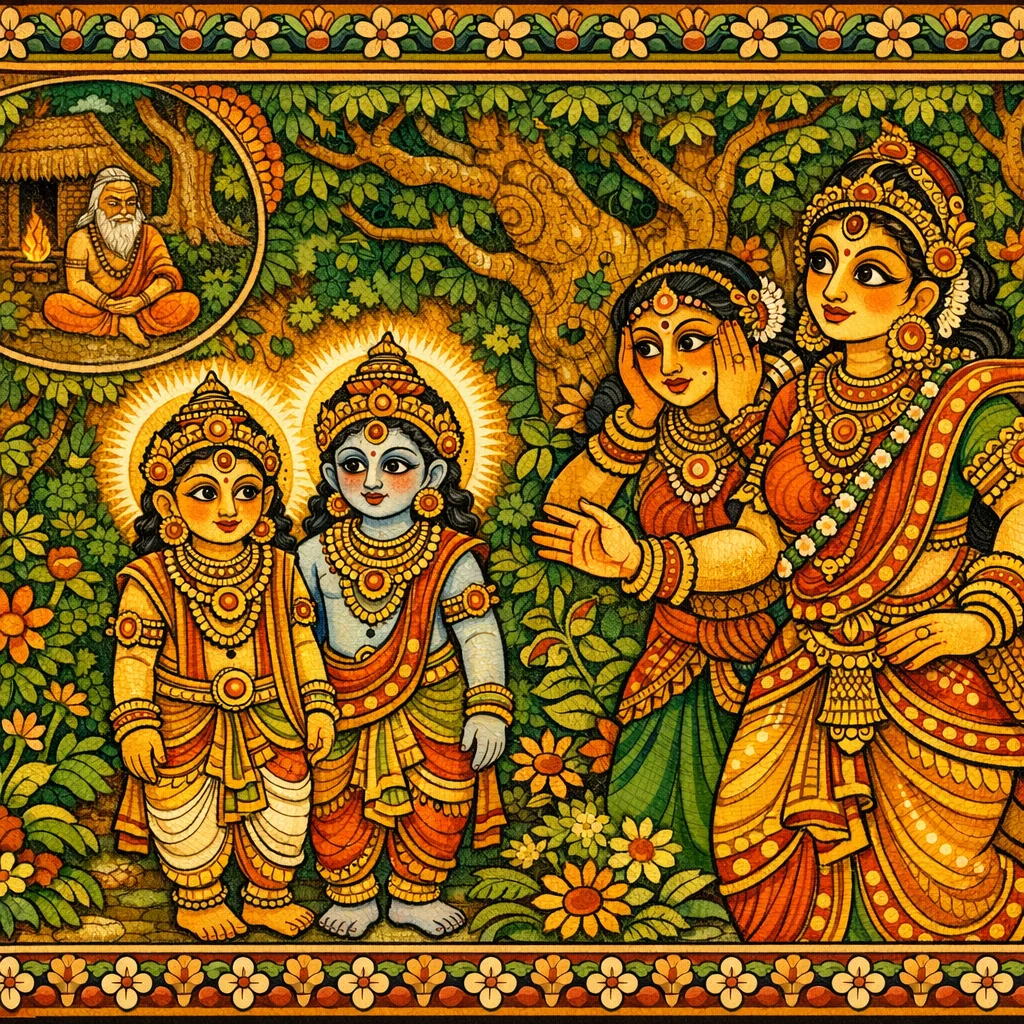
Adhyaya 32: Devayānī–Śarmiṣṭhā Dialogue: Yayāti’s Transgression, Śukra’s Curse, and the Transfer of Old Age
देवयानी-शर्मिष्ठा-संवादः । ययाति-शापो जरासंक्रान्तिश्च
Speaker: Śaunaka (narrator), Devayānī, Śarmiṣṭhā, Yayāti, Śukra (Kāvya Uśanas / Śukrācārya)
Śaunaka recounts Devayānī’s anguish on hearing that Śarmiṣṭhā has borne a child, and her confrontation with Śarmiṣṭhā, who insists the child was granted by a righteous Vedic sage and that she acted within dharma. Devayānī accepts this yet asks how a true dvija is known beyond outward lineage marks. The genealogical outcomes are stated: Devayānī bears Yadu and Turvasu; Śarmiṣṭhā bears Druhyu, Anu, and Pūru. In the forest Devayānī sees divine-looking boys resembling the king; their presence exposes the hidden sons and deepens her grievance. She appeals to her father Śukra, accusing Yayāti of violating maryādā (proper bounds). Śukra curses Yayāti with immediate jarā (old age). Yayāti defends himself by citing ṛtu-dharma: refusing a wife in her fertile season is a grave sin according to Veda-teachers. Śukra upholds the curse’s truth yet offers a remedy—Yayāti may transfer his old age to another without sin if done while meditating on Śukra’s authority, promising kingship and fame to the son who gives his youth.
Key Concepts
Shlokas in Adhyaya 32
Verse 1
*शौनक उवाच श्रुत्वा कुमारं जातं सा देवयानी शुचिस्मिता चिन्तयाविष्टदुःखार्ता शर्मिष्ठां प्रति भारत //
Śaunaka said: Hearing that a son had been born, Devayānī—she of the pure smile—was overwhelmed by anxious thoughts and stricken with sorrow; she turned her mind toward Śarmiṣṭhā, O Bhārata.
Verse 2
ततो ऽभिगम्य शर्मिष्ठां देवयान्यब्रवीदिदम् किमर्थं वृजिनं सुभ्रूः कृतं ते कामलुब्धया //
Then Devayānī approached Śarmiṣṭhā and said: “For what reason, O fair-browed one, have you committed this wrongdoing, driven by lust?”
Verse 3
*शर्मिष्ठोवाच ऋषिर् अभ्यागतः कश्चिद् धर्मात्मा वेदपारगः स मया तु वरः कामं याचितो धर्मसंहतम् //
Śarmiṣṭhā said: “A certain sage came to us—righteous in nature and perfected in Vedic learning. From him I sought, as I wished, a boon that was in harmony with dharma.”
Verse 4
नाहमन्यायतः कामम् आचरामि शुचिस्मिते तस्माद् ऋषेर् ममापत्यम् इति सत्यं ब्रवीमि ते //
O pure-smiling one, I do not indulge desire in an unrighteous manner; therefore I tell you the truth: “The child is mine through the sage.”
Verse 5
*देवयान्युवाच पद्येतदेवं शर्मिष्ठे न मन्युर्विद्यते मम अपत्यं यदि ते लब्धं ज्येष्ठाच्छ्रेष्ठाच्च वै द्विजात् //
Devayānī said: “So be it, Śarmiṣṭhā—there is no anger in me. If you have obtained offspring from that twice-born man who is elder and more eminent, then let it be so.”
Verse 6
शोभनं भीरु सत्यं चेत् कथं स ज्ञायते द्विजः गोत्रनामाभिजनतः श्रोतुमिच्छामि तं द्विजम् //
O gentle one, if truth is indeed the mark of what is noble, then how is a ‘dvija’ (twice-born man) to be recognized? Is it by lineage—by gotra, name, and family descent? I wish to hear of that true dvija.
Verse 7
*शर्मिष्ठोवाच ओजसा तेजसा चैव दीप्यमानं रविं यथा तं दृष्ट्वा मम संप्रष्टुं शक्तिर् नासीच्छुचिस्मिते //
Śarmiṣṭhā said: “He blazed with vigor and tejas, like the sun aflame. On seeing him, O you of pure smile, I had no strength to question him.”
Verse 8
*शौनक उवाच अन्योन्यमेवम् उक्त्वा च सम्प्रहस्य च ते मिथः जगाम भार्गवी वेश्म तथ्यमित्यभिजानती //
Śaunaka said: Having thus spoken to one another, and after they had laughed together in mutual good humour, the Bhārgavī woman went to her home, recognizing it as the truth.
Verse 9
ययातिर्देवयान्यां तु पुत्राव् अजनयन्नृपः यदुं च तुर्वसुं चैव शक्रविष्णू इवापरौ //
King Yayāti, through Devayānī, begot two sons—Yadu and Turvasu—who were like Indra and Viṣṇu in their prowess, as it were, in another form.
Verse 10
तस्मादेव तु राजर्षेः शर्मिष्ठा वार्षपर्वणी द्रुह्यं चानुं च पूरुं च त्रीन्कुमारानजीजनत् //
From that royal sage, Śarmiṣṭhā—the daughter of Vṛṣaparvan—gave birth to three sons: Druhyu, Anu, and Pūru.
Verse 11
ततः काले च कस्मिंश्चिद् देवयानी शुचिस्मिता ययातिसहिता राजञ् जगाम हरितं वनम् //
Then, at a certain time, Devayānī—smiling with pure grace—together with Yayāti, O King, went to the green forest.
Verse 12
ददर्श च तदा तत्र कुमारान्देवरूपिणः क्रीडमानान् तु विस्रब्धान् विस्मिता चेदमब्रवीत् //
Then, there she saw youthful boys of divine appearance, playing about with complete ease and confidence; astonished, she spoke these words.
Verse 13
*देवयान्युवाच कस्यैते दारका राजन् देवपुत्रोपमाः शुभाः वर्चसा रूपतश्चैव दृश्यन्ते सदृशास्तव //
Devayānī said: “O King, whose are these boys—auspicious, like sons of the gods? In brilliance and in beauty they appear, and they seem to resemble you.”
Verse 14
एवं पृष्ट्वा तु राजानं कुमारान्पर्यपृच्छत किं नामधेयगोत्रे वः पुत्रका ब्राह्मणः पिता //
Having thus questioned the king, she then closely questioned the princes: “O sons, what are your name and gotra (lineage)? And who is your Brahmin father?”
Verse 15
विब्रूत मे यथातथ्यं श्रोतुकामास्म्यतो ह्य् अहम् ते ऽदर्शयन्प्रदेशिन्या तमेव नृपसत्तमम् //
“Tell me the matter exactly as it truly is, for I am eager to hear it.” Then they pointed out—indicating the very spot—that same best of kings.
Verse 16
शर्मिष्ठां मातरं चैव तस्या ऊचुः कुमारकाः *शौनक उवाच इत्युक्त्वा सहितास्तेन राजानम् उपचक्रमुः //
The young boys spoke to Śarmiṣṭhā and to her mother. Śaunaka said: Having thus spoken, they all went together and approached the king.
Verse 17
नाभ्यनन्दत तान्राजा देवयान्यास् तदान्तिके रुदन्तस्ते ऽथ शर्मिष्ठाम् अभ्ययुर् बालकास्तदा //
The king did not welcome them when they were near Devayānī. Then those boys, weeping, went to Śarmiṣṭhā.
Verse 18
दृष्ट्वा तेषां तु बालानां प्रणयं पार्थिवं प्रति बुद्ध्वा च तत्त्वतो देवी शर्मिष्ठामिदमब्रवीत् //
Seeing the affection of those young maidens toward the king, and understanding the matter truly, the noble lady Śarmiṣṭhā spoke these words.
Verse 19
*देवयान्युवाच मदधीना सती कस्माद् अकार्षीर्विप्रियं मम तमेवासुरधर्मं त्वम् आस्थिता न बिभेषि किम् //
Devayānī said: “Though you live under my authority, why have you done what is displeasing to me? You have taken to that very ‘Asura-way’—are you not afraid?”
Verse 20
*शर्मिष्ठोवाच यदुक्तमृषिरित्येव तत्सत्यं चारुहासिनि न्यायतो धर्मतश्चैव चरन्ती न बिभेमि ते //
Śarmiṣṭhā said: “What the sage has stated is indeed true, O you of charming smile. Since I act in accordance with justice and with dharma, I do not fear you.”
Verse 21
यदा त्वया वृतो राजा वृत एव तदा मया सखीभर्ता हि धर्मेण भर्ता भवति शोभने //
When the king has been chosen by you, he is then chosen by me as well; for, O lovely one, by the rule of dharma the husband of one’s friend becomes a husband to the other too.
Verse 22
पूज्यासि मम मान्या च श्रेष्ठा ज्येष्ठा च ब्राह्मणी त्वत्तो हि मे पूज्यतरो राजर्षिः किं न वेत्सि तत् //
You are worthy of my worship and respect—noble, foremost, and elder, O Brahmin lady. Yet higher than you in my reverence is the royal sage; do you not know this?
Verse 23
*शौनक उवाच श्रुत्वा तस्यास्ततो वाक्यं देवयान्यब्रवीद् इदम् राजन्नाद्येह वत्स्यामि विप्रियं मे त्वया कृतम् //
Śaunaka said: Having heard her words, Devayānī then spoke this to the king: “O King, from today I will remain here; you have done what is displeasing to me.”
Verse 24
सहसोत्पतितां श्यामां दृष्ट्वा तां साश्रुलोचनाम् तूर्णं सकाशं काव्यस्य प्रस्थितां व्यथितस्तदा //
Seeing Śyāmā suddenly rise up—her eyes filled with tears—and hasten away toward Kāvyā’s presence, he was distressed at that moment.
Verse 25
अनुवव्राज संभ्रान्तः पृष्ठतः सान्त्वयन्नृपः न्यवर्तत न सा चैव क्रोधसंरक्तलोचना //
Agitated, the king followed after her from behind, trying to soothe her; but she did not turn back at all—her eyes were reddened with anger.
Verse 26
अविब्रुवन्ती किंचिच्च राजानं साश्रुलोचना अचिरादेव सम्प्राप्ता काव्यस्योशनसो ऽन्तिकम् //
Without speaking anything to the king, her eyes brimming with tears, she soon approached the presence of Kāvya Uśanas (Śukrācārya).
Verse 27
सा तु दृष्ट्वैव पितरम् अभिवाद्याग्रतः स्थिता अनन्तरं ययातिस्तु पूजयामास भार्गवम् //
As soon as she saw her father, she bowed to him and stood before him. Thereafter, King Yayāti duly honored Bhārgava, the sage of the Bhṛgu lineage.
Verse 28
*देवयान्युवाच अधर्मेण जितो धर्मः प्रवृत्तमधरोत्तरम् शर्मिष्ठा यातिवृत्तास्ति दुहिता वृषपर्वणः //
Devayānī said: “By unrighteousness (adharma), righteousness (dharma) has been overcome; the order of higher and lower has been turned upside down. Śarmiṣṭhā—daughter of Vṛṣaparvan—has overstepped the bounds with Yayāti, acting improperly toward him.”
Verse 29
त्रयो ऽस्यां जनिताः पुत्रा राज्ञानेन ययातिना दुर्भगाया मम द्वौ तु पुत्रौ तात ब्रवीमि ते //
By King Yayāti, three sons were born to her. But as for me, the unfortunate one—dear father—I tell you: two sons were born to me (through that affair, by her involvement).
Verse 30
धर्मज्ञ इति विख्यात एष राजा भृगूद्वह अतिक्रान्तश्च मर्यादां काव्यैतत्कथयामि ते //
O best of the Bhṛgus, this king was famed as “the knower of dharma”; yet he overstepped the proper bounds. I shall relate to you this very account, as handed down in the line of Kāvya (Śukra).
Verse 31
*शुक्र उवाच धर्मज्ञस्त्वं महाराज यो ऽधर्मम् अकृथाः प्रियम् तस्माज्जरा त्वाम् अचिराद् धर्षयिष्यति दुर्जया //
Śukra said: “O great king, though you know dharma, you have made unrighteousness your delight. Therefore, before long, invincible old age (jarā) will overpower you.”
Verse 32
*ययातिरुवाच ऋतुं यो याच्यमानाया न ददाति पुमान्वृतः भ्रूणहेत्युच्यते ब्रह्मन् स चेह ब्रह्मवादिभिः //
Yayāti said: “O Brahmin, the man who—though fit and obligated—does not grant his wife access in her fertile season when she asks, is declared a ‘slayer of the embryo’; so it is stated here by those who expound the Veda.”
Verse 33
ऋतुकामां स्त्रियं यस्तु गम्यां रहसि याचितः नोपैति यो हि धर्मेण ब्रह्महेत्युच्यते बुधैः //
If a woman who is in her fertile season and is lawfully approachable privately invites a man, yet he does not go to her in accordance with dharma, the wise declare him to be ‘as guilty as a slayer of a Brahmin’ (brahma-hatyā).
Verse 34
इत्येतानि समीक्ष्याहं कारणानि भृगूद्वह अधर्मभयसंविग्नः शर्मिष्ठाम् उपजग्मिवान् //
“Having thus considered these causes, O best of the Bhṛgus, and being shaken by fear of unrighteousness, I approached Śarmiṣṭhā.”
Verse 35
*शुक्र उवाच न त्व् अहं प्रत्यवेक्ष्यस्ते मदधीनो ऽसि पार्थिव मिथ्याचरणधर्मेषु चौर्यं भवति नाहुष //
Śukra said: “I am not one to be questioned by you; O king, you are under my authority. O Nāhuṣa, in the codes of false and unrighteous conduct, theft indeed arises.”
Verse 36
*शौनक उवाच क्रोधेनोशनसा शप्तो ययातिर्नाहुषस्तदा पूर्वं वयः परित्यज्य जरां सद्यो ऽन्वपद्यत //
Śaunaka said: Then King Yayāti, son of Nahusha, cursed in anger by Uśanas (Śukra), at once abandoned his former youth and instantly fell into old age.
Verse 37
*ययातिरुवाच अतृप्तो यौवनस्याहं देवयान्यां भृगूद्वह प्रसादं कुरु मे ब्रह्मञ् जरेयं मा विशेत माम् //
Yayāti said: “I am not satisfied with youth, O Devayānī. O best of the Bhṛgus, O Brāhmaṇa—show me your favor; let old age not enter into me.”
Verse 38
*शुक्र उवाच नाहं मृषा वदाम्येतज् जरां प्राप्तो ऽसि भूमिप जरां त्व् एतां त्वमन्यस्मिन् संक्रामय यदीच्छसि //
Śukra said: “I do not speak falsely in this matter. O king, you have been overtaken by old age. If you wish, transfer this very old age of yours into another.”
Verse 39
*ययातिरुवाच राज्यभाक् स भवेद्ब्रह्मन् पुण्यभाक्कीर्तिभाक्तथा यो दद्यान्मे वयः पुत्रस् तद्भवाननुमन्यताम् //
Yayāti said: “O Brāhmaṇa, that son who would grant me his youth would become a sharer in the kingdom, and likewise a recipient of merit and fame. May you consent to this.”
Verse 40
*शुक्र उवाच संक्रामयिष्यसि जरां यथेष्टं नहुषात्मज मामनुध्याय तत्त्वेन न च पापमवाप्स्यसि //
Śukra said: “O son of Nahusha, you shall transfer old age as you desire. Meditating upon me in truth, you will not incur any sin.”
Verse 41
वयो दास्यति ते पुत्रो यः स राजा भविष्यति आयुष्मान्कीर्तिमांश्चैव बह्वपत्यस् तथैव च //
Your son will sustain you in old age; he will become king, long-lived and renowned, and likewise blessed with many offspring.
Frequently Asked Questions
The chapter teaches that even a dharma-known king can fall by crossing maryādā (proper limits), and that dharma disputes often hinge on competing authorities—social hierarchy, conjugal duty (ṛtu-dharma), and the guru’s sanction. Śukra’s curse establishes accountability, while the permitted jarā-saṅkrānti remedy shows that consequences may be mitigated only through an authorized, ethically bounded transfer that tests responsibility and merit.
This adhyāya is primarily Genealogy and Dharma/Rajadharma. It lists Yayāti’s five sons—Yadu, Turvasu, Druhyu, Anu, and Pūru—forming major royal lineages, and debates dharma regarding dvija identity, marital obligation during ṛtu, and the king’s conduct under Śukra’s authority. Vastu/architecture is not treated in this chapter.
Śukra curses Yayāti because Devayānī reports that Yayāti violated proper bounds by taking Śarmiṣṭhā against her wishes and by indulging in conduct deemed adharmic under Śukra’s guardianship. The curse manifests instantly as jarā, dramatizing the idea that royal power does not override moral and familial authority.
Yayāti argues that a man who refuses a wife seeking union in her fertile season commits a grave fault, compared by Veda-expositors to embryo-slaying and even brahma-hatyā in severity. He presents this as his dharmic rationale for approaching Śarmiṣṭhā, though Śukra rejects it as justification for the broader breach of conduct.
Jarā-saṅkrānti is the permitted transfer of Yayāti’s old age into another person, offered by Śukra as a conditional remedy after the curse. Śukra states the curse is not false, but allows Yayāti to shift jarā if he does so under Śukra’s true contemplation/authority, with the recipient (later sought among sons) gaining kingship-share, merit, and fame.