Adhyaya 279
श्रेयो-धर्मकर्मविचारः (Inquiry into Śreyas, Dharma, and Karma)
Upa-parva: Mokṣa-dharma / Karma and Ethical Discipline Discourse (Śānti-parva instructional cycle)
Yudhiṣṭhira requests further instruction from Bhīṣma on what constitutes the highest good (śreyas), stating that he is not satiated by Bhīṣma’s words. He asks what auspicious action enables a person to attain the supreme welfare both here and after death. Bhīṣma responds by recounting a precedent: King Janaka once questioned the sage Parāśara on the same problem—what is beneficial for all beings in this world and the next and what should be practiced. Parāśara’s reply identifies dharma performed (dharma eva kṛtaḥ) as the highest good, asserting the continuity of karmic consequence. The chapter outlines karma as fourfold in modality—by eye (perception/intent), mind, speech, and bodily action—and insists that beings experience results corresponding to what they do, with no transfer of another’s merit or demerit. It critiques simplistic appeals to daiva (fate) by stressing svabhāva and prior action as explanatory principles, and it describes mixed and delayed fruition of deeds. A compact virtue-list is offered as conducive to well-being: self-restraint (dama), forgiveness (kṣamā), steadiness (dhṛti), vigor (tejas), contentment (saṃtoṣa), truthfulness, modesty, non-harm, freedom from addiction, and competence. The closing cautions against envy and depicts socially lamentable types (e.g., truth-deviant or duty-deficient figures), functioning as a negative ethical mirror for governance and personal conduct.
Chapter Arc: शुक्राचार्य दैत्यराज को संबोधित कर आकाश सहित पृथ्वी को धारण करने वाले, अनन्त-शिरोमणि भगवान् विष्णु को नमस्कार करके उनके माहात्म्य का उपदेश आरम्भ करते हैं। → विष्णु-तत्त्व को विश्व-रचना के भीतर प्रतिष्ठित दिखाया जाता है—सूर्य, चन्द्र, बुद्धि, रस, पृथ्वी-स्वर्ग आदि को उनके अंग-प्रत्यंग रूप में रखकर श्रोता की दृष्टि को सीमित देह-भाव से विराट् पुरुष की ओर मोड़ा जाता है; साथ ही संहार-काल की भयावहता और प्रजा-देवगण के ब्रह्मा की शरण में जाने का प्रसंग उठता है। → वृत्र का वचन—उपदेश सुनकर उसका विषाद गलता है; वह स्वयं को विकल्मष, विपाप्मा अनुभव करता है और सत्य-दृष्टि (सम्यक् पश्यामि) प्राप्त होने की घोषणा करता है—यही ‘वृत्रगीता’ का निर्णायक मोड़ है, जहाँ दैत्य-भाव पर ज्ञान की विजय होती है। → ज्ञानाग्नि द्वारा सूक्ष्म-स्थूल बन्धनों के दग्ध होने, संहार-काल में भी परम आश्रय की उपलब्धि, और विष्णु-परायणता/ज्ञान-परायणता के फल का निष्कर्ष स्थापित होता है; भीष्म युधिष्ठिर को आश्वस्त करते हैं कि पाण्डव शुद्ध आचरण से देव-लोक के सुख भोगकर पुनः मानव-लोक में धर्मपूर्वक लौटेंगे और सिद्धि को प्राप्त होंगे।
Shlokas
Verse 1
शुक्राचार्यने कहा--तात! आकाशसहित यह सारी पृथ्वी जिनकी भुजाओंके बलपर स्थित है, महान् प्रभावशाली उन भगवान् विष्णुदेवको नमस्कार है
Śukrācārya said: “Dear child! Salutations to that Lord Viṣṇu of mighty splendor, upon the strength of whose arms this entire earth—together with the sky—stands supported.”
Verse 2
मूर्धा यस्य त्वनन्तं च स्थानं दानवसत्तम | तस्याहं ते प्रवक्ष्यामि विष्णोमहित्म्यमुत्तमम्
Bhīṣma said: “O best among the Dānavas, I shall now declare to you the supreme greatness of Viṣṇu—of Him whose head is beyond limit and whose abode is Ananta.”
Verse 3
दानवश्रेष्ठ जिनका मस्तक और स्थान भी अनन्त है, उन भगवान् विष्णुका उत्तम माहात्म्य मैं तुम्हें बताऊँगा ।। तयो: संवदतोरेवमाजगाम महामुनि: । सनत्कुमारो धर्मात्मा संशयच्छेदनाय वै,शुक्राचार्य और वृत्रासुरमें ये बातें हो ही रही थीं कि वहाँ महामुनि धर्मात्मा सनत्कुमार उनके संशयका निवारण करनेके लिये आ पहुँचे
Bhīṣma said: “O foremost among the Dānavas, I shall tell you the supreme greatness of Lord Viṣṇu—He whose head and abode are without end. While Śukrācārya and Vṛtrāsura were thus conversing, the great sage Sanatkumāra, righteous in spirit, arrived there in order to cut through their doubt.”
Verse 4
स पूजितोअसुरेन्द्रेण मुनिनोशनसा तथा । निषसादासने राजन महाहें मुनिपुड्रव:,राजन! असुरराज वृत्र और मुनि शुक्राचार्यके द्वारा पूजित हो मुनिवर सनत्कुमार एक बहुमूल्य सिंहासनपर विराजमान हुए
Bhīṣma said: Thus honored by the lord of the Asuras and likewise by the sage Uśanas (Śukrācārya), the foremost of sages took his seat, O king, upon a highly precious throne.
Verse 5
तमासीन महाप्रज्ञमुशना वाक्यमब्रवीत् । ब्रूहास्मे दानवेन्द्राय विष्णोमहित्म्यमुत्तमम्,जब महाज्ञानी सनत्कुमार आरामसे बैठ गये, तब शुक्राचार्यने उनसे कहा--“भगवन्! आप इस दानवराजको भगवान् विष्णुका उत्तम माहात्म्य बताइये”
Bhīṣma said: When the great sage of vast wisdom (Sanatkumāra) was seated at ease, Uśanas (Śukrācārya) addressed him: “Revered one, please recount for us—so that it may be told to the lord of the Dānavas—the supreme greatness of Lord Viṣṇu.”
Verse 6
सनत्कुमारस्तु तत: श्रुत्वा प्राह वचो<र्थवत् । विष्णोमहित्म्यसंयुक्तं दानवेन्द्राय धीमते,यह सुनकर सनत्कुमारजीने बुद्धिमान् दानवराज वृत्रासुरके प्रति भगवान् विष्णुकी महिमासे युक्त यह सार्थक वचन कहा--
Bhishma said: Hearing this, Sanatkumara spoke words of true import—an instruction suffused with the glory of Lord Vishnu—addressed to the wise lord of the Danavas (Vritrasura).
Verse 7
शृणु सर्वमिदं दैत्य विष्णोमहित्म्यमुत्तमम् । विष्णौ जगत् स्थितं सर्वमिति विद्धि परंतप,'शत्रुओंको संताप देनेवाले दैत्य! भगवान् विष्णुका यह सम्पूर्ण उत्तम माहात्म्य सुनो-- तुम्हें यह मालूम होना चाहिये कि यह समस्त संसार भगवान् विष्णुमें ही स्थित है
Bhishma said: “O Daitya, scorcher of foes, listen to this complete and supreme account of Vishnu’s greatness. Know for certain: the entire world abides in Vishnu.”
Verse 8
सृजत्येष महाबाहो भूतग्रामं चराचरम् | एष चाक्षिपते काले काले विसृजते पुन:,“पर महाबाहो! ये श्रीविष्णु ही सम्पूर्ण चराचर प्राणिसमुदायकी सृष्टि करते हैं और ये ही समय आनेपर उसका विनाश करते हैं एवं समय आनेपर पुन: सृष्टि भी करते हैं
Bhishma said: “O mighty-armed one, He brings forth the entire multitude of beings—both moving and unmoving. And He, in due season, draws it back; in due season, He releases it again.”
Verse 9
सनकादि महर्षियोंकी शुक्राचार्य एवं वृत्रासुरसे भेंट अस्मिन् गच्छन्ति विलयमस्माच्च प्रभवन्त्युत । नैष ज्ञानवता शक््यस्तपसा नैव चेज्यया । सम्प्राप्तुमिन्द्रियाणां तु संयमेनैव शक््यते,“समस्त प्राणी इन्हींमें लयको प्राप्त होते हैं और इन्हींसे प्रकट भी होते हैं। इन्हें कोई शास्त्रज्ञान, तपस्या और यज्ञके द्वारा भी नहीं पा सकता। केवल इन्द्रियोंके संयमसे ही उनकी उपलब्धि हो सकती है
Bhishma said: “The great sages beginning with Sanaka met with Shukracharya and Vritrasura. All beings dissolve into this supreme principle and from it they arise again. It cannot be attained merely by scriptural learning, nor by austerity, nor even by sacrifice. It is attainable only through the restraint and mastery of the senses.”
Verse 10
बाहों चाभ्यन्तरे चैव कर्मणोर्मनसि स्थित: । निर्मलीकुरुते बुद्धा सोअमुत्रानन्त्यमश्लुते,“जो बाह्य (यज्ञ आदि) और आशभ्यन्तर (शम, दम आदि) कर्मोमें प्रवृत्त होकर मनके विषयमें स्थिरता प्राप्त करके अर्थात् मनको स्थिर करके बुद्धिके द्वारा उसे निर्मल बनाता है, वह परलोकमें अक्षय सुख (मोक्ष) को प्राप्त कर लेता है
Bhishma said: One who engages in both outward disciplines (such as sacrificial and ritual duties) and inward disciplines (such as self-restraint and sense-control), and who establishes steadiness in the mind—purifying it through discerning intelligence—attains in the hereafter an imperishable, limitless good: liberation.
Verse 11
यथा हिरण्यकर्ता वै रूप्यमग्नौ विशोधयेत् । बहुशो&तिप्रयत्नेन महता55त्मकृतेन ह,“जैसे सोनार बारंबार किये हुए अपने महान् प्रयत्नके द्वारा चाँदीको आगमें डालकर उसे शुद्ध करता है, उसी प्रकार जीव सैकड़ों जन्मोंमें अपने मनको शुद्ध कर पाता है; परंतु इस यज्ञ आदि और शम-दम आदि कर्मोंद्वारा यदि वह महान् प्रयत्न करे तो एक ही जन्ममें शुद्ध हो जाता है
Bhīṣma said: “Just as a goldsmith repeatedly purifies silver by placing it in fire through great, self-applied effort, so too a living being purifies the mind only over hundreds of births. But if one undertakes a great effort through disciplines such as sacrifice and the practices of self-restraint—śama and dama—then one becomes purified in a single birth.”
Verse 12
तद्वज्जातिशतैर्जीव: शुद्धातेडनेन कर्मणा । यत्नेन महता चैवाप्येकजातौ विशुद्धाते,“जैसे सोनार बारंबार किये हुए अपने महान् प्रयत्नके द्वारा चाँदीको आगमें डालकर उसे शुद्ध करता है, उसी प्रकार जीव सैकड़ों जन्मोंमें अपने मनको शुद्ध कर पाता है; परंतु इस यज्ञ आदि और शम-दम आदि कर्मोंद्वारा यदि वह महान् प्रयत्न करे तो एक ही जन्ममें शुद्ध हो जाता है
Bhishma said: “In the same way, the living being becomes purified by this discipline only after hundreds of births. Yet, if one applies great and sustained effort, one can become purified within a single lifetime.”
Verse 13
लीलयाल्पं यथा गात्रात् प्रमूज्यादात्मनो रज: । बहुयत्नेन महता दोषनिर्हरणं तथा,“जैसे अपने शरीरमें लगी हुई थोड़ी-सी धूलको मनुष्य साधारण चेष्टासे खेल-खेलमें ही झाड़-पोछ देता है, उसी प्रकार बारंबार किये हुए महान् प्रयत्नसे वह अपने राग-द्वेष आदि दोषोंको भी दूर कर सकता है
Bhishma said: Just as a person casually brushes off a little dust from the body with an easy, almost playful motion, so too can one remove inner faults—such as attachment and aversion—by sustained and earnest effort repeated over time.
Verse 14
यथा चाल्पेन माल्येन वासितं तिलसर्षपम् । न मुज्चति स्वकं गन्ध॑ तद्वत् सूक्ष्मस्य दर्शनम्,'जैसे थोड़े-से पुष्प एवं मालाद्वारा वासित किया हुआ तिल और सरसोंका तेल अपनी गन्ध नहीं छोड़ता है, उसी प्रकार थोड़े-से प्रयत्नसे न तो दोष दूर होते हैं और न सूक्ष्म ब्रह्मका साक्षात्कार ही हो पाता है
Bhīṣma said: “Just as sesame or mustard, though lightly perfumed with a small garland of flowers, does not give up its own inherent scent, so too the vision of the Subtle (Brahman) is not attained by slight effort—nor are one’s faults removed by a little practice.”
Verse 15
तदेव बहुभिमर्माल्यैर्वास्यथमानं पुनः पुनः । विमुञज्चति स्वकं गन्धं माल्यगन्धे च तिष्ठति,“वही तिल या सरसोंका तेल बहुत-से सुगन्धित पुष्पोंद्वारा बारंबार वासित होनेपर अपनी गन्धको छोड़ देता है और उस फूलकी गन्धमें ही स्थित हो जाता है। उसी प्रकार सैकड़ों जन्मोंमें स्त्री-पुत्र आदिके संसर्गसे युक्त तथा सत्त्व, रज और तम--इन तीनों गुणोंद्वारा प्रवर्तित दोषसमूह बुद्धि तथा अभ्यासजनित यत्नसे निवृत्त हो पाता है
Bhishma said: “That very sesame or mustard oil, when repeatedly perfumed by many fragrant flower-garlands, gives up its own native smell and comes to abide in the fragrance of the garlands. In the same way, the mass of faults that has been set in motion by the three guṇas—sattva, rajas, and tamas—and strengthened through hundreds of births by association with wife, children, and the like, can be brought to cessation through understanding and the sustained effort born of disciplined practice.”
Verse 16
एवं जातिशतैरयुक्तो गुणैरेव प्रसज्धिषु । बुद्धा निवर्तते दोषो यत्नेनाभ्यासजेन ह,“वही तिल या सरसोंका तेल बहुत-से सुगन्धित पुष्पोंद्वारा बारंबार वासित होनेपर अपनी गन्धको छोड़ देता है और उस फूलकी गन्धमें ही स्थित हो जाता है। उसी प्रकार सैकड़ों जन्मोंमें स्त्री-पुत्र आदिके संसर्गसे युक्त तथा सत्त्व, रज और तम--इन तीनों गुणोंद्वारा प्रवर्तित दोषसमूह बुद्धि तथा अभ्यासजनित यत्नसे निवृत्त हो पाता है
Bhīṣma said: Thus, a person bound through hundreds of births—entangled in the play of the guṇas and repeatedly drawn into attachments—can still turn back from fault and moral blemish by awakened understanding and by sustained effort born of disciplined practice. As oil infused again and again with fragrant flowers relinquishes its own odor and takes on the flowers’ scent, so too the mind long conditioned by worldly contacts can be re-scented by wisdom and repeated training, withdrawing from its habitual defects.
Verse 17
कर्मणा स्वनुरक्तानि विरक्तानि च दानव | यथा कर्मविशेषांश्र प्राप्रुवन्ति तथा शूणु,“दनुनन्दन! कर्मसे अनुरक्त और कर्मसे विरक्त होनेवाले प्राणिसमूह जिस प्रकार राग और विरागके हेतुभूत विभिन्न कर्मोको प्राप्त होते हैं, वह सुनो
Bhīṣma said: O Dānava, beings become attached or detached according to their deeds. Now listen to how, in accordance with particular kinds of actions, they come to attain the corresponding conditions—those that generate passion and those that generate dispassion.
Verse 18
यथावत् सम्प्रवर्तन्ते यस्मिंस्तिष्ठन्ति वा विभो । तत् ते<नुपूर्व्या व्याख्यास्थे तदिहैकमना: शृणु,'प्रभो! जिस प्रकार वे कर्ममें प्रवृत्त होते तथा जिस निमित्तसे उसमें स्थित होते हैं और जिस अवस्थामें उससे निवृत्त हो जाते हैं, वह सब मैं तुमसे क्रमश: बताऊँगा। तुम उसे यहाँ एकाग्रचित्त होकर सुनो
Bhīṣma said: “O mighty one, I shall explain to you, in due order, how beings properly set themselves in motion in action, for what reason they remain established in it, and in what condition they withdraw from it. Listen here with a single-pointed mind.”
Verse 19
अनादिनिधन: श्रीमान् हरिनारायण: प्रभु: । देव: सृजति भूतानि स्थावराणि चराणि च
Bhīṣma said: The glorious Lord Hari-Nārāyaṇa—without beginning or end—creates all beings, both the immobile and the mobile. In this teaching, creation is presented as grounded in a supreme, eternal sovereignty, inviting the listener to see the moral order of the world as rooted in the divine source of all life.
Verse 20
'श्रीमान् भगवान् नारायण हरि आदि और अन्तसे रहित हैं। वे ही चराचर प्राणियोंकी रचना करते हैं ।। स वै सर्वेषु भूतेषु क्षरश्चाक्षर एव च । एकादशविकारात्मा जगत् पिबति रश्मिभि:,'वे ही सम्पूर्ण प्राणियोंमें क्र और अक्षररूपसे विद्यमान हैं। ग्यारह इन्द्रियोंका जो वैकारिक- सर्ग है, वह भी उन्हींका स्वरूप है। वे अपनी चैतन्यमयी किरणोंद्वारा सम्पूर्ण जगत्में व्याप्त हो रहे हैं
Bhīṣma said: The Blessed Lord Nārāyaṇa—Hari—is glorious, without beginning or end. He alone fashions all beings, moving and unmoving. He abides in every creature as both the perishable and the imperishable. Even the manifest complex of the eleven faculties is His own mode of being; and by His rays of consciousness He pervades and sustains the whole world.
Verse 21
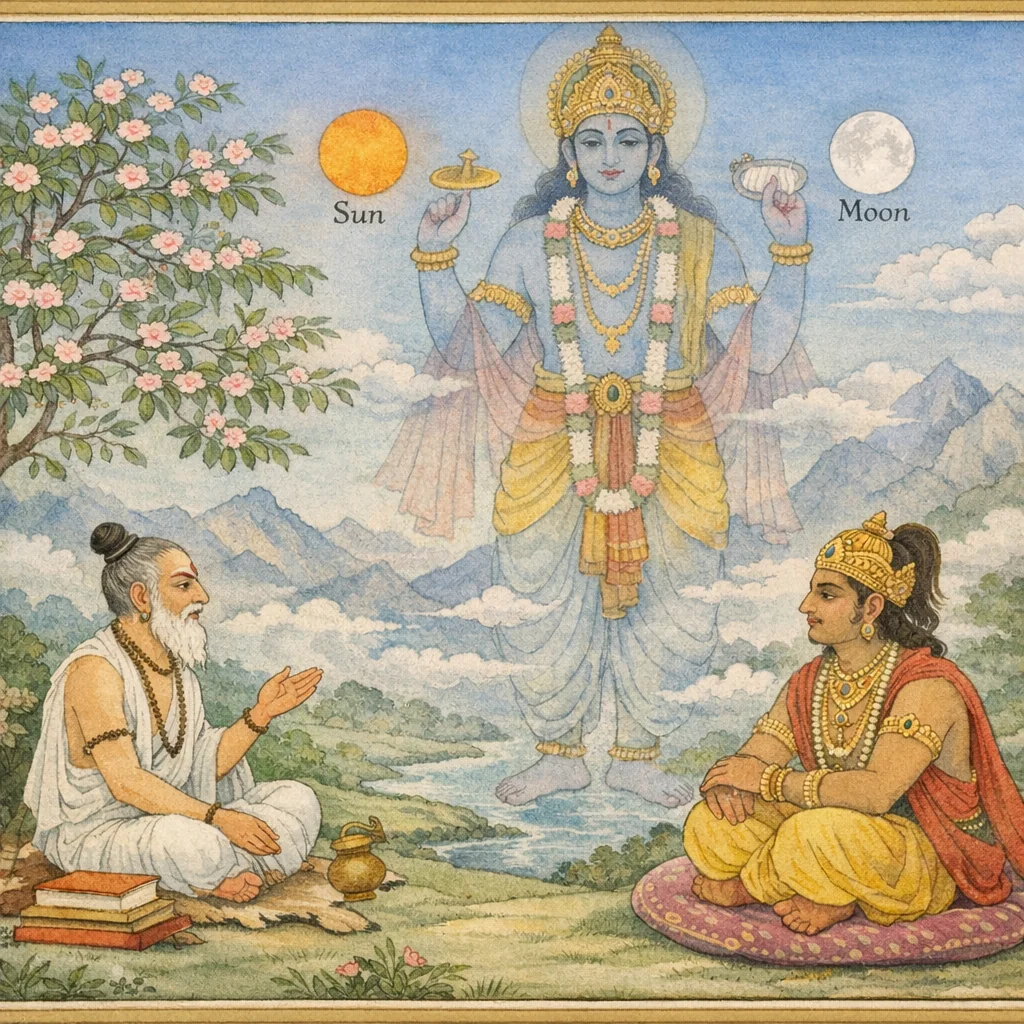
पादौ तस्य महीं विद्धि मूर्धानं दिवमित्युत । बाहवस्तु दिशो दैत्य श्रोत्रमाकाशमेव च,'दैत्यराज! पृथ्वीको भगवान् विष्णुके दोनों चरण समझो, स्वर्गलोकको मस्तक जानो, ये चारों दिशाएँ उनकी चार भुजाएँ हैं, आकाश कान है, तेजस्वी सूर्य उनका नेत्र है, मन चन्द्रमा है, बुद्धि (महत्तत्त्व) उनकी नित्य ज्ञानवृत्ति है और जल रसनेन्द्रिय है
Bhishma said: “O Daitya, know the earth to be His two feet, and heaven to be His head. The directions are His arms, and the sky itself is His ear.”
Verse 22
तस्य तेजोमय: सूर्यो मनश्नन्द्रमसि स्थितम् । बुद्धिरज्ञनिगता नित्यं रसस्त्वप्सु प्रतिष्ठित:,'दैत्यराज! पृथ्वीको भगवान् विष्णुके दोनों चरण समझो, स्वर्गलोकको मस्तक जानो, ये चारों दिशाएँ उनकी चार भुजाएँ हैं, आकाश कान है, तेजस्वी सूर्य उनका नेत्र है, मन चन्द्रमा है, बुद्धि (महत्तत्त्व) उनकी नित्य ज्ञानवृत्ति है और जल रसनेन्द्रिय है
Bhishma said: “Of Him, the radiant Sun is the manifestation of splendor; the mind abides in the Moon; the intellect is ever established as the constant movement of knowing; and taste—the essence—is grounded in the waters.”
Verse 23
भ्रुवोरनन्तरास्तस्य ग्रहा दानवसत्तम । नक्षत्रचक्रं नेत्राभ्यां पादयोर्भूश्न दानव
Bhīṣma said: “O best of Dānavas, the planets are set close between His eyebrows; the entire wheel of constellations is in His two eyes; and the earth itself is at His feet, O Dānava.”
Verse 24
“दानवप्रवर! सम्पूर्ण ग्रह उनकी दोनों भौंहोंके बीचमें स्थित हैं। नक्षत्रमण्डल नेत्रोंसे प्रकट हुआ है। दनुनन्दन! यह पृथ्वी उनके दोनों चरणोंमें स्थित है ।। (तं विद्धि भूत॑ विश्वादिं परम विद्धि चेश्वरम् ।) रजस्तमश्न सत्त्वं च विद्धि नारायणात्मकम् | सो55श्रमाणां फलं तात कर्मणस्तत् फलं विदु:,“उन्हें तुम सम्पूर्ण भूतस्वरूप, इस जगत्का आदिकारण और परमेश्वर समझो। रजोगुण, तमोगुण और सत्त्वगगुण--इन तीनोंको नारायणमय ही मानो। तात! समस्त आश्रमोंका फल वे ही हैं। विद्वान् पुरुष समस्त कर्माद्वारा प्राप्तव्य फल उन्हींको मानते हैं
Bhishma said: “O foremost of the Daityas! All the planets are stationed between His two eyebrows; the circle of the constellations shines forth from His eyes. O son of Danu, this earth rests upon His two feet. Know Him as the very form and origin of all beings, the first cause of the universe, and the supreme Lord. Understand rajas, tamas, and sattva—the three guṇas—as pervaded by Nārāyaṇa. Dear one, He alone is the fruit of all the āśramas; the wise know Him to be the final fruit attainable through every kind of action.”
Verse 25
अकमर्ण: फलं चैव स एव परमव्यय: । छन्दांसि यस्य रोमाणि हाक्षरं च सरस्वती,“कर्मोंका त्यागरूप जो संन्यास है, उसका फल भी वे ही अविनाशी परमात्मा हैं। वेद- मन्त्र उनके रोम हैं तथा प्रणव उनकी वाणी है
Bhishma said: The imperishable Supreme is Himself the fruit of renunciation characterized by akarma—freedom from bondage to action. The Vedic metres are His hairs, and the sacred syllable (Om), together with Sarasvatī, the power of speech and learning, is His own expression.
Verse 26
बह्दाश्रयो बहुमुखो धर्मो हृदि समाश्रित: । स ब्रह्म परमो धर्मस्तपश्च॒ सदसच्च स:,“बहुत-से वर्ण और आश्रम उनके आश्रय हैं, उनके अनेक मुख हैं। हृदयमें आश्रित धर्म भी उन्हींका स्वरूप है। वे ही ब्रह्म हैं। वे ही आत्मदर्शनरूप परम धर्म हैं। वे ही तप और सदसत्स्वरूप हैं
Bhishma said: “Dharma rests upon many supports and speaks with many voices. Yet the dharma that abides in the heart is none other than That itself. That is Brahman; That is the supreme dharma realized as direct knowledge of the Self. That is also tapas (austerity), and That is the very form of both the real and the unreal.”
Verse 27
श्रुतिशास्त्रग्रहोपेत: षोडशर्त्विक् क्रतुश्न सः । पितामहमश्न विष्णुश्न सोउ5श्विनौ स पुरंदर: | मित्रो5थ वरुणश्रैव यमो5थ धनदस्तथा
Bhīṣma said: Endowed with the grasp of the Vedas and the śāstras, he is that sacrifice furnished with sixteen officiating priests. He is also Pitāmaha (Brahmā) and Viṣṇu; he is the twin Aśvins and Purandara (Indra). He is Mitra and Varuṇa as well; he is Yama, and likewise Dhanada (Kubera).
Verse 28
“श्रुति (वेद), शास्त्र और सोमपात्रसहित सोलह” ऋत्विजोंवाला यज्ञ भी वे ही हैं। वे ही ब्रह्मा, विष्णु, अश्विनीकुमार, इन्द्र, मित्र, वरुण, यम और कुबेर हैं ।। ते पृथग्दर्शनास्तस्य संविदन्ति तथैकताम् । एकस्य विद्धि देवस्य सर्व जगदिदं वशे,“उनका दर्शन पृथक्-पृथक् होनेपर भी वे अपनी एकताको जानते हैं। तुम भी इस सम्पूर्ण जगत्को एक परमात्मदेवके ही अधीन समझो
Bhishma declares that the One Supreme is present as the Veda and the authoritative teachings, and even as the complete sacrifice furnished with the soma-vessel and the sixteen officiating priests. That same Reality is also known by many divine names—Brahmā, Viṣṇu, the Aśvin twins, Indra, Mitra, Varuṇa, Yama, and Kubera. Though people behold Him in distinct forms, those who truly understand recognize His single unity. Therefore, know that this entire world stands under the sovereignty of that one Divine Lord.
Verse 29
नानाभूतस्य दैत्येन्द्र तस्यैकत्वं वदत्ययम् । जन्तुः पश्यति विज्ञानात् ततो ब्रह्म प्रकाशते,'दैत्यागाज! अनेक रूपोंमें प्रकट हुए उन परमात्माकी एकताका यह वेद प्रतिपादन करता है। जीव विज्ञानबलसे ही ब्रह्मका साक्षात्कार करता है। उस समय उसकी बुद्धिमें वह ब्रह्म प्रकाशित हो जाता है
Bhishma said: “O lord of the Daityas, though the Supreme appears in many forms, this Vedic teaching declares His essential oneness. When a living being truly sees through discriminative knowledge, Brahman is then revealed—shining forth within the intellect as direct realization.”
Verse 30
संहारविक्षेपसहसत्रकोटी - स्तिष्ठन्ति जीवा: प्रचरन्ति चान्ये । प्रजाविसर्गस्य च पारिमाण्यं वापीसहस्राणि बहूनि दैत्य
Bhīṣma said: Countless crores of living beings remain poised within the cycles of dissolution and dispersal, while others move about in active existence. And the measure of creation’s outpouring is vast beyond reckoning—like many thousands of reservoirs—O Daitya; thus the world’s becoming and passing is immeasurable, and one should not cling to it as permanent.
Verse 31
“कितने ही जीव करोड़ों कल्पोंतक स्थावररूपसे एक स्थानमें स्थित रहते हैं और कितने ही उतने समयतक इधर-उधर विचरते रहते हैं। दैत्यप्रवर! प्रजाके सृष्टिका परिमाण कई हजार बावड़ियोंकी संख्याके समान है ।। वाप्य: पु]नर्योजनविस्तृतास्ता: क्रोशं च गम्भीरतयावगाढा: । आयामत: पज्चशताश्ष सर्वा: प्रत्येकशो योजनत: प्रवृद्धा:
Bhīṣma said: “Many beings remain fixed in one place for crores of aeons, taking the form of immobile life (sthāvara); and many others, for the same span of time, keep roaming here and there. O foremost of the Daityas, the measure of the creation of creatures is like the count of many thousands of step-wells. Each of those step-wells spreads over a yojana, sinks to the depth of a krośa, and all of them extend five hundred in length—each increasing by a yojana.”
Verse 32
वाप्या जल क्षिप्पति वालकोट्या त्वह्ला सकृच्चाप्यथ न द्वितीयम् । तासां क्षये विद्धि परं विसर्ग संहारमेक॑ च तथा प्रजानाम्
Bhīṣma said: “Just as a child, with the edge of his hand, may splash water from a pond only once and not a second time in the same way, so know this: when their store is exhausted, there follows the final discharge and a single, inevitable withdrawal—so too with living beings.”
Verse 33
“वे सारी बावड़ियाँ पाँच सौ योजन चौड़ी, पाँच सौ योजन लंबी और एक-एक कोस गहरी हों। गहराई इतनी हो कि कोई उनमें प्रवेश न कर सके। तात्पर्य यह कि प्रत्येक बावड़ी बहुत लंबी-चौड़ी और गहरी हो--उनमेंसे एक बावड़ीके जलको कोई दिनभरमें एक ही बार एक बालकी नोकसे उलीचे, दूसरी बार न उलीचे। इस प्रकार उलीचनेसे उन सारी बावड़ियोंका जल जितने समयमें समाप्त हो सकता है, उतने ही समयमें प्राणियोंकी सृष्टि और संहारके क्रमकी समाप्ति हो सकती है (अर्थात् जैसे उक्त प्रकारसे उलीचनेपर उन बावड़ियोंका जल सूखना असम्भव है, वैसे ही बिना ज्ञानके संसारका उच्छेद होना असम्भव है।) ।। षड् जीववर्णा: परमं प्रमाणं कृष्णो धूम्रो नीलमथास्य मध्यम् । रक्त पुन: सहातरं सुखं तु हारिद्रवर्ण सुसुखं च शुक्लम्,'प्राणियोंके वर्ण छ: प्रकारके हैं--कृष्ण, धूम्र, नील, रक्त, हरिद्रा (पीला) और शुक्ल-। इनमेंसे कृष्ण, धूत्र और नील वर्णका सुख मध्यम होता है। रक्तवर्ण विशेष रूपसे सहन करने योग्य होता है। हरिद्राकी-सी कान्ति सुख देनेवाली होती है और शुक्लवर्ण अत्यन्त सुखदायक होता है
Bhīṣma said: “Beings are described as having six ‘color-types’ (varṇas): black, smoky, blue, red, yellow (turmeric-hued), and white. Among these, the black, smoky, and blue types are associated with middling happiness. The red type is said to be more endurable in its experience. The yellow type is pleasant and happiness-giving, while the white type is supremely pleasant.”
Verse 34
परं तु शुक्लं विमल॑ विशोक॑ गतकक््लमं सिद्धाति दानवेन्द्र | गत्वा तु योनिप्रभवाणि दैत्य सहस्रश: सिद्धिमुपैति जीव:,“दानवराज! शुक्लवर्ण निर्मल, शोकहीन, परिश्रम-शून्य होनेके कारण सिद्धिकारक होता है। दितिकुलनन्दन! जीव सहस्रों योनियोंमें जन्म ग्रहण करनेके बाद मनुष्ययोनिमें आकर कभी सिद्धि लाभ करता है
Bhīṣma said: “But that state which is white—pure, spotless, sorrowless, and free from fatigue—is what brings about perfection (siddhi), O lord of the Dānavas. And, O Daitya, the individual self (jīva), after passing through thousands of births arising from various wombs, at times attains perfection—having come to the human condition.”
Verse 35
गतिं च यां दर्शनमाह देवो गत्वा शुभं दर्शनमेव चापि । गति: पुनर्वर्णकृता प्रजानां वर्णस्तथा कालकृतोडसुरेन्द्र,“असुरेन्द्र! देवराज इन्द्रने मंगलमय तत्त्वज्ञान प्राप्त करके हमारे निकट जिस गति और दर्शन-शास्त्रका वर्णन किया है, वह प्राणियोंकी वर्णजनित गति है अर्थात् शुक्लवर्णवालोंको वही सिद्धि प्राप्त होती है। वह वर्ण कालकृत माना गया है
Bhīṣma said: “O lord of the Asuras, the deity—Indra, king of the gods—having attained an auspicious vision (true insight), declared that very doctrine of ‘vision’ and the ‘path’ (gati). Yet the destinies of beings are again spoken of as conditioned by varṇa (color/class): beings attain corresponding results according to that varṇa. And that varṇa itself is said to be fashioned by Time (kāla).”
Verse 36
शतं सहस्राणि चतुर्दशेह परागतिर्जीवगणस्य दैत्य | आरोहणं तत्कृतमेव विद्धि स्थान तथा नि:सरणं च तेषाम्,'दैत्यप्रवर! इस जगत्में समस्त जीव-समुदायकी परागति चौदह लाख बतायी गयी है। (पाँच कर्मन्द्रिय, पाँच ज्ञानेन्द्रिय तथा मन, बुद्धि, चित्त और अहंकार--ये चौदह करण हैं। इन्हींके भेदसे चौदह प्रकारकी गति होती है। फिर विषयभेदसे वृत्तिभेद होनेके कारण चौदह लाख प्रकारकी गति होती है।) जीवका जो ऊर्ध्वलोकोंमें गमन होता है, वह भी उन्हीं चौदह करणोंद्वारा सम्पादित होता है। विभिन्न स्थानोंमें जो स्थिरतापूर्वक निवास है, वह और उन स्थानोंसे जो उन जीवोंका अधःपतन होता है, वह भी उन्हींके सम्बन्धसे होता है। इस बातको तुम अच्छी तरह जान लो (अत: इन चौदह करणोंको सात्त्विक मार्गाभिमुखी बनाना चाहिये)
Bhīṣma said: O Daitya, the total range of transmigratory destinies for the multitude of living beings is here declared to be fourteen hundred thousand. Know that their ascent to higher worlds is accomplished through that very set of fourteen instruments; likewise, their abiding in particular stations and their departure or fall from those stations also occur in dependence upon them. Therefore, one should understand that the moral direction of these inner and outer faculties determines whether a being rises, remains, or declines.
Verse 37
कृष्णस्य वर्णस्य गतिर्निकृष्टा स सज्जते नरके पच्यमान: । स्थानं तथा दुर्गतिभिस्तु तस्य प्रजाविसर्गान् सुबहून् वदन्ति,“कृष्णवर्णकी गति नीच बतायी गयी है। वह नरक प्रदान करनेवाले निषिद्ध कर्मोमें आसक्त होता है, इसीलिये नरककी आगमें पकाया जाता है। वह कुमार्ममें प्रवृत्त हुए पूर्वोक्त चौदह करणोंद्वारा पापाचार करनेके कारण अनेक कल्पोंतक नरकमें ही निवास करता है-- ऐसा ऋषि-मुनि कहते हैं
Bhīṣma said: “The destiny of one in the ‘dark’ state is described as degraded. Becoming attached to forbidden deeds that lead to hell, he is cooked in the fires of hell. Sages declare that his abode is among those who meet evil ends, and that he remains there through many cycles of creation—because, driven by wrongful conduct, he repeatedly commits sin.”
Verse 38
शतं सहस्त्राणि ततक्ष्रित्वा प्राप्रोति वर्ण हरितं तु पश्चात् स चैव तस्मिन् निवसत्यनीशो युगक्षये तपसा संवृतात्मा,“तदनन्तर वह जीव लाखों बार (या लाखों वर्षोतक) नरकमें विचरण करके फिर धूम्रवर्ण पाता है (पशु-पक्षी आदिकी योनिमें जन्म लेता है)। उस योनिमें भी वह विवश होकर बड़े दुःखसे निवास करता है। फिर युगक्षय होनेपर वह तप (पुरातन पुण्यकर्म या विवेक) के प्रभावसे सुरक्षित होकर उस संकटसे उद्धार पा जाता है
Bhīṣma said: After being hewn down—undergoing suffering—for hundreds of thousands (of times/years), the embodied being later attains a greenish hue, signifying entry into lower births such as animals and birds. In that state too, powerless and constrained, he dwells in great misery. But when the aeon comes to its end, his inner self—protected and steadied by tapas (the force of austerity, or the ripening of ancient merit and discernment)—is delivered from that peril.
Verse 39
स वै यदा सन्त्वगुणेन युक्त- स्तमो व्यपोहन् घटते स्वबुद्धा । स लोहितं वर्णमुपैति नीलान् मनुष्यलोके परिवर्तते च,“वही जीव जब सत्त्वगुणसे युक्त होता है, तब अपनी बुद्धिके द्वारा तमोगुणकी प्रवृत्तिको दूर हटाता हुआ अपने कल्याणके लिये प्रयत्न करता है। उस समय सत्त्वगुणके बढ़ जानेपर वह रक्तवर्णको प्राप्त होता है (इसीको अनुग्रह सर्ग कहा गया है, चित्तकी विभिन्न वृत्तियोंपर अनुग्रह करनेवाले देवविशेषका ही नाम “अनुग्रह” है)। जब सत्त्वगुणमें कुछ कमी रह जाती है, तब वह जीव नीलवर्णको प्राप्त होकर मनुष्यलोकमें आवागमन करने लगता है
Bhīṣma said: When the embodied being becomes endowed with the quality of sattva, it dispels the impulses of tamas through its own discernment and strives for its highest good. As sattva increases, it attains the ‘red’ state (a higher, grace-associated condition); but when sattva remains deficient, it takes on the ‘blue’ state and continues to revolve through births and deaths in the human world.
Verse 40
स तत्र संहारविसर्गमेक॑ स्वधर्मजैर्बन्धनै: क्लिश्यमान: । ततः स हारिद्रमुपैति वर्ण संहारविक्षेपशते व्यतीते
There, the embodied being undergoes the single cycle of dissolution and re-emergence, tormented by the fetters born of its own dharma—its binding duties and dispositions. Then, when a hundred such alternations of withdrawal and projection have passed, it attains the tawny (yellow-golden) state of being.
Verse 41
“तत्पश्चात् वह मनुष्यलोकमें एक कल्पतक स्वधर्मजनित बन्धनोंसे बँधकर क्लेश उठाता हुआ जब धीरे-धीरे अपनी तपस्याको बढ़ाता है, तब हल्दीकी-सी कान्तिवाले पीतवर्ण--देवताभावको प्राप्त होता है। वहाँ भी सैकड़ों कल्प व्यतीत कर लेनेपर वह पुनः पुण्यक्षयके पश्चात् मनुष्य होता है (इस प्रकार वह देवतासे मनुष्य और मनुष्यसे देवता होता रहता है) ।। हारिद्रवर्णस्तु प्रजाविसर्गात् सहस्रशस्तिष्ठति संचरन् वै । अविप्रमुक्तो निरये च दैत्य ततः सहस्राणि दशापराणि,'दैत्य! सहस्रों कल्पोंतक देवरूपसे विचरते रहनेपर भी जीव विषयभोगसे मुक्त नहीं होता तथा प्रत्येक कल्पमें किये हुए अशुभ कर्मोंके फलोंको नरकमें रहकर भोगता हुआ जीव उन्नीस- हजार विभिन्न गतियोंको प्राप्त होता है। तत्पश्चात् उसे नरकसे छुटकारा मिलता है। मनुष्यके सिवा अन्य सभी योनियोंमें केवल सुख-दुःखके भोग प्राप्त होते हैं। मोक्षका सुयोग हाथ नहीं लगता है। इस बातको तुम्हें भलीभाँति समझ लेना चाहिये
Bhishma said: Thereafter, the soul, bound in the human world by fetters born of its own prescribed duty, endures hardship; and as it gradually increases its austerity, it attains a divine state of yellow hue, radiant like turmeric. Even there, after hundreds of aeons have passed, it becomes human again when its merit is exhausted—thus it keeps moving from godhood to humanity and from humanity to godhood. Yet, O Daitya, even after roaming for thousands of aeons in a godlike form, the living being is not freed from sense-enjoyment; and, experiencing in hell the fruits of the unwholesome deeds done in each aeon, it reaches nineteen thousand different courses of existence. Only then does it obtain release from hell. In all births other than the human, one merely undergoes pleasure and pain; the fitting opportunity for liberation does not come. This you should understand clearly.
Verse 42
गती: सहस्राणि च पञठच तस्य चत्वारि संवर्तकृतानि चैव । विमुक्तमेनं निरयाच्च विद्धि सर्वेषु चान्येषु च सम्भवेषु,'दैत्य! सहस्रों कल्पोंतक देवरूपसे विचरते रहनेपर भी जीव विषयभोगसे मुक्त नहीं होता तथा प्रत्येक कल्पमें किये हुए अशुभ कर्मोंके फलोंको नरकमें रहकर भोगता हुआ जीव उन्नीस- हजार विभिन्न गतियोंको प्राप्त होता है। तत्पश्चात् उसे नरकसे छुटकारा मिलता है। मनुष्यके सिवा अन्य सभी योनियोंमें केवल सुख-दुःखके भोग प्राप्त होते हैं। मोक्षका सुयोग हाथ नहीं लगता है। इस बातको तुम्हें भलीभाँति समझ लेना चाहिये
O Daitya, it reaches nineteen thousand courses of existence; and there are also four that are causes of the world’s dissolution and re-formation (saṃvarta). Know that it is then released from hell; and in all other births (save the human) there is only the undergoing of pleasure and pain.
Verse 43
स देवलोके विहरत्यभीक्षणं ततकश्ष्युतो मानुषतामुपैति । संहारविक्षेपशतानि चाष्टौ मर्त्येषु तिष्ठत्यमृतत्वमेति,“वह जीव निरन्तर देवलोकमें विहार करता है और वहाँसे भ्रष्ट होनेपर मनुष्ययोनिको प्राप्त होता है। मर्त्पलोकमें वह आठ सौ कल्पोंतक बारंबार जन्म लेता रहता है। तत्पश्चात् शुभकर्म करके वह पुनः देवभावको प्राप्त करता है (यह आवागमनका चक्र तभीतक चलता है, जबतक जीवको परमज्ञान या अनन्य भक्तिकी प्राप्ति नहीं हो जाती, उसकी प्राप्ति होनेपर तो वह मुक्त या परमात्माको प्राप्त हो जाता है।)
Bhishma said: He dwells again and again in the world of the gods; and when he falls from there, he enters human existence. In the mortal realm he remains through eight hundred cycles of dissolution and re-projection, taking birth repeatedly; thereafter, through auspicious action, he attains the divine state once more—until the round of coming and going is ended by the attainment of highest knowledge (or single-minded devotion), by which one reaches liberation.
Verse 44
सो<स्मादथ भ्रश्यति कालयोगात् कृष्णे तले तिष्ठति सर्वकृष्टे । यथा त्वयं सिद्धाति जीवलोक- स्तत् तेडभिधास्याम्यसुरप्रवीर,“असुरोंके प्रमुख वीर! वह जीव कालक्रमसे अशुभ कर्म करके कभी-कभी मर्त्यलोकसे भी नीचे गिर जाता है और सबसे निकृष्ट, तलप्रदेशकी भाँति निम्नतम, कृष्णवर्ण (स्थावर योनि) में जन्म ग्रहण करके स्थित होता है। इस प्रकार उत्थान-पतनके चक्रमें पड़े हुए इस जीवसमूहको जिस प्रकार सिद्धि (मुक्ति) प्राप्त होती है, वह मैं तुम्हें बता रहा हूँ
Bhishma said: “Thereafter, through the workings of time, a being falls away—descending to the darkest and lowest level, as though to an underworld-like stratum, taking birth among the most degraded forms of existence. And now, O foremost hero among the Asuras, I shall explain to you how this world of living beings, caught in the cycle of rise and fall, attains true accomplishment—liberation.”
Verse 45
दैवानि स व्यूहशतानि सप्त रक्तो हरिद्रोडथ तथैव शुक्ल: । संश्रित्य संधावति शुक्लमेत- मष्टावरानर्च्यतमान् स लोकान्,"क्रमशः रक्तवर्ण (अनुग्राहक देवता), हरिद्रावर्ण (देवता) तथा शुकक्लवर्ण (सनकादिकुमारों-जैसा सिद्ध शरीरधारी) होकर वह जीव बारी-बारीसे सात सौ दिव्य शरीरोंका आश्रय ले भू आदि सात उत्तमोत्तम लोकोंमें विचरण करके पूर्व पुण्यके प्रभावसे वेगपूर्वक विशुद्ध ब्रह्मलोकमें चला जाता है
Bhishma explains that the embodied being, propelled by the force of prior merit, successively assumes divine formations and bodies—first of a red hue, then turmeric-golden, and then pure white like the perfected, subtle-bodied sages. Taking refuge in these divine embodiments in due order, it ranges through the highest worlds beginning with Bhū and onward, honoring the presiding powers there; and then, moving swiftly, it reaches the utterly purified Brahma-world.
Verse 46
अष्टौ च षष्टिं च शतानि चैव मनोनिरुद्धानि महाद्युतीनाम् । शुक्लस्य वर्णस्य परा गतिर्या त्रीण्येव रुद्धानि महानुभाव,“महानुभाव वृत्रासुर! प्रकृति, महत्तत््व, अहंकार और पंचतन्मात्राएँ--ये आठ, तथा दूसरे साठ- तत्त्व और इनकी जो सैकड़ों वृत्तियाँ हैं--ये सब महातेजस्वी योगियोंके मनके द्वारा अवरुद्ध की हुई होती हैं तथा सत्त्व, रज और तम--इन तीनों गुणोंको भी वे अवरुद्ध कर देते हैं। अतः शुक्लवर्णवाले (सनकादिकोंके समान सिद्ध) पुरुषको जो उत्तम गति प्राप्त होती है, वही उन योगियोंको मिलती है
Bhishma said: The eight principles, the sixty, and even the hundreds of their mental modifications are restrained by the mind of the great-lustrous yogins. They also restrain the three guṇas—sattva, rajas, and tamas. Therefore, the supreme goal attained by the “white” (pure, luminous) order of perfected beings is the very same highest state reached by those yogins who have mastered such restraint.
Verse 47
संहारविक्षेपमनिष्टमेक॑ चत्वारि चान्यानि वसत्यनीश: । षष्ठस्य वर्णस्य परा गतिर्या सिद्धावसिद्धस्य गतक्लमस्य,“जो परमगति छठे (शुक्ल) वर्णके साधकको मिलती है, उसे पानेका अधिकार भ्रष्ट करके भी जो असिद्ध हो रहा है एवं जिसके समस्त पाप नष्ट हो चुके हैं ऐसा योगी भी यदि योगजनित ऐश्वर्यके सुखभोगकी वासनाका त्याग करनेमें असमर्थ है तो वह न चाहनेपर भी एक कल्पतक अपनी साधनाके फलरूप महर्, जन, तप और सत्य--इन चारों लोकोंमें क्रमश: निवास करता है (और कल्पके अन्तमें मुक्त हो जाता है)
Bhishma said: Even if a yogin has become free of fatigue and his sins are exhausted, yet remains unable to abandon the desire to enjoy the supernatural prosperities born of yoga, then—though he does not wish it—he is compelled to dwell, as the fruit of his practice, for the span of a kalpa in four higher worlds in succession: Maharloka, Janaloka, Tapoloka, and Satyaloka. Only thereafter does he attain the supreme goal that belongs to the “sixth (bright/śukla) class” of aspirants.
Verse 48
सप्तोत्तरं तत्र वसत्यनीश: संहारविक्षेपशतं सशेषम् | तस्मादुपावृत्य मनुष्यलोके ततो महान् मानुषतामुपैति,“किंतु जो भलीभाँति योगसाधनमें असमर्थ है, वह योगगश्रष्ट पुरुष सौ कल्पोंतक ऊपरके सात लोकोंमें निवास करता है। फिर बचे हुए कर्मसंस्कारोंके सहित वहाँसे लौटकर मनुष्यलोकमें पहलेसे बढ़कर महत्त्व-सम्पन्न हो मनुष्यशरीरको पाता है
Bhishma said: One who is not fully masterful in yoga-practice dwells there—above, in the higher worlds—for a period extending to a hundred cycles of dissolution and re-manifestation, with residual karmic traces still remaining. From there, returning again to the human realm, he attains a human birth of greater stature and capability than before, carrying those remaining impressions forward toward completion of the yogic path.
Verse 49
तस्मादुपावृत्य ततः क्रमेण सो5ग्रेण संतिष्ठति भूतसर्गम् । स सप्तकृत्वश्न परैति लोकान् संहारविक्षेपकृतप्रभाव:,“तदनन्तर मनुष्ययोनिसे निकलकर वह उत्तरोत्तर श्रेष्ठ देवादि योनियोंकी ओर अग्रसर होता है एवं सातों लोकोंमें प्रभावशाली होकर एक कल्पतक निवास करता है
Bhishma said: Returning from there, he then, in due order, establishes himself in the unfolding creation of beings, advancing toward ever higher births. By the power generated through dissolution and re-dispersion (saṃhāra–vikṣepa), he passes through the worlds repeatedly, becoming influential in the seven realms and dwelling for a kalpa.
Verse 50
सप्तैव संहारमुपप्लवानि सम्भाव्य संतिष्ठति जीवलोके । ततोडव्ययं स्थानमनन्तमेति देवस्य विष्णोरथ ब्रह्मणश्न | शेषस्य चैवाथ नरस्य चैव देवस्य विष्णो: परमस्य चैव,“फिर वह योगी भू आदि सात लोकोंको विनाशशील क्षणभंगुर समझकर पुनः मनुष्यलोकमें भलीभाँति (शोक-मोहसे रहित होकर) निवास करता है। तदनन्तर शरीरका अन्त होनेपर वह अव्यय (अविनाशी या निर्विकार) एवं अनन्त (देश, काल और वस्तुकृत परिच्छेदसे शून्य) स्थान (परब्रह्मपद) को प्राप्त होता है। वह अव्यय एवं अनन्त स्थान किसीके मतमें महादेवजीका कैलासधाम है। किसीके मतमें भगवान् विष्णुका वैकुण्ठधाम है। किसीके मतमें ब्रह्माजीका सत्यलोक है। कोई-कोई उसे भगवान् शेष या अनन्तका धाम बताते हैं। कोई वह जीवका ही परमधाम है--ऐसा कहते हैं और कोई-कोई उसे सर्वव्यापी चिन्मय प्रकाशसे युक्त परब्रह्मका स्वरूप बताते हैं
Bhīṣma said: Having understood that the seven worlds are subject to dissolution and are unstable, the yogin abides steadily in the realm of living beings, free from grief and delusion. Then, when the body comes to its end, he attains the imperishable and infinite Abode—beyond limitation by place, time, or object. Some identify that Abode as Śiva’s Kailāsa; some as Viṣṇu’s Vaikuṇṭha; some as Brahmā’s Satyaloka; others as the realm of Śeṣa (Ananta); some call it the supreme station of the individual self; and others describe it as the very nature of the supreme, all-pervading, conscious Brahman.
Verse 51
संहारकाले परिदग्धकाया ब्रद्माणमायान्ति सदा प्रजा हि । चेष्टात्मनो देवगणाश्न सर्वे ये ब्रह्मलोकादपरा: सम तेडपि,'ज्ञानाग्निके द्वारा जिनके सूक्ष्म, स्थूल और कारण-शरीर दग्ध हो गये हैं, वे प्रजाजन अर्थात् योगीलोग प्रलयकालमें सदा परब्रह्म परमात्माको प्राप्त होते हैं एवं जो ब्रह्मलोकसे नीचेके लोकोंमें रहनेवाले साधनशील दैवी प्रकृतिसे सम्पन्न साधक हैं, वे सब परब्रह्मको प्राप्त हो जाते हैं
Bhishma said: At the time of cosmic dissolution, those beings—the yogins—whose bodies (gross, subtle, and causal) have been burned away by the fire of knowledge ever attain the Supreme Brahman. Likewise, all the divine hosts and disciplined seekers who dwell in worlds below Brahmaloka, endowed with a divine nature and steadfast in practice, also reach that Supreme Brahman. The teaching is that liberation is won not by rank or cosmic station, but by inner purification and knowledge that consumes embodied limitation.
Verse 52
प्रजाविसर्ग तु सशेषकाले स्थानानि स्वान्येव सरन्ति जीवा: । निःशेषतस्तत्पदं यान्ति चान्ते सर्वे देवा ये सदृशा मनुष्या:,“प्रलयकालमें जो जीव देवभावको प्राप्त थे, वे यदि अपने सम्पूर्ण कर्मफलोंका उपभोग समाप्त करनेसे पहले ही लयको प्राप्त हो जाते हैं तो कल्पान्तरमें पुनः प्रजाकी सृष्टि होनेपर वे शेष फलका उपभोग करनेके लिये उन्हीं स्थानोंको प्राप्त होते हैं, जो उन्हें पूर्वकल्पमें प्राप्त थे; किंतु जो कल्पान्तमें उस योनिसम्बन्धी कर्मफल-भोगको पूर्ण कर चुके हैं, वे स्वर्गलोकका नाश हो जानेपर दूसरे कल्पमें उनके जैसे कर्म हैं, उसीके सदृश अन्य प्राणियोंकी भाँति मनुष्य-योनिको ही प्राप्त होते हैं
Bhīṣma explains that when creation is renewed, those beings whose karmic results were still unfinished at the moment of dissolution naturally return to the very same stations and realms they had previously attained, to experience the remaining fruits. But those who, by the end of the aeon, have fully exhausted the results that sustained their divine status—when that heavenly world itself perishes—enter the next cycle not as gods again, but like other beings of comparable deeds, taking birth in the human condition.
Verse 53
ये तु च्युता: सिद्धलोकात् क्रमेण तेषां गति यान्ति तथा<<नुपूर्व्या जीवा: परे तद्धलतुल्यरूपा: स्वं स्वं विधि यान्ति विपर्ययेण,“जो योगी सिद्धलोकसे गिरकर मृत्युलोकमें आये हैं, उनके समान साधनबलसे सम्पन्न जो अन्य योगी हैं, वे भी एक लोकसे दूसरे लोकमें ऊपर उठते हुए क्रमश: उन सिद्ध पुरुषोंकी ही गतिको प्राप्त होते हैं। परंतु जो वैसे नहीं हैं, वे विपरीतभावके कारण अपनी- अपनी गतिको प्राप्त होते हैं
Bhishma said: “Those who have fallen from the Siddha-world descend in due order; and other embodied beings, endowed with comparable spiritual discipline, likewise move step by step from one realm to another, rising upward and ultimately attaining the very course of those Siddhas. But those who are not so equipped—because their disposition runs contrary—reach their own respective destinations by an opposite trajectory.”
Verse 54
स यावदेवास्ति सशेषभुक् ते प्रजाश्न देव्या च तथैव शुक्ले । तावत् तदज्लेषु विशुद्धभाव: संयम्य पज्चेन्द्रियरूपमेतत्,“विशुद्धभावसे सम्पन्न सिद्ध पुरुष जबतक पंचेन्द्रियरूप इस करणसमुदायका संयम करके शेष प्रारब्ध कर्मका उपभोग करता है, तबतक उसके शरीरमें समस्त प्रजागणोंका अर्थात् इन्द्रियोंक देवताओंका तथा अपरा और परा विद्याका निवास रहता है
Bhishma said: So long as that purified-souled perfected man remains embodied and continues to experience only the residual momentum of past action, he restrains this inner apparatus that takes the form of the five senses. During that time, within his body abide the presiding deities of the senses and the powers of knowledge—both the lower and the higher—until the remaining karma is exhausted.
Verse 55
शुद्धां गतिं तां परमां परैति शुद्धेन नित्यं मनसा विचिन्वन् । ततोडव्ययं स्थानमुपैति ब्रह्म दुष्प्रापमभ्येति स शाश्वतं वै,“जो साधक सदा शुद्ध मनसे उस विशुद्ध परमगतिका अनुसंधान करता है, वह उसे अवश्य प्राप्त कर लेता है। तदनन्तर अविकारी, दुर्लभ एवं सनातन ब्रह्मपदको प्राप्त करके वह उसीमें प्रतिष्ठित हो जाता है
Bhishma says: One who, with a mind kept ever pure, continually contemplates that stainless, supreme goal surely attains it. Thereafter he reaches the imperishable station—Brahman—difficult to obtain and truly eternal, and becomes firmly established in that reality.
Verse 56
इत्येतदाख्यातमहीनसत्त्व नारायणस्येह बल॑ मया ते,उत्कृष्ट बलशाली दैत्यराज! इस प्रकार यहाँ मैंने तुमसे यह भगवान् नारायणका बल एवं प्रभाव बताया है”
Bhishma said: “O you of undiminished courage, O mighty Daitya-king of surpassing strength! Thus, here I have recounted to you the power—and the manifest greatness—of Lord Nārāyaṇa. Let this understanding restrain pride, steady the mind, and turn strength toward righteous conduct rather than rivalry with the divine.”
Verse 57
वृत्र बवाच एवं गते मे न विषादो<स्ति कश्चित् सम्यक् च पश्यामि वचस्तथैतत् | श्रुत्वा तु ते वाचमदीनसत्त्व विकल्मषोअस्म्यद्य तथा विपाप्मा,वृत्रासुर बोला--उदारचित्त महात्मा सनत्कुमारजी! यदि ऐसी बात है तो मुझे कोई विषाद नहीं है। मैं आपके वचनको अच्छी तरह समझता और इसे यथार्थ मानता हूँ। आज मैं यह अनुभव कर रहा हूँ कि आपकी इस वाणीको सुनकर मेरे सारे पाप और कलुष दूर हो गये
Vṛtra said: “If matters stand thus, then no sorrow remains for me. I see your statement clearly and accept it as true. O noble-hearted one, having heard your words today, I feel cleansed—my stains have fallen away, and I am freed from sin.”
Verse 58
प्रवृत्तमेतद् भगवन् महर्षे महद्युतेश्नक्रमनन्तवीर्यम् । विष्णोरनन्तस्य सनातनं तत् स्थान सर्गा यत्र सर्वे प्रवृत्ता: । स वै महात्मा पुरुषोत्तमो वै तस्मिन् जगत् सर्वमिदं प्रतिष्ठितम्,भगवन! महर्षे! महातेजस्वी, अनन्त एवं सर्वव्यापी भगवान् विष्णुका यह अमित शक्तिशाली संसारचक्र चल रहा है। यह भगवान् विष्णुका वह सनातन स्थान है, जहाँसे सारी सृष्टियोंका आरम्भ होता है। महात्मा विष्णु पुरुषोत्तम हैं। उन्हींमें यह सम्पूर्ण जगत् प्रतिष्ठित है
Bhishma said: “O Blessed one, O great seer of mighty splendor—this vast, beginningless wheel of the world, endowed with infinite power, moves by the agency of Vishnu, the Infinite. That is His eternal abode, the source from which all creations set forth. That great-souled Vishnu is indeed the Supreme Person; in Him this entire universe is established and upheld.”
Verse 59
भीष्म उवाच एवमुक््त्वा स कौन्तेय वृत्र: प्राणानवासृजत् । योजयित्वा तथा55त्मानं परं स्थानमवाप्तवान्,भीष्मजी कहते हैं--कुन्तीनन्दन! ऐसा कहकर वृत्रासुरने अपने आत्माको परमात्मामें लगाकर उन्हींका ध्यान करते हुए प्राण त्याग दिये और परमेश्वरके परमधामको प्राप्त कर लिया
Bhishma said: “O son of Kunti, having spoken thus, Vritra gave up his life-breaths. Fixing his self in that manner upon the Supreme, meditating on Him, he attained the highest abode of the Lord.”
Verse 60
युधिछिर उवाच अयं स भगवान् देव: पितामह जनार्दन: । सनत्कुमारो वृत्राय यत्तदाख्यातवान् पुरा,युधिष्ठिरने पूछा--पितामह! पूर्वकालमें महात्मा सनत्कुमारने वृत्रासुरसे जिनके स्वरूपका वर्णन किया था, वे भगवान् विष्णु-ये हमारे जनार्दन श्रीकृष्ण ही तो हैं?
Yudhiṣṭhira said: “Grandfather, is this very Janārdana—Śrī Kṛṣṇa—indeed that same Blessed Lord, the divine Supreme Being, whose true nature the great sage Sanatkumāra once described long ago to Vṛtrāsura?”
Verse 61
भीष्म उवाच मूलस्थायी महादेवो भगवान् स्वेन तेजसा । तत्स्थ:सृजति तान् भावान् नानारूपान् महामना:,भीष्मजीने कहा--युधिष्ठिर! मूल-कारणरूपसे स्थित, महान् देव, महामनस्वी भगवान् नारायण हैं। वे अपने उस चिन्मय स्वरूपमें स्थित होकर अपने प्रभावसे नाना प्रकारके सम्पूर्ण पदार्थोंकी सृष्टि करते हैं
Bhishma said: The great Lord, the Blessed One, abides in the primal source itself. Remaining established in His own radiance, that great-minded One brings forth all those existences in manifold forms.
Verse 62
तुरीयांशेन तस्येमं विद्धि केशवमच्युतम् । तुरीयार्थेन लोकांस्त्रीन् भावयत्येव बुद्धिमान्,अपनी महिमासे कभी च्युत न होनेवाले इन भगवान् श्रीकृष्णको तुम उस श्रीनारायणके एक चतुर्थ अंशसे सम्पन्न समझो। बुद्धिमान् श्रीकृष्ण अपने उस चतुर्थ अंशसे ही तीनों लोकोंकी रचना करते हैं
Bhishma said: Know this Keshava, the unfailing Achyuta, to be endowed with a fourth part of that Supreme Narayana. With that very quarter-portion, the wise Lord sustains and brings into being the three worlds—yet never falls away from His own inherent majesty.
Verse 63
अवाक् स्थितस्तु यः स्थायी कल्पान्ते परिवर्तते | स शेते भगवानप्सु योडसावतिबल: प्रभु: । तान् विधाता प्रसन्नात्मा लोकां श्वरति शाश्वतान्,जो परवर्ती सनातन नारायण प्रलयकालमें भी विद्यमान हैं, वे ही अत्यन्त बलशाली और सबके अधीश्वर भगवान् श्रीहरि कल्पान्तमें जलके भीतर शयन करते हैं तथा वे प्रसन्नात्मा सृष्टिकर्ता ईश्वर उन समस्त शाश्वत लोकोंमें विचरण करते हैं
Bhishma said: He who remains ever-enduring, though turned upside-down at the end of an aeon, is the Lord of immeasurable strength and sovereign power. At the close of the kalpa, that Blessed One lies in the waters, and as the serene-souled Creator he moves among those eternal worlds. That ancient Narayana, who abides beyond all change, is present even at the time of cosmic dissolution.
Verse 64
सर्वाण्यशून्यानि करोत्यनन्तः सनातन: संचरते च लोकान् । स चानिरुद्ध: सृजते महात्मा तत्स्थं जगत् सर्वमिदं विचित्रम्,अनन्त एवं सनातन भगवान् श्रीहरि समस्त कारणोंको सत्ता और स्फूर्ति देकर परिपूर्ण करते और लीलावपु धारण करके लोकोंमें विचरण करते हैं। उन महापुरुषकी गतिको कोई रोक नहीं सकता। वे ही इस जगत्की सृष्टि करते हैं। उन्हींमें यह सम्पूर्ण विचित्र विश्व प्रतिष्ठित है
Bhishma said: The Eternal, Infinite Lord fills all things so that nothing remains void, and, assuming forms in play, moves among the worlds. His course cannot be obstructed by anyone. He alone brings forth this universe, and in Him this entire wondrous cosmos stands established.
Verse 65
युधिछिर उवाच वृत्रेण परमार्थज्ञ दृष्टा मन्ये55त्मनो गति: । शुभा तस्मात् स सुखितो न शोचति पितामह,युधिष्ठिरने कहा--परमार्थतत्त्वके ज्ञाता पितामह! मैं समझता हूँ कि वृत्रासुरने आत्माके शुभ एवं यथार्थ स्वरूपका साक्षात्कार कर लिया था; इसीलिये वह सुखी था, शोक नहीं करता था
Yudhiṣṭhira said: “O Grandfather, knower of the highest truth, I believe that Vṛtra beheld the true course of the Self—auspicious and real. Therefore he was at peace and did not grieve.”
Verse 66
शुक्ल: शुक्लाभिजातीय: साध्यो नावर्ततेडनघ । तिर्यग्गतेश्व निर्मुक्तो निरयाच्च पितामह,निष्पाप पितामह! वह शुद्ध कुलमें उत्पन्न हुआ था और स्वभावसे भी शुद्ध था। जान पड़ता है वह साध्य नामक देवता ही था; इसीलिये पुनः संसारमें नहीं लौटा। वह पशु- पक्षियोंकी योनि तथा नरकसे छुटकारा पा गया
Yudhiṣṭhira said: “O sinless Grandsire, he was ‘Śukla’—born of a pure lineage and pure by nature. It seems he was in truth a Sādhya deity; therefore he does not return again to worldly existence. He has been released from falling into animal and bird births, and from hell as well, O Grandfather.”
Verse 67
हारिद्रवर्णे रक्ते वा वर्तमानस्तु पार्थिव । तिर्यगेवानुपश्येत कर्मभिस्तामसैर्वृत:,पृथ्वीनाथ! पीतवर्णवाले देवसर्गमें तथा रक्तवर्णवाले अनुग्रहसर्गमें विद्यमान प्राणी कभी तामस कर्मोंसे आवृत होकर तिर्यग्योनिका भी दर्शन कर सकता है
Yudhiṣṭhira said: “O king, a being who is presently situated in a yellow-hued (divine) creation or even in a red-hued (favoured) creation may, when enveloped by tamasic actions, come to behold—indeed to enter—the condition of an animal birth. Thus, even higher states are not secure when conduct declines into darkness.”
Verse 68
वयं तु भृशमापन्ना रक्ता दुःखसुखे5सुखे । कां गतिं प्रतिपत्स्यामो नीलां कृष्णाधमामथ,हमलोग तो और भी अधिक आपपत्तिसे घिरे हुए हैं। दुःख-सुखसे मिश्रित भावमें अथवा केवल दुःखमय भावमें आसक्त हैं। ऐसी दशामें पता नहीं हमें किस गतिकी प्राप्ति होगी। हम नीलवर्णवाली मानव-योनिमें पड़ेंगे या कृष्णवर्णवाली स्थावर योनिसे भी हीन दशाको जा पहुँचेंगे
Yudhiṣṭhira said: “We, however, are in grievous distress, clinging either to a state mixed of pain and pleasure, or to sheer pain alone. In such a condition, what destiny shall we attain? Shall we fall into a ‘blue’ human birth, or sink to an even lower state—dark and degraded, beneath even the stationary forms of life?”
Verse 69
भीष्म उवाच शुद्धाभिजनसम्पन्ना: पाण्डवा: संशितव्रता: । विह्वृत्य देवलोकेषु पुनर्मानुषमेष्यथ,भीष्मजीने कहा--युधिष्ठिर! तुम सभी पाण्डव विशुद्ध कुलसे सम्पन्न और तीक्षण व्रतोंका भलीभाँति पालन करनेवाले हो; अतः देवताओंके लोकोंमें विहार करके पुनः मनुष्य-शरीरको ही प्राप्त करोगे
Bhishma said: “O Pandavas, you are endowed with a pure and noble lineage and steadfast in well-honed vows. Therefore, after enjoying your sojourn in the worlds of the gods, you will return again to the human condition—taking up a human body once more.”
Verse 70
प्रजाविसर्ग च सुखेन काले प्रत्येत्य देवेषु सुखानि भुक्त्वा । सुखेन संयास्यथ सिद्धसंख्यां मा वो भयं भूद् विमला: स्थ सर्वे,तुम सब लोग यथासमय सुखसे संतानोत्पादन करके देवलोकोंमें जाकर सुख भोगोगे। तत्पश्चात् सुखपूर्वक सिद्धि प्राप्त करके सिद्धोंमें गिने जाओगे। तुम्हारे मनमें दुगीतिका भय नहीं होना चाहिये; क्योंकि तुम सब लोग निर्मल एवं निष्पाप हो
Bhishma said: “In due time you will joyfully beget offspring and, departing from this world, reach the realms of the gods and enjoy celestial pleasures. Thereafter, renouncing with ease, you will attain perfection and be counted among the Siddhas. Let no fear arise in you—remain assured, for you are all pure and free from sin.”
Verse 280
इति श्रीमहाभारते शान्तिपर्वणि मोक्षधर्मपर्वणि वृत्रगीतासु अशीत्यधिकद्धिशततमो<ध्याय:
Thus, in the Śrī Mahābhārata, within the Śānti Parvan—specifically the Mokṣa-dharma section—concludes the two-hundred-and-eightieth chapter, belonging to the passages known as the Vṛtra-gītā. This is a colophon marking the end of the chapter and situating the teaching within the larger ethical and liberative discourse delivered by Bhīṣma.
Frequently Asked Questions
The problem is definitional and practical: which action or discipline reliably yields the highest welfare for a person—both in worldly life and after death—amid competing explanations such as fate (daiva) versus moral causality (karma).
Dharma enacted as disciplined conduct is presented as the supreme good; karma is individually owned and correspondingly experienced, operating through thought, speech, and action, with virtue-cultivation functioning as a stable method for well-being.
No explicit phalaśruti formula is given in these verses; the chapter instead closes with prescriptive cautions (e.g., against envy) and illustrative negative typologies that imply consequences through the stated karma framework.