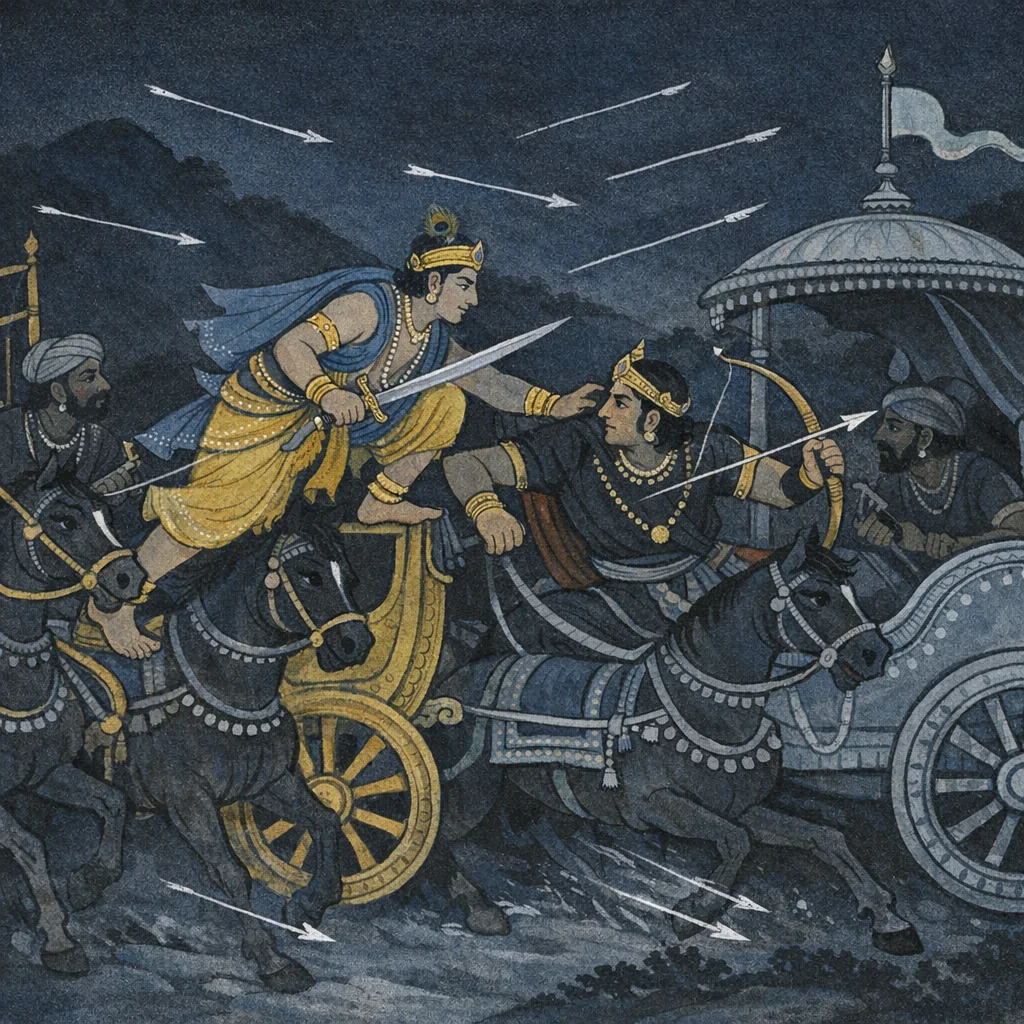
Adhyaya 170
द्रौणिप्रतिज्ञा–नारायणास्त्रवर्णनम् (Drauṇi’s Vow and the Description of the Nārāyaṇāstra)
Upa-parva: Nārāyaṇāstra-prayoga (Episode of the Nārāyaṇa Weapon’s Deployment)
Saṃjaya reports that Aśvatthāman wreaks severe devastation upon opponents, likened to end-time destruction. He reiterates a vow before Dhṛtarāṣṭra’s son (Duryodhana), prompting a renewed convergence of Kuru and Pāṇḍava forces. Amid heightened martial sound and imagery, Drauṇi deploys the Nārāyaṇāstra against the Pāṇḍava–Pāñcāla host; countless blazing projectiles and weapon-forms fill the sky, and the astra intensifies in response to resistance. The Pāṇḍava side experiences acute fear as casualties mount. Yudhiṣṭhira, overwhelmed, issues instructions for withdrawal and even expresses self-destructive despair. Kṛṣṇa (Vāsudeva) intervenes with a technical countermeasure: all should lay down weapons and dismount, since the astra targets those who resist. Bhīma refuses the counsel and attempts direct opposition, whereupon the astra’s force increases; the army largely complies by disarming and dismounting, causing the weapon’s pressure to fall away from them while concentrating upon Bhīma, who becomes obscured by blazing energy as the chapter closes.
Chapter Arc: संजय धृतराष्ट्र को रात्रियुद्ध के भीतर उठती नई मुठभेड़ों का वृत्तांत सुनाते हैं—शतानीक का चित्रसेन से सामना, वृषसेन का द्रुपद (यज्ञसेन) पर प्रहार, और प्रतिविन्ध्य का दुःशासन से टकराव। → तीर-प्रतितीर की वर्षा में शतानीक और चित्रसेन एक-दूसरे को बार-बार बेधते हैं; उधर वृषसेन क्रुद्ध होकर यज्ञसेन की छाती में अनेक तीक्ष्ण बाण उतारता है। रात्रि का अंधकार, थकान और भ्रम युद्ध को और निर्दय बनाते हैं। → एक महारथी का धनुष कट जाता है, घोड़े-सारथि मारे जाते हैं और वह विरथ होकर भी तुरंत हार्दिक्य (कृतवर्मा) के रथ पर चढ़कर युद्ध में लौट आता है—रात्रियुद्ध में जीवन-मरण की डोर एक क्षण में टूटती और फिर किसी दूसरे रथ से बंध जाती है। → सारथियों की चतुराई और रथ-परिवर्तन से मोर्चे संभलते हैं; प्रतिविन्ध्य अपने तीक्ष्ण बाणों से घोड़ों को गिराकर दुष्कर पराक्रम दिखाता है। पर निर्णायक विजय किसी एक पक्ष की नहीं—रात्रि के भीतर युद्ध चलता रहता है। → निशीथ के दारुण समय में ‘यमराष्ट्रविवर्धन’ जैसा घोर संग्राम और भड़क उठता है—अगले क्षण किसका रथ टूटेगा, किसका तेज बुझ जाएगा, यह अनिश्चित रह जाता है।
Shlokas
Verse 1
ऑपनआक्रा बछ। अंक अष्टषष्ट्यधिकशततमो< ध्याय: शतानीकके द्वारा चित्रसेनकी और वृषसेनके द्वारा द्रुपदकी पराजय तथा प्रतिविन्ध्य एवं दुःशासनका युद्ध संजय उवाच शतानीकं शरैस्तूर्ण निर्दहन्तं चमूं तव । चित्रसेनस्तव सुतो वारयामास भारत,संजय कहते हैं--भारत! एक ओरसे नकुलपुत्र शतानीक अपनी शराग्निसे आपकी सेनाको भस्म करता हुआ आ रहा था। उसे आपके पुत्र चित्रसेनने रोका
Sañjaya said: “O Bharata (Dhṛtarāṣṭra), at that time Śatānīka, Nakula’s son, swiftly advanced, scorching your army with his arrows as though with fire; but your son Citrasena checked him and held him back.”
Verse 2
नाकुलिकश्रित्रसेनं तु विदृध्वा पजचभिराशुगै: । सतुतंप्रतिविव्याध दशभिर्निशितै: शरैः,शतानीकने चित्रसेनको पाँच बाण मारे। चित्रसेनने भी दस पैने बाण मारकर बदला चुकाया
Sañjaya said: Having pierced Nakula’s ally Śritrasena with five swift arrows, Citrāsena then struck back at Śatānīka, wounding him with ten razor‑sharp shafts. In the heat of battle, injury answered injury, and the wheel of retaliation turned ever more fiercely.
Verse 3
चित्रसेनो महाराज शतानीकं पुनर्युधि । नवभिर्निशितैर्बाणैराजघान स्तनान्तरे,महाराज! चित्रसेनने युद्धस्थलमें पुनः नौ तीखे बाणोंद्वारा शतानीककी छातीमें गहरी चोट पहुँचायी
Sañjaya said: O great king, in the midst of battle Citrāsena again struck Śatānīka, piercing him in the chest with nine sharp arrows. Thus the war’s relentless momentum pressed on, as repeated assaults displayed prowess even while the moral weight of violence hung over the field.
Verse 4
नाकुलिस्तस्य विशिखैर्वर्म संनतपर्वभि: । गात्रात् संच्यावयामास तदद्भुतमिवाभवत्,तब नकुलपुत्रने झुकी हुई गाँठवाले अनेक बाण मारकर चित्रसेनके शरीरसे उसके कवचको काट गिराया। वह अद्धभुत-सा कार्य हुआ
Sañjaya said: Nakulī, with many arrows whose feathers were bent, struck him and dislodged the armour from his body. That feat seemed wondrous indeed—martial skill flashing forth amid the unrelenting press of war.
Verse 5
सो<पेतवर्मा पुत्रस्ते विरराज भृशं नृप । उत्सृज्य काले राजेन्द्र निर्मोकमिव पन्नग:,नरेश्वर! राजेन्द्र! कवच कट जानेपर आपका पुत्र चित्रसेन समयपर केंचुल छोड़नेवाले सर्पके समान अत्यन्त सुशोभित हुआ
Sañjaya said: O king, your son—Citrāsena (Apetavarmā)—shone exceedingly. At the proper moment, O lord of kings, he cast off his armour like a serpent shedding its slough, as though shifting deliberately from protection to decisive action amid the war’s pressure.
Verse 6
ततोअस्य निशितैर्बाणैर्थ्वजं चिच्छेद नाकुलि: । धनुश्वैव महाराज यतमानस्य संयुगे,महाराज! तदनन्तर नकुलपुत्र शतानीकने युद्धस्थलमें विजयके लिये प्रयत्न करनेवाले चित्रसेनके ध्वज और धनुषको पैने बाणोंद्वारा काट दिया
Sañjaya said: Then, with sharp arrows, Nakulī cut down his banner and also his bow, O king, as he strove in the thick of battle. This was not mere slaughter, but a tactical crippling—stripping him of emblem and weapon, and turning the contest toward decisive advantage.
Verse 7
स च्छिन्नधन्वा समरे विवर्मा च महारथ: । धनुरन्यन्महाराज जग्राहारिविदारणम्,राजेन्द्र! समरांगणमें धनुष और कवच कट जानेपर महारथी चित्रसेनने दूसरा धनुष हाथमें लिया, जो शत्रुको विदीर्ण करनेमें समर्थ था
Sañjaya said: In the midst of battle, that great chariot-warrior—his bow cut down and his armour torn away—took up another bow, O great king, O lord of kings, a weapon capable of rending the enemy.
Verse 8
ततस्तूर्ण चित्रसेनो नाकुलिं नवभि: शरै: | विव्याध समरे क्रुद्धो भरतानां महारथ:,उस समय समरभूमिमें कुपित हुए भरतकुलके महारथी वीर चित्रसेनने नकुलपुत्र शतानीकको नौ बाणोंसे घायल कर दिया
Then, in the heat of battle, the great chariot-warrior Citrasena of the Bharata line—angered and swift—pierced Nakula’s son Śatānīka with nine arrows.
Verse 9
शतानीको<थ संक्रुद्धश्चित्रसेनस्थ मारिष । जघान चतुरो वाहान् सारथिं च नरोत्तम:,माननीय नरेश! तब अत्यन्त कुपित हुए नरश्रेष्ठ शतानीकने चित्रसेनके चारों घोड़ों और सारथिको मार डाला
Sañjaya said: Then Śatānīka, inflamed with anger, struck down the four horses of Citrasena and also his charioteer.
Verse 10
अवलप्लुत्य रथात् तस्माच्चित्रसेनो महारथ: । नाकुलिं पञ्चविंशत्या शराणामार्दयद् बली,तब बलवान महारथी चित्रसेनने उस रथसे कूदकर नकुलपुत्र शतानीकको पचीस बाण मारे
Sañjaya said: Then the mighty great chariot-warrior Citrasena leapt down from that chariot and struck Nākuli (Śatānīka, the son of Nakula) with twenty-five arrows.
Verse 11
तस्य तत्कुर्वत: कर्म नकुलस्य सुतो रणे । अर्धचन्द्रेण चिच्छेद चापं रत्नविभूषितम्,यह देख रणक्षेत्रमें नकुलपुत्रने पूर्वोक्त कर्म करनेवाले चित्रसेनके रत्नविभूषित धनुषको एक अर्धचन्द्राकार बाणसे काट डाला
Sañjaya said: As he was engaged in that very action on the battlefield, Nakula’s son struck and cleanly severed his jewel-adorned bow with a crescent-headed arrow.
Verse 12
सच्छिन्नधन्वा विरथो हताश्वनो हतसारथि: । आरुरोह रथं तूर्ण हार्दिक्यस्य महात्मन:,धनुष कट गया, घोड़े और सारथि मारे गये और वह रथहीन हो गया। उस अवस्थामें चित्रसेन तुरंत भागकर महामना कृतवर्माके रथपर जा चढ़ा
Sañjaya said: His bow having been cut down, his chariot lost, his horses slain and his charioteer killed, he became chariotless; and swiftly he mounted the chariot of the high-souled Hārdikya (Kṛtavarmā).
Verse 13
ट्रुपदं तु सहानीकं द्रोणप्रेप्सुं महारथम् । वृषसेनो<भ्ययात् तूर्ण किर|ञ्शरशतैस्तदा,द्रोणाचार्यका सामना करनेके लिये आते हुए महारथी द्रुपदपर वृषसेनने सैकड़ों बाणोंकी वर्षा करते हुए तत्काल आक्रमण कर दिया
Sañjaya said: Then Vṛṣasena swiftly charged the great chariot-warrior Drupada, who was advancing with his forces, intent on confronting Droṇa; and at that moment he showered him with hundreds of arrows.
Verse 14
यज्ञसेनस्तु समरे कर्णपुत्रं महारथम् । षष्ट्या शराणां विव्याध बाह्दवोरुगसि चानघ,निष्पाप नरेश! समरांगणमें राजा यज्ञसेन (द्रुपद)-ने महारथी कर्णपुत्र वृषसेनकी छाती और भुजाओंमें साठ बाण मारे
Sañjaya said: In the thick of battle, King Yajñasena (Drupada) struck Karṇa’s son, the great chariot-warrior, with sixty arrows, piercing his arms and chest. O blameless king, thus the combat intensified.
Verse 15
वृषसेनस्तु संक्रुद्धो यज्ञसेनं रथे स्थितम् । बहुभि: सायकैस्ती3्ष्णराजघान स्तनान्तरे,तब वृषसेन अत्यन्त कुपित होकर रथपर बैठे हुए यज्ञसेनकी छातीमें बहुत-से पैने बाण मारे
Sañjaya said: Enraged, Vṛṣasena struck Yajñasena, who stood upon his chariot, with many sharp arrows, piercing him in the region of the chest.
Verse 16
तावुभौ शरनुन्नाज़ौ शरकण्टकितौ रणे । व्यभ्राजेतां महाराज श्वाविधौ शललैरिव,महाराज! उन दोनोंके ही शरीर एक-दूसरेके बाणोंसे क्षत-विक्षत हो गये थे। वे दोनों ही बाणरूपी कंटकोंसे युक्त हो काँटोंसे भरे हुए दो साही नामक जन्तुओंके समान शोभित हो रहे थे
Sañjaya said: O King, both of them, driven and pierced by arrows in the battle, their bodies bristling with arrow-thorns, shone on the field like two porcupines covered with quills.
Verse 17
रुक्मपुड्खीै: प्रसन्नाग्रै: शरैश्छिन्नतनुच्छदौ । रुधिरीघपरिक्लिन्नौ व्यभ्राजेतां महामृथे,सोनेके पंख और स्वच्छ धारवाले बाणोंसे उस महासमरमें दोनोंके कवच कट गये थे और दोनों ही लहूलुहान होकर अद्भुत शोभा पा रहे थे
Sañjaya said: In that great battle, their coats of mail were cut to pieces by arrows with golden fletching and clear, keen points; drenched in streams of blood, the two warriors nonetheless shone with a strange, formidable splendor—showing how, amid the violence of war, steadfast resolve and a warrior’s dharma can still appear as a grim radiance.
Verse 18
तपनीयनिभौ चित्रौ कल्पवृक्षाविवाद्भुतौ । किंशुकाविव चोत्फुल्लौ व्यकाशेतां रणाजिरे,वे दोनों सुवर्णके समान विचित्र, कल्पवृक्षके समान अद्भुत और खिले हुए दो पलाशवृक्षोंके समान अनूठी शोभासे सम्पन्न हो रणभूमिमें प्रकाशित हो रहे थे
Sañjaya said: On the battlefield, the two shone with a singular splendor—variegated like refined gold, wondrous like the wish-fulfilling kalpavṛkṣa, and radiant like two fully blossomed kiṃśuka (flame-of-the-forest) trees. The image suggests that even amid violence, heroic presence can dazzle, deepening both awe of valor and the tragic beauty of war.
Verse 19
वृषसेनस्ततो राजन ट्रुपदं नवभि: शरै: | विद्ध्वा विव्याध सप्तत्या पुनरन्यैस्त्रिभिस्त्रिभि:,राजन! तदनन्तर वृषसेनने राजा द्रुपदको नौ बाणोंसे घायल करके फिर सत्तर बाणोंसे बींध डाला। तत्पश्चात् उन्हें तीन-तीन बाण और मारे
Sañjaya said: Then, O King, Vṛṣasena struck Drupada with nine arrows; having pierced him, he further wounded him with seventy more, and again with other arrows, three at a time. The scene shows the relentless escalation of violence on the battlefield, where prowess is displayed through repeated volleys even as the moral cost of such excess remains unspoken.
Verse 20
तत:ः शरसहस्राणि विमुज्चन् विवभौ तदा । कर्णपुत्रो महाराज वर्षमाण इवाम्बुद:,महाराज! तदनन्तर सहस्रों बाणोंका प्रहार करता हुआ कर्णपुत्र वृषसेन जलकी वर्षा करनेवाले मेघके समान सुशोभित होने लगा
Sañjaya said: Then, releasing thousands of arrows, Karṇa’s son shone forth, O King—like a rain-bearing cloud pouring down its shower. The image evokes the overwhelming, almost impersonal force of martial skill: prowess becomes a deluge that tests endurance, resolve, and a warrior’s dharma amid the harsh ethics of war.
Verse 21
इससे क्रोधमें भरे हुए राजा द्रपदने एक पानीदार पैने भल्लसे वृषसेनके धनुषके दो टुकड़े कर डाले
Sañjaya said: Enraged, King Drupada, with swift resolve, struck with a sharp, gleaming bhalla-arrow and split Vṛṣasena’s bow into two. In the heat of battle, anger can drive decisive action, yet it also signals the moral peril of letting wrath rule one’s judgment.
Verse 22
सोअन्यत् कार्मुकमादाय रुक्मबद्धं नवं दृढम् । तूणादाकृष्य विमलं भल्लं पीत॑ शितं दृढम्,तब उसने सोनेसे मढ़े हुए दूसरे नवीन एवं सुदृढ़ धनुषको हाथमें लेकर तरकशसे एक चमचमाता हुआ पानीदार, तीखा और मजबूत भल्ल निकाला। उसे धनुषपर रखा और कानतक खींचकर समस्त सोमकोंको भयभीत करते हुए वृषसेनने राजा ट्रुपदको लक्ष्य करके वह भल्ल्ल छोड़ दिया
Sañjaya said: Taking up another bow—new, firm, and bound with gold—he drew from his quiver a spotless, gleaming bhalla-arrow, yellow-hued, sharp, and strong. Setting it on the bow and drawing it back to his ear, Vṛṣasena, striking fear into the Somakas, released that bhalla with King Drupada as his mark.
Verse 23
द्रपदस्तु ततः क्रुद्धो वृषसेनस्य कार्मुकम् । द्विधा चिच्छेद भललेन पीतेन निशितेन च,कार्मुके योजयित्वा त॑ द्रुपदं संनिरीक्ष्य च आकर्णपूर्ण मुमुचे त्रासयन् सर्वसोमकान् तब उसने सोनेसे मढ़े हुए दूसरे नवीन एवं सुदृढ़ धनुषको हाथमें लेकर तरकशसे एक चमचमाता हुआ पानीदार, तीखा और मजबूत भल्ल निकाला। उसे धनुषपर रखा और कानतक खींचकर समस्त सोमकोंको भयभीत करते हुए वृषसेनने राजा ट्रुपदको लक्ष्य करके वह भल्ल्ल छोड़ दिया
Sañjaya said: Then King Drupada, enraged, split Vṛṣasena’s bow in two with a sharp, gold-adorned bhalla-arrow. Thereupon Vṛṣasena, fixing another bow, took aim at Drupada; drawing the string back to his ear, he released his arrow, terrifying all the Somakas.
Verse 24
हृदयं तस्य भित्त्वाच जगाम वसुधातलम् । कश्मलं प्राविशद् राजा वृषसेनशराहत:,वह भल्ल्ल ट्रपदकी छाती छेदकर धरतीपर जा गिरा। वृषसेनके उस भललसे आहत होकर राजा ट्रुपद मूर्च्छित हो गये
Sañjaya said: The arrow, having pierced his heart, fell down upon the surface of the earth. Struck by Vṛṣasena’s shaft, the king was seized by bewilderment and collapsed—his senses failing amid the violence of battle.
Verse 25
सारथिस्तमपोवाह स्मरन् सारथिचेष्टितम् । तस्मिन् प्रभग्ने राजेन्द्र पजचालानां महारथे
Sañjaya said: The charioteer then drove him away, recalling the proper conduct and duties of a charioteer. O best of kings, when that great chariot-warrior of the Pañcālas had been routed, the charioteer acted with presence of mind—prioritizing the protection of his lord and the discipline of his craft amid the chaos of war.
Verse 26
ततस्तु द्रुपदानीकं शरैश्छिन्नतनुच्छदम् । सम्प्राद्रवत् तदा राजन् निशीथे भैरवे सति
Sañjaya said: Then, O King, Drupada’s battle-division—its bodies and armor-clad frames cut and torn by showers of arrows—broke into a headlong flight, as the dreadful midnight hour prevailed.
Verse 27
राजेन्द्र! तब सारथि अपने कर्तव्यका स्मरण करके उन्हें रणभूमिसे दूर हटा ले गया। पांचालोंके महारथी द्रपदके हट जानेपर बाणोंसे कटे हुए कवचवाली द्रुपदकी सारी सेना उस भयंकर आधीरातके समय वहाँसे भाग चली ।। प्रदीपैर्हि परित्यक्तैज्वलट्धिस्तै: समन््ततः । व्यराजत मही राजन वीताभ्रा द्यौरिव ग्रहै:,राजन! भागते हुए सैनिकोंने जो मशालें फेंक दी थीं, वे सब ओर जल रही थीं। उनके द्वारा वह रणभूमि ग्रह-नक्षत्रोंसे भरे हुए मेघहीन आकाशके समान सुशोभित हो रही थी
Sañjaya said: O king of kings, then the charioteer, recalling his duty, drew them away from the battlefield. When Drupada—the great chariot-warrior of the Pāñcālas—had withdrawn, all Drupada’s army, their armor cut and torn by arrows, fled from that place in the dreadful hour of midnight. For the torches that the fleeing soldiers cast away were burning on every side; by their blaze the earth shone, O king, like a cloudless sky filled with planets and stars.
Verse 28
तथाडूुदैर्निपतितैव्यराजत वसुंधरा । प्रावृट्काले महाराज विद्युदूभिरिव तोयद:,महाराज! वीरोंके गिरे हुए चमकीले बाजूबन्दोंसे वहाँकी भूमि वैसी ही शोभा पा रही थी, जैसे वर्षाकालमें बिजलियोंसे मेघ प्रकाशित होता है
Sañjaya said: O great king, the earth shone with the fallen, gleaming armlets, just as in the rainy season a cloud is lit up by flashes of lightning.
Verse 29
ततः कर्णसुतात् त्रस्ता: सोमका विद्रदुद्रुव॒ुः । यथेन्द्रभयवित्रस्ता दानवास्तारकामये
Sañjaya said: Then the Somakas, terrified by Karṇa’s son, fled swiftly—just as the Dānavas, shaken by fear of Indra, once scattered in the battle for Tārakā.
Verse 30
तदनन्तर कर्णपुत्र वृषसेनके भयसे त्रस्त हो सोमकवंशी क्षत्रिय उसी प्रकार भागने लगे, जैसे तारकामय संग्राममें इन्द्रके भयसे डरे हुए दानव भागे थे ।। तेना्यमाना: समरे द्रवमाणाश्षु सोमका: । व्यराजन्त महाराज प्रदीपैरवभासिता:,महाराज! समरभूमिमें वृषसेनसे पीड़ित होकर भागते हुए सोमक-योद्धा प्रदीपोंसे प्रकाशित हो बड़ी शोभा पा रहे थे
Sañjaya said: Thereafter, the Somaka Kshatriyas, terrified by Karṇa’s son Vṛṣasena, began to flee—just as, in the Tārakāmaya battle, the Daityas once fled in fear of Indra. Harried by him on the battlefield and running in disorder, the Somaka warriors, O King, appeared striking as they were lit up by blazing torches.
Verse 31
तांस्तु निर्जित्य समरे कर्णपुत्रो5प्यरोचत । मध्यंदिनमनुप्राप्तो घर्माशुरिव भारत,भारत! युद्धस्थलमें उन सबको जीतकर कर्णपुत्र वृषसेन भी दोपहरके प्रचण्ड किरणोंवाले सूर्यके समान उद्धासित हो रहा था
Sañjaya said: Having conquered them in the battle, Karṇa’s son Vṛṣasena shone forth. Reaching the height of midday, he blazed like the sun with scorching rays.
Verse 32
तेषु राजसहस्रेषु तावकेषु परेषु च । एक एव ज्वलंस्तस्थौ वृषसेन: प्रतापवान्,आपके और शत्रुपक्षेके सहस्नों राजाओंके बीच एकमात्र प्रतापी वृषसेन ही अपने तेजसे प्रकाशित होता हुआ रणभूमिमें खड़ा था
Sañjaya said: Amid those thousands of kings—on both the Kaurava side and the opposing host—Vṛṣasena alone stood blazing on the battlefield, radiant with martial splendor.
Verse 33
स विजित्य रणे शूरान् सोमकानां महारथान् | जगाम त्वरितस्तत्र यत्र राजा युधिष्ठटिर:,वह युद्धके मैदानमें शूरवीर सोमक महारथियोंको परास्त करके तुरंत वहाँ चला गया, जहाँ राजा युधिष्छिर खड़े थे
Sañjaya said: Having defeated in battle the heroic great chariot-warriors of the Somakas, he hurried at once to the spot where King Yudhiṣṭhira was standing.
Verse 34
प्रतिविन्ध्यमथ क्रुद्ध॑ प्रदहन्तं रणे रिपून् दुःशासनस्तव सुत:ः प्रत्यगच्छन्महारथ:,दूसरी ओर क्रोधमें भरा हुआ प्रतिविन्ध्य रणक्षेत्रमें शत्रुओंकी दग्ध कर रहा था। उसका सामना करनेके लिये आपका महारथी पुत्र दुःशासन आ पहुँचा
Sañjaya said: Then Prativindhya, inflamed with wrath, was scorching the enemy ranks on the battlefield. To confront him, your son Duḥśāsana—the great chariot-warrior—advanced to meet him.
Verse 35
तयो: समागमो राजंश्रित्ररूपो बभूव ह । व्यपेतजलद व्योम्नि बुधभास्करयोरिव,राजन! जैसे मेघरहित आकाशमें बुध और सूर्यका समागम हो, उसी प्रकार युद्धस्थलमें उन दोनोंका अद्भुत मिलन हुआ
Sañjaya said: O King, the encounter of those two became wondrous to behold. It was like the meeting of Mercury and the Sun in a sky cleared of clouds—so, on the battlefield, their extraordinary convergence appeared.
Verse 36
प्रतिविन्ध्यं तु समरे कुर्वाणं कर्म दुष्करम् । दुःशासनस्त्रिभिर्बाणैर्ललाटे समविध्यत,समरांगणमें दुष्कर कर्म करनेवाले प्रतिविन्ध्यके ललाटमें दुःशासनने तीन बाण मारे
Sañjaya said: In the thick of battle, as Prativindhya was performing a feat difficult to accomplish, Duḥśāsana struck him on the forehead with three arrows.
Verse 37
सो5तिविद्धों बलवता तव पुत्रेण धन्विना । विरराज महाबाहु: सशृज्ञ इव पर्वतः,आपके बलवान धनुर्धर पुत्रद्वारा चलाये हुए उन बाणोंसे अत्यन्त घायल हो महाबाहु प्रतिविन्ध्य तीन शिखरोंवाले पर्वतके समान सुशोभित हुआ
Sañjaya said: Struck again and again and grievously wounded by the powerful arrows shot from your son’s bow, the mighty-armed Prativindhya still shone forth—like a mountain crowned with peaks. Even amid injury, the warrior’s steadfast presence becomes a stark image of endurance within the harsh ethics of battlefield duty.
Verse 38
दुःशासन तु समरे प्रतिविन्ध्यो महारथ: । नवश्ि: सायकैर्विद्ध्वा पुनर्विव्याध सप्तभि:,तत्पश्चात् महारथी प्रतिविन्ध्यने समरभूमिमें दुःशासनको नौ बाणोंसे घायल करके फिर सात बाणोंसे बींध डाला
Sañjaya said: In the thick of battle, the great chariot-warrior Prativindhya struck Duḥśāsana with nine arrows, and then pierced him again with seven more. The narration underscores the relentless escalation of violence on the battlefield, where prowess and vengeance drive repeated wounding rather than restraint.
Verse 39
तत्र भारत पुत्रस्ते कृतवान् कर्म दुष्करम् | प्रतिविन्ध्यहयानुग्रै: पातयामास सायकै:,भारत! उस समय वहाँ आपके पुत्रने एक दुष्कर पराक्रम कर दिखाया। उसने अपने भयंकर बाणोंद्वारा प्रतिविन्ध्यके घोड़ोंको मार गिराया
Sañjaya said: “There, O Bhārata, your son performed a deed of formidable difficulty. With fierce arrows he struck down the horses of Prativindhya.” The line underscores how, in the brutal logic of war, disabling an opponent’s mobility becomes a decisive—though ethically grim—means of gaining advantage.
Verse 40
सारथिं चास्य भल्लेन ध्वजं च समपातयत् | रथं च तिलशो राजन् व्यधमत् तस्य धन्विन:,राजन्! फिर एक भल्ल्ल मारकर उसने धनुर्थर वीर प्रतिविन्ध्यके सारथि और ध्वजको धराशायी कर दिया तथा रथके भी तिलके समान टुकड़े-टुकड़े कर डाले
Sañjaya said: With a single bhalla-arrow he struck down that warrior’s charioteer and also felled his banner. Then, O King, he shattered the archer’s chariot itself into fragments as small as sesame seeds—an image of ruthless battlefield skill where prowess aims not only at the fighter but at the very supports of his combat.
Verse 41
पताकाश्व सतूणीरा रश्मीन् योक्त्राणि च प्रभो । चिच्छेद तिलश: क्रुद्ध: शरै: संनतपर्वभि:,प्रभो! क्रोधमें भरे हुए दुःशासनने झुकी हुई गाँठवाले बाणोंसे प्रतिविन्ध्यकी पताकाओं, तरकसों, उनके घोड़ोंकी बागडोरों और रथके जोतोंको भी तिल-तिल करके काट डाला
Sanjaya said: O lord, Duhshasana, inflamed with anger, sliced to pieces—bit by bit—with arrows having well-bent knots, Prativindhya’s banners, his horses, his quivers, the reins, and even the yoke-straps of the chariot. The scene underscores how wrath in battle drives a warrior not merely to strike the opponent, but to dismantle the very supports of his mobility and honor, turning combat into systematic destruction.
Verse 42
विरथ: स तु धर्मात्मा धनुष्पाणिरवस्थित: । अयोधयत् तव सुतं किरञ्शरशतान् बहून्,धर्मात्मा प्रतिविन्ध्य रथहीन हो जानेपर हाथमें धनुष लिये पृथ्वीपर खड़ा हो गया और सैकड़ों बाणोंकी वर्षा करता हुआ आपके पुत्रके साथ युद्ध करने लगा
Sañjaya said: Though left without a chariot, that righteous warrior stood his ground with bow in hand. Showering many hundreds of arrows, he engaged your son in battle—steadfast in dharma even amid the chaos of war.
Verse 43
क्षुरप्रेण धनुस्तस्य चिच्छेद तनयस्तव । अथैनं दशभिर्बाणैश्छिन्नधन्वानमार्दयत्,तब आपके पुत्रने एक क्षुरप्रसे प्रतिविन्ध्यका धनुष काट दिया और धनुष कट जानेपर उसे दस बाणोंसे गहरी चोट पहुँचायी
Sañjaya said: With a razor-headed arrow your son cut down his bow. Then, seeing him disarmed, he struck him hard with ten arrows—an episode that highlights the ruthless momentum of battlefield advantage, where the loss of a weapon immediately becomes an opening for intensified assault.
Verse 44
त॑ दृष्टवा विरथं तत्र भ्रातरो5स्य महारथा: । अन्ववर्तन्त वेगेन महत्या सेनया सह,उसे रथहीन हुआ देख उसके अन्य महारथी भाई विशाल सेनाके साथ बड़े वेगसे उसकी सहायताके लिये आ पहुँचे
Sañjaya said: Seeing him there deprived of his chariot, his brothers—great chariot-warriors—rushed forward at speed, accompanied by a vast host, to support and protect him amid the press of battle. The scene underscores the battlefield ethic of standing by one’s own kin and commander when he is suddenly rendered vulnerable.
Verse 45
आप्लुत: स ततो यान॑ सुतसोमस्य भास्वरम् | धनुर्गह्ा महाराज विव्याध तनयं तव,महाराज! तब प्रतिविन्ध्य उछलकर सुतसोमके तेजस्वी रथपर जा बैठा और हाथमें धनुष लेकर आपके पुत्रको घायल करने लगा
Sañjaya said: Then Prativindhya sprang up onto Sutasoma’s radiant chariot. Taking up his bow, O King, he began to wound your son—an episode that shows how, in the press of battle, valor and tactical advantage are pursued even at the cost of kinship bonds and the ordinary restraints of compassion.
Verse 46
ततस्तु तावका: सर्वे परिवार्य सुतं तव । अभ्यवर्तन्त संग्रामे महत्या सेनया वृता:,यह देख आपके सभी योद्धा आपके पुत्र दुःशासनको सब ओरसे घेरकर विशाल सेनाके साथ वहाँ युद्धके लिये डट गये
Sañjaya said: Then all your warriors, surrounding your son, advanced again into the battle, protected and supported by a great host. The scene underscores the Kaurava reliance on collective force and protective formations to preserve a key fighter amid the moral and strategic pressures of the war.
Verse 47
ततः प्रववृते युद्ध तव तेषां च भारत । निशीथे दारुणे काले यमराष्ट्रविवर्धनम्,भारत! तदनन्तर उस भयंकर निशीथकालमें आपके पुत्र और द्रौपदीपुत्रोंका घोर युद्ध आरम्भ हुआ, जो यमराजके राज्यकी वृद्धि करनेवाला था
Sañjaya said: Then, O Bhārata, a battle began between your sons and those warriors—at the dreadful hour of midnight—one that would only swell the realm of Yama, the Lord of Death.
Verse 167
इस प्रकार श्रीमह्ााभारत द्रोणपर्वके अन्तर्गत घटोत्कचवधपर्वमें रात्रियुद्धके अवसरपर अलगम्बुषका पराजयविषयक एक सौ सरसठवाँ अध्याय पूरा हुआ
Sañjaya said: Thus, in the Śrī Mahābhārata, within the Droṇa Parva, in the section concerning the slaying of Ghaṭotkaca, on the occasion of the night-battle, the one hundred and sixty-seventh chapter—dealing with the defeat of Alambusha—comes to its close.
Verse 168
इति श्रीमहाभारते द्रोणपर्वणि घटोत्कचवधपर्वणि रात्रियुद्धे शतानीकादियुद्धे5ष्टषष्ट्यधिकशततमो< ध्याय:,इस प्रकार श्रीमह्ाभारत द्रोणपर्वके अन्तर्गत घटोत्कचवधपर्वमें रात्रियुद्धके समय शतानीक आदिका युद्धविषयक एक सौ अड़सठवाँ अध्याय पूरा हुआ
Sañjaya said: Thus, in the Śrī Mahābhārata, within the Droṇa Parva, in the sub-section concerning the slaying of Ghaṭotkaca, during the night-battle, in the episode describing the combat involving Śatānīka and others, the one hundred and sixty-eighth chapter is concluded.
Frequently Asked Questions
Whether valor requires continued resistance when resistance predictably worsens collective harm: the chapter frames a dharma-sankat between pride-driven confrontation and restraint-based compliance to protect the wider host.
Under certain conditions, the ethically superior action is controlled non-resistance: disciplined renunciation of aggression can be both morally coherent and strategically effective when a threat is designed to amplify against opposition.
No explicit phalaśruti appears in this passage; the meta-instruction is implicit in Kṛṣṇa’s procedural teaching that correct knowledge of an astra’s operating rule is itself protective within the epic’s broader dharma framework.