Adhyaya 109
भीमसेनस्य बहुमहारथसंयुगः (Bhīmasena’s Engagement with Multiple Mahārathas)
Upa-parva: Bhīma-saṃyoga (Strategic Engagement of Bhīmasena with Kaurava Mahārathas)
Sañjaya reports that a coalition of Kaurava fighters—Bhagadatta, Kṛpa, Śalya, Kṛtavarmā, Vindānuvinda, Jayadratha, Citraseṇa, Vikarṇa, and Durmarṣaṇa—press Bhīmasena with coordinated volleys. Bhīma responds by counter-wounding key opponents, severing Kṛpa’s bow, and repeatedly checking the group’s advance. Jayadratha’s chariot is neutralized through targeted strikes that kill horses and charioteer; Jayadratha relocates onto Citraseṇa’s chariot, marking a tactical retreat rather than collapse. Śalya escalates with a heavy barrage and calls for Bhīma to stand, while others support Śalya’s pressure. Bhīma continues to intercept and cut down incoming heavy missiles (tomara, paṭṭiśa, śataghnī, śakti), demonstrating defensive mastery alongside offense. As the engagement intensifies, Arjuna moves toward Bhīma’s position, and the Kaurava side anticipates reduced prospects upon seeing the two Pāṇḍava leaders aligned. The chapter closes with Duryodhana directing Suśarmā and the Trigartas to engage and attempt to neutralize Arjuna and Bhīma through massed chariot forces, broadening the conflict from a focused melee to a larger encirclement battle.
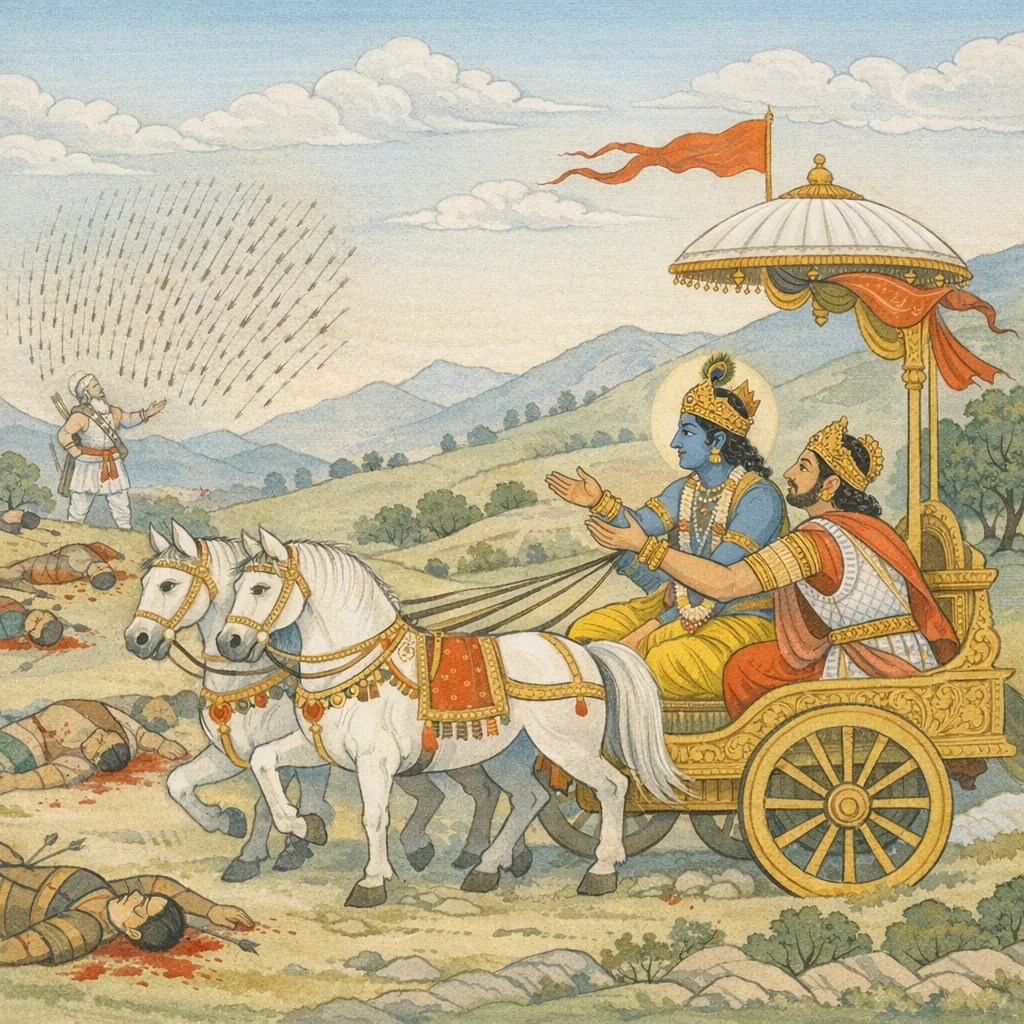
Chapter Arc: भीष्म के बाणों से पाण्डव-सेना में भगदड़ मचती है; रणभूमि पर शान्तनुनन्दन का प्रचण्ड पराक्रम सबको स्तब्ध कर देता है। → भीष्म एक-एक कर पाण्डव पक्ष के प्रमुख योद्धाओं को बेधते हैं—भीम, सात्यकि, नकुल, सहदेव और धृष्टद्युम्न तक; महाचमू महेन्द्र-सम वीर्य से ‘वध्यमाना’ प्रतीत होती है और पाण्डव सैनिक भयपीड़ित होकर पीछे हटते हैं। → अर्जुन के भीतर निर्णायक क्षण आता है—वह व्यग्रताशून्य चित्त से गोविन्द को पुकारकर रथ को भीष्म की ओर ले चलने और स्वयं को महाहव में गिरा देने तक का आग्रह करता है; उसी क्षण कृष्ण अर्जुन के विक्रम को जानकर परमप्रीत होते हुए भी क्रोध को साधकर रथ पर पुनः आरूढ़ होते हैं। → कृष्ण-अर्जुन को रथ पर स्थित देखकर भीष्म फिर से मेघवत् शरवर्षा आरम्भ करते हैं; पाण्डव पक्ष की पीड़ा और दबाव बना रहता है, पर अर्जुन का संकल्प अब स्पष्ट और तीक्ष्ण हो चुका है। → भीष्म की बाण-वृष्टि के बीच अर्जुन का प्रतिघात किस रूप में फूटेगा—क्या वह भीष्म-वध के संकल्प तक पहुँचेगा या धर्म-संकट उसे रोक देगा?
Shlokas
Verse 1
[दाक्षिणात्य अधिक पाठके ५ ६ श्लोक मिलाकर कुल ४० ६ “लोक हैं।] #फ्जिआा तल () अजीज षर्डाधिकशततमोब< ध्याय: भीष्मके द्वारा पराजित पाण्डवसेनाका पलायन और भीष्मको मारनेके लिये ४६90 हुए श्रीकृष्णको अर्जुनका कना संजय उवाच ततः पिता तव क्रुद्धो निशितैः सायकोत्तमै: । आजपघान रणे पार्थान् सहसेनान् समन्ततः,संजय कहते हैं--महाराज! तब आपके ताऊ देवव्रत कुपित हो रणभूमिमें अपने तीखे एवं श्रेष्ठ सायकोंद्वारा सेनासहित कुन्तीकुमारोंकोी सब ओरसे घायल करने लगे
Sanjaya said: Then your father’s elder, Devavrata (Bhishma), angered, struck the sons of Pritha—along with their troops—on every side in the battle, with sharp and excellent arrows. The scene underscores Bhishma’s formidable martial duty as a commander, even as it intensifies the moral tension of elders fighting kin in a war driven by contested righteousness.
Verse 2
भीम॑ द्वादशभिवविंद्ध्वा सात्यकिं नवभि: शरै: | नकुलं च त्रिभिर्विंद्ूध्वा सहदेवं च सप्तभि:
Sañjaya said: Having pierced Bhīma with twelve arrows and Sātyaki with nine, he then struck Nakula with three and Sahadeva with seven. The report underscores the relentless arithmetic of battle—valor measured in endurance and restraint, even as kin and allies are wounded amid the demands of kṣatriya duty.
Verse 3
धृष्टदय्युम्न॑ ततो विद्ध्वा ननाद सुमहाबल:
Sañjaya said: Having then struck Dhr̥ṣṭadyumna, the warrior of immense strength let out a mighty roar—an exultant cry meant to proclaim prowess, rally allies, and intimidate foes amid the moral strain of battle.
Verse 4
तं द्वादशाख्यैर्नकुलो माधवद्च त्रिभि: शरै: । धृष्टय्युम्नश्व॒ सप्तत्या भीमसेनश्न सप्तभि:
Sañjaya said: Nakula struck him with twelve arrows, and Mādhava (Kṛṣṇa) with three. Dhṛṣṭadyumna pierced him with seventy, and Bhīmasena with seven. Thus, in the press of battle, the Pāṇḍava warriors concentrated their shafts upon a single foe, displaying coordinated martial resolve amid the harsh ethics of war where duty is pursued through disciplined force.
Verse 5
युधिष्ठिरो द्वादशभश्रि: प्रत्यविध्यत् पितामहम् | तदनन्तर धृष्टद्युम्मको भी अपने बाणोंद्वारा बीधकर महाबली भीष्मने सिंहके समान गर्जना की। तब नकुलने बारह, सात्यकिने तीन, धृष्टद्युम्नने सत्तर, भीमसेनने सात तथा युधिष्ठिरने बारह बाण मारकर पितामह भीष्मको घायल कर दिया ।। ३-४ ह ।। द्रोणस्तु सात्यकिं विद्ध्वा भीमसेनमविध्यत
Sanjaya said: Yudhishthira struck the Grandsire Bhishma with twelve arrows. Thereafter Dhrishtadyumna too pierced him with his own shafts; and the mighty Bhishma, roaring like a lion, answered the assault with undiminished valor. Then Nakula with twelve, Satyaki with three, Dhrishtadyumna with seventy, Bhimasena with seven, and Yudhishthira again with twelve arrows wounded the Grandsire Bhishma. But Drona, having pierced Satyaki, then struck Bhimasena as well.
Verse 6
तौच तं प्रत्यविध्येतां त्रिभिस्त्रिभिरजिह्मागै:
Sanjaya said: Then the two of them struck back at him, each with three arrows that flew straight and true.
Verse 7
सौवीरा: कितवा: प्राच्या: प्रतीच्योदीच्यमालवा:,सौवीर, कितव, प्राच्य, प्रतीच्य, उदीच्य, मालव, अभीषाह, शूरसेन, शिबि और वसाति देशके योद्धा शत्रुओंके तीखे बाणोंसे पीड़ित होनेपर भी संग्रामभूमिमें भीष्मको छोड़कर नहीं भागे
Sanjaya said: The warriors of the Sauvīras, the Kitavas, the Easterners, the Westerners, the Northerners, and the Mālavas—along with the Śūrasenas, the Śibis, and the Vasāti people—though tormented by the enemies’ sharp arrows, did not flee the battlefield, nor did they abandon Bhīṣma. Their steadfastness showed the martial ethic of standing firm under suffering and keeping faith with their commander amid the terror of war.
Verse 8
अभीषाहा: शूरसेना: शिवयो5थ वसातय: । संग्रामे नाजहुर्भीष्मं वध्यमाना: शितै: शरै:,सौवीर, कितव, प्राच्य, प्रतीच्य, उदीच्य, मालव, अभीषाह, शूरसेन, शिबि और वसाति देशके योद्धा शत्रुओंके तीखे बाणोंसे पीड़ित होनेपर भी संग्रामभूमिमें भीष्मको छोड़कर नहीं भागे
Sanjaya said: The warriors of the Abhīṣāhas, the Śūrasenas, the Śibis, and the Vasātis—though being struck down by sharp arrows—did not abandon Bhīṣma on the battlefield. Their steadfastness reflected the Kaurava host’s loyalty to its commander and the martial ethic of standing firm under suffering rather than breaking ranks in fear.
Verse 9
तथैवान्ये महीपाला नानादेशसमागता: । पाण्डवानभ्यवर्तन्त विविधायुधपाणय:,इसी प्रकार विभिन्न देशोंसे आये हुए अन्य भूपाल भी हाथोंमें नाना प्रकारके अस्त्र-शस्त्र लिये पाण्डवोंपर आक्रमण करने लगे
Sanjaya said: “In the same way, other kings too—having assembled from many different regions—advanced against the Pāṇḍavas, their hands bearing a variety of weapons. Thus the conflict widens beyond a single rivalry into a pan-regional war, where rulers, driven by alliance, ambition, and duty as they perceive it, press into violence that will test dharma on the battlefield.”
Verse 10
तथैव पाण्डवा राजन् परिवद्रु: पितामहम् | स समन्तात् परिवृतो रथौघैरपराजित:
Sañjaya said: “In the same manner, O King, the Pāṇḍavas pressed around the grandsire Bhīṣma. Yet he, unconquered, stood encircled on every side by a flood of chariots.”
Verse 11
रथाग्न्यगारक्षापार्चिरसिशक्तिगदेन्धन:
Sañjaya describes the battle as a blazing conflagration: chariots are its fire, protective armor its fire-house, flames its radiance, swords and spears its tongues, and maces its fuel—evoking the moral horror and consuming nature of war that devours lives and virtues alike.
Verse 12
सुवर्णपुड्खैरिषुभिय्धपक्षै: सुतेजनै:,उन्होंने स्वर्णभूषित गृध्रपंखयुक्त तेज बाणों तथा कर्णी, नालीक और नाराचोंद्वारा पाण्डवोंकी सेनाको आच्छादित कर दिया। तीखे बाणोंसे ध्वजोंको काट डाला और रथियोंको भी मार गिराया
Sañjaya said: With keen arrows fitted with golden shafts and vulture-feathered fletching, and with weapons such as karṇī, nālīka, and nārāca, he blanketed the Pāṇḍava army. With sharp shafts he cut down their standards and brought even the chariot-warriors to the ground—an image of war’s ruthless efficiency, where victory is sought by breaking both the symbols of honor and the fighters who uphold them.
Verse 13
कर्णिनालीकनाराचैश्छादयामास तद् बलम् | अपातयद् ध्वजांश्नैव रथिनश्न शितै: शरै:,उन्होंने स्वर्णभूषित गृध्रपंखयुक्त तेज बाणों तथा कर्णी, नालीक और नाराचोंद्वारा पाण्डवोंकी सेनाको आच्छादित कर दिया। तीखे बाणोंसे ध्वजोंको काट डाला और रथियोंको भी मार गिराया
With karṇī, nālīka, and nārāca he covered that host; and with keen arrows he brought down their standards and struck the chariot-warriors to the earth in the fight.
Verse 14
मुण्डतालवनानीव चकार स रथव्रजान् । निर्मनुष्यान् रथान् राजन् गजाननश्चांश्व संयुगे
Sañjaya said: O King, in the thick of battle he reduced the massed chariots to a state like a grove of shorn palmyra trees—leaving chariots without their men, and likewise bringing down elephants and horses. The verse underscores the grim efficiency of warfare: prowess that, while celebrated as martial skill, results in the swift stripping away of life and agency from the instruments and participants of combat.
Verse 15
अकरोत् स महाबाहु: सर्वशस्त्रभूतां वर: । ध्वजाएँ काटकर उन्होंने रथसमूहोंको मुण्डित ताल-वनोंके समान कर दिया। राजन! युद्धस्थलमें समस्त शस्त्रधारियोंमें श्रेष्ठ महाबाहु भीष्मने बहुत-से रथों, हाथियों और घोड़ोंको मनुष्योंसे रहित कर दिया ।। १४ ह ।। तस्य ज्यातलनिर्घोषं विस्फूर्जितमिवाशने:,उनके धनुषकी प्रत्यंचाकी टंकारथ्वनि वज्की गड़गड़ाहटके समान जान पड़ती थी। भारत! उसे सुनकर समस्त प्राणी काँप उठते थे। भरतश्रेष्ठ] आपके ताऊ भीष्मके बाण कभी खाली नहीं जाते थे
Sañjaya said: The mighty-armed Bhīṣma, foremost among all who bear weapons, cut down the standards and made the mass of chariots look like a grove of palmyra trees with their tops shorn. O King, on the battlefield that great-armed hero—best of all armed warriors—left many chariots, elephants, and horses bereft of their riders. The twang of his bowstring sounded like the thunder of a lightning-bolt; hearing it, all creatures trembled, O Bhārata. Bhīṣma’s arrows, once loosed, did not go in vain.
Verse 16
निशम्य सर्वभूतानि समकम्पन्त भारत | अमोघा हापतन् बाणा: पितुस्ते भरतर्षभ,उनके धनुषकी प्रत्यंचाकी टंकारथ्वनि वज्की गड़गड़ाहटके समान जान पड़ती थी। भारत! उसे सुनकर समस्त प्राणी काँप उठते थे। भरतश्रेष्ठ] आपके ताऊ भीष्मके बाण कभी खाली नहीं जाते थे
Sañjaya said: “O Bhārata, on hearing it all creatures trembled. O bull among the Bharatas, the arrows shot forth by your grandsire never fell in vain.”
Verse 17
नासज्जन्त तनुत्रेषु भीष्मचापच्युता: शरा: । हतवीरान् रथात् राजन् संयुक्ताञ्जवनैर्हयै:
Sañjaya said: O King, the arrows released from Bhīṣma’s bow did not lodge in the warriors’ armor; instead, they struck with such force that they brought down the chariots—swiftly drawn by fast horses—after their champions had been slain. The scene underscores the grim momentum of battle, where prowess and fate combine to strip even well-protected fighters of security.
Verse 18
चेदिकाशिकरूषाणां सहस््राणि चतुर्दश
Sañjaya said: “(There were) fourteen thousand (warriors) belonging to the Cedis, the Kāśis, and the Karūṣas.”
Verse 19
महारथा: समाख्याता: कुलपुत्रास्तनुत्यज: । अपरावर्तिन: सर्वे सुवर्णविकृतध्वजा:
Sañjaya said: “They are renowned as great chariot-warriors—noble-born men who have staked their very bodies in battle. None of them will turn back; all advance bearing standards adorned and fashioned with gold.”
Verse 20
संग्रामे भीष्ममासाद्य व्यादितास्यमिवान्तकम् । निमग्ना: परलोकाय सवाजिरथकुज्जरा:
Sañjaya said: In the thick of battle, when they encountered Bhīṣma—like Death himself with gaping jaws—the warriors, with their horses, chariots, and elephants, seemed swallowed up, sinking toward the world beyond.
Verse 21
चेदि, काशि और करूष देशके चौदह हजार विख्यात महारथी थे। वे उच्चकुलमें उत्पन्न होकर पाण्डवोंके लिये अपना शरीर निछावर कर चुके थे। उनमेंसे कोई भी युद्धमें पीठ दिखानेवाला नहीं था। उन सबकी ध्वजाएँ सोनेकी बनी हुई थीं। मुँह बाये हुए कालके समान भीष्मजीके सामने पहुँचकर वे सब-के-सब महारथी युद्धरूपी समुद्रमें डूब गये। भीष्मजीने घोड़े, रथ और हाथियोंसहित उन सबको परलोकका पथिक बना दिया ।। १८-- २० || भग्नाक्षोपस्करान् कांश्रचिद् भग्नचक्रांश्व भारत । अपश्याम महाराज शतशो5थ सहस्रश:,भरतनन्दन! महाराज! हमने वहाँ सैकड़ों और हजारों ऐसे रथ देखे, जिनके धुरे आदि सामान टूट गये थे और पहियोंके टुकड़े-टुकड़े हो गये थे
Sañjaya said: O Bhārata, O great king, we saw there—by the hundreds and even by the thousands—chariots whose axles and fittings had been shattered and whose wheels were broken to pieces. The scene bore witness to the crushing force of battle: the proud instruments of war lay ruined, and martial glory collapsed before might and fate.
Verse 22
सवरूथै रथैर्भग्नै रथिभिक्ष निपातितै: । शरै: सुकवचैश्किन्नै: पट्टिशैश्व विशाम्पते,चापैश्वन बहुधा च्छिन्नैः समास्तीर्यत मेदिनी । माननीय प्रजानाथ! वरूथोंसहित टूटे हुए रथ, मारे गये रथी, कटे हुए बाण, कवच, पट्टिश, गदा, भिन्दिपाल, तीखे सायक, छित्न-भिन्न हुए अनुकर्ष, उपासंग, पहिये, कटी हुई बाँह, धनुष, खड़्ग, कुण्डलोंसहित मस्तक, तलत्राण, अंगुलित्राण, गिराये गये ध्वज और अनेक टुकड़ोंमें कटकर गिरे हुए चाप--इन सबके द्वारा वहाँकी पृथ्वी आच्छादित हो गयी थी
Sañjaya said: O lord of men, the earth was strewn and covered with shattered chariots still bearing their protective frames, with fallen chariot-warriors, with arrows and fine cuirasses cut to pieces, with battle-axes, and with bows hacked apart in many ways. The field became a grim carpet of broken weapons and ruined defenses.
Verse 23
गदाभिभिंन्दिपालैश्न निशितैश्व शिलीमुखै: । अनुकर्षैरुपासड्ड श्षक्रैर्भग्नैश्ष मारिष
Sañjaya said: “O revered one, they closed in upon him, striking with maces, bhindipālas, and sharp arrows; pressing the attack with dragging-hooks and other weapons—even with shattered arms as well—so fierce was the clash.”
Verse 24
बाहुभि: कार्मुकै: खड़्गैः शिरोभिश्व सकुण्डलै: । तलन्रैरड्गुलित्रैश्व ध्वजैश्न विनिपातितै:
Sañjaya said: The battlefield was strewn with severed arms, bows, and swords; with heads still adorned with earrings; with palms and fingers cut away; and with fallen standards—grim signs of war’s relentless destruction and the terrible cost paid by warriors bound by their chosen duty.
Verse 25
हतारोहा गजा राजन् हयाश्व हतसादिन:
Sañjaya said: “O King, elephants have been left riderless, and horses too—those who once bore their riders are now bereft of them.”
Verse 26
युधिष्ठिरं द्वादशभिर्बाह्वोरुरसि चार्पयत् । उन्होंने भीमसेनको बारह, सात्यकिको नौ, नकुलको तीन और सहदेवको सात बाणोंसे घायल करके राजा युधिष्ठिरकी दोनों भुजाओं और छातीमें बारह बाण मारे,यतमानाश्ष ते वीरा द्रवमाणान् महारथान्
Sañjaya said: He struck King Yudhiṣṭhira with twelve arrows, planting them in his arms and chest. Meanwhile, those valiant warriors, striving with all their might, pressed upon the great chariot-fighters as they were driven back—an image of relentless combat where resolve and duty are tested amid the chaos of war.
Verse 27
महेन्द्रसमवीर्येण वध्यमाना महाचमू:
Sañjaya said: The great host, being struck down by one whose prowess equaled that of Indra, began to suffer heavy destruction—an image of war’s overwhelming force where even vast armies falter before extraordinary valor.
Verse 28
आविद्धरथनागाश्चं पतितध्वजसंकुलम्
Sañjaya said: “It was filled with chariots and war-elephants struck and thrown into confusion, and it was crowded with fallen banners.”
Verse 29
जघानात्र पिता पुत्रं पुत्रश्न पितरं तथा
Sañjaya said: Here, a father struck down his own son, and likewise a son struck down his father—showing how, in the blindness of war, kinship and natural affection were overrun by the demands of battle and allegiance.
Verse 30
विमुच्य कवचानन्ये पाण्डुपुत्रस्य सैनिका:
Sañjaya said: Some of the soldiers of the son of Pāṇḍu cast off their armor and acted thus in the midst of battle.
Verse 31
प्रकीर्य केशान् धावन्त: प्रत्यदृश्यन्त सर्वशः । पाण्डुपुत्र युधिष्ठिरके दूसरे सैनिक कवच उतारकर केश बिखेरे हुए सब ओर भागते दिखायी देते थे ।। ३० ह ।। तद् गोकुलमिवोद्शभ्रान्तमुद्भ्रान्तरथकूबरम्
Sañjaya said: With their hair dishevelled, they were seen running in every direction. In the army of Yudhiṣṭhira, the son of Pāṇḍu, other soldiers too—having cast off their armor—appeared fleeing on all sides, their hair loosened in panic. That host looked like a cowherd-settlement (Gokula) thrown into confusion, with chariot-poles and fittings tossed about in the turmoil.
Verse 32
प्रभज्यमान सैन्यं तु दृष्टवा यादवनन्दन:
Sañjaya said: Seeing the army being shattered and broken apart, the delight of the Yādavas (Kṛṣṇa) watched the ruin unfolding on the battlefield.
Verse 33
अयं स काल: सम्प्राप्त: पार्थ यः काड्क्षितस्तव
Sañjaya said: “O Pārtha (Arjuna), the very moment you had long awaited has now arrived.”
Verse 34
यत् पुरा कथितं वीर राज्ञां तेषां समागमे
Sañjaya said: “O hero, this is what was formerly recounted—spoken in the assembly where those kings had gathered.”
Verse 35
विराटनगरे तात संजयस्य समीपत: । भीष्मद्रोणमुखान् _सर्वान् धार्तराष्ट्स्य सैनिकान्
Sañjaya said: “Dear father, in the city of Virāṭa, close by Sañjaya, all the soldiers of Dhṛtarāṣṭra were gathered, with Bhīṣma and Droṇa foremost at their head.”
Verse 36
सानुबन्धान् हनिष्यामि ये मां योत्स्यन्ति संगरे । इति तत् कुरु कौन्तेय सत्यं वाक्यमरिंदम
Sañjaya said: “I shall slay, together with their followers and allies, those who will fight against me in battle.” Therefore, O son of Kuntī, do so—make your word true, O subduer of foes.
Verse 37
क्षत्रधर्ममनुस्मृत्य युध्यस्व विगतज्वर: । “वीर! तात! पूर्वकालमें विराटनगरके भीतर जब सम्पूर्ण राजा एकत्र हुए थे, उनके सामने और संजयके समीप जो तुमने यह कहा था कि मैं युद्धमें, जो मेरा सामना करने आयेंगे, दुर्योधनके उन भीष्म, द्रोण आदि सम्पूर्ण सैनिकोंको सगे-सम्बन्धियोंसहित मार डालूँगा।” शत्रुदमन कुन्तीनन्दन! अपने उस कथनको सत्य कर दिखाओ। तुम क्षत्रियधर्मका स्मरण करके सारी चिन्ताएँ छोड़कर युद्ध करो” || ३४--३६ ह ।। इत्युक्तो वासुदेवेन तिर्यग्दृष्टिरधोमुख:
“Remembering the duty of a kṣatriya, fight—free from feverish anxiety.” Thus addressed by Vāsudeva, he (Arjuna) kept his gaze turned aside and downward, his face lowered—still weighed by inner conflict even as he was urged toward righteous action in war.
Verse 38
अवध्यानां वध कृत्वा राज्यं वा नरकोत्तरम्
Sañjaya said: “Having slain those who ought not to be slain, one may gain a kingdom—yet it becomes a ‘hell-excelling’ reward, for sovereignty purchased by unrighteous killing turns into moral and spiritual downfall.”
Verse 39
दुःखानि वनवासे वा किं नु मे सुकृतं भवेत् । 'प्रभो! अवध्य महापुरुषोंका वध करके नरकसे भी बढ़कर निन्दनीय राज्य प्राप्त करूँ अथवा वनवासमें रहकर कष्ट भोगूँ--इन दोनोंमें कौन मेरे लिये पुण्य-दायक होगा? ।। ३८ -॥] चोदयाश्वान् यतो भीष्म: करिष्ये वचनं तव
Sañjaya said: “Which would be merit for me: to slay great men who ought not to be slain and gain a kingdom more blameworthy than hell, or to dwell in forest exile and endure suffering?” Then he said: “Urge on the horses and drive the chariot to where Bhīṣma is; I shall do as you command.”
Verse 40
स चाश्वान् रजतप्रख्यांश्नीदयामास माधव:
Sañjaya said: Mādhava (Kṛṣṇa), too, tended and refreshed the horses that shone like silver. Even amid the violence of war, he personally performed the humble, necessary service that sustains life and dharma—showing steadiness, care, and responsibility rather than pride.
Verse 41
यतो भीष्मस्ततो राजन दुष्प्रेक्ष्यो रश्मिवानिव । राजन्! तब भगवान् श्रीकृष्णने चाँदीके समान श्वेत वर्णवाले घोड़ोंको उसी ओर हाँका, जहाँ अंशुमाली सूर्यके समान दुर्निरीक्ष्य भीष्म युद्ध कर रहे थे || ४० हू ।। ततस्तत् पुनरावृत्तं युधिष्तचिरबलं महत्
Sañjaya said: “O King, wherever Bhishma stood, there he appeared hard to look upon, blazing like the sun with its rays. Then the Blessed Lord Krishna drove the white horses—bright as silver—toward that very direction, where Bhishma, dazzling like the radiant sun, was fighting.”
Verse 42
ततो भीष्म: कुरुश्रेष्ठ: सिंहवद् विनदन् मुहुः
Sañjaya said: Then Bhīṣma, the foremost of the Kurus, repeatedly roared like a lion—an act of martial resolve meant to hearten his own side and to proclaim fearless readiness for the righteous contest of arms.
Verse 43
क्षणेन स रथस्तस्यथ सहय: सहसारथि:
Sañjaya said: In an instant, his chariot—together with its horses and the charioteer—was brought under control and made ready, signaling swift, disciplined action amid the pressures of war.
Verse 44
शरवर्षेण महता न प्राज्ञायत भारत । भारत! एक ही क्षणमें बाणोंकी उस भारी वर्षाके कारण सारथि और घोड़ोंसहित उनका वह रथ ऐसा अदृश्य हो गया कि उसका कुछ पता ही नहीं चलता था ।। ४३ ई ।। वासुदेवस्त्वसम्भ्रान्तो धैर्यमास्थाय सत्वर:
Sañjaya said: O Bhārata, because of that immense shower of arrows, nothing could be made out; in a single moment the chariot, together with its charioteer and horses, became as though invisible, leaving no clear trace. Yet Vāsudeva, unshaken, quickly steadied himself, taking refuge in firmness of mind.
Verse 45
चोदयामास तानश्चान् विनुन्नान् भीष्मसायकै: । भगवान् श्रीकृष्ण बिना किसी घबराहटके धैर्य धारणकर भीष्मके सायकोंसे क्षत- विक्षत हुए उन घोड़ोंको शीघ्रतापूर्वक हाँक रहे थे || ४४ ह ।। ततः पार्थो धनुर्गृह्ा दिव्यं जलदनि:स्वनम्
Sañjaya said: Then the Blessed Śrī Kṛṣṇa, steady and unshaken, without the least alarm, urged on those horses—already wounded and battered by Bhīṣma’s arrows—and drove them swiftly forward with firm resolve. The scene proclaims disciplined courage: amid injury and peril, the charioteer upholds his duty without panic, sustaining the warrior’s cause through composure and skill.
Verse 46
स च्छिन्नधन्वा कौरव्य: पुनरन्यन्महद् धनु:
Sañjaya said: The Kaurava warrior, his bow having been cut, at once took up another great bow—showing unbroken resolve amid the violence of battle, where persistence and prowess are continually tested.
Verse 47
चकर्ष च ततो दोर्भ्या धनुर्जलदनि:स्वनम्,अथास्य तदपि क्रुद्धश्चिच्छेद धनुररजुन: । तदनन्तर मेघोंके समान गम्भीर नाद करनेवाले उस धनुषको उन्होंने दोनों हाथोंसे खींचा। इतनेहीमें कुपित हुए अर्जुनने उनके उस धनुषको भी काट दिया
Sañjaya said: Then, with both his arms, he drew the bow that roared like a thundercloud. But Arjuna, angered, at once cut down that bow as well. The scene shows how, in the fury of battle, prowess and swift judgment decide the moment—yet wrath (krodha) also drives escalation, turning skill into relentless destruction of the opponent’s means.
Verse 48
।। तस्य तत् पूजयामास लाघवं शान्तनो: सुतः
Sañjaya said: Seeing that act, the son of Śāntanu honored and commended that display of swiftness and skill—acknowledging merit even amid the pressures of war.
Verse 49
गाड़ेयस्त्वब्रवीत् पार्थ धन्विश्रेष्ठमरिंदम । शत्रुदमन नरेश! उस समय शान्तनुकुमार गंगानन्दन भीष्मने धनुर्धरोंमें श्रेष्ठ कुन्तीपुत्र अर्जुनकी उस फुर्तीके लिये उनकी भूरि-भूरि प्रशंसा की और इस प्रकार कहा-- || ४८ || साधु साधु महाबाहो साधु कुन्तीसुतेति च,“महाबाहो! कुन्तीकुमार! बहुत अच्छा, बहुत अच्छा, तुम्हें साधुवाद।” ऐसा कहकर भीष्मने पुनः दूसरा सुन्दर धनुष लेकर समरांगणमें अर्जुनके रथकी ओर बाणोंकी वर्षा आरम्भ कर दी
Sañjaya said: Then Bhīṣma—Śāntanu’s son, the joy of the Gaṅgā—addressed Arjuna, Kuntī’s son, the foremost of bowmen and a crusher of foes. O king, at that moment, seeing Arjuna’s swift prowess, Bhīṣma praised him again and again and said: “Well done, well done, mighty-armed one! Well done, son of Kuntī!” Having spoken these words of approval, Bhīṣma took up another fine bow and, on the battlefield, began once more to shower arrows toward Arjuna’s chariot. Ethically, the scene highlights the kṣatriya ideal: even amid lethal combat, excellence is acknowledged without malice, and respect for a worthy opponent coexists with unwavering resolve to fight one’s duty.
Verse 50
समाभाष्यैवमपरं प्रगृह्म रुचिरं धनु: । मुमोच समरे भीष्म: शरान् पार्थरथं प्रति,“महाबाहो! कुन्तीकुमार! बहुत अच्छा, बहुत अच्छा, तुम्हें साधुवाद।” ऐसा कहकर भीष्मने पुनः दूसरा सुन्दर धनुष लेकर समरांगणमें अर्जुनके रथकी ओर बाणोंकी वर्षा आरम्भ कर दी
Sañjaya said: Having thus addressed him again, Bhīṣma took up another splendid bow and, in the midst of battle, released a volley of arrows toward the chariot of Pārtha (Arjuna). The scene affirms the warrior’s code: even while praising valor, a kṣatriya does not withdraw from his duty in combat.
Verse 51
अदर्शयद् वासुदेवो हययाने परं बलम् | मोघान् कुर्वज्शरांस्तस्य मण्डलानि निदर्शयन्,भगवान् श्रीकृष्णने घोड़ोंके हाँकनेकी कलामें अपनी अद्भुत शक्ति दिखायी। वे भाँति- भाँतिके पैंतरे दिखाते हुए भीष्मके बाणोंको व्यर्थ करते जा रहे थे
Sañjaya said: Vāsudeva displayed his supreme prowess in the art of driving the horses. By executing circling maneuvers and deft turns, the Blessed Śrī Kṛṣṇa kept rendering Bhīṣma’s arrows ineffective, protecting Arjuna amid the fury of battle.
Verse 52
(सारथ्यं निपुणं कुर्वन् प्रत्यदृश्यत संयुगे । भीष्मस्तावत् सुसंक्रुद्ध: पुनर्बाणान् मुमोच ह ।। पार्थाय युधि राजेन्द्र तदद्भुतमिवाभवत् | अर्जुनस्तु सुसंक्रुद्ध:/ पितामहमरिंदम: । अवर्षद् बाणवर्षेण योद्धुं ह्ाभिमुखे स्थितम् ।। तावुभौ युधि दुर्धर्षी युयुधाते परस्परम् ।) युद्धस्थलमें भगवान् श्रीकृष्ण कुशलतापूर्वक सारथ्य-कर्म करते दिखायी दिये। राजेन्द्र! भीष्म अत्यन्त क्रोधमें भरकर युद्धमें पार्थके ऊपर बारंबार बाणोंकी वर्षा करते रहे। वह अद्भुत-सी बात थी। फिर शत्रुदमन अर्जुनने भी क्रोधमें भरकर युद्धके लिये अपने सामने खड़े हुए भीष्मपर बाणोंकी वर्षा प्रारम्भ कर दी। वे दोनों रण-दुर्जय वीर एक-दूसरेसे युद्ध कर रहे थे। शुशुभाते नरव्याप्रौ तौ भीष्मशरविक्षतौ । गोवृषाविव संरब्धौ विषाणोल्लिखिताड्॒कितौ,उस समय पुरुषसिंह श्रीकृष्ण और अर्जुन दोनों ही भीष्मके बाणोंसे क्षत-विक्षत हो सींगोंके आघातसे घायल हुए दो रोषभरे साँड़ोंके समान सुशोभित हो रहे थे
Sañjaya said: In the thick of battle, Kṛṣṇa was seen expertly performing the charioteer’s task. Then Bhīṣma, inflamed with anger, again and again loosed his arrows at Pārtha (Arjuna); O king, it seemed almost wondrous. Arjuna too, the foe-subduer, enraged, began to shower Bhīṣma—standing before him ready to fight—with a rain of arrows. Thus those two warriors, hard to withstand in combat, fought each other. And Kṛṣṇa and Arjuna, the two ‘tigers among men,’ though torn and wounded by Bhīṣma’s shafts, shone like two furious bulls marked and gashed by the scraping blows of horns.
Verse 53
(भीष्मो5तीव सुसंक्रुद्ध: पृषत्कैरर्जुनं बलात् । जघान समरे मुर्ध्नि सिंहवद् विनदन् मुहुः ।।) तत्पश्चात् भीष्मने भी रणक्षेत्रमें अत्यन्त क्ुद्ध होकर अपने बाणोंद्वारा बलपूर्वक अर्जुनके मस्तकपर आघात किया। उसके बाद वे बारंबार सिंहके समान गर्जना करने लगे। वासुदेवस्तु सम्प्रेक्ष्य पार्थस्य मृदुयुद्धताम् भीष्मं च शरवर्षाणि सृजन्तमनिशं युधि,युगान्तमिव कुर्वाणं भीष्म यौधिष्छिरे बले । भगवान् श्रीकृष्णने देखा कि अर्जुन मन लगाकर युद्ध नहीं कर रहे हैं। वे भीष्मके प्रति कोमलता दिखा रहे हैं और उधर भीष्म युद्धमें सेनाके मध्यभागमें खड़े हो निरन्तर बाणोंकी वर्षा करते हुए दोपहरके सूर्यके समान तप रहे हैं। पाण्डवसेनाके चुने हुए उत्तमोत्तम वीरोंको मार रहे हैं और युधिष्ठिरसेनामें प्रलयकालका-सा दृश्य उपस्थित कर रहे हैं
Sañjaya said: Bhīṣma, inflamed with intense wrath, struck Arjuna in the battle with his arrows, forcefully hitting his head. Thereafter, again and again, he roared like a lion. Vāsudeva (Kṛṣṇa) saw that Pārtha (Arjuna) was fighting too gently—showing tenderness toward the venerable Pitāmaha—while Bhīṣma stood in the midst of the host, ceaselessly pouring forth showers of arrows, blazing like the midday sun, slaying the choicest warriors of the Pāṇḍavas and raising in Yudhiṣṭhira’s ranks a scene like the world’s dissolution.
Verse 54
प्रतपन्तमिवादित्यं मध्यमासाद्य सेनयो: । वरान् वरान् विनिष्नन्तं पाण्डुपुत्रस्य सैनिकान्
Sañjaya said: Having reached the very midst of the two armies, he blazed like the sun in its heat, striking down—again and again—the foremost warriors among the troops of the son of Pāṇḍu.
Verse 55
नामृष्यत महाबाहुर्माधव: परवीरहा,तब शत्रुवीरोंका नाश करनेवाले महाबाहु माधवको यह सहन नहीं हुआ। आर्य! वे योगेश्वर भगवान् वासुदेव चाँदीके समान सफेद रंगवाले अर्जुनके घोड़ोंको छोड़कर उस विशाल रथसे कूद पड़े और केवल भुजाओंका ही आयुध लिये हाथोंमें चाबुक उठाये बारंबार सिंहनाद करते हुए बलवान् एवं तेजस्वी श्रीहरि भीष्मकी ओर बड़े वेगसे दौड़े
Sañjaya said: Mighty-armed Mādhava, slayer of the enemy’s heroes, could not endure it. O noble one, the Lord Vāsudeva—master of yoga—leapt down from that great chariot, leaving behind Arjuna’s horses, white as silver. Taking only his own arms as weapons and grasping the whip in his hands, roaring like a lion again and again, the powerful and radiant Śrī Hari rushed at great speed toward Bhīṣma.
Verse 56
एकैकं पजञ्चभिर्बाणैर्यमदण्डोपमै: शितै: । ट्रोणाचार्यने यमदण्डके समान भयंकर एवं तीखे पाँच-पाँच बाणोंद्वारा सात्यकि और भीमसेनमेंसे प्रत्येकको घायल किया। पहले सात्यकिको चोट पहुँचाकर फिर भीमसेनपर गहरा आघात किया,उत्सृज्य रजतप्रख्यान् हयान् पार्थस्य मारिष । वासुदेवस्ततो योगी प्रचस्कन्द महारथात् तब शत्रुवीरोंका नाश करनेवाले महाबाहु माधवको यह सहन नहीं हुआ। आर्य! वे योगेश्वर भगवान् वासुदेव चाँदीके समान सफेद रंगवाले अर्जुनके घोड़ोंको छोड़कर उस विशाल रथसे कूद पड़े और केवल भुजाओंका ही आयुध लिये हाथोंमें चाबुक उठाये बारंबार सिंहनाद करते हुए बलवान् एवं तेजस्वी श्रीहरि भीष्मकी ओर बड़े वेगसे दौड़े
Sañjaya said: With five razor-sharp arrows at a time, comparable to Yama’s staff, Droṇa struck each of them—Sātyaki and Bhīmasena—inflicting fearsome wounds; first he hurt Sātyaki, and then he dealt a heavy blow to Bhīma. Then Vāsudeva, the master of yoga, unable to endure this, left behind Arjuna’s silver-white horses and leapt down from the great chariot. Taking only his own arms as weapons, whip in hand, roaring like a lion again and again, the mighty and radiant Hari rushed with great speed toward Bhīṣma, intent on the destruction of the enemy heroes.
Verse 57
अभिदुद्राव भीष्मं स भुजप्रहरणो बली । प्रतोदपाणिस्तेजस्वी सिंहवद् विनदन् मुहुः,तब शत्रुवीरोंका नाश करनेवाले महाबाहु माधवको यह सहन नहीं हुआ। आर्य! वे योगेश्वर भगवान् वासुदेव चाँदीके समान सफेद रंगवाले अर्जुनके घोड़ोंको छोड़कर उस विशाल रथसे कूद पड़े और केवल भुजाओंका ही आयुध लिये हाथोंमें चाबुक उठाये बारंबार सिंहनाद करते हुए बलवान् एवं तेजस्वी श्रीहरि भीष्मकी ओर बड़े वेगसे दौड़े
Sañjaya said: Then that mighty and radiant one rushed straight at Bhīṣma, having only his arms as weapons. With a whip in his hand, he repeatedly roared like a lion, charging forward with great speed—unable to endure the slaughter of heroic warriors any longer. Leaving Arjuna’s silver-white horses and leaping down from the great chariot, Vāsudeva (Mādhava), the Lord of Yoga, ran toward Bhīṣma, driven by an urgent ethical resolve to halt the killing and protect dharma even at the cost of breaking his own vow.
Verse 58
दारयन्निव पद्धयां स जगतीं जगदी श्वर: । क्रोधताम्रेक्षण: कृष्णो जिघांसुरमितद्युति:,सम्पूर्ण जगत्के स्वामी, अमित तेजस्वी भगवान् श्रीकृष्ण क्रोधसे लाल आँखें करके भीष्मको मार डालनेकी इच्छा लेकर पैरोंकी धमकसे वसुधाको विदीर्ण-सी कर रहे थे
Sañjaya said: The Lord of the universe, Kṛṣṇa of immeasurable splendor, his eyes reddened with wrath, advanced with the intent to slay Bhīṣma—so forcefully that the earth seemed to split beneath the pounding of his feet.
Verse 59
ग्रसन्तमिव चेतांसि तावकानां महाहवे । दृष्टवा माधवमाक्रन्दे भीष्मायोद्यतमन्तिके,भगवान् श्रीकृष्ण उस महायुद्धमें आपके पुत्रों और सैनिकोंकी चेतनाको मानो अपना ग्रास बनाये ले रहे थे। महाराज! उस मार-काटमें माधवको समीप आकर भीष्मके वधके लिये उद्यत हुआ देख उस समय उन वासुदेवके भयसे चारों ओर यह महान् कोलाहल सुनायी देने लगा कि “भीष्म मारे गये, भीष्म मारे गये”
Sañjaya said: In that great battle, Mādhava seemed, as it were, to swallow the very consciousness of your men. And when they saw Mādhava, amid the tumult, come close and rise with intent to slay Bhīṣma, a great uproar spread on all sides out of fear of Vāsudeva—“Bhīṣma has been slain! Bhīṣma has been slain!”
Verse 60
हतो भीष्मो हतो भीष्मस्तत्र तत्र वचो महत् | अश्रूयत महाराज वासुदेवभयात् तदा,भगवान् श्रीकृष्ण उस महायुद्धमें आपके पुत्रों और सैनिकोंकी चेतनाको मानो अपना ग्रास बनाये ले रहे थे। महाराज! उस मार-काटमें माधवको समीप आकर भीष्मके वधके लिये उद्यत हुआ देख उस समय उन वासुदेवके भयसे चारों ओर यह महान् कोलाहल सुनायी देने लगा कि “भीष्म मारे गये, भीष्म मारे गये”
Sañjaya said: “‘Bhīṣma is slain! Bhīṣma is slain!’—this great cry was heard again and again on every side, O King, at that time, arising from fear of Vāsudeva. For in that dreadful slaughter, the Blessed Śrī Kṛṣṇa seemed to be consuming the very consciousness of your sons and soldiers; and seeing Mādhava draw near, intent on Bhīṣma’s death, the army was seized with panic and the tumult spread everywhere.”
Verse 61
पीतकौशेयसंवीतो मणिश्यामो जनार्दन: । शुशुभे विद्रवन् भीष्म विद्युन्माली यथाम्बुद:,रेशमी पीताम्बर धारण किये इन्द्रनीलमणिके समान श्यामसुन्दर श्रीकृष्ण भीष्मकी ओर दौड़ते समय ऐसी शोभा पा रहे थे, मानो विद्युन्मालासे अलंकृत श्याममेघ जा रहा हो
Sañjaya said: Clad in yellow silk, Janārdana—dark-hued like a sapphire—shone brilliantly as he rushed toward Bhīṣma, like a dark rain-cloud adorned with a garland of lightning.
Verse 62
स सिंह इव मातज़ूं यूथर्षभ इवर्षभम् | अभिदु॒द्राव वेगेन विनदन् यादवर्षभ:,यादवशिरोमणि बारंबार गर्जना करते हुए भीष्मके ऊपर उसी प्रकार वेगसे धावा कर रहे थे, जैसे सिंह गजराजपर और गोयूथका स्वामी साँड़ दूसरे साँड़पर आक्रमण करता है
Sañjaya said: The foremost of the Yādavas, roaring again and again, charged at Bhīṣma with swift force—like a lion rushing upon a lordly elephant, or like the leader of a herd of bulls attacking another bull.
Verse 63
तमापततन्तं सम्प्रेक्ष्य पुण्डरीकाक्षमाहवे । असम्भ्रमं रणे भीष्मो विचकर्ष महद् धनु:,उस महासमरमें कमलनयन श्रीकृष्णको आते देख भीष्म उस रणक्षेत्रमें तनिक भी भयभीत न होकर अपने विशाल धनुषको खींचने लगे
Sañjaya said: Seeing lotus-eyed Kṛṣṇa rushing toward him on the battlefield, Bhīṣma—unshaken and without the least confusion amid the fight—drew back his great bow.
Verse 64
उवाच चैव गोविन्दमसम्भ्रान्तेन चेतसा | एह्ोहि पुण्डरीकाक्ष देवदेव नमोस्तु ते,साथ ही व्यग्रताशून्य मनसे भगवान् गोविन्दको सम्बोधित करके बोले--'आइये, आइये, कमलनयन! देवदेव! आपको नमस्कार है
Sañjaya said: With a mind free from agitation, he addressed Govinda and said, “Come, come, O lotus-eyed one! O God of gods—salutations to you.”
Verse 65
मामद्य सात्वतश्रेष्ठ पातयस्व महाहवे । त्वया हि देव संग्रामे हतस्यापि ममानघ
Sañjaya said: “O best of the Sātvatas, cast me down today in this great battle. For, O sinless one, even if I am slain by you in a divine combat, it will be for me no disgrace—rather, it will be a fitting end.”
Verse 66
तोत्रैरिव महानागं द्रोणं ब्राह्मणपुज्ञवम् । तब उन दोनोंने भी अंकुशोंसे महान् गजराजके समान सीधे जानेवाले तीन-तीन बाणोंद्वारा ब्राह्मणप्रवर द्रोणाचार्यको घायल करके तुरंत बदला चुकाया,श्रेय एव परं कृष्ण लोके भवति सर्वतः । 'सात्वतशिरोमणे! इस महासमरमें आज मुझे मार गिराइये। देव! निष्पाप श्रीकृष्ण! आपके द्वारा संग्राममें मारे जानेपर भी संसारमें सब ओर मेरा परम कल्याण ही होगा ।। ६५ - सम्भावितो5स्मि गोविन्द त्रैलोक्येनाद्य संयुगे
Sañjaya said: Like a great elephant checked by goads, the foremost Brahmin Droṇa was struck by straight-flying triple shafts, and the two warriors at once repaid him in kind. Then a voice declares: “O Kṛṣṇa, the highest good alone arises everywhere in the world. O crest-jewel of the Sātvatas, in this great battle today, strike me down. O god, sinless Śrī Kṛṣṇa—though I be slain by you in combat, for me it will be supreme welfare on every side. O Govinda, today in this encounter I am honored by the three worlds.”
Verse 67
प्रहरस्व यथेष्टं वै दासो5स्मि तव चानघ । “गोविन्द! आज इस युद्धमें मैं तीनों लोकोंद्वारा सम्मानित हो गया। अनघ! मैं आपका दास हूँ। आप अपनी इच्छाके अनुसार मुझपर प्रहार कीजिये” ।। ६६ ह ।। अन्वगेव ततः पार्थ: समभिद्रुत्य केशवम्
Sañjaya said: “Strike me as you wish; I am your servant, O sinless one.” Having spoken thus, Pārtha (Arjuna) then followed after Keśava (Kṛṣṇa), rushing up to him.
Verse 68
निजग्राह महाबाहुर्बाहुभ्यां परिगृहा वै । इधर महाबाहु अर्जुन श्रीकृष्णके पीछे-पीछे दौड़ रहे थे। उन्होंने अपनी दोनों भुजाओंसे उन्हें पकड़कर काबूमें कर लिया ।। ६७ ई ।। निगृहयमाण: पार्थन कृष्णो राजीवलोचन:
Sañjaya said: The mighty-armed Arjuna, closing in from behind, seized Kṛṣṇa firmly with both arms and restrained him. Thus held back by Pārtha, the lotus-eyed Kṛṣṇa was checked.
Verse 69
जगामैवैनमादाय वेगेन पुरुषोत्तम: । अर्जुनके द्वारा पकड़े जानेपर भी कमलनयन पुरुषोत्तम भगवान् श्रीकृष्ण उन्हें लिये- दिये ही वेगपूर्वक आगे बढ़ने लगे ।। ६८ ई ।। पार्थस्तु विष्टभ्य बलाच्चरणौ परवीरहा
Sañjaya said: The lotus-eyed Supreme Person, Śrī Kṛṣṇa, carried him along and surged forward with speed, even though Arjuna had seized him. But Pārtha (Arjuna), the slayer of enemy-heroes, braced his feet with force, striving to hold him back.
Verse 70
तत एवमुवाचार्त: क्रोधपर्याकुलेक्षणम्,उस समय श्रीकृष्णके नेत्र क्रोधसे व्याप्त हो रहे थे और वे फुफकारते हुए सर्पके समान लम्बी साँस खींच रहे थे। उनके सखा अर्जुन आर्तभावसे प्रेमपूर्वक बोले--“महाबाहो! लौटिये, अपनी प्रतिज्ञाको झूठी न कीजिये
Sañjaya said: Then, seeing him thus—his eyes clouded with anger—Kṛṣṇa seemed like a hissing serpent, drawing long, forceful breaths. At that moment his friend Arjuna, distressed yet speaking with affection, pleaded: “Mighty-armed one, turn back. Do not make your own vow prove false.”
Verse 71
निःश्वसन्तं यथा नागमर्जुन: प्रणयात् सखा । निवर्तस्व महाबाहो नानृतं कर्तुमहसि,उस समय श्रीकृष्णके नेत्र क्रोधसे व्याप्त हो रहे थे और वे फुफकारते हुए सर्पके समान लम्बी साँस खींच रहे थे। उनके सखा अर्जुन आर्तभावसे प्रेमपूर्वक बोले--“महाबाहो! लौटिये, अपनी प्रतिज्ञाको झूठी न कीजिये
Sañjaya said: Seeing him heaving long breaths like a hissing serpent, Arjuna—his intimate friend—spoke with affectionate urgency: “Mighty-armed one, turn back. You ought not make your vow untrue.”
Verse 72
यत् त्वया कथित पूर्व न योत्स्यामीति केशव । मिथ्यावादीति लोकास्त्वां कथयिष्यन्ति माधव,“केशव! आपने पहले जो यह कहा था कि “मैं युद्ध नहीं करूँगा” उस वचनकी रक्षा कीजिये। अन्यथा माधव! लोग आपको मिथ्यावादी कहेंगे
Sañjaya said: “Keśava, uphold what you declared earlier—‘I will not fight.’ Otherwise, Mādhava, people will speak of you as one who speaks falsely.”
Verse 73
ममैष भार: सर्वो हि हनिष्यामि पितामहम् । शपे केशव शस्त्रेण सत्येन सुकृतेन च,“केशव! यह सारा भार मुझपर है। मैं अपने अस्त्र-शस्त्र, सत्य और सुकृतकी शपथ खाकर कहता हूँ कि पितामह भीष्मका वध करूँगा
Sañjaya said: “This entire burden rests upon me alone. O Keśava, I swear by my weapons, by truth, and by my accumulated merit: I shall slay the grandsire Bhīṣma.”
Verse 74
अन्तं यथा गमिष्यामि शत्रूणां शत्रुसूदन | अद्यैव पश्य दुर्धर्ष पात्यमानं महारथम्
Sañjaya said: “O slayer of foes, as I am about to bring the enemies to their end, look—this very day—O irresistible one, at that great chariot-warrior being struck down.”
Verse 75
तारापतिमिवापूर्णमन्तकाले यदृच्छया । 'शत्रुसूदन! मैं सब शत्रुओंका अन्त कर डालूँगा। देखिये, आज ही मैं पूर्ण चन्द्रमाके समान दुर्जय वीर महारथी भीष्मको उनके अन्तिम समयमें इच्छानुसार मार गिराता हूँ ।। ७४ है || माधवस्तु वच: श्रुत्वा फाल्गुनस्य महात्मन:
Sañjaya said: “As though one were to strike down the lord of the stars—the moon—before it has yet grown full, at the destined hour of ending, as if by sheer chance…” (The line introduces Arjuna’s proud resolve to fell Bhīṣma, likening it to an extraordinary, almost unnatural feat, and sets the moral tension between heroic vow, fate, and war’s grim inevitability.)
Verse 76
तौ रथस्थौ नरव्याप्रौ भीष्म: शान्तनव: पुन:
Sañjaya said: Those two mighty men, standing upon their chariots—Bhīṣma, the son of Śāntanu—once again came into view (or rejoined the fray). The line marks Bhīṣma’s renewed prominence on the battlefield, where an elder’s formidable duty returns despite the moral weight of kin-slaying and fratricidal war.
Verse 77
प्राणानादत्त योधानां पिता देवव्रतस्तव
Sañjaya said: Your father Devavrata (Bhīṣma) has taken away the lives of the warriors, cutting them down in battle. The line lays bare war’s grim ethical weight: even a revered elder, bound by duty to his side, becomes an instrument of widespread death.
Verse 78
गभस्तिभिरिवादित्यस्तेजांसि शिशिरात्यये । राजन्! आपके ताऊ देवव्रत उसी प्रकार पाण्डव योद्धाओंके प्राण लेने लगे, जैसे ग्रीष्म-ऋतुमें सूर्य अपनी किरणोंद्वारा सबके तेज हर लेते हैं || ७७ ह ।। यथा कुरूणां सैन्यानि बभज्जुर्युधि पाण्डवा:
Sañjaya said: “O King, your uncle Devavrata (Bhīṣma) began to take the lives of the Pāṇḍava warriors, just as, at winter’s end when summer comes, the sun draws away the vigor of all beings with its rays. And in that same manner, in the battle, the Pāṇḍavas shattered the armies of the Kurus.”
Verse 79
तथा पाण्डवसैन्यानि बभज्ज युधि ते पिता । महाराज! जैसे पाण्डवोंने युद्धमें कौरव-सेनाओंको खदेड़ा था, उसी प्रकार आपके ताऊ भीष्मने भी पाण्डव-सेनाओंको मार भगाया ।। ७८ ह || हतविद्रुतसैन्यास्तु निरुत्साहा विचेतस:,घायल होकर भागे हुए सैनिक उत्साहशून्य और अचेत हो रहे थे। वे रणक्षेत्रमें अनुपम वीर भीष्मजीकी ओर आँख उठाकर देख भी न सके, ठीक उसी तरह, जैसे दोपहरमें अपने तेजसे तपते हुए सूर्यकी ओर कोई भी देख नहीं पाता
Sañjaya said: “Just as the Pāṇḍavas had earlier driven back the Kaurava forces in battle, so too did your grandsire Bhīṣma shatter the Pāṇḍava ranks and rout them. Those soldiers who were struck and fled became dispirited and bewildered; on the battlefield they could not even raise their eyes to look at the incomparable hero Bhīṣma—just as no one can gaze upon the blazing sun at midday.”
Verse 80
निरीक्षितुं न शेकुस्ते भीष्ममप्रतिमं रणे । मध्यंगतमिवादित्यं प्रतपन्तं स्वतेजसा,घायल होकर भागे हुए सैनिक उत्साहशून्य और अचेत हो रहे थे। वे रणक्षेत्रमें अनुपम वीर भीष्मजीकी ओर आँख उठाकर देख भी न सके, ठीक उसी तरह, जैसे दोपहरमें अपने तेजसे तपते हुए सूर्यकी ओर कोई भी देख नहीं पाता
Sañjaya said: Those warriors could not even raise their eyes to look upon Bhīṣma, unrivalled in battle. He blazed with his own splendor like the sun at midday—so that, struck down and fleeing, the soldiers became spiritless and senseless, unable to face him.
Verse 81
ते वध्यमाना भीष्मेण शतशो5थ सहस््रश: । कुर्वाणं समरे कर्माण्यतिमानुषविक्रमम्
Sañjaya said: Struck down by Bhīṣma—by the hundreds and even by the thousands—they beheld him on the battlefield performing deeds of war with a prowess beyond ordinary human measure.
Verse 82
तथा पाण्डवसैन्यानि द्राव्यमाणानि भारत,भारत! भागती हुई पाण्डव-सेनाएँ कीचड़में फँसी हुई गायोंकी भाँति किसीको अपना रक्षक नहीं पाती थीं। समरभूमिमें बलवान् भीष्मने उन दुर्बल सैनिकोंको चींटियोंकी भाँति मसल डाला
Sañjaya said: “So too, O Bhārata, the Pāṇḍava forces, being driven back in flight, found no protector. Like cattle stuck fast in mire, they could not free themselves; and on that battlefield the mighty Bhīṣma crushed those weakened soldiers as though they were ants.”
Verse 83
त्रातारं नाध्यगच्छन्त गाव: पड़कगता इव | पिपीलिका इव क्षुण्णा दुर्बला बलिना रणे,भारत! भागती हुई पाण्डव-सेनाएँ कीचड़में फँसी हुई गायोंकी भाँति किसीको अपना रक्षक नहीं पाती थीं। समरभूमिमें बलवान् भीष्मने उन दुर्बल सैनिकोंको चींटियोंकी भाँति मसल डाला
Sañjaya said: “The Pandava troops, fleeing in disorder, could find no protector—like cattle stuck fast in mire. On the battlefield, the mighty Bhishma crushed those weakened soldiers as though they were ants, O Bharata.”
Verse 84
महारथं भारत दुष्प्रकम्पं शरौधिणं प्रतपन्तं नरेन्द्रान् । भीष्म न शेकुः प्रतिवीक्षितुं ते शरार्चिषं सूर्यमिवातपन्तम्,भारत! महारथी भीष्म अविचलभावसे खड़े होकर बाणोंकी वर्षा करते और पाण्डव- पक्षीय नरेशोंको संताप देते थे। बाणरूपी किरणावलियोंसे सुशोभित और सूर्यकी भाँति तपते हुए भीष्मकी ओर वे देख भी नहीं पाते थे
Sañjaya said: O Bhārata, Bhīṣma—the unshakable great chariot-warrior—stood firm and poured forth a torrent of arrows, scorching the kings aligned with the Pāṇḍavas. Blazing like the sun and wreathed in rays of arrows, he was so formidable that they could not even bear to look upon him.
Verse 85
विमृद्नतस्तस्य तु पाण्डुसेना- मस्तं जगामाथ सहस्नररश्मि: । ततो बलानां श्रमकर्शितानां मनो<वहारं प्रति सम्बभूव,भीष्म पाण्डव-सेनाको जब इस प्रकार रौंद रहे थे, उसी समय सहस्रों किरणोंसे सुशोभित भगवान् सूर्य अस्ताचलको चले गये। उस समय परिश्रमसे थकी हुई समस्त सेनाओंके मनमें यही इच्छा हो रही थी कि अब युद्ध बंद हो जाय
Sañjaya said: While Bhīṣma was thus crushing the Pāṇḍava army, the thousand-rayed Sun began to set. Then, among all the forces—worn down by toil—there arose a common impulse toward cessation: the desire that the fighting should now be held back and brought to a stop. The verse underscores how the rhythms of nature and the limits of human endurance impose restraint even upon the fury of war.
Verse 106
गहने<ग्निरिवोत्सृष्ट: प्रजज्वाल दहन् परान् | राजन! पाण्डवोंने भी पितामह भीष्मको घेर लिया। चारों ओरसे रथसमूहोंद्वारा घिरे हुए अपराजित वीर भीष्म गहन वनमें लगायी हुई आगके समान शत्रुओंको दग्ध करते हुए प्रज्वलित हो उठे,इति श्रीमहाभारते भीष्मपर्वणि भीष्मवधपर्वणि नवमदिवसयुद्धसमाप्तौ षडधिकशततमो<ध्याय:
Sanjaya said: “Like a fire kindled in a dense forest, he blazed forth, burning down his foes. O King, the Pāṇḍavas too surrounded Grandfather Bhīṣma. Encircled on all sides by masses of chariots, the unconquered hero Bhīṣma flared up, scorching the enemy—like a wildfire in thick woodland.”
Verse 116
शरस्फुलिड्ो भीष्मानिनेर्ददाह क्षत्रियर्षभान् रथ ही उनके लिये अग्निशालाके समान था, धनुष ज्वालाओंके समान प्रकाशित होता था, खड़्ग, शक्ति और गदा आदि अस्त्र-शस्त्र समिधाका काम कर रहे थे। बाण चिनगारियोंके समान थे। इस प्रकार भीष्मरूपी अग्नि वहाँ क्षत्रियशिरोमणियोंको दग्ध करने लगी
Sañjaya said: Bhīṣma, like a blazing fire, began to burn up the foremost of the kṣatriyas. Their chariots seemed like firebrands; his bow shone like a tongue of flame. Swords, spears, maces, and other weapons served as fuel, and his arrows flew like sparks. Thus the fire that was Bhīṣma set about consuming the crown-jewels of the warrior class on that battlefield.
Verse 173
अपश्याम महाराज द्वियमाणान् रणाजिरे | राजन! भीष्मके धनुषसे छूटे हुए बाण कवचोंमें नहीं अटकते थे (उन्हें छिन्न-भिन्न करके भीतर घुस जाते थे)। महाराज! हमने समरांगणमें ऐसे बहुत-से रथ देखे, जिनके रथी और सारथि तो मार दिये गये थे; परंतु वेगशाली घोड़ोंसे जुते हुए होनेके कारण वे इधर- उधर खींचकर ले जाये जा रहे थे
Sanjaya said: O great king, I saw on the battlefield men being cut down. O King, the arrows released from Bhishma’s bow did not lodge in armor; they tore it apart and drove inward. O great king, we also saw many chariots on the field whose warrior and charioteer had been slain, yet, still yoked to swift horses, they were dragged and pulled here and there across the ground—an image of war’s blind momentum once human guidance is destroyed.
Verse 246
चापैश्वन बहुधा च्छिन्नैः समास्तीर्यत मेदिनी । माननीय प्रजानाथ! वरूथोंसहित टूटे हुए रथ, मारे गये रथी, कटे हुए बाण, कवच, पट्टिश, गदा, भिन्दिपाल, तीखे सायक, छित्न-भिन्न हुए अनुकर्ष, उपासंग, पहिये, कटी हुई बाँह, धनुष, खड़्ग, कुण्डलोंसहित मस्तक, तलत्राण, अंगुलित्राण, गिराये गये ध्वज और अनेक टुकड़ोंमें कटकर गिरे हुए चाप--इन सबके द्वारा वहाँकी पृथ्वी आच्छादित हो गयी थी
Sañjaya said: The earth was spread over and covered everywhere with bows—many of them shattered into pieces—so that the battlefield itself seemed carpeted with the broken instruments of war, bearing witness to the relentless destruction wrought by the combatants.
Verse 256
न्यपतन्त गतप्राणा: शतशो5थ सहस्रश: । राजन! जिनके सवार मार दिये गये थे, ऐसे हाथी और घोड़े सैकड़ों और हजारोंकी संख्यामें निष्प्राण होकर पड़े थे
Sañjaya said: O King, hundreds and even thousands fell down lifeless—war-elephants and horses whose riders had been slain—lying inert across the battlefield, a stark witness to the ruin that follows when combat consumes both men and the creatures bound to their service.
Verse 266
नाशवनुवन् वारयितुं भीष्मबाणप्रपीडितान् । पाण्डव वीर बहुत प्रयत्न करनेपर भी भीष्मके बाणोंसे पीड़ित होकर भागते हुए अपने महारथियोंको रोक नहीं पा रहे थे
Sañjaya said: Even after making great efforts, the Pāṇḍava heroes could not restrain their own great chariot-warriors, who—tormented by Bhīṣma’s arrows—were fleeing from the field. The scene underscores how, in war, sheer valor and intention can be overborne by superior force and fear, and how leadership is tested when one’s own ranks begin to break.
Verse 276
अभज्यत महाराज न च द्वौ सह धावत: । महाराज! महेन्द्रके समान पराक्रमी भीष्मजीके द्वारा मारी जाती हुई उस विशाल सेनामें भगदड़ मच गयी थी। दो आदमी भी एक साथ नहीं भागते थे
Sañjaya said: O King, the army broke apart in panic; as it was being cut down by Bhīṣma—whose prowess was like Indra’s—there was such a rout that not even two men fled together in the same direction.
Verse 286
अनीकं पाण्दुपुत्राणां हाहाभूतमचेतनम् | पाण्डवोंकी सेना अचेत-सी होकर हाहाकार कर रही थी। उसके रथ, हाथी और घोड़े बाणोंसे क्षत-विक्षत हो रहे थे। ध्वजाएँ कटकर धराशायी हो गयी थीं
Sañjaya said: The battle-array of the sons of Pāṇḍu had become a scene of frantic lamentation, as if stunned and senseless. Their chariots, elephants, and horses were torn and mangled by arrows; their banners were cut down and fell to the earth.
Verse 296
प्रियं सखाय॑ं चाक्रन्दे सखा दैवबलात् कृत: । उस भीषण मार-काटमें दैवसे प्रेरित होकर पिताने पुत्रको, पुत्रने पिताको और मित्रने प्यारे मित्रको मार डाला
Sañjaya said: In that dreadful slaughter, driven by the force of fate, a friend cried out for his beloved companion—yet friend became the slayer of friend. So too, fathers killed sons and sons killed fathers, as the bonds of affection were shattered under the compulsion of war and destiny.
Verse 316
ददृशे पाण्डुपुत्रस्य सैन्यमार्तस्वरं तदा । उस समय पाण्डुनन्दन युधिष्ठटिरकी सारी सेना (सिंहसे डरी हुई) गौओंके समुदायकी भाँति घबराहटमें पड़ गयी थी। रथके कूबर उलट-पलट हो गये थे और समस्त सैनिक आर्तनाद कर रहे थे
Sañjaya said: At that moment he beheld the army of the son of Pāṇḍu raising cries of distress. The Pāṇḍava host, shaken with fear like a herd of cattle, fell into confusion; chariot-yokes slipped out of true, and the soldiers wailed aloud.
Verse 326
उवाच पार्थ बीभत्सुं निगृहा रथमुत्तमम् । उस सेनामें भगदड़ पड़ी देख यादवनन्दन भगवान् श्रीकृष्णने अपने उत्तम रथको रोककर कुन्तीकुमार अर्जुनसे कहा--
Sañjaya said: Seeing the army thrown into panic and disorder, the Lord Krishna—delight of the Yadus—checked his excellent chariot and addressed Arjuna, the son of Kunti, the valiant Partha.
Verse 336
प्रहरास्मिन् नरव्याप्र न चेन्मोहाद् विमुहा[से । 'पार्थ! तुम्हें जिस अवसरकी अभिलाषा और प्रतीक्षा थी, वह आ पहुँचा। पुरुषसिंह! यदि तुम मोहसे मोहित नहीं हो रहे हो तो इन भीष्मपर प्रहार करो
Sañjaya said: “Strike now, O tiger among men—if you are not being bewildered by delusion. O Partha, the moment you had long desired and awaited has arrived. O lion among men, if you are not overcome by confusion, then direct your blows against Bhishma.”
Verse 376
अकाम इव बीभत्सुरिदं वचनमत्रवीत् । भगवान् श्रीकृष्णके ऐसा कहनेपर अर्जुनने मुँह नीचे किये तिरछी दृष्टिसे देखते हुए अनिच्छुककी भाँति उनसे इस प्रकार कहा--
Sañjaya said: As though unwilling, Arjuna (Bībhatsu) spoke these words. When the Blessed Śrī Kṛṣṇa had spoken thus, Arjuna—lowering his face and looking sideways—addressed Him like one reluctant to speak, revealing inner conflict.
Verse 396
पातयिष्यामि दुर्धर्ष भीष्म॑ कुरुपितामहम् । “अच्छा, जहाँ भीष्म हैं, उसी ओर घोड़ोंको बढ़ाइये। आज मैं आपकी आज्ञाका पालन करूँगा। कुरुकुलके वृद्ध पितामह दुर्धर्ष वीर भीष्मको मार गिराऊँगा”
Sañjaya said: “I shall strike down Bhīṣma, the unconquerable grandsire of the Kurus. Drive the horses toward wherever Bhīṣma stands. Today I will carry out your command; I will bring down that aged pitāmaha of the Kuru line, the hard-to-vanquish hero Bhīṣma.”
Verse 416
दृष्टवा पार्थ महाबाहुं भीष्मायोद्यतमाहवे । महाबाहु कुन्तीकुमार अर्जुनको भीष्मके साथ युद्ध करनेके लिये उद्यत देख युधिष्ठिरकी वह भागती हुई विशाल सेना पुनः लौट आयी
Sañjaya said: Seeing mighty-armed Arjuna, the son of Kuntī, standing ready in battle to engage Bhīṣma, that vast army of Yudhiṣṭhira—which had been fleeing—turned back and returned again. The sight of Arjuna’s resolve restored courage and order, checking panic and reestablishing the duty of standing firm in a righteous war.
Verse 426
धनंजयरथं शीघ्रं शरवर्षरवाकिरत् | तब बारंबार सिंहनाद करते हुए कुरुश्रेष्ठ भीष्मने धनंजयके रथपर शीघ्र ही बाणोंकी वर्षा आरम्भ कर दी
Sañjaya said: Bhishma, the foremost of the Kurus, repeatedly roaring like a lion, swiftly covered Dhananjaya’s chariot with a thunderous shower of arrows. In the heat of battle, the elder’s relentless assault displays the grim ethic of kṣatriya warfare—unyielding resolve and mastery of arms directed toward victory, even against a peerless opponent.
Verse 456
पातयामास भीष्मस्य धनुश्कछित्त्वा शितै: शरै: । तब कुन्तीकुमारने मेघके समान गम्भीर घोष करनेवाले अपने दिव्य धनुषको हाथमें लेकर तीखे बाणोंद्वारा भीष्मके धनुषको काट गिराया
Sañjaya said: Then Kuntī’s son, taking in hand his divine bow that resounded with a deep roar like thunderclouds, struck with keen arrows and cut down Bhīṣma’s bow, causing it to fall. In the moral texture of the battle, the act shows disciplined martial skill directed toward disabling an opponent’s weapon rather than indulging in reckless slaughter—warfare carried out with focus, restraint, and purpose amid the demands of dharma on the battlefield.
Verse 466
निमेषान्तरमात्रेण सज्यं चक्रे पिता तव । धनुष कट जानेपर आपके ताऊ कुरुकुलरत्न भीष्मने पुनः दूसरा धनुष हाथमें ले पलक मारते-मारते उसके ऊपर प्रत्यंचा चढ़ा दी
Sañjaya said: In the mere interval of a blink, your father (Bhīṣma) made his bow ready—stringing it again with effortless mastery. The scene underscores the seasoned warrior’s unwavering resolve and disciplined readiness in battle, where skill is guided by duty rather than hesitation.
Verse 543
युगान्तमिव कुर्वाणं भीष्म यौधिष्छिरे बले । भगवान् श्रीकृष्णने देखा कि अर्जुन मन लगाकर युद्ध नहीं कर रहे हैं। वे भीष्मके प्रति कोमलता दिखा रहे हैं और उधर भीष्म युद्धमें सेनाके मध्यभागमें खड़े हो निरन्तर बाणोंकी वर्षा करते हुए दोपहरके सूर्यके समान तप रहे हैं। पाण्डवसेनाके चुने हुए उत्तमोत्तम वीरोंको मार रहे हैं और युधिष्ठिरसेनामें प्रलयकालका-सा दृश्य उपस्थित कर रहे हैं
Sañjaya said: “Bhagavān Śrī Kṛṣṇa observed that Arjuna, his mind softened toward Bhīṣma, was not fighting with full resolve. Meanwhile Bhīṣma stood in the very midst of the battle-line, pouring forth an unbroken rain of arrows, blazing like the midday sun. He struck down the finest chosen warriors of the Pāṇḍava host and made the army of Yudhiṣṭhira appear as though the hour of dissolution had arrived.”
Verse 696
निजग्राह हृषीकेशं कथंचिद् दशमे पदे । तब शत्रुवीरोंका संहार करनेवाले अर्जुनने बलपूर्वक भगवान्के चरणोंको पकड़ लिया और इस प्रकार दसवें कदमतक जाते-जाते वे किसी प्रकार हृषीकेशको रोकनेमें सफल हो सके
Sañjaya said: Arjuna, the mighty slayer of enemy heroes, forcibly seized Hṛṣīkeśa (Kṛṣṇa) and clutched the Lord’s feet. Thus, even as Kṛṣṇa had advanced to the tenth step, Arjuna somehow managed to restrain him. The scene lays bare the moral urgency of averting a catastrophic deed in war, and the devotee’s desperate appeal to the divine charioteer to return to restraint and right conduct.
Verse 746
(अभवत्् परमप्रीतो ज्ञात्वा पार्थस्य विक्रमम् ।) न किंचिदुक्त्वा सक्रोध आरुरोह रथं पुन: । महामना अर्जुनका यह वचन सुनकर उनके पराक्रमको जानते हुए भगवान् श्रीकृष्ण मन-ही-मन अत्यन्त प्रसन्न हुए और ऊपरसे कुछ भी न बोलकर पुनः क्रोधपूर्वक ही रथपर जा बैठे
Sañjaya said: Knowing the might of Partha, Krishna became inwardly supremely pleased. Yet, without saying anything aloud, he again mounted the chariot, still outwardly bearing the force of anger—an anger directed toward the crisis of dharma on the battlefield rather than toward Arjuna himself.
Verse 766
ववर्ष शरवर्षेण मेघो वृष्ट्या यथाचलौ । पुरुषसिंह श्रीकृष्ण और अर्जुनको रथपर बैठे देख शान्तनुनन्दन भीष्मने पुनः उनपर बाणोंकी वर्षा आरम्भ कर दी, मानो मेघ दो पर्वतोंपर जलकी धारा गिरा रहा हो
Sañjaya said: Bhīṣma, the son of Śāntanu, seeing the lion among men—Śrī Kṛṣṇa—and Arjuna seated together upon their chariot, once again began to shower them with a rain of arrows, as though a cloud were pouring down torrents of water upon two mountains. The verse underscores the relentless intensity of righteous combat: steadfast valor meets steadfast resistance, and the battlefield becomes a testing ground for resolve and duty.
Verse 816
वीक्षांचक्रुमहाराज पाण्डवा भयपीडिता: । महाराज! भीष्मके द्वारा मारे जाते हुए सैकड़ों और हजारों पाण्डव सैनिक समरमें अलौकिक पराक्रम प्रकट करनेवाले भीष्मको भयसे पीड़ित होकर देख रहे थे
Sañjaya said: O great king, the Pāṇḍava warriors, tormented by fear, looked on—while hundreds and thousands of their men were being cut down by Bhīṣma, whose prowess in battle appeared almost superhuman. The scene underscores how even righteous fighters can be shaken when confronted with overwhelming martial power, and how fear spreads through an army when its protectors fall in masses.
Frequently Asked Questions
The implicit tension is between sanctioned martial duty and the escalating costs of concentrated violence: the chapter depicts how role-obligation drives continued engagement even as tactics expand to disabling chariots, horses, and support personnel.
Operational composure: Bhīma models prioritization under saturation—neutralizing incoming threats (weapon interception, bow-breaking) while maintaining offensive pressure, illustrating disciplined action rather than reactive aggression.
No explicit phalaśruti appears in this adhyāya; its significance is contextual, serving as a tactical and character demonstration that clarifies relative capabilities and motivates subsequent command decisions in the war narrative.