Adhyaya 58
Kṛṣṇasya Dvārakā-praveśaḥ — Krishna’s Return to Dvārakā and the Raivataka Festival
Upa-parva: Raivataka-mahotsava and Dvārakā-praveśa (episode within Āśvamedhika Parva)
Janamejaya asks what Govinda did after granting Uttaṅka a boon. Vaiśaṃpāyana replies that Kṛṣṇa departs with Sātyaki and, crossing lakes, rivers, and forests, reaches the delightful city of Dvāravatī. The scene is set during the Raivataka mountain festival, described as richly ornamented with gold-like radiance, garlands, fine garments, wish-fulfilling trees, and golden lamp-trees illuminating caves and waterfalls. The mountain resounds with singing, festive cries, and crowded marketplaces stocked with food, drink, clothing, and music. Continuous charitable giving to the needy is highlighted. Kṛṣṇa enters his auspicious residence, is welcomed by Bhojas, Vṛṣṇis, and Andhakas, pays respects to his parents, is embraced and consoled, and then—rested and ceremonially attended—begins to recount the ‘great conflict’ when questioned by his father.
Chapter Arc: यज्ञ-प्रतिज्ञा की ज्वाला में उत्तंक मुनि राजा सौदास (कल्माषपाद) के पास आते हैं—दो मणिकुण्डलों की मांग, और राजा का भयभीत-सा निषेध: ‘मेरे पास मत आओ।’ → सौदास अपनी दुर्गति का रहस्य खोलता है—ब्राह्मणों को प्रणाम करने पर भी एक ब्राह्मण-दोष से पतन, मदयन्ती के साथ असहायता, और यह आशंका कि जो भी निकट आएगा वह संकट में पड़ेगा। फिर भी उत्तंक अडिग रहता है, रानी से कुण्डल दिलवाता है और राजा से ‘गुह्य वचन’ सुनने की जिद करता है। → मार्ग में कुण्डल बंधे मृगचर्म का बंधन बेलों/लताओं की चोट से टूटता है; कुण्डल सहित चर्म वृक्ष से सहसा गिर पड़ता है—और उसी क्षण ऐरावत-कुल का सर्प उसे देख कर वल्मीक में घुस जाता है। प्रतिज्ञा-पूर्ति एक पल में संकट बन जाती है। → उत्तंक के हाथ में प्राप्त कुण्डल फिर छिन जाते हैं; अध्याय का अंत इस बोध के साथ होता है कि केवल मानवीय पराक्रम पर्याप्त नहीं—दैवी सहायता (इन्द्र-अग्नि) और तप-बल की परीक्षा अभी शेष है। → कुण्डल वल्मीक में समा चुके हैं—उत्तंक अब किस उपाय से नागलोक/वल्मीक के भीतर उतरकर उन्हें वापस लाएगा?
Shlokas
Verse 1
ऑपनआक्राता बछ। 2 अष्टपञज्चाशत्तमो< ध्याय: कुण्डल लेकर उत्तंकका लौटना, मार्गमें उन कुण्डलोंका अपहरण होना तथा इन्द्र और अग्निदेवकी कृपासे फिर उन्हें पाकर गुरुपत्नीको देना वैशम्पायन उवाच स मित्रसहमासाद्य अभिज्ञानमयाचत । तस्मै ददावभिज्ञानं स चेक्ष्वाकुवरस्तदा,वैशम्पायनजी कहते हैं--जनमेजय! रानी मदयन्तीकी बात सुनकर उत्तंकने महाराज मित्रसह (सौदास)-के पास जाकर उनसे कोई पहचान माँगी। तब इक्ष्वाकुवंशियोंमें श्रेष्ठ उन नरेशने पहचानके रूपमें रानीको सुनानेके लिये निम्नांकित सन्देश दिया इस प्रकार श्रीमह्या भारत आश्वमेधिकपर्वके अन्तर्गत अनुगीतापर्वमें उत्तंकका उपाख्यानविषयक अद्दावनवाँ अध्याय पूरा हुआ ॥/ ५८ ॥/ अपन क्रा बछ। अर: एकोनषष्टितमो< ध्याय: व सम द्वारकामें जाकर रैवतक पर्वतपर सम्मिलित होना और सबसे मिलना जनमेजय उवाच उत्तड़कस्य वरं दत्त्वा गोविन्दो द्विजसत्तम । अत ऊर्ध्व महाबाहु: कि चकार महायशा:
Vaiśampāyana said: Uttanka approached King Mitrasaha and asked for a token of recognition. Then that foremost ruler of the Ikṣvāku line gave him a sign of identification—meant to be conveyed to the queen—so that his message would be received as genuine. Thus the tale proclaims a dharmic caution: when weighty and delicate words are carried, trustworthy proof must guard them, lest deception enter.
Verse 2
सौदाय उवाच न चैवैषा गति: क्षेम्या न चान्या विद्यते गति: । एतन्मे मतमाज्ञाय प्रयच्छ मणिकुण्डले,सौदास बोले--प्रिये! मैं जिस दुर्गतिमें पड़ा हूँ, यह मेरे लिये कल्याण करनेवाली नहीं है तथा इसके सिवा अब दूसरी कोई भी गति नहीं है। मेरे इस विचारको जानकर तुम अपने दोनों मणिमय कुण्डल इन ब्राह्मणदेवताको दे डालो
Saudāya said: “This course into which I have fallen is not for my welfare, and apart from it no other way remains. Knowing my resolve, give this Brāhmaṇa your jeweled earrings.”
Verse 3
इत्युक्तस्तामुत्तड़कस्तु भर्तुर्वाक्यमथाब्रवीत् । श्रुत्वा च सा तदा प्रादात् ततस्ते मणिकुण्डले,राजाके ऐसा कहनेपर उत्तंकने रानीके पास जाकर पतिकी कही हुई बात ज्यों-की-त्यों दुहरा दी। महारानी मदयन्तीने स्वामीका वचन सुनकर उसी समय अपने मणिमय कुण्डल उत्तंक मुनिको दे दिये
Thus addressed, Uttanka went to her and repeated exactly the words spoken by her husband. Hearing them, the queen at once complied and handed over the jeweled earrings to the sage—prompt obedience to a rightful request, and steadfastness in dharma.
Verse 4
अवाप्य कुण्डले ते तु राजानं पुनरब्रवीत् । किमेतद् गुह्मवचनं श्रोतुमिच्छामि पार्थिव,उन कुण्डलोंको पाकर उत्तंक मुनि पुनः राजाके पास आये और इस प्रकार बोले --'पृथ्वीनाथ! आपके गूढ़ वचनका क्या अभिप्राय था, यह मैं सुनना चाहता हूँ
Having obtained the earrings, the sage again addressed the king: “O lord of the earth, I wish to hear what you meant by that secret and enigmatic statement.”
Verse 5
सौदास उवाच प्रजानिसर्गाद् विप्रान् वै क्षत्रिया: पूजयन्ति ह । विप्रेभ्यश्षापि बहवो दोषा: प्रादुर्भवन्ति वै,सौदास बोले--ब्रह्मन! क्षत्रियलोग सृष्टिके प्रारम्भकालसे ब्राह्मणोंकी पूजा करते आ रहे हैं तथापि ब्राह्मणोंकी ओरसे भी क्षत्रियोंके लिये बहुत-से दोष प्रकट हो जाते हैं
Saudāsa said: “O Brāhmaṇa, from the beginning of creation the Kṣatriyas have honored the Brāhmaṇas. Yet even from the Brāhmaṇas, many faults and troubles arise for the Kṣatriyas.”
Verse 6
सोडहं द्विजेभ्य: प्रणतो विप्राद् दोषमवाप्तवान् | गतिमन्यां न पश्यामि मदयन्तीसहायवान्,मैं सदा ही ब्राह्मणोंकी प्रणाम किया करता था, किंतु एक ब्राह्मणके ही शापसे मुझे यह दोष--यह दुर्गति प्राप्त हुई है। मैं मदयन्तीके साथ यहाँ रहता हूँ, मुझे इस दुर्गतिसे छुटकारा पानेका कोई उपाय नहीं दिखायी देता
Saudāsa said: “Though I have always bowed in reverence to the twice-born, it is from a single brāhmaṇa’s curse that I have incurred this taint and fallen into this wretched condition. Here I remain with Madayantī as my companion, yet I see no other path—no means of release—from this calamity.”
Verse 7
न चान्यामपि पश्यामि गति गतिमतां वर । स्वर्गद्वारस्य गमने स्थाने चेह द्विजोत्तम,जंगम प्राणियोंमें श्रेष्ठ विप्रवर! अब इस लोकमें रहकर सुख पाना और परलोकमें स्वर्गीय सुख भोगनेके लिये मुझे दूसरी कोई गति नहीं दीख पड़ती
Saudāsa said: “O best of the twice-born, foremost among those who move and live, I see no other course for me—neither for attaining happiness while remaining in this world, nor for reaching the gate of heaven in the world beyond.”
Verse 8
न हि राज्ञा विशेषेण विरुद्धेन द्विजातिभि: । शक्यं हि लोके स्थातु वै प्रेत्य वा सुखमेधितुम्,कोई भी राजा विशेषरूपसे ब्राह्मणोंके साथ विरोध करके न तो इसी लोकमें चैनसे रह सकता है और न परलोकमें ही सुख पा सकता है। यही मेरे गूढ़ संदेशका तात्पर्य है
Saudāsa said: “A king who, in a deliberate and exceptional way, sets himself in opposition to the twice-born (Brahmins) cannot truly stand secure in this world, nor, after death, can he flourish in happiness. Such is the inner purport of my counsel.”
Verse 9
तदिष्टे ते मया दत्ते एते स्वे मणिकुण्डले । यः कृतस्ते5द्य समय: सफल तं कुरुष्व मे,अच्छा अब आपकी इच्छाके अनुसार ये अपने मणिमय कुण्डल मैंने आपको दे दिये। अब आपने जो प्रतिज्ञा की है, वह सफल कीजिये
“As you desired, I have given you these jeweled earrings that are mine. Now, make fruitful the promise you have made today—fulfil it for my sake.”
Verse 10
उत्तड्ुक उवाच राजंस्तथेह कर्तास्मि पुनरेष्यामि ते वशम् | प्रश्न॑ च कंचित् प्रष्टूं त्वां निवृत्तोडस्मि परंतप,उत्तंकने कहा--राजन्! शत्रुसंतापी नरेश! मैं अपनी प्रतिज्ञाका पालन करूँगा, पुनः आपके अधीन हो जाऊँगा; किंतु इस समय एक प्रश्न पूछनेके लिये आपके पास लौटकर आया हूँ
Uttaṅka said: “O king, so shall I do here; I will fulfill what is to be done and then return again to your authority. Yet for the moment, O scorcher of foes, I have turned back to you in order to ask a certain question.”
Verse 11
सौदासने कहा--विप्रवर! आप इच्छानुसार प्रश्न कीजिये। मैं आपकी बातका उत्तर दूँगा। आपके मनमें जो भी संदेह होगा अभी उसका निवारण करूँगा। इसमें मुझे कुछ भी विचार करनेकी आवश्यकता नहीं पड़ेगी
Saudāsa said: “O best of Brahmins, ask whatever question you wish. I will answer you. Whatever doubt may arise in your mind, I shall remove it at once. In this matter I need not deliberate at all.”
Verse 12
उत्तद़्क उवाच प्राहुर्वाकुसंयतं विप्रं धर्मनैपुणदर्शिन: । मित्रेषु यश्चव विषम: स्तेन इत्येव तं विदु:,उत्तंकने कहा--राजन्! धर्मनिपुण विद्वानोंने उसीको ब्राह्मण कहा है, जो अपनी वाणीका संयम करता हो--सत्यवादी हो। जो मित्रोंक साथ विषमताका व्यवहार करता है, उसे चोर माना गया है
Uttaṅka said: “Those who are skilled in discerning dharma declare that a true brāhmaṇa is one who restrains his speech—one who is truthful and self-controlled in words. But whoever behaves with partiality and unfairness toward friends is known, indeed, as a thief.”
Verse 13
सौदास उवाच ब्रृहि विप्र यथाकामं प्रतिवक्तास्मि ते वच: । छेत्तास्मि संशयं तेडद्य न मे5त्रास्ति विचारणा,स भवान् मित्रतामद्य सम्प्राप्तो मम पार्थिव । स मे बुद्धि प्रयच्छस्व सम्मतां पुरुषर्षभ पृथ्वीनाथ! पुरुषप्रवर! आज आपके साथ मेरी मित्रता हो गयी है, इसलिये आप मुझे अच्छी सलाह दीजिये
Saudāsa said: “Speak, O brāhmaṇa, exactly as you wish; I shall answer your words. Today I will cut through your doubt—there is no hesitation in me about this. O king, you have now entered into friendship with me; therefore, O best of men, lord of the earth, foremost among persons, grant me counsel that is sound and approved.”
Verse 14
अवाप्तार्थोहमग्येह भवांश्व पुरुषादक: । भवत्सकाशमागन्तुं क्षमं मम न वेति वै,आज यहाँ मेरा मनोरथ सफल हो गया है और आप नरभक्षी राक्षस हो गये हैं। ऐसी दशामें आपके पास मेरा फिर लौटकर आना उचित है या नहीं
“Today, here, my purpose has been fulfilled—and you have become a man-eating being. In such a condition, is it proper for me to come back again into your presence, or is it not?”
Verse 15
सौदासने कहा--द्विजश्रेष्ठ! यदि यहाँ मुझे उचित बात कहनी है, तब तो मैं यही कहूँगा कि ब्राह्मणोत्तम! आपको मेरे पास किसी तरह नहीं आना चाहिये
Saudāsa said: “O best of the twice-born! If I am to speak what is truly proper here, then this alone I would say: O foremost of Brahmins, you should not come near me in any way.”
Verse 16
एवं तव प्रपश्यामि श्रेयो भूगुकुलोद्वह | आगच्छतो हि ते विप्र भवेन्मृत्युर्न संशय:,भगुकुलभूषण विप्र! ऐसा करनेमें ही मैं आपकी भलाई देखता हूँ। यदि आयेंगे तो आपकी मृत्यु हो जायगी। इसमें संशय नहीं है
Thus do I perceive what is truly for your good, O foremost of the Bhṛgu lineage. For if you come here, O brāhmaṇa, death will befall you—of this there is no doubt.
Verse 17
वैशम्पायन उवाच इत्युक्त: स तदा राज्ञा क्षमं बुद्धिमता हितम् । अनुज्ञाप्य स राजानमहल्यां प्रतिजग्मिवान्,वैशम्पायनजी कहते हैं--जनमेजय! इस प्रकार बुद्धिमान् राजा सौदासके मुखसे उचित और हितकी बात सुनकर उनकी आज्ञा ले उत्तंक मुनि अहल्याके पास चल दिये
Vaiśampāyana said: Having thus been addressed, and having heard from the wise king words that were fitting and beneficial, the sage Uttaṅka took the king’s leave and then set out again toward Ahalyā.
Verse 18
गृहीत्वा कुण्डले दिव्ये गुरुपत्न्या: प्रियंकर: । जवेन महता प्रायाद् गौतमस्याश्रमं प्रति,गुरुपत्नीका प्रिय करनेवाले उत्तंक दोनों दिव्य कुण्डल लेकर बड़े वेगसे गौतमके आश्रमकी ओर बढ़े
Vaiśampāyana said: Having taken the two divine earrings—dear to his teacher’s wife and meant to please her—Uttaṅka set out with great speed toward the hermitage of Gautama.
Verse 19
यथा तयो रक्षणं च मदयन्त्याभिभाषितम् । तथा ते कुण्डले बद्ध्वा तदा कृष्णाजिनेडनयत्,रानी मदयन्तीने उन कुण्डलोंकी रक्षाके लिये जैसी विधि बतायी थी, उसी प्रकार उन्हें काले मृगचर्ममें बाँधकर वे ले जा रहे थे
Vaiśampāyana said: “Just as Madayantī had instructed the method for safeguarding those (ear-ornaments), so they then bound the pair of kuṇḍalas and carried them wrapped in a black antelope-skin.”
Verse 20
स कम्मिंश्चित् क्षुधाविष्टः फलभारसमन्वितम् । बिल्व॑ ददर्श विप्रर्षिरारुरोह च त॑ तत:,शत्रुदमन! रास्तेमें एक स्थानमें उन्हें बड़े जोरकी भूख लगी। वहाँ पास ही फलोंके भारसे झुका हुआ एक बेलका वृक्ष दिखायी दिया। ब्रह्मर्षि उत्तंक उस वृक्षपर चढ़ गये और उस काले मृगचर्मको उन्होंने उसकी एक शाखामें बाँध दिया। फिर वे ब्राह्मणपुंगव उस समय वहाँ बेल तोड़-तोड़कर गिराने लगे
Vaiśampāyana said: Tormented by hunger at a certain spot, the brahmarṣi saw a bilva tree bent down under the weight of its fruit. He then climbed that tree, bound the black antelope-skin bundle to a branch, and began to pluck and drop the bilva fruits there, seeking to relieve his pressing need.
Verse 21
शाखामासज्य तस्यैव कृष्णाजिनमरिंदम । पातयामास बिल्वानि तदा स द्विजपुज्गव:,शत्रुदमन! रास्तेमें एक स्थानमें उन्हें बड़े जोरकी भूख लगी। वहाँ पास ही फलोंके भारसे झुका हुआ एक बेलका वृक्ष दिखायी दिया। ब्रह्मर्षि उत्तंक उस वृक्षपर चढ़ गये और उस काले मृगचर्मको उन्होंने उसकी एक शाखामें बाँध दिया। फिर वे ब्राह्मणपुंगव उस समय वहाँ बेल तोड़-तोड़कर गिराने लगे
Vaiśampāyana said: “O subduer of foes, having fastened that very black antelope-skin to a branch, the foremost of Brahmins then began to knock down bilva fruits.”
Verse 22
अथ पातयमानस्य बिल्वापदह्वतचक्षुष: । न्यपतंस्तानि बिल्वानि तस्मिन्नेवाजिने विभो
Vaiśampāyana said: As he was knocking them down, his eyes fixed upon the bilva tree, those bilva fruits dropped and fell upon that very hide, O mighty one.
Verse 23
बिल्वप्रहारैस्तस्याथ व्यशीर्यद् बन्धनं ततः
Vaiśampāyana said: Then, struck repeatedly by the falling bilva fruits, the binding was torn apart.
Verse 24
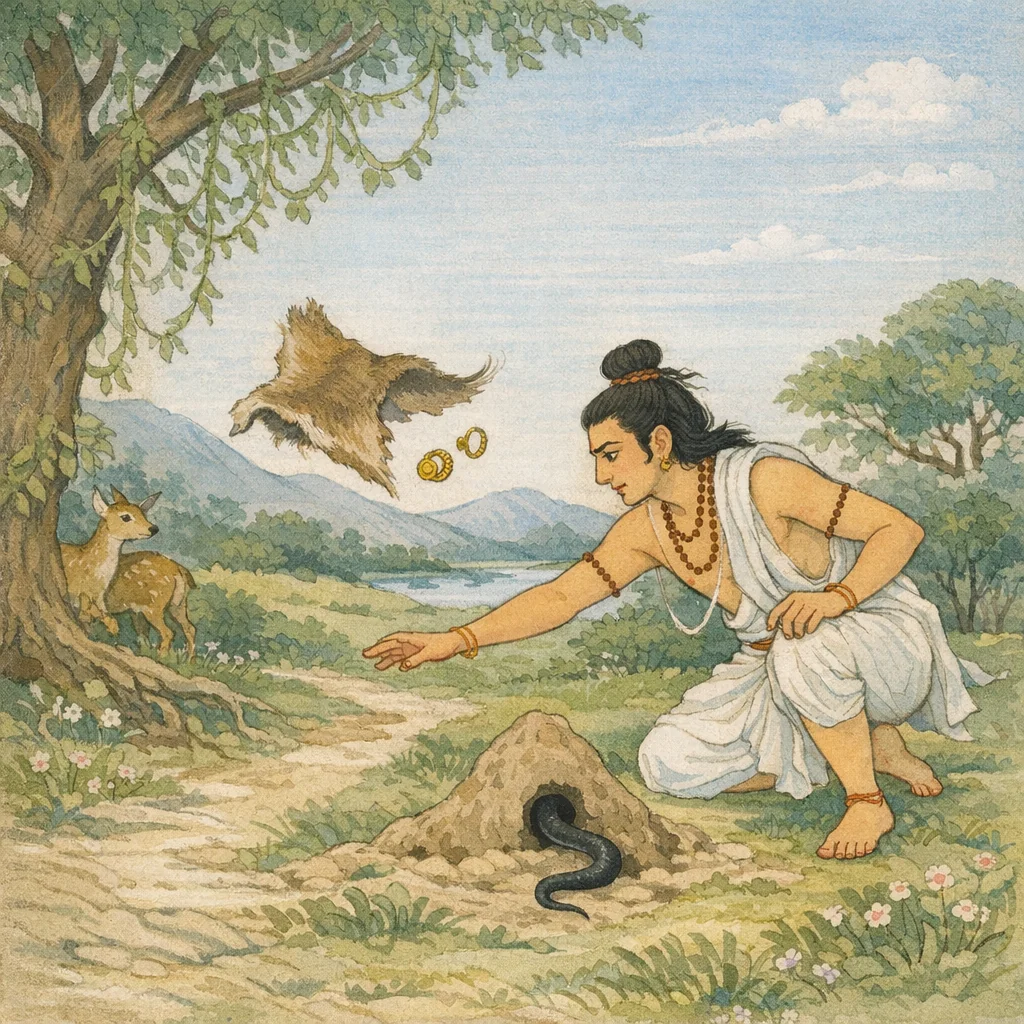
विशीर्णबन्धने तस्मिन् गते कृष्णाजिने महीम्,विदश्यास्थेन वल्मीक॑ विवेशाथ स कुण्डले । बन्धन टूट जानेपर उस काले मृगछालेके पृथ्वीपर गिरते ही किसी सर्पकी दृष्टि उसपर पड़ी। वह ऐरावतके कुलमें उत्पन्न हुआ तक्षक था। उसने मृगछालाके भीतर रखे हुए उस मणिमय कुण्डलोंको देखा। फिर तो बड़ी शीघ्रता करके वह उन कुण्डलोंको दाँतोंमें दबाकर एक बाँबीमें घुस गया
Vaiśampāyana said: When the binding had broken and that black antelope-skin fell to the ground, a serpent happened to notice it. It was Takṣaka, born in the line of Airāvata. Seeing the gem-studded earrings kept within the deerskin, he swiftly seized those earrings in his teeth and slipped into an anthill.
Verse 25
अपश्यद् भुजग: कश्रित् ते तत्र मणिकुण्डले । ऐरावतकुलोद्धूत: शीघ्रो भूत्वा तदा हि सः
Vaiśampāyana said: There, a certain serpent caught sight of those jeweled earrings. As one sprung from the lineage of Airāvata, it at once became swift and moved to seize them.
Verse 26
ह्वियमाणे तु दृष्टवा स कुण्डले भुजगेन ह,सर्पके द्वारा कुण्डलोंका अपहरण होता देख उत्तंक मुनि उद्विग्न हो उठे और अत्यन्त क्रोधमें भरकर वृक्षसे कूद पड़े। आकर एक काठका डंडा हाथमें ले उसीसे उस बाँबीको खोदने लगे
Vaiśaṃpāyana said: Seeing the serpent carry off the earrings, the sage Uttaṅka was shaken with alarm. Overwhelmed by fierce anger, he leapt down from the tree, seized a wooden staff, and began digging at the anthill—driven by duty to recover what had been taken and to set right an act of wrongful seizure.
Verse 27
पपात वृक्षात् सोद्वेगो दुः:खात् परमकोपन: । स दण्डकाष्ठमादाय वल्मीकमखनत् तदा,सर्पके द्वारा कुण्डलोंका अपहरण होता देख उत्तंक मुनि उद्विग्न हो उठे और अत्यन्त क्रोधमें भरकर वृक्षसे कूद पड़े। आकर एक काठका डंडा हाथमें ले उसीसे उस बाँबीको खोदने लगे
Vaiśampāyana said: Distressed and agitated by grief, and inflamed with extreme anger, he leapt down from the tree. Taking a wooden staff in his hand, he then began to dig up the anthill. The scene underscores how a perceived violation—the theft of the earrings—provokes a surge of righteous indignation, yet also shows the peril of anger driving immediate, forceful action.
Verse 28
अहानि त्रिंशदव्यग्र: पठच चान्यानि भारत । क्रोधामर्षाभिसंतप्तस्तदा ब्राह्णसत्तम:,भरतनन्दन! ब्राह्मणशिरोमणि उत्तंक क्रोध और अमर्षसे संतप्त हो लगातार पैंतीस दिनोंतक बिना किसी घबराहटके बिल खोदनेके कार्यमें जुटे रहे
Vaiśaṃpāyana said: O Bhārata, the foremost of Brāhmaṇas, then inflamed with anger and wounded pride, remained undistracted and kept digging for thirty days and more. The passage underscores how intense emotions can drive relentless effort—yet it also hints at the ethical tension between steadfast resolve and being ruled by wrath.
Verse 29
तस्य वेगमसहां तमसहन्ती वसुन्धरा । दण्डकाष्ठाभिनुन्नाज़ी चचाल भृूशमाकुला,उनके उस असह्ा वेगको पृथ्वी भी नहीं सह सकी। वह डंडेकी चोटसे घायल एवं अत्यन्त व्याकुल होकर डगमगाने लगी
Unable to endure the force of his onrush, the Earth herself could not bear it. Struck and wounded by the blow of a staff, she trembled and reeled violently in great distress—signaling that such unchecked power, when turned into violence, shakes even the foundations of the world-order.
Verse 30
ततः खनत एवाथ वित्रर्षरर्धरणीतलम् । नागलोकस्य पन्थानं कर्तुकामस्य निश्चयात्,उत्तंक नागलोकमें जानेका मार्ग बनानेके लिये निश्चय करके धरती खोदते ही जा रहे थे कि महातेजस्वी वज्रधारी इन्द्र घोड़े जुते हुए रथपर बैठकर उस स्थानपर आ पहुँचे और विप्रवर उत्तंकसे मिले
Vaiśampāyana said: Then, resolved to make a passage to the realm of the Nāgas, Uttanka kept digging into the earth without pause. At that very spot, Indra—the mighty wielder of the thunderbolt—arrived seated on a chariot yoked with horses and encountered the foremost of brāhmaṇas, Uttanka.
Verse 31
रथेन हरियुक्तेन तं देशमुपजग्मिवान् । वज्रपाणिर्महातेजास्तं ददर्श द्विजोत्तमम्,उत्तंक नागलोकमें जानेका मार्ग बनानेके लिये निश्चय करके धरती खोदते ही जा रहे थे कि महातेजस्वी वज्रधारी इन्द्र घोड़े जुते हुए रथपर बैठकर उस स्थानपर आ पहुँचे और विप्रवर उत्तंकसे मिले
Vaiśampāyana said: Indra, mighty and radiant, wielder of the thunderbolt, rode to that place in a chariot yoked with tawny steeds and beheld Uttanka, foremost among Brahmins. It was a fateful moment: as the resolute ascetic pressed on, digging into the earth to make a way to the realm of the Nāgas, divine authority arrived—poised to counsel him on dharma and the limits of personal vengeance.
Verse 32
वैशम्पायन उवाच सतुतं ब्राह्मणो भूत्वा तस्य दुःखेन दुःखित: । उत्तड़कमब्रवीत् वाक््यं नैतच्छक्यं त्वयेति वै,वैशम्पायनजी कहते हैं--राजन्! इन्द्र उत्तंकके दुःखसे दुःखी थे। अतः ब्राह्मणका वेष बनाकर उनसे बोले--“ब्रह्मन! यह काम तुम्हारे वशका नहीं है। नागलोक यहाँसे हजारों योजन दूर है। इस काठके डंडेसे वहाँका रास्ता बने, यह कार्य सधनेवाला नहीं जान पड़ता”
Vaiśampāyana said: Indra, grieved by Uttanka’s grief, assumed the guise of a brāhmaṇa and said to him, “O brāhmaṇa, this cannot be accomplished by you. The realm of the Nāgas lies thousands of yojanas from here; to make a path to it with this mere wooden staff does not seem a work that can succeed.” Thus compassionate counsel appears as dharmic restraint—checking an impossible, self-harming resolve while still acknowledging the seeker’s sorrow.
Verse 33
इतो हि नागलोको वै योजनानि सहस्रश: । न दण्डकाष्ठसाध्यं च मन्ये कार्यमिदं तव,वैशम्पायनजी कहते हैं--राजन्! इन्द्र उत्तंकके दुःखसे दुःखी थे। अतः ब्राह्मणका वेष बनाकर उनसे बोले--“ब्रह्मन! यह काम तुम्हारे वशका नहीं है। नागलोक यहाँसे हजारों योजन दूर है। इस काठके डंडेसे वहाँका रास्ता बने, यह कार्य सधनेवाला नहीं जान पड़ता”
Vaiśampāyana said: “From here, the realm of the Nāgas lies thousands of yojanas away. And I judge that this task of yours cannot be accomplished by means of a mere wooden staff.”
Verse 34
उत्तद़्क उवाच नागलोके यदि ब्रह्म॒न् न शक््ये कुण्डले मया । प्राप्तुं प्राणान् विमोक्ष्यामि पश्यतस्तु द्विजोत्तम,उत्तंकने कहा--ब्रह्मन! द्विजश्रेष्ठ] यदि नागलोकमें जाकर उन कुण्डलोंको प्राप्त करना मेरे लिये असम्भव है तो मैं आपके सामने ही अपने प्राणोंका परित्याग कर दूँगा
Uttaṅka said: “O Brahmin, O best of the twice-born, if it is not possible for me to go to the realm of the Nāgas and obtain those earrings, then before your very eyes I will relinquish my life.”
Verse 35
वैशम्पायन उवाच यदा स नाशकत् तस्य निश्चयं कर्तुमन्यथा । वज्रपाणिस्तदा दण्डं वज्रास्त्रेण युयोज ह,वैशम्पायनजी कहते हैं--राजन! वज्रधारी इन्द्र जब किसी तरह उत्तंकको अपने निश्चयसे न हटा सके, तब उन्होंने उनके डंडेके अग्रभागमें अपने वच्रास्त्रका संयोग कर दिया
Vaiśampāyana said: When Indra, wielder of the thunderbolt, could not by any means turn Uttanka from his resolve, he then joined the power of his vajra-weapon to the tip of Uttanka’s staff.
Verse 36
ततो वजप्रहारैस्तैर्दार्यमाणा वसुन्धरा । नागलोकस्य पन्थानमकरोज्जनमेजय,जनमेजय! उस वज्रके प्रहारसे विदीर्ण होकर पृथ्वीने नागलोकका रास्ता प्रकट कर दिया
Vaiśampāyana said: Then, struck again and again by those thunderbolt-like blows, the earth was split open; and, O Janamejaya, it revealed a passage leading to the realm of the Nāgas.
Verse 37
स तेन मार्गेण तदा नागलोकं विवेश ह । ददर्श नागलोकं॑ च योजनानि सहस्रश:,उसी मार्गसे उन्होंने नागलोकमें प्रवेश किया और देखा कि नागोंका लोक सहस्ोरों योजन विस्तृत है
Following that very route, he then entered the realm of the Nāgas. There he beheld the Nāga-world spread out for thousands of yojanas—vast and far-reaching.
Verse 38
प्राकारनिचर्यर्दिव्यैर्मणिमुक्तास्वलंकृतै: । उपपन्नं महाभाग शातकुम्भमयैस्तथा,महाभाग! उसके चारों ओर दिव्य परकोटे बने हुए हैं; जो सोनेकी ईंटोंसे बने हुए हैं और मणि-मुक्ताओंसे अलंकृत हैं
Vaiśampāyana said: O noble one, it was furnished with divine ramparts and surrounding structures, adorned with gems and pearls, and likewise provided with walls made of śātakumbha (fine gold).
Verse 39
वापी: स्फटिकसोपाना नदीक्ष विमलोदका: । ददर्श वक्षांश्व बहून् नानाद्धिजगणायुतान्,वहाँ स्फटिक मणिकी बनी हुई सीढ़ियोंसे सुशोभित बहुत-सी बावड़ियों, निर्मल जलवाली अनेकानेक नदियों और विहगवृन्दसे विभूषित बहुत-से मनोहर वृक्षोंको भी उन्होंने देखा
Vaiśampāyana said: He beheld many stepwells adorned with crystal stairways, and many rivers whose waters were clear and pure. He also saw numerous delightful trees, graced by flocks of diverse birds.
Verse 40
तस्य लोकस्य च द्वारं स ददर्श भृगूद्वह: । पञ्चयोजनविस्तारमायतं शतयोजनम्,भगुकुलतिलक उत्तंकने नागलोकका बाहरी दरवाजा देखा, जो सौ योजन लंबा और पाँच योजन चौड़ा था
Then that foremost of the Bhṛgus beheld the gateway to that realm: it stretched a hundred yojanas in length and spanned five yojanas in breadth—an immense threshold marking entry into the Nāga-world.
Verse 41
नागलोकमुत्तड़्कस्तु प्रेक्ष्य दीनो5भवत् तदा । निराशश्वाभवत् तत्र कुण्डलाहरणे पुन:,नागलोककी वह विशालता देखकर उत्तंक मुनि उस समय दीन--हतोत्साह हो गये। अब उन्हें फिर कुण्डल पानेकी आशा नहीं रही
Vaiśaṃpāyana said: Seeing the vast realm of the Nāgas, Uttanka became dejected and dispirited at that moment. There, he once again lost hope of recovering the earrings, and his resolve faltered before the daunting task.
Verse 42
तत्र प्रोवाच तुरगस्तं कृष्णश्वेतवालधि: । ताम्रास्यनेत्र: कौरव्य प्रज्वलन्निव तेजसा,इसी समय उनके पास एक घोड़ा आया, जिसकी एूँछके बाल काले और सफेद थे। उसके नेत्र और मुँह लाल रंगके थे। कुरुनन्दन! वह अपने तेजसे प्रज्वलित-सा हो रहा था
Then there appeared a horse, its tail-hairs black and white. Its mouth and eyes were copper-red; O descendant of Kuru, it seemed to blaze with its own radiance.
Verse 43
धमस्वापानमेतन्मे ततस्त्वं विप्र लप्स्यसे । ऐरावतसुतेनेह तवानीते हि कुण्डले,उसने उत्तंकसे कहा--विप्रवर! तुम मेरे इस अपान मार्गमें फूँक मारो। ऐसा करनेसे ऐरावतके पुत्रने जो तुम्हारे दोनों कुण्डल लाये हैं, वे तुम्हें मिल जायँगे
It said to Uttanka, “O best of Brahmins, blow into this passage of my apāna-breath. When you do so, you will obtain the two earrings that have been brought here for you by the son of Airāvata.”
Verse 44
मा जुगुप्सां कृथा: पुत्र त्वमत्रार्थे कथंचन । त्वयैतद्धि समाचीर्ण गौतमस्याश्रमे तदा,“बेटा! इस कार्यमें तुम किसी तरह घृणा न करो; क्योंकि गौतमके आश्रममें रहते समय तुमने अनेक बार ऐसा किया है”
Vaiśaṃpāyana said: “My son, do not feel any disgust in this matter at all. For you yourself practiced this very act earlier, when you were living in Gautama’s hermitage.”
Verse 45
उत्तड़्क उवाच कथं भवन्तं जानीयामुपाध्यायाश्रमं प्रति । यन्मया चीर्णपूर्व हि श्रोतुमिच्छामि तद्ध्यहम्,उत्तंकने पूछा--गुरुदेवके आश्रमपर मैंने कभी आपका दर्शन किया है, इसका ज्ञान मुझे कैसे हो? और आपके कथनानुसार वहाँ रहते समय पहले जो कार्य मैं अनेक बार कर चुका हूँ, वह क्या है? यह मैं सुनना चाहता हूँ
Uttanka said: “How am I to recognize you in relation to my teacher’s hermitage? I wish to hear clearly what it is that, as you say, I had already practiced there before.”
Verse 46
अश्व उवाच गुरो्गुरुं मां जानीहि ज्वलनं जातवेदसम् | त्वया हाहं सदा विप्र गुरोरर्थेंडभिपूजित:,घोड़ेने कहा--ब्रह्मन! मैं तुम्हारे गुरुका भी गुरु जातवेदा अग्नि हूँ, यह तुम अच्छी तरह जान लो। भृगुनन्दन! तुमने अपने गुरुके लिये सदा पवित्र रहकर विधिपूर्वक मेरी पूजा की है। इसलिये मैं तुम्हारा कल्याण करूँगा। अब तुम मेरे बताये अनुसार कार्य करो, विलम्ब न करो
The Horse said: “Know me well as the Fire—Jātavedas—who is even the guru of your guru. O brāhmaṇa, you have always worshipped me with due rites for the sake of your teacher, maintaining purity. Therefore I shall bring about your welfare. Now act according to what I tell you—do not delay.”
Verse 47
विधिवत् सततं विप्र शुचिना भृगुनन्दन । तस्माच्छेयो विधास्यामि तवैवं कुरु मा चिरम्,घोड़ेने कहा--ब्रह्मन! मैं तुम्हारे गुरुका भी गुरु जातवेदा अग्नि हूँ, यह तुम अच्छी तरह जान लो। भृगुनन्दन! तुमने अपने गुरुके लिये सदा पवित्र रहकर विधिपूर्वक मेरी पूजा की है। इसलिये मैं तुम्हारा कल्याण करूँगा। अब तुम मेरे बताये अनुसार कार्य करो, विलम्ब न करो
The Horse said: “O brāhmaṇa, O Bhṛgu’s descendant, you have continually worshipped me in due rite, remaining pure. Therefore I shall bring about your welfare. Do exactly as I instruct—do not delay.”
Verse 48
इत्युक्तस्तु तथाकार्षीदुत्तड़कश्ित्रभानुना । घृतार्चि: प्रीतिमांश्वापि प्रजज्वाल दिधक्षया,अग्निदेवके ऐसा कहनेपर उत्तंकने उनकी आज्ञाका पालन किया। तब घृतमयी अर्चिवाले अग्निदेव प्रसन्न होकर नागलोकको जला डालनेकी इच्छासे प्रज्वलित हो उठे
Thus addressed, Uttaṅka carried out exactly what he had been told by Citrabhānu. Pleased, Agni—the one whose flames are fed by ghee—blazed up with the intent to burn the realm of the Nāgas.
Verse 49
ततो<स्य रोमकूपेभ्यो धम्यतस्तत्र भारत । घन: प्रादुरभूद् धूमो नागलोक भयावह:,भारत! जिस समय उत्तंकने फूँक मारना आरम्भ किया, उसी समय उस अश्वरूपधारी अग्निके रोम-रोमसे घनीभूत धूम उठने लगा; जो नागलोकको भयभीत करनेवाला था
Then, O Bhārata, as he was being blown upon there, from the pores of his body a dense smoke suddenly arose—terrifying to the realm of the Nāgas.
Verse 50
तेन धूमेन महता वर्धमानेन भारत । नागलोके महाराज न प्राज्ञायत किंचन,महाराज भरतनन्दन! बढ़ते हुए उस महान् धूमसे आच्छन्न हुए नागलोकमें कुछ भी सूझ नहीं पड़ता था
As that vast smoke kept swelling and spreading, O Bhārata, within the realm of the Nāgas, O great king, nothing at all could be made out.
Verse 51
हाहाकृतमभूत् सर्वमैरावतनिवेशनम् । वासुकिप्रमुखानां च नागानां जनमेजय,जनमेजय! ऐरावतके सारे घरमें हाहाकार मच गया। भारत! वासुकि आदि नागोंके घर धूमसे आच्छादित हो गये। उनमें अँधेरा छा गया। वे ऐसे जान पड़ते थे, मानो कुहासासे ढके हुए वन और पर्वत हों
The entire dwelling of Airāvata was thrown into a tumult of cries. And, O Janamejaya, the abodes of the Nāgas headed by Vāsuki were covered with thick smoke; darkness spread over them, so that they looked like forests and mountains veiled in mist.
Verse 52
न प्राकाशन्त वेश्मानि धूमरुद्धानि भारत । नीहारसंवृतानीव वनानि गिरयस्तथा,जनमेजय! ऐरावतके सारे घरमें हाहाकार मच गया। भारत! वासुकि आदि नागोंके घर धूमसे आच्छादित हो गये। उनमें अँधेरा छा गया। वे ऐसे जान पड़ते थे, मानो कुहासासे ढके हुए वन और पर्वत हों
The Horse said: “O Bhārata, the dwellings no longer shone, choked and blocked by smoke. O Janamejaya, they appeared like forests and mountains veiled in mist.”
Verse 53
ते धूमरक्तनयना वल्नलितेजोडभितापिता: । आजममुनिश्चियं ज्ञातुं भार्गवस्य महात्मन:,धुआँ लगनेसे नागोंकी आँखें लाल हो गयी थीं। वे आगकी आँचसे तप रहे थे। महात्मा भार्गव (उत्तंक)-का क्या निश्चय है, यह जाननेके लिये सभी एकत्र होकर उनके पास आये
With their eyes reddened by smoke and their bodies scorched by the licking flames, the Nāgas came together and approached the great Bhārgava sage, seeking to learn what resolve he had formed.
Verse 54
श्रुत्वा च निश्चयं तस्य महर्षेरतितेजस: । सम्भ्रान्तनयना: सर्वे पूजां चक्रुर्यथाविधि,उस समय उन अत्यन्त तेजस्वी महर्षिका निश्चय सुनकर सबकी आँखें भयसे कातर हो गयीं तथा सबने उनका विधिवत् पूजन किया
Hearing the resolve of that exceedingly radiant great seer, all present became wide-eyed with alarm and reverence; and, according to proper rule, they performed worship in his honor.
Verse 55
सर्वे प्राजजलयो नागा वृद्धबालपुरोगमा: । शिरोभि: प्रणिपत्योचु: प्रसीद भगवज्निति,अन्तमें सभी नाग बूढ़े और बालकोंको आगे करके हाथ जोड़, मस्तक झुका प्रणाम करके बोले--“भगवन्! हमपर प्रसन्न हो जाइये”
All the Nāgas, with palms joined in reverence and with the aged and the young placed at the front, bowed their heads and prostrated themselves. They pleaded, “O Blessed Lord, be gracious to us.”
Verse 56
प्रसाद्य ब्राह्मण ते तु पाद्यमर्घ्य निवेद्य च । प्रायच्छन् कुण्डले दिव्ये पन्नगा: परमार्चिते,इस प्रकार ब्राह्मण देवताको प्रसन्न करके नागोंने उन्हें पाद्य और अर्घ्य निवेदन किया और वे दोनों परम पूजित दिव्य कुण्डल भी वापस कर दिये
Having propitiated the brāhmaṇa, the Nāgas offered him the customary water for washing the feet (pādya) and the arghya of honor; and they returned the two divine earrings, supremely revered.
Verse 57
इस प्रकार श्रीमह्याभारत आश्वमेधिकपर्वके अन्तर्गत अनुगीतापर्वमें उत्तंक मुनिका उपाख्यानविषयक सत्तावनवाँ अध्याय पूरा हुआ,ततः स पूजितो नागैस्तदोत्तड़क: प्रतापवान् | आन्मनिं प्रदक्षिणं कृत्वा जगाम गुरुसझ तत् तदनन्तर नागोंसे सम्मानित होकर प्रतापी उत्तंक मुनि अग्निदेवकी प्रदक्षिणा करके गुरुके आश्रमकी ओर चल दिये
Then the illustrious sage Uttaṅka, honored by the Nāgas, circumambulated Agni in reverence and set out toward his teacher’s hermitage.
Verse 58
स गत्वा त्वरितो राजन् गौतमस्य निवेशनम् | प्रायच्छत् कुण्डले दिव्ये गुरुपत्न्यास्तदानघ,निष्पाप नरेश! वहाँ गौतमके घरमें शीघ्रतापूर्वक पहुँचकर उन्होंने गुरुपत्नीको वे दोनों दिव्य कुण्डल दे दिये इति श्रीमहाभारते आश्वमेधिके पर्वणि अनुगीतापर्वणि उत्तड़कोपाख्याने अष्टपज्चाशत्तमो< ध्याय:
O King, having gone swiftly to Gautama’s dwelling, he presented those two divine earrings to the guru’s wife.
Verse 59
वासुकिप्रमुखानां च नागानां जनमेजय । सर्व शशंस गुरवे यथावद् द्विजसत्तम:,जनमेजय! वासुकि आदि नागोंके यहाँ जो घटना घटी थी, उसका सारा समाचार द्विजश्रेष्ठ उत्तंकने अपने गुरु महर्षि गौतमसे ठीक-ठीक कह सुनाया
O Janamejaya, the best of the twice-born (Uttaṅka) reported in full and exactly as it had occurred the entire account of the Nāgas—headed by Vāsuki—to his teacher, the sage Gautama.
Verse 60
एवं महात्मना तेन त्रीललॉकान् जनमेजय । परिक्रम्याह्वते दिव्ये ततस्ते मणिकुण्डले,जनमेजय! इस प्रकार महात्मा उत्तंकने तीनों लोकोंमें घूमकर वे मणिमय दिव्य कुण्डल प्राप्त किये थे
Thus, O Janamejaya, that great-souled one (Uttaṅka), having traversed the three worlds, obtained those divine, jewel-made earrings.
Verse 61
एवंप्रभाव: स मुनिरुत्तड़को भरतर्षभ । परेण तपसा युक्तो यन्मां त्वं परिपृच्छसि,भरतश्रेष्ठ! उत्तंक मुनि, जिनके विषयमें तुम मुझसे पूछ रहे थे, ऐसे ही प्रभावशाली और महान् तपस्वी थे
The Horse said: “O bull among the Bharatas, that sage Uttaṅka—about whom you question me—was indeed of extraordinary power: a great ascetic, endowed with supreme austerity.”
Verse 215
सौदास उवाच क्षमं चेदिह वक्तव्यं तव द्विजवरोत्तम । मत्समीपं द्विजश्रेष्ठ नागन्तव्यं कथंचन
Saudāsa said: “If you deem it proper to speak here, O best and foremost among the twice-born brāhmaṇas, then, O foremost of brāhmaṇas, you must not come near me in any way.”
Verse 226
यस्मिंस्ते कुण्डले बद्धे तदा द्विजवरेण वै । उस समय उनकी दृष्टि बेलोंपर ही लगी हुई थी (वे कहाँ गिरते हैं, इसकी ओर उनका ध्यान नहीं था)। प्रभो! उनके तोड़े हुए प्रायः सभी बेल उस मृगछालापर ही, जिसमें उन विप्रवरने वे दोनों कुण्डल बाँध रखे थे, गिरे
Vaiśaṃpāyana said: “At that time, the brahmin of excellent stature had fastened those two earrings upon a deerskin. Their gaze was fixed only on the creepers; they were not attentive to where the cut vines were falling. Thus, almost all the vines they severed fell upon that very deerskin on which the two earrings had been tied.”
Verse 236
सकुण्डलं तदजिनं पपात सहसा तरो: । उन बेलोंकी चोटसे बन्धन टूट गया और कुण्डलसहित वह मृगचर्म सहसा वृक्षसे नीचे जा गिरा
Vaiśaṃpāyana said: “The deerskin, with the earring still attached, suddenly fell down from the tree. Struck by the force of the creepers, the fastening snapped, and the bound hide dropped at once—an abrupt turn in the episode that signals how fragile external restraints are when confronted by sudden natural force.”
Verse 253
विदश्यास्थेन वल्मीक॑ विवेशाथ स कुण्डले । बन्धन टूट जानेपर उस काले मृगछालेके पृथ्वीपर गिरते ही किसी सर्पकी दृष्टि उसपर पड़ी। वह ऐरावतके कुलमें उत्पन्न हुआ तक्षक था। उसने मृगछालाके भीतर रखे हुए उस मणिमय कुण्डलोंको देखा। फिर तो बड़ी शीघ्रता करके वह उन कुण्डलोंको दाँतोंमें दबाकर एक बाँबीमें घुस गया
Vaiśampāyana said: “Then, with the jeweled earrings in his possession, he swiftly entered an anthill. In the surrounding narrative, once the dark deerskin fell to the ground after the bonds were broken, the serpent Takṣaka—born in the lineage of Airāvata—noticed it, saw the gem-like earrings kept within the hide, seized them in his teeth, and disappeared into an anthill. The episode underscores how negligence and attachment to valuables invite opportunistic harm, and how hidden greed can exploit moments of vulnerability.”
Frequently Asked Questions
The passage frames prosperity as publicly shared order: abundance is paired with continuous giving (dāna) and communal participation, implying that social welfare and cultural life are integral to legitimate polity.
After reception and familial salutations, Kṛṣṇa—rested and ritually attended—prepares to narrate the ‘mahāhavam’ (the great conflict) in response to his father’s inquiry, shifting from description to retrospective testimony.
No explicit phalaśruti appears here; the meta-function is archival and transitional—establishing setting, social atmosphere, and narrative readiness for a subsequent war-account within the Dvārakā frame.