Adhyaya 83
Gayā-kṣetra and Phalgu Tīrtha: Sites, Rites, and the Liberation of the Pitṛs
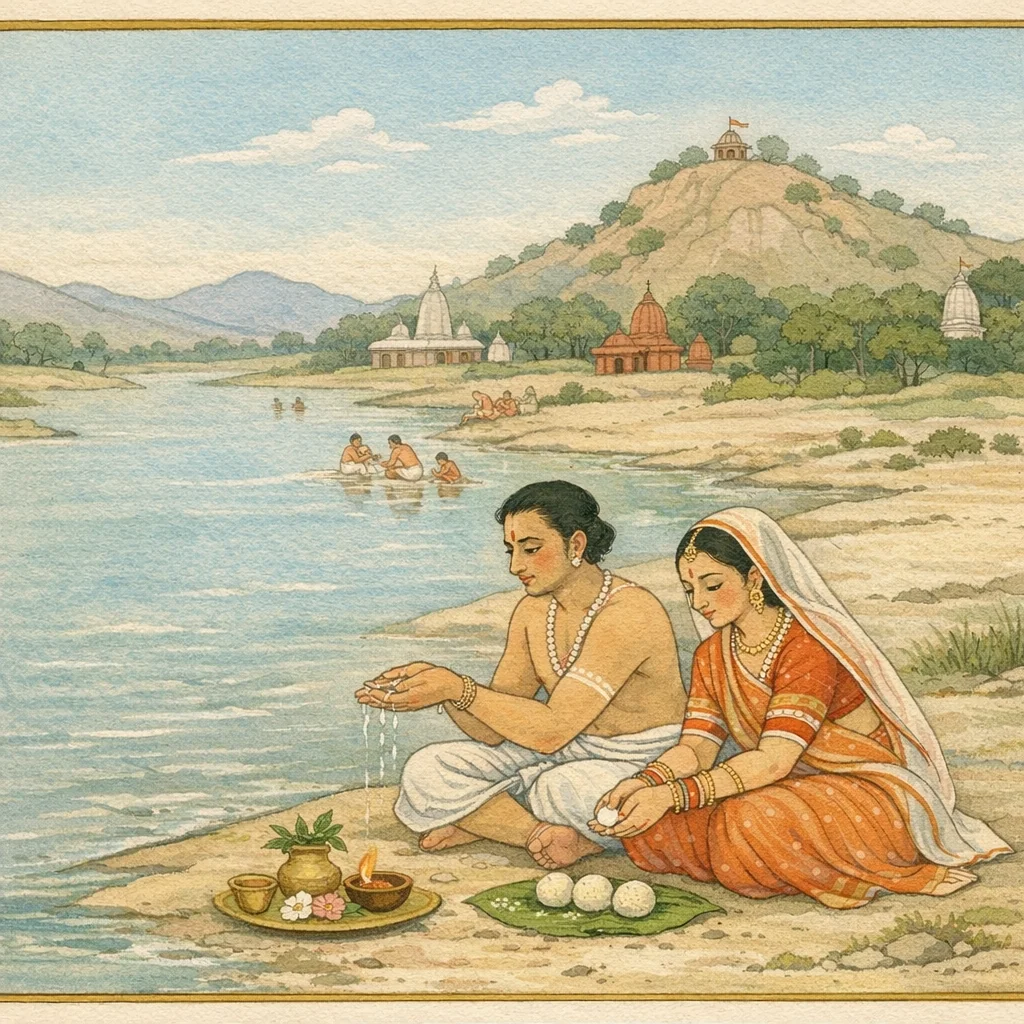
In the Purāṇic manner of teaching dharma through sacred geography, Brahmā proclaims Gayā the foremost kṣetra for Pitṛ-kārya. He defines the bounds of Muṇḍapṛṣṭha, Gayā-kṣetra, and Gayāśiras/Phalgu, and connects specific observances—darśana of Janārdana, the Sun, and key liṅgas/deities; Sandhyā with Gāyatrī/Sāvitrī; snāna and tarpaṇa; śrāddha and piṇḍa-dāna—with release from debts and sins and the ancestors’ attainment of Brahmaloka/mokṣa. A catalog of tīrthas (wells, lakes, forests, hermitages, footprints) serves as a pilgrimage itinerary, often stating measured fruits such as the uplift of 21 persons/generations, imperishable merit, and freedom from rebirth. The chapter also sets ritual standards: feeding duly qualified brāhmaṇas, performing vṛṣotsarga, and offering piṇḍas even with minimal materials. It ends by urging the practitioner to continue delivering the Pitṛs across multiple Gayā tīrthas, preparing the transition to further procedural detail and additional tīrtha enumerations in the māhātmya sequence.
Shlokas
Verse 1
द्व्यशीतितमो ऽध्यायः ब्रह्मोवाच / कीकटेषु गया पुण्या पुण्यं राजगृहं वनम् / विषयश्चारणः पुण्यो नदीनां च पुनः पुना
Brahmā said: In the land of the Kīkaṭas, Gayā is sacred; sacred too is the forest of Rājagṛha. The region called Cāraṇa is also holy, and among rivers, Punaḥpunā is likewise holy.
Verse 2
मुण्डपृष्ठं तु पूर्वस्मिन्पश्चिमे दक्षिणोत्तरे / सार्धक्रोशद्वयं मानं गयायां परिकीर्तितम्
In Gayā, the sacred area called Muṇḍapṛṣṭha is described as extending to the east and west, and to the south and north; its measured extent is said to be two krośas and a half.
Verse 3
पञ्चक्रोशं गयाक्षेत्रं क्रोशमेकं गयाशिरः / तत्र पिण्डप्रदानेन तृप्तिर्भवति शाश्वती
The sacred field of Gayā extends for five krośas, and Gayāśiras measures one krośa. By offering piṇḍas (funerary rice-balls) there, lasting satisfaction is attained for the departed ancestors.
Verse 4
नगाज्जनार्दनाच्चैव कूपाच्चोत्तरमानसात् / एतद्गयाशिरः प्रोक्तं फल्गुतीर्थं तदुच्यते
From the hill, from Janārdana, from the well, and from the northern sacred lake—this is declared to be “Gayāśiras”; it is also known as the Phalgu Tīrtha.
Verse 5
तत्र पिण्डप्रदानेन पितॄणा परमा गतिः / गयागमनमात्रेण पितॄणामनृणो भवेत्
There, by offering piṇḍas (funeral rice-balls), the ancestors attain the highest course. By merely going to Gayā, one becomes free from the debt owed to the ancestors.
Verse 6
गयायां पितृरूपेण देवदेवो जनार्दनः / तं दृष्ट्वा पुण्डरीकाक्षं मुच्यते वै ऋणत्रयात्
At Gayā, Janārdana—the God of gods—abides in the form of the Pitṛs (forefathers). By beholding that lotus-eyed Lord, one is indeed freed from the threefold debt.
Verse 7
रथमार्गं गयतीर्थे दृष्ट्वा रुद्रपदादिके / कालेश्वरं च केदारं पितॄणामनृणो भवेत्
By beholding the Ratha-mārga at the sacred Gayā-tīrtha, and holy sites such as Rudrapada, as well as Kāleśvara and Kedāra, one becomes free from debt to the Pitṛs (ancestral manes).
Verse 8
दृष्ट्वा पितामहं देवं सर्वपापैः प्रमुच्यते / लोकं त्वनामयं याति दृष्ट्वा च प्रपितामहम्
Having beheld the divine Grandfather (Brahmā), one is released from all sins; and having beheld the Great-Grandfather, one goes to a world free from affliction.
Verse 9
तथा गदाधरं देवं माधवं पुरुषोत्तमम् / तं प्रणम्य प्रयत्नेन न भूयो जायते नरः
Likewise, by reverently bowing with sincere effort to the Lord who bears the mace—Mādhava, the Supreme Person—one is not born again.
Verse 10
मौनादित्यं महात्मानं कनकार्कं विशेषतः / दृष्ट्वा मौनेन विप्रर्षे पितॄणामनृणो भवेत्
O best of sages among the twice-born: by silently beholding the great-souled Sun—especially the golden-rayed Sun—one becomes free from indebtedness to the Pitṛs (ancestral manes).
Verse 11
ब्रह्माणं पूजयित्वा च ब्रह्मलोकमवाप्नुयात् / गायत्त्रीं प्रतरुत्थाय यस्तु पश्यति मानवः
Having worshipped Brahmā, one attains Brahmā’s world. And whoever rises at dawn and beholds—by reverent recitation and meditation—the Gāyatrī, reaches that same exalted goal.
Verse 12
सन्ध्यां कृत्वा प्रयत्नेन सर्ववेदफलं लभेत् / सावित्रीं चैव मध्याह्ने दृष्ट्वा यज्ञफलं लभेत्
By earnestly performing the Sandhyā worship, one gains merit equal to the fruits of all the Vedas. And by beholding—through reverent recitation and meditation—the Sāvitrī at midday, one attains the fruit of a sacrifice (yajña).
Verse 13
सरस्वतीं च सायाह्ने दृष्ट्वा दानफलं लभेत् / नगस्थमीश्वरं दृष्ट्वा पितॄणामनृणो भवेत्
By beholding Sarasvatī in the evening, one gains the fruit of charity. By beholding the Lord who abides upon the mountain, one becomes free from indebtedness to the Pitṛs, the ancestral spirits.
Verse 14
धर्मारण्यं धर्ममीशं दृष्ट्वा स्यादृणनाशनम् / देवं गृध्रेश्वरं दृष्ट्वा को न मुच्येत बन्धनात्
By beholding Dharmāraṇya and Dharmamīśa, one’s debts are destroyed. And by beholding the divine Gṛdhreśvara, who would not be released from bondage?
Verse 15
धेनुं दृष्ट्वा धेनुवने ब्रह्मलोकं नयेत्पितॄन् / प्रभासेशं प्रभासे च दृष्ट्वा याति परां गतिम्
By beholding the sacred Cow in the forest of Dhenūvana, one conveys the Pitṛs to Brahmaloka. And by beholding Prabhāseśa at Prabhāsa, one attains the supreme state.
Verse 16
कोटीश्वरं चाश्वमेधं दृष्ट्वा स्यादृणनाशनम् / स्वर्गद्वारेश्वरं दृष्ट्वा मुच्यते भवबन्धनात्
By beholding Kōṭīśvara and Aśvamedha, one’s debts are destroyed; and by beholding Svargadvāreśvara, one is released from the bondage of worldly existence.
Verse 17
रामेश्वरं गदालोलं दृष्ट्वा स्वर्गमवाप्नुयात् / ब्रह्मेश्वरं तथा दृष्ट्वा मुच्यते ब्रह्महत्यया
By beholding Rāmeśvara, the Lord whose mace moves in playful grace, one attains heaven; and likewise, by beholding Brahmeśvara, one is freed from the sin of brahma-hatyā, the slaying of a brāhmaṇa.
Verse 18
मुण्डपृष्ठे महाचण्डीं दृष्ट्वा कामानवाप्नुयात् / फल्ग्वीशं फल्गुचण्डीं च गौरीं दृष्ट्वा च मङ्गलाम्
At Muṇḍapṛṣṭha, by beholding Mahācaṇḍī one attains one’s desired aims. By beholding Phalgvīśa, Phalgucaṇḍī, and also Gaurī, one attains auspiciousness (maṅgala).
Verse 19
गोमकं गोपतिं देवं पितॄणामनृणो भवेत् / अङ्गारेशं च सिद्धेशं गयादित्यं गजं तथा
By worshipping or remembering Gomaka and Gopati Deva, one becomes free from debt to the Pitṛs (ancestors). Likewise, one should revere Aṅgāreśa, Siddheśa, Gayāditya, and also Gaja.
Verse 20
मार्कण्डेयेश्वरं दृष्ट्वा पितॄणामनृणो भवेत् / फल्गुतीर्थे नरः स्नात्वा दृष्ट्वा देवं गदाधरम्
By beholding Mārkaṇḍeyeśvara, one becomes free from the debt owed to the Pitṛs (ancestors). And one who bathes at the sacred ford of Phalgu and beholds the Lord Gadādhara (Viṣṇu, bearer of the mace) attains that same purifying merit.
Verse 21
एतेन किं न पर्याप्तं नॄणां सुकृतकारिणाम् / ब्रह्मलोकं प्रयान्तीह पुरुषा एकविंशतिः
What more is needed for those who perform meritorious deeds? Here, twenty-one such persons go to the realm of Brahmā (Brahmaloka).
Verse 22
पृथिव्यां यानि तीर्थानी ये समुद्राः सरांसि च / फल्गुतीर्थं गमिष्यन्ति वारमेकं दिनेदिने
All the sacred fords on earth—along with the oceans and the lakes—go each day, once, to Phalgu Tīrtha.
Verse 23
पृथिव्यां च गया पुण्या गयायां च गयाशिरः / श्रेष्ठं तथा फल्गुतीर्थं तन्मुखं च सुरस्य हि
On the earth, Gayā is holy; and within Gayā, Gayāśiras is supreme. Likewise, Phalgu Tīrtha is the best—indeed it is said to be the very ‘mouth’, the chief gateway of the gods.
Verse 24
उदीचि कनकानद्यो नाभितीर्थं तु मध्यतः / पुण्यं ब्रह्मसदस्तीर्थं स्नानात्स्याद्ब्रह्मलोकदम्
To the north are the rivers called Kanakā; in the middle lies Nābhi-tīrtha. The sacred ford known as Brahma-sadas is highly meritorious—by bathing there, one attains Brahmaloka.
Verse 25
कूपे पिण्डादिकं कृत्वा पितॄणामनृणो भवेम् / तथाक्षयवटे श्राद्धी ब्रह्मलोकं नयेत्पितॄन्
By offering piṇḍas and related rites at a well, one becomes free of debt to the Pitṛs (ancestors). Likewise, one who performs śrāddha at the Akṣaya-vaṭa leads the Pitṛs to Brahmaloka.
Verse 26
हंसतीर्थे नरः स्नात्वा सर्वपापैः प्रमुच्यते / कोटितीथ गयालोले वैतरण्यां च गोमके
Having bathed at Haṁsa-tīrtha, a person is freed from all sins; likewise, by bathing at Koṭi-tīrtha, in the sacred waters of Gayā, at Vaitaraṇī, and at Gomaka, one attains the same purification.
Verse 27
ब्रह्मलोकं नयेच्छ्राद्धी पुरुषानेकविंशतिम् / ब्रह्मतीर्थे रामतीर्थे आग्नेये सोमतीर्थके
By performing śrāddha (the ancestral rite) at Brahma-tīrtha, Rāma-tīrtha, Agneya-tīrtha, and Soma-tīrtha, the performer is said to lead twenty-one persons to Brahmaloka.
Verse 28
श्राद्धी रामह्रदे ब्रह्मलोकं पितृकुलं नयेत् / उत्तरे मानसे श्राद्धी न भूयो जायते नरः
One who performs śrāddha at Rāma-hrada leads the ancestral lineage to Brahmaloka. And one who performs śrāddha at the northern Mānasā lake is not born again as a human.
Verse 29
दक्षिणे मानसे श्राद्धी ब्रह्मलोकं पितॄन्नयेत् / स्वगद्वारे नरः श्राद्धी ब्रह्मलोकं नयेत्पितॄन् / भीष्मतर्पणकृत्तस्य कूटे तारयते पितॄन् / गृध्रेश्वरे तथा श्राद्धी पितॄणामनृणो भवेत्
By performing śrāddha at Dakṣiṇa-Mānasa, one leads the Pitṛs to Brahmaloka. A man who performs śrāddha at Svargadvāra likewise conveys his ancestors to Brahmaloka. One who performs the Bhīṣma-tarpaṇa at Kūṭa delivers the Pitṛs. And by performing śrāddha at Gṛdhreśvara, one becomes free of debt to the ancestors.
Verse 30
श्राद्धी च धेनुकारण्ये ब्रिह्मलोकं पितॄन्नयेत् / तिलधेनुप्रदः स्नात्वा दृष्ट्वा धेनुं न संशयः
One who performs śrāddha in Dhenukāraṇya leads the Pitṛs to Brahmaloka. And the giver of a tiladhenu (a sesame-cow), after bathing and beholding the cow, surely attains the fruit—of this there is no doubt.
Verse 31
ऐन्द्रे वा नरतीर्थे च वासवे वैष्णवे तथा / महानद्यां कृतश्राद्धो ब्रह्मलोकं नयेत्पितॄन्
Or, if one performs śrāddha at the Aindra tīrtha, at Nara-tīrtha, at the Vāsava tīrtha, at the Vaiṣṇava tīrtha, or upon the bank of a great river, that śrāddha leads the Pitṛs to Brahmaloka.
Verse 32
गायत्त्रे चैव सावित्रे तीर्थे सारस्वते तथा / स्नानस न्ध्यातर्पणकृच्छ्राद्धी चैकोत्तरं शतम्
At the sacred ford of Gāyatrī and at Sāvitrī, and likewise at the holy Sarasvatī tīrtha, one should perform bathing, the Sandhyā rites, tarpaṇa offerings, the Kṛcchra penance, and śrāddha—making, in all, one hundred and one observances.
Verse 33
पितॄणां तु कुलं ब्रह्मलोकं नयति मानवः / ब्रह्मयोनिं विनिर्गच्छेत्प्रयतः पितृमानसः
A person devoted to the Pitṛs leads the lineage of the ancestors toward Brahmaloka; disciplined and intent upon the Pitṛs, he departs to the yoni, the very source of Brahmā.
Verse 34
तर्पयित्वा पितॄन्देवान्न विशेद्योनिसङ्कटे / तर्पणे काकजङ्घार्या पितॄणां तृप्तिरक्षया
Having satisfied the Pitṛs and the Devas through tarpaṇa, one does not fall into the peril of the womb—into the straits of repeated birth. In tarpaṇa, even an offering as small as the measure called “kākajaṅghā” grants the Pitṛs inexhaustible satisfaction.
Verse 35
धर्मारण्ये मतङ्गस्य वाप्यां श्राद्धाद्दिवं व्रजेत् / धर्मयूपे च कूपे त पितॄणामनृणो भवेत्
By performing śrāddha at Matanga’s pond in Dharmāraṇya, one goes to heaven; and at the well at Dharmayūpa, one becomes free from debt to the Pitṛs—released from ancestral obligation.
Verse 36
प्रमाणं देवताः सन्तु लोकपालाश्च साक्षिणः / मयागत्य मतङ्गे ऽस्मिन्पितॄणां निष्कृतिः कृता
Let the gods be the authority, and let the Lokapālas, guardians of the worlds, be witnesses: having come to this sacred place of Matanga, I have performed expiation and release for the Pitṛs (ancestors).
Verse 37
रामतीर्थे नराः स्नात्वा श्राद्धं कृत्वा प्रभासके / शिलायां प्रेतभावात्स्युर्मुक्ताः पितृगणाः किल
Having bathed at Rāma-tīrtha and performed śrāddha at Prabhāsa, people are said to liberate, at the Śilā (sacred stone/spot), the ancestral fathers who had fallen into the state of pretas.
Verse 38
श्राद्धकृच्छ स्वपुष्टायां त्रिः सफ्तकुंलमुद्धरेत् / श्राद्धकृन्मुण्डपृष्ठादौ ब्रह्मलोकं नयेत्पितॄन्
One who performs the Śrāddha at Svapuṣṭā uplifts seven generations of his lineage, threefold. One who performs Śrāddha at Muṇḍapṛṣṭha and such holy sites leads the Pitṛs to Brahmaloka.
Verse 39
गयायां न हि तत्स्थानं यत्र तीर्थं न विद्यते / पञ्चक्रोशे गयाक्षेत्रे यत्र तत्र तु पिण्डदः
In Gayā there is no place where a tīrtha (sacred ford) is absent. Within the five-krośa extent of the sacred region of Gayā, one may offer piṇḍa (funerary oblations) at any spot.
Verse 40
अक्षयं फलमाप्नोति ब्रह्मलोकं नयेत्पितॄन् / जनार्दनस्य हस्ते तु पिण्डं दद्यात्स्वकं नरः
He attains an imperishable reward and leads the Pitṛs to Brahmaloka. Therefore a man should place his own piṇḍa (funerary rice-ball) into the hand of Janārdana (Viṣṇu).
Verse 41
एष पिण्डे मया दत्तस्तव हस्ते जनार्दन ! / परलोकं गते मोक्षमक्षय्यमुपतिष्ठताम्
O Janārdana, this piṇḍa has been offered by me into Your hand. For the one who has departed to the other world, may imperishable mokṣa be attained.
Verse 42
ब्रह्मलोकमवाप्नोति पितृभिः सह निश्चितम् / गयायां धर्मपृष्ठे च सरसि ब्रह्मणस्तथा
He certainly attains Brahmaloka together with the Pitṛs—this is assured—by performing the rites at Gayā, at Dharmapṛṣṭha, and also at the sacred lake of Brahmā.
Verse 43
गयाशीर्षे ऽक्षयवटे पितॄणां दत्तमक्षयम् / धर्मारण्यं धर्मपृष्ठं धेनुकारण्यमेव च
At Gayā-śīrṣa, at the Akṣaya-vaṭa, whatever is offered to the Pitṛs becomes imperishable. Likewise are these sacred places: Dharmāraṇya, Dharmapṛṣṭha, and also Dhenukāraṇya.
Verse 44
दृष्ट्वैतानि पितॄंश्चार्यवंश्यान्विंशतिमुद्धरेत् / ब्रह्मारण्यं महानद्याः पश्चिमो भाग उच्यते
Having beheld these Pitṛs and the noble lineages, one should uplift and deliver twenty ancestors. The sacred forest called Brahmāraṇya is said to lie in the western region of the great river.
Verse 45
पूर्वो ब्रह्मसदो भागो नागाद्रिर्भरताश्रमः / भरतस्याश्रमे श्राद्धी मतङ्गस्य पदे भवेत्
To the east lies the region called Brahmasadana; there are Nāgādri and the hermitage of Bharata. In Bharata’s hermitage, the performer of Śrāddha attains the station (pada) of Mataṅga.
Verse 46
गयाशीर्षाद्दक्षिणतो महानद्याश्च पश्चिमे / तत्स्मृतं चम्पकवनं तत्र पाण्डुशिलास्ति हि
To the south of Gayāśīrṣa and to the west of the Mahānadī lies the forest remembered as Campaka; indeed, the Pāṇḍu-śilā, the pale sacred stone, is there.
Verse 47
श्राद्धी तत्र तृतीयायां निश्चिरायाश्च मण्डले / महाह्रदे च कौशिक्यामक्षयं फलमाप्नुयात्
Whoever performs Śrāddha there—on the third lunar day—at the maṇḍala of Niścirā and at the great lake upon the Kauśikī attains imperishable, unfailing merit.
Verse 48
वैतरण्या श्चोत्तरतस्तृतीयाख्यो जलाशयः / पदानि तत्र क्रौञ्चस्य श्राद्धी स्वर्गं नयेत्पितॄन्
To the north of the Vaitaraṇī is a third body of water known by that very name. There are the footprints of a krauñca there; by performing Śrāddha in that place, one leads the Pitṛs, the ancestors, to heaven.
Verse 49
क्रौञ्चपादादुत्तरतो निश्चिराख्यो जलाशयः / सकृद्यत्राभिगमनं सकृत्पिंण्डप्रपातनम्
To the north of Krauñcapāda lies a lake called Niścirā. There one should go only once, and there the offering of a piṇḍa is to be made only once.
Verse 50
दुर्लभं किं पुनर्नित्यमस्मिन्नेव व्यवस्थितिः / महानद्यामुपस्पृश्य तर्पयेत्पितृदेवताः
If even this is hard to obtain, how much more difficult is constant, continual abiding in it! Therefore, having bathed in a great river, one should offer tarpaṇa—libations of water—to the Pitṛs and to the deities.
Verse 51
अक्षयान्प्राप्नुयाल्लोकान्कुलं चापि समुद्धरेत् / सावित्रे पठ्यते सन्ध्या कृता स्याद्द्वादशाब्दिकी
One attains imperishable worlds and also uplifts one’s lineage. When Sandhyā worship is performed with the recitation of the Sāvitrī (Gāyatrī), it is said to grant the merit of Sandhyā practiced for twelve years.
Verse 52
शुक्लकृष्णावुभौ पक्षौ गयायां यो वसेन्नरः पुनात्यासप्तमं चैव कुलं नास्त्यत्र संशयः
A man who resides at Gayā through both fortnights—the bright and the dark—purifies his family up to the seventh generation; of this there is no doubt.
Verse 53
गयायां मुणाडपृष्ठं च अरविन्दं च पर्वतम् / तृतीयं क्रैञ्चपादं च दृष्ट्वा पापैः प्रमुच्यते
In Gayā, by beholding Muṇāḍapṛṣṭha and Mount Aravinda, and thirdly Krañcapāda, one is released from sins.
Verse 54
मकरे वर्तमाने च ग्रहणे चन्द्रसूर्ययोः / दुर्लभं त्रिषु लोकेषु गयायां पिण्डपातनम्
When the Sun is in Makara (Capricorn), and during eclipses of the Moon and the Sun, the offering of piṇḍas at Gayā is exceedingly rare—indeed difficult to obtain in all the three worlds.
Verse 55
महाह्रदे च कौशिक्यां मूलक्षेत्रे विशेषतः / गुहायां गृध्रकूटस्य श्राद्धं दत्तं (सप्त) महाफलम्
A Śrāddha offering made at Mahāhrada, on the Kauśikī river—especially at Mūlakṣetra—and in the cave of Gṛdhrakūṭa yields exceedingly great fruit (traditionally said to be sevenfold).
Verse 56
यत्र माहेश्वरी धारा श्राद्धी तत्रानृणो भवेत् / पुण्यां विशालामासाद्य नदीं त्रैलोक्य विश्रुताम्
Where the sacred stream called Māheśvarī flows, one who performs śrāddha there becomes free from debt to the Pitṛs (ancestors). Having reached the holy and expansive river Viśālā, renowned throughout the three worlds…
Verse 57
अग्निष्टोममवाप्नोति श्राद्धी प्रायाद्दिवं नरः / श्राद्धी मासपदे स्नात्वा वाजपेयफलं लभेत्
A man who performs Śrāddha attains the merit of the Agniṣṭoma sacrifice and, through Śrāddha, goes to heaven. The performer of Śrāddha, having bathed at Māsa-pada, obtains the fruit of the Vājapeya sacrifice.
Verse 58
रविपादे पिण्डदानात्पतितोद्धारणं भवेत् / गयास्थो यो ददात्यन्नं पितरस्तेन पुत्रिणः
By offering a piṇḍa at Ravipāda, the upliftment of the fallen becomes possible. And the one who, while staying at Gayā, gives food-offerings—by him the Pitṛs become as though endowed with a son, fulfilled and supported.
Verse 59
काङ्क्षन्ते पितरः पुत्रान्नरकाद्भयभीरवः / गयां यास्यति यः कश्चित्सो ऽस्मान्सन्तरयिष्यति
Fearing the terrors of hell, the Pitṛs long for sons, thinking: “Whoever among them goes to Gayā—he will ferry us across, deliver us.”
Verse 60
गयाप्राप्तं सुतं दृष्ट्वा पितॄणामुत्सवो भवेत् / पभ्द्यामपि जलं स्पृष्ट्वा अस्मभ्यं किल दास्यति
On seeing a son who has come to Gayā, the ancestors rejoice in celebration, thinking: “Even by merely touching water with his hands, he will surely offer it to us.”
Verse 61
आत्मजो वा तथान्यो वा गयाकूपे यदा तदा / यन्नाम्ना पातयेत्पिण्डं तं नयेद्ब्रह्म शाश्वतम्
Whether it is one’s own son or another, whenever a piṇḍa-offering is dropped into the well of Gayā in the departed one’s name, that offering leads that soul to the eternal Brahman (final liberation).
Verse 62
पुण्डरीकं विष्णुलोकं प्राप्नुयात्कोटितीर्थगः / या सा वैतरणी नाम त्रिषु लोकेषु विश्रुता
One who has bathed at a crore of sacred fords attains Puṇḍarīka, the realm of Viṣṇu. That river—known as Vaitaraṇī—is renowned throughout the three worlds.
Verse 63
सावतीर्णा गयाक्षेत्रे पितॄणां तारणाय हि / श्राद्धदः पिण्डदस्तत्र गोप्रदानं करोतियः
Truly, it has descended into the sacred field of Gayā for the deliverance of the Pitṛs. Whoever there performs śrāddha, offers piṇḍas, and gives the gift of a cow becomes a cause of their liberation.
Verse 64
एकविंशतिवंश्यान्स तारयेन्नात्र संशयः / यदि पुत्रो गयां गच्छेत्कदाचित्कालपर्यये
He surely delivers twenty-one generations—there is no doubt—if a son goes to Gayā at some time, when circumstances allow.
Verse 65
तानेव भोजयेद्विप्रान्ब्रह्मणा ये प्रकल्पिताः / तेषां ब्रह्मसदः स्थानं सोमपानं तथैव च
One should feed only those learned Brāhmaṇas who have been duly appointed by Brahmā, in accordance with scriptural ordinance. For them there is a seat in Brahmā’s assembly, and likewise the privilege of drinking Soma.
Verse 66
ब्रह्मप्रकल्पितं स्थानं विप्रा ब्रह्मप्रकल्पपिताः / पूजितैः पूजिताः सर्वे पितृभिः सह देवताः
O brāhmaṇas, this is a place ordained by Brahmā, and the Pitṛs (forefathers) too are arranged by Brahmā’s ordinance. When the Pitṛs are worshipped, all the deities as well are worshipped—together with the Pitṛs.
Verse 67
तर्पयेत्तु गयाविप्रान्हव्यकव्यैर्विधानतः / स्थानं देहपरित्यागे गयायां तु विधीयते
One should duly satisfy the brāhmaṇas of Gayā with the prescribed offerings—both havis for the gods and kavya for the Pitṛs. For the time of leaving the body, a sacred place is indeed ordained at Gayā.
Verse 68
यः करोति वृषोत्सर्गं गयाक्षेत्रे ह्यनुत्तमे / अग्निष्टोमशतं पुण्यं लभते नात्र संशयः
Whoever performs the vṛṣotsarga—the ritual release of a bull—in the unsurpassed sacred field of Gayā obtains the merit equal to a hundred Agniṣṭoma sacrifices; of this there is no doubt.
Verse 69
आत्मनो ऽपि महाबुद्धिर्गयायां तु तिलैर्विना / पिण्डनिर्वापणं कुर्यादन्येषामपि मानवः
Even for himself, a wise man should perform the offering of piṇḍas at Gayā; and even without sesame seeds, a human being should still carry out the piṇḍa-offering for others as well.
Verse 70
यावन्तो ज्ञातयः पित्र्या बान्धवाः सुहृदस्तथा / तेभ्यो व्यासगयाभूमौ पिण्डो देयो विधानतः
To all those kinsmen on the father’s side—relatives, family connections, and well-wishers alike—piṇḍa-offerings should be given for them, according to the prescribed rite, on the sacred ground of Vyāsa-Gayā.
Verse 71
रामतीर्थे नरः स्नात्वा गोशतस्याप्नुयात्फलम् / मतङ्गवाप्यां स्नात्वा च गोसहस्रफलं लभेत्
By bathing at Rāma-tīrtha, one gains merit equal to the gift of a hundred cows; and by bathing in Mataṅga’s sacred pond, one attains merit equal to the gift of a thousand cows.
Verse 72
निश्चिरासंगमे स्नात्वा ब्रह्मलोकं नयेत्पितॄन् / वसिष्ठस्याश्रमे स्नात्वा वाजपेयं च विन्दति
By bathing at the confluence called Niścirā, one leads the Pitṛs (ancestral spirits) to Brahmaloka. By bathing at the hermitage of Vasiṣṭha, one also attains the merit of the Vājapeya sacrifice.
Verse 73
महाकौश्यां समावासादश्वमेधफलं लभेत् / पितामहस्य सरसः प्रसृता लोकपावनी
By residing at Mahākauśyā one attains the fruit of the Aśvamedha sacrifice. From the lake of Pitāmaha (Brahmā) flows forth a sacred stream that purifies the worlds.
Verse 74
समीपे त्वग्निधारेति विश्रुता कपिला हि सा / अग्निष्टोमफलं श्राद्धी स्नात्वात्र कृतकृत्यता
Nearby is a river famed as Agnidhārā—indeed she is also called Kapilā. One who has performed śrāddha, after bathing there, attains merit equal to the Agniṣṭoma sacrifice and becomes fulfilled in duty.
Verse 75
श्राद्धी कुमारधारायामश्वमेधफलं लभेत् / कुमारमभिगम्याथ नत्वा मुक्तिमवाप्नुयात्
One who performs śrāddha at Kumāradhārā attains merit equal to that of an Aśvamedha sacrifice. Having approached Kumāra (Skanda) and offered reverent salutations, one then attains liberation (mokṣa).
Verse 76
सोमकुण्डे नरः स्नात्वा सोमलोकं च गच्छति / संवर्तस्य नरो वाप्यां सुभगः स्यात्तु पिण्डदः
By bathing in Soma-kuṇḍa, a person attains Soma-loka, the heavenly realm of Lord Soma. And by offering piṇḍa at the well (vāpyā) of Saṃvarta, one becomes fortunate and auspicious.
Verse 77
धौतपापो नरो याति प्रेतकुण्डे च पिण्डदः / देवनद्यां लेलिहाने मथने जानुगर्तके
He whose sins have been washed away goes onward; and the giver of piṇḍa passes beyond the Preta-kuṇḍa—crossing the Deva-river, the place called Lelihaṇa, the region called Mathana, and the knee-deep pit, Jānugartaka.
Verse 78
एवमादिषु तीर्थेषु पिण्डदस्तारयेत्पितॄन् / नत्वा देवान्वसिष्ठेशप्रभृतीनृणसंक्षयम्
At such sacred fords and the like, one should deliver the Pitṛs by offering piṇḍas; and, having bowed to the Devas—beginning with Vasiṣṭha and other revered ones—one should bring one’s obligations and debts to their proper settlement.
Frequently Asked Questions
The text explicitly states that at Gayāśiras and Akṣaya-vaṭa, offerings to the Pitṛs become imperishable. This ‘akṣaya’ framing is reinforced by the claim that Gayā is saturated with tīrthas within the five-krośa region, so the rite—when performed with proper intent and prescribed observances—yields enduring satisfaction for Pitṛs and lasting spiritual merit for the performer.
Janārdana is described as abiding at Gayā in the form of the Pitṛs themselves. Therefore, darśana of the lotus-eyed Lord and the act of placing one’s piṇḍa into His hand are presented as directly effecting Pitṛ-satisfaction and liberation, while also releasing the performer from ancestral indebtedness.
Adhyāya 83 integrates daily Vedic discipline with ancestral rites: Sandhyā performed earnestly is equated with the merit of all the Vedas; Sāvitrī at midday is linked to yajña-fruit; and Sandhyā with Sāvitrī is said to yield the merit of twelve years of Sandhyā. This positions Gayā practice as both Pitṛ-oriented and Veda-aligned, strengthening the claim of debt-release and akṣaya merit.