Adhyaya 22
Pṛthu Mahārāja Meets the Four Kumāras: Bhakti as the Boat Across Saṁsāra
As Pṛthu’s citizens praise him, the four Kumāras descend, recognized by their effulgence and siddhi. Pṛthu rises at once, receives them according to śāstra, worships them, and honors caraṇāmṛta as the exemplary way to welcome advanced devotees. He extols the presence of brāhmaṇas and Vaiṣṇavas as the true sanctifier of household life, contrasting it with opulent homes devoid of devotees. Pṛthu then asks the Kumāras—friends of the conditioned—how those scorched by saṁsāra may quickly reach the supreme goal. Sanat-kumāra replies that steadfast attachment to Bhagavān’s lotus feet, cultivated through bhakti-yoga (inquiry, worship, śravaṇa-kīrtana) and by avoiding sense-driven association, uproots lust and karmic knots. He analyzes mental agitation, loss of remembrance, and the futility of fixation on artha-kāma, urging earnest pursuit of mokṣa through surrender to Paramātmā. Pṛthu offers everything to the sages; they bless and praise him, and the chapter turns to his continued rule as a prosperous yet detached, devotional monarch, preparing for further description of his exemplary reign.
Shlokas
Verse 1
मैत्रेय उवाच जनेषु प्रगृणत्स्वेवं पृथुं पृथुलविक्रमम् । तत्रोपजग्मुर्मुनयश्चत्वार: सूर्यवर्चस: ॥ १ ॥
Maitreya said: As the citizens thus offered prayers and praise to the mighty King Pṛthu, the four Kumāras, radiant like the sun, arrived there.
Verse 2
तांस्तु सिद्धेश्वरान् राजा व्योम्नोऽवतरतोऽर्चिषा । लोकानपापान् कुर्वाणान् सानुगोऽचष्ट लक्षितान् ॥ २ ॥
Seeing the radiant effulgence of the four Kumāras, masters of all mystic power, the King and his associates recognized them as they descended from the sky, purifying the worlds by their own light.
Verse 3
तद्दर्शनोद्गतान् प्राणान् प्रत्यादित्सुरिवोत्थित: । ससदस्यानुगो वैन्य इन्द्रियेशो गुणानिव ॥ ३ ॥
Seeing the four Kumāras, Pṛthu Mahārāja’s very breath rose in eager welcome. With his officers and attendants he quickly stood up, like a conditioned soul whose senses are at once drawn to the guṇas of material nature.
Verse 4
गौरवाद्यन्त्रित: सभ्य: प्रश्रयानतकन्धर: । विधिवत्पूजयां चक्रे गृहीताध्यर्हणासनान् ॥ ४ ॥
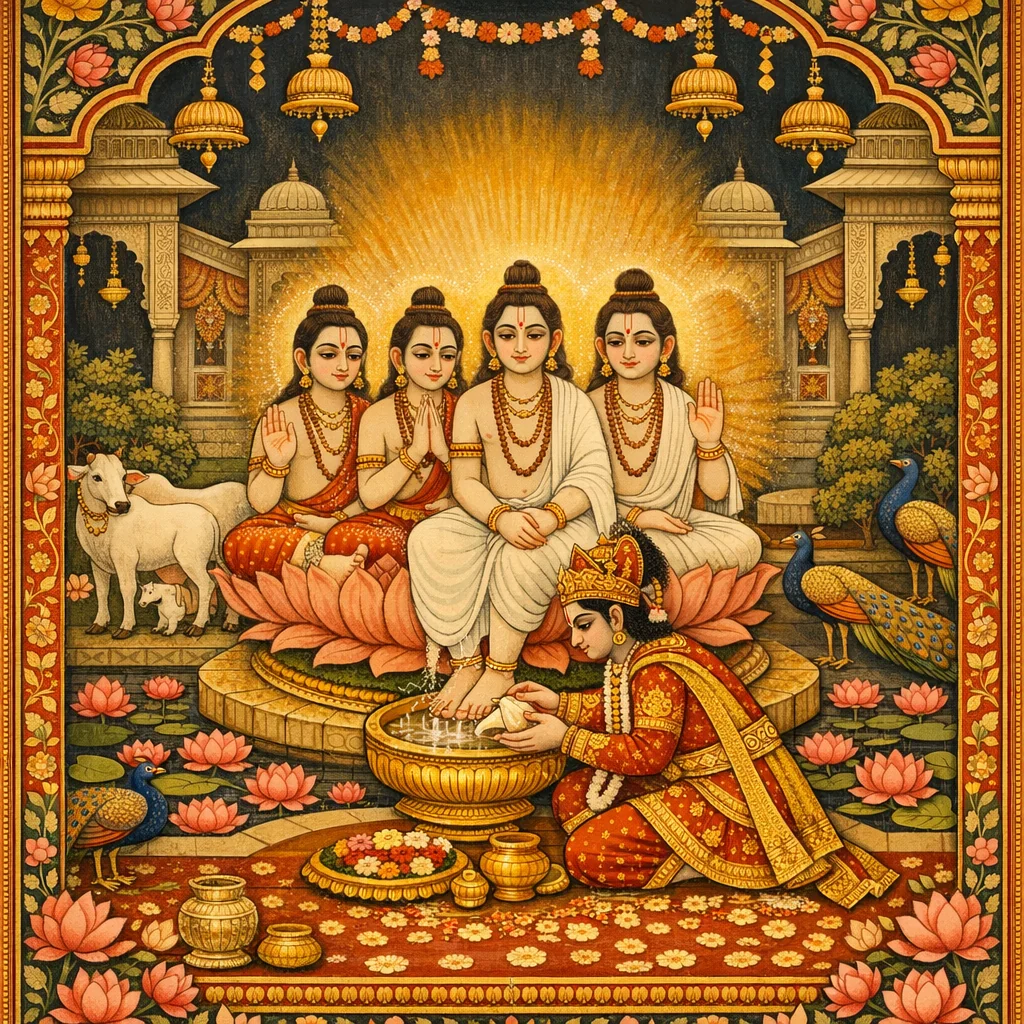
When the great sages accepted the reception according to the śāstras and sat upon the honored seats offered by the King, the King—moved by their glory—bowed his head in humility and worshiped the four Kumāras in proper rite.
Verse 5
तत्पादशौचसलिलैर्मार्जितालकबन्धन: । तत्र शीलवतां वृत्तमाचरन्मानयन्निव ॥ ५ ॥
Thereafter the King took the water that had washed the Kumāras’ lotus feet and sprinkled it upon his hair. By such reverent conduct, he set the example of how to honor and receive a spiritually exalted saint.
Verse 6
हाटकासन आसीनान् स्वधिष्ण्येष्विव पावकान् । श्रद्धासंयमसंयुक्त: प्रीत: प्राह भवाग्रजान् ॥ ६ ॥
The four great sages, elder even than Lord Śiva, sat upon a golden throne and shone like fire blazing upon an altar. Mahārāja Pṛthu, filled with faith, restraint, and affection, addressed them as follows.
Verse 7
पृथुरुवाच अहो आचरितं किं मे मङ्गलं मङ्गलायना: । यस्य वो दर्शनं ह्यासीद्दुर्दर्शानां च योगिभि: ॥ ७ ॥
King Pṛthu said: “O great sages, you are the very abode of auspiciousness. What pious deed have I performed that I have obtained your darśana so easily? Even for mystic yogīs, seeing you is exceedingly rare.”
Verse 8
किं तस्य दुर्लभतरमिह लोके परत्र च । यस्य विप्रा: प्रसीदन्ति शिवो विष्णुश्च सानुग: ॥ ८ ॥
For one who pleases the brāhmaṇas and the Vaiṣṇavas, what remains truly rare to attain in this world or the next? Moreover, auspicious Lord Śiva and Lord Viṣṇu, who accompany them, also bestow their favor.
Verse 9
नैव लक्षयते लोको लोकान् पर्यटतोऽपि यान् । यथा सर्वदृशं सर्व आत्मानं येऽस्य हेतव: ॥ ९ ॥
Though you travel throughout all worlds, people cannot recognize you—just as they do not perceive the Paramātmā, the all-seeing Witness dwelling in everyone’s heart.
Verse 10
अधना अपि ते धन्या: साधवो गृहमेधिन: । यद्गृहा ह्यर्हवर्याम्बुतृणभूमीश्वरावरा: ॥ १० ॥
Even if a householder is not wealthy, he becomes blessed and glorified when saintly devotees come to his home. The master and servants who offer the exalted guests water, a seat, and articles of reception—and the home itself—are all sanctified and praised.
Verse 11
व्यालालयद्रुमा वै तेष्वरिक्ताखिलसम्पद: । यद्गृहास्तीर्थपादीयपादतीर्थविवर्जिता: ॥ ११ ॥
By contrast, even a house overflowing with opulence, where the Lord’s devotees are never allowed to enter and where no sacred water is kept for washing their feet, should be regarded like a tree that shelters venomous serpents.
Verse 12
स्वागतं वो द्विजश्रेष्ठा यद्व्रतानि मुमुक्षव: । चरन्ति श्रद्धया धीरा बाला एव बृहन्ति च ॥ १२ ॥
Mahārāja Pṛthu welcomed the four Kumāras, addressing them as the foremost of brāhmaṇas. He said: From birth you have faithfully observed the vows of brahmacarya; though expert in the path of liberation, you remain as innocent as small children.
Verse 13
कच्चिन्न: कुशलं नाथा इन्द्रियार्थार्थवेदिनाम् । व्यसनावाप एतस्मिन्पतितानां स्वकर्मभि: ॥ १३ ॥
Pṛthu Mahārāja asked the sages: O revered lords, can those who, by their own past deeds, have fallen into this perilous material existence—seeking only sense gratification—attain any true welfare or auspicious fortune?
Verse 14
भवत्सु कुशलप्रश्न आत्मारामेषु नेष्यते । कुशलाकुशला यत्र न सन्ति मतिवृत्तय: ॥ १४ ॥
There is no need to ask about your good or bad fortune, for you are ātmārāmas, ever absorbed in spiritual bliss. In you there are no mental movements that fabricate “auspicious” and “inauspicious”; thus, how could there be any question of luck or misfortune?
Verse 15
तदहं कृतविश्रम्भ: सुहृदो वस्तपस्विनाम् । सम्पृच्छे भव एतस्मिन् क्षेम: केनाञ्जसा भवेत् ॥ १५ ॥
I am fully assured that saintly persons like you are the only true friends of those who burn in the fire of material existence. Therefore I ask: in this world, by what means may we swiftly attain the supreme welfare and life’s ultimate goal?
Verse 16
व्यक्तमात्मवतामात्मा भगवानात्मभावन: । स्वानामनुग्रहायेमां सिद्धरूपी चरत्यज: ॥ १६ ॥
The Supreme Personality of Godhead, the very Soul of the self-realized and the awakener of spiritual consciousness, is ever eager to uplift the living beings who are His own parts. For their special mercy, the Lord roams the world in the form of realized sages like you.
Verse 17
मैत्रेय उवाच पृथोस्तत्सूक्तमाकर्ण्य सारं सुष्ठु मितं मधु । स्मयमान इव प्रीत्या कुमार: प्रत्युवाच ह ॥ १७ ॥
The great sage Maitreya continued: Hearing King Pṛthu’s words—substantial, fitting, measured, and sweet to the ear—Sanat-kumāra, foremost among the celibates, smiled in full satisfaction and began to reply as follows.
Verse 18
सनत्कुमार उवाच साधु पृष्टं महाराज सर्वभूतहितात्मना । भवता विदुषा चापि साधूनां मतिरीदृशी ॥ १८ ॥
Sanat-kumāra said: O great King, you have inquired most excellently. Because your heart seeks the welfare of all beings, this question is auspicious for everyone. Though you are learned and know, you ask in this way, for such is the conduct of saintly persons; such intelligence befits your station.
Verse 19
सङ्गम: खलु साधूनामुभयेषां च सम्मत: । यत्सम्भाषणसम्प्रश्न: सर्वेषां वितनोति शम् ॥ १९ ॥
The gathering of devotees is indeed cherished by both—the speaker and the hearer—for in such dialogue, questions and answers spread peace and true happiness for all.
Verse 20
अस्त्येव राजन् भवतो मधुद्विष: पादारविन्दस्य गुणानुवादने । रतिर्दुरापा विधुनोति नैष्ठिकी कामं कषायं मलमन्तरात्मन: ॥ २० ॥
My dear King, you already have an inclination to glorify the lotus feet of Madhudviṣa, the Supreme Lord. Such attachment is rare to attain; yet when it becomes unwavering and steadfast, it naturally washes away lust, taint, and impurity from the core of the heart.
Verse 21
शास्त्रेष्वियानेव सुनिश्चितो नृणां क्षेमस्य सध्र्यग्विमृशेषु हेतु: । असङ्ग आत्मव्यतिरिक्त आत्मनि दृढा रतिर्ब्रह्मणि निर्गुणे च या ॥ २१ ॥
The scriptures, after careful deliberation, have conclusively determined that the highest welfare of humanity is detachment from the bodily conception of self and the steady, firm attachment to the Supreme Lord—nirguṇa Parabrahman, beyond the modes of material nature.
Verse 22
सा श्रद्धया भगवद्धर्मचर्यया जिज्ञासयाध्यात्मिकयोगनिष्ठया । योगेश्वरोपासनया च नित्यं पुण्यश्रव:कथया पुण्यया च ॥ २२ ॥
That attachment increases through śraddhā (faith), by practicing Bhagavata-dharma, by inquiring about the Supreme Lord, by steadfast application of bhakti-yoga, by daily worship of Yogeśvara, and by hearing and chanting the sacred, meritorious narrations of His glories.
Verse 23
अर्थेन्द्रियारामसगोष्ठ्यतृष्णया तत्सम्मतानामपरिग्रहेण च । विविक्तरुच्या परितोष आत्मनि विना हरेर्गुणपीयूषपानात् ॥ २३ ॥
One advances in spiritual life by giving up the craving to associate with those absorbed only in wealth and sense pleasure, and by avoiding even those who keep such company. One should shape life so that without drinking the nectar of Hari’s glorification, the heart finds no peace; by becoming disgusted with the taste for sense enjoyment, one is uplifted.
Verse 24
अहिंसया पारमहंस्यचर्यया स्मृत्या मुकुन्दाचरिताग्र्यसीधुना । यमैरकामैर्नियमैश्चाप्यनिन्दया निरीहया द्वन्द्वतितिक्षया च ॥ २४ ॥
A seeker of spiritual advancement must be nonviolent, follow the path of the great paramahaṁsa ācāryas, always remember the finest nectar of Mukunda’s pastimes, observe yama and niyama without material desire, and—while observing them—never blaspheme others. The devotee should live simply and learn to tolerate dualities without disturbance.
Verse 25
हरेर्मुहुस्तत्परकर्णपूर गुणाभिधानेन विजृम्भमाणया । भक्त्या ह्यसङ्ग: सदसत्यनात्मनि स्यान्निर्गुणे ब्रह्मणि चाञ्जसा रति: ॥ २५ ॥
The devotee should steadily cultivate devotional service by repeatedly hearing the transcendental qualities of Śrī Hari, which are ornaments for the ears of the bhaktas. By such bhakti one rises beyond the material guṇas, becomes detached from the unreal non-self, and easily attains firm loving attachment to the nirguṇa Brahman—Śrī Bhagavān Himself.
Verse 26
यदा रतिर्ब्रह्मणि नैष्ठिकी पुमा- नाचार्यवान् ज्ञानविरागरंहसा । दहत्यवीर्यं हृदयं जीवकोशं पञ्चात्मकं योनिमिवोत्थितोऽग्नि: ॥ २६ ॥
When, by the grace of the ācārya, knowledge and detachment awaken with force and one’s loving attachment becomes firmly fixed in Śrī Bhagavān, then the jīva within the heart—covered by the five elements—burns up the material encasement, just as fire arising from wood consumes that very wood.
Verse 27
दग्धाशयो मुक्तसमस्ततद्गुणो नैवात्मनो बहिरन्तर्विचष्टे । परात्मनोर्यद्वयवधानं पुरस्तात् स्वप्ने यथा पुरुषस्तद्विनाशे ॥ २७ ॥
When one’s material desires are burned away and one is freed from all material qualities, one no longer perceives a division between outer and inner action. Then the difference between the ātman and the Paramātman that seemed to exist before self-realization is dissolved—just as, when a dream ends, no distinction remains between the dream and the dreamer.
Verse 28
आत्मानमिन्द्रियार्थं च परं यदुभयोरपि । सत्याशय उपाधौ वै पुमान् पश्यति नान्यदा ॥ २८ ॥
When the soul lives for sense gratification, it fashions many desires and thus becomes bound by designations (upādhis). But in the transcendental state, one is interested in nothing except fulfilling the will of the Lord.
Verse 29
निमित्ते सति सर्वत्र जलादावपि पूरुष: । आत्मनश्च परस्यापि भिदां पश्यति नान्यदा ॥ २९ ॥
Only because of differing causes does a person perceive a distinction between himself and others everywhere, just as the body’s reflection appears differently when seen in water, in oil, or in a mirror.
Verse 30
इन्द्रियैर्विषयाकृष्टैराक्षिप्तं ध्यायतां मन: । चेतनां हरते बुद्धे: स्तम्बस्तोयमिव ह्रदात् ॥ ३० ॥
When the senses are drawn to their objects for enjoyment, the mind is thrown into agitation. By continually dwelling on sense objects, the true consciousness within the intelligence is nearly stolen away, like the water of a lake gradually sucked up by the thick grass straws on its bank.
Verse 31
भ्रश्यत्यनुस्मृतिश्चित्तं ज्ञानभ्रंश: स्मृतिक्षये । तद्रोधं कवय: प्राहुरात्मापह्नवमात्मन: ॥ ३१ ॥
When one strays from original consciousness, the mind’s recollection collapses, and with the loss of memory comes the ruin of knowledge. The wise call this obstruction ātma-apahnava—self-concealment of the soul, the forgetting of one’s own true nature.
Verse 32
नात: परतरो लोके पुंस: स्वार्थव्यतिक्रम: । यदध्यन्यस्य प्रेयस्त्वमात्मन: स्वव्यतिक्रमात् ॥ ३२ ॥
In this world there is no greater obstruction to one’s true self-interest than to deem other matters more pleasing than self-realization.
Verse 33
अर्थेन्द्रियार्थाभिध्यानं सर्वार्थापह्नवो नृणाम् । भ्रंशितो ज्ञानविज्ञानाद्येनाविशति मुख्यताम् ॥ ३३ ॥
Constantly brooding over wealth and how to use it for sense gratification destroys all human interests. Devoid of knowledge, realized understanding, and bhakti, one falls into births like those of trees and stones.
Verse 34
न कुर्यात्कर्हिचित्सङ्गं तमस्तीव्रं तितीरिषु: । धर्मार्थकाममोक्षाणां यदत्यन्तविघातकम् ॥ ३४ ॥
Those who earnestly wish to cross the ocean of nescience should never associate with the mode of darkness (tamas), for hedonistic pursuits are the greatest obstacles to dharma, artha, kama, and, at last, moksha.
Verse 35
तत्रापि मोक्ष एवार्थ आत्यन्तिकतयेष्यते । त्रैवर्ग्योऽर्थो यतो नित्यं कृतान्तभयसंयुत: ॥ ३५ ॥
Among the four aims of life, liberation (mokṣa) alone is the supreme purpose and must be taken with utmost seriousness. Dharma, artha, and kāma are ever subject to destruction by nature’s stern law—death.
Verse 36
परेऽवरे च ये भावा गुणव्यतिकरादनु । न तेषां विद्यते क्षेममीशविध्वंसिताशिषाम् ॥ ३६ ॥
The higher and lower conditions of life we take as blessings exist only through the interplay of the material modes. In truth they hold no lasting security, for all are destined to be destroyed by the Supreme Controller.
Verse 37
तत्त्वं नरेन्द्र जगतामथ तस्थूषां च देहेन्द्रियासुधिषणात्मभिरावृतानाम् । य: क्षेत्रवित्तपतया हृदि विश्वगावि: प्रत्यक् चकास्ति भगवांस्तमवेहि सोऽस्मि ॥ ३७ ॥
O King Pṛthu, know the Bhagavān, the Supreme Personality of Godhead, who dwells in the heart of every being—moving or unmoving—as the Lord of the field (kṣetra) and the inwardly shining witness beside the individual soul. The jīvas are covered by the gross body and the subtle body of prāṇa and intelligence.
Verse 38
यस्मिन्निदं सदसदात्मतया विभाति माया विवेकविधुति स्रजि वाहिबुद्धि: । तं नित्यमुक्तपरिशुद्धविशुद्धतत्त्वं प्रत्यूढकर्मकलिलप्रकृतिं प्रपद्ये ॥ ३८ ॥
In Him this world appears, by māyā, as cause and effect—seeming real and unreal. But one who, through discerning contemplation, has crossed beyond illusion—like dispelling the snake-mistake upon a rope—understands that the Paramātmā is eternally free, perfectly pure, the spotless truth, untouched by the grime of karma. To Him alone I surrender.
Verse 39
यत्पादपङ्कजपलाशविलासभक्त्या कर्माशयं ग्रथितमुद्ग्रथयन्ति सन्त: । तद्वन्न रिक्तमतयो यतयोऽपि रुद्ध स्रोतोगणास्तमरणं भज वासुदेवम् ॥ ३९ ॥
By the playful, loving bhakti of serving the Lord’s lotus-toes, the saints easily untie the hard knot of karmic desire. But those devoid of devotion—even jñānīs and yogīs—cannot truly dam the waves of sense enjoyment, though they strive. Therefore worship Vāsudeva, Śrī Kṛṣṇa, the son of Vasudeva.
Verse 40
कृच्छ्रो महानिह भवार्णवमप्लवेशां षड्वर्गनक्रमसुखेन तितीर्षन्ति । तत्त्वं हरेर्भगवतो भजनीयमङ्घ्रिं कृत्वोडुपं व्यसनमुत्तर दुस्तरार्णम् ॥ ४० ॥
This ocean of nescience is exceedingly hard to cross, swarming with perilous sharks and crocodiles—the six inner foes. The faithless strive to pass it by severe austerities; but we advise you: take refuge in the worshipful lotus feet of Bhagavān Hari as your boat, and you will surmount this difficult sea and all its dangers.
Verse 41
मैत्रेय उवाच स एवं ब्रह्मपुत्रेण कुमारेणात्ममेधसा । दर्शितात्मगति: सम्यक्प्रशस्योवाच तं नृप: ॥ ४१ ॥
Maitreya said: Thus enlightened with complete spiritual knowledge by the son of Brahmā—one of the Kumāras, perfected in wisdom of the Self—the King clearly beheld his soul’s true course. He duly praised the sage and then spoke as follows.
Verse 42
राजोवाच कृतो मेऽनुग्रह: पूर्वं हरिणार्तानुकम्पिना । तमापादयितुं ब्रह्मन् भगवन् यूयमागता: ॥ ४२ ॥
The King said: O brāhmaṇa, O mighty one, formerly Bhagavān Hari, compassionate to the distressed, bestowed His causeless mercy upon me and indicated that you would come to my home; to confirm that blessing, you have all now arrived.
Verse 43
निष्पादितश्च कार्त्स्न्येन भगवद्भिर्घृणालुभि: । साधूच्छिष्टं हि मे सर्वमात्मना सह किं ददे ॥ ४३ ॥
My dear brāhmaṇa, you too are compassionate like the Lord, and thus you have carried out the command in full. Therefore it is my duty to offer you something; yet all I possess is but like remnants left by great sādhus. What can I give—even including myself?
Verse 44
प्राणा दारा: सुता ब्रह्मन् गृहाश्च सपरिच्छदा: । राज्यं बलं मही कोश इति सर्वं निवेदितम् ॥ ४४ ॥
The King continued: Therefore, O brāhmaṇas, my very life, my wife, my children, my home with all its furnishings, my kingdom, my strength, my lands, and especially my treasury—everything I offer unto you.
Verse 45
सैनापत्यं च राज्यं च दण्डनेतृत्वमेव च । सर्व लोकाधिपत्यं च वेदशास्त्रविदर्हति ॥ ४५ ॥
Only one fully educated in Vedic knowledge deserves to be commander-in-chief, ruler of the state, chastiser, and lord of the whole world; therefore Mahārāja Pṛthu offered all these powers to the Kumāras.
Verse 46
स्वमेव ब्राह्मणो भुङ्क्ते स्वं वस्ते स्वं ददाति च । तस्यैवानुग्रहेणान्नं भुञ्जते क्षत्रियादय: ॥ ४६ ॥
The brāhmaṇa eats from his own wealth, clothes himself with his own wealth, and gives charity from his own wealth; by his mercy the kṣatriyas and others are able to partake of food.
Verse 47
यैरीदृशी भगवतो गतिरात्मवाद एकान्ततो निगमिभि: प्रतिपादिता न: । तुष्यन्त्वदभ्रकरुणा: स्वकृतेन नित्यं को नाम तत्प्रतिकरोति विनोदपात्रम् ॥ ४७ ॥
How can anyone repay those cloudlike, compassionate saints who have rendered limitless service by explaining— with firm conviction and Vedic proof— the path of self-realization in relation to Bhagavān for our enlightenment? Beyond offering water in folded palms for their satisfaction, what return is possible? Such great souls are pleased only by their own deeds, which they distribute among humanity out of boundless mercy.
Verse 48
मैत्रेय उवाच त आत्मयोगपतय आदिराजेन पूजिता: । शीलं तदीयं शंसन्त: खेऽभवन्मिषतां नृणाम् ॥ ४८ ॥
Maitreya said: Thus worshiped by Mahārāja Pṛthu, the four Kumāras—masters of bhakti-yoga—became greatly pleased. They appeared in the sky, praised the King’s character, and all the people beheld them.
Verse 49
वैन्यस्तु धुर्यो महतां संस्थित्याध्यात्मशिक्षया । आप्तकाममिवात्मानं मेन आत्मन्यवस्थित: ॥ ४९ ॥
Among great souls, Vainya Pṛthu was foremost because he was firmly established in spiritual instruction. Abiding within the self, he remained satisfied like one who has attained complete success in transcendental understanding.
Verse 50
कर्माणि च यथाकालं यथादेशं यथाबलम् । यथोचितं यथावित्तमकरोद्ब्रह्मसात्कृतम् ॥ ५० ॥
Self-satisfied, Mahārāja Pṛthu performed his duties as perfectly as possible according to time, circumstance, strength, and means. In all his actions his sole aim was to please the Absolute Truth, the Bhagavān; thus he acted properly.
Verse 51
फलं ब्रह्मणि संन्यस्य निर्विषङ्ग: समाहित: । कर्माध्यक्षं च मन्वान आत्मानं प्रकृते: परम् ॥ ५१ ॥
Pṛthu Mahārāja offered the fruits of all his work to Brahman—the Bhagavān—becoming free from attachment and steady in concentration. He regarded the Lord as the overseer of all karma and always thought of himself as the eternal servant of the Supreme Personality, beyond material nature.
Verse 52
गृहेषु वर्तमानोऽपि स साम्राज्यश्रियान्वित: । नासज्जतेन्द्रियार्थेषु निरहंमतिरर्कवत् ॥ ५२ ॥
Though endowed with the splendor of his prosperous empire, Mahārāja Pṛthu lived at home as a householder. Never inclined to use opulence for sense enjoyment, he remained unattached—like the sun, unaffected in every circumstance.
Verse 53
एवमध्यात्मयोगेन कर्माण्यनुसमाचरन् । पुत्रानुत्पादयामास पञ्चार्चिष्यात्मसम्मतान् ॥ ५३ ॥
Thus situated in adhyātma-yoga—devotional service—Mahārāja Pṛthu properly carried out his duties and, with his wife Arci, begot five sons. Indeed, those sons were born according to his own desire.
Verse 54
विजिताश्वं धूम्रकेशं हर्यक्षं द्रविणं वृकम् । सर्वेषां लोकपालानां दधारैक: पृथुर्गुणान् ॥ ५४ ॥
After begetting five sons—Vijitāśva, Dhūmrakeśa, Haryakṣa, Draviṇa, and Vṛka—Mahārāja Pṛthu continued to rule the world. In him alone were found all the qualities of the lokapāla devas who govern the other planets.
Verse 55
गोपीथाय जगत्सृष्टे: काले स्वे स्वेऽच्युतात्मक: । मनोवाग्वृत्तिभि: सौम्यैर्गुणै: संरञ्जयन् प्रजा: ॥ ५५ ॥
As a perfect devotee of the Supreme Lord Acyuta, Mahārāja Pṛthu sought to protect the Lord’s creation by pleasing the citizens according to their varied desires; thus by mind, speech, deeds, and gentle conduct he satisfied them in every way.
Verse 56
राजेत्यधान्नामधेयं सोमराज इवापर: । सूर्यवद्विसृजन् गृह्णन् प्रतपंश्च भुवो वसु ॥ ५६ ॥
Mahārāja Pṛthu became renowned as a king like Soma-rāja, the lord of the moon. He was also powerful and exacting like the sun-god, who bestows heat and light while at the same time drawing up the waters of the worlds.
Verse 57
दुर्धर्षस्तेजसेवाग्निर्महेन्द्र इव दुर्जय: । तितिक्षया धरित्रीव द्यौरिवाभीष्टदो नृणाम् ॥ ५७ ॥
Mahārāja Pṛthu was as unassailable as fire—no one could defy his command—and as unconquerable as Indra. Yet he was as tolerant as the earth, and in fulfilling the desires of human society he was like the very heavens.
Verse 58
वर्षति स्म यथाकामं पर्जन्य इव तर्पयन् । समुद्र इव दुर्बोध: सत्त्वेनाचलराडिव ॥ ५८ ॥
Just as rain falls according to desire and satisfies all, Mahārāja Pṛthu satisfied everyone. He was like the ocean, whose depths none can fathom, and like Mount Meru, king of hills, unwavering in his resolve.
Verse 59
धर्मराडिव शिक्षायामाश्चर्ये हिमवानिव । कुवेर इव कोशाढ्यो गुप्तार्थो वरुणो यथा ॥ ५९ ॥
Mahārāja Pṛthu’s intelligence and learning were wondrous like those of Yamarāja, the overseer of dharma. His opulence was like the Himalayas, stocked with jewels and metals. He was wealthy like Kuvera, and his secrets were hidden like Varuṇa’s—none could disclose them.
Verse 60
मातरिश्वेव सर्वात्मा बलेन महसौजसा । अविषह्यतया देवो भगवान् भूतराडिव ॥ ६० ॥
In bodily strength and the power of his senses, Mahārāja Pṛthu was like the all-pervading wind. In irresistible might, he was like Bhagavān’s Rudra expansion, Sadāśiva, the lord of beings.
Verse 61
कन्दर्प इव सौन्दर्ये मनस्वी मृगराडिव । वात्सल्ये मनुवन्नृणां प्रभुत्वे भगवानज: ॥ ६१ ॥
In beauty he was like Kandarpa (Cupid), and in thoughtful courage like a lion. In affection he resembled Svāyambhuva Manu, and in sovereign control he was like Bhagavān Brahmā.
Verse 62
बृहस्पतिर्ब्रह्मवादे आत्मवत्त्वे स्वयं हरि: । भक्त्या गोगुरुविप्रेषु विष्वक्सेनानुवर्तिषु । ह्रिया प्रश्रयशीलाभ्यामात्मतुल्य: परोद्यमे ॥ ६२ ॥
In spiritual wisdom he was like Bṛhaspati, and in self-control like Hari Himself. In devotion he followed the devotees—followers of Viṣvaksena—who were devoted to protecting cows and serving the spiritual master and the brāhmaṇas. He was perfect in sacred modesty and gentle humility, and in works for others he labored as if for his own self.
Verse 63
कीर्त्योर्ध्वगीतया पुम्भिस्त्रैलोक्ये तत्र तत्र ह । प्रविष्ट: कर्णरन्ध्रेषु स्त्रीणां राम: सतामिव ॥ ६३ ॥
Throughout the three worlds—higher, middle, and lower—Pṛthu Mahārāja’s fame was loudly sung. Women and saintly souls heard his sweet glories, like the nectarean glories of Lord Rāmacandra.
Frequently Asked Questions
This act honors caraṇāmṛta as spiritually purifying and models śāstric etiquette: a ruler becomes truly glorious by humility before realized devotees. In Bhāgavata theology, the Lord’s mercy flows through His devotees; reverence to them accelerates purification and anchors kingship in service rather than pride.
He defines it as detachment from the bodily concept and steady attachment to the Supreme Lord beyond the guṇas. This attachment is cultivated through bhakti practices—hearing, chanting, worship, and inquiry—and it naturally cleanses lust from the heart, making liberation meaningful and stable.
Those absorbed in money-making and sense gratification—and even those who keep such association—should be avoided, because that association agitates the mind, strengthens anarthas, and obstructs dharma, artha, kāma, and especially mokṣa. The chapter frames bad association as the practical root of spiritual decline.
Because without devotion to the Lord’s lotus feet, the ‘hard-knotted’ desires for fruitive activity persist. Sanat-kumāra presents bhakti as uniquely effective: service to Bhagavān redirects desire itself, whereas mere restraint or analysis often fails against entrenched saṁskāras.
The Lord’s lotus feet are compared to boats that carry one safely across saṁsāra, which is dangerous like an ocean filled with sharks (temptations, anarthas, karmic reactions). The teaching emphasizes śaraṇāgati—taking shelter—over relying solely on austerity or self-powered methods.