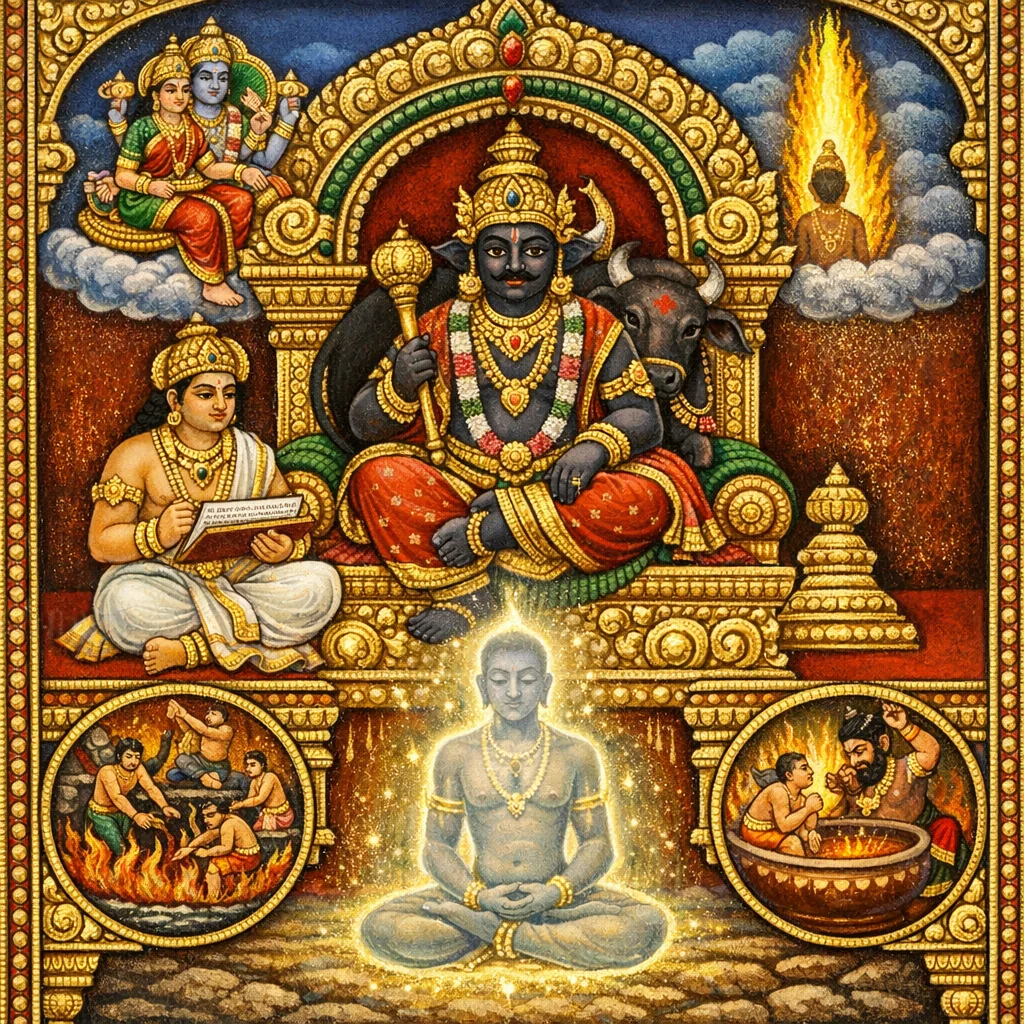
Adhyaya 370
Chapter 370: नरकनिरूपणम् (Naraka-nirūpaṇa) — Description of Hell (with the physiology of dying and the subtle transition)
Agni continues his ordered teaching, turning from Yama’s routes to a precise account of dying and the post-mortem passage. It opens with a quasi-physiological description: bodily heat is disturbed, vāyu constricts the system, obstructs the doṣas, and shuts down prāṇa-sthānas and marmas. Seeking an exit, vāyu is said to depart “upward” (eyes, ears, nostrils, mouth) for auspicious karma, or “downward” (anus, genitals) for inauspicious karma, while the yogin departs sovereignly through the brahma-randhra at the crown. As prāṇa and apāna converge and awareness is veiled, the jīva—centered in the navel region—assumes an atīvāhika transitional subtle body, seen by gods and siddhas with divine sight. Yama’s messengers then lead the subtle person along the terrifying Yama-mārga; offerings by relatives sustain him until judgment before Yama and Citragupta. The chapter catalogs vast hell-realms and their rulers, describes severe punishments, and concludes with karmic rebirth outcomes for mahāpātakas, finally widening to the threefold suffering (ādhyātmika, ādhibhautika, ādhidaivika) and recommending jñāna-yoga, vows, gifts, and worship of Viṣṇu as remedies.
Shlokas
Verse 1
इत्य् आग्नेये महापुराणे शरीरावयवा नामो न सप्तत्यधिकत्रिशततमो ऽध्यायः अथसप्रत्यधिकत्रिशततमो ऽध्यायः नरकनिरूपणम् अग्निर् उवाच उक्तानि यममार्गाणि वक्ष्ये ऽथ मरणे नृणां ऊष्मा प्रकुपितः काये तीव्रवायुसमीरितः
Thus in the Agni Mahāpurāṇa ends the chapter called “The Bodily Limbs,” the three-hundred-and-sixty-ninth. Now begins the three-hundred-and-seventieth chapter: “Description of Hell.” Agni said: “I shall now explain the paths of Yama that have been spoken of, and what occurs for humans at the time of death: the bodily heat, violently agitated and driven by fierce winds, becomes inflamed within the body.”
Verse 2
शरीरमुपरुध्याथ कृत्स्नान्दोषान्रुणद्धि वै छिनत्ति प्राणस्थानानि पुनर्मर्माणि चैव हि
When the body is constricted or obstructed, it indeed blocks all the doṣas; it further destroys the vital seats of life (prāṇa-sthānas), and likewise the marmas (marma), the crucial junction-points of vitality.
Verse 3
शैत्यात् प्रकुपितो वायुश्छिद्रमन्विष्यते ततः द्वे नेत्रे द्वौ तथा कर्णौ द्वौ तु नासापुटौ तथा
Aggravated by cold, the vāyu (wind principle) then searches for an opening. The principal apertures are the two eyes, the two ears, and likewise the two nostril-passages.
Verse 4
ऊर्ध्वन्तु सप्त च्छिद्राणि अष्टमं वदनं तथा एतैः प्राणो विनिर्याति प्रायशः शुभकर्मणां
Seven apertures are situated upward, and the mouth is the eighth; through these, the vital breath (prāṇa) commonly departs—especially in the case of those engaged in auspicious, meritorious deeds.
Verse 5
अधः पायुरुपस्थञ्च अनेनाशुभकारिणां पिण्डं कृत्वा तुव्न्यसेदिति ञ मूर्धानं योगिनो भित्त्वा जीवो यात्यथ चेच्छया
Below—through the anus and the genital organ—the jīva departs; by this route the doers of inauspicious deeds go, becoming as it were a “mass,” bound and condensed by karmic impurity. But the yogin, splitting open the crown of the head (brahma-randhra), causes the jīva to depart at will.
Verse 6
अन्तकाले तु सम्प्राप्रे प्राणे ऽपानमुपस्थिते तमसा संवृते ज्ञाने संवृतेषु च मर्मसु
But when the final moment has arrived—when apāna draws near to and converges with prāṇa—when awareness is veiled by darkness, and the vital junctions (marmas) too become obstructed or shut down,
Verse 7
स जिवो नाभ्यधिष्टानश्चाल्यते मातरिश्वना बाध्यमाणश्चानयते अष्टाङ्गाः प्राणवृत्तिकाः
That living being, whose seat is the navel-region, is set into motion by Mātariśvan, the vital wind. When constrained or afflicted, it also drives forth the eightfold operations of prāṇa, the activity of vital life.
Verse 8
च्यवन्तं जायमानं वा प्रविशन्तञ्च योनिषु प्रपश्यन्ति च तं सिद्धा देवा दिव्येन चक्षुपा
The Siddhas and the gods, with their divine sight, behold him—whether he is departing from the body, being born, or entering into wombs (yoni) for rebirth.
Verse 9
गृह्णाति तत्क्षणाद्योगे शरीरञ्चातिवाहिकम् आकाशवायुतेजांसि विग्रहादूर्ध्वगामिनः
In yoga, at that very instant, he takes up the ‘atīvāhika’ body—the transitional, subtle body; and from the embodied form the elements—space, wind, and fire—move upward.
Verse 10
जलं मही च पञ्चत्वमापन्नः पुरुषः स्मृतः आतिवाहिकदेहन्तु यमदूता नयन्ति तं
A person is said to have “attained the state of the five elements” when the gross body returns to water and earth; yet it is that person, in the ātivāhika (subtle carrier) body, whom Yama’s messengers lead away.
Verse 11
याम्यं मार्गं महाघोरं षडशीतिसहस्रकम् अन्नोदकं नीयमानो बान्धवैर् दत्तमश्नुते
Led along the Yama-path—most terrifying, extending for eighty-six thousand yojanas—he, while being taken, partakes of the food and water given by his kinsmen.
Verse 12
यमं दृष्ट्वा यमोक्तेन चित्रगुप्तेन चेरितान् प्राप्नोति नरकान्रौद्रान्धर्मी शुभपथैर् दिवम्
Having beheld Yama, a person—conducted by Citragupta at Yama’s command—attains the dreadful hells; but the righteous one, by auspicious paths, reaches heaven.
Verse 13
भुज्यन्ते पापिभिर्वक्ष्ये नरकांस्ताश् च यातनाः अष्टाविंशतिरेवाधःक्षितेर्नरककोटयः
These torments are endured by sinners; I shall describe those hells and those punishments. Below the earth there are indeed twenty-eight koṭis (vast multitudes) of hell-realms.
Verse 14
सप्तमस्य तलस्यान्ते घोरे तमसि संस्थिताः घोराख्या प्रथमाकोटिः सुघोरा तदधःस्थिता
At the end of the seventh Tala, in dreadful darkness (tamas), there is situated the first boundary-line (koṭi) called “Ghorā”; beneath that lies another called “Sughora”.
Verse 15
अतिघोरा महाघोरा घोररूपा च पञ्चमी षष्ठी तरलताराख्या सप्तमी च भयानका
The tithi-goddess of the fifth day is called Atighorā, Mahāghorā, and also Ghorarūpā; the sixth is named Taralatārā; and the seventh is Bhayānakā (the Terrifying).
Verse 16
भयोत्कटा कालरात्री महाचण्डा च चण्डया कोलाहला प्रचण्डाख्या पद्मा नरकनायिका
She is called Bhayotkaṭā (the Terrifying), Kālarātrī (the Night of Time/Death), Mahācaṇḍā (the Great Fierce One) and Caṇḍayā (the Fierce Goddess); Kolāhalā (She of tumult), famed as Pracaṇḍā (the Very Violent); Padmā (the Lotus-One), and Narakanāyikā (the Mistress of Hell).
Verse 17
पद्मावती भीषणा च भीमा चैव करालिका विकराला महावज्रा त्रिकोणा पञ्चकोणिका
“Padmāvatī; Bhīṣaṇā (the Terrifying); Bhīmā (the Formidable); Karālikā (the Grim-faced); Vikarālā (the Very Terrible); Mahāvajrā (She of the Great Thunderbolt); Trikoṇā (the Triangular-formed); and Pañcakoṇikā (the Five-angled-formed).”
Verse 18
सदीर्घा वर्तुला सप्तभूमा चैव सुभूमिका दीप्तमायाष्टाविंशतयः कोटयः पापिदुःखदाः
Sadīrghā, Vartulā, Saptabhūmā, Subhūmikā, and Dīptamāyā—these hell-realms, totaling twenty-eight crores (koṭi), bestow suffering upon sinners.
Verse 19
अष्टाविंशतिकोटीनां पञ्च पञ्च च नायकाः रौरवाद्याः शतञ्चैकं चत्वारिंशच्चतुष्टयं
For the twenty-eight crores (koṭi) of hell-divisions, there are rulers arranged in groups of “five and five.” Beginning with Raurava, the hells number one hundred and one; and in addition there is a set of forty-four.
Verse 20
तामिश्रमन्धतामिश्रं महारौरवरौरवौ असिपत्रं वनञ्चैव लोहभारं तथैव च
Tāmiśra, Andhatāmiśra, Mahāraurava and Raurava, Asipatra, the Asipatra-forest, and likewise Lohabhāra—these are the hells.
Verse 21
नरकं कालसूत्रञ्च महानरकमेव व सञ्जीवनं महावीचि तपनं सम्प्रतापनं
“(These are the hells:) Naraka, Kālasūtra, Mahānaraka, Sañjīvana, Mahāvīcī, Tapana, and Sampratāpana.”
Verse 22
सङ्घातञ्च सकाकोलं कुद्मलं पूतिमृत्तिकं लोहशङ्कुमृजीषञ्च प्रधानं शाल्मलीं नदीम्
Also mention Saṅghāta, Sakākola, Kudmala, the foul-smelling earth (pūti-mṛttikā), the iron spike, and Mṛjīṣa; these are principal (torments), along with Śālmalī and the river (of punishment).
Verse 23
नरकान्विद्धि कोटीशनागन्वै घोरदर्शनान् पात्यन्ते पापकर्माण एकैकस्मिन्बहुष्वपि
Know that there are hundreds of crores of hells, truly dreadful to behold; sinners—those of evil deeds—are cast down, each into one (hell), and some even into many.
Verse 24
मार्जारोलूकगोमायुगृघ्रादिवदनाश् च ते तैलद्रोण्यां नरं क्षिप्त्वा ज्वालयन्ति हुताशनं
And those tormentors, with faces like cats, owls, jackals, vultures, and the like, hurl a man into a trough of oil and then kindle the consuming fire.
Verse 25
अम्बरीषेषु चैवान्यांस्ताम्रपात्रेषु चापरान् अयःपात्रेषु चैवान्यान् बहुवह्निकणेषु च
Some (offerings) should indeed be placed in cooking-pots; others in copper vessels; others again in iron vessels; and others in vessels marked by many fire-grains (i.e., fire-associated implements/containers used in rites).
Verse 26
शूलाग्रारोपिताश्चान्ये छिद्यन्ते नरके ऽपरे ताड्यन्ते च कशाभिस्तु भोज्यन्ते चाप्ययोगुडान्
Some are impaled upon the tips of spears; others are cut to pieces in hell. Some are beaten with whips, and some are forced to eat iron balls.
Verse 27
यमदूतैर् नराः पांशून्विष्ठारक्तकफादिकान् तप्तं मद्यं पाययन्ति पाटयन्ति पुनर्नरान्
By Yama’s messengers, the men are made to drink heated liquor mixed with dust, feces, blood, phlegm, and the like; and again those men are split/cleft (tortured) repeatedly.
Verse 28
यन्त्रेषु पीडयन्ति स्म भक्ष्यन्ते वायसादिभिः तैलेनोष्णेन सिच्यन्ते छिद्यन्ते नैकघा शिरः
They are pressed in machines; they are eaten by crows and the like; they are drenched with hot oil; their heads are cut in many ways.
Verse 29
हा तातेति क्रन्दमानाः स्वकन्निदन्ति कर्म ते महापातकजान्घोरान्नरकान्प्राप्य गर्हितान्
Wailing, “Alas, dear father!”, they condemn their own deeds; having reached the dreadful, despised hells that arise from the great sins (mahāpātakas), they lament.
Verse 30
कर्मक्षयात्प्रजायन्ते महापातकिनस्त्विह मृगश्वशूकरोष्ट्राणां ब्रह्महा योनिमृच्छति
When (evil) karma ripens and is exhausted, the perpetrators of the great sins are born here again. A slayer of a brāhmaṇa enters the wombs of deer, horse, boar, and camel.
Verse 31
खरपुक्कशम्लेच्छानां मद्यपः स्वर्णहार्यपि कृमिकीटपतङ्गत्वं गुरुगस्तृणगुल्मतां
A drinker of intoxicants is reborn among the Khara, Pukkasa, and Mleccha peoples; and even a thief of gold becomes worms, insects, and flying pests. One who violates the teacher’s wife attains the state of grass and shrubs.
Verse 32
ब्रह्महा क्षयरोगी स्यात् सुरापः श्यावदन्तकः स्वर्णहारी तु कुनखी दुश् चर्मा गुरुतल्पगः
A slayer of a brāhmaṇa becomes afflicted with consumption; a drinker of liquor becomes one with darkened teeth; a thief of gold becomes diseased in the nails; and one who violates the teacher’s bed becomes a person of foul skin.
Verse 33
यो येन संस्पृशत्येषां स तल्लिङ्गो ऽभिजायते अन्नहर्ता मायावी स्यान्मूको वागपहारकः
A person is reborn bearing the very mark corresponding to whatever sin he commits against these beings; the one who steals food becomes a deceitful trickster, and the one who robs another of speech becomes mute.
Verse 34
धान्यं हृत्वातिरिक्ताङ्गः पिशुनः पूतिनासिकः तैलहृत्तैलपायी स्यात् पूतिवक्त्रस्तु सूचकः
One who steals grain becomes deformed with an excessive (superfluous) limb. A slanderer comes to have a foul-smelling nose. One who steals oil becomes an oil-drinker; while an informer (spy/accuser) becomes foul-mouthed, with a stinking mouth.
Verse 35
परस्य योषितं हृत्वा ब्रह्मस्वमपहृत्य च अरण्ये निर्जने देशे जायते ब्रह्मराक्षसः
One who abducts another man’s wife and also steals property belonging to a brāhmaṇa is born as a brahma-rākṣasa, dwelling in a forest, in a desolate and solitary place.
Verse 36
रत्नहारी हीनजातिर्गन्धान् छुछुन्दरी शुभान् पत्रं शाकं शिखी हृत्वा मुखरो धान्यहारकः
A jewel-thief is deemed of low birth; one who steals perfumes is called a ‘chuchundarī’ (a furtive, musk-rat-like thief); one who steals auspicious offerings—leaves and vegetables—is termed a ‘śikhī’; and one who steals grain is a noisy (mukhara) thief.
Verse 37
अजः पशुंपयः काको यानमुष्ट्रः फलं कपिः मधु दंशः फलं गृध्रो गृहकाक उपस्करं
Aja means “goat”; paśuṃpayaḥ denotes “animal milk”; kāka means “crow.” Uṣṭra is “camel” as a riding or transport animal. Kapi denotes “monkey” and also “fruit.” Daṃśa denotes “bee,” the maker of honey. Gṛdhra denotes “vulture” and also “fruit.” Gṛhakāka is “house-crow,” and upaskara means “household implements and equipment.”
Verse 38
शिवत्री वस्त्रं सारसञ्च झल्ली लवणहारकः उक्त आध्यात्मिकस्तापः शस्त्राद्यैर् आधिभौतिकः
Śivatrī, vastra (cloth as a protective covering), sārasa, jhallī, and ‘lavaṇa-hāraka’ are stated (as measures/terms) for the ādhātmika kind of affliction (inner, personal). Affliction arising from weapons and the like is called ādhidaivika—i.e., ādhibhautika (external, material in origin).
Verse 39
ग्रहाग्निदेवपीडाद्यैर् आधिकैविक ईरितः यानं वस्त+इति ख त्रिथा तापं हि संसारं ज्ञानयोगाद्विनाशयेत् कृच्छ्रैर् व्रतैश् च दानाद्यैर् विष्णुपूजादिभिर्नरः
Afflictions arising from planets, fire, and divine agencies are declared to be of the ādhidaivika kind. A man should destroy the threefold torment of saṃsāra through jñāna-yoga (the yoga of knowledge), and also by austere observances such as the Kṛcchra-vrata, by gifts and related meritorious acts, and by worship of Viṣṇu and similar devotional rites.
Frequently Asked Questions
It is the subtle carrier-body assumed at death, through which the jīva is led by Yama’s messengers after the gross elements resolve; it functions as the vehicle for post-mortem transit and experience.
Meritorious persons commonly depart through the upward apertures; inauspicious actors depart through the lower apertures; the yogin departs by will through the crown (brahma-randhra), indicating mastery over prāṇa and consciousness.
Citragupta operates as Yama’s recorder and administrator of karmic account, guiding the soul’s adjudication that leads either to naraka experiences or to auspicious destinations.
It links metaphysical doctrine to a technical account of prāṇa dynamics, subtle embodiment, and karmic causality, concluding with prescriptive sādhanā—jñāna-yoga, vrata, dāna, and devotion—as methods to dissolve saṃsāric suffering.