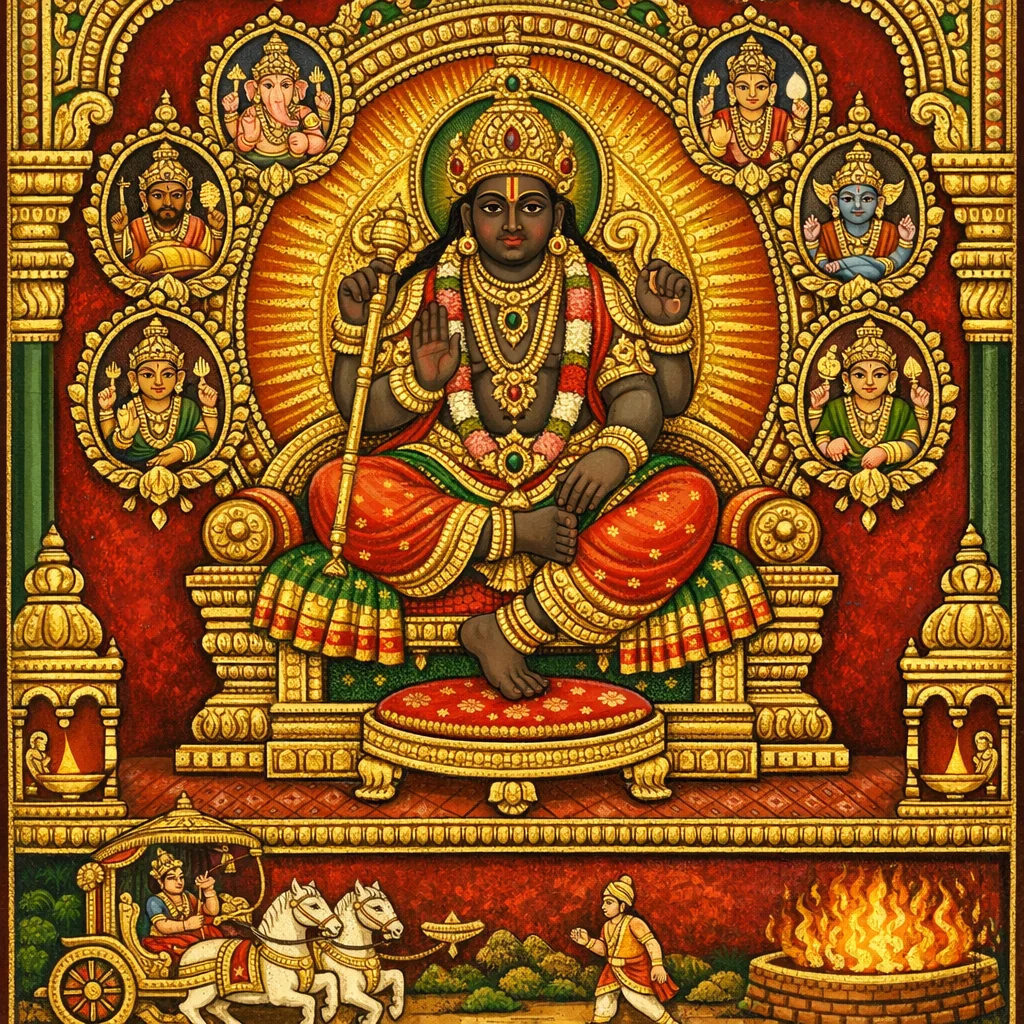
Adhyaya 381
Chapter 381 — यमगीता (Yama-gītā)
Agni introduces the Yama-gītā as a mokṣa teaching once spoken by Yama to Naciketas, promising both bhukti and mukti to reciters and listeners. Yama exposes human delusion: the impermanent self longs for stable possessions. He then weaves together authoritative “songs” of śreyas—sense-restraint and Self-contemplation (Kapila), equal vision and non-possessiveness (Pañcaśikha), discernment of life-stages (Gaṅgā–Viṣṇu), and remedies for suffering (Janaka). The teaching turns Vedāntic: the notion of difference within the non-different Supreme must be pacified; abandoning desire yields realized knowledge (Sanaka). Viṣṇu is identified as Brahman, transcendent and immanent, known through many divine names. Practices—meditation, vows, worship, dharma-hearing, gifts, and tīrtha—support realization. The Naciketas chariot metaphor teaches mastery of the senses through mind and buddhi, ascending the hierarchy up to Puruṣa. Finally, the eight limbs of yoga (yama, niyama, āsana, prāṇāyāma, pratyāhāra, dhāraṇā, dhyāna, samādhi) are outlined, ending in non-dual identity: the jīva, freed from avidyā, becomes Brahman.
Shlokas
Verse 1
इत्य् आग्नेये महापुराणे गीतासारो नामाशीत्यधिकत्रिशततमो ऽध्यायः अथैकाशीत्यधिकत्रिशततमो ऽध्यायः यमगीता अग्निर् उवाच यमगीतां प्रवक्ष्यामि उक्ता या नाचिकेतसे पठतां शृण्वतां भुक्त्यै मुक्त्यै मोक्षार्थिनां सतां
Thus, in the Agni Mahāpurāṇa ends the three-hundred-and-eightieth-plus-one (381st) chapter, called “The Essence of the Gītā.” Now begins the three-hundred-and-eightieth-plus-one (381st) chapter, “Yama-gītā.” Agni said: “I shall expound the Yama-gītā—the teaching spoken to Naciketas—bringing worldly enjoyment and liberation to those who recite it and those who listen to it, to the virtuous seekers of mokṣa.”
Verse 2
यम उवाच आसनं शयनं यानपरिधानगृहादिकम् वाञ्छत्यहो ऽतिमोहेन सुस्थिरं स्वयमस्थिरः
Yama said: Alas—through extreme delusion, one who is himself unstable (impermanent) longs for what is very stable: a seat, a bed, conveyances, clothing, a house, and the like.
Verse 3
भोगेषु शक्तिः सततं तथैवात्मावलोकनं श्रेयः परं मनुष्यानां कपिलोद्गीतमेव हि
Constant discipline regarding sense-enjoyments—and likewise the steady contemplation of the Self—indeed is the highest good for human beings; for this is precisely what Kapila has proclaimed.
Verse 4
सर्वत्र समदर्शित्वं निर्मसत्वमसङ्गता श्रेयः परम् मनुष्यानां गीतं पञ्चशिखेन हि
Seeing all beings with equal vision everywhere, freedom from the sense of ‘mine’, and non-attachment—this is the highest good (śreyas) for human beings; thus it was taught (sung) by Pañcaśikha.
Verse 5
आगर्भजन्मबाल्यादिवयो ऽवस्थादिवेदनं श्रेयः परं मनुष्याणाम् गङ्गाविष्णुप्रगीतकं
For human beings, the highest welfare lies in understanding the stages of life—beginning from conception, then birth, childhood, and the other age-phases—(a teaching) sung/proclaimed by Ganga and Vishnu.
Verse 6
आध्यात्मिकादिदुःखानामाद्यन्तादिप्रतिक्रिया श्रेयः परं मन्ष्याणां जनकोद्गीतमेव च
For the sufferings beginning with the inner (ādhyātmika) kind, the countermeasure that addresses their beginning, end, and related conditions is the supreme good (śreyas) for human beings—indeed, that which was sung (taught) by King Janaka.
Verse 7
अभिन्नयोर्भेदकरः प्रत्ययो यः परात्मनः तच्छान्तिपरमं श्रेयो ब्रह्मोद्गीतमुदाहृतं
That notion which, with regard to the Supreme Self (Paramātman), produces a sense of difference within what is truly non-different—this is declared to be the teaching chanted as Brahman: the highest good whose consummation is peace.
Verse 8
कर्तव्यमिति यत्कर्म ऋग्यजुःसामसंज्ञितं कुरुते श्रेयसे सङ्गान् जैगीषव्येण गीयते
That act which is undertaken with the conviction “this must be done,” and which is designated in the forms of Ṛg, Yajus, and Sāman, is performed for spiritual welfare (śreyas); its connected melodic passages are sung according to the Jaigīṣavya tradition or mode of chanting.
Verse 9
हानिः सर्वविधित्सानामात्मनः सुखहैतुकी श्रेयः परं मनुष्याणां देवलोद्गीतमीरितं
For those who seek to know every rule and prescription, ‘loss’ itself becomes the cause of inner happiness; but for human beings the supreme good (śreyas) is that which is proclaimed as sung forth by the gods.
Verse 10
कामत्यागात्तु विज्ञानं सुखं ब्रह्म परं पदं कामिनां न हि विज्ञानं सनकोद्गीतमेव तत्
But from the abandonment of desire (kāma) arises realized knowledge (vijñāna); bliss is Brahman—the supreme state. For those driven by desire, realized knowledge does not arise; this indeed is what was sung by Sanaka.
Verse 11
प्रवृत्तञ्च निवृत्तञ्च कार्यं कर्मपरो ऽब्रवीत् श्रेयसां श्रेय एतद्धि नैष्कर्म्यं ब्रह्म तद्धरिः
One devoted to action (karma) declared that both engagement (pravṛtti) and withdrawal (nivṛtti) are to be duly undertaken. For this indeed is the best of all goods: actionlessness (naiṣkarmya), which is Brahman—He is Hari (Viṣṇu) Himself.
Verse 12
पुमांश्चाधिगतज्ञानो भेदं नाप्नोति सत्तमः ब्रह्मणा विष्णुसंज्ञेन परमेणाव्ययेन च
A man who has attained true knowledge—the best among the good—perceives no difference, for the Supreme, imperishable Reality is known as Brahman and also by the name Viṣṇu.
Verse 13
ज्ञानं विज्ञानमास्तिक्यं सौभाग्यं रूपमुत्तमम् तपसा लभ्यते सर्वं मनसा यद्यदिच्छति
Knowledge, realized understanding, faith in the sacred (theism), good fortune, and excellent beauty—everything is obtained through austerity (tapas); whatever one desires in the mind, that is gained.
Verse 14
नास्ति विष्णुसमन्ध्येयं तपो नानशनात्परं नास्त्यारोग्यसमं धन्यं नास्ति गङ्गासमा सरित्
There is no object of meditation equal to Viṣṇu; no austerity higher than fasting; no blessed good equal to health; and no river equal to the Gaṅgā.
Verse 15
न सो ऽस्ति बान्धवः कश्चिद्विष्णुं मुक्त्वा जगद्गुरुं अधश्चोर्धं हरिश्चाग्रे देहेन्द्रियमनोमुखे
There is no true kinsman at all, apart from Viṣṇu—the World-Teacher (Jagad-guru). Below and above, Hari alone stands in front; He is foremost before body, senses, mind, and speech.
Verse 16
इत्येवं संस्मरन् प्राणान् यस्त्यजेत्स हरिर्भवेत् यत्तद् ब्रह्म यतः सर्वं यत्सर्वं तस्य संस्थितम्
Thus, whoever relinquishes the life-breaths (prāṇa) while remembering in this way becomes Hari (attains oneness with Viṣṇu). That indeed is Brahman—from which everything arises, and in which all this is established.
Verse 17
अग्राह्यकमनिर्देश्यं सुप्रतिष्ठञ्च यत्परं परापरस्वरूपेण विष्णुः सर्वहृदि स्थितः
That Supreme Reality is ungraspable and beyond definition, yet firmly established; as Viṣṇu, in the form of both the transcendent (para) and the immanent (apara), He abides within the heart of all beings.
Verse 18
यज्ञेशं यज्ञपुरुषं केचिदिच्छन्ति तत्परं केचिद्विष्णुं हरं केचित् केचिद् ब्रह्माणमीश्वरं
Some, devoted to that Highest Reality, seek Him as the Lord of sacrifice and the Person embodied in sacrifice; some seek Him as Viṣṇu, some as Hara (Śiva), and some as Brahmā, the Lord.
Verse 19
इन्द्रादिनामभिः केचित् सूर्यं सोमञ्च कालकम् ब्रह्मादिस्तम्भपर्यन्तं जगद्विष्णुं वदन्ति च
Some, using names such as Indra and the rest, speak of the Lord of the universe—Viṣṇu—as manifesting as the Sun, the Moon, and Time; indeed, from Brahmā down to a mere pillar, all this is said to be Viṣṇu.
Verse 20
स विष्णुः परमं ब्रह्म यतो नावर्तते पुनः सुवर्णादिमहादानपुण्यतीर्थावगाहनैः
That Viṣṇu is the Supreme Brahman, from whom one does not return again (to saṃsāra); one approaches Him/that state through great gifts—such as gifts of gold—and by immersion in meritorious sacred tīrthas.
Verse 21
ध्यानैर् व्रतैः पूजया च धर्मश्रुत्या तदाप्नुयात् आत्मानं रथिनं विद्धि शरीरं रथमेव तु
By meditation, vows, worship, and the hearing of dharma, one attains That. Know the Self to be the charioteer (rider), and the body indeed to be the chariot.
Verse 22
बुद्धिन्तु सारथिं विद्धि मनः प्रग्रहमेव च इन्द्रयाणि हयानाहुर्विषयांश्चेषुगोचरान्
Know buddhi (intellect) to be the charioteer, and manas (mind) indeed to be the reins. The senses are said to be the horses, and the sense-objects their fields of movement, the ranges in which they roam.
Verse 23
आत्मेन्द्रियमनोयुक्तं भोक्तेत्याहुर्मनीषिणः यस्त्वविज्ञानवान् भवत्ययुक्तेन मनसा सदा
The wise declare the ‘enjoyer’ (experiencer) to be the Self (Ātman) when associated with the senses and the mind (manas). But one who lacks discriminative knowledge, ever joined to an unrestrained mind, remains bound to experience.
Verse 24
न सत्पदमवाप्नोति संसारञ्चाधिगच्छति यस्तु विज्ञानवान् भवति युक्तेन मनसा सदा
He does not attain the true state (sat-pada), the highest good; rather, he continues to enter saṃsāra, transmigratory existence—if, though possessed of discriminative knowledge, he is not always endowed with a disciplined, yoked mind.
Verse 25
स तत्पदमवाप्नोति यस्माद्भूयो न जायते विज्ञानसारथिर्यस्तु मनःप्रग्रहवान्नरः
That man attains that Supreme State from which he is not born again—he whose charioteer is vijñāna (discriminative knowledge) and who holds the mind firmly in check, like reins.
Verse 26
सो ऽध्वानं परमाप्नोति तद्विष्णोः परमं पदम् इन्द्रियेभ्यः परा ह्य् अर्था अर्थेभ्यश् च परं मनः
He attains the supreme course, that highest station of Viṣṇu. Sense-objects (viṣaya) are indeed higher than the senses; and higher than the objects is the mind (manas).
Verse 27
मनसस्तु परा बुद्धिः बुद्धेरात्मा महान् परः महतः परमव्यक्तमव्यक्तात्पुरुषः परः
Higher than the mind (manas) is the intellect (buddhi); higher than the intellect is the Great Principle (Mahat). Higher than Mahat is the Unmanifest (Avyakta), and higher than the Unmanifest is the Supreme Person (Puruṣa).
Verse 28
पुरुषान्न परं किञ्चित् सा काष्ठा सा परा गतिः एषु सर्वेषु भूतेषु गूढात्मा न प्रकाशते
Nothing is higher than the Puruṣa; that is the utmost limit, that is the supreme destination. Within all these beings, the Self remains hidden and does not shine forth to ordinary perception.
Verse 29
दृश्यते त्वग्र्यया बुध्या सूक्ष्मया सूक्ष्मदर्शिभिः यच्छेद्वाङ्मनसी प्राज्ञः तद्यच्छेज्ज्ञानमात्मनि
But It is perceived by those who see the subtle—through a foremost, subtle intellect. The wise person should restrain speech and mind; and that restrained knowledge he should merge in the Self.
Verse 30
ज्ञानमात्मनि महति नियच्छेच्छान्त आत्मनि ज्ञात्वा ब्रह्मात्मनोर्योगं यमाद्यैर् ब्रह्म सद्भवेत्
One should restrain and steady knowledge within the great Self—the tranquil inner Self. Having realized the union (yoga) of Brahman and the individual Self, by the disciplines beginning with yama, one truly becomes established in Brahman.
Verse 31
अहिंसा सत्यमस्तेयं ब्रह्मचर्यापरिग्रहौ यमाश् च नियमाः पञ्च शौचं सन्तोषसत्तपः
Non-violence (ahiṃsā), truthfulness (satya), non-stealing (asteya), celibate conduct (brahmacarya), and non-possessiveness (aparigraha)—these are the five yamas; and the five niyamas are purity (śauca), contentment (santoṣa), right austerity (sat-tapas), together with the remaining observances.
Verse 32
स्वाध्यायेश्वरपूजा च आसनं पद्मकादिकं प्राणायामो वायुजयः प्रत्याहारः स्वनिग्रहः
Self-study (svādhyāya) and worship of the Lord; postures such as the lotus-seat (padmāsana) and the like; prāṇāyāma—regulation of the breath, mastery over the vital wind (prāṇa-vāyu); and pratyāhāra—withdrawal of the senses, self-restraint: these are the disciplines of yogic practice.
Verse 33
शुभे ह्य् एकत्र विषये चेतसो यत् प्रधारणं निश् चलत्वात्तु धीमद्भिर्धारणा द्विज कथ्यते
O twice-born (dvija), the steady fixing of the mind upon a single auspicious object—because of its unmoving, one-pointed nature—is called dhāraṇā by the wise.
Verse 34
पौनःपुन्येन तत्रैव विषयेष्वेव धारणा ध्यानं स्मृतं समाधिस्तु अहं ब्रह्मात्मसंस्थितिः
By repeated practice, fixing the mind there alone upon that very object is called dhāraṇā (concentration). Dhyāna is defined as sustained contemplation; and samādhi, however, is abiding in the realization “I am Brahman,” established in the Self (Ātman).
Verse 35
घटध्वंसाद्यथाकाशमभिन्नं नभसा भवेत् मुक्तो जीवो ब्रह्मणैवं सद्ब्रह्म ब्रह्म वै भवेत्
Just as, when a pot (ghaṭa) is destroyed, the space within it becomes non-different from the vast sky, so too the liberated jīva becomes identical with Brahman; that true Brahman indeed is Brahman.
Verse 36
आत्मानं मन्यते ब्रह्म जीवो ज्ञानेन नान्यथा जीवो ह्य् अज्ञानतत्कार्यमुक्तः स्यादजरामरः
Through true knowledge, the jīva recognizes itself as Brahman and not otherwise. For the jīva, once freed from ignorance (avidyā) and from the effects produced by that ignorance, becomes ajara-amara—free from decay and death.
Verse 37
अग्निर् उवाच वशिष्ठ यमगीतोक्ता पठतां भुक्तिमुक्तिदा आत्यन्तिको लयः प्रोक्तो वेदान्तब्रह्मधीमयः
Agni said: O Vasiṣṭha, this teaching known as the Yama-gītā, when recited, bestows both worldly enjoyment and liberation. Here the “ultimate dissolution” (ātyantika laya) is declared, consisting in the Vedāntic insight into Brahman.
Frequently Asked Questions
It teaches that liberation arises from discrimination, desirelessness, and yogic discipline, culminating in Vedāntic realization of the jīva’s non-difference from Brahman—identified also as Viṣṇu/Hari.
The body is the chariot, buddhi the charioteer, mind the reins, senses the horses, and objects their field; disciplined mind guided by discriminative knowledge leads to the ‘highest station of Viṣṇu’ (mokṣa).
Yamas and niyamas (including ahiṃsā, satya, asteya, brahmacarya, aparigraha; plus śauca, santoṣa, tapaḥ, svādhyāya, īśvara-pūjā), along with āsana, prāṇāyāma, pratyāhāra, dhāraṇā, dhyāna, and samādhi.
They function as a chain of authoritative lineages validating a unified doctrine of śreyas: restraint, equanimity, discernment, and desirelessness leading to Brahman-knowledge.