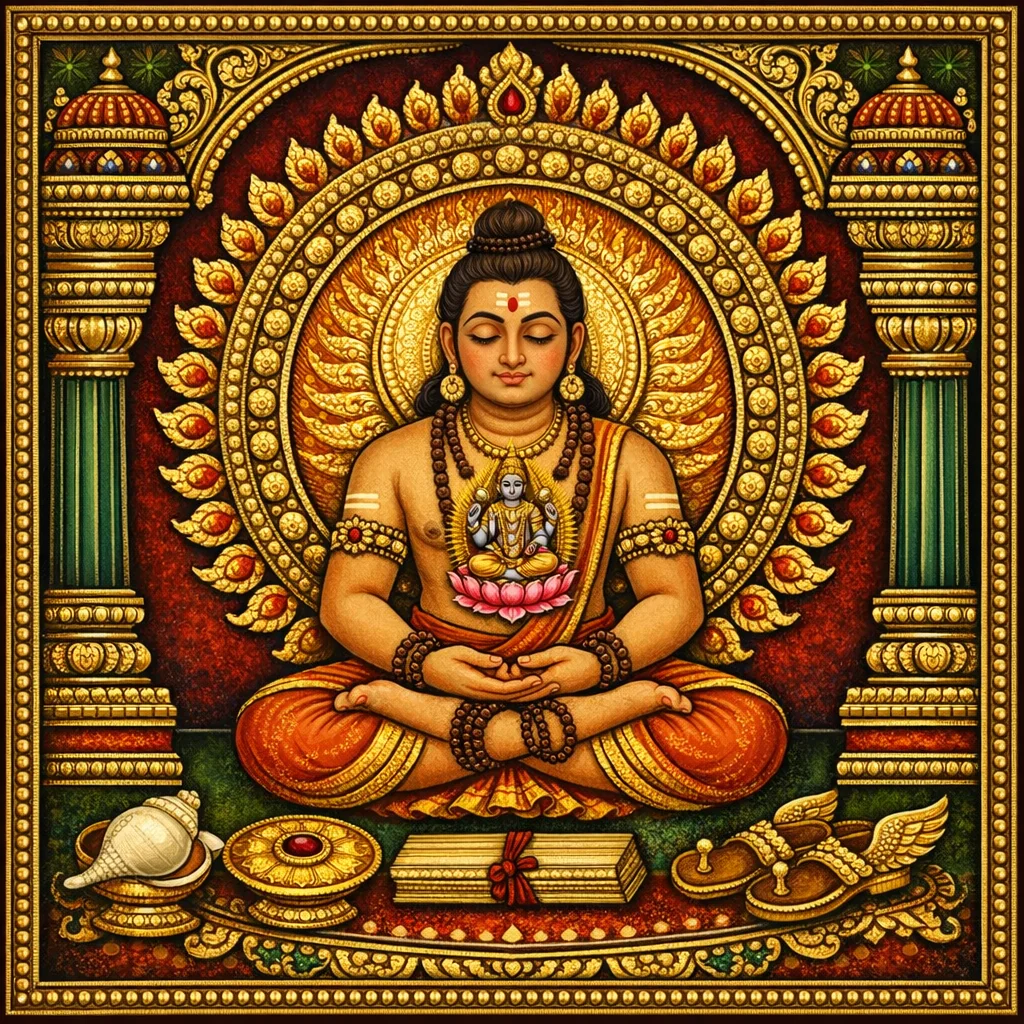
Adhyaya 375
Adhyāya 375 — समाधिः (Samādhi)
Lord Agni defines samādhi as meditation in which only the Self shines—steady like an unmoving ocean and a lamp in a windless place—when sensory activity and mental constructions cease. He then describes the yogin’s experience: seeming insentience to externals, absorption into Īśvara, and the rise of portent-like signs and temptations—divine enjoyments, royal gifts, spontaneous learning, poetic genius, medicines, rasāyana, and arts—explicitly declared distractions to be cast off like straw for Viṣṇu’s grace. The teaching widens into Brahma-vidyā: purity as the prerequisite for self-knowledge; the one Self appearing as many like space in pots or the sun in water; cosmogenesis through buddhi, ahaṅkāra, elements, tanmātras, and guṇas; bondage by karma and desire and liberation by knowledge. It also integrates eschatology: the upward “bright path” (archirādi) to transcendent attainment versus the return-path (dhūmādi). It concludes that even a righteous householder may be liberated through truth, just wealth, hospitality, śrāddha, and tattva-jñāna.
Shlokas
Verse 1
इत्य् आग्नेये महापुराणे धारणा नाम चतुःसप्तत्यधिकत्रिशततमो ऽध्यायः अथ पञ्चसप्तत्यधिकत्रिशततमो ऽध्यायः समाधिः अग्निर् उवाच यदात्ममात्रं निर्भासं स्तिमितोदधिवत् स्थितं चैतन्यरूपवद्ध्यानं तत् समाधिरिहोच्यते
Thus, in the Agni Mahāpurāṇa, the three-hundred-and-seventy-fourth chapter is called “Dhāraṇā.” Now begins the three-hundred-and-seventy-fifth chapter: “Samādhi.” Agni said: That meditation in which only the Self shines forth—steady like a calm, unmoving ocean—abiding in the form of pure consciousness, is here called samādhi.
Verse 2
ध्यायन्मनः सन्निवेश्य यस्तिष्ठेदचलस्थिरः निर्वातानलवद्योगी समाधिस्थः प्रकीर्तितः
He who, meditating, firmly fixes the mind and remains unmoving and steady—like a flame in a windless place—that yogin is proclaimed to be established in samādhi.
Verse 3
न शृणोति न चाघ्राति न पश्यति न वम्यति न च स्पर्शं विजानाति न सङ्कल्पयते मनः
He neither hears nor smells; he neither sees nor speaks; he does not cognize touch, and the mind does not form saṅkalpa (intentional thought-constructs).
Verse 4
न चाभिमन्यते किञ्चिन्न च बुध्यति काष्ठवत् एवमीश्वरसंलीनः समाधिस्थः स गीयते
He identifies with nothing and does not cognize external objects; like a piece of wood. Thus, absorbed into the Lord, he is said to be established in samādhi.
Verse 5
यथा दीपो निवातस्यो नेङ्गते सोपमा स्मृता ध्यायतो विष्णुमात्मानं समाधिस्तस्य योगिनः
As a lamp placed where there is no wind does not flicker—this is the remembered simile. So too, for the yogin who meditates on Viṣṇu as the Self (Ātman), that steadiness of mind is samādhi.
Verse 6
उपसर्गाः प्रवर्तन्ते दिव्याः सिद्धिप्रसूचकाः पातितः श्रावणो धातुर्दशनस्वाङ्गवेदनाः
Prodromal symptoms arise—divine, portent-like signs indicating the attainment of siddhi: discharge from the ear, the shedding of bodily tissue/element, pain in the teeth, and pain in one’s own limbs.
Verse 7
प्रार्थयन्ति च तं देवा भोगैर् दिव्यैश् च योगिनं नृपाश् च पृथिवीदानैर् धनैश् च सुधनाधिपाः
The gods also entreat that yogin with divine enjoyments; and kings—lords of abundant wealth—entreat him with gifts of land and with riches.
Verse 8
वेदादिसर्वशास्त्रञ्च स्वयमेव प्रवर्तते अभीष्टछन्दोविषयं काव्यञ्चास्य प्रवर्तते
All disciplines—beginning with the Veda and all śāstras—arise and proceed of their own accord; and for him, poetry too comes forth, taking as its domain the metrical forms (chandas) he desires.
Verse 9
रसायनानि दिव्यानि दिव्याश् चौषधयस् तथा समस्तानि च शिल्पानि कलाः सर्वाश् च विन्दति
He obtains the divine rasāyana preparations, and likewise the divine medicinal herbs; and he also gains mastery of all crafts and of every art.
Verse 10
सुरेन्द्रकन्या इत्य् आद्या गुणाश् च प्रतिभादयः तृणवत्तान्त्यजेद् यस्तु तस्य विष्णुः प्रसीदति
Beginning with (the example) “surendrakanyā …”, the poetic qualities—such as pratibhā (creative genius) and the rest—should be cast off by one as though they were mere straw; for such a person, Viṣṇu becomes gracious (is pleased).
Verse 11
अणिमादिगुणैश्वर्यः शिष्ये ज्ञानं प्रकाश्य च भुक्त्वा भोगान् यथेच्छातस्तनुन्त्यक्त्वालयात्ततः
Endowed with lordly mastery of the virtues beginning with aṇimā (minute-ness), he illumines knowledge in his disciple; and, having enjoyed enjoyments as he pleases, he then abandons the body and thereafter attains dissolution (final absorption).
Verse 12
तिष्ठेत् स्वात्मनि विज्ञान आनन्दे ब्रह्मणीश्वरे मलिनो हि यथादर्श आत्मज्ञानाय न क्षमः
One should remain established in one’s own Self—in realized knowledge (vijñāna), in bliss (ānanda), in Brahman who is the Lord. For the mind that is impure is like a stained mirror: it is not capable of true Self-knowledge.
Verse 13
सर्वाश्रयन्निजे देहे देही विन्दति वेदनां योगयुक्तस्तु सर्वेषां योगान्नाप्नोति वेदनां
The embodied Self, taking refuge in its own body, experiences pain; but one united with Yoga—through all the disciplines of Yoga—does not incur pain.
Verse 14
आकाशमेकं हि यथा घटादिषु पृथग् भवेत् तथात्मैको ह्य् अनेकेषु जलाधारेष्विवांशुमान्
Just as the one space appears as though divided among pots and the like, so the one Self appears as though many among numerous bodies—like the sun reflected in many containers of water.
Verse 15
ब्रह्मखानिलतेजांसि जलभूक्षितिधातवः इमे लोका एष चात्मा तस्माच्च सचराचरं
Brahman, space, wind, and fire; water, earth, and the constituent elements—these worlds, and this very Self: from That arises all that is moving and unmoving.
Verse 16
गृद्दण्दचक्रसंयोगात् कुम्भकारो यथा घटं करोति तृणमृत्काष्ठैर् गृहं वा गृहकारकः
Just as a potter, through the conjunction of the clay-lump, the staff (rod), and the wheel, produces a pot; or as a house-builder constructs a house from straw, earth (clay), and wood—so an effect is brought about through the combination of its operative means and materials.
Verse 17
करणान्येवमादाय तासु तास्विह योनिषु मृजत्यात्मानमात्मैवं सम्भूय करणानि च
Thus, taking up the instruments (the sense-faculties), the Self, in this world, enters those various wombs (births) and—having come together again with the instruments—purifies itself.
Verse 18
कर्मणा दोषमोहाभ्यामिच्छयैव स बध्यते ज्ञानाद्विमुच्यते जीवो धर्माद् योगी न रोगभाक्
A person is bound by action (karma), by faults and delusion, and indeed by desire itself. The individual self (jīva) is liberated through knowledge; and through dharma the yogin does not become subject to disease.
Verse 19
वर्त्याधारस्नेहयोगाद् यथा दीपस्य संस्थितिः विक्रियापि च दृष्ट्वैवमकाले प्राणसंक्षयः
Just as a lamp remains steady through the proper conjunction of wick, support, and oil, so too—when a similar derangement (in the body’s sustaining factors) is observed—the life-breath (prāṇa) wastes away, leading to untimely death.
Verse 20
अनन्ता रश्मयस्तस्य दीपवद् यः स्थितो हृदि सितासिताः कद्रुनीलाः कपिलाः पीतलोहिताः
His rays are endless. He who abides in the heart like a lamp has rays of many hues—white and dark, brown and blue-black, tawny (kapila), yellow, and red.
Verse 21
ऊर्ध्वमेकः स्थितस्तेषां यो भित्त्वा सूर्यमण्डलं ब्रह्मलोकमतिक्रम्य तेन याति पराङ्गतिं
Among those paths, one is established as the upward course: he who, piercing the solar orb, passes beyond Brahmaloka—by that route he attains the supreme, transcendent goal.
Verse 22
यदस्यान्यद्रश्मिशतमूर्ध्वमेव व्यवस्थितं तेन देवनिकायानि धामानि प्रतिपद्यते
That other set of a hundred rays of his, stationed upward alone—by that upward-streaming radiance one attains the abodes (dhāma) belonging to the hosts of gods.
Verse 23
ये नैकरूपाश्चाधस्ताद्रश्मयो ऽस्य मृदुप्रभाः इह कर्मोपभोगाय तैश् च सञ्चरते हि सः
Those rays of His, manifold in form and streaming downward, are of gentle radiance; and by them indeed He moves here for the experiencing of the fruits of karma.
Verse 24
बुद्धीन्द्रियाणि सर्वाणि मनः कर्मेन्द्रियाणि च अहङ्कारश् च बुद्धिश् च पृथिव्यादीनि चैव हि
All the cognitive sense-faculties, the mind (manas) and the organs of action, as well as egoity (ahaṅkāra) and intellect (buddhi), together with the gross elements beginning with earth—these indeed are to be understood as the constituents.
Verse 25
अव्यक्त आत्मा क्षेत्रज्ञः क्षेत्रस्त्यास्य निगद्यते ईश्वरः सर्वभूतस्य सन्नसन् सदसच्च सः
The unmanifest Self (avyakta ātman) is called the Knower of the Field (kṣetrajña); and its field (kṣetra) is also so designated. He is the Lord of all beings—being and non-being alike; and He is both the existent and the non-existent as well.
Verse 26
बुद्धेरुत्पत्तिरव्यक्ता ततो ऽहङ्कारसम्भवः तस्मात् खादीनि जायन्ते एकोत्तरगुणानि तु
From the Unmanifest (Avyakta) arises intellect (buddhi); from that, egoity (ahaṅkāra) is produced. From that (ahaṅkāra) are born space (ākāśa) and the rest of the elements, each possessing qualities increasing by one in succession.
Verse 27
शब्दः स्पर्शश् च रूपञ्च रसो गन्धश् च तद्गुणाः यो यस्मिन्नाश्रितश् चैषां स तस्मिन्नेव लीयते
Sound, touch, form, taste, and smell—these are their elemental qualities. Whatever quality depends upon whatever substrate, it dissolves into that very substrate alone.
Verse 28
सत्त्वं रजस्तमश् चैव गुणास्तस्यैव कीर्तिताः रजस्तमोभ्यामाविष्टश् चक्रवद्भ्राभ्यते हि सः
Sattva, rajas, and tamas are declared to be precisely its guṇas—its qualities (of the mind or embodied being). When seized by rajas and tamas, one indeed revolves, wandering like a wheel.
Verse 29
अनादिरादिमान् यश् च स एव पुरुषः परः लिङ्गेन्द्रियैर् उपग्राह्याः स विकार उदाहृतः
He who is beginningless yet the source of all beginnings—He alone is the Supreme Puruṣa. That which is apprehended through the liṅga (subtle body) and the senses is declared to be ‘vikāra’, the modification.
Verse 30
यतो देवाः पुराणानि विद्योपनिषदस् तथा श्लोकाः सूत्राणि भाष्याणि यच्चान्यद्माङ्भयं भवेत्
From Him (that divine source) arise the gods, the Purāṇas, the sciences and the Upaniṣads, as well as ślokas, sūtras, bhāṣyas (commentaries), and whatever else may exist within the domain of speech.
Verse 31
पितृयानोपवीथ्याश् च यदगस्त्यस्य चान्तरं तेनाग्निहोत्रिणो यान्ति प्रजाकामा दिवं प्रति
Along the by-path of the Pitṛyāna, and through the interval associated with (the star-region of) Agastya, the performers of the Agnihotra—desiring progeny—proceed toward heaven.
Verse 32
ये च दानपराः सम्यगष्टाभिश् च गुणैर् युताः अष्टाशीतिसहस्राणि मुनयो गृहमेधिनः
And those householders who are truly devoted to dāna (giving) and endowed with the eight virtues—such persons are the eighty-eight thousand munis who live the householder life.
Verse 33
पुनरावर्तने वीजभूता धर्मप्रवर्तकाः सप्तर्षिनाग्वीथ्याश् च देवलोकं समाश्रिताः
At the time of cosmic recurrence, those who serve as the seed of re-creation—the promulgators of dharma—namely the Seven Sages (Saptarṣi) and the Nāgavīthī, take refuge in the world of the gods, Devaloka.
Verse 34
तावन्त एव मुनयः सर्वारम्भविवर्जिताः तपसा ब्रह्मचर्येण सङ्गत्यागेन मेधया
Only those are truly sages (munis): those who have abandoned every undertaking, steadfast through austerity (tapas), through celibate discipline (brahmacarya), through renunciation of attachment, and through discerning intelligence (medhā).
Verse 35
यत्र यत्रावतिष्ठन्ते यावदाहूतसंप्लवं वेदानुवचनं यज्ञा ब्रह्मचर्यं तपो दमः
Wherever they reside, and until the time of the summoned dissolution (the final inundation), there prevail: recitation of the Vedas, sacrificial rites (yajña), celibate discipline (brahmacarya), austerity (tapas), and self-restraint (dama).
Verse 36
श्रद्धोपवासः सत्यत्वमात्मनो ज्ञानहेतवः स त्वाश्रमैर् निदिध्यास्यः समस्तैर् एवमेव तु
Faith (śraddhā), religious fasting (upavāsa), and truthfulness toward one’s own self are causes of spiritual knowledge. Therefore That (the Self/Truth) is to be steadily contemplated by means of all the āśramas (stages of life)—indeed, in just this way.
Verse 37
द्रष्टव्यस्त्वथ मन्तव्यः श्रोतव्यश् च द्विजातिभिः य एवमेनं विन्दन्ति ये चारण्यकमाश्रिताः
Therefore, by the twice-born (dvija) it is to be directly realized, then reflected upon, and also heard from authoritative teaching. Those who thus attain Him/That—those who have taken refuge in the āraṇyaka, the forest-discipline of contemplation—indeed find the Truth.
Verse 38
उपासते द्विजाः सत्यं श्रद्धया परया युताः क्रमात्ते सम्भवन्त्यर्चिरहः शुक्लं तथोत्तरं
The twice-born, endowed with supreme faith, worship Truth; and for them, in due order, arise the stages of the bright path—the realm of flame, day, the bright fortnight, and then the further (northern course).
Verse 39
अयनन्देवलोकञ्च सवितारं सविद्युतं ततस्तान् पुरुषो ऽभ्येत्य मानसो ब्रह्मलौकिकान्
He reaches the blissful world of the gods, the realm of Savitṛ, and the luminous world of Vidyut; thereafter, that person—by mind alone—approaches those planes belonging to the Brahma-worlds.
Verse 40
करोति पुनरावृत्तिस्तेषामिह न विद्यते यज्ञेन तपसा दानैर् ये हि स्वर्गजितो जनाः
For those people who have conquered heaven through sacrifice, austerity, and gifts, there is no return here to mortal existence.
Verse 41
धूमं निशां कृष्णपक्षं दक्षिणायनमेव च पितृलोकं चन्द्रमसं नभो वायुं जलं महीं
([The departing soul proceeds by]) smoke, night, the dark fortnight, and the sun’s southern course; then to the world of the ancestors, to the lunar sphere, to space, to wind, to water, and to the earth.
Verse 42
क्रमात्ते सम्भवन्तीह पुनरेव व्रजन्ति च एतद्यो न विजानाति मार्गद्वितयमात्मनः
In due course they are born here, and again they depart. Whoever does not understand this twofold path of the Self—the route of return and the route of liberation—remains bound to this cycle.
Verse 43
दन्दशूकः पतङ्गो वा भवेद्कीटो ऽथवा कृमिः हृदये दीपवद्ब्रह्म ध्यानाज्जिवो मृतो भवेत्
By meditation, the individual soul becomes as though dead to worldly identity. Whether one becomes a serpent, a moth, an insect, or a worm—by contemplating Brahman in the heart like a lamp, the jīva’s sense of separate self is extinguished.
Verse 44
न्यायागतधनस्तत्त्वज्ञाननिष्ठो ऽतिथिप्रियः श्राद्धकृत्सत्यवादी च गृहस्थो ऽपि विमुच्यते
Even a householder is liberated—one whose wealth is gained by just means, who is steadfast in knowledge of reality, who delights in honoring guests, who performs the śrāddha rites, and who speaks truth.
Frequently Asked Questions
Samādhi is the unwavering absorption where the Self alone shines; the yogin remains motionless like a lamp in a windless place, with sensory cognition and mental intention-making stilled.
The chapter treats siddhi-like outcomes—divine offers, royal patronage, spontaneous śāstra-knowledge, poetic genius, rasāyana and medicines, and mastery of arts—as upasargas (temptations/portents) to be renounced; casting them off is presented as the condition for Viṣṇu’s favor and final dissolution.
It links meditative absorption to a tattva model: from avyakta arises buddhi, then ahaṅkāra, then the elements and their qualities (sound to smell), governed by the guṇas; bondage arises from karma and desire, while liberation is by knowledge.
It distinguishes the bright, upward path (archirādi) leading beyond Brahmaloka toward the supreme goal, from the smoke/night/dark-fortnight southern path (dhūmādi) that returns beings to rebirth for karma-experience.
It integrates dharma (purity, truth, restraint, right livelihood, hospitality) with yoga (samādhi) and jñāna (tattva-knowledge), asserting that both renunciants and qualified householders can reach mokṣa when knowledge and detachment mature.