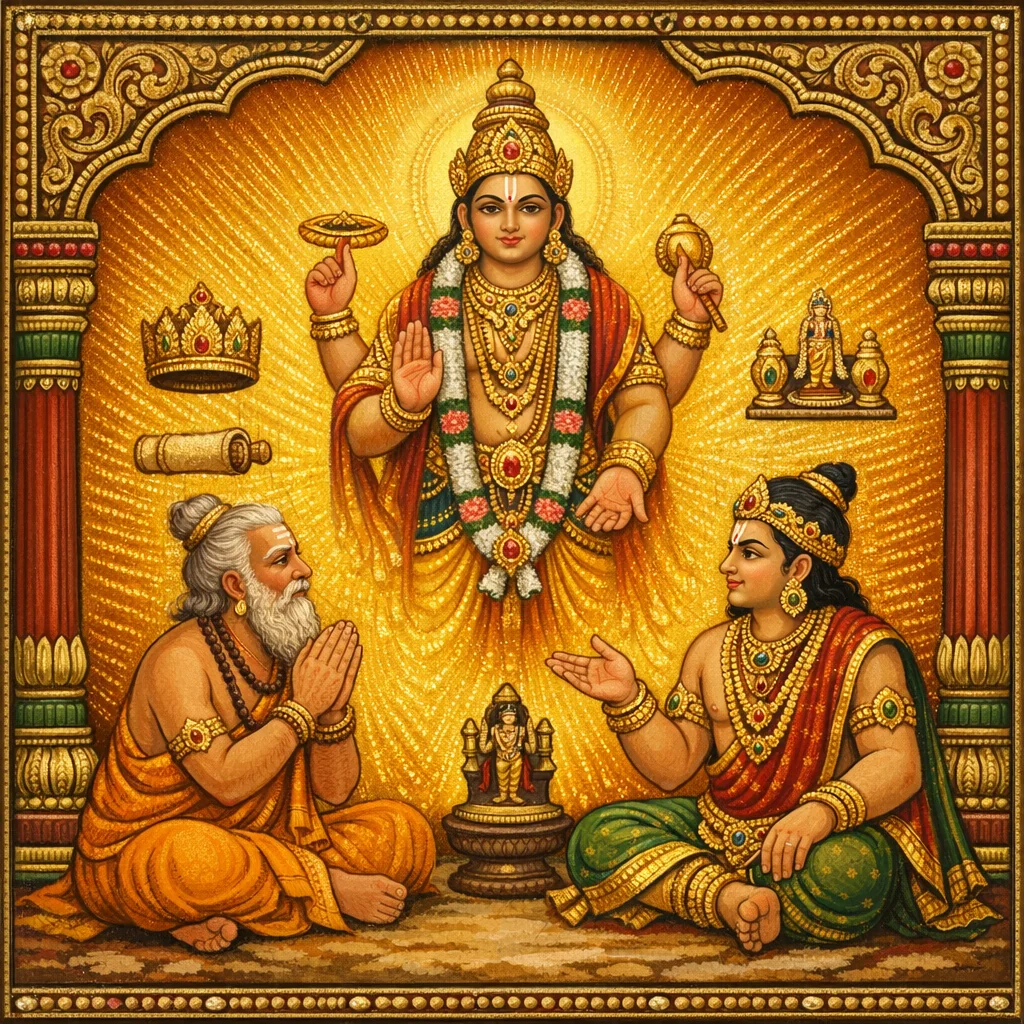
Adhyaya 379
Adhyāya 379 — अद्वैतब्रह्मविज्ञानम् (Advaita-brahma-vijñāna)
Agni announces a focused exposition of Advaita-brahma-vijñāna, introduced through a seeker’s austerity at Śālagrāma and worship of Vāsudeva, with a warning that attachment shapes rebirth (the deer-attachment motif) though yoga can restore one’s true state. The teaching unfolds in a social episode: an avadhūta-like knower, forced into labor to carry a palanquin, instructs a king by analytically dismantling agency and identity. Mapping “carrier,” “carried,” and “palanquin” onto bodily limbs, elements, and conventional labels, he shows that ‘I’ and ‘you’ are linguistic impositions upon guṇa-streams driven by karma accumulated through avidyā, while the Self is pure, nirguṇa, and beyond prakṛti. The chapter then turns to the Nidāgha–Ṛtu dialogue as formal Advaita pedagogy: hunger and satisfaction reveal bodily limits, whereas the Self pervades all like space, neither going nor coming. Non-duality culminates in recognizing the undivided universe as the very nature of Vāsudeva, and liberation is affirmed as knowledge-born, the “enemy” that fells the tree of saṃsāric ignorance.
Shlokas
Verse 1
इत्य् आग्नेये महापुराणे ब्रह्मज्ञानं नामाष्टसप्तत्यधिकत्रिशततमो ऽध्यायः अथोनाशीत्यधिकत्रिशततमो ऽध्यायः अद्वैतब्रह्मविज्ञानं अग्निर् उवाच अद्वैतब्रह्मविज्ञानं वक्ष्ये यद्भवतो ऽगदत् शालग्राने तपश् चक्रे वासुदेवार्चनादिकृत्
Thus, in the Agni Mahāpurāṇa, the three-hundred-and-seventy-eighth chapter is entitled “Brahma-jñāna (Knowledge of Brahman).” Now begins the three-hundred-and-seventy-ninth chapter, “Advaita-brahma-vijñāna (Non-dual Knowledge of Brahman).” Agni said: “I shall expound the non-dual knowledge of Brahman, as you have asked. (The seeker) performed austerity at Śālagrāma, engaging in the worship of Vāsudeva and related rites.”
Verse 2
मृगसङ्गाम्मृगो भूत्वा ह्य् अन्तकाले स्मरन् मृगं जातिस्मरो मृगस्त्यक्त्वा देहं योगात्स्वतो ऽभवत्
Through attachment to a deer he became a deer; and at the time of death, remembering that deer, he was reborn as a deer—yet, retaining memory of his former birth, that deer, abandoning its body, by the power of yoga attained his own true state again.
Verse 3
अद्वैतब्रह्मभूतश् च जडवल्लोकमाचरत् क्षत्तासौ वीरराजस्य विष्टियोगममन्यत
Though established in non-dual Brahman, he moved among people as if inert and unconcerned. That kṣattā, the chamberlain of King Vīrarāja, took it to be the condition of enforced service (viṣṭi-yoga).
Verse 4
उवाह शिविक्रामस्य क्षत्तुर्वचनचोदितः गृहीतो विष्टिना ज्ञानी उवाहात्मक्षयाय तं
Urged on by the chamberlain’s command, the wise man carried the palanquin (śivikā) of Śivikramā. Seized by forced labour (viṣṭi), he bore it—bringing about his own ruin.
Verse 5
ययौ जडगतिः पश्चात् ये त्वन्ये त्वरितं ययुः शीघ्रान् शीघ्रगतीन् दृष्ट्वा अशीघ्रं तं नृपोऽब्रवीत्
He whose pace was sluggish went behind, while the others proceeded quickly. Seeing the swift ones moving swiftly, the king said to that slow-moving man: “Do not be so unhurried.”
Verse 6
राजोवाच किं श्रान्तो ऽस्यल्पमध्वानं त्वयोढा शिविका मम किमायाससहो न त्वं पीवानसि निरीक्ष्यसे
The king said: “Are you weary? You have borne my palanquin only a short distance. Can you not endure exertion? Looking at you, you do not appear robust.”
Verse 7
ब्राह्मण उवाच नाहं पीवान्न वैषोढा शिविका भवतो मया न श्रान्तो ऽस्मि न वायासो वोढव्यो ऽसि महीपते
The brāhmaṇa said: “I have not been drinking, nor am I unable to bear the load. This palanquin of yours is to be carried by me. I am not tired, nor am I weary. You are to be carried, O king.”
Verse 8
भूमौ पादयुगन्तस्थौ जङ्घे पादद्वये स्थिते उरू जङ्घाद्वयावस्थौ तदाधारं तथोदरम्
On the ground are placed the two feet; upon the two feet are situated the shanks. The thighs are positioned above the pair of shanks; above that support is likewise the abdomen.
Verse 9
वक्षःस्थलं तथा वाहू स्कन्धौ चोदरसंस्थितौ स्कन्धस्थितेयं शिविका मम भावो ऽत्र किं कृतः
The chest and the arms, and the shoulders too, are set upon the belly; this palanquin rests on the shoulders—what, then, has my own intention (or effort) accomplished here?
Verse 10
शिविकायां स्थितञ्चेदं देहं त्वदुपलक्षितं तत्र त्वमहमप्यत्र प्रोच्यते चेदमन्यथा
If this body, seated in a palanquin, is identified by you as “you,” then in that very context “I” is also spoken of here—otherwise the expression would become contradictory.
Verse 11
अहं त्वञ्च तथान्ये च भूतैरुह्याम पार्थिव गुणप्रवाहपतितो गुणवर्गो हि यात्ययं
“I, you, and others as well are borne along by the bodily elements, O king. For this aggregate of guṇas, having fallen into the current of guṇas, is indeed carried onward.”
Verse 12
कर्मवश्या गुणाश् चैते सत्त्वाद्याः पृथिवीपते अविद्यासञ्चितं कर्म तच्चाशेषेषु जन्तुषु
O Lord of the earth, these guṇas—sattva and the rest—operate under the governance of karma; and karma, accumulated through ignorance (avidyā), exists in all living beings without exception.
Verse 13
आत्मा शुद्धो ऽक्षरः शान्तो निर्गुणः प्रकृतेः परः प्रवृद्ध्यपचयौ नास्य एकस्याखिलजन्तुषु
The Self is pure, imperishable, and tranquil; it is without qualities and beyond Prakṛti. For that one Self, present in all beings, there is neither increase nor decline.
Verse 14
यदा नोपचयस्तस्य यदा नापचयो नृप तदा पीवानसीति त्वं कया युक्त्या त्वयेरितं
O king, when there is neither increase for him nor any decrease, by what reasoning did you yourself assert, “then he is well-nourished (pīvānas)?”
Verse 15
भूजङ्घापादकट्यूरुजठरादिषु संस्थिता शिविकेयं तथा स्कन्धे तदा भावःसमस्त्वया
This ‘śivikā’ (the vital region so named) is situated in the arms, shanks, feet, waist, thighs, abdomen, and the like; it is also found on the shoulder. Thus, the complete account is stated by you/for you.
Verse 16
तदन्यजन्तुभिर्भूप शिविकोत्थानकर्मणा शैलद्रव्यगृहोत्थोपि पृथिवीसम्भवोपि वा
O king, the same rule applies if it is caused by other living beings—whether it arises from the act of lifting a palanquin, or from stone, material objects, or a building, or even from the earth itself.
Verse 17
यथा पुंसः पृथग्भावः प्राकृतैः करणैर् नृप सोढव्यः स महाभारः कतरो नृपते मया
O king, just as a man’s separative sense of individuality is borne through his natural faculties, so too that great burden must be endured. Tell me, O lord of kings—which burden is to be borne by me?
Verse 18
यद्द्रव्या शिविका चेयं तद्द्रव्यो भूतसंग्रहः भवतो मे ऽखिलस्यास्य समत्वेनोपवृंहितः
Whatever substances constitute this palanquin—those very substances constitute the aggregate of beings. O Lord, by your power the entirety of this (world/collection) has been sustained and enlarged in an equal, impartial manner.
Verse 19
तच्छ्रुत्वोवाच राजा तं गृहीत्वाङ्घ्री क्षमाप्य च प्रसादं कुरु त्यक्त्वेमां शिविकां ब्रूहि शृण्वते यो भवान् यन्निमित्तं वा यदागमनकारणम्
Hearing that, the king said: “Taking hold of your feet and asking forgiveness, be gracious. Abandon this palanquin and tell me—for I am listening—who are you, for what purpose, and what is the reason for your coming?”
Verse 20
ब्राह्मण उवाच श्रूयतां कोहमित्येतद्वक्तुं नैव च शक्यते पाठो ऽयं न समीचीनः उपभोगनिमित्तञ्च सर्वत्रागमनक्रिया
The Brāhmaṇa said: “Listen. It is not at all possible to state ‘Who am I?’ in this manner. This reading is not correct; rather, the intended sense is that the act of ‘going/approaching’ is undertaken everywhere for the sake of enjoyment—namely, the experience of results.”
Verse 21
सुखदुःखोपभोगौ तु तौ देशाद्युपपादकौ धर्माधर्मोद्भवौ भोक्तुं जन्तुर्देशादिमृच्छति
The experience of pleasure and pain—arising from dharma and adharma—determines one’s circumstances such as the place of birth; in order to undergo those results, the embodied being attains a particular place and other conditions.
Verse 22
रजोवाच यो ऽस्ति सोहमिति ब्रह्मन् कथं वक्तुं न शक्यते आत्मन्येषु न दोषाय शब्दोहमिति यो द्विज
Rajas said: “O Brahmin, how can one be unable to utter, ‘I am He (so’ham)’? For those established in the Self, the word ‘I’ is not a fault—O twice-born.”
Verse 23
ब्राह्मण उवाच शब्दोहमिति दोषाय नात्मन्येष तथैव तत् अनात्मन्यात्मविज्ञानं शब्दो वा भ्रान्तिलक्षणः
The Brāhmaṇa said: “The notion ‘I am sound/word’ leads to error; likewise, this does not pertain to the Self. The cognition of the Self in what is not-Self—or taking mere words as truth—is a mark of delusion.”
Verse 24
यदा समस्तदेहेषु पुमानेको व्यवस्थितः तदा हि को भवान् कोहमित्येतद्विफलं वचः
When the one Person (Self) is established in all bodies, then the speech, “Who are you? Who am I?” becomes futile.
Verse 25
त्वं राजा शिविका चेयं वयं वाहाः पुरःसराः अयञ्च भवतो लोको न सदेतन्नृपोच्यते
“You are the king; this is the palanquin; we are the bearers who go in front; and this is your retinue. But this is not a proper, truly accurate statement; thus a king should not be spoken of in such self-exalting terms.”
Verse 26
वृक्षाद्दारु ततश्चेयं शिविका त्वदधिष्ठिता का वृक्षसंज्ञा जातस्य दारुसंज्ञाथ वा नृप
From a tree comes timber; and this palanquin (śivikā), borne by you, is made from that very timber. How, then, could it still be called a “tree,” or should it rather be called “timber,” O king?
Verse 27
वृक्षारूढो महाराजो नायं वदति चेतनः न च दारुणि सर्वस्त्वां ब्रवीति शिविकागतं
One does not say, “The great king is mounted upon the tree”; a sentient person does not speak so. Nor does everyone, in harsh speech, address you as “one who has come by palanquin (śivikā).”
Verse 28
शिविकादारुसङ्घातो रचनास्थितिसंस्थितः अन्विष्यतां नृपश्रेष्ठ तद्भेदे शिविका त्वया
The palanquin (śivikā) is an assemblage of timbers, secured according to its arrangement and structural placement. O best of kings, have it examined; by distinguishing its components, you will understand the palanquin’s construction (and any faults within it).
Verse 29
पुमान् स्त्री गौरयं वाजी कुञ्चरो विहगस्तरुः देहेषु लोकसंज्ञेयं विज्ञेया कर्महेतुषु
“Man,” “woman,” “cow,” “horse,” “elephant,” “bird,” and “tree”—such terms are to be understood as conventional worldly designations applied to embodied forms; the particular embodiment is to be known as arising from causes constituted by karma.
Verse 30
जिह्वा ब्रवीत्यहमिति दन्तौष्ठौ तालुकं नृप एते नाहं यतः सर्वे वाङ्निपादनहेतवः
“The tongue says, ‘I (am the speaker).’ The teeth, the lips, and the palate (tālu) also say, ‘Not I (but we).’ O king, for all of these are causes by which speech is brought into manifestation.”
Verse 31
किं हेतुभिर्वदत्येषा वागेवाहमिति स्वयं तथापि वाङ्नाहमेतदुक्तं मिथ्या न युज्यते
What need is there for reasons? Speech itself proclaims, “I am speech.” Even so, the statement “I am not speech” is unfitting as a falsehood; it cannot be maintained as a valid denial.
Verse 32
पिण्डः पृथग् यतः पुंसः शिरःपाय्वादिलक्षणः ततो ऽहमिति कुत्रैतां संज्ञां राजन् करोम्यहं
Since the bodily aggregate (pinda) of a person is distinct—marked by head, anus, and the like—then where within that aggregate should I apply the designation “I”? O king, how am I to make that identification?
Verse 33
यदन्यो ऽस्ति परः कोपि मत्तः पार्थिवसत्तम तदेषोहमयं चान्यो वक्तुम् एवमपीष्यते
O best of kings, if there exists anyone at all who is superior to me, then let him—this “I” and that “other”—be willing to speak in this very manner.
Verse 34
परमार्थभेदो न नगो न पशुर्नच पादपः शरीराश् च विभेदाश् च य एते कर्मयोनयः
In ultimate reality there is no difference: there is neither serpent, nor beast, nor even tree; and the various bodies and their distinctions seen here are merely births (forms) produced by karma.
Verse 35
यस्तु राजेति यल्लोके यच्च राजभटात्मकम् तच्चान्यच्च नृपेत्थन्तु न सत् सम्यगनामयं
But that which in the world is called “the king,” and that which consists of the king’s troops or retainers, and whatever else is of the nature of kingship—O ruler—when rightly examined according to its proper definition, is not truly real.
Verse 36
त्वं राजा सर्वलोकस्य पितुः पुत्रो रिपोरिपुः पत्न्याः पतिः पिता सूनोः कस्त्वां भूप वदाम्यहं
You are the king of all people—the son of your father, the enemy of the enemy, the husband of your wife, and the father of your son. O protector of the earth, who indeed am I to instruct or describe you?
Verse 37
त्वं किमेतच्छिरः किन्नु शिरस्तव तथोदरं किमु पादादिकं त्वं वै तवैतत् किं महीपते
Are you this head? Or is the head yours? Likewise, are you the belly? Or are the feet and the rest you? Tell me, O king—what of this is ‘you’, and what of it is ‘yours’?
Verse 38
समस्तावयेभ्यस्त्वं पृथग्भूतो व्यवस्थितः कोहमित्यत्र निपुणं भूत्वा चिन्तय पार्थिव तच्छ्रत्वोवाच राजा तमवधूतं द्विजं हरिं
You stand established as distinct from all the constituents of body and mind. Becoming skilled in this point—“Who am I?”—reflect deeply on it, O king. Having heard that, the king spoke to that avadhūta, the Brāhmaṇa Hari.
Verse 39
रजोवाच श्रेयो ऽर्थमुद्यतः प्रष्टुं कपिलर्षिमहं द्विज तस्यांशः कपिलर्षेस्त्वं मत् कृते ज्ञानदो भुवि ज्ञानवीच्युदछेर्यस्माद्यच्छ्रेयस्तच्च मे वद
Rajo said: “O twice-born one, I have set out to question the sage Kapila for the sake of the Highest Good (śreyas). You are a portion of that sage Kapila; for my sake you are the giver of knowledge upon the earth. Therefore, since from you the wave of knowledge has arisen, tell me what indeed is the Highest Good.”
Verse 40
ब्राह्मण उवाच भूयः पृच्छसि किं श्रेयः परमार्थन्न पृच्छसि श्रेयांस्यपरमार्थानि अशेषाण्येव भूपते
The Brāhmaṇa said: “Again you ask, ‘What is beneficial (śreyas)?’ Yet you do not ask about the supreme goal (paramārtha). O king, all those ‘benefits’ that are not the supreme goal are, indeed, wholly finite and secondary.”
Verse 41
देवताराधनं कृत्वा धनसम्पत्तिमिच्छति पुत्रानिच्छति राज्यञ्च श्रेयस्तस्यैव किं नृप
Having performed the worship of the deities, one desires wealth and prosperity; one desires sons and also sovereignty—what higher good could there be than that, O king?
Verse 42
विवेकिनस्तु संयोगः श्रेयो यः परमात्मनः यज्ञादिका क्रिया न स्यात् नास्ति द्रव्योपपत्तिता
For the discerning person, union with the Supreme Self is the highest good. Ritual acts such as sacrifice should not be undertaken, for the required material means are not truly attainable (or are ultimately insubstantial).
Verse 43
परमार्थात्मनोर्योगः परमार्थ इतीष्यते एको व्यापी समः शुद्धो निर्गुणः प्रकृतेः परः
The union (yoga) of the Supreme Reality and the individual Self is declared to be the highest truth (paramārtha). He is one, all-pervading, equal toward all, pure, without qualities, and beyond Prakṛti (material nature).
Verse 44
जन्मवृद्ध्यादिरहित आत्मा सर्वगतो ऽव्ययः परं ज्ञानमयो ऽसङ्गी गुणजात्यादिभिर्विभुः
The Self is devoid of birth, growth, and the like; it is all-pervading and imperishable—supreme, consisting of consciousness, unattached, and not delimited by qualities, class, and other such attributes; it is all-encompassing.
Verse 45
निदाधऋतुसंवादं वदामि द्विज तं शृणु ऋतुर्ब्रह्मसुतो ज्ञानी तच्छिष्यो ऽभूत् पुलस्त्यजः
O twice-born one, listen as I relate the dialogue between Nidādha and Ṛtu. Ṛtu, the wise son of Brahmā, had Pulastya’s son as his disciple.
Verse 46
निदाघः प्राप्तविद्यो ऽस्मान्नगरे वै पुरे स्थितः देविकायास्तटे तञ्च तर्कयामास वै ऋतुः
Nidāgha, having attained learning, dwelt in our city, in that town; and there, on the bank of the Devikā river, Ṛtu indeed engaged him in reasoning and discussion.
Verse 47
दिव्ये वर्षसहस्रे ऽगान्निदाघमवलोकितुं निदाघो वैश्वदेवान्ते भुक्त्वान्नं शिष्यमब्रवीत् भुक्तन्ते तृप्तिरुत्पन्ना तुष्टिदा साक्षया यतः
After a thousand divine years had passed, he went to see Nidāgha. Nidāgha, having eaten at the conclusion of the Vaiśvadeva offering, said to his disciple: “You have eaten; tṛpti (satisfaction) has arisen in you—therefore tuṣṭi (contentment), which grants enduring fulfillment, is directly evident.”
Verse 48
ऋतुर् उवाच क्षुदस्ति यस्य भुते ऽन्ने तुष्टिर्ब्राह्मण जायते न मे क्षुदभवत्तृप्तिं कस्मात्त्वं परिपृच्छसि
Ṛtu said: “O brāhmaṇa, satisfaction arises for one who is hungry when food is eaten. Hunger has not arisen in me; therefore tṛpti from eating does not occur. Why, then, do you question me about it?”
Verse 49
क्षुत्तृष्णे देहधर्माख्ये न ममैते यतो द्विज पृष्टोहं यत्त्वया ब्रूयां तृप्तिरस्त्ये व मे सदा
Hunger and thirst—known as conditions of the body—are not mine, O twice-born. Since you have questioned me, I shall state it: for me, indeed, there is always contentment.
Verse 50
पुमान् सर्वगतो व्यापी आकाशवदयं यतः अतो ऽहं प्रत्यगात्मास्मीत्येतदर्थे भवेत् कथं
Since this Person (the Self) is all-pervading and pervasive—like space—how, then, can the meaning of the statement, “Therefore I am the inner Self (pratyagātman),” be established?
Verse 51
सो ऽहं गन्ता न चागन्ता नैकदेशनिकेतनः त्वं चान्यो न भवेन्नापि नान्यस्त्वत्तो ऽस्मि वा प्यहं
I am That: I neither go nor come, and I do not dwell in any single place. And you are not other than Me; nor am I other than you.
Verse 52
निदाघऋतुसंवादमद्वैतबुद्धये शृण्विति ख , ञ च ततः क्षुत्सम्भवाभावादिति ख , ञ च कुतः कुत्र क्व गन्तासीत्येतदप्यर्थवत् कथमिति ख , ञ च भोक्तेति क मृण्मयं हि गृहं यद्वन्मृदालिप्तं स्थिरीभवेत् पार्थिवो ऽयं तथा देहः पार्थिवैः परमाणुभिः
“Listen to the dialogue of Nidāgha and Ṛtu for the awakening of non-dual understanding.” (Some recensions add:) “Thereafter, because the arising of hunger does not occur.” (And:) “From where, where, and to what place would one go?—this too is meaningful; how (could it be otherwise)?” (And:) “(Who is) the enjoyer?” Just as a house made of clay, when plastered with clay, becomes firm, so too this body is earthy, being constituted of earthy atoms.
Verse 53
ऋतुरस्मि तवाचार्यः प्रज्ञादानाय ते द्विज इहागतो ऽहं यास्यामि परमार्थस्तवोदितः
I am Ṛtu, your teacher. O twice-born one, I have come here to bestow wisdom upon you. I shall depart; the highest truth has been spoken to you.
Verse 54
एकमेवमिदं विद्धि न भेदः सकलं जगत् वासुदेवाभिधेयस्य स्वरूपं परमात्मनः
Know this as the sole truth: the entire universe is without division. It is the very nature of the Supreme Self, whose designation is ‘Vāsudeva’.
Verse 55
ऋतुर्वर्षसहस्रान्ते पुनस्तन्नगरं ययौ निदाघं नगरप्रान्ते एकान्ते स्थितमब्रवीत् एकान्ते स्थीयते कस्मान्निदाघं ऋतुरब्रवीत्
At the end of a thousand years, Ṛtu again went to that city. Seeing Nidāgha standing alone on the outskirts of the town, in a secluded place, he spoke: “Nidāgha, for what reason are you staying in solitude?”—thus said Ṛtu to Nidāgha.
Verse 56
निदाघ उवाच भो विप्र जनसंवादो महानेष नरेश्वर प्रविवीक्ष्य पुरं रम्यं तेनात्र स्थीयते मया
Nidāgha said: “O brāhmaṇa, O lord of men, this is a great public gathering and discourse. Having come to behold this delightful city, I remain here for that very reason.”
Verse 57
ऋतुर् उवाच नराधिपो ऽत्र कतमः कतमश्चेतरो जनः कथ्यतां मे द्विजश्रेष्ठ त्वमभिज्ञो द्विजोत्तम
Ṛtu said: “Among the people here, who is to be regarded as the king, and who is the other—an ordinary person? Tell me, O best of the twice-born; you are learned, O foremost of brāhmaṇas.”
Verse 58
यो ऽयं गजेन्द्रमुन्मत्तमद्रिशृङ्गसमुत्थितं अधिरूढो नरेन्द्रो ऽयं परिवारस्तथेतरः
This king here—mounted upon the lordly elephant, maddened (in rut) and towering like a mountain-peak—is the sovereign; these are his attendants, and the others are those who follow after.
Verse 59
गजो यो ऽयमधो ब्रह्मन्नुपर्येष स भूपतिः ऋतुराह गजः को ऽत्र राजा चाह निदाघकः
“O brāhmaṇa, the elephant that is down below—he is the king; the one above is the lord of the earth.” Thus spoke Ṛtu. Then the king asked, “Which one here is the elephant?” and Nidāghaka replied.
Verse 60
ऋतुर्निदाघ आरूढो दृष्टान्तं पश्य वाहनं उपर्यहं यथा राजा त्वमधः कुञ्जरो यथा
Ṛtu said to Nidāgha: “Mounted upon a conveyance, observe this illustration: just as the king is above, so you are below—like the elephant that bears him.”
Verse 61
ऋतुः प्राह निदाघन्तं कतमस्त्वामहं वदे उक्तो निदाघस्तन्नत्वा प्राह मे त्वं गुरुर्ध्रुवम्
Ṛtu said to Nidāgha: “By what name shall I address you?” Thus questioned, Nidāgha, bowing in reverence, replied: “You are indeed my steadfast and true teacher.”
Verse 62
आरूढो ऽयं गजं राजा परलोकस्तथेतर इति ख , ञ च क पुस्तके सर्वत्र ऋभुरिति ऋतुस्थानीयः पाठः नान्यस्माद्द्वैतसंस्कारसंस्कृतं मानसं तथा ऋतुः प्राह निदाघन्तं ब्रह्मज्ञानाय चागतः परमार्थं सारभूतमद्वैतं दर्शितं मया
“This king has mounted an elephant; thus there is the other world and also this world”—so runs a variant reading found in the kha-, ña-, and ka-manuscripts; in those books the reading “ṛbhu” occurs where “ṛtu” would stand. The mind, conditioned by the latent impressions of duality, cannot grasp the truth otherwise. Ṛtu said to Nidāgha: “I have come to impart knowledge of Brahman. I have shown you Advaita, non-duality—the essential core and the highest truth.”
Verse 63
ब्राह्मण उवाच निदाघो ऽप्युपदेशेन तेनाद्वैतपरो ऽभवत् सर्वभूतान्यभेदेन ददृशे स तदात्मनि
The Brāhmaṇa said: Even Nidāgha, through that instruction, became devoted to non-duality; and he beheld all beings without distinction, as identical with That Self.
Verse 64
अवाप मुक्तिं ज्ञानात्स तथा त्वं मुक्तिमाप्स्यसि एकः समस्तं त्वञ्चाहं विष्णुः सर्वगतो यतः
He attained liberation through knowledge; so too you will attain liberation. The One is all; you and I are that all-pervading Viṣṇu, for He is everywhere.
Verse 65
पीतनीलादिभेदेन यथैकं दृश्यते नभः भ्रान्तिदृष्टिभिरात्मापि तथैकः स पृथक् पृथक्
Just as the one sky is perceived as differentiated—yellow, blue, and so on—so too the Self, though one, is mistakenly seen as separate and manifold by deluded modes of perception.
Verse 66
अग्निर् उवाच मुक्तिं ह्य् अवाप भवतो ज्ञानसारेण भूपतिः संसाराज्ञानवृक्षारिज्ञानं ब्रह्मेति चिन्तय
Agni said: “Indeed, through you the king attained liberation by the essence of true knowledge. Contemplate that knowledge—which is the enemy that fells the tree of worldly ignorance in saṃsāra—as Brahman.”
Frequently Asked Questions
The teacher dismantles the king’s assumptions by showing that ‘carrier’ and ‘carried’ are conventions imposed on a composite body driven by elements, guṇas, and karma, while the true Self is nirguṇa, unchanged, and not the agent of bodily motion.
Because when the one Self is recognized as present in all bodies, personal identity-questions based on separative naming lose ultimate meaning; they remain valid only at the level of social convention (vyavahāra), not paramārtha.
It uses experiential markers (hunger, satisfaction, place, movement) to show these belong to body-conditions, whereas the Self is all-pervading like space—neither coming nor going—thus undermining dualistic habit (dvaita-saṃskāra).
Not finite gains (wealth, sons, sovereignty) sought through deity-worship, but the discerning ‘union’ with the Supreme Self—paramārtha—realized through knowledge of the Self beyond prakṛti and guṇas.