Adhyaya 373
Chapter 373 — ध्यानम् (Dhyāna / Meditation)
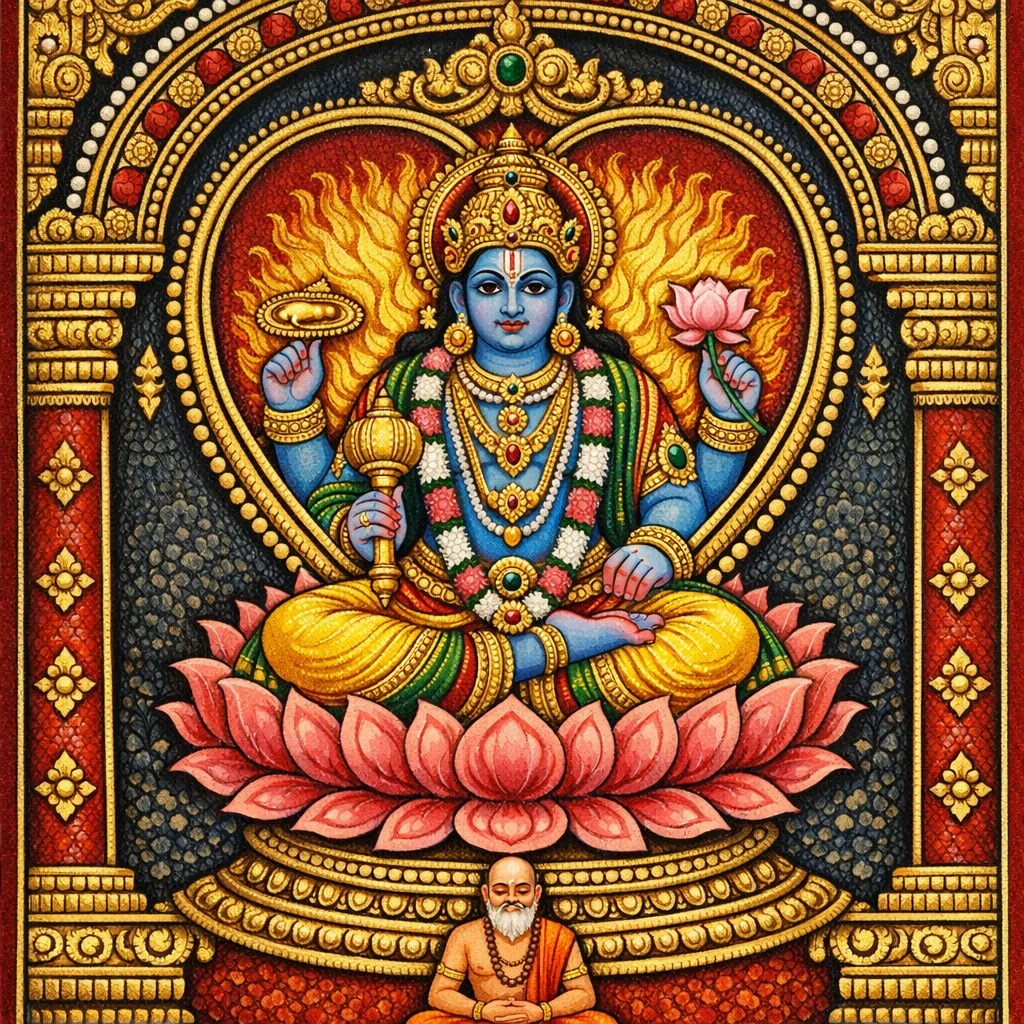
Lord Agni defines dhyāna as uninterrupted, undistracted contemplation—again and again fixing the mind on Viṣṇu/Hari and, at its summit, on Brahman itself. Meditation is a stabilized single-current cognition (pratyaya) without intervening thoughts, practicable anywhere and at all times (walking, standing, sleeping, waking). He sets out a fourfold framework—meditator, meditation, object, and purpose—linking yoga-abhyāsa to both mukti and the eight aiśvarya (aṇimā and related powers). The chapter extols “dhyāna-yajña” as the supreme inner sacrifice, pure and non-violent, surpassing external rites; it purifies the mind and yields apavarga. A graded visualization is taught: sequencing the three guṇas, three colored maṇḍalas, the heart-lotus with symbolic correspondences (petals as siddhis; stalk/pericarp as jñāna–vairāgya), and the thumb-sized Oṅkāra or a radiant lotus-seated Lord transcending Pradhāna and Puruṣa. Practice culminates in Vaiṣṇava iconographic contemplation and a mahāvākya-like resolve, “I am Brahman… I am Vāsudeva,” balanced with japa; japa-yajña is praised as unrivaled for protection, prosperity, liberation, and conquest of death.
Shlokas
Verse 1
इत्य् आग्नेये महापुराणे आसनप्राणायामप्रत्याहारा नाम द्विसप्तत्यधिकत्रिशततमो ऽध्यायः अथ त्रिसप्तत्यधिकत्रिशततमो ऽध्यायः ध्यानम् अग्निर् उवाच ध्यै चिन्तायां स्मृतो धातुर्विष्णुचिन्ता मुहूर्मुहुः अनाक्षिप्तेन मनसा ध्यानमित्यभिधीयते
Thus, in the Agni Mahāpurāṇa ends the chapter entitled “Posture (āsana), Breath-control (prāṇāyāma), and Withdrawal (pratyāhāra),” the 372nd. Now begins the 373rd chapter: “Meditation (dhyāna).” Agni said: The verbal root dhyai is remembered in the sense of “contemplation.” To think upon Viṣṇu again and again, with a mind not distracted—this is called meditation (dhyāna).
Verse 2
आत्मनः समनस्कस्य मुक्ताशेषोपधस्य च ब्रह्मचिन्तासमा शक्तिर्ध्यानं नाम तदुच्यते
Meditation (dhyāna) is said to be that power of the Self (Ātman) when the mind is harmonized and all upādhis (limiting adjuncts) are cast off—being equal to steady contemplation of Brahman.
Verse 3
ध्येयालम्बनसंस्थस्य सदृशप्रत्ययस्य च प्रत्यान्तरनिर्मुक्तः प्रत्ययो ध्यानमुच्यते
Meditation (dhyāna) is said to be that mental cognition established upon the support (ālambana) of the object to be contemplated, uniform in character, and free from intervening, distracting cognitions.
Verse 4
ध्येयावस्थितचित्तस्य प्रदेशे यत्र कुत्रिचित् ध्यानमेतत्समुद्दिष्टं प्रत्ययस्यैकभावना
Meditation is declared to be this: for one whose mind is settled upon the object of contemplation, in any place whatsoever, the single-pointed cultivation of one mental content (pratyaya).
Verse 5
एवं ध्यानसमायुक्तः खदेहं यः परित्यजेत् कुलं स्वजनमित्राणि समुद्धृत्य हरिर्भवेत्
Thus, one who is fully united with meditation and then relinquishes the body—having uplifted (redeemed) his lineage, his own people, and his friends—becomes Hari (attains identity with Viṣṇu).
Verse 6
एवं मुहूर्तमर्धं वा ध्यायेद् यः श्रद्धया हरिं सोपि यां गतिमाप्नोति न तां सर्वैर् महामखैः
Thus, whoever meditates on Hari with faith for even half a muhūrta attains the very state (final destination) that cannot be reached even by all the great Vedic sacrifices.
Verse 7
भोगनद्यभिवेशेनेति ञ ध्याता ध्यानं तथा ध्येयं यच्च ध्यानप्रयोजनं एतच्चतुष्टयं ज्ञात्वा योगं युञ्जीत तत्त्ववित्
Knowing this—namely, through absorption into the ‘river of enjoyments’—the knower should understand the fourfold basis of meditation: the meditator, the act of meditation, the object to be meditated upon, and the purpose of meditation. Having known this fourfold set, the one who knows reality should engage in Yoga.
Verse 8
योगाभ्यासाद्भवेन्मूक्तिरैश्वर्यञ्चाष्टधा महत् ज्ञानवैराग्यसम्पन्नः श्रद्दधानः क्षमान्वितः
Through the disciplined practice of yoga, liberation arises, and great lordly power in eight forms also arises. The yogin should be endowed with knowledge and dispassion, possessed of faith, and furnished with forbearance.
Verse 9
विष्णुभक्तः सदोत्साही ध्यातेत्थं पुरुषः स्मृतः मूर्तामूर्तं परम्ब्रह्म हरेर्ध्यानं हि चिन्तनम्
A person devoted to Viṣṇu and ever-energetic should meditate in this manner; such a one is remembered as a true practitioner. For the supreme Brahman is both with form and without form; indeed, meditation on Hari is itself contemplative reflection.
Verse 10
सकलो निष्कलो ज्ञेयः सर्वज्ञः परमो हरिः अणिमादिगुणैश्वर्यं मुक्तिर्ध्यानप्रयोजनम्
Hari, the Supreme, is to be known both as possessing form (sakala) and as formless (niṣkala); He is omniscient. Mastery endowed with qualities such as aṇimā and the rest, and liberation—these are stated as the aims of meditation.
Verse 11
फलेन योजको विष्णुरतो ध्यायेत् परेश्वरं गच्छंस्तिष्ठन् स्वपन् जाग्रदुन्मिषन् निमिषन्नपि
Therefore, one who links all actions and their fruits as an offering to Viṣṇu should meditate on the Supreme Lord—whether walking, standing, sleeping, awake, even while opening and closing the eyes.
Verse 12
शुचिर्वाप्यशुचिर्वापि ध्यायेत् शततमीश्वरम् स्वदेहायतनस्यान्ते मनसि स्थाप्य केशवम्
Whether one is pure or impure, one should constantly meditate upon the Supreme Lord; placing Keśava in the mind, at the innermost end of the body as His shrine.
Verse 13
हृत्पद्मपीठिकामध्ये ध्यानयोगेन पूजयेत् ध्यानयज्ञः परः शुद्धः सर्वदोषविवर्जितः
One should worship within the pedestal-seat of the lotus of the heart by the discipline of meditation. The sacrifice performed as meditation (dhyāna-yajña) is supreme, pure, and free from every defect.
Verse 14
तेनेष्ट्वा मुक्तिमाप्नोति वाह्यशुद्धैश् च नाध्वरैः हिंसादोषविमुक्तित्वाद्विशुद्धिश्चित्तसाधनः
Having performed that sacrifice, one attains liberation—not by outwardly “pure” rites that are not truly sacrifices. Because it is free from the fault of violence, it brings genuine purification and serves as a means for disciplining and refining the mind.
Verse 15
ध्यानयज्ञः परस्तस्मादपवर्गफलप्रदः तस्माद्शुद्धं सन्त्यज्य ह्य् अनित्यं वाह्यसाधनं
The sacrifice consisting of meditation is superior to that external rite and bestows the fruit of apavarga (liberation). Therefore, renouncing the outward means—though deemed pure yet impermanent—one should resort to the inward path.
Verse 16
यज्ञाद्यं कर्म सन्त्यज्य योगमत्यर्थमभ्यसेत् विकारमुक्तमव्यक्तं भोग्यभोगसमन्वितं
Having renounced ritual action beginning with sacrifice, one should practice Yoga with utmost intensity—contemplating the Unmanifest (Avyakta) that is free from modifications, and yet is associated with both the objects enjoyed and the act/experience of enjoyment.
Verse 17
चिन्तयेद्धृदये पूर्वं क्रमादादौ गुणत्रयं तमः प्रच्छाद्य रजसा सत्त्वेन च्छादयेद्रजः
First, one should contemplate in the heart, in due sequence, the triad of guṇas: covering tamas with rajas, and then covering rajas with sattva.
Verse 18
ध्यानमार्गेणेति ख , ज च ध्यायेत्त्रिमण्डलं पूर्वं कृष्णं रक्तं सितं क्रमात् सत्त्वोपाधिगुणातीतः पुरुषः पञ्चविंशकः
“By the path of meditation”—so read the Kha and Ja manuscripts. One should first meditate upon the three circles, in order: black, red, and white. Beyond the guṇas, conditioned only by sattva as an upādhi, is the Puruṣa, reckoned as the twenty-fifth principle.
Verse 19
ध्येयमेतदशुद्धञ्च त्यक्त्वा शुद्धं विचिन्तयेत् ऐश्वर्यं पङ्कजं दिव्यं पुरुशोपरि संस्थितं
Setting aside this impure object of meditation, one should contemplate the pure form: the divine lotus of sovereignty (aiśvarya), established above the Cosmic Person (Puruṣa).
Verse 20
द्वादशाङ्गुलविस्तीर्णं शुद्धं विकशितं सितं नालमष्टाङ्णूलं तस्य नाभिकन्दसमुद्भवं
It should be twelve finger-breadths wide—pure, fully blossomed, and white. Its stalk should be eight finger-breadths, arising from the bulb (kanda) at its navel-centre.
Verse 21
पद्मपत्राष्टकं ज्ञेयमणिमादिगुणाष्टकम् कर्णिकाकेशरं नालं ज्ञानवैराग्यमुत्तमम्
The lotus’s eight petals should be understood as the eight qualities beginning with aṇimā (subtle minuteness). Its pericarp and filaments, as well as its stalk, are the supreme knowledge and dispassion (jñāna and vairāgya).
Verse 22
विष्णुधर्मश् च तत्कन्दमिति पद्मं विचिन्तयेत् तद्धर्मज्ञानवैराग्यं शिवैश्वर्यमयं परं
One should contemplate the lotus, thinking: “Its bulb (kanda) is Viṣṇu and Dharma.” From that arise dharma, knowledge, and dispassion—supreme, consisting in Śiva’s lordly power (aiśvarya).
Verse 23
ज्ञात्वा पद्मासनं सर्वं सर्वदुःखान्तमाप्नुयात् तत्पद्मकर्णिकामध्ये शुद्धदीपशिखाकृतिं
Having understood (and mastered) the lotus-posture in its entirety, one attains the cessation of all suffering. In the middle of that lotus’s pericarp, one should visualize a pure form shaped like the flame of a lamp.
Verse 24
अङ्गुष्ठमात्रममलं ध्यायेदोङ्कारमीश्वरं कदम्बगोलकाकारं तारं रूपमिव स्थितं
One should meditate on the stainless Lord as Oṅkāra—thumb-sized—in the form of the sacred Tāra (Praṇava), as though abiding in a spherical shape like a kadamba bud.
Verse 25
ध्यायेद्वा रश्मिजालेन दीप्यमानं समन्ततः प्रधानं पुरुषातीतं स्थितं पद्मस्थमीश्वरं
Or, one should meditate on the Lord seated upon a lotus—established as the Supreme—blazing on all sides with a net of rays, transcending both Pradhāna (primordial Nature) and Puruṣa (the individual conscious principle).
Verse 26
ध्यायेज्जपेच्च सततमोङ्कारं परमक्षरं मनःस्थित्यर्थमिच्छान्ति स्थूलध्यानमनुक्रमात्
One should constantly meditate upon and repeat the Oṃkāra, the supreme imperishable syllable. Seeking steadiness of mind, one proceeds step by step in meditation, beginning with the gross (support-based) form.
Verse 27
तद्भूतं निश् चलीभूतं लभेत् सूक्ष्मे ऽपि संस्थितं नाभिकन्दे स्थितं नालं दशाङ्गुलसमायतं
When that (the inner principle, i.e., the vital current) becomes motionless, one apprehends it even though it abides in the subtle body. It is the tubular channel (nāla) situated in the navel-bulb (nābhi-kanda), extending to the measure of ten finger-breadths.
Verse 28
नालेनाष्टदलं पद्मं द्वादशाङ्गुलविस्तृतं सत्त्वोपाधिसमायुक्तः सदा ध्येयश् च केशव इति ख लब्धदीपशिखाकृतिमिति ख , ञ च सकर्णिके केसराले सूर्यसोमाग्निमण्डलं
One should visualize, with its stalk, an eight-petalled lotus measuring twelve finger-breadths across. Keśava—associated with the sattva-conditioning (sattva-upādhi)—is to be meditated upon constantly. (Some recensions add: “having the form of a lamp-flame.”) In the lotus, complete with its pericarp and filaments, one should also visualize the solar, lunar, and fire mandalas.
Verse 29
अग्निमण्डलमध्यस्थः शङ्खचक्रगदाधरः पद्मी चतुर्भुजो विष्णुरथ वाष्टभुजो हरिः
Stationed in the center of the fire-maṇḍala is Viṣṇu: lotus-bearing, four-armed, holding the conch, discus, and mace; or else he is to be contemplated as Hari with eight arms.
Verse 30
शार्ङ्गाक्षवलयधरः पाशाङ्कुशधरः परः स्वर्णवर्णः श्वेतवर्णः सश्रोवत्सः सकौस्तुभः
He bears the Śārṅga bow and armlets; he holds the noose and the goad; he is the Supreme. His complexion is golden and also radiant-white; he is marked with the Śrīvatsa sign and adorned with the Kaustubha jewel.
Verse 31
वनमाली स्वर्णहारी स्फुरन्मकरकुण्डलः रत्नोज्ज्वलकिरीटश् च पीताम्बरधरो महान्
He wears the forest-garland; he bears a golden necklace; his makara-shaped earrings gleam; his crown shines with jewels; and the great one is clad in yellow garments.
Verse 32
सर्वाभरणभूषाढ्यो वितस्तर्वा यथेच्छया अहं ब्रह्म ज्योतिरात्मा वाउदेवो बिमुक्त ॐ
Adorned with every ornament, and assuming at will a form of the measure of a vitasti (a span), one should contemplate: “I am Brahman; my essence is light; I am Vāsudeva—fully liberated.” Oṃ.
Verse 33
ध्यानाच्छ्रान्तो जपेन्मन्त्रं जपाच्छ्रान्तश् च चिन्तयेत् जपध्यानादियुक्तस्य विष्णुः शीघ्रं प्रसीदति
When wearied by meditation, one should repeat the mantra; and when wearied by repetition, one should contemplate its meaning and the deity. For one engaged in practices such as mantra-repetition and meditation, Viṣṇu becomes pleased quickly.
Verse 34
जपयज्ञस्य वै यज्ञाः कलां नार्हन्ति षोडशीं जपिनं नोपसर्पन्ति व्याधयश्चाधयो ग्रहाः भुक्तिर्मुर्क्तिर्मृत्युजयो जपेन प्राप्नुयात् फलं
Indeed, other sacrifices do not equal even a sixteenth part of the sacrifice of japa (mantra-repetition). Diseases, mental afflictions, and harmful planetary influences do not approach the practitioner of japa. Through japa one attains worldly enjoyment and prosperity, liberation (mukti), and victory over death—this is its fruit.
Frequently Asked Questions
It specifies dhyāna as a single, uniform pratyaya free from intervening cognitions, and gives a stepwise inner-visualization protocol: guṇa sequencing, tri-maṇḍala colors, heart-lotus measurements (e.g., 12-aṅgula lotus; stalk measures), Oṅkāra as thumb-sized, and placement of Viṣṇu within fire/solar/lunar maṇḍalas.
It reframes worship as dhyāna-yajña—an inward, non-violent sacrifice that purifies the mind, replaces reliance on external rites, stabilizes attention through Omkāra and japa, and culminates in realization-oriented contemplation (Hari/Brahman), thereby supporting both disciplined living (bhukti) and liberation (mukti/apavarga).
Liberation (mukti/apavarga) and aṣṭa-aiśvarya—mastery through qualities beginning with aṇimā—are explicitly stated as the purposes of dhyāna, with japa also yielding protection from afflictions and victory over death.