Adhyaya 372
Āsana–Prāṇāyāma–Pratyāhāra (Posture, Breath-control, and Withdrawal of the Senses)
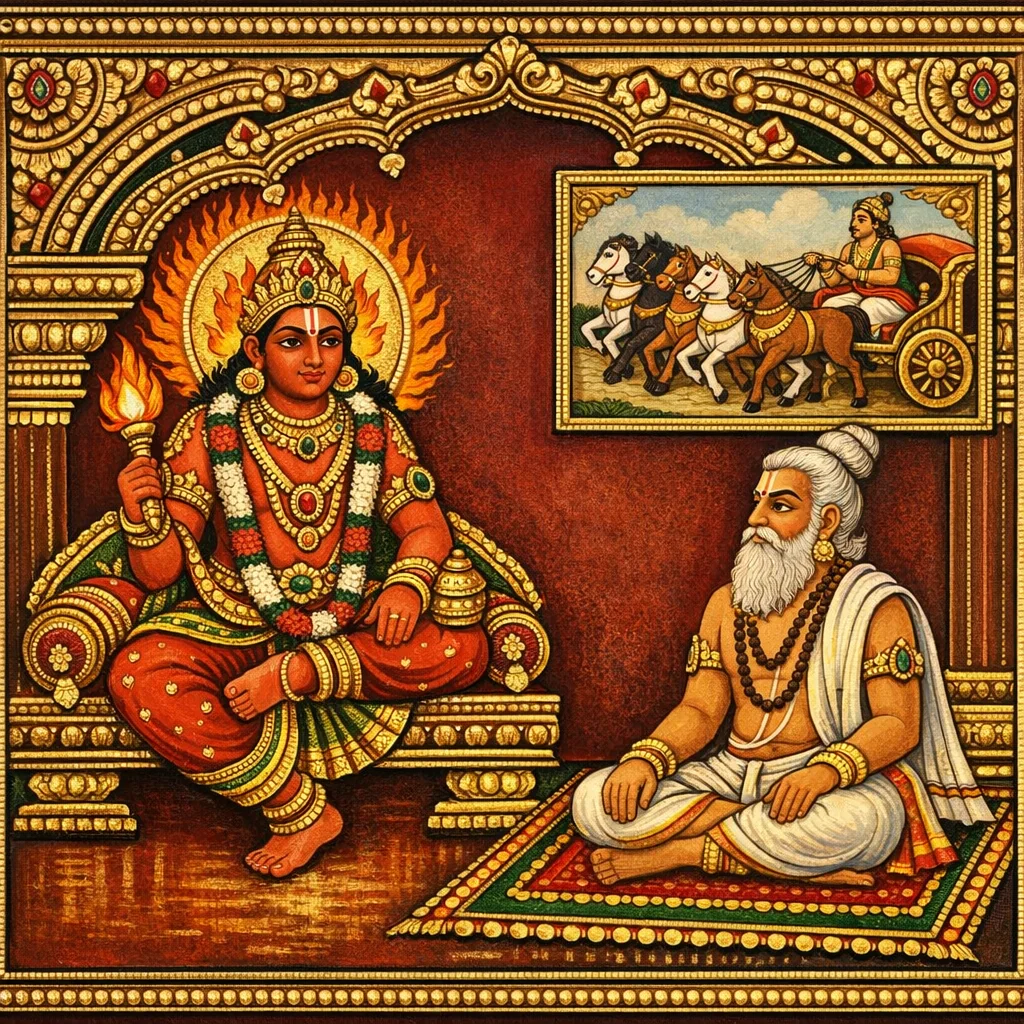
Lord Agni begins a yoga instruction that is technical yet aimed at liberation. The practitioner prepares a clean practice-space and a steady seat (neither too high nor too low), layered with cloth, deerskin, and kuśa grass. With the body aligned (torso, head, neck) and the gaze fixed at the nose-tip (nasāgra-dṛṣṭi), protective and stabilizing placements of heels and hands are prescribed, stressing stillness and one-pointedness as prerequisites for inward contemplation of the Supreme. Prāṇāyāma is then defined as the regulated extension and restraint of prāṇa, detailing the classical triad—recaka (exhalation), pūraka (inhalation), and kumbhaka (retention)—and time-measures/types (kanyaka, madhyama, uttama) as metrics for regulation. Benefits are presented medically and spiritually—health, vigor, voice, complexion, and doṣa-reduction—while warning that unmastered breath-discipline can worsen ailments. Japa and dhyāna are declared essential for “garbha” (the inner seed-state/concentration), culminating in the doctrine of sense-conquest: the senses generate heaven and hell; the body is a chariot, the senses horses, the mind the charioteer, and prāṇāyāma the whip. Finally, pratyāhāra is defined as drawing back the senses from the ocean of objects, urging self-rescue through refuge in the “tree of knowledge.”
Shlokas
Verse 1
इत्य् आग्नेये महापुराणे यमनियमा नामैकसप्तत्यधिकत्रिशततमो ऽध्यायः अथ द्विसप्त्यधिकत्रिशततमो ऽध्यायः आसनप्राणायामप्रत्याहाराः अग्निर् उवाच आसनं कमलाद्युक्तं तद्बद्ध्वा चिन्तयेत्परं शुचौ देशे प्रतिष्ठाप्य स्थिरमासनमात्मनः
Thus, in the Agni Mahāpurāṇa ends the three-hundred-and-seventy-first chapter called “Yama and Niyama.” Now begins the three-hundred-and-seventy-second chapter: “Posture, Breath-control, and Withdrawal (of the senses).” Agni said: “Having adopted a posture such as the lotus-seat and firmly established it (sitting steadily), one should contemplate the Supreme. In a clean place, having set up for oneself a stable seat, one should proceed.”
Verse 2
नात्युच्छ्रितं नातिनीचं चेलाजिनकुशोत्तरं तत्रैकाग्रं मनः कृत्वा यातचित्तेन्द्रियक्रियः
On a seat that is neither too high nor too low, with cloth, deerskin, and kuśa-grass laid on top, having made the mind one-pointed there, one should restrain the operations of the mind and senses.
Verse 3
उपविश्यासने युञ्ज्याद्योगमात्मविशुद्धये समकायशीरग्रीवं धारयन्नचलं स्थिरः
Seated upon a proper seat, one should practice yoga for the purification of the self, holding the body, head, and neck aligned and even—motionless and steady.
Verse 4
सम्प्रेक्ष्य नासिकाग्रं स्वन्दिशश्चानवलोकयन् पार्ष्णिभ्यां वृषणौ रक्षंस् तथा प्रजननं पुनः
Fixing the gaze on the tip of the nose, and not looking around in one’s own directions, one should protect the testicles with the two heels, and likewise safeguard the generative organ.
Verse 5
उरुभ्यामुपरिस्थाप्य वाहू तिर्यक् प्रयत्नतः दक्षिणं करपृष्ठञ्च न्यसेद्धामतलोपरि
Placing both forearms upon the thighs, one should, with deliberate effort, hold the arms crosswise; and one should set the back of the right hand upon the palm of the left hand.
Verse 6
उन्नम्य शनकैर् वक्रं मुखं विष्टभ्य चाग्रतः प्राणः स्वदेहजो वायुस्तस्यायामो निरोधनं
Having gently raised the body step by step, and fixing the mouth in a controlled manner facing forward, the prāṇa—the vital wind born within one’s own body—is to be extended and restrained; that regulated restraint is called prāṇāyāma.
Verse 7
नासिकापुटमङ्गुल्या पीड्यैव च परेण च आदरं रेचयेद्वायुं रेचनाद्रेचकः स्मृतः
After pressing one nostril with the finger and exhaling through the other, one should carefully expel the breath; because it consists in expulsion, it is called recaka (exhalation).
Verse 8
वाह्येन वायुना देहं दृतिवत् पूरयेद्यथा तथा पुर्णश् च सन्तिष्ठेत् पूरणात् पूरकः स्मृतः
Just as one fills the body with the external breath like a bellows, so too, having become fully filled, one should remain steady; because it is a filling (pūraṇa), it is known as Pūraka (inhalation).
Verse 9
न भुञ्चति न गृह्णाति वायुमन्तर्वाहिःस्थितम् सम्पूर्णकुम्भवत्तिष्ठेदचलः स तु कुम्भकः
When one neither exhales nor inhales, and the breath remains stationed within (without moving outward), one stays motionless like a completely filled jar—this indeed is called kumbhaka (breath-retention).
Verse 10
कन्यकः सकृदुद्घातः स वै द्वादशमात्रिकः मध्यमश् च द्विरुद्घातश् चतुर्विंशतिमात्रिकः
The metre called Kanyaka has a single udghāta (opening lift) and comprises twelve mātrās (time-units). The metre called Madhyama has a double udghāta and comprises twenty-four mātrās.
Verse 11
उत्तमश् च त्रिरुद्घातः षट्त्रिंशत्तालमात्रिकः स्वेदकम्पाभिधातानाम् जननश्चोत्तमोत्तमः
And the (metre/type) called Uttama is threefold in its udghāta (opening rise); it measures thirty-six tāla-mātrās. It is the generative source of the varieties known as Sveda and Kampa, and thus is ‘the best among the best’.
Verse 12
अजितान्नारुहेद्भूमिं हिक्काश्वासादयस् तथा जिते प्राणे खल्पदोजविन्मूत्रादि प्रजायते
If one has not mastered prāṇa (the vital breath), one should not climb to elevated ground; otherwise hiccup, dyspnoea, and similar afflictions arise. But when prāṇa is conquered (brought under control), disorders such as phlegm-related imbalance (kapha), disturbances of stool and urine, and the like are regulated and become manageable, no longer obstructing.
Verse 13
आरोग्यं शीघ्रगामित्वमुत्साहः स्वरसौष्ठवम् बलवर्णप्रसादश् च सर्वदोषक्षयः फलं
The result is: good health, swift movement, enthusiasm, excellence of voice, and clarity of strength and complexion—together with the diminution of all bodily doṣas (humoral faults).
Verse 14
जपध्यानं विनागर्भः स गर्भस्तत्समन्वितः इन्द्रियाणां जयार्थाय स गर्भं धारयेत्परं
Without japa (mantra-recitation) and meditation there is no true ‘garbha’; but that ‘garbha’ becomes complete when accompanied by them. For the conquest of the senses, one should hold fast to that supreme ‘garbha’ (the inner seed-state of concentration).
Verse 15
ज्ञानवैराग्ययुक्ताभ्यां प्राणायामवशेन च इन्द्रियांश् च विनिर्जित्य सर्वमेव जितं भवेत्
Endowed with knowledge and dispassion, and through mastery of prāṇāyāma, having subdued the senses, one indeed comes to have conquered everything.
Verse 16
इन्द्रियाण्येव तत्सर्वं यत् स्वर्गनरकावुभौ निगृहीतविसृष्टानि स्वर्गाय नरकाय च
All of that is indeed the senses: heaven and hell—both—arise from them; when the senses are restrained they lead to heaven, and when unleashed they lead to hell.
Verse 17
शरीरं रथमित्याहुरिन्द्रियाण्यस्य वाजिनः मनश् च सारथिः प्रोक्तः प्राणायामः कशःस्मृतः
They declare the body to be a chariot; its senses are the horses. The mind is said to be the charioteer, and prāṇāyāma (breath-discipline) is remembered as the whip.
Verse 18
ज्ञानवैराग्यरश्मिभ्यां सायया विधृतं मनः शनैर् निश्चलताम् एति प्राणायामैकसंहितम्
The mind, held in check by the rein made of the rays of knowledge and dispassion, gradually attains steadiness through the unified discipline of prāṇāyāma (breath-regulation).
Verse 19
जलविन्दुं कुशाग्रेण मासे मासे पिवेत्तु यः संवत्सरशतं साग्रं प्राणयामश् च तत्समः
Whoever drinks a single drop of water (taken) on the tip of a kuśa blade, month after month—the merit of that practice is equal to the merit of prāṇāyāma performed for a full hundred years and more.
Verse 20
इन्द्रियाणि प्रसक्तानि प्रविश्य विषयोदधौ कन्यस इति ञ प्राणायामो ऽङ्कुश इति झ आहृत्य यो निगृह्णाति प्रत्याहारः स उच्यते
When the senses, through attachment, have entered the ocean of sense-objects, the one who draws them back and restrains them—as with prāṇāyāma, the “goad” (aṅkuśa)—is said to practice pratyāhāra, the withdrawal of the senses.
Verse 21
उद्धरेदात्मनात्मानं मज्जमानं यथाम्भसि भोगनद्यतिवेगेन ज्ञानवृक्षं समाश्रयेत्
Let a person raise the self by the self, like one sinking in water, when swept away by the overpowering current of the river of sense-enjoyments; let one take refuge in the tree of knowledge.
Frequently Asked Questions
It emphasizes precise practice-setup (seat height and layers), posture alignment and gaze-fixation, the definitions of recaka–pūraka–kumbhaka, and measured regulation via mātrā/tāla-based types (kanyaka, madhyama, uttama).
It frames bodily steadiness and breath-regulation as tools for purification and indriya-jaya, integrating japa and dhyāna to stabilize the ‘garbha’ (inner seed-state), thereby enabling pratyāhāra and refuge in knowledge—steps that support Brahma-vidyā and liberation.