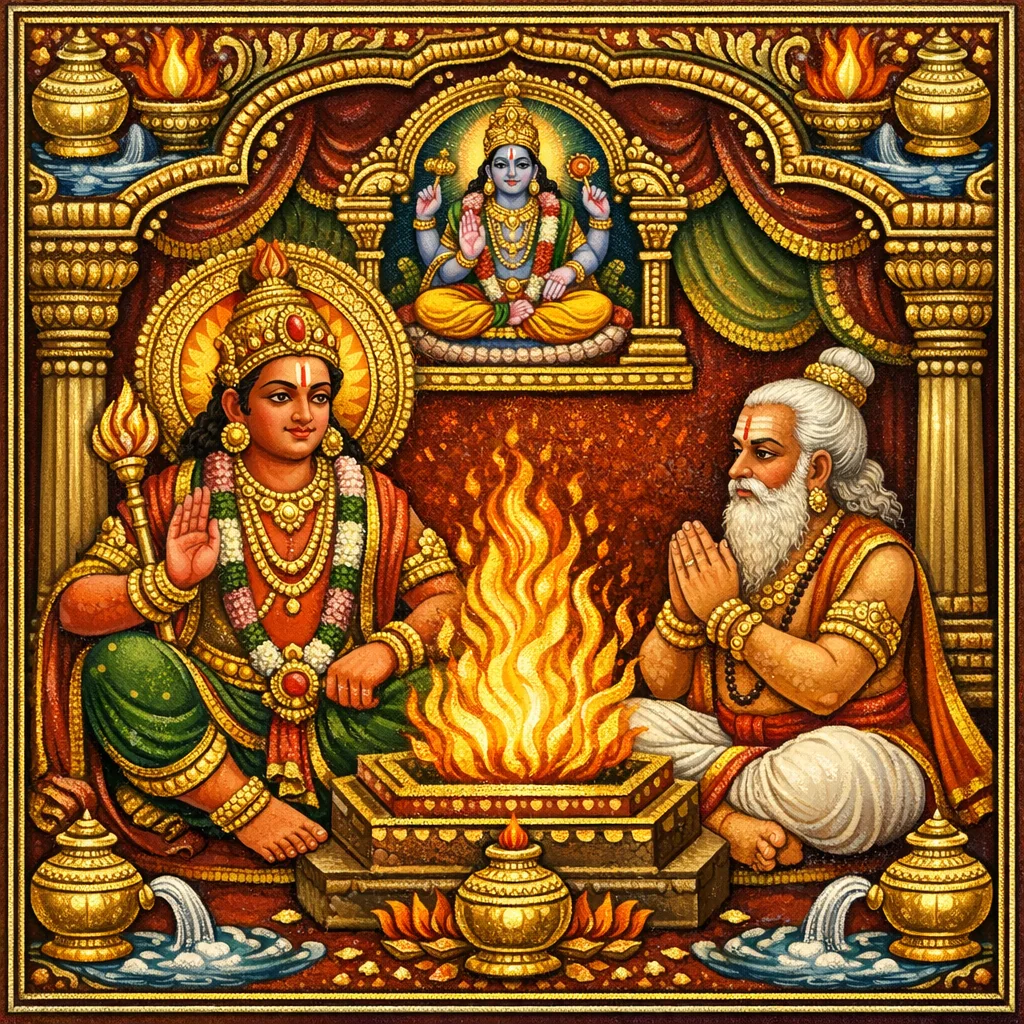
Adhyaya 378
Chapter 378: Brahma-jñāna (Knowledge of Brahman)
Lord Agni sets forth a graded path of attainments: sacrifice (yajña) yields divine and cosmic states, tapas leads to Brahmā’s station, renunciation with dispassion (vairāgya) to prakṛti-laya, and knowledge (jñāna) to kaivalya. Jñāna is defined as discrimination between the sentient and the insentient, and the Supreme Self—support of all—is praised as Viṣṇu and Yajñeśvara, worshipped by pravṛtti-oriented ritualists and realized by nivṛtti-oriented jñāna-yogins. Two modes of knowing are distinguished: śabda-brahman grounded in āgama/veda and para-brahman realized through viveka; “Bhagavān” is explained by etymology and the six bhagas (aiśvarya, vīrya, yaśas, śrī, jñāna, vairāgya). Bondage is diagnosed as avidyā—superimposing Self on non-Self—and the water–fire–pot analogy separates ātman from prakṛti’s adharma. Practice is prescribed: withdraw the mind from objects, remember Hari as Brahman, and establish yoga as the mind’s union with Brahman, stabilized through yama-niyama, āsana, prāṇāyāma, pratyāhāra, and samādhi. Since the formless Absolute is difficult at first, meditation begins with form and culminates in non-difference, with perceived difference attributed to ignorance.
Shlokas
Verse 1
इत्य् आग्नेये महापुराणे समाधिर्नाम सप्तसप्तत्यधिकत्रिशततमो ऽध्यायः अथाष्टसप्तत्यधिकत्रिशततमो ऽध्यायः ब्रह्मज्ञानं अग्निर् उवाच यज्ञैश् च देवानाप्नोति वैराजं तपसा पदं ब्रह्मणः कर्मसन्न्यासाद्वैराग्यात् प्रकृतौ लयं
Thus, in the Agni Mahāpurāṇa ends the three-hundred-and-seventy-seventh chapter called “Samādhi.” Now begins the three-hundred-and-seventy-eighth chapter: “Brahma-jñāna (Knowledge of Brahman).” Agni said: By sacrifices one attains the gods and the Virāj (cosmic) state; by austerity, the station of Brahmā; and by renunciation of actions—through dispassion—one attains dissolution into Prakṛti (the primordial nature).
Verse 2
ज्ञानात् प्राप्नोति कैवल्यं पञ्चैता गतयःस्मृताः प्रीतितापविषादादेर्विनिवृत्तिर्विरक्तता
Through knowledge one attains kaivalya (absolute liberation). These five courses (gatayaḥ) are remembered; and dispassion (viraktatā) is the cessation of states such as delight, torment, dejection, and the rest.
Verse 3
सन्न्यासः कर्मणान्त्यागः कृतानामकृतैः सह अव्यक्तादौ विशेषान्ते विकारो ऽस्मिन्निवर्तते
Renunciation (sannyāsa) is the abandonment of actions, together with the sense of what has been done and what remains undone. In this principle, from the Unmanifest (avyakta) at the beginning to the differentiated particulars at the end, all modification ceases.
Verse 4
चेतनाचेतनान्यत्वज्ञानेन ज्ञानमुच्यते परमात्मा च सर्वेषामाधारः परमेश्वरः
Knowledge is defined as discerning the distinction between the sentient (chetana) and the insentient (achetana); and the Supreme Self (Paramātman) is the Supreme Lord (Parameśvara), the support and ground of all beings.
Verse 5
विष्णुनाम्ना च देवेषु वेदान्तेषु च गीयते यज्ञेश्वरो यज्ञपुमान् प्रवृत्तैर् इज्यते ह्य् असौ
He is sung among the gods and in the Vedānta under the name “Viṣṇu”; as the Lord of sacrifice (Yajñeśvara), as the very Person embodied in sacrifice (Yajña-Pumā́n), He indeed is worshipped by those engaged in sacrificial rites.
Verse 6
निवृत्तैर् ज्ञानयोगेन ज्ञानमूर्तिः स चेक्ष्यते ह्रस्वदीर्घप्लुताद्यन्तु वचस्तत्पुरुषोत्तमः
By those who have withdrawn from sense-activity through the discipline of the yoga of knowledge, He—whose very form is knowledge—is indeed perceived. And speech (vāc), beginning with the short, the long, and the prolated (pluta) measures, is ultimately that Supreme Person (Puruṣottama).
Verse 7
तत्प्राप्तिहेतुर्ज्ञानञ्च कर्म चोक्तं महामुने आगमोक्तं विवेकाच्च द्विधा ज्ञानं तथोच्यते
O great sage, knowledge and action (karma) have been declared as the means to attain That. Knowledge is likewise said to be of two kinds: that taught by scripture (āgama) and that arising from discriminative discernment (viveka).
Verse 8
शब्दब्रह्मागममयं परं ब्रह्म विवेकजम् द्वे ब्रह्मणी वेदितव्ये ब्रह्मशब्दपरञ्च यत्
The Supreme Brahman is constituted of the āgamas as the “Brahman in the form of sound” (śabda-brahman) and is realized through discriminative knowledge (viveka). Therefore two Brahmans are to be known: Brahman as Word/Sound (brahma-śabda) and Brahman as the Supreme (param).
Verse 9
वेदादिविद्या ह्य् अपरमक्षरं ब्रह्मसत्परम् तदेतद्भगवद्वाच्यमुपचारे ऽर्चने ऽन्यतः
Vedic and allied disciplines indeed culminate in the Supreme Imperishable—Brahman, the highest reality. That very Supreme is, by devotional convention, denoted by the word “Bhagavān” in the context of ritual offerings and worship (arcana), and also elsewhere.
Verse 10
सम्भर्तेति तथा भर्ता भकारो ऽर्थद्वयान्वितः नेता गमयिता स्रष्टा गकारो ऽयं महमुने
“Bha” is endowed with a twofold meaning: “the one who sustains and maintains” (sambhartā) and “the supporter” (bhartā). “Ga” denotes the leader, the one who causes beings to proceed, and the creator—O great sage.
Verse 11
ऐश्वर्यस्य समग्रस्य वीर्यस्य यशसः श्रियः ज्ञानवैराग्ययोश् चैव षणां भग इतीङ्गना
The term “bhaga” is said to denote these six: complete sovereignty (aiśvarya), valor/potency (vīrya), fame (yaśas), prosperity/fortune (śrī), knowledge (jñāna), and dispassion (vairāgya).
Verse 12
वसन्ति विष्णौ भुतानि स च धातुस्त्रिधात्मकः एवं हरौ हि भगवान् शब्दो ऽन्यत्रोपचारतः
All beings abide in Viṣṇu, and he is the fundamental constituent (dhātu) with a threefold nature. Thus, in the case of Hari alone the term “Bhagavān” is primary; elsewhere it is applied only in a secondary, figurative sense.
Verse 13
उत्पत्तिं प्रलयश् चैव भूतानामगतिं गतिं वेत्ति विद्यामविद्याञ्च स वाच्यो भगवानिति
He who knows the origination and dissolution of beings, their non-going and their going (their helpless condition and their true course), and who knows both knowledge and ignorance—he is to be designated as “Bhagavān” (the Blessed Lord).
Verse 14
ज्ञानशक्तिः परैश्वर्यं वीर्यं तेजांस्यशेषतः भगवच्छब्दवाच्यानि विना हेयैर् गुणादिभिः
The power of knowledge, supreme lordship, valor, and splendor—entirely (in full measure)—are what the word “Bhagavān” denotes, and this is without any blameworthy qualities and the like.
Verse 15
खाण्डिक्यजनकायाह योगं केशिध्वजः पुरा अनात्मन्यात्मबुद्धिर्या आत्मस्वमिति या मतिः
Formerly Keśidhvaja taught Yoga to Khāṇḍikya-Janaka: namely, that cognition by which one superimposes the notion of “Self” upon the non-Self, and the idea “this is mine,” is the fundamental error.
Verse 16
अविद्याभवम्भूतिर्वीजमेतद्द्विधा स्थिरम् पञ्चभूतात्मके देहे देही मोहतमाश्रितः
Ignorance (avidyā) and the arising of worldly becoming (bhava) are the seed—this is firmly established as twofold. In the body constituted of the five elements, the embodied Self (dehī) abides, resorting to the densest darkness of delusion.
Verse 17
अहमेतदितीत्युच्चैः कुरुते कुमतिर्मतिं इत्थञ्च पुत्रपौत्रेषु तद्देहोत्पातितेषु च
Thinking, “I am this (body) indeed,” the ill-minded person loudly asserts such a notion; and in the same way, this delusion persists even with regard to sons and grandsons—when bodies are generated from that (same) body.
Verse 18
करोति पण्डितः साम्यमनात्मनि कलेवरे सर्वदेहोपकाराय कुरुते कर्म मानवः
The wise maintain equanimity toward the body, which is not the Self; and a human being should perform action for the welfare of all embodied beings.
Verse 19
देहश्चान्यो यदा पुंसस्तदा बन्धाय तत्परं निर्वाणमय एवायमात्मा ज्ञानमयो ऽमलः
When a person regards the body as separate (from the Self), that very fixation becomes a cause of bondage. But this Self is truly of the nature of nirvāṇa—made of knowledge (pure consciousness) and stainless.
Verse 20
दुःखज्ञानमयो ऽधर्मः प्रकृतेः स तु नात्मनः जलस्य नाग्निना सङ्गः स्थालीसङ्गात्तथापि हि
Adharma—characterized by suffering and misapprehension—belongs to Prakṛti, not to the Self. For water has no direct contact with fire; such association appears only through contact with the vessel (the pot).
Verse 21
शब्दास्ते कादिका धर्मास्तत् कृता वै महामुने तथात्मा प्रकृतौ सङ्गादहंमानादिभूषितः
Those sounds—beginning with ‘ka’—are indeed the dharmas (defining rules); they have been set forth, O great sage. Thus the Self, through attachment to Prakṛti, becomes ‘adorned’ with ego-sense (ahaṃkāra) and the like.
Verse 22
भजते प्राकृतान्धर्मान् अन्यस्तेभ्यो हि सो ऽव्ययः वन्धाय विषयासङ्गं मनो निर्विषयं धिये
He may practise ordinary (worldly) duties, yet he is truly other than them—imperishable. Attachment to sense-objects is for bondage; for wisdom, the mind is to be made free from objects.
Verse 23
विषयात्तत्समाकृष्य ब्रह्मभूतं हरिं स्मरेत् आत्मभावं नयत्येनं तद्ब्रह्मध्यायिनं मुने
Having drawn the mind back from the sense-objects, one should remember Hari, who is of the nature of Brahman. O sage, this practice leads the meditator on Brahman to the state of the Self.
Verse 24
विचार्य स्वात्मनः शक्त्या लौहमाकर्षको यथा आत्मप्रयत्नसापेक्षा विशिष्टा या मनोगतिः
Just as a magnet draws iron by its own inherent power, so that distinctive movement of the mind depends upon one’s personal effort (self-application).
Verse 25
तस्या ब्रह्मणि संयोगो योग इत्य् अभिधीयते विनिष्पन्दः समाधिस्थः परं ब्रह्माधिगच्छति
Its union with Brahman is called ‘yoga’; established in samādhi, free from all vibration of mental activity, one attains the Supreme Brahman.
Verse 26
यमैः सन्नियमैः स्थित्या प्रत्याहृत्या मरुज्जयैः प्राणायामेन पवनैः प्रत्याहारेण चेन्द्रियैः
By the yamas and the well-established niyamas; by steadiness of posture; by withdrawal (pratyāhṛti); by mastery over the vital wind (marut); by regulation of the breath (prāṇāyāma) and the currents of vāyu; and by pratyāhāra—i.e., by restraining the sense-faculties.
Verse 27
वशीकृतैस्ततः कुर्यात् स्थितं चेतः शुभाश्रये आश्रयश्चेतसो ब्रह्म मूर्तञ्चामूर्तकं द्विधा
Then, with the senses brought under control, one should steady the mind upon an auspicious support. The support of the mind is Brahman, which is of two kinds: with form (manifest) and without form (unmanifest).
Verse 28
सनन्दनादयो ब्रह्मभावभावनया युताः कर्मभावनया चान्ये देवाद्याः स्थावरान्तकाः
Sanandana and the like are endowed with the cultivation (bhāvanā) of the Brahman-state; others—beginning with the gods and extending down to immobile beings—are characterized by contemplation connected with action (karma).
Verse 29
हिरण्यगर्भादिषु च ज्ञानकर्मात्मिका द्विधा त्रिविधा भावना प्रोक्ता विश्वं ब्रह्म उपास्यते
With regard to Hiraṇyagarbha and the other cosmic principles, contemplation (bhāvanā) is taught as twofold—of the nature of knowledge (jñāna) and of action (karma)—and also as threefold; by this, Brahman as the universe is to be worshipped.
Verse 30
प्रत्यस्तमितभेदं यत् सत्तामात्रमगोचरं वचसामात्मसंवेद्यं तज्ज्ञानं ब्रह्म संज्ञितम्
That knowledge is called “Brahman”—where all distinctions are dissolved, which is pure Being alone, beyond the reach of speech, and to be directly realized through one’s own Self-awareness.
Verse 31
तच्च विष्णोः परं रूपमरूपस्याजमक्षरं अशक्यं प्रथमं ध्यातुमतो मूर्तादि चिन्तयेत्
And that supreme form of Viṣṇu—formless, unborn, and imperishable—is impossible to meditate upon at the outset; therefore one should contemplate Him beginning with a tangible form (mūrti) and attributes.
Verse 32
सद्भावभावमापन्नस्ततो ऽसौ परमात्मना भवत्यभेदी भेदश् च तस्याज्ञानकृतो भवेत्
Having entered into the state of true being (sad-bhāva), that person becomes non-different from the Supreme Self (Paramātman); and any perceived difference in relation to That arises only from ignorance (avidyā).
Frequently Asked Questions
Sacrifice yields divine/Virāj states, tapas yields Brahmā’s station, renunciation with dispassion yields dissolution into prakṛti, and knowledge yields kaivalya—placing Brahma-jñāna as the direct route to liberation.
Śabda-brahman is Brahman approached through āgama/veda as sacred sound and doctrinal transmission, while para-brahman is realized through viveka and direct self-awareness beyond speech and distinctions.
Because the formless, unborn, imperishable supreme is difficult to grasp initially; therefore saguṇa contemplation serves as an entry-point that matures into nirguṇa realization and non-difference.
Avidyā: the superimposition of ‘I’ upon the body (anātman) and ‘mine’ upon related extensions, producing ego-sense and attachment through prakṛti.
It supplies the para-vidyā capstone: it reframes pravṛtti (ritual/action) and nivṛtti (knowledge/withdrawal) as a coherent ladder, and then gives operational yogic steps (yama-niyama through samādhi) to convert doctrine into realization.