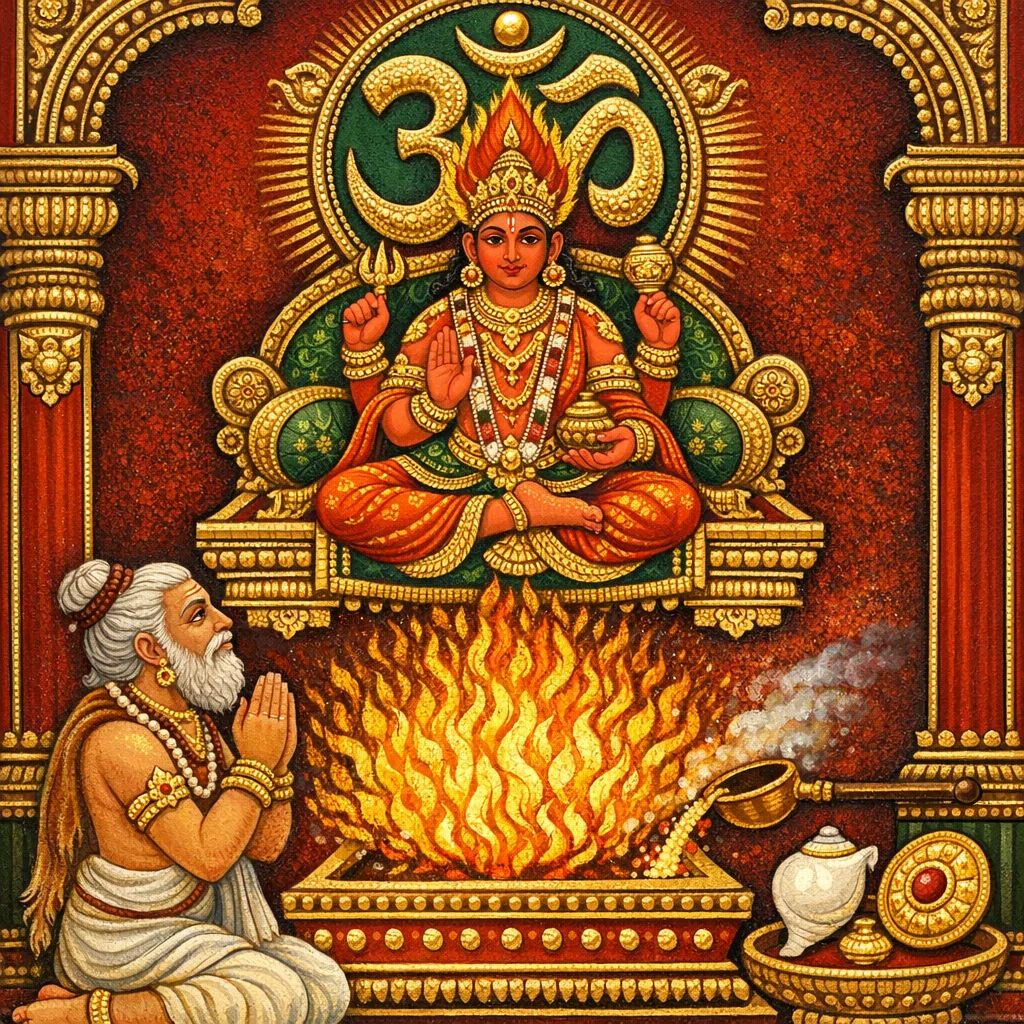
Adhyaya 371
Chapter 371 — Yama-Niyama and Praṇava-Upāsanā (Oṅkāra) as Brahma-vidyā
Agni defines yoga as ekacittatā (one-pointedness) and upholds citta-vṛtti-nirodha as the supreme means to realize the jīva–Brahman relation. The chapter codifies the five yamas—ahiṃsā, satya, asteya, brahmacarya, aparigraha—and the five niyamas—śauca, santoṣa, tapas, svādhyāya, īśvara-pūjana—teaching ethics as the indispensable ground of Brahma-vidyā. Ahiṃsā is exalted as the highest dharma; satya is refined as speech that is ultimately beneficial, governed by the rule of truth-and-pleasantness. Brahmacarya is explained as an eightfold restraint from thought to deed, and aparigraha is limited to the minimum needed for bodily maintenance. The teaching then moves from purification and tapas to svādhyāya centered on Praṇava: Om is analyzed as A-U-M with the subtle “half-mātrā,” and correlated with the Vedas, worlds, guṇas, states of consciousness, and divine triads. Meditation on the “Fourth” (turīya) in the heart-lotus is prescribed, with the bow-arrow-target metaphor: Praṇava as bow, self as arrow, Brahman as target. Finally, mantra-practice is ritualized through Gāyatrī-meter attribution, viniyoga for bhukti-mukti, kavaca/nyāsa, Viṣṇu-worship, homa, and disciplined japa culminating in Brahman’s manifestation; the chapter closes by affirming that meanings dawn fully for one who has para-bhakti to God and equal reverence to the Guru.
Shlokas
Verse 1
इत्य् आग्नेये महापुराणे नरकनिरूपणं नाम सप्तत्यधिकत्रिशततमो ऽध्यायः अथैकसप्तत्यधिकत्रिशततमो ऽध्यायः यमनियमाः अग्निर् उवाच संसारतापमुक्त्यर्थं वक्ष्याम्य् अष्टाङ्गयोगकं ब्रह्मप्रकाशकं ज्ञानं योगस्तत्रैकचित्तता
Thus ends, in the Agni Mahāpurāṇa, the three-hundred-and-seventieth chapter entitled “Description of Hell.” Now begins the three-hundred-and-seventy-first chapter: “The Yamas and Niyamas.” Agni said: “For release from the burning afflictions of saṃsāra, I shall teach the eight-limbed yoga (aṣṭāṅga-yoga)—the knowledge that reveals Brahman. In that discipline, yoga is the one-pointedness of the mind.”
Verse 2
चित्तवृत्तिर्निरोधश् च जीवब्रह्मात्मनोः परः अहिंसा सत्यमस्तेयं ब्रह्मचर्यापरिग्रहौ
The restraint (nirodha) of the mind’s modifications (citta-vṛttis) is the supreme means for realizing the transcendence/identity of the individual self (jīva) and the Supreme Self (Brahman/Ātman). (The foundational vows are:) non-violence, truthfulness, non-stealing, celibacy/chastity (brahmacarya), and non-possessiveness (aparigraha).
Verse 3
यमाः पञ्च स्मृता नियमाद्भुक्तिमुक्तिदाः शौचं सन्तोषतपसी स्वाध्यायेश्वरपूजने
Five yamas are remembered; and from the niyamas arise the bestowers of worldly enjoyment (bhukti) and liberation (mukti): purity (śauca), contentment (santoṣa), austerity (tapas), self-study (svādhyāya), and the worship of the Lord (Īśvara-pūjana).
Verse 4
भूतापीडा ह्य् अहिंसा स्यादहिंसा धर्म उत्तमः यथा गजपदे ऽन्यानि पदानि पथगामिनां
Indeed, non-injury to living beings is what is called ahiṃsā; and ahiṃsā is the highest dharma—just as, within the footprint of an elephant, the footprints of other creatures that travel the path are contained.
Verse 5
एवं सर्वमहिंसायां धर्मार्थमभिधीयते उद्वेगजननं हिंसा सन्तापकरणन्तथा
Thus, in the context of complete non-violence, dharma is explained as having this purpose. Violence is that which produces agitation (fear and distress) and likewise that which causes suffering.
Verse 6
रुक्कृतिः शोनितकृतिः पैशुन्यकरणन्तथा ब्रह्मप्रकाशनं ज्ञानमिति ञ यथा नागपदे ऽन्यानीति क पदगामिनामिति ख , ज च हितस्यातिनिषेधश् च मर्मोद्घाटनमेव च
Causing pain, causing bloodshed, and engaging in slander; likewise, divulging sacred knowledge pertaining to Brahman—these are to be understood as blameworthy acts. Also (blameworthy are) leading others onto a wrong path, and the fault of those who follow such a path; further, excessive prohibition even of what is beneficial, and the very act of exposing another’s vital secrets (marmas).
Verse 7
सुखापह्नुतिः संरोधो बधो दशविथा च सा यद्भूतहितमत्यन्तं वचः सत्यस्य लक्षणं
‘Truthful speech’ is of ten kinds—including the concealment of another’s pleasure, restraint, and prohibition. That utterance which is supremely beneficial to beings is the defining mark of truth.
Verse 8
सत्यं ब्रूयात्प्रियं ब्रूयान्न ब्रूयात्सत्यमप्रियं प्रियञ्च नानृतं ब्रूयादेष धर्मः सनातनः
One should speak the truth; one should speak what is pleasing. One should not speak a truth that is unpleasant; and one should not speak a pleasing falsehood. This is the eternal rule of dharma.
Verse 9
मैथुनस्य परित्यागो ब्रह्मचर्यन्तदष्टधा स्मरणं कीर्तनं केलिः प्रेक्ष्यणं गुह्यभाषणं
Brahmacarya is the renunciation of sexual intercourse; and it is (also) eightfold: (avoiding) lustful recollection, erotic talk, amorous play, looking with desire, and secret/indecent conversation (and the remaining related modes of erotic contact).
Verse 10
सङ्कल्पो ऽध्यवसायश् च क्रियानिर्वृत्तिरेव च एतन्मैथुनमष्टाङ्गं प्रवदन्ति मनीषिणः
Intention (saṅkalpa), firm resolve (adhyavasāya), and the very completion of the act (kriyā-nirvṛtti)—the wise declare that this constitutes the eightfold form of sexual union (aṣṭāṅga-maithuna).
Verse 11
ब्रह्मचर्यं क्रियामूलमन्यथा विफला क्रिया वसिष्ठश् चन्द्रमाः शुक्रो देवाचार्यः पितामहः
Brahmacarya (continence and the disciplined life of a student) is the very root of all sacred acts; otherwise, ritual action becomes fruitless. Thus teach Vasiṣṭha, Candramā (the Moon), Śukra, the preceptor of the gods (Bṛhaspati), and Pitāmaha (Brahmā).
Verse 12
तपोवृद्धा वयोवृद्धास्ते ऽपि स्त्रीभिर्विमोहिताः गौडी पैष्टी च माध्वी च विज्ञेयास्त्रिविधाः सुराः
Even those advanced in tapas (austerity) and those advanced in age are indeed deluded by women. Know that surā (intoxicating liquor) is of three kinds: gauḍī, paiṣṭī, and mādhvī.
Verse 13
चतुर्थी स्त्री सुरा ज्ञेया ययेदं मोहितं जगत् माद्यति प्रमदां दृष्ट्वा सुरां पीत्वा तु माद्यति
The fourth (caturthī, the fourth metrical unit/foot) is to be known as ‘woman’ and as ‘surā (liquor)’, by which this world is deluded: one becomes intoxicated on seeing a lovely woman; and one becomes intoxicated by drinking liquor.
Verse 14
यस्माद्दृष्टमदा नारी तस्मात्तान्नावलोकयेत् यद्वा तद्वापरद्रव्यमपहृत्य बलान्नरः
Since a woman becomes intoxicated with pride (or passion) upon being looked at, therefore one should not gaze at her. Likewise, a man should not, by force, seize another person’s property—whatever it may be.
Verse 15
अवश्यं याति तिर्यक्त्वं जग्ध्वा चैवाहुतं हविः कौपीनाच्छादनं वासः कन्थां शीतनिवारिणीं
He inevitably falls into an animal birth for having eaten the havis (oblation) that had been offered. His clothing becomes only a loincloth (kaupīna), and a ragged blanket serves merely to ward off the cold.
Verse 16
पादुके चापि गृह्णीयात् कुर्यान्नान्यस्य संग्रहं देहस्थितिनिमित्तस्य वस्त्रादेः स्यात्परिग्रहः
He may also accept a pair of sandals; he should not accumulate anything else. Possession should be only of clothing and the like, solely for the maintenance of the body.
Verse 17
शरीरं धर्मसंयुक्तं रक्षणीयं प्रयत्नतः शौचन्तु द्विविधं प्रोक्तं वाह्यमभ्यन्तरं तथा
The body, being connected with dharma, should be protected with diligent effort. Purity (śauca) is declared to be of two kinds: external and internal.
Verse 18
गृज्जलाभ्यां स्मृतं वाह्यं भावशुद्धेरथान्तरं उभयेन शुचिर्यस्तु स शुचिर्नेतरः शुचिः
External purity is declared to be attained by earth and water; internal purity is attained by the purification of one’s disposition. One who is pure by both is truly pure; the other is not truly pure.
Verse 19
यथा कथञ्चित्प्राप्त्या च सन्तोषस्तुष्टिरुच्यते मनसश्चेन्द्रियाणाञ्च ऐकाग्र्यं तप उच्यते
Contentment (santoṣa), also called satisfaction (tuṣṭi), is said to be being pleased with whatever is obtained by any means. The one-pointed steadiness (aikāgrya) of the mind and the senses is called austerity (tapas).
Verse 20
तज्जयः सर्वधर्मेभ्यः स धर्मः पर उच्यते वाचिकं मन्त्रजप्यादि मानसं रागवर्जनं
The conquest of that (the inner enemy—desire and attachment) surpasses all other duties; that indeed is declared to be the supreme Dharma. Verbal discipline consists of mantra-recitation and the like; mental discipline is the abandonment of passion and attachment.
Verse 21
शारीरं देवपूजादि सर्वदन्तु त्रिधा तपः प्रणवाद्यास्ततो वेदाः प्रणवे पर्यवस्थिताः
Tapas (austerity) is threefold—bodily, such as the worship of the gods and the like, and (the other forms) in every respect. The Vedas begin with the Praṇava (Oṃ); indeed, the Vedas are established in the Praṇava.
Verse 22
वाङ्मयः प्रणवः सर्वं तस्मात्प्रणवमभ्यसेत् अकारश् च तथोकारो मकारश्चार्धमात्रया
The Praṇava (Oṃ) is the entirety of articulated speech; therefore one should practice (recite and contemplate) the Praṇava—consisting of the phonemes A, U, and M, together with the half-mātrā (the subtle concluding resonance).
Verse 23
तिस्रो मात्रास्त्रयो वेदाः लोका भूरादयो गुणाः जाग्रत्स्वप्नः सुषुप्तिश् च ब्रह्मविष्णुमहेश्वराः
There are three mātrās, three Vedas, and the worlds beginning with Bhūḥ; (there are) the three guṇas; the states of waking, dream, and deep sleep; and (the triad of deities) Brahmā, Viṣṇu, and Maheśvara.
Verse 24
प्रद्युम्नः श्रीर्वासुदेवः सर्वमोङ्गारकः क्रमात् अमात्रो नष्टमात्रश् च द्वैतस्यापगमः शिवः
He is Pradyumna; He is Śrī (prosperity and auspicious fortune); He is Vāsudeva. In due sequence, He is the all-pervading ‘Oṃ’-principle. He is without measurable mātrā, and He is the one in whom all measures are dissolved; He is the cessation of duality—He is Śiva, the auspicious One.
Verse 25
ओङ्कारो विदितो येन स मुनिर्नेतरो मुनिः चतुर्थी मात्रा गान्धारी प्रयुक्ता मूर्ध्निलक्ष्यते
He alone is a true sage (muni) by whom the syllable Oṃ (Oṅkāra) is rightly understood; any other is not (truly) a sage. The fourth mātrā—called Gāndhārī—when properly applied, is recognized by its mark at the crown (mūrdhan), that is, as an upper/cerebral resonance.
Verse 26
तत्तुरीयं परं ब्रह्म ज्योतिर्दीपो घटे यथा तथा हृत्पद्मनिलयं ध्यायेन्नित्यं जपेन्नरः
That ‘Fourth’ (turīya) is the Supreme Brahman—like the light of a lamp within a pot. In the same way, one should ever meditate on That which abides in the lotus of the heart, and should continually repeat it in japa.
Verse 27
प्रणवो धनुः शरो ह्य् आत्मा ब्रह्म तल्लक्ष्यमुच्यते अप्रमत्तेन वेद्धव्यं शरवत्तन्मयो भवेत्
Praṇava (Oṁ) is the bow; the Self indeed is the arrow; Brahman is said to be its target. With unwavering attentiveness one should pierce that target; then, like an arrow, one becomes of the nature of That (Brahman).
Verse 28
एतेदेकाक्षरं ब्रह्म एतदेकाक्षरं परं देतदेकाक्षरं ज्ञात्वा यो यदिच्छति तस्य तत्
This is the One-Syllable Brahman; this is the supreme One-Syllable. Having known this One-Syllable, whatever one desires—of that, it becomes his.
Verse 29
छन्दो ऽस्य देवी गायत्री अन्तर्यामी ऋषिः स्मृतः देवता परमात्मास्य नियोगो भुक्तिमुक्तये
The meter (chandas) of this mantra is the divine Gāyatrī; the Ṛṣi is remembered as Antaryāmin; its presiding deity is the Supreme Self (Paramātman). Its application (viniyoga) is for the attainment of both worldly enjoyment and liberation.
Verse 30
भूरग्न्यात्मने हृदयं भुवः प्राजापत्यात्मने शिरः स्वःसूर्यात्मने च शिखा कवचमुच्यते
‘Bhūḥ’—as having Agni as its inner Self—is assigned to the heart; ‘Bhuvaḥ’—as having Prajāpati as its inner Self—is assigned to the head; and ‘Svaḥ’—as having the Sun as its inner Self—is assigned to the crown-lock (śikhā). This is what is called the protective armor (kavaca).
Verse 31
ओंभूर्भुवः स्वःकवचं सत्यात्मने ततो ऽस्त्रकं विन्यस्य पूजयेद्विष्णुं जपेद्वै भुक्तिमुक्तये
Having set upon oneself the protective armor-mantra “oṁ bhūr bhuvaḥ svaḥ” for the True-Souled Lord, and then performed astra-nyāsa (the placement of the weapon-mantra), one should worship Viṣṇu and repeat the mantra for the sake of worldly enjoyment and liberation.
Verse 32
जुहुयाच्च तिलाज्यादि सर्वं सम्पद्यते नरे यस्तु द्वादशसाहस्रं जपमन्वहमाचरेत्
And one should offer into the ritual fire (homa) sesame, ghee, and the like; everything becomes successfully accomplished for the person who, day after day, performs a japa of twelve thousand repetitions.
Verse 33
तस्य द्वादशभिर्मासैः परं ब्रह्म प्रकाशते अनिमादि कोटिजप्याल्लक्षात्सारस्वतादिकं
For that practitioner, within twelve months the Supreme Brahman (Parabrahman) becomes manifest. This is said to arise from the merit of koṭis of recitations, beginning with siddhis such as aṇimā and the rest, and from a hundred thousand recitations of the Sarasvatī mantra and the like.
Verse 34
वैदिकस्तान्त्रिको मिश्रो विष्णार्वै त्रिविधो मखः त्रयानामीप्सितेनैकविधिना हरिमर्चयेत्
Indeed, the makha (sacrificial rite) for Viṣṇu is of three kinds—Vedic, Tantric, and mixed. In any of these three, one should worship Hari by the single method that is desired, namely the one appropriate to the chosen rite.
Verse 35
प्रणम्य दण्डवद्भूमौ नमस्कारेण यो ऽर्चयेत् स याङ्गतिमवाप्नोति न तां क्रतुशतैर् अपि
Whoever, having bowed down upon the ground like a staff (daṇḍavat prostration), worships by means of reverential salutation—he attains that supreme state, which cannot be gained even by a hundred sacrificial rites.
Verse 36
यस्य देवे परा भक्तिर्यथा देवे तथा गुरौ तस्यैते कथिता ह्य् अर्थाः प्रकाशन्ते महात्मनः
For that great-souled person who has supreme devotion to God—and, just as to God, so also to the Guru—these taught meanings indeed become manifest, clearly revealed.
Frequently Asked Questions
It gives a structured, quasi-śāstric mapping of Praṇava: A-U-M plus ardha-mātrā; correlations with Vedas, lokas, guṇas, and consciousness-states; and a ritual-technical protocol (viniyoga, kavaca, astra-nyāsa, homa, and a quantified japa regimen of 12,000 daily).
It builds a step-ladder from conduct to concentration: yama-niyama purify intention and behavior, tapas and svādhyāya stabilize attention, and Praṇava-upāsanā focuses the mind toward turīya—culminating in non-dual realization framed as ‘piercing’ Brahman with unwavering awareness.