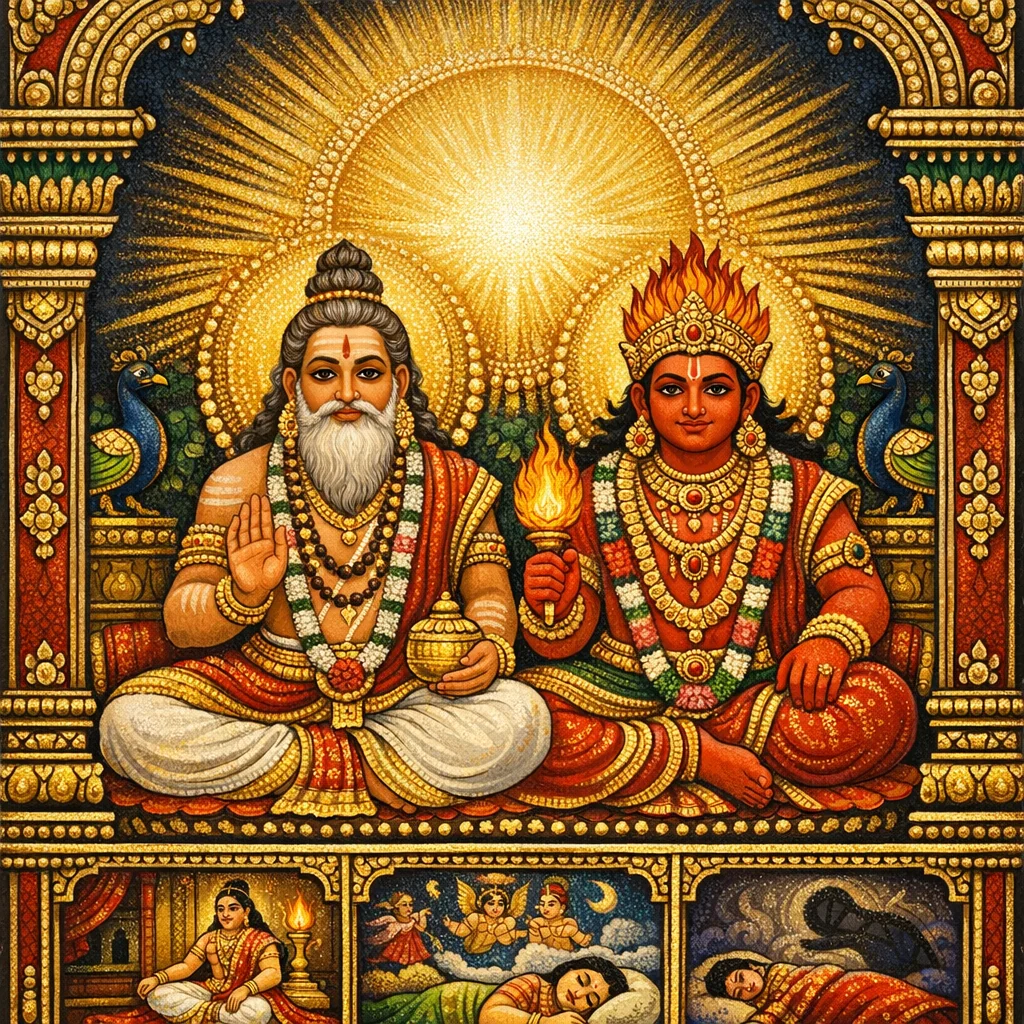
Adhyaya 377
Brahma-jñāna (Knowledge of Brahman)
In this Yoga–Brahma-vidyā section, Lord Agni gives a concentrated non-dual proclamation through repeated self-identification: “I am Brahman, the supreme Light.” The teaching proceeds by systematic negation (apavāda) of all limiting adjuncts—first the gross elements (earth, fire, wind, space), then cosmic and psychological identifications (Virāṭ; waking/dream/deep sleep; taijasa/prājña), the organs of action and perception, the inner instruments (mind/manas, intellect/buddhi, citta, ahaṅkāra), and prāṇa with its divisions. Agni further denies conceptual frames such as measure/measured, cause/effect, existence/non-existence, difference/non-difference, and even the limiting spiritual notion of “witnesshood,” culminating in Brahman as Turīya—beyond the three states. The chapter closes by affirming Brahman’s intrinsic nature as eternal purity, consciousness, freedom, truth, bliss, and non-duality, and links this realization to the highest samādhi as the direct bestower of mokṣa.
Shlokas
Verse 1
इत्य् आग्नेये महापुराणे ब्रह्मज्ञानं नाम षट्सप्तत्यधिकत्रिशततमो ऽध्यायः अथ सप्तसप्तत्यधिकत्रिशततमो ऽध्यायः ब्रह्मज्ञानं अग्निर् उवाच अहं ब्रह्म परं ज्योतिः पृथिव्यवनलोज्झितं अहं ब्रह्म परं ज्योतिर्वाय्वाकाशविवर्जितं
Thus, in the Agni Mahāpurāṇa, the chapter entitled “Brahma-jñāna” (Knowledge of Brahman), the three-hundred-and-seventy-sixth chapter ends. Now begins the three-hundred-and-seventy-seventh chapter, “Brahma-jñāna.” Agni said: “I am Brahman, the supreme Light—free from earth and fire. I am Brahman, the supreme Light—devoid of wind and space.”
Verse 2
अहं ब्रह्म परं ज्योतिरादिकार्यविवर्जितम् अहं ब्रह्म परं ज्योतिर्विराडात्मविवर्जितं
I am Brahman—the supreme Light—free from all primordial causation and its effects. I am Brahman—the supreme Light—devoid of identification with the cosmic Person (Virāṭ) and all embodied self-notions.
Verse 3
अहं ब्रह्म परं ज्योतिर्जाग्रत्स्थानविवर्जितम् अहं ब्रह्म परं ज्योतिर्विश्वभावविवर्जितम्
I am Brahman, the supreme Light, free from the waking state. I am Brahman, the supreme Light, free from the condition of being the universe (as its manifested becoming).
Verse 4
अहं ब्रह्म परं ज्योतिराकाराक्षरवर्जितं अहं ब्रह्म परं ज्योतिर्वाक्पाण्यङ्घ्रिविवर्जितम्
I am Brahman—the supreme Light—devoid of form and devoid of letters (sound/word). I am Brahman—the supreme Light—devoid of speech, hands, and feet.
Verse 5
अहं ब्रह्म परं ज्योतिः पायूपस्थविवर्जितं अहं ब्रह्म परं ज्योतिः श्रोत्रत्वक्चक्षुरुज्झितं
I am Brahman, the supreme Light—free from the anus and the generative organ. I am Brahman, the supreme Light—devoid of ear, skin, and eye, that is, not limited by the sense-organs.
Verse 6
अहं ब्रह्म परं ज्योतीरसरूपविवर्जितम् अहं ब्रह्म परं ज्योतिः सर्वगन्धविवर्जितम्
I am Brahman, the supreme Light—devoid of taste and form. I am Brahman, the supreme Light—devoid of all fragrance.
Verse 7
अहं ब्रह्म परं ज्योतिर्जिह्वाघ्राणविवर्जितं अहं ब्रह्म परं ज्योतिः स्पर्शशब्दविवर्जितं
I am Brahman, the supreme Light—devoid of tongue and smell. I am Brahman, the supreme Light—devoid of touch and sound.
Verse 8
अहं ब्रह्म परं ज्योतिर्मनोबुद्धिविवर्जितं अहं ब्रह्म परं ज्योतिश्चित्ताहङ्कारवर्जितं
I am Brahman—the supreme Light—devoid of mind (manas) and intellect (buddhi). I am Brahman—the supreme Light—free from the mind-stuff (citta) and the ego-sense (ahaṅkāra).
Verse 9
अहं ब्रह्म परं ज्योतिः प्राणापानविवर्जितं अहं ब्रह्म परं ज्योतिर्व्यानोदानविवर्जितं
I am Brahman, the supreme Light—free from prāṇa and apāna. I am Brahman, the supreme Light—free from vyāna and udāna.
Verse 10
अहं ब्रह्म परं ज्योतिः समानपरिवर्जितं अहं ब्रह्म परं ज्योतिर्जरामरणवर्जितं
I am Brahman—the supreme Light—free from all comparison and equivalence. I am Brahman, the supreme Light, devoid of old age and death.
Verse 11
अहं ब्रह्म परं ज्योतिः शोकमोहविवर्जितं अहं ब्रह्म परं ज्योतिः क्षुत्पिपासाविवर्जितं
I am Brahman, the Supreme Light, free from grief and delusion. I am Brahman, the Supreme Light, free from hunger and thirst.
Verse 12
अहं ब्रह्म परं ज्योतिः शब्दोद्भूतादिवर्जितं अहं ब्रह्म परं ज्योतिर्हिरण्यगर्भवर्जितं
I am Brahman, the supreme Light—free from what is produced from sound and the rest; I am Brahman, the supreme Light—beyond and distinct from Hiraṇyagarbha.
Verse 13
अहं ब्रह्म परं ज्योतिः स्वप्नावस्थाविवर्जितं अहं ब्रह्म परं ज्योतिस्तैजसादिविवर्जितं
I am Brahman, the supreme Light, free from the dream-state. I am Brahman, the supreme Light, devoid of taijasa (dream-consciousness) and the other conditioned states.
Verse 14
अहं ब्रह्म परं ज्योतिरपकारादिवर्जितं अहं ब्रह्म परं ज्योतिः सभाज्ञानविवर्जितं
I am Brahman—the supreme Light—free from harm and the like. I am Brahman—the supreme Light—devoid of all conventional and discursive cognition.
Verse 15
अहं ब्रह्म परं ज्योतिरध्याहृतविवर्जितं अहं ब्रह्म परं ज्योतिः सत्त्वादिगुणवर्जितं
I am Brahman—the supreme Light—free from all superimposed attributes. I am Brahman—the supreme Light—devoid of qualities such as sattva and the rest.
Verse 16
अहं ब्रह्म परं ज्योतिः सदसद्भाववर्जितं अहं ब्रह्म परं ज्योतिः सर्वावयववर्जितं
I am Brahman, the supreme Light—free from the notions of existence and non-existence. I am Brahman, the supreme Light—devoid of all parts and limbs, utterly without division.
Verse 17
अहं ब्रह्म परं ज्योतिर्भेदाभेदविवर्जितं अहं ब्रह्म परं ज्योतिः सुषुप्तिस्थानवर्जितम्
I am Brahman, the supreme Light, beyond both difference and non-difference. I am Brahman, the supreme Light, untouched by the state called deep sleep.
Verse 18
अहं ब्रह्म परं ज्योतिः प्राज्ञभावविवर्जितम् अहं ब्रह्म परं ज्योतिर्मकारादिविवर्जितम्
I am Brahman—the Supreme Light—free from the state of conditioned cognition (prājña). I am Brahman, the Supreme Light, beyond the phonemic constituents beginning with ‘ma’, that is, beyond letters and articulated sound.
Verse 19
अहं ब्रह्म परं ज्योतिर्मानमेयविवर्जितम् अहं ब्रह्म परं ज्योतिर्मितिमाहृविवर्जितम्
I am Brahman—the Supreme Light—free from the duality of ‘measure’ and ‘that which is measured’. I am Brahman, the Supreme Light, beyond all limiting cognition and the act of grasping—knowledge as appropriation.
Verse 20
अहं ब्रह्म परं ज्योतिः साक्षित्वादिविवर्जितम् अहं ब्रह्म परं ज्योतिः कार्यकारणवर्जितम्
I am Brahman, the Supreme Light—devoid of limiting notions such as witnesshood and the like. I am Brahman, the Supreme Light—free from the distinctions of effect and cause.
Verse 21
देहेन्द्रियमनोबुद्धिप्राणाहङ्कारवर्जितं जाग्रत् सप्नसुषुप्त्यादिमुक्तं ब्रह्म तुरीयकं
Brahman, called the Fourth (Turīya), is free from body, senses, mind, intellect, vital-breaths, and ego, and is beyond the states beginning with waking, dream, and deep sleep.
Verse 22
नित्यशुद्धबुद्धमुक्तं सत्यमानन्दमद्वयम् ब्रह्माहमस्म्यहं ब्रह्म सविज्ञानं विमुक्त ॐ अहं ब्रह्म परं ज्योतिः समाधिर्मोक्षदः परः
I am Brahman—eternally pure, conscious, and free; reality, bliss, and non-dual. I am Brahman; I am Brahman—liberated with direct, realized knowledge. Om: I am Brahman, the supreme light; this highest samādhi is the bestower of liberation.
Frequently Asked Questions
A structured apavāda (negation) that removes identification with elements, senses, mind, prāṇa, cosmic principles, and conceptual dualities, revealing Brahman as the non-dual Param Jyoti beyond all states.
It defines Turīya as Brahman free from body–sense–mind complexes and beyond jāgrat, svapna, and suṣupti, including the conditioned cognitions associated with viśva/taijasa/prājña.
It frames the highest samādhi as realization-identical knowledge (savi-jñāna vimukti): abiding as “I am Brahman, the supreme Light,” which is explicitly said to bestow mokṣa.