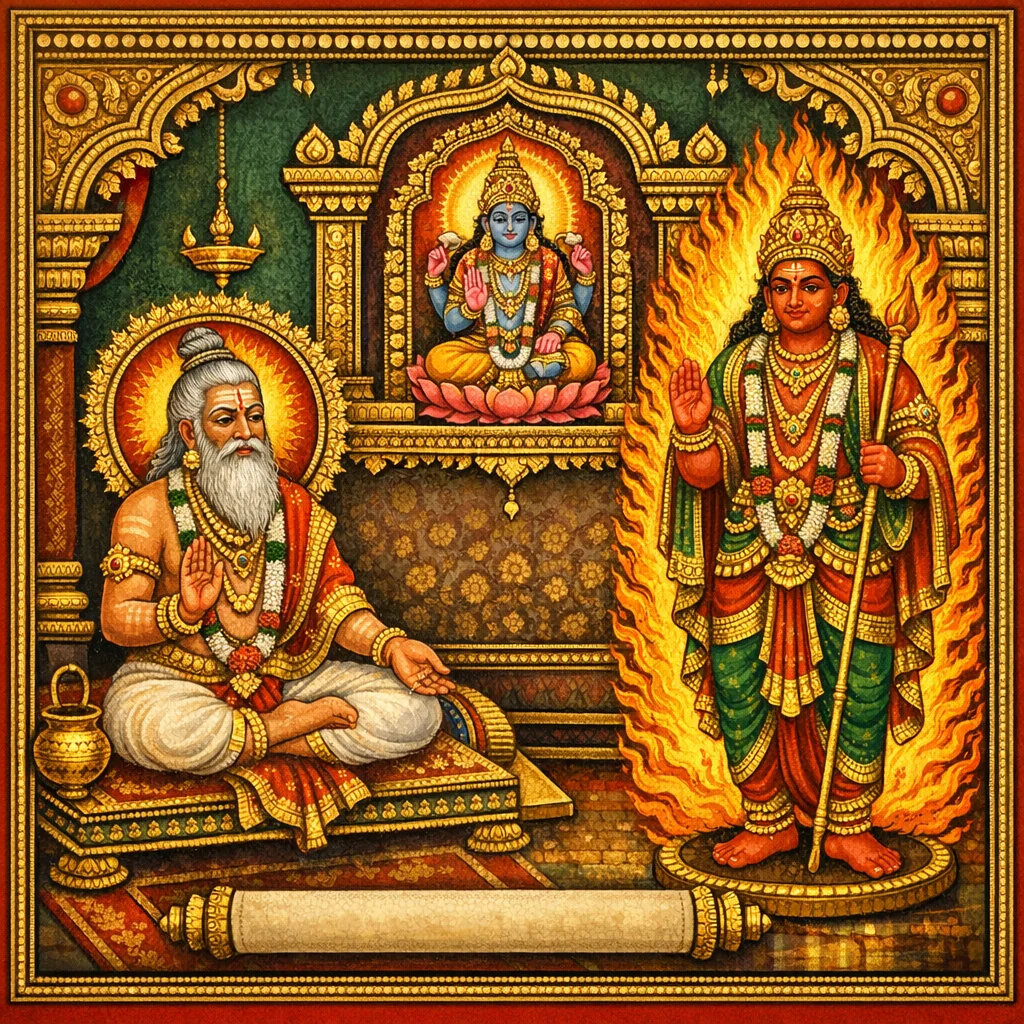
Adhyaya 374
Chapter 374 — ध्यान (Dhyāna) — Colophon & Transition to Dhāraṇā
This unit serves as a textual hinge: it closes the prior teaching on meditation (dhyāna) and explicitly transitions to the next, more technical yoga limb—dhāraṇā (concentration). The chapter-ending colophon stresses the soteriological aim of the practice—attaining Hari (Viṣṇu) and the “fruit” of disciplined contemplation—while preserving variant manuscript readings that witness a living transmission. By placing dhyāna immediately before dhāraṇā, the Agni Purāṇa signals a structured yogic pedagogy: the mind is first trained in sustained meditative orientation, then refined into precise fixation upon chosen loci and principles. Within the Purāṇa’s encyclopedic project, this chapter exemplifies how inner yogic method is treated as a śāstric science, with definitional boundaries and progression, embedded in Agni’s divine instruction to Vasiṣṭha and, by extension, to practitioners seeking clarity of mind and liberation.
Shlokas
Verse 1
इत्य् आग्नेये महापुराणे ध्यानं नाम त्रिसप्तत्यधिकत्रिशततमो ऽध्यायः प्राप्नुयाद्धरिमिति ख प्राप्यते फलमिति ञ अथ चतुःसप्तत्यधिकत्रिशततमो ऽध्यायः धारणा अग्निर् उवाच धारणा मनसोध्येये संस्थितिर्ध्यानवद्द्विधा मूर्तामूर्तहरिध्यानमनोधारणतो हरिः
Thus, in the Agni Mahāpurāṇa, the three-hundred-and-seventy-fourth chapter, called “Meditation (Dhyāna),” ends. (Variant readings: “One attains Hari,” / “The fruit is attained.”) Now begins the three-hundred-and-seventy-fifth chapter: “Concentration (Dhāraṇā).” Agni said: “Dhāraṇā is the steady fixing of the mind upon the object to be contemplated, and—like meditation—it is of two kinds. By concentrating the mind through meditation on Hari in both His embodied (with form) and unembodied (formless) aspects, one reaches Hari.”},{
Verse 2
यद्वाह्यावस्थितं लक्षयं तस्मान्न चलते मनः तावत् कालं प्रदेशेषु धारणा मनसि स्थितिः
When the chosen object of attention is set externally and the mind does not move away from it, then for that duration, the mind’s steady abiding in the (designated) locus is called dhāraṇā (concentration).
Verse 3
कालावधि परिच्छिन्नं देहे संस्थापितं मनः न प्रच्यवति यल्लक्ष्याद्धारणा साभिधीयते
When the mind, fixed within the body for a delimited period of time, does not slip away from its intended object (lakṣya), that is called dhāraṇā (concentration).
Verse 4
धारणा द्वादशायामा ध्यानं द्वदशधारणाः ध्यानं द्वादशकं यावत्समाधिरभिधीयते
Twelve āyāmas (measures of time) constitute dhāraṇā; twelve dhāraṇās constitute dhyāna; and when dhyāna reaches a set of twelve, it is termed samādhi.
Verse 5
धारणाभ्यासयुक्तात्मा यदि प्राणैर् विमुच्यते कुलैकविंशमुत्तार्य स्वर्याति परमं पदं
If a person whose self is disciplined through the practice of dhāraṇā (concentration) departs from the body through the vital breaths (prāṇas), then—having delivered twenty-one generations of his family—he goes to heaven and attains the supreme state.
Verse 6
यस्मिन् यस्मिन् भवेदङ्गे योगिनां व्याधिसम्भवः तत्तदङ्गं धिया व्याप्य धारयेत्तत्त्वधारणं
In whatever limb a disease arises for yogins, one should mentally pervade that very limb with focused awareness and then practice ‘tattva-dhāraṇā’ (concentration on the elemental principle) there.
Verse 7
आग्नेयी वारुणी चैव ऐशानी चामृतात्मिका साग्निः शिखा फडन्ता च विष्णोः कार्या द्विजोत्तम
O best of the twice-born, the śikhā-rite of Viṣṇu should be performed with the śaktis Agneyī, Vāruṇī, and Aiśānī—of the nature of amṛta (nectar)—together with Agni, and ending with the exclamation “phaṭ”.
Verse 8
नाडीभिर्विकटं दिव्यं शूलाग्रं वेधयेच्छुभम् पादाङ्गुष्ठात् कपालान्तं रश्मिमण्डलमावृतं
With the nāḍīs, one should pierce (i.e., mentally traverse) the auspicious, divine, formidable ‘tip of a spear’; from the great toe up to the crown of the skull, it is to be contemplated as enclosed by a sphere of rays, a radiant aureole.
Verse 9
स्वयं याति परं पदमिति ख तिर्यक्चाधोर्ध्वभागेभ्यः प्रयान्त्यो ऽतीव तेजसा चिन्तयेत् साधकेन्द्रस्तं यावत्सर्वं महामुने
“It goes of itself to the supreme state,” indeed. From the lateral, lower, and upper regions, as (those currents) depart with exceedingly great brilliance, the foremost practitioner should contemplate that process until it is wholly complete, O great sage.
Verse 10
भस्प्रीभूतं शरीरं स्वन्ततश् चैवीपसंहरेत् शीतश्लेष्मादयः पापं विनश्यन्ति द्विजातयः
When the body has been reduced to ashes, one should then gather it up of one’s own accord; cold, phlegm and the like—and sin as well—are destroyed, O twice-born.
Verse 11
शिरो धीरञ्च कारञ्च कण्ठं चाधोमुखे स्मरेत् ध्यायेदच्छिन्नचिन्तात्मा भुयो भूतेन चात्मना
Let him remember (visualize) the head, the syllables dhī and kā, and also the throat, all facing downward. With a mind whose contemplation is unbroken, let him meditate again and again, identifying the Self with the elemental principle (bhūta).
Verse 12
स्फुरच्छीकरसंस्मर्शप्रभूते हिमगामिभिः धाराभिरखिलं विश्वमापूर्य भुवि चिन्तयेत्
One should meditate upon the entire world on earth as being completely flooded by streams that move like snow—cooling and purifying—abundant with the touch of flashing spray-droplets.
Verse 13
ब्रह्मरन्ध्राच्च संक्षोभाद्यावदाधारमण्डलग् सुषुम्नान्तर्गतो भूत्वा संपूर्णेन्दुकृतालयं
From the Brahmarandhra, stirred into motion, it enters within the Suṣumnā and proceeds down to the circle of the Ādhāra (Mūlādhāra), taking up its abode in the “full-moon” station.
Verse 14
संप्लाव्य हिमसंस्पर्शतोयेनामृतमूर्तिना क्षुत्पिपासाक्रमप्रायसन्तापपरिपीडितः
After bathing—thoroughly dousing himself—with water cool to the touch and nectar-like in its effect, one who is afflicted by the onslaught of hunger and thirst and tormented by oppressive heat is relieved.
Verse 15
धारयेद्वारुणीं मन्त्रो तुष्ट्यर्थं चाप्यतन्त्रितः वारुणीधारणा प्रोक्ता ऐशानीधारणां शृणु
The mantra-practitioner, remaining undistracted, should perform the Vāruṇī dhāraṇā for the sake of propitiation. The Vāruṇī dhāraṇā has been explained; now listen to the Āiśānī dhāraṇā.
Verse 16
व्योम्नि ब्रह्ममये पद्मे प्राणापाणे क्षयङ्गते प्रसादं चिन्तयेद् विष्णोर्यावच्चिन्ता क्षयं गता
In the inner sky, within the Brahman-constituted lotus, when the in-breath and out-breath have subsided, one should contemplate the gracious presence of Viṣṇu—until even the act of thought itself comes to rest.
Verse 17
महाभावञ्जपेत् सर्वं ततो व्यापक ईश्वरः अर्धेन्दुं परमं शान्तं निराभासन्निरञ्जनं
One should recite this in the state of great devotional disposition (mahā-bhāva); then the all-pervading Lord is to be meditated upon as the supreme, tranquil One—like the crescent moon—luminous yet without reflected appearance, immaculate and unstained.
Verse 18
असत्यं सत्यमाभाति तावत्सर्वं चराचरं यावत् स्वस्यन्दरूपन्तु न दृष्टं गुरुवक्त्रतः
So long as one has not beheld one’s own inner form (the Self) from the mouth of the Guru (through the Guru’s instruction), the unreal appears as real—indeed, the entire moving and unmoving world seems true.
Verse 19
दृष्ठे तस्मिन् परे तत्त्वे आब्रह्म सचराचरं पाठो ऽयमादर्शदोषेण दुष्टः वीरश्चेति ञ प्रमातृमानमेयञ्च ध्यानहृत्पद्मकल्पनं
When that Supreme Principle is realized, the entire world—from Brahmā downward, together with all that moves and does not move—is known as one. This reading, however, is corrupted due to a scribal defect. The intended sense is: the triad of knower, means/measure, and object of knowledge is transcended; and meditation is the imaginative construction of the lotus of the heart as the locus for contemplation.
Verse 20
मातृमोदकवत्सर्वं जपहोमार्चनादिकं विष्णुमन्त्रेण वा कुर्यादमृतां धारणां वदे
One should perform everything—such as mantra-recitation (japa), fire-offering (homa), worship (arcana), and the like—either according to the Mātṛ-modaka rite or by means of a Viṣṇu-mantra. Now I shall state the nectar-like dhāraṇā called “Amṛtā.”
Verse 21
संपूर्णेन्दुनिभं ध्यायेत् कमलं तन्त्रिमुष्टिगम् शिरःस्थं चिन्तयेद् यत्नाच्छशाङ्कायुतवर्चसं
One should meditate on a lotus resembling the full moon, with a pericarp like the knob (mūṣṭi) of a lute; and with effort one should contemplate it as situated in the head, radiant like ten million moons.
Verse 22
सम्पूर्णमण्डलं व्योम्नि शिवकल्लोलपूर्णितं तथा हृत्कमले ध्यायेत्तन्मध्ये स्वतनुं स्मरेत् साधको विगतक्लेशो जायते धारणादिहिः
One should meditate on the all-complete maṇḍala in the inner sky, filled with the surging waves of Śiva; likewise one should contemplate it in the lotus of the heart, and within it recall (visualize) one’s own form. By this dhāraṇā itself, the practitioner becomes free from afflictions here, in this very life.
Frequently Asked Questions
It closes the dhyāna instruction and prepares the reader for the next limb—dhāraṇā—by reiterating the attainment of Hari as the intended fruit and marking the textual transition.
They indicate manuscript-lineage diversity and preserve interpretive nuances (e.g., ‘one attains Hari’ vs. ‘the fruit is attained’), useful for critical study and traditional recitation lineages.