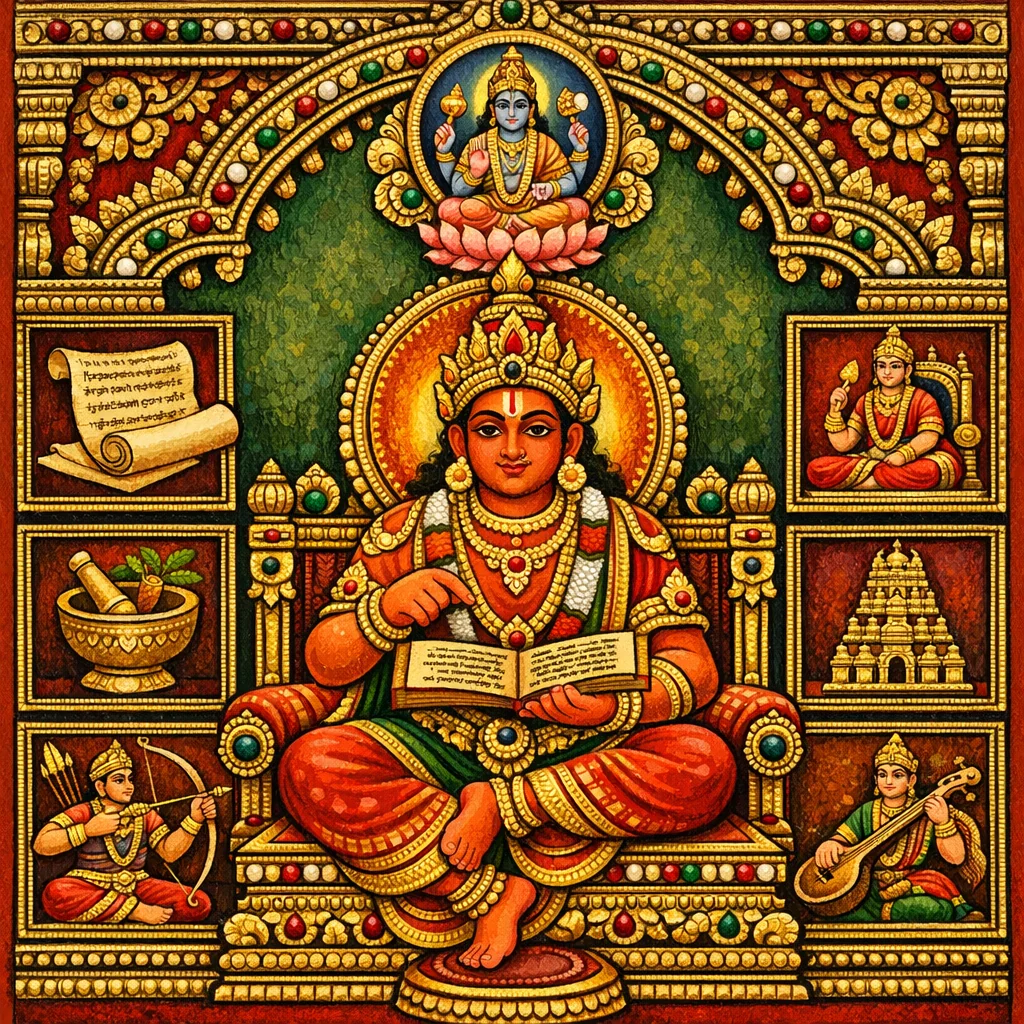
Adhyaya 382
Āgneya-Purāṇa-māhātmya (The Greatness and Self-Testimony of the Agni Purāṇa)
The chapter closes the prior “Yama-gītā” and immediately proclaims the Agni Purāṇa as brahmarūpa and mahān, embodying vidyādvaya: teaching for the manifest order (saprapañca) and for the transcendent (niṣprapañca). Agni surveys the Purāṇa’s encyclopedic range—Vedas and auxiliary sciences, Dharmaśāstra, Nyāya–Mīmāṃsā, Ayurveda, polity, martial and performing arts—clarifying aparā vidyā (comprehensive disciplines) versus parā vidyā (realization of the supreme Akṣara). The teaching then turns to Viṣṇu-bhakti as the practical essence: devotion and meditation on Govinda/Keśava remove sin, counter Kali’s affliction, and define authentic dhyāna, kathā, and karma. A strong māhātmya follows, declaring protective and purifying merits from hearing, reciting, writing, worshipping, gifting, and even keeping the book at home, along with seasonal merits and ritual honors for Purāṇa reciters. The speakers (Agni → Vasiṣṭha → Vyāsa → Sūta) reaffirm Veda-concordance, the synthesis of pravṛtti and nivṛtti dharma, and the promise of bhukti and mukti, culminating in the Upaniṣadic refrain: “Know all as Brahman.”
Shlokas
Verse 1
इत्य् आग्नेये महापुराणे यमगीता नामैकाशीत्यधिकत्रिशततमो ऽध्यायः अथ द्व्यशीत्यधिकत्रिशततमो ऽध्यायः आग्नेयपुराणमाहात्म्यं अग्निर् उवाच आग्नेयं ब्रह्मरूपन्ते पुराणं कथतं मया सप्रपञ्चं निष्प्रपञ्चं विद्याद्वयमयं महत्
Thus, in the Agni Mahāpurāṇa ends the three-hundred-and-eighty-first chapter called “Yama-gītā.” Now begins the three-hundred-and-eighty-second chapter on “The Greatness of the Agni Purāṇa.” Agni said: “To you I have expounded the Agneya Purāṇa, which is of the nature of Brahman—vast and great—embodying a twofold knowledge: the teaching that includes the manifested world (saprapañca) and the teaching that is beyond manifestation (niṣprapañca).”
Verse 2
ऋग्यजुःसामाथर्वाख्या विद्या विष्णुर्जगज्जनिः छन्दः शिक्षा व्याकरणं निघण्टुज्योतिराख्यकाः
The Vedic sciences known as the Ṛg, Yajus, Sāman, and Atharvan are forms of knowledge; Viṣṇu is the generator of the world. Also included are Chandas (metrics), Śikṣā (phonetics), Vyākaraṇa (grammar), and those called Nighaṇṭu (lexicography) and Jyotiṣa (astral science).
Verse 3
निरुक्तधर्मशास्त्रादि मीमांसान्यायविस्तराः आयुर्वेदपुराणाख्या धनुर्गन्धर्वविस्तराः
Also treated are Nirukta and the Dharmaśāstras and related disciplines; the extensive systems of Mīmāṃsā and Nyāya; Ayurveda and what is known as the Purāṇas; and the detailed expositions of Dhanurveda and Gandharvaveda.
Verse 4
विद्या सैवार्थशास्त्राख्या देवान्तान्या हरिर्महान् इत्येषा चापरा विद्या परिविद्याक्षरं परं
That knowledge which is called Arthaśāstra (statecraft and polity) is indeed a form of knowledge; and the other knowledge, culminating in the gods, declares: “Hari (Viṣṇu) is the Great (Supreme).” Thus this is the lower (aparā) knowledge; but by fully knowing the supreme Imperishable (Akṣara), one attains the higher realization.
Verse 5
यस्य भावो ऽखिलं विष्णुस्तस्य नो बाधते कलिः अनिष्ट्वा तु महायज्ञानकृत्वापि पितृस्वधां
For one whose entire inner disposition is wholly fixed on Viṣṇu, Kali does not afflict him. Even without performing great sacrifices, and even without offering the ancestral oblations (svadhā) to the Pitṛs, he remains unharmed by Kali’s influence.
Verse 6
कृष्णमभ्यर्चयन्भक्त्या नैनसो भाजनं भवेत् सर्वकारणमत्यन्तं विष्णुं ध्यायन्न सीदति
Worshipping Kṛṣṇa with devotion, one does not become a receptacle of sin. Meditating on Viṣṇu—the ultimate cause of all—one does not fall into sorrow or ruin.
Verse 7
अन्यतन्त्रादिदोषोत्थो विषयाकृष्टमानसः कृत्वापि पापं गोविन्दं ध्यायन्पापैः प्रमुच्यते
Even one whose mind is drawn toward sense-objects, and who has fallen into faults arising from other misleading doctrines and the like—even if he commits sin—by meditating on Govinda he is released from sins.
Verse 8
तद्ध्यानं यत्र गोविन्दः स कथा यत्र केशवः तत् कर्म यत्तदर्थीयं किमन्यैर् बहुभाषितैः
That alone is meditation in which Govinda is the object; that alone is sacred discourse in which Keśava is the theme. That alone is action undertaken for His sake—what need is there for much other talk?
Verse 9
न तत् पिता तु पुत्राय न शिष्याय गुरुर्द्विज परमार्थं परं ब्रूयाद्यदेतत्ते मयोदितं
O twice-born, neither a father should disclose this to his son, nor a teacher to his disciple; this supreme truth—the highest purport (paramārtha)—which I have spoken to you, should not be uttered lightly.
Verse 10
संसारे भ्रमता लभ्यं पुत्रदारधनं वसु सुहृदश् च तथैवान्ये नोपदेशो द्विजेदृशः
For one who wanders in saṃsāra, sons, wife, wealth, possessions, friends, and the like are obtainable; but true instruction—guiding counsel—from one who sees like a twice-born (a dharma-trained sage) is not easily obtained.
Verse 11
किं पुत्रदारैर् मित्रैर् वा किं मित्रक्षेत्रवान्धवैः उपदेशः परो वन्धुरीदृशो यो विमुक्तये
What use are sons and wife, or friends? What use are friends, land, and relatives? The supreme true kinsman is instruction of this kind, by which one attains liberation (mokṣa).
Verse 12
द्विविधो भूतमार्गीयं दैव आसुर एव च विष्णुभक्तिपरो दैवो विपरीतस् तथासुरः
Beings that follow the course of saṃsāra are of two kinds—divine and demonic. The divine are devoted to bhakti toward Viṣṇu; the demonic are the opposite of that.
Verse 13
एतत् पवित्रमारोग्यं धन्यं दुःस्वप्ननाशनं सुखप्रीतिकरं नॄणां मोक्षकृद्यत्तवेरितं
This teaching is purifying and health-giving, auspicious, a destroyer of bad dreams, and a bestower of happiness and delight for people; indeed, what you have declared is a giver of liberation.
Verse 14
येषां गृहेषु लिखितमाग्नेयं हि पुराणकं पुस्तकं स्थास्यति सदा तत्र नेशुरुपद्रवाः
In the homes where the written book of the Agneya Purāṇa is kept permanently, troubles and calamities do not arise there.
Verse 15
किं तीर्थैर् गोप्रदानैर् वा किं यज्ञैः किमुपोषितैः आग्नेयं ये हि शृण्वन्ति अहन्यहनि मानवाः
What need is there of pilgrimage-places or of gifting cows? What need of sacrifices or of fasting? For those who listen to the Agni Purāṇa day after day, no further observances are required.
Verse 16
ये ददाति तिलप्रस्थं सुवर्णस्य च माषकं शृणोति श्लोकमेकञ्च आग्नेयस्य तदाप्नुयात्
Whoever gives a prastha-measure of sesame and a māṣaka-weight of gold, and also listens to even a single verse of the Agni Purāṇa, attains that very same merit.
Verse 17
अध्यायपठनञ्चास्य गोप्रदानाद् विशिष्यते अहोरात्रकृतं पापं श्रोतुमिच्छोः प्रणश्यति
The recitation of this chapter is superior even to the gifting of a cow; for one who desires to listen to it, the sin committed over a day and a night is destroyed.
Verse 18
कपिलानां शते दत्ते यद् भवेज्ज्येष्ठपुष्करे तदाग्नेयं पुराणं हि पठित्वा फलमाप्नुयात्
Whatever merit arises from gifting a hundred tawny cows (kapilā) at Jyeṣṭha-Puṣkara—one attains that very fruit by reading the Agneya Purāṇa.
Verse 19
प्रवृत्तञ्च निवृत्तञ्च धर्मं विद्याद्वयात्मकं आग्नेयस्य पुराणस्य शास्त्रस्यास्य समं न हि
One should understand dharma as twofold in nature—pravṛtti, the path of engagement in action, and nivṛtti, the path of renunciation. Indeed, there is no scripture equal to this Āgneya Purāṇa.
Verse 20
पठन्नाग्नेयकं नित्यं शृण्वन् वापि पुराणकं भक्तो वशिष्ठ मनुजः सर्वपापैः प्रमुच्यते
O Vasiṣṭha, a devoted person who regularly recites the Agneya (Agni Purāṇa), or even listens to this Purāṇa, is completely released from all sins.
Verse 21
नोपसर्गा न चानर्था न चौरारिभयं गृहे तस्मन् स्याद् यत्र चाग्नेयपुराणस्य हि पुस्तकं
In that house where the book of the Agneya Purāṇa is present, there will be no calamities, no misfortunes, and no fear arising from thieves or enemies.
Verse 22
न गर्भहारिणीभीतिर्न च बालग्रहा गृहे यत्राग्नेयं पुराणं स्यान्न पिशाचादिकं भयं
In a house where the Agneya Purāṇa is present, there is no fear of the ‘pregnancy-stealing’ evil (garbhahāriṇī), no affliction by child-seizing spirits (bāla-grahas), and no fear from piśācas and the like.
Verse 23
शृण्वन्विप्रो वेदवित् स्यात् क्षत्रियः पृथिवीपतिः ऋद्धिं प्राप्नोति वैश्यश् च शूद्रश्चारोग्यमृच्छति
By listening (to this teaching), a brāhmaṇa becomes a knower of the Veda; a kṣatriya becomes a lord of the earth; a vaiśya attains prosperity; and a śūdra reaches freedom from disease (good health).
Verse 24
यः पठेत्शृणुयान्नित्यं समदृग्विष्णुमानसः ब्रह्माग्नेयं पुराणं सत्तत्र नश्यन्त्युपद्रवाः
Whoever daily recites or listens to this holy Brahmāgneya Purāṇa—being even-minded in outlook and with the mind devoted to Viṣṇu—there, all troubles and calamities are destroyed.
Verse 25
दिव्यान्तरीक्षभौमाद्या दुःस्वप्नाद्यभिचारकाः यच्चान्यद्दुरितं किञ्चित्तत्सर्वं हन्ति केशवः
Keśava destroys all harmful influences arising from the divine realm, the mid-air, or the earthly sphere—including evil dreams and acts of sorcery; indeed, whatever other sin or misfortune there may be, he destroys it all.
Verse 26
पठतः शृण्वतः पुंसः पुस्तकं यजतो महत् आग्नेयं श्रीपुराणं हि हेमन्ते यः शृणोति वै
For a man who recites or listens to it, and who performs the great worship of the book, he who listens to the revered Agneya Purāṇa in the hemanta season (winter) indeed obtains great religious merit.
Verse 27
प्रपूज्य गन्धपुष्पाध्यैर् अग्निष्टोमफलं लभेत् शिशिरे पुण्डरीकस्य वसन्ते चाश्वमेधजम्
By duly worshipping with abundant perfumes and flowers, one obtains the merit of the Agniṣṭoma sacrifice; in the śiśira season (deep winter), the merit of the Puṇḍarīka rite; and in spring, that born of the Aśvamedha sacrifice.
Verse 28
ग्रीष्मे तु वाजपेयस्य राजसूयस्य वर्षति गोसहस्रस्य शरदि फलं तत्पठतो ह्य् ऋतौ
But in summer (grīṣma), the merit is that of the Vājapeya; in the rainy season (varṣā), that of the Rājasūya; in autumn (śarad), the fruit equals the gift of a thousand cows—such is the seasonal reward for one who recites it at the proper time.
Verse 29
आग्नेयं हि पुराणं यो भक्त्याग्रे पठेते हरेः सो ऽर्चयेच्च वसिष्ठेह ज्ञानयज्ञेन केशवम्
O Vasiṣṭha, whoever, with devotion, first recites the Āgneya Purāṇa of Hari—he indeed worships Keśava here in this world through the sacrifice of knowledge (jñāna-yajña).
Verse 30
यस्याग्नेयपुराणस्य पुस्तकं तस्य वै जयः लिखितं पूजितं गेहे भुक्तिर्मुक्तिः करे ऽस्ति हि
He who possesses a book of the Agneya Purāṇa indeed attains victory. When it is written out and worshipped in one’s home, worldly enjoyment and final liberation (mokṣa) are truly held in one’s hand.
Verse 31
इति कालाग्निरूपेण गीतं मे हरिणा पुरा आग्नेयं हि पुराणं वै ब्रह्मविद्याद्वयास्पदम् विद्याद्वयं वसिष्ठेदं भक्तेभ्यः कथयिष्यसि
Thus, in the form of Time-and-Fire (Kāla-Agni), Hari sang this to me long ago. Indeed, the Agneya Purāṇa is the very abode of the twofold knowledge of Brahman. O Vasiṣṭha, you will expound this twofold knowledge to the devotees.
Verse 32
वसिष्ठ उवाच व्यासाग्नेयपुराणं ते रूपं विद्याद्वयात्मकं कथितं ब्रह्मणो विष्णोरग्निना कथितं यथा
Vasiṣṭha said: “O Vyāsa, the Agneya Purāṇa you have set forth—know its form to be constituted of a twofold knowledge. It has been taught as originating from Brahmā and Viṣṇu, in the manner in which it was taught by Agni.”
Verse 33
सार्धं देवैश् च मुनिभिर्मह्यं सर्वाथदर्शकं पुराणमग्निना गौतमाग्नेयं ब्रह्मसन्मितं
Together with the gods and the sages, Agni imparted to me the Gautama-Agneya Purāṇa—an all-purpose illuminator, revealing every aim and subject, a Purāṇa held to be in accord with Brahman, the highest truth.
Verse 34
यः पठेच्छृणुयाद्ध्यास लिखेद्वा लेखयेदपि श्रावयेत्पाठयेद्वापि पूजयेद्धारयेदपि
Whoever recites it, or listens to it, or studies it with focused attention; or writes it, or has it written; or causes it to be heard, or causes it to be recited and taught; or worships it, or even bears it upon one’s person—
Verse 35
सर्वपापविनिर्मुक्तः प्राप्रकामो दिवं व्रजेत् लेखयित्वा पुराणं यो दद्याद्विप्रेभ्य उत्तमं
Freed from all sins and having attained the fulfillment of his aims, one goes to heaven—namely, the person who, after having a Purāṇa copied (or copying it), gives that excellent manuscript to Brahmin sages.
Verse 36
स ब्रह्मलोकमाप्नोति कुलानां शतमुद्धरेत् एकं श्लोकं पठेद्यस्तु पापपङ्काद्विमुच्यते
He attains the world of Brahmā and redeems a hundred generations of his lineage. But whoever recites even a single verse is released from the mire of sin.
Verse 37
तस्माद्व्यास सदा श्राव्यं शिष्येभ्यः सर्वदर्शनं शुकाद्यैर् मुनिभिः सर्धं श्रोतुकामैः पुराणकं
Therefore, O Vyāsa, this Purāṇa—comprehensive of all viewpoints—should always be recited to the disciples, together with sages such as Śuka and other seers who desire to hear it.
Verse 38
आग्नेयं पठितं ध्यातं शुभं स्याद् भुक्तिमुक्तिदं अग्नये तु नमस्तस्मै येन गीतं पुरानकं
The Agneya Purāṇa, when recited and meditated upon, becomes auspicious and bestows both worldly enjoyment and liberation. Salutations indeed to that Agni by whom this ancient Purāṇa was sung.
Verse 39
व्यास उवाच वसिष्ठेन पुरा गीतं सूतैतत्ते मयोदितं पराविद्यापराविद्यास्वरूपं परमं पदम्
Vyāsa said: O Sūta, I have now told you this—what was formerly sung by Vasiṣṭha—the true nature of higher knowledge (parā-vidyā) and lower knowledge (aparā-vidyā), and the supreme state, the highest goal.
Verse 40
आग्नेयं दुर्लभं रूपं प्राप्यते भाग्यसंयुतैः ध्यायन्तो ब्रह्म चाग्नेयं पुराणं हरिमागताः
The rare Agneya form is attained by those endowed with good fortune. Meditating on Brahman and on the Agneya Purāṇa, they reach Hari (Viṣṇu).
Verse 41
विद्यार्थिनस् तथा विद्यां राज्यं राज्यार्थिनो गताः अपुत्राः पुत्रिणः सन्ति नाश्रया आश्रयं गताः
Seekers of learning attain learning; seekers of sovereignty attain a kingdom. The childless become possessed of children; and those without refuge obtain a refuge.
Verse 42
सौभाग्यार्थी च सौभाग्यं मोक्षं मोक्षार्थिनो गताः लिखन्तो लेखयन्तश् च निष्पापश् च श्रियं गताः
Those who seek good fortune attain good fortune; those who seek liberation attain liberation. Those who write (this text) and those who cause it to be written become free from sin and attain prosperity.
Verse 43
शुकपैलमुखैः सूत आग्नेयन्तु पुराणकं रूपं चिन्तय यातासि भुक्तिं मुक्तिं न संशयः
O Sūta, contemplate the form of this Agneya Purāṇa, as taught from the mouths of Śuka and Paila; you shall attain both worldly enjoyment and liberation—of this there is no doubt.
Verse 44
श्रावय त्वञ्च शिष्येभ्यो भक्तेभ्यश् च पुराणकम् सूत उवाच व्यास प्रसादादाग्नेयं पुराणं श्रुतमादरात्
“And you too should cause this Purāṇa to be recited to your disciples and to the devotees.” Sūta said: “By Vyāsa’s grace, the Agni Purāṇa has been heard by me with reverent care.”
Verse 45
आग्नेयं ब्रह्मरूपं हि मुनयः शौनकादयः भवन्तो नैमिषारण्ये यजन्तो हरिमीश्वरं
Indeed, you sages—Śaunaka and the others—while performing sacrifice in Naimiṣāraṇya, worship Hari, the Lord, who is Agneya (fiery, pertaining to Agni) and whose form is Brahman itself.
Verse 46
तिष्ठन्तः श्रद्धया युक्तास्तस्माद्वः समुदीरितम् अग्निना प्रोक्तमाग्नेयं पुराणं वेदसम्मितं
Therefore, standing firm and endowed with faith, I have declared this to you: the Agneya Purāṇa, spoken by Agni, in full accord with the Vedas.
Verse 47
ब्रह्मविद्याद्वयोपेतं भुक्तिदं मुक्तिदं महत् नास्मात्परतरः सारो नास्मात्परतरः सुहृत्
Endowed with the twofold Brahma-knowledge, it is great—bestowing worldly enjoyment and liberation. Beyond this there is no higher essence, and beyond this there is no greater benefactor.
Verse 48
नास्मात्परतरो ग्रन्थो नास्मात्परतरो गतिः नास्मात्परतरं शास्त्रं नास्मात्परतरा श्रुतिः
There is no text superior to this; there is no higher refuge or goal than this. There is no teaching-system greater than this; and no revealed tradition (Śruti) higher than this.
Verse 49
नास्मात्परतरं ज्ञानं नास्मात्परतरा स्मृतिः नास्मात्परो ह्य् आगमो ऽस्ति नास्माद्विद्या परास्ति हि
There is no knowledge higher than this; no Smṛti higher than this. Indeed, there is no Āgama superior to this, and truly no Vidyā greater than this.
Verse 50
नास्मात्परः स्यात्सिद्धन्तो नास्मात्परममङ्गलम् नास्मात्परो ऽस्ति वेदान्तः पुराणं परमन्त्विदं
No doctrine is higher than this; no greater auspiciousness exists than this. No Vedānta surpasses this; indeed, this Purāṇa is supreme.
Verse 51
नास्मात्परतरं भूमौ विद्यते वस्तु दुर्लभम् आग्नेये हि पुराणे ऽस्मिन् सर्वविद्याः प्रदर्शिताः
On earth, nothing rarer than this is to be found; for in this Agni Purāṇa all branches of knowledge are set forth and made manifest.
Verse 52
सर्वे मत्स्यावताराद्या गीता रामायणन्त्विह हरिवंशो भारतञ्च नव सर्गाः प्रदर्शिताः
Here, all narratives beginning with the Matsya incarnation, as well as the Gītā, the Rāmāyaṇa, the Harivaṁśa, and the Bhārata, and the nine primary creations/sections (nava-sarga) have been set forth.
Verse 53
आगमो वैष्णवो गीतः पूजादीक्षाप्रतिष्ठया पवित्रारोहणादीनि प्रतिमालक्षणादिकं
The Vaiṣṇava Āgama has been taught—covering worship, initiation (dīkṣā), and consecration/installation (pratiṣṭhā); as well as rites such as the raising of the pavitra (sacred thread/garland) and other observances, together with the characteristics and related details of icons (pratimā).
Verse 54
प्रासादलक्षणाद्यञ्च मन्त्रा वै भुक्तिमुक्तिदाः शैवागमस्तदर्थश् च शाक्तेयः सौर एव च
The mantras, beginning with the characteristics of temples (prāsāda), indeed bestow both bhukti (worldly enjoyment) and mukti (liberation). Their intended purport is taught in the Śaiva Āgama—and likewise in the Śākta and the Saura Āgamas.
Verse 55
मण्डलानि च वास्तुश् च मन्ताणि विविधानि च प्रतिसर्गश्चानुगीतो ब्रह्माण्डपरिमण्डलं
Also described were the maṇḍalas (ritual diagrams), vāstu (architectural science), the various mantras, and the doctrine of re-creation (pratisarga); and likewise the measured form and extent of the cosmic egg, the brahmāṇḍa.
Verse 56
गीतो भुवनकोषश् च द्वीपवर्षादिनिम्नगाः गयागङ्गाप्रयागादि तीर्थमाहात्म्यमीरितं
Thus have been described the bhuvanakośa (cosmic geography), the continents and regions, the rivers and the like; and the greatness of sacred pilgrimage-places—such as Gayā, the Gaṅgā, and Prayāga—has also been set forth.
Verse 57
ज्योतिश् चक्रं ज्योतिषादि गीतो युद्धजयार्णवः मन्वन्तरादयो गीताः धर्मा वर्णादिकस्य च
The Cycle of Astrology (Jyotiṣa-cakra) is sung, as are the disciplines beginning with Jyotiṣa; the “Ocean of Victory in War” (Yuddha-jayārṇava) is sung; the Manvantaras and related topics are sung; and the laws and duties concerning the varṇas (social classes) and allied matters are also sung.
Verse 58
अशौचं द्रव्यशुद्धिश् च प्रायश्चित्तं प्रदर्शितं राजधर्मा दानधर्मा व्रतानि विविधानि च
Impurity (aśauca), the purification of goods and possessions, and expiatory rites (prāyaścitta) have been set forth; likewise the duties of kings (rājadharma), the duties of charitable giving (dānadharma), and various kinds of vows (vrata).
Verse 59
व्यवहाराः शान्तयश् च ऋग्वेदादिविधानकं सूर्यवंशः सोमवंशो धनुर्वेदश् च वैद्यकं
Also described are jurisprudential procedures (vyavahāra) and rites of pacification (śānti); the ordinances beginning with the Ṛgveda; the Solar and Lunar dynasties (Sūryavaṃśa and Somavaṃśa); as well as Dhanurveda (the science of arms) and Vaidyaka (medicine/Ayurveda).
Verse 60
गान्धर्ववेदो ऽर्थशास्त्रं मीमांसा न्यायविस्तरः पुराणसंख्यामाहत्म्यं छन्दो व्यकरणं स्मृतं
Also remembered as branches of knowledge are: the Gāndharva-veda (science of music and performance), Arthaśāstra (statecraft and polity), Mīmāṃsā (Vedic hermeneutics), the extensive system of Nyāya (logic), the enumeration and glorification of the Purāṇas, Chandas (prosody/metrics), and Vyākaraṇa (grammar).
Verse 61
अलङ्कारो विघण्डुश् च शिक्षाकल्प इहोदितः स्मृतः नैमित्तिकः प्राकृतिको लय आत्यन्तिकः
Here, Alaṅkāra and Vighaṇḍu, and the Śikṣā-kalpa have been stated. Dissolution (laya) is remembered as of three kinds: incidental (naimittika), natural/elemental (prākṛtika), and absolute/final (ātyantika).
Verse 62
वेदान्तं ब्रह्मविज्ञानं योगो ह्य् अष्टाङ्ग ईरितः स्तोत्रं पुराणमाहात्म्यं विद्या ह्य् अष्टादश स्मृताः
Vedānta, the science of realizing Brahman, and Yoga—declared to be eight-limbed—together with hymns and the glorificatory greatness of the Purāṇas: these are remembered among the eighteen branches of knowledge (vidyās).
Verse 63
ऋग्वेदाद्याः परा ह्य् अत्र पराविद्याक्षरं परं सप्रपञ्चं निष्प्रपञ्चं ब्रह्मणो रूपमीरितं
Here, the Ṛgveda and the other Vedas are taught as the higher knowledge within the manifested order (apara); but the supreme, imperishable (akṣara) knowledge—Parāvidyā—is declared to be the form of Brahman, both with manifestation (saprapañca) and beyond manifestation (niṣprapañca).
Verse 64
इदं पञ्चदशसोहस्रं शतकोटिप्रविस्तरं देवलोके दैवतैश् च पुराणं पठ्यते सदा
This Purāṇa consists of fifteen thousand verses, and in the breadth of its detailed exposition it extends to a hundred koṭis; in the world of the gods (Devaloka) as well, the deities ever recite this Purāṇa.
Verse 65
लोकानां हितकामेन संक्षिप्योद्गीतमग्निना सर्वं ब्रह्मेति जानीध्वं मुनयः शौनकादयः
For the welfare of the worlds, Agni has sung this teaching in brief: “Know that all is Brahman,” O sages—Śaunaka and the rest.
Verse 66
शृणुयाच्छ्रावयेद्वापि यः पठेत्पाठयेदपि लिखेल्लेखापयेद्वापि युजयेत्कीर्तयेदपि
Whoever listens to this Purāṇic teaching or causes it to be heard; whoever recites it or has it recited; whoever writes it or causes it to be written; whoever puts it into practice or proclaims it aloud—such a person attains the stated religious merit.
Verse 67
पुराणपाठकञ्चैव पूजयेत् प्रयतो नृपः गोभूहिरण्यदानाद्यैर् वस्त्रालङ्कारतर्पणैः
And the king, disciplined and attentive, should honour the reciter of the Purāṇa—through gifts such as cows, land, and gold, and also by offerings of garments, ornaments, and tarpaṇa (ritual satisfaction).
Verse 68
तं संपूज्य लभेच्चैव पुराणश्रवणात् फलं पुराणान्ते च वै कुर्यादवश्यं द्विजभोजनं
Having duly honoured him, one indeed obtains the full merit arising from hearing the Purāṇa; and at the conclusion of the Purāṇa, one should certainly perform the feeding of Brahmins (dvija).
Verse 69
निर्मलः प्राप्तसर्वार्थः सकुलः स्वर्गमाप्नुयात् शरयन्त्रं पुस्तकाय सूत्रं वै पत्रसञ्चयं
Being purified and having attained all aims, he—together with his family—reaches heaven. (For a book one should prepare) the binding device (śarayantra), the thread, and the collection of leaves (folios).
Verse 70
पट्टिकाबन्धवस्त्रादि दद्याद् यः स्वर्गमाप्नुयात् यो दद्याद्ब्रह्मलोकी स्यात् पुस्तकं यस्य वै गृहे
Whoever gives in charity garments and the like—such as cloth with bands or fastenings—attains heaven. Whoever gives a book becomes a dweller in Brahmā’s world; indeed, blessed is the one in whose house a sacred book resides.
Verse 71
तस्योत्पातभयं नास्ति भुक्तिमुक्तिमवाप्नुयात् यूयं समरत चाग्नेयं पुराणं रूपमैश्वरं सूतो गतः पुजितस्तैः शौनकाद्या हरिं यायः
For him there is no fear of evil portents; he attains both worldly enjoyment and liberation. You should remember the Agneya Purāṇa, the very form of the Lord’s sovereignty. The Sūta then departed, honored by them; Śaunaka and the others went to Hari (Viṣṇu).
Frequently Asked Questions
A structured taxonomy of knowledge: Vedas and Vedāṅgas (Śikṣā, Chandas, Vyākaraṇa, Nirukta/Nighaṇṭu, Jyotiṣa), plus śāstric systems (Nyāya, Mīmāṃsā, Dharmaśāstra), applied sciences (Ayurveda, Arthaśāstra, Dhanurveda, Gandharvaveda), and ritual-architectural domains (Āgamas, Pratimā-lakṣaṇa, Prāsāda-lakṣaṇa, Vāstu, Maṇḍala).
It defines parāvidyā as realization of the supreme Akṣara while positioning aparā disciplines as supportive; it then centers practice on Viṣṇu-bhakti—meditation on Govinda/Keśava—as the unifying sādhanā that purifies sin, protects from Kali, and culminates in bhukti and mukti.
Yes. It repeatedly asserts no text, doctrine, knowledge, or refuge is higher, while also claiming Veda-concordance (veda-sammita) and presenting the Purāṇa as an all-aim illuminator (sarvārtha-darśaka).