Adhyaya 376
Chapter 376 — ब्रह्मज्ञानम् (Knowledge of Brahman)
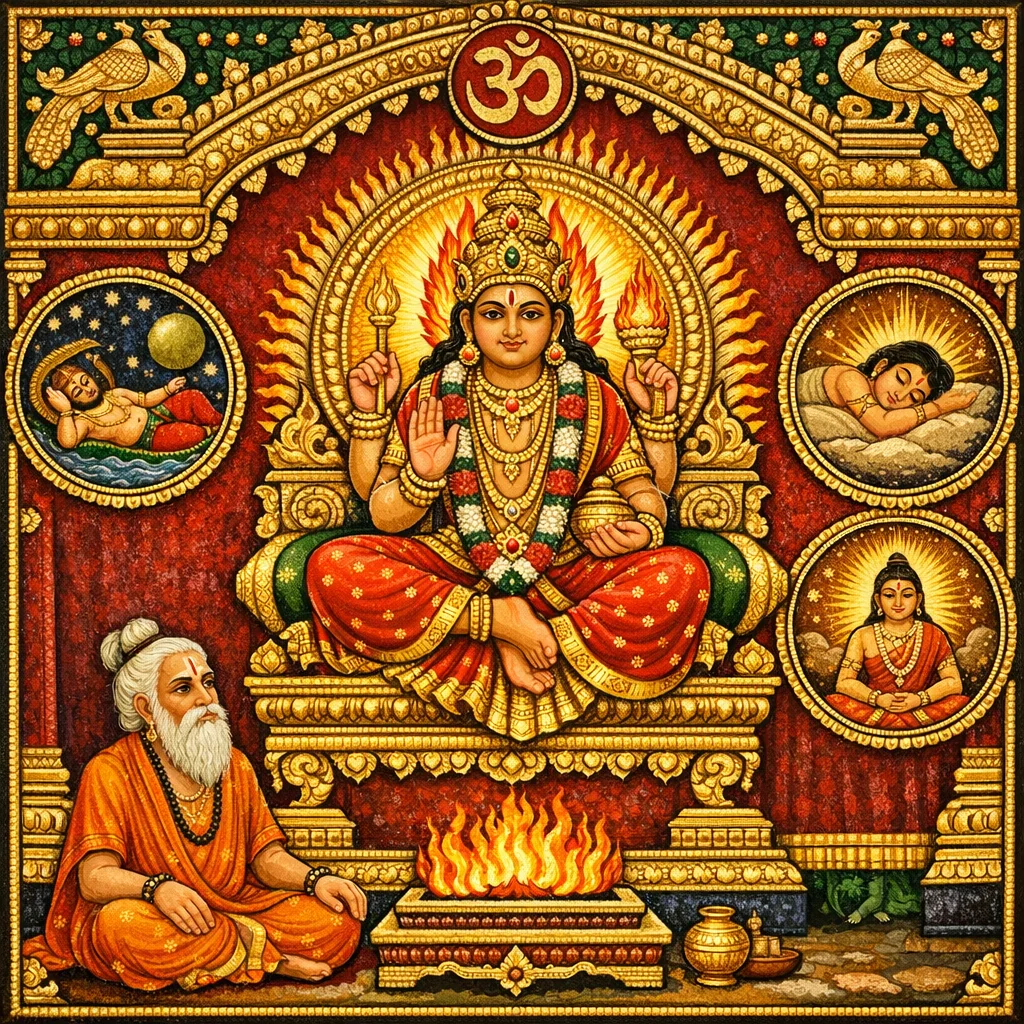
Lord Agni begins teaching Brahma-jñāna as the direct cure for saṃsāra-born ignorance, centered on the liberating recognition “ayam ātmā paraṃ brahma—aham asmi.” Through viveka, the body is rejected as non-Self because it is perceived like an object; the senses, mind, and prāṇa are likewise treated as instruments, not the witnessing subject. The Self is affirmed as the inner light in all hearts—seer and experiencer—shining like a lamp in darkness. Agni then gives a samādhi-entry contemplation: tracing cosmic emanation from Brahman through the elements, and reversing it by laya (dissolution) as the gross is reabsorbed into Brahman, introducing Virāṭ (cosmic gross), liṅga/Hiraṇyagarbha (subtle body with seventeen constituents), and the three states—waking, dream, deep sleep—with viśva, taijasa, prājña. Reality is said to be inexpressible (anirvacanīya), approached by “neti,” and attained by realized knowledge rather than karma. The teaching culminates in mahāvākya-like affirmations of witness-consciousness free from ignorance; the fruit is liberation, as the brahma-jñānī “becomes Brahman.”
Shlokas
Verse 1
इत्य् आग्नेये महापुराणे समाधिर्नाम पञ्चसप्तत्यधिकत्रिशततमो ऽध्यायः अथ षट्सप्तत्यधिकत्रिशततमो ऽध्यायः ब्रह्मज्ञानं अग्निर् उवाच ब्रह्मज्ञानं प्रवक्ष्यामि संसाराज्ञानमुक्तये अयमात्मा पर्ं ब्रह्म अहमस्मीति मुच्यते
Thus, in the Agni Mahāpurāṇa ends the three-hundred-and-seventy-fifth chapter called “Samādhi.” Now begins the three-hundred-and-seventy-sixth chapter, “Knowledge of Brahman.” Agni said: “I shall expound the knowledge of Brahman for liberation from the ignorance that binds one to saṃsāra. Knowing, ‘This Self is the supreme Brahman; I am That,’ one is freed.”
Verse 2
देह आत्मा न भवति दृस्यत्वाच्च घटादिवत् प्रसप्ते मरणे देहादात्मान्यो ज्ञायते ध्रुवं
The body is not the Self, because it is an object of perception—like a pot and the like. When death has occurred, it is certainly understood that the Self is distinct from the body.
Verse 3
देहः स चेदव्यवहरेद्विकार्यादिसन्निभः चक्षुरादीनीन्द्रियाणि नात्मा वै करणं त्वतः
If the body were not an instrument of activity, it would be comparable to inert, modifiable matter and the like. Therefore, the eye and the other senses are instruments (of experience and action); the Self is not an instrument.
Verse 4
मनो धीरपि आत्मा न दीपवत् करणं त्वतः प्राणो ऽप्यात्मा न भवति सुषुप्ते चित्प्रभावतः
The mind, though it may be steady, is not the Self; it is only an instrument, like a lamp. Likewise, prāṇa, the vital-breath, is not the Self; for in deep sleep (suṣupti), by the very power of consciousness, it is evident that the Self remains distinct.
Verse 5
जाग्रत्स्वप्ने च चैतन्यं सङ्कीर्णत्वान्न बुध्यते विज्ञानरहितः प्राणः सुषुप्ते ज्ञायते यतः
In the waking and dream states, consciousness is not distinctly recognized because it is intermingled with objects and mental modifications. But in deep sleep (suṣupti), prāṇa is known to be without vijñāna—differentiated cognition—and thus that state is ascertainable.
Verse 6
अतो नात्मेन्द्रियं तस्मादिन्त्रियादिकमात्मनः अहङ्कारो ऽपि नैवात्मा देहवद्व्यभिचारतः
Therefore the sense-organ (indriya) is not the Self; hence the senses and the rest of the psycho-physical apparatus are not of the nature of the Self. Even ahaṅkāra, the “I-maker,” is not the Self, because it is inconstant and variable, like the body.
Verse 7
उक्तेभ्यो व्यतिरिक्तो ऽयमात्मा सर्वहृदि स्थितः सर्वद्रष्टा च भोक्ता च नक्तमुज्ज्वलदीपवत्
Distinct from all that has been described, this Self abides in the heart of every being; it is the universal witness and the experiencer, shining like a bright lamp in the night.
Verse 8
समाध्यारम्भकाले च एवं सञ्चिन्तयेन्मुनिः यतो ब्रह्मण आकाशं खाद्वायुर्वायुतो ऽनलः
At the beginning of samādhi, the sage should contemplate thus: from Brahman arises ākāśa, space; from space comes vāyu, wind; and from wind arises anala, fire.
Verse 9
अग्नेरापो जलात्पृथ्वी ततः सूक्ष्मं शरीरकं अपञ्चीकृतभूतेभ्य आसन् पञ्चीकृतान्यतः
From fire arise the waters; from water, the earth. Thereafter, the subtle body is formed from the unquintuplicated elements (apancīkṛta); and from these same elements the gross, quintuplicated elements (pañcīkṛta) come into being.
Verse 10
स्थूलं शरीरं ध्यात्वास्माल्लयं ब्रह्मणि चिन्तयेत् पञ्चीकृतानि भूतानि तत्कार्यञ्च विराट्स्मृतम्
Having meditated upon the gross body, one should contemplate its dissolution into Brahman. The five elements in their quintuplicated state (pañcīkṛta)—and their resultant aggregate effect—are remembered as the Virāṭ, the cosmic gross form.
Verse 11
एतत् स्थूलं शरीरं हि आत्मनो ज्ञानकल्पितं इन्द्रियैर् अथ विज्ञानं धीरा जागरितं विदुः
This gross body, indeed, is a construct projected by cognition (jñāna) upon the Self (Ātman); and the wise know the waking state as the operative consciousness (vijñāna) connected with the senses.
Verse 12
विश्वस्तदभिमानी स्यात् त्रयमेतदकारकं अपञ्चीकृतभूतानि तत्कार्यं लिङ्गमुच्यते
One who identifies with the whole cosmos is called the ‘universal’ (viśva). This triad is non-agentive (not itself the doer). The unquintuplicated elements (apancīkṛta), and what is produced from them, are said to be the subtle body, the liṅga.
Verse 13
संयुक्तं सप्तदशभिर्हिरण्यगर्भसंज्ञितं शरीरमात्मनः सूक्ष्मं लिङ्गमित्यभिधीयते
That which is conjoined with the seventeen constituents—the subtle body of the Self, known as Hiraṇyagarbha—is called the liṅga, the subtle or indicative body.
Verse 14
जाग्रत्संस्कारजः स्वप्नः प्रत्ययो विषयात्मकः आत्मा तदुपमानी स्त्यात्तैजसो ह्य् अप्रपञ्चतः
A dream arises from the latent impressions (saṃskāras) of the waking state; it is a cognition whose content consists of objects. The Self there is comparable to the dream-knower and is called Taijasa, for in that state it is indeed without external manifoldness.
Verse 15
स्थूलसूक्ष्मशरीराख्यद्वयस्यैकं हि कारणं आत्मा ज्ञानञ्च साभासं तदध्याहृतमुच्यते
For the pair known as the gross body (sthūla) and the subtle body (sūkṣma), the single true cause is the Ātman; and cognition together with its appearance or reflection (ābhāsa) is said to be superimposed (adhyāsa), i.e., mistakenly attributed to It.
Verse 16
न सन्नासन्न सदसदेतत्सावयवं न तत् निर्गतावयवं नेति नाभिन्नं भिन्नमेव च
This Reality is neither existent nor non-existent, nor can it be described as both being and non-being. It has no parts, nor is it a whole produced from parts. It is spoken of as “not this” (neti); it is not undivided, and yet it is differentiated only as appearances.
Verse 17
भिन्नाभिन्नं ह्य् अनिर्वाच्यं बन्धसंसारकारकं एकं स ब्रह्म विज्ञानात् प्राप्तं नैव च कर्मभिः
That one Brahman—appearing as both different and non-different, and indeed inexpressible—is the cause of bondage and worldly transmigration (saṃsāra) so long as It is not rightly known. It is attained through realized knowledge (vijñāna), and not at all through ritual actions (karma).
Verse 18
सर्वात्मना हीन्द्रियाणां संहारः कारणात्मनां बुद्धेः स्थानं सुषुप्तं स्यात्तद्द्वयस्याभिमानवान्
Indeed, in every respect there is a complete withdrawal (dissolution) of the sense-faculties (indriyas), whose nature is causal. The locus of buddhi (intellect) is said to be deep sleep (suṣupti); and the one who identifies with that pair (buddhi and its causal condition) is the possessor of abhimāna, the ego-notion.
Verse 19
प्राज्ञ आत्मा त्रयञ्चैतत् मकारः प्रणवः स्मृतः अकारश् च उकारो ऽसौ मकारो ह्य् अयमेव च
The prājña is the Self; and this (Oṁ) is threefold. The sound “M” is remembered as the praṇava; indeed it consists of “A”, “U”, and precisely this “M” as well.
Verse 20
अहं साक्षी च चिन्मात्रो जाग्रत्स्वप्नादिकस्य च नाज्ञानञ्चैव तत्कार्यं संसारादिकबन्धनं
I am the witnessing Self, pure consciousness alone, of the states beginning with waking and dreaming; ignorance and its effects—bondage in the form of saṃsāra and the rest—do not belong to me.
Verse 21
नित्यशुद्धबन्धमुक्तसत्यमानन्दमद्वयं ब्रह्माहमस्म्यहं ब्रह्म परं ज्योतिर्विमुक्त ॐ
I am Brahman—eternally pure, free from bondage, real, blissful, and non-dual. I am Brahman, the supreme Light, utterly liberated—Oṃ.
Verse 22
अहं ब्रह्म परं ज्ञानं समाधिर्बन्धघातकः चिरमानन्दकं ब्रह्म सत्यं ज्ञानमनन्तकं
I am Brahman—the supreme knowledge. Samādhi is the destroyer of bondage. Brahman is enduring bliss; it is truth, knowledge, and the infinite.
Verse 23
अयमात्मा परम्ब्रह्म तद् ब्रह्म त्वमसीति च गुरुणा बोधितो जीवो ह्य् अहं ब्रह्मास्मि वाह्यतः
Instructed by the guru—“This Self is the Supreme Brahman,” and “That is Brahman; thou art That”—the individual soul is awakened and indeed comes to the conviction: “I am Brahman,” even in outward conduct.
Verse 24
सो ऽसावादित्यपुरुषः सो ऽसावहमखण्ड ॐ मुच्यते ऽसारसंसाराद्ब्रह्मज्ञो ब्रह्म तद्भवेत्
He indeed is that Solar Person (Āditya-Puruṣa); I indeed am That—undivided (non-dual)—Om. The knower of Brahman is freed from the worthless cycle of saṃsāra; he becomes Brahman—he becomes That.
Frequently Asked Questions
Discrimination (viveka) that negates body–senses–mind–prāṇa–ego as non-Self, followed by contemplative dissolution (laya) and firm abidance as the witnessing consciousness expressed in “aham brahmāsmi.”
It uses emanation (ākāśa → vāyu → agni → āpaḥ → pṛthvī) and pañcīkaraṇa as a samādhi-entry map, then reverses it through laya so the practitioner resolves the gross and subtle identifications into Brahman.
It explicitly prioritizes realized knowledge (vijñāna/jñāna) over karma and culminates in non-dual affirmations (Brahman as pure consciousness, neti, aham brahmāsmi), aligning strongly with Advaita-leaning Brahma-vidyā.